1. Introduction
Several studies have proposed innovative strategies for pressure management in WDNs that involve the installation of pressure reducing valves (PRVs) in order to dissipate excess head and reduce water leakage [
1]. The installation of pumps as turbines (PATs) in place of PRV allows the conversion of the excess pressure to electrical energy, with several studies demonstrating that the higher installation and maintenance costs for the PATs are compensated within a few years [
2,
3].
In recent decades, researchers have proposed several installation layouts for a prototype that comprises PAT and PRV. Between these, the hydraulic regulation showed the most attractive results in terms of the pay-back period [
4,
5]. In the WDNs, the flow and pressure continuously changed during the day and, as consequence, a real-time control of the prototype for the energy production is required. The studies by Fontana et al. [
6,
7] validated the efficiency and robustness of the proposed methodology through laboratory tests in which the produced energy were dissipated. Aiming to simulate the real installation in the WDNs, Maio et al. [
8] directly connected the PAT to the grid by means of an electrical switch that allowed connection when the flow runs in the generation line and de-electrified the PAT in the opposite case, avoiding power absorption. In these studies, the desired head drop is obtained by operating the PRVs via a PID controller.
Despite the previous studies, the real-time control of pressure in a WDN remains an open issue. This article fits into this context with the aim of proposing a complete algorithm that provides for both pressure regulation and the maximization of hydroelectric energy production. A combination of integral and feedforward controls was proposed and validated via experimental tests in order to reduce the time needed to attain the desired pressure.
2. Experimental Setup
The experiments were carried out at the Hydraulic Laboratory of the Department of Civil, Architectural, and Environmental Engineering, University of Naples Federico II. The laboratory network is composed of four loops, fabricated mainly of cast iron, with a diameter of 150 mm. Measured data were acquired in real time, at 1 s intervals, through programmable logic controllers with supervisory and data acquisition controls. The prototype includes:
A bypass line that comprises diaphragm valve (model Clayton 93E-NG-01/KS, Milan, Italy) coupled with an electric actuator (model E-Drive33, Claval, Abilene, TX, USA);
A generation line that includes a diaphragm valve (same model as bypass line) and a pump operating in reverse mode as turbine (model 66SV01G055T/D, Xylem Lowara, Washington, DC, USA) and connected to the electrical grid by means of a switch.
The control node was identified just downstream of the prototype where the pressure was measured through a pressure transducer (
hc). The discharge running the generation line (
Q2) was measured through a flow meter, while the flow that runs in the bypass (
Q1) was computed as the difference between the total flow measured from a flow meter just downstream the prototype (
QTOT) and the flow in the generation line. More details on the characteristics of the laboratory network can be found in Maio et al. [
8] and are thus not discussed below for the sake of brevity.
3. Control Algorithm
The control of pressure at the critical node and the maximization of PAT-produced power is a feedback control problem, because the measured pressure was used as an input to modify the setting. The excess pressure is dissipated by PAT and/or PRV in order to obtain the desired pressure at the control node. The input signal to the PRVs was calculated via an integral controller as:
where
i is the variable sent to the actuator by the PLC, and
is the integral gain fixed equal to 5 EU/(m s). The command is driven from the resulting error
e, computed as the difference between the pressure measured at the control node and the set point pressure
hdes. Aiming to reduce the time needed to reach steady condition where the flow abruptly varies, a feedforward control was implemented in the algorithm. The feedforward control suggests the position that the PRV has to reach to obtain the desired pressure. For this reason, in the proposed algorithm, the feedforward control operated when the discharge was varied and the integral control operated to preserve the steady condition.
4. Laboratory Tests
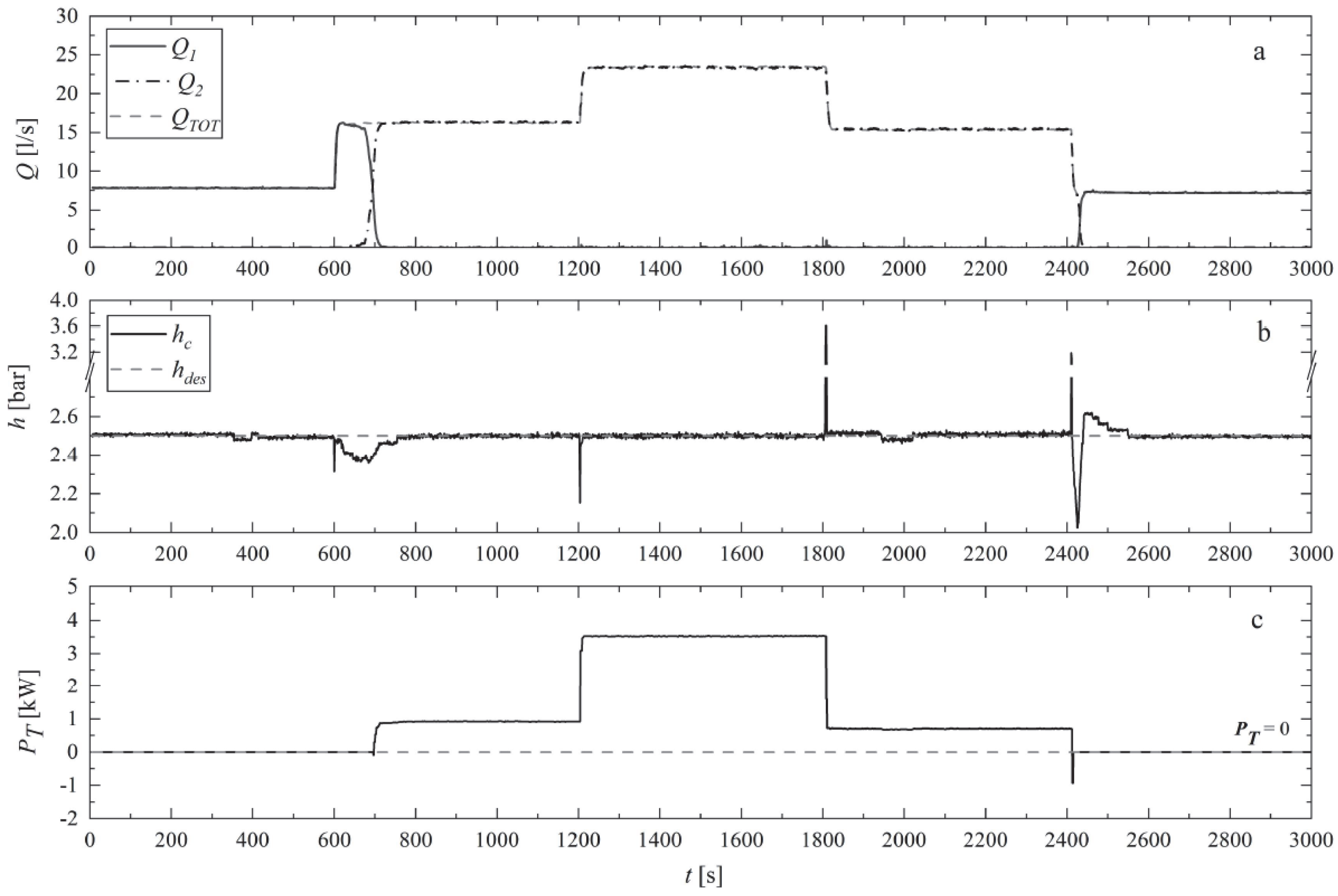
During the experiments, the flow was varied through a motorized gate valve located at the network outlet. The test comprised three different discharges varying between about 7.5 L/s and 23.0 L/s, with an intermediate step set to about 15.5 L/s. Each flow step lasted 600 s, for a total of about 3000 s, and the desired pressure at the control node was set equal to 2.5 bar with a dead band of 0.5 m. The results reported the QTOT, Q1 and Q2, hc, and the power produced by the PAT (PT).
The first experiment (
Figure 1) was conducted by using pure integral control. Over the first 600 s, the
QTOT was too low to enable power production with the installed PAT, and the algorithm regulated the PRVs in order to cause flow discharge to run the bypass line. During this step, the desired pressure was attained by regulating the PRV in the bypass line, and the PAT was disconnected from the electrical grid.
At t = 600 s, the outlet valve was suddenly opened, increasing the QTOT to 15.5 L/s, allowing for power production by the PAT. The algorithm modified the setting of the PRVs by directing the flow in the generation lines with the integral control commands of the PRV in the generation line to achieve hdes. At this step, the power produced by the PAT is slightly higher than 0.8 kW. After 600 s, the discharge was increased to 23 L/s with the algorithm that set the pressure downstream of PRV to reach the desired pressure at the control node (that was attained in few seconds). By increasing the discharge, the PT increased from 0.8 kW to 3.4 kW. At t = 1800 s and 2400 s, the discharge was decreased to 15.5 L/s and to 7.5 L/s, respectively, in order to test the algorithm’s ability to reach the desired pressure when the flow decreases. At 2400 s, in order to avoid power absorption, the discharge switched from the generation to bypass line, and the PAT was disconnected from the electrical grid.
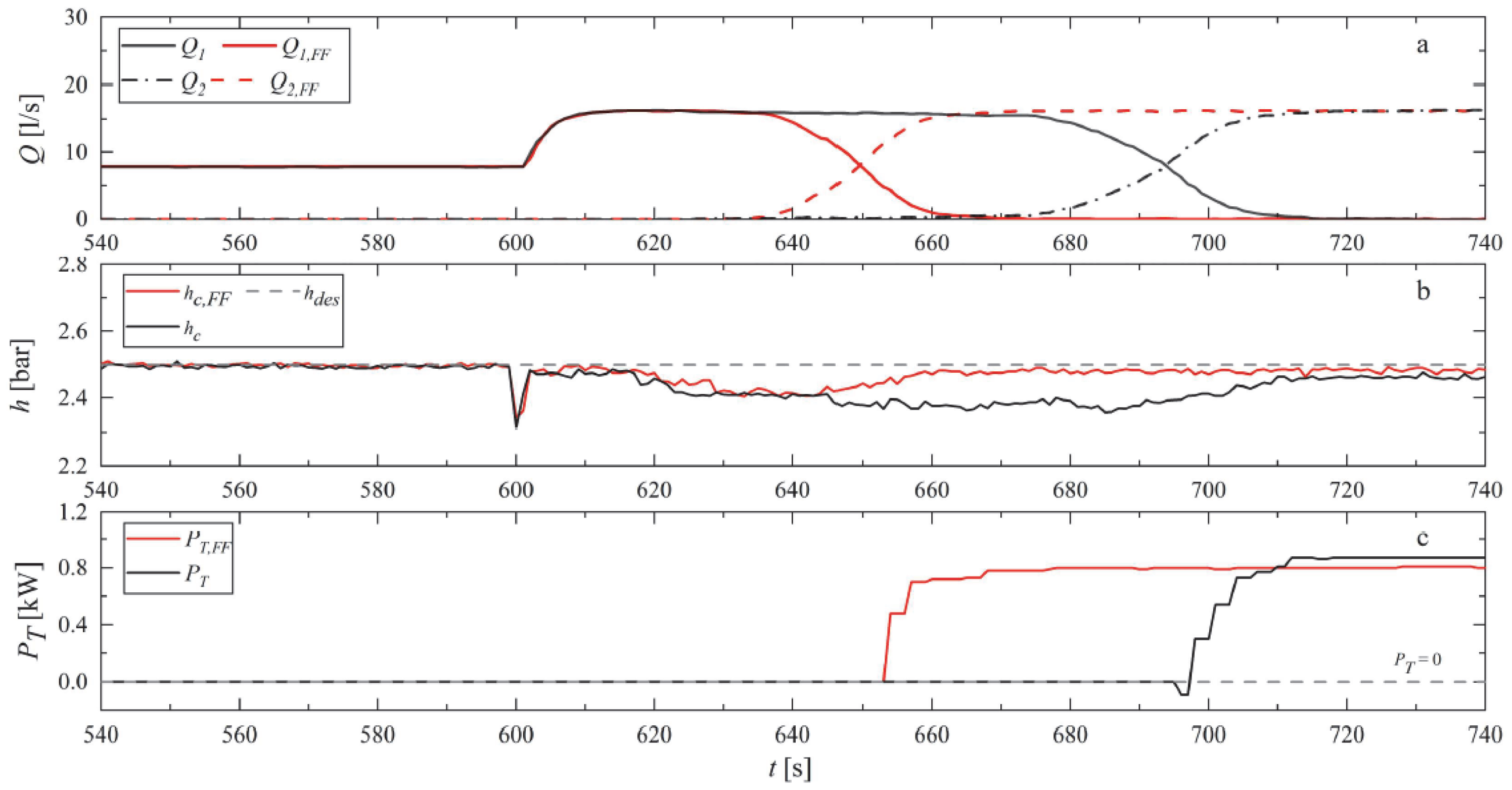
The laboratory test with pure integral control showed a need to reduce the time to reach the steady condition when the flow runs from the bypass line to generation line, and vice versa. With this aim, a feedforward (FF) control coupled with an integral control was implemented. The same discharge pattern was tested, and
Figure 2 shows the comparison at
t = 600 s (the subscript FF refers to the experiment with feedforward). The implementation of FF decreased the transition time, with the entire discharge switched from the bypass to generation line in about 60 s, and the desired pressure was attained at 650 s (about 40 s and 50 s earlier than the test without FF, respectively). Consequently, the algorithm electrified the PAT at 652 s, with the produced power reaching a constant value at 675 s, about 50 s earlier than previous experiments.
5. Conclusions
The results showed the algorithm’s ability to control the pressure at the critical node while producing power through the PAT. The implementation of feedforward resulted in a time reduction in obtaining the steady condition when switching between generation and bypass lines, with desired pressure and energy production attained about 50 s earlier.
Author Contributions
Conceptualization, F.D.M. and G.D.; methodology, M.M. and G.M.; software, M.M.; validation, M.M. and G.D.; formal analysis, G.D. and F.D.M.; investigation, F.D.M.; resources, G.M.; data curation, G.D.; writing—original draft preparation, M.M. and G.D.; writing—review and editing, F.D.M. and G.M.; visualization, M.M.; supervision, G.M.; project administration, G.M.; funding acquisition, G.M. All authors have read and agreed to the published version of the manuscript.
Funding
This research was funded by Project ARS01_01080 “WATERGY-L’efficientamento energetico del Servizio Idrico Integrato” Ministry of Education, Universities and Research: CUP B52F20001180005.
Institutional Review Board Statement
Not applicable.
Informed Consent Statement
Not applicable.
Data Availability Statement
The data presented in this study are available on request from the corresponding author.
Conflicts of Interest
The authors declare no conflict of interest.
References
- Hui, D.; Xu, H.; Ma, Z.; Sun, F.; Zhou, J.; Meng, Y. Study on Intelligent Pressure Reducing Valve and Leakage Diagnosis. In 2022 IEEE 6th Information Technology and Mechatronics Engineering Conference (ITOEC); IEEE: Piscataway, NJ, USA, 2022; Volume 6, pp. 584–588. [Google Scholar] [CrossRef] [Scilit]
- Marini, G.; Di Menna, F.; Maio, M.; Fontana, N. HYPER: Computer-Assisted Optimal Pump-as-Turbine (PAT) Selection for Microhydropower Generation and Pressure Regulation in a Water Distribution Network (WDN). Water 2023, 15, 2807. [Google Scholar] [CrossRef] [Scilit]
- Novara, D.; McNabola, A. The Development of a Decision Support Software for the Design of Micro-Hydropower Schemes Utilizing a Pump as Turbine. Proceedings 2018, 2, 678. [Google Scholar] [CrossRef] [Scilit]
- Marini, G.; Maio, M.; Di Menna, F.; Pugliese, F.; De Paola, F.; Fontana, N. Innovative Approach for Selection of Pump as Turbine in Water Distribution Network. Environ. Sci. Proc. 2022, 21, 25. [Google Scholar] [CrossRef] [Scilit]
- Fontana, N.; Marini, G. A Methodology to Assess Optimal Operation of a Prototype for Pressure Regulation and Hydropower Generation. J. Water Resour. Plan. Manag. 2021, 147, 04021088. [Google Scholar] [CrossRef] [Scilit]
- Fontana, N.; Eng, C.; Asce, M.; Giugni, M.; Glielmo, L.; Marini, G. Real Time Control of a Prototype for Pressure Regulation and Energy Production in Water Distribution Networks. J. Water Resour. Plan. Manag. 2016, 142, 04016015. [Google Scholar] [CrossRef] [Scilit]
- Fontana, N.; Giugni, M.; Glielmo, L.; Marini, G.; Zollo, R. Operation of a Prototype for Real Time Control of Pressure and Hydropower Generation in Water Distribution Networks. Water Resour. Manag. 2019, 33, 697–712. [Google Scholar] [CrossRef] [Scilit]
- Maio, M.; Marini, G.; Zotti, F.; Fontana, N. Direct Grid Connection of a Prototype with Real-Time Control for Energy Recovery and Pressure Control in a Water Distribution Network through Hydraulic Regulation. J. Water Resour. Plan. Manag. 2024, 150, 4024049. [Google Scholar] [CrossRef] [Scilit]
| Disclaimer/Publisher’s Note: The statements, opinions and data contained in all publications are solely those of the individual author(s) and contributor(s) and not of MDPI and/or the editor(s). MDPI and/or the editor(s) disclaim responsibility for any injury to people or property resulting from any ideas, methods, instructions or products referred to in the content. |