Artificial Intelligence Mathematical Foundations and Models: Cross-Domain Applications in Unmanned Aerial Vehicles and Autonomous Vehicles †

Abstract
1. Introduction
2. Related Work
3. Methodology
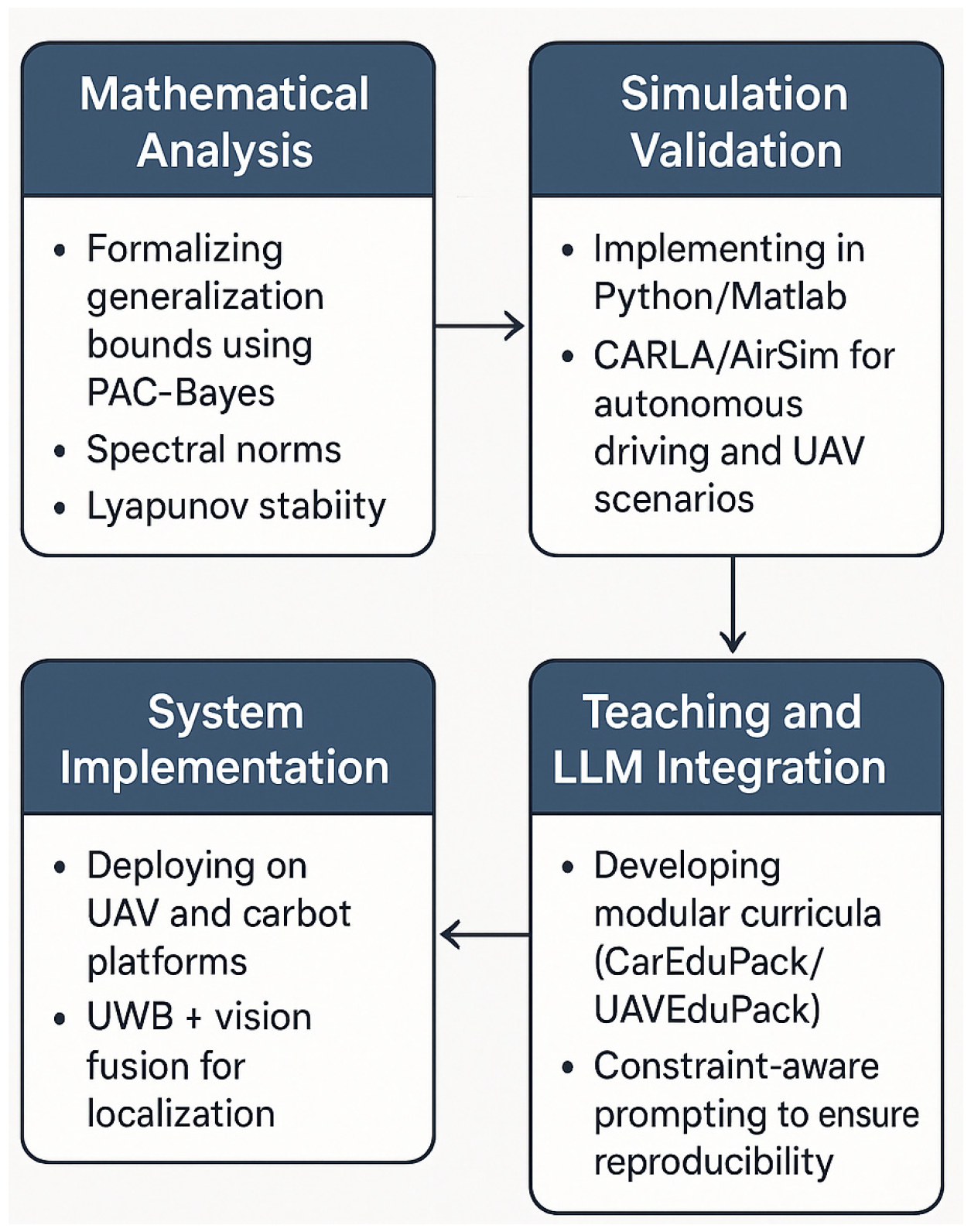
- Mathematical analysis: Formalizing generalization bounds using PAC-Bayes, spectral norms, and Lyapunov stability.
- Simulation validation: Implementing in Python (v3.10.12, Python Software Foundation, Wilmington, DE, USA) and MATLAB (vR2023b, MathWorks, Natick, MA, USA) with CARLA (v0.9.15, Computer Vision Center, Barcelona, Spain) and AirSim (v1.8.1, Microsoft, Redmond, WA, USA) for autonomous driving and UAV scenarios.
- System implementation: Deploying on UAV and carbot platforms with UWB and vision fusion for localization.
3.1. System Architecture and Software Stack
- Development Languages: Systems are implemented using Python (v3.10.12, Python Software Foundation, USA) and MATLAB (vR2023b, MathWorks, USA) for core logic and mathematical validation.
- Simulation Environments: CARLA (v0.9.15, Barcelona, Spain) and AirSim (v1.8.1, Redmond, WA, USA) serve as the primary high-fidelity environments for autonomous driving and UAV scenario testing.
- Computer Vision: The Open Source Computer Vision Library (OpenCV v4.8.0, Intel Corporation, Santa Clara, CA, USA) is employed for real-time lane recognition using HSV thresholding and Hough transform.
- Communication Protocols: A Flask-based (v3.0.0, Pallets Projects) web server handles real-time video streaming and control APIs. Node-RED (v3.1.0, OpenJS Foundation, San Francisco, CA, USA) and MQTT brokers manage telemetry and dashboard updates.
3.2. Hardware Platforms
- Imaging: PiCamera2 (Raspberry Pi Ltd., Cambridge, UK) for visual input.
- Motor Control: PCA9685 motor drivers (NXP Semiconductors, Eindhoven, Netherlands) used in conjunction with TT Motors (TT Motors Industrial Co., Ltd., Shenzhen, China).
- Sensors: Ultrasonic sensors and UWB anchors for obstacle detection and localization.
4. Experiments and Preliminary Results
4.1. Hardware Implementation and Testbed Setup
- Core Computing Unit: A Raspberry Pi 5 (Raspberry Pi Ltd., Cambridge, UK) single-board computer manages high-level processing and sensor fusion.
- Motor and Servo Control: A PCA9685 (NXP Semiconductors, Eindhoven, Netherlands) 16-channel PWM controller is utilized, with motors assigned to channels 0, 5, 6, and 11, and servos assigned to channels 9 and 10.
- Actuators: The vehicle platform uses TT Motors (TT Motors Industrial Co., Ltd., Shenzhen, China).
- Sensors and Localization:
- ▪
- Visual: PiCamera2 (Raspberry Pi Ltd., Cambridge, UK) for lane and object detection.
- ▪
- Distance: HC-SR04 ultrasonic sensors for obstacle avoidance.
- ▪
- Localization: Ultra-Wideband (UWB) anchors and modules paired with an Inertial Measurement Unit (IMU) and GPS.
- UAV Hardware: Quadrotors are equipped with IMU, GPS, and UWB modules, fused via an Extended Kalman Filter (EKF) for centimeter-level precision.
4.2. Software Specifications
- Operating System: Raspberry Pi OS (64-bit, v12 Bookworm, Raspberry Pi Ltd., Cambridge, UK).
- Web Framework: Flask (v3.0.0, Pallets Projects) for remote control and real-time video streaming.
- Dashboard & Logic: Node-RED (v3.1.0, OpenJS Foundation, San Francisco, CA, USA) for telemetry visualization.
- Communication Protocol: Mosquitto MQTT Broker (v2.0.18, Eclipse Foundation, Ottawa, ON, Canada).
- Computer Vision: OpenCV (v4.8.0, Intel Corporation, Santa Clara, CA, USA) for lane detection and image processing.
- Simulation Environments: CARLA (v0.9.15, Computer Vision Center, Barcelona, Spain) and AirSim (v1.8.1, Microsoft, Redmond, WA, USA).
4.3. Validation Metrics
5. Discussion
6. Conclusions and Future Work
Author Contributions
Funding
Institutional Review Board Statement
Informed Consent Statement
Data Availability Statement
Conflicts of Interest
References
- Vapnik, V.N. Statistical Learning Theory; Wiley: Hoboken, NJ, USA, 1998. [Google Scholar]
- Bartlett, P.L.; Foster, D.J.; Telgarsky, M. Spectrally normalized margin bounds for neural networks. In Proceedings of the Advances in Neural Information Processing Systems 30 (NeurIPS 2017), Long Beach, CA, USA, 4–9 December 2017. [Google Scholar]
- Belkin, M.; Hsu, D.; Ma, S.; Mandal, S. Reconciling modern machine learning and the bias-variance trade-off. Proc. Natl. Acad. Sci. USA 2019, 116, 15849–15854. [Google Scholar] [CrossRef] [PubMed]
- Nakkiran, P.; Kaplun, G.; Bansal, Y.; Yang, T.; Barak, B.; Sutskever, I. Deep double descent: Where bigger models and more data hurt. J. Stat. Mech. Theory Exp. 2021, 2021, 124003. [Google Scholar] [CrossRef]
- Goodfellow, I.J.; Pouget-Abadie, J.; Mirza, M.; Xu, B.; Warde-Farley, D.; Ozair, S.; Courville, A.; Bengio, Y. Generative adversarial nets. In Proceedings of the Advances in Neural Information Processing Systems 27 (NeurIPS 2014), Montreal, QC, Canada, 8–13 December 2014. [Google Scholar]
- Ho, J.; Jain, A.; Abbeel, P. Denoising diffusion probabilistic models. In Proceedings of the Advances in Neural Information Processing Systems 33 (NeurIPS 2020), Virtual, 6–12 December 2020. [Google Scholar]
- Lee, J.; Lu, C.; Song, Y. Score-based generative modeling through stochastic differential equations. arXiv 2022, arXiv:2011.13456. [Google Scholar] [CrossRef]
- Sutton, R.S.; Barto, A.G. Reinforcement Learning: An Introduction, 2nd ed.; MIT Press: Cambridge, MA, USA, 2018; Available online: http://incompleteideas.net/book/the-book-2nd.html (accessed on 1 April 2026).
- Powell, W.B. Reinforcement Learning and Stochastic Optimization; Wiley: Hoboken, NJ, USA, 2022. [Google Scholar]
- Dulac-Arnold, G.; Evans, R.; Sunehag, P.; Coppin, B. Reinforcement learning in large discrete action spaces. arXiv 2015, arXiv:1512.07679. [Google Scholar] [CrossRef]
- Karniadakis, G.E.; Kevrekidis, I.G.; Lu, L.; Perdikaris, P.; Wang, S.; Yang, L. Physics-informed machine learning. Nat. Rev. Phys. 2021, 3, 422–440. [Google Scholar] [CrossRef]
- Thrun, S. Probabilistic Robotics; MIT Press: Cambridge, MA, USA, 2005. [Google Scholar]
- Olfati-Saber, R. Distributed Kalman Filtering for Sensor Networks. In Proceedings of the 46th IEEE Conference on Decision and Control, New Orleans, LA, USA, 12–14 December 2007; pp. 5492–5498. [Google Scholar]
- Zhang, C.; Bengio, S.; Hardt, M.; Recht, B.; Vinyals, O. Understanding Deep Learning Requires Rethinking Generalization. arXiv 2017, arXiv:1611.03530. [Google Scholar] [CrossRef]
- Gunasekar, S.; Lee, J.; Soudry, D.; Srebro, N. Characterizing implicit bias in terms of optimization geometry. In Proceedings of the 35th International Conference on Machine Learning (ICML 2018), Stockholm, Sweden, 10–15 July 2018; p. PMLR 80. [Google Scholar]


| Test Scenario | Metric | Mean | Standard Deviation | Success Rate | Note |
|---|---|---|---|---|---|
| Remote control integration | Latency (ms) | 85 | 12 | 97% | MQTT round-trip test |
| Control server (Flask) | Command response time (ms) | 110 | 15 | 95% | Measured with 20 commands |
| Node-RED flow | Dashboard update rate (Hz) | 9.8 | 0.5 | 100% | Stable at ~10 Hz |
| Lane detection (HSV + Hough) | RMS lateral error (m) | 0.22 | 0.05 | 93% | 100 trials |
| UWB + Vision Fusion | RMS localization error (m) | 0.18 | 0.04 | 90% | 50 trials |
Disclaimer/Publisher’s Note: The statements, opinions and data contained in all publications are solely those of the individual author(s) and contributor(s) and not of MDPI and/or the editor(s). MDPI and/or the editor(s) disclaim responsibility for any injury to people or property resulting from any ideas, methods, instructions or products referred to in the content. |
© 2026 by the authors. Licensee MDPI, Basel, Switzerland. This article is an open access article distributed under the terms and conditions of the Creative Commons Attribution (CC BY) license.
Share and Cite
Cho, S.-M.; Yeh, C.-L.; Huang, C.-P. Artificial Intelligence Mathematical Foundations and Models: Cross-Domain Applications in Unmanned Aerial Vehicles and Autonomous Vehicles. Eng. Proc. 2026, 134, 95. https://doi.org/10.3390/engproc2026134095
Cho S-M, Yeh C-L, Huang C-P. Artificial Intelligence Mathematical Foundations and Models: Cross-Domain Applications in Unmanned Aerial Vehicles and Autonomous Vehicles. Engineering Proceedings. 2026; 134(1):95. https://doi.org/10.3390/engproc2026134095
Chicago/Turabian StyleCho, Shih-Ming, Ching-Long Yeh, and Chia-Ping Huang. 2026. "Artificial Intelligence Mathematical Foundations and Models: Cross-Domain Applications in Unmanned Aerial Vehicles and Autonomous Vehicles" Engineering Proceedings 134, no. 1: 95. https://doi.org/10.3390/engproc2026134095
APA StyleCho, S.-M., Yeh, C.-L., & Huang, C.-P. (2026). Artificial Intelligence Mathematical Foundations and Models: Cross-Domain Applications in Unmanned Aerial Vehicles and Autonomous Vehicles. Engineering Proceedings, 134(1), 95. https://doi.org/10.3390/engproc2026134095