1. Introduction
Fire outbreaks in residential kitchens continue to pose a persistent safety hazard, primarily due to unattended cooking and the presence of both liquid and solid combustibles. The first phase of this study was to develop a servo-automated fire suppression mechanism capable of distinguishing between fire types using smoke and flame sensors, deploying either Class A or Class K extinguishers accordingly. The Centers for Disease Control and Prevention of the United States explains the importance of fire, which can reach temperatures of up to 160 °C, causing skin damage and health dangers for humans. Inhaling such particles from the smoke can cause heavy breathing, coughing, chest pain, and other symptoms [
1]. The Philippines alone experiences major outbreaks of fire, which are primarily caused by electrical fires, the use of paper and combustible materials, and kitchen fires. As reported, some are left scarred because many houses lack automated fire suppression systems capable of suppressing the fire when it occurs. Almost 30% of people in America do not have their homes equipped with a suppression system, and 32% do not have an escape plan in place in case a fire breaks out in their homes [
2].
Kitchen fire outbreaks are commonly caused by liquids or solid combustibles present in the area, such as kitchen oil or cooking oil used during cooking, and solid combustibles near the kitchen stove [
3]. Several restaurants are equipped with automated fire suppression systems that can reduce the impact of a fire outbreak within the area. However, many ordinary people who use kitchen stoves for cooking have not installed an automated suppression system in their household, and such combustible materials may pose a risk to various individuals in protecting their homes.
The objective of this study is to analyze combustible materials, both solid and liquid, in kitchen fire scenarios using an automated fire suppression system designed to contain smoke and fire within the affected area. The study aims to assess whether the use of specific classifications of fire extinguishers—Class A for solid combustibles and Class K for liquid combustibles—can effectively reduce suppression time and minimize false triggers. Furthermore, various testing procedures be conducted to evaluate the accuracy and responsiveness of the system based on sensor placement, including height and distance, to determine the optimal configuration for maximum effectiveness in fire detection and suppression.
An automated fire suppression system is integrated with an Arduino microcontroller, which functions as the central processing unit for interpreting data received from smoke and fire sensors in the kitchen environment. The study emphasizes the importance of sensor placement by testing various heights and distances to evaluate the system’s ability to detect and respond to fire incidents accurately. The research focuses on the application of Class A and Class K fire extinguishers, specifically targeting solid and liquid combustible materials commonly found in kitchens. The experimental setup features a traditional Filipino kitchen design, complete with a standard stove equipped with a pan to simulate realistic fire scenarios [
4].
2. Review of Related Literature
Fires originating from the kitchen are among the most common causes of residential fires in the Philippines. It often results from cooking oils, combustibles, or unattended cooking. Existing suppression systems are commercially available but often fail to provide sufficient coverage for various fire classes.
An early fire detection system prototype was developed to gather critical information, including location, temperature, gas content, humidity, and pressure. According to the study, the system can detect the gas content in 10 and 30 s for fires, with a maximum mounting height of 3 m. Aside from this, an ESP32 sensor was used to track and log the data, and it notify the user via email through its mobile application [
5].
In 2023, an autonomous firefighting robot was designed to detect, classify, and extinguish two classes of fire: Class A and Class B. They used cloth, alcohol, wood, and gas to determine the response time indoors and outdoors. For the response time indoors, the values are 18.1 for cloth, 18.7 for alcohol, 18.2 for wood, and 19.3 for gas. For outdoors, the response times are 25.7, 26.2, 25.7, and 26.6, respectively [
6].
3. Methodology
3.1. Conceptual Framework
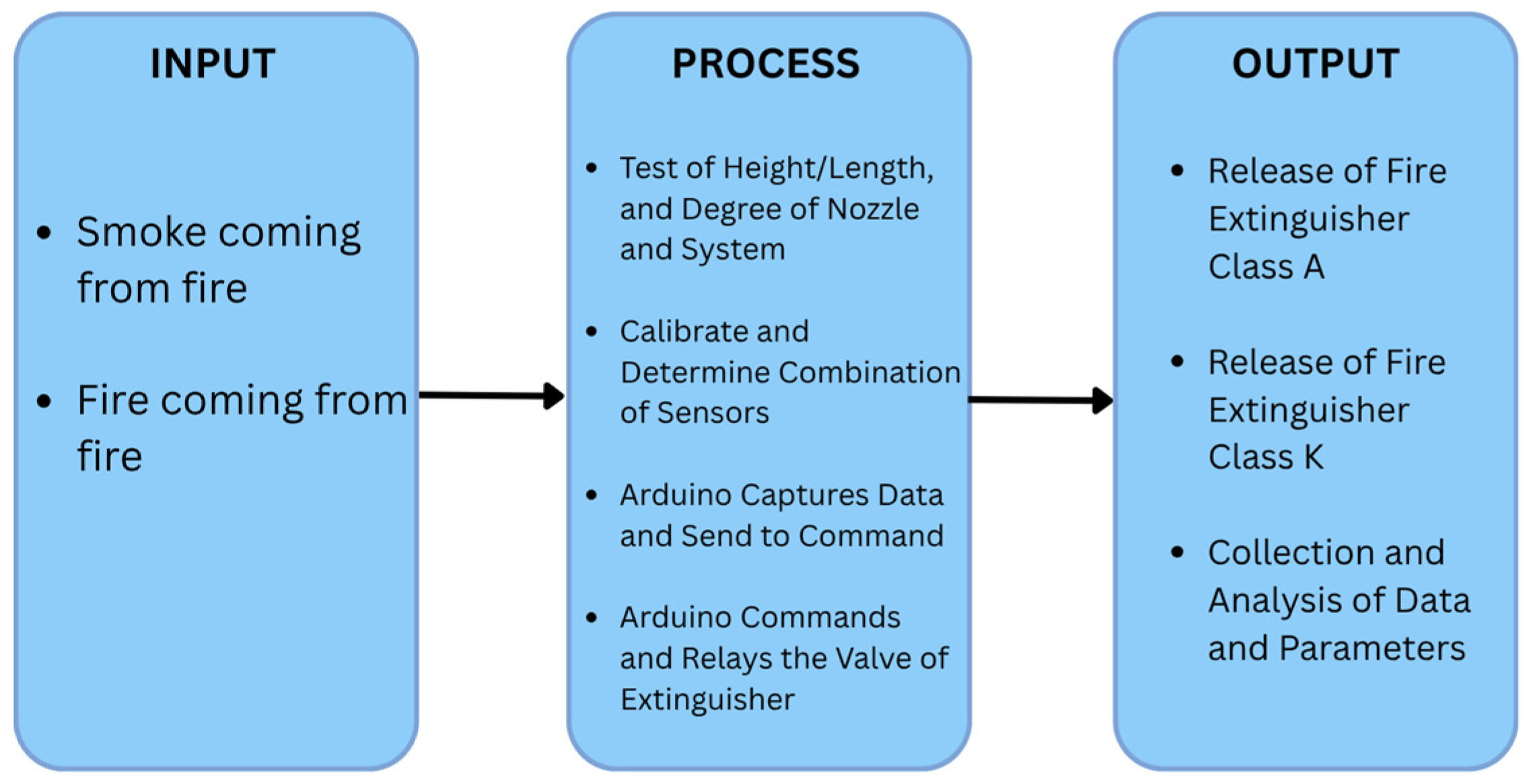
One of the system’s inputs is the fire from the kitchen, and the other is the smoke it causes. There are five processes involved in the system: (1) The testing of different-degree angles and the best height of the nozzle to sufficiently extinguish the fire coming from the kitchen. (2) Determination and calibration of the best possible combination of fire and smoke sensors to be used for the system. (3) Passing of data from the smoke sensor through the Arduino (Arduino IDE ver. 2.3.2) and fire sensor, with the digital data from the Arduino being stored. (4) The Arduino captures the value coming from the storage and digitally encodes commands to be sent to the relay. (5) The relay opens or closes the servo motor, depending on the codes and commands of the Arduino microcontroller. The system outputs the chemical of the class K fire extinguisher into the target. The system’s outputs were interpreted accordingly (
Figure 1).
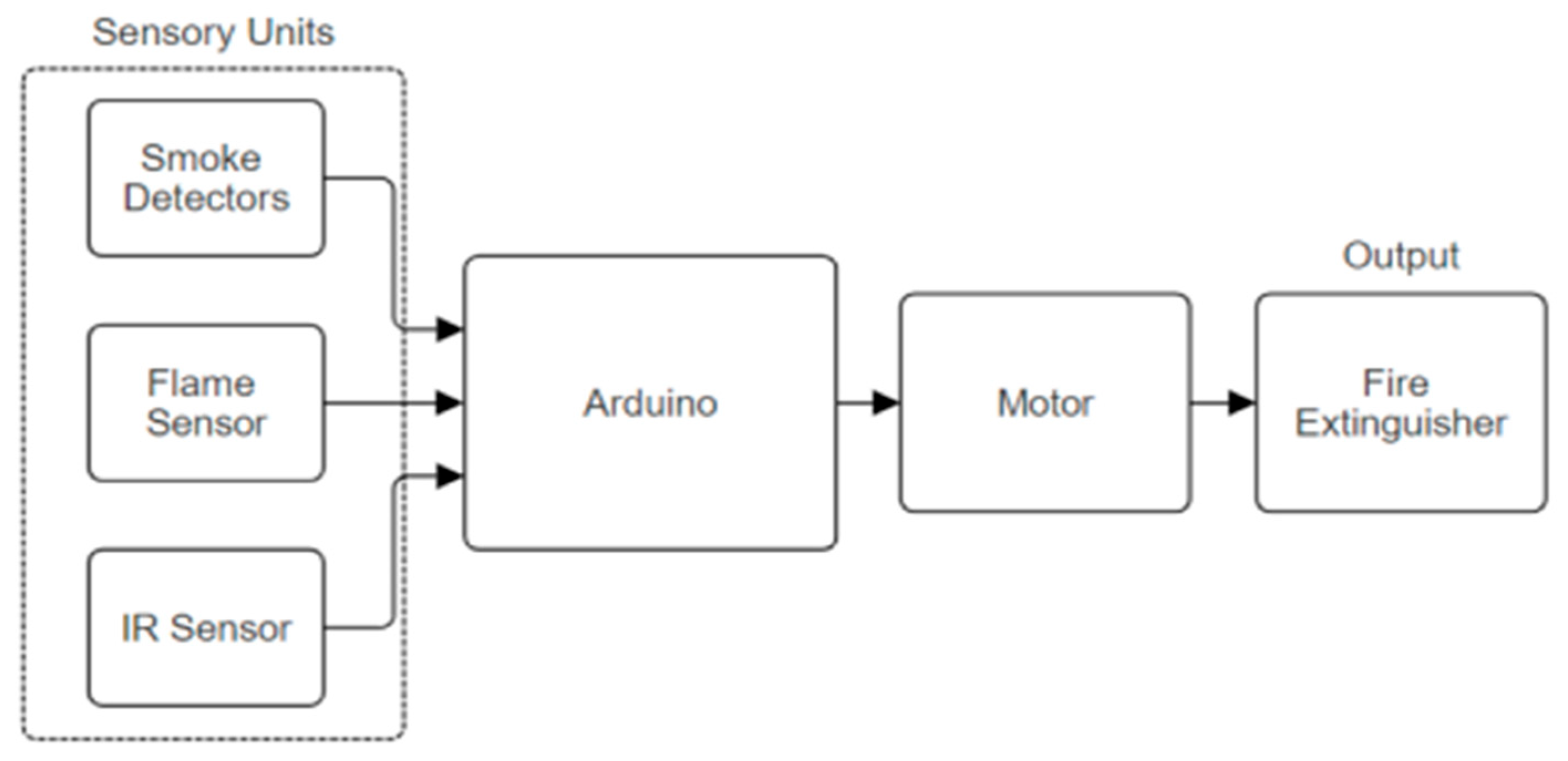
Figure 2 illustrates the process by which the system triggers the fire extinguisher system. The initial input comes from the fire and smoke in a safe area, where it can be simulated with various types of fire. The infrared (IR) sensor, DHT sensor, flame sensor, and smoke detectors detect those initial values. The values are interpreted as temperature, fire, humidity, gas, and smoke. The Arduino captures those values and interprets them as parameters, allowing those values to be set. If the system can now detect that the set parameters are above, then it sends a command to the servo motor to activate the fire extinguisher and release the nozzle. The system also detects if the set parameters are being exceeded, then it sends a command to the servo motor to deactivate and stop the nozzle in the fire extinguisher.
3.2. Materials and Equipment
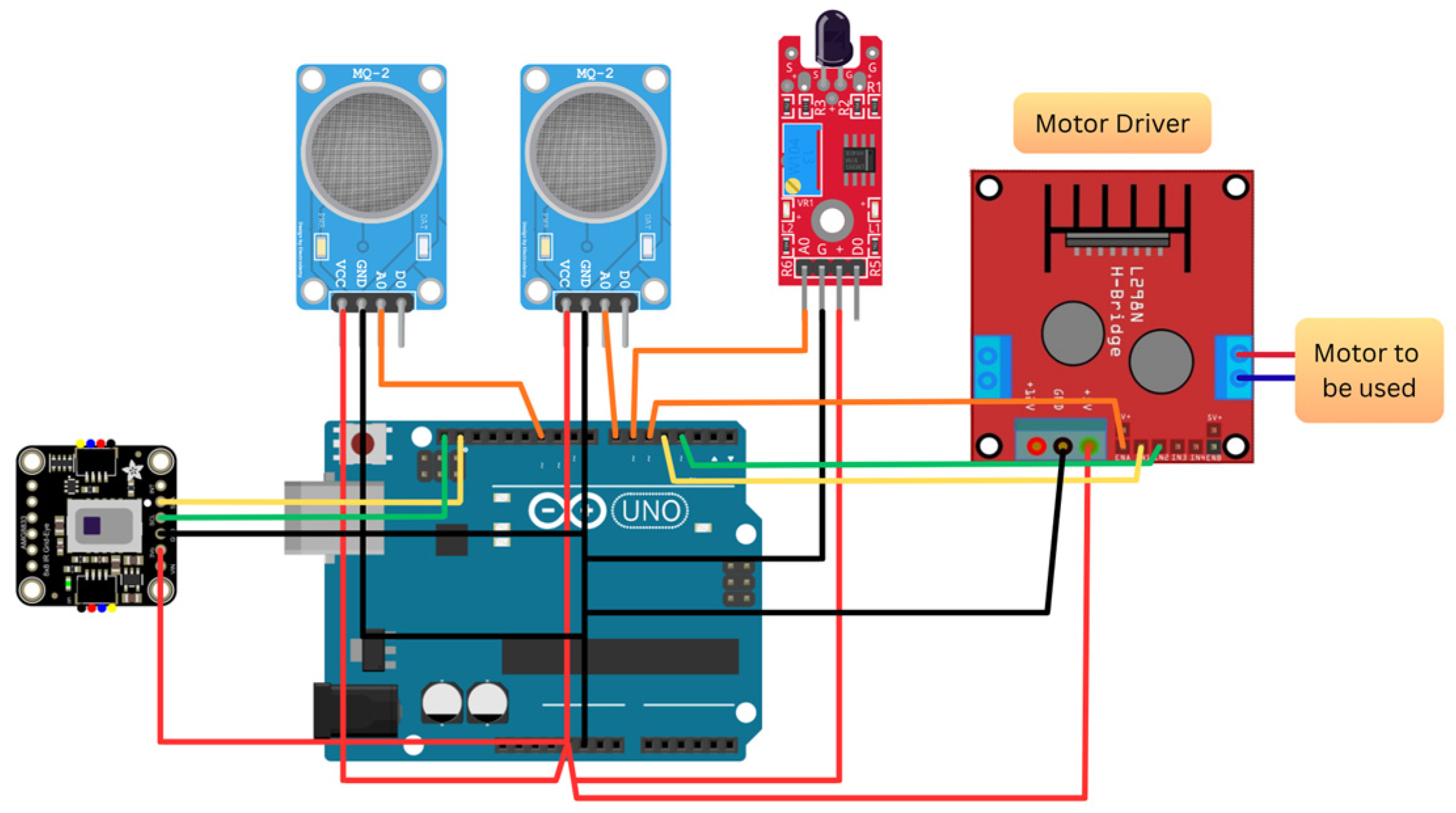
The Arduino serves as the central control unit for the automated fire suppression system. It is connected to two types of smoke detectors—photoelectric and ionization—alongside a flame sensor and an IR sensor, all of which are integrated into the board. Additionally, a motor is included in the system, functioning as the actuator responsible for deploying the fire suppressant (
Figure 3).
Before conducting the fire tests, adherence to safety protocols was mandatory. In compliance with the Bureau of Fire Protection (BFP) of the Philippines, it is required to follow strict safety measures before and after any fire and smoke-related testing. The BFP provided guidance, and the tests were limited to a controlled number of combustible materials [
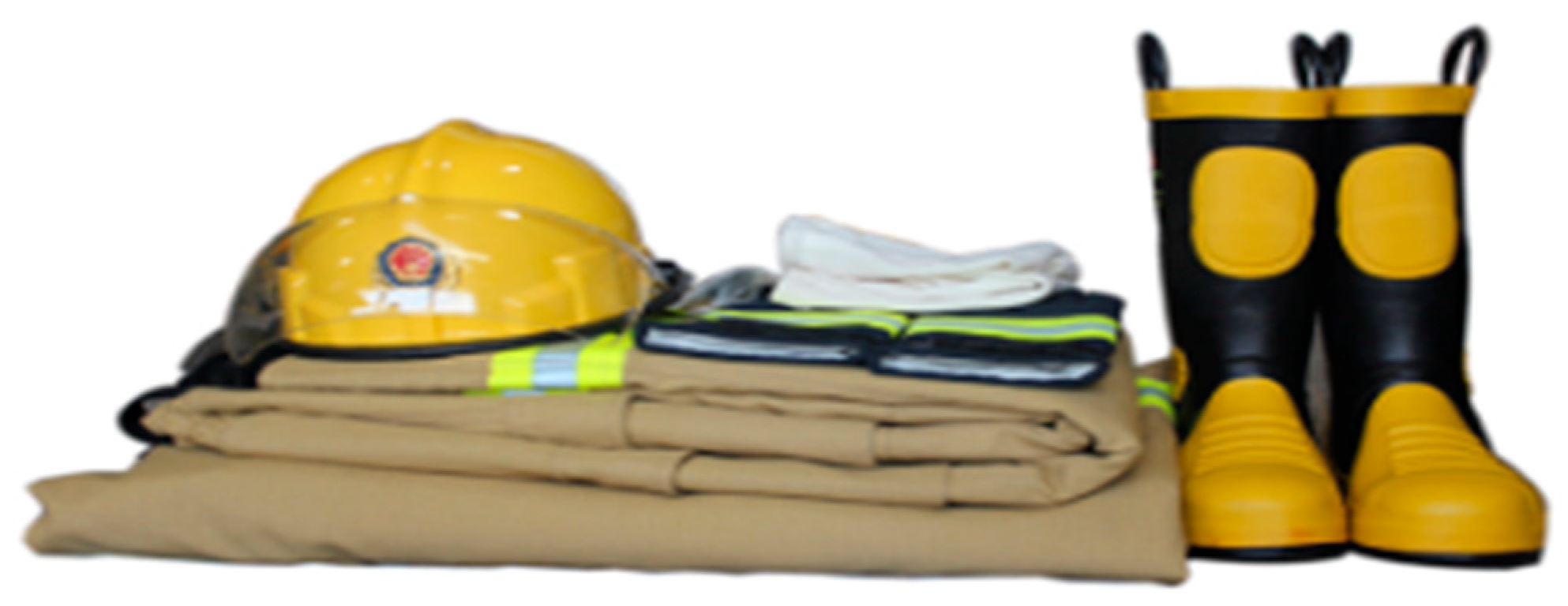
7]. Personal protective equipment or PPE is required for all individuals to wear during the testing, comprising safety helmets, turnout gear, high-temperature resistance gloves, and boots (
Figure 4).
3.3. Servo Motor and Stop
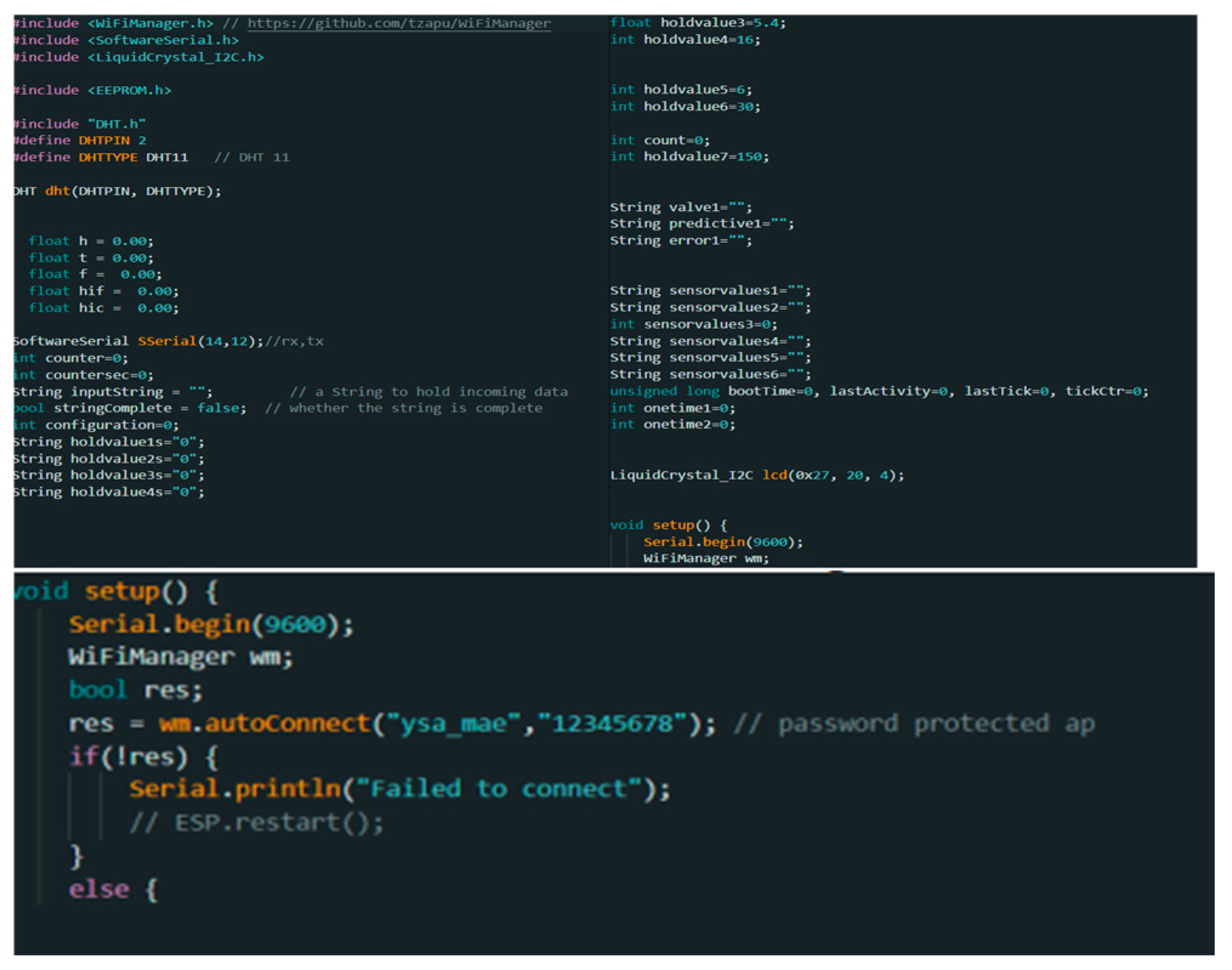
After obtaining the necessary values for the system, the system was encoded to trigger the servo motor and activate the suppression system. The parameters were set to capture and record the temperature, humidity, gas, fire, and smoke values, which were then written to a table for observation. Codes such as “valve open” the servo motor, while “valve close” is used to stop the suppression system (
Figure 5).
3.4. Data Viewing
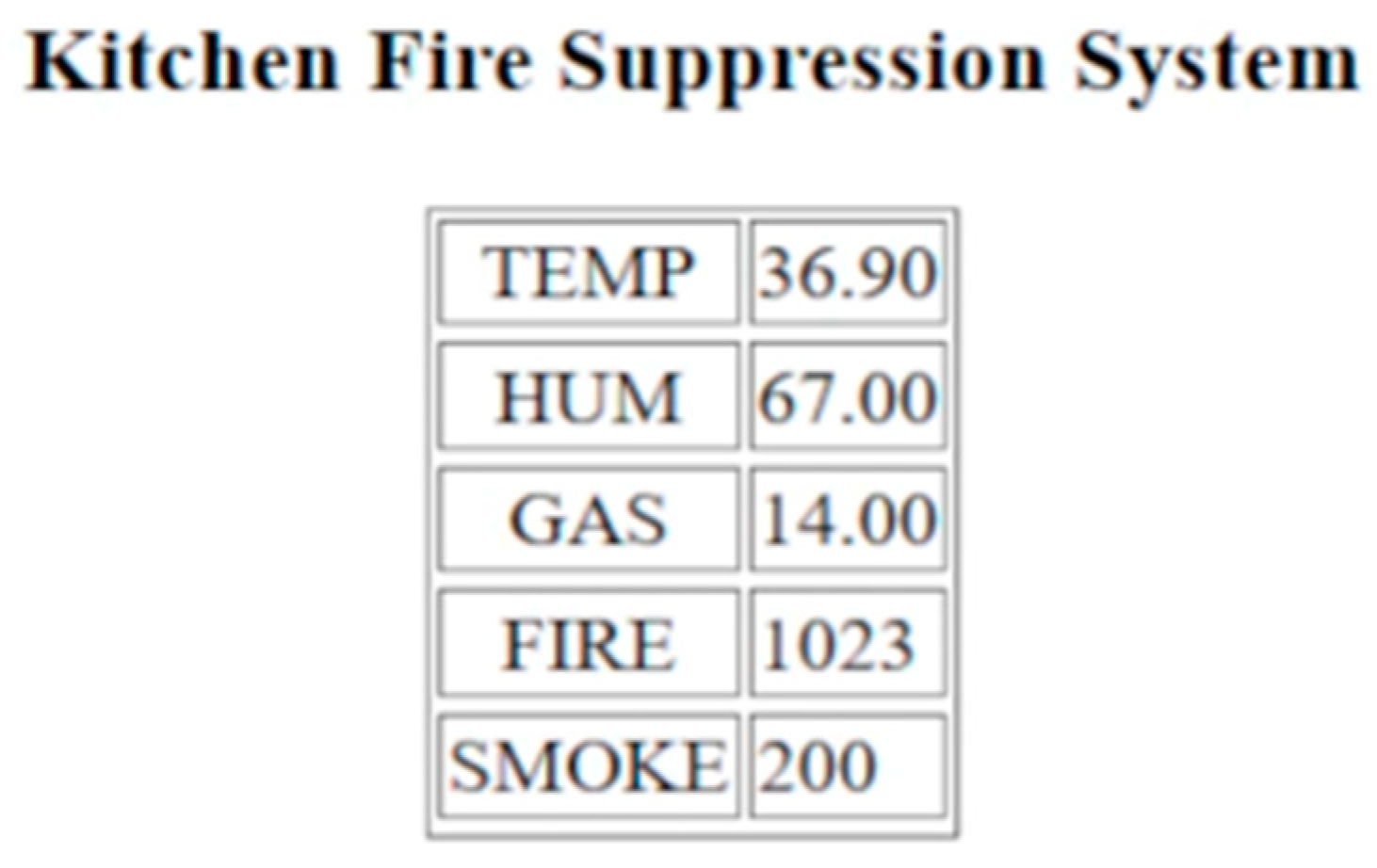
To view the data, users must connect to the WI-FI module of the Arduino; the service set identifier is “Fire Suppression,” and the password is “123456.” The user accesses the module of the system to read the values such as temp, hum, gas, fire, and smoke (
Figure 6).
4. Result and Discussion
The data and parameters were gathered from testing various combustible materials, as well as the optimal height and distance required for the system to operate accurately. They highlight the importance of selecting the appropriate type of fire extinguisher for specific kitchen fire scenarios to ensure adequate suppression.
4.1. Calibration of Flame Sensor and Smoke Sensors
Table 1,
Table 2 and
Table 3 present the calibration results of the flame sensor, photoelectric sensor, and ionization smoke detector based on the distance at which the system can detect its outputs. Each sensor underwent 15 trials, and the data shows that as the distance increases, the output voltage remains within the acceptable range recognized by the system, indicating consistent sensor responsiveness.
Fifteen trials are conducted to ensure that accuracy reading from the system is on point with the reading with extending distances from 18 cm, 30 cm, 51 cm, 75 cm, 100 cm, and 144 cm. The distances given are provided by the smoke detector manufacturer guidelines, of which the nearest distance that the sensor can read is about 18 cm and anything less than that will not be read by the sensor. Furthermore, anything above 100 cm will not be read by the sensor, so testing the absolute maximum distance that the sensor can read would result in no error being captured in the data. Other distances such as 30 cm, 51 cm, and 75 cm are also part of previous study, indicating the effectiveness of the flame and smoke sensors on those particular distances and how they provided optimum results that the study will also use. Every other test below will also make use of the distances in ensuring accurate reading from the system (
Table 2).
Table 4,
Table 5 and
Table 6 show that as the distance increases, the detection time recorded by the Arduino system also becomes longer, which is unfavorable for an automated suppression system that aims for a rapid response.
4.2. Sensor/s Combination Test
The use of the Response Time P.E.% or response time percentage error will determine the optimal combination of the sensors needed for the system, with the accepted value being the last type of fire utilized per sensor combination (in this case type III fire) and the experimental value being the total average time of all types of fire used per sensor combination testing [
5]. In addition to the individual testing of the sensor and detectors, the combination of the flame sensor with either the photoelectric or ionization smoke detector was tested and when all sensors and smoke detectors are present. The accepted value is based on the final fire type tested, while the experimental value represents the overall average across all fire types (
Table 7). Utilizing all three sensors resulted in the lowest percentage error of 2.53%, whereas setups using only one or two sensors had higher errors. Therefore, it is recommended to use the complete set of sensors at a distance of 18 cm from the fire and smoke source to achieve optimal performance of the suppression system.
4.3. Combustible Material Pearson Correlation Test
Using Pearson correlation, we assessed whether there is a positive or negative relationship between the type of combustible material and its corresponding detection time and distance. Data were manually recorded at heights ranging from 25 to 100 cm while testing both solid and liquid combustible materials.
Table 8,
Table 9,
Table 10,
Table 11,
Table 12 and
Table 13 display the results of testing various combustible materials at different system heights. At 25 cm—the closest distance—the detection time was the quickest, with the highest correlation value. This indicates that as the distance increases, the detection time also becomes longer. Among the materials tested, liquid combustibles had the fastest detection time, followed by solid combustibles.
4.4. Final Kitchen Fire Combustible Testing
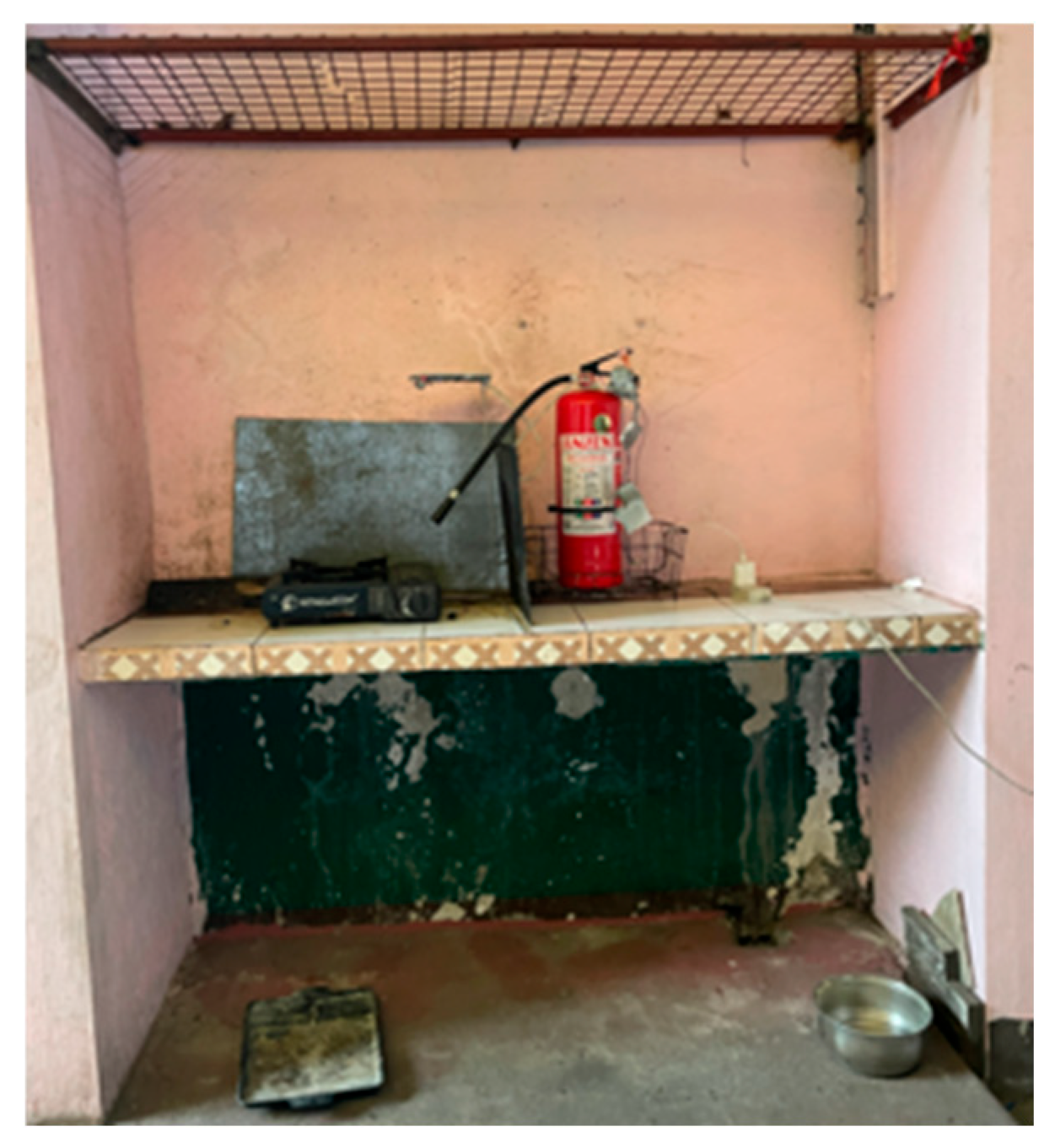
A kitchen area was used for the test, along with the use of PPE and safety personnel. The area must be cleared of any debris so that no fire can break out (
Figure 7).
Table 14,
Table 15 and
Table 16 reveal that the percentage error is higher for liquid combustible materials when using a Class A fire extinguisher. In contrast, solid combustible materials, ranging from paper to wood, yielded faster suppression results with the Class A extinguisher.
Table 17 shows that there is a direct relationship between suppression time and temperature after suppression; as one increases, so does the other. Therefore, achieving a faster suppression time is essential for maintaining a lower post-suppression temperature.
Analysis of
Table 18,
Table 19 and
Table 20 shows that Class K fire extinguishers suppress both solid and liquid combustibles more quickly than the results shown in
Table 14,
Table 15,
Table 16 and
Table 17. Liquid combustibles are extinguished faster than solid combustibles with Class K extinguishers, where solid combustibles rank second. Furthermore, the Pearson correlation in
Table 20 reveals that as suppression time increases, the temperature after suppression also rises.
5. Conclusions
The study results demonstrated that all integrated sensors, photoelectric, ionization, flame, and IR, provided acceptable output voltages across varying distances, with 18 cm identified as the optimal detection range. Among the sensor combinations tested, the integration of all four sensors yielded the lowest percentage error of 2.53%, proving to be the most reliable configuration. In testing various combustible materials, the results indicated that liquid combustibles were detected more quickly than solid combustibles. This is attributed to the denser smoke and more intense flames produced by liquids, which activated the sensors more rapidly. When analyzing the influence of system height, the optimal placement was found to be 25 cm, especially effective for detecting and suppressing fires from both solid and liquid combustibles. For instance, the use of a standard Class A extinguisher at this height suppressed liquid fires in an average time of 1.433 s and solid combustibles in under 2 s—ideal for automated fire response. Further testing compared Class A and Class K fire extinguishers. Class K was more efficient in suppressing both solid and liquid fires, resulting in faster nozzle activation, quicker temperature reduction to ambient room levels, and lower P.E. values overall.
Future studies are necessary to integrate an emergency notification feature, such as an SOS alert or automated text message system, to inform users when the suppression system is triggered. Enhancing the system with additional sensors that account for environmental or weather-related conditions can improve reliability. Expanding the system’s application beyond kitchen environments to more diverse settings could increase its utility. The inclusion of AI is also recommended, enabling the system to identify the specific type of fire and automatically deploy the appropriate fire extinguisher nozzle. Incorporating machine learning models could further enhance the system’s ability to distinguish between solid and liquid combustibles, thereby improving detection precision and suppression effectiveness.
Author Contributions
Conceptualization, C.B.G.C. and M.R.A.H.; methodology, C.B.G.C.; software, C.B.G.C.; validation, J.B.G.I., C.B.G.C. and M.R.A.H.; formal analysis, C.B.G.C. and M.R.A.H.; investigation, C.B.G.C. and M.R.A.H.; resources, C.B.G.C. and M.R.A.H.; data curation, C.B.G.C. and M.R.A.H.; writing—original draft preparation, C.B.G.C. and M.R.A.H.; writing—review and editing, J.B.G.I., C.B.G.C. and M.R.A.H.; visualization, C.B.G.C. and M.R.A.H.; supervision, J.B.G.I.; project administration, C.B.G.C. and M.R.A.H.; funding acquisition, C.B.G.C. and M.R.A.H. All authors have read and agreed to the published version of the manuscript.
Funding
This research received no external funding.
Institutional Review Board Statement
Not applicable.
Informed Consent Statement
Not applicable.
Data Availability Statement
The data presented in this study is available in this manuscript.
Conflicts of Interest
The authors declare no conflict of interest.
References
- Centers for Disease Control and Prevention. Available online: https://www.cdc.gov/wildfires/risk-factors/index.html (accessed on 25 March 2025).
- PR Newswire: Press Release Distribution, Targeting, Monitoring and Marketing. Available online: https://www.prnewswire.com/news-releases/new-survey-shows-gaps-in-home-fire-safety-knowledge-302268022.html (accessed on 25 March 2025).
- Firecode Safety Equipment, Inc. Available online: https://firecode.com/top-3-fire-hazards-in-a-commercial-kitchen-and-how-to-prevent-them/ (accessed on 25 March 2025).
- The Filipino Expat. Available online: https://www.thefilipinoexpat.com/cooking-lessons-from-lola-juana/ (accessed on 25 March 2025).
- Garcia, C.F.I.; Ibarra, J.B.G. Efficiency and Performance Evaluation of an Early Fire Detector Device Using an ESP32 Wireless Sensor Network. In Proceedings of the 2023 2nd International Conference on Vision Towards Emerging Trends in Communication and Networking Technologies (ViTECoN), Vellore, India, 5–6 May 2023; pp. 1–6. [Google Scholar]
- Buhay, J.E.B.; Gutierrez, E.T.; Magwili, G.V. Design and Implementation of a Sensor-Based Autonomous Firefighting Robot for Detection, Classification, and Extinguishing of Class A and Class B Fires. In Proceedings of the 2023 IEEE 15th International Conference on Humanoid, Nanotechnology, Information Technology, Communication and Control, Environment, and Management (HNICEM), Palawan, Philippines, 19–23 November 2023; pp. 1–6. [Google Scholar]
- Fire Protection Contractor in the Philippines. Available online: https://flameguardph.com/blogs/Bureau-of-Fire-Protection-Requirements-and-Fire-Code-of-the-Philippines (accessed on 25 March 2025).
Figure 1.
Workflow of this study.
Figure 1.
Workflow of this study.
Figure 2.
Block diagram of the system process.
Figure 2.
Block diagram of the system process.
Figure 3.
System process diagram.
Figure 3.
System process diagram.
Figure 4.
Personal protective equipment (PPE) for safety testing.
Figure 4.
Personal protective equipment (PPE) for safety testing.
Figure 5.
Arduino code for relaying to the suppression motor.
Figure 5.
Arduino code for relaying to the suppression motor.
Figure 6.
Data captured from the system.
Figure 6.
Data captured from the system.
Figure 7.
Test in the kitchen.
Figure 7.
Test in the kitchen.
Table 1.
Flame sensor calibration results.
Table 1.
Flame sensor calibration results.
| Trial Number | Output Voltage (V) |
|---|
| 1 | 2.15 |
| 2 | 2.01 |
| 3 | 1.95 |
| 4 | 2.34 |
| 5 | 2.12 |
| 6 | 2.15 |
| 7 | 2.01 |
| 8 | 2.17 |
| 9 | 1.97 |
| 10 | 2.23 |
| 11 | 2.34 |
| 12 | 1.95 |
| 13 | 2.01 |
| 14 | 2.11 |
| 15 | 2.21 |
Table 2.
Photoelectric smoke detector calibration.
Table 2.
Photoelectric smoke detector calibration.
| Trial Number | 18 cm | 30 cm | 51 cm | 75 cm | 100 cm | 144 cm |
|---|
| Output Voltage (V) |
|---|
| 1 | 2.70 | 2.45 | 2.11 | 1.47 | 0.95 | 0.51 |
| 2 | 2.61 | 2.15 | 1.99 | 0.88 | 0.99 | 0.57 |
| 3 | 2.72 | 2.21 | 1.88 | 1.18 | 0.57 | 0.60 |
| 4 | 2.70 | 2.50 | 2.05 | 1.03 | 0.61 | 0.49 |
| 5 | 2.57 | 2.55 | 2.10 | 0.79 | 0.61 | 0.50 |
| 6 | 2.65 | 2.25 | 1.96 | 1.39 | 0.75 | 0.55 |
| 7 | 2.80 | 2.40 | 1.77 | 1.12 | 0.77 | 0.51 |
| 8 | 2.72 | 2.50 | 1.60 | 0.96 | 0.70 | 0.35 |
| 9 | 2.72 | 2.21 | 1.57 | 0.75 | 0.65 | 0.40 |
| 10 | 2.50 | 2.35 | 1.32 | 1.17 | 0.61 | 0.45 |
| 11 | 2.62 | 2.45 | 1.88 | 1.25 | 0.52 | 0.51 |
| 12 | 2.57 | 2.52 | 1.89 | 1.30 | 0.43 | 0.62 |
| 13 | 2.70 | 2.51 | 1.77 | 1.15 | 0.43 | 0.65 |
| 14 | 2.51 | 2.52 | 2.11 | 0.83 | 0.51 | 0.43 |
| 15 | 2.62 | 2.20 | 1.95 | 0.96 | 0.55 | 0.39 |
| AVG | 2.65 | 2.38 | 1.86 | 1.08 | 0.64 | 0.50 |
Table 3.
Ionization smoke detector calibration.
Table 3.
Ionization smoke detector calibration.
| Trial Number | 18 cm | 30 cm | 51 cm | 75 cm | 100 cm | 144 cm |
|---|
| Output Voltage (V) |
|---|
| 1 | 1.75 | 1.35 | 1.01 | 1.12 | 0.52 | 0.25 |
| 2 | 1.08 | 1.35 | 0.98 | 1.14 | 0.53 | 0.23 |
| 3 | 1.42 | 1.30 | 0.95 | 1.04 | 0.48 | 0.19 |
| 4 | 1.18 | 1.25 | 0.92 | 0.93 | 0.41 | 0.25 |
| 5 | 1.60 | 1.20 | 0.89 | 0.80 | 0.27 | 0.16 |
| 6 | 1.10 | 1.05 | 0.95 | 0.87 | 0.35 | 0.21 |
| 7 | 1.15 | 0.98 | 0.99 | 1.08 | 0.35 | 0.14 |
| 8 | 1.33 | 1.28 | 1.02 | 1.11 | 0.50 | 0.17 |
| 9 | 1.27 | 1.12 | 1.01 | 0.76 | 0.44 | 0.12 |
| 10 | 1.55 | 1.07 | 0.88 | 0.95 | 0.39 | 0.20 |
| 11 | 1.33 | 1.18 | 0.85 | 0.89 | 0.59 | 0.18 |
| 12 | 1.50 | 0.92 | 0.82 | 1.00 | 0.44 | 0.22 |
| 13 | 1.75 | 1.02 | 0.85 | 0.82 | 0.46 | 0.11 |
| 14 | 1.70 | 1.02 | 1.00 | 1.13 | 0.25 | 0.15 |
| 15 | 1.55 | 1.15 | 1.01 | 0.90 | 0.44 | 0.24 |
| AVG | 1.42 | 1.15 | 0.94 | 0.97 | 0.43 | 0.19 |
Table 4.
Flame sensor response time (unit in seconds).
Table 4.
Flame sensor response time (unit in seconds).
| Trial Number | 18 cm | 30 cm | 51 cm | 75 cm | 100 cm | 144 cm |
|---|
| Response Time (Second) |
|---|
| 1 | 1.38 | 1.56 | 1.53 | 1.86 | 2.34 | 4.51 |
| 2 | 1.33 | 1.57 | 1.87 | 2.37 | 2.68 | 4.65 |
| 3 | 1.42 | 1.42 | 1.72 | 2.85 | 3.14 | 4.72 |
| 4 | 1.36 | 1.49 | 1.62 | 1.94 | 3.01 | 4.55 |
| 5 | 1.45 | 1.61 | 1.55 | 1.94 | 2.87 | 4.39 |
| 6 | 1.39 | 1.57 | 1.55 | 2.63 | 3.67 | 4.30 |
| 7 | 1.34 | 1.52 | 1.80 | 2.05 | 2.48 | 4.07 |
| 8 | 1.41 | 1.46 | 1.61 | 2.10 | 3.32 | 4.44 |
| 9 | 1.45 | 1.65 | 1.67 | 1.88 | 2.55 | 4.51 |
| 10 | 1.45 | 1.59 | 1.99 | 1.85 | 3.23 | 4.30 |
| 11 | 1.37 | 1.44 | 1.56 | 2.75 | 3.72 | 4.52 |
| 12 | 1.32 | 1.53 | 1.75 | 2.44 | 2.91 | 4.33 |
| 13 | 1.43 | 1.41 | 1.68 | 2.58 | 3.45 | 4.15 |
| 14 | 1.40 | 1.50 | 1.86 | 1.92 | 2.38 | 4.12 |
| 15 | 1.35 | 1.63 | 1.89 | 2.18 | 3.56 | 4.46 |
| AVG | 1.39 | 1.53 | 1.71 | 2.22 | 3.02 | 4.40 |
Table 5.
Photoelectric smoke detector response time (unit in seconds).
Table 5.
Photoelectric smoke detector response time (unit in seconds).
| Trial Number | 18 cm | 30 cm | 51 cm | 75 cm | 100 cm | 144 cm |
|---|
| Response Time (Second) |
|---|
| 1 | 1.73 | 1.75 | 1.82 | 2.32 | 2.75 | 3.50 |
| 2 | 1.45 | 1.88 | 1.82 | 2.78 | 2.88 | 4.12 |
| 3 | 1.82 | 1.75 | 1.94 | 2.45 | 2.56 | 3.88 |
| 4 | 1.29 | 1.71 | 1.60 | 2.95 | 2.47 | 4.56 |
| 5 | 1.58 | 1.51 | 1.70 | 2.30 | 2.71 | 4.23 |
| 6 | 1.67 | 1.62 | 1.70 | 2.62 | 2.65 | 3.95 |
| 7 | 1.39 | 1.95 | 1.77 | 2.53 | 2.52 | 3.50 |
| 8 | 1.91 | 1.59 | 2.01 | 2.84 | 2.99 | 4.61 |
| 9 | 1.77 | 1.74 | 2.12 | 2.41 | 2.77 | 5.20 |
| 10 | 1.61 | 1.80 | 2.00 | 2.72 | 2.43 | 4.71 |
| 11 | 1.33 | 1.68 | 1.92 | 2.96 | 2.95 | 4.03 |
| 12 | 1.29 | 1.54 | 1.58 | 2.58 | 2.53 | 4.80 |
| 13 | 1.50 | 1.52 | 1.49 | 2.49 | 2.92 | 4.67 |
| 14 | 1.85 | 1.50 | 1.66 | 2.89 | 2.82 | 3.62 |
| 15 | 1.54 | 1.58 | 1.68 | 2.73 | 2.76 | 4.94 |
| AVG | 1.58 | 1.67 | 1.79 | 2.64 | 2.71 | 4.29 |
Table 6.
Ionization smoke detector response time (unit in seconds).
Table 6.
Ionization smoke detector response time (unit in seconds).
| Trial Number | 18 cm | 30 cm | 51 cm | 75 cm | 100 cm | 144 cm |
|---|
| Response Time (Second) |
|---|
| 1 | 2.38 | 2.45 | 2.90 | 3.10 | 3.05 | 4.56 |
| 2 | 2.63 | 2.75 | 2.91 | 3.01 | 3.56 | 4.32 |
| 3 | 2.63 | 2.81 | 2.90 | 3.13 | 4.25 | 4.85 |
| 4 | 2.41 | 2.80 | 2.76 | 3.12 | 4.13 | 3.76 |
| 5 | 2.63 | 2.46 | 3.08 | 3.30 | 4.01 | 3.79 |
| 6 | 2.22 | 2.72 | 3.01 | 2.85 | 3.86 | 3.75 |
| 7 | 2.51 | 2.57 | 2.74 | 2.92 | 4.l7 | 4.21 |
| 8 | 2.65 | 2.67 | 3.11 | 3.15 | 3.92 | 4.51 |
| 9 | 2.29 | 2.54 | 3.11 | 2.86 | 4.02 | 4.13 |
| 10 | 2.40 | 2.39 | 3.03 | 3.06 | 4.30 | 4.75 |
| 11 | 2.30 | 2.88 | 3.15 | 3.11 | 4.41 | 4.36 |
| 12 | 2.28 | 2.77 | 3.22 | 2.90 | 3.19 | 4.50 |
| 13 | 2.61 | 2.90 | 2.75 | 3.14 | 4.17 | 4.23 |
| 14 | 2.65 | 2.93 | 2.90 | 3.04 | 3.07 | 3.95 |
| 15 | 2.49 | 2.79 | 3.10 | 3.33 | 4.36 | 4.18 |
| AVG | 2.47 | 2.70 | 2.98 | 3.07 | 3.90 | 4.26 |
Table 7.
Sensor and combination test.
Table 7.
Sensor and combination test.
| Sensor | Sensor Response Time (Second) | Total Average Time | Sensor Response Time (Percentage Error %) |
|---|
| | Type I Fire | Type II Fire | Type III Fire | | |
|---|
| Flame sensor | 1.44 | 1.72 | 1.52 | 1.56 | 2.631578947 |
| Photoelectric smoke detector | 1.52 | 1.89 | 1.52 | 1.6433333 | 8.114035088 |
| Ionization smoke detector | 1.65 | 1.85 | 1.95 | 1.81666667 | 6.837606838 |
| Flame sensor and photoelectric smoke detector | 1.52 | 1.57 | 1.67 | 1.59 | 4.790419162 |
| Flame sensor and ionization smoke detector | 1.52 | 1.72 | 1.85 | 1.69666667 | 8.288288288 |
| Flame sensor with photoelectric and ionization smoke detector | 1.39 | 1.62 | 1.45 | 1.48666667 | 2.528735632 |
Table 8.
Paper combustible correlational value.
Table 8.
Paper combustible correlational value.
| 25 cm | 50 cm | 75 cm | 100 cm |
|---|
| Distance (cm) | Detection Time (Second) | Distance (cm) | Detection Time (Second) | Distance (cm) | Detection Time (Second) | Distance (cm) | Detection Time (Second) |
|---|
| 18 | 2.411 | 18 | 2.215 | 18 | 2.609 | 18 | 3.191 |
| 30 | 2.512 | 30 | 2.404 | 30 | 3.109 | 30 | 3.378 |
| 51 | 2.841 | 51 | 2.757 | 51 | 3.325 | 51 | 3.600 |
| 75 | 3.151 | 75 | 3.171 | 75 | 3.392 | 75 | 3.795 |
| 100 | 3.303 | 100 | 3.599 | 100 | 3.808 | 100 | 4.554 |
| 144 | 3.584 | 144 | 3.861 | 144 | 4.715 | 144 | 5.834 |
| Correlation Value | 0.981 | Correlation Value | 0.982 | Correlation Value | 0.974 | Correlation Value | 0.971 |
Table 9.
Plastic combustible correlational value.
Table 9.
Plastic combustible correlational value.
| 25 cm | 50 cm | 75 cm | 100 cm |
|---|
| Distance (cm) | Detection Time (Second) | Distance (cm) | Detection Time (Second) | Distance (cm) | Detection Time (Second) | Distance (cm) | Detection Time (Second) |
|---|
| 18 | 1.847 | 18 | 2.333 | 18 | 2.379 | 18 | 2.491 |
| 30 | 1.969 | 30 | 2.718 | 30 | 2.422 | 30 | 2.625 |
| 51 | 2.215 | 51 | 2.981 | 51 | 2.695 | 51 | 3.087 |
| 75 | 2.391 | 75 | 3.018 | 75 | 3.061 | 75 | 3.767 |
| 100 | 2.819 | 100 | 3.370 | 100 | 3.286 | 100 | 4.134 |
| 144 | 3.698 | 144 | 4.266 | 144 | 4.453 | 144 | 4.607 |
| Correlation Value | 0.984 | Correlation Value | 0.974 | Correlation Value | 0.976 | Correlation Value | 0.984 |
Table 10.
Cloth combustible correlational value.
Table 10.
Cloth combustible correlational value.
| 25 cm | 50 cm | 75 cm | 100 cm |
|---|
| Distance (cm) | Detection Time (Second) | Distance (cm) | Detection Time (Second) | Distance (cm) | Detection Time (Second) | Distance (cm) | Detection Time (Second) |
|---|
| 18 | 1.723 | 18 | 1.775 | 18 | 1.969 | 18 | 2.494 |
| 30 | 1.865 | 30 | 1.731 | 30 | 2.237 | 30 | 2.572 |
| 51 | 1.943 | 51 | 2.433 | 51 | 2.410 | 51 | 3.165 |
| 75 | 2.202 | 75 | 2.546 | 75 | 2.509 | 75 | 3.335 |
| 100 | 2.785 | 100 | 2.709 | 100 | 3.266 | 100 | 3.791 |
| 144 | 3.389 | 144 | 3.329 | 144 | 3.263 | 144 | 4.281 |
| Correlation Value | 0.981 | Correlation Value | 0.969 | Correlation Value | 0.942 | Correlation Value | 0.989 |
Table 11.
Wood combustible correlational value.
Table 11.
Wood combustible correlational value.
| 25 cm | 50 cm | 75 cm | 100 cm |
|---|
| Distance (cm) | Detection Time (Second) | Distance (cm) | Detection Time (Second) | Distance (cm) | Detection Time (Second) | Distance (cm) | Detection Time (Second) |
|---|
| 18 | 2.368 | 18 | 2.544 | 18 | 2.816 | 18 | 3.006 |
| 30 | 2.552 | 30 | 2.544 | 30 | 2.976 | 30 | 2.989 |
| 51 | 2.893 | 51 | 2.991 | 51 | 3.224 | 51 | 3.054 |
| 75 | 3.091 | 75 | 3.015 | 75 | 3.771 | 75 | 3.173 |
| 100 | 3.296 | 100 | 3.351 | 100 | 3.765 | 100 | 4.093 |
| 144 | 3.617 | 144 | 4.206 | 144 | 5.594 | 144 | 5.823 |
| Correlation Value | 0.985 | Correlation Value | 0.975 | Correlation Value | 0.950 | Correlation Value | 0.917 |
Table 12.
Coal combustible correlational value.
Table 12.
Coal combustible correlational value.
| 25 cm | 50 cm | 75 cm | 100 cm |
|---|
| Distance (cm) | Detection Time (Second) | Distance (cm) | Detection Time (Second) | Distance (cm) | Detection Time (Second) | Distance (cm) | Detection Time (Second) |
|---|
| 18 | 2.977 | 18 | 3.064 | 18 | 3.177 | 18 | 3.284 |
| 30 | 3.181 | 30 | 3.267 | 30 | 3.375 | 30 | 3.867 |
| 51 | 3.377 | 51 | 3.425 | 51 | 3.626 | 51 | 4.115 |
| 75 | 3.625 | 75 | 3.875 | 75 | 4.084 | 75 | 4.870 |
| 100 | 4.027 | 100 | 4.207 | 100 | 4.681 | 100 | 5.286 |
| 144 | 5.270 | 144 | 5.437 | 144 | 4.989 | 144 | 5.769 |
| Correlation Value | 0.972 | Correlation Value | 0.981 | Correlation Value | 0.985 | Correlation Value | 0.977 |
Table 13.
Kitchen oil combustible correlational value.
Table 13.
Kitchen oil combustible correlational value.
| 25 cm | 50 cm | 75 cm | 100 cm |
|---|
| Distance (cm) | Detection Time (Second) | Distance (cm) | Detection Time (Second) | Distance (cm) | Detection Time (Second) | Distance (cm) | Detection Time (Second) |
|---|
| 18 | 1.433 | 18 | 1.559 | 18 | 1.772 | 18 | 2.251 |
| 30 | 1.647 | 30 | 1.695 | 30 | 1.805 | 30 | 2.356 |
| 51 | 1.988 | 51 | 2.344 | 51 | 2.045 | 51 | 2.614 |
| 75 | 2.063 | 75 | 2.851 | 75 | 2.529 | 75 | 2.746 |
| 100 | 2.810 | 100 | 2.991 | 100 | 2.965 | 100 | 3.550 |
| 144 | 4.293 | 144 | 3.687 | 144 | 4.307 | 144 | 4.599 |
| Correlation Value | 0.965 | Correlation Value | 0.982 | Correlation Value | 0.977 | Correlation Value | 0.972 |
Table 14.
Nozzle response time unit in seconds (Class A).
Table 14.
Nozzle response time unit in seconds (Class A).
| Scenario of Kitchen Fire | 1 | 2 | 3 | 4 | 5 | 6 | 7 | 8 | 9 | 10 | Nozzle Response Time (Percentage Error, %) |
|---|
| Kitchen oil pan fire | 1.87 | 2.11 | 1.98 | 2.42 | 1.73 | 2.30 | 1.79 | 2.59 | 2.03 | 1.92 | 8.020833 |
| Combustibles near stove (paper) | 1.45 | 1.80 | 1.85 | 2.00 | 1.95 | 1.60 | 1.84 | 1.62 | 1.92 | 1.88 | 4.734043 |
| Combustibles near stove (plastic) | 1.56 | 2.00 | 2.05 | 1.89 | 1.78 | 1.92 | 1.83 | 1.74 | 2.11 | 1.98 | 4.747475 |
| Combustibles near stove (cloth) | 1.73 | 2.14 | 2.01 | 2.06 | 1.67 | 2.21 | 1.92 | 2.00 | 1.81 | 2.08 | 5.625 |
| Combustibles near stove (wood) | 1.78 | 1.92 | 1.94 | 2.18 | 1.75 | 2.19 | 1.63 | 2.21 | 1.71 | 1.94 | 5.637255 |
| Intended stove on | -- | -- | -- | -- | -- | -- | -- | -- | -- | -- | N/A |
Table 15.
After suppression temperature unit in degree Celsius (Class A).
Table 15.
After suppression temperature unit in degree Celsius (Class A).
| Scenario of Kitchen Fire | 1 | 2 | 3 | 4 | 5 | 6 | 7 | 8 | 9 | 10 | After Suppression Temperature (Percentage Error, %) |
|---|
| Kitchen oil pan fire | 28 | 29 | 30 | 32 | 34 | 35 | 32 | 31 | 33 | 35 | 6.66666667 |
| Combustibles near stove (paper) | 29 | 30 | 33 | 27 | 29 | 33 | 35 | 31 | 33 | 30 | 3.00 |
| Combustibles near stove (plastic) | 29 | 29 | 32 | 31 | 30 | 32 | 35 | 30 | 33 | 32 | 4.33333333 |
| Combustibles near stove (cloth) | 29 | 31 | 34 | 33 | 35 | 32 | 33 | 30 | 29 | 28 | 4.66666667 |
| Combustibles near stove (wood) | 29 | 33 | 29 | 31 | 29 | 35 | 33 | 29 | 31 | 36 | 5.00 |
| Intended stove on | -- | -- | -- | -- | -- | -- | -- | -- | -- | -- | N/A |
Table 16.
Fire suppression time unit in seconds (Class A).
Table 16.
Fire suppression time unit in seconds (Class A).
| Scenario of Kitchen Fire | 1 | 2 | 3 | 4 | 5 | 6 | 7 | 8 | 9 | 10 |
|---|
| Kitchen oil pan fire | 1.87 | 2.01 | 2.14 | 2.57 | 2.11 | 2.36 | 2.65 | 2.70 | 2.67 | 2.89 |
| Combustibles near stove (paper) | 1.78 | 1.97 | 1.88 | 1.45 | 1.55 | 1.92 | 2.01 | 1.95 | 1.82 | 1.98 |
| Combustibles near stove (plastic) | 1.60 | 1.85 | 1.92 | 1.78 | 1.75 | 1.99 | 1.97 | 1.67 | 1.85 | 1.81 |
| Combustibles near stove (cloth) | 1.92 | 1.92 | 2.11 | 2.51 | 2.92 | 2.11 | 2.01 | 2.45 | 1.87 | 1.75 |
| Combustibles near stove (wood) | 1.85 | 2.21 | 2.10 | 2.25 | 2.20 | 2.42 | 2.69 | 2.23 | 2.01 | 2.45 |
| Intended stove on | -- | -- | -- | -- | -- | -- | -- | -- | -- | -- |
Table 17.
Pearson correlation coefficient of fire extinguisher Class A.
Table 17.
Pearson correlation coefficient of fire extinguisher Class A.
| Kitchen Oil Pan Fire | Combustibles Near Stove (Paper) | Combustibles Near Stove (Plastic) | Combustibles Near Stove (Cloth) | Combustibles Near Stove (Wood) |
|---|
| Suppression Time | Temperature After Suppression | Suppression Time | Temperature After Suppression | Suppression Time | Temperature After Suppression | Suppression Time | Temperature After Suppression | Suppression Time | Temperature After Suppression |
|---|
| 1.87 | 28 | 1.78 | 29 | 1.60 | 29 | 2.55 | 31 | 1.85 | 29 |
| 2.01 | 29 | 1.97 | 30 | 1.85 | 29 | 2.25 | 31 | 2.21 | 33 |
| 2.14 | 30 | 1.88 | 33 | 1.92 | 32 | 1.22 | 32 | 2.10 | 29 |
| 2.57 | 32 | 1.45 | 27 | 1.78 | 31 | 2.43 | 29 | 2.25 | 31 |
| 2.11 | 34 | 1.55 | 29 | 1.75 | 30 | 1.92 | 31 | 2.20 | 29 |
| 2.36 | 35 | 1.92 | 33 | 1.99 | 32 | 2.25 | 34 | 2.42 | 35 |
| 2.65 | 32 | 2.01 | 35 | 1.97 | 35 | 2.05 | 30 | 2.69 | 33 |
| 2.70 | 32 | 1.95 | 34 | 1.67 | 30 | 2.01 | 32 | 2.23 | 29 |
| 2.67 | 33 | 1.82 | 33 | 1.85 | 33 | 2.45 | 31 | 2.01 | 31 |
| 2.89 | 35 | 1.98 | 30 | 1.81 | 32 | 1.35 | 33 | 2.45 | 36 |
| Correlation Value | 0.647 | Correlation Value | 0.708 | Correlation Value | 0.717 | Correlation Value | 0.681 | Correlation Value | 0.669 |
Table 18.
After suppression temperature unit in degree Celsius (Class K).
Table 18.
After suppression temperature unit in degree Celsius (Class K).
| Scenario of Kitchen Fire | 1 | 2 | 3 | 4 | 5 | 6 | 7 | 8 | 9 | 10 | After Suppression Temperature (Percentage Error, %) |
|---|
| Kitchen oil pan fire | 28 | 29 | 29 | 29 | 34 | 33 | 30 | 34 | 32 | 31 | 3.00 |
| Combustibles near stove (paper) | 28 | 29 | 30 | 31 | 30 | 30 | 33 | 34 | 33 | 35 | 4.33333333 |
| Combustibles near stove (plastic) | 30 | 30 | 31 | 31 | 32 | 30 | 31 | 35 | 34 | 30 | 4.66666667 |
| Combustibles near stove (cloth) | 28 | 28 | 29 | 33 | 30 | 33 | 35 | 34 | 32 | 33 | 5.00 |
| Combustibles near stove (wood) | 29 | 30 | 29 | 36 | 36 | 32 | 32 | 35 | 33 | 27 | 6.33333333 |
| Intended stove on | -- | -- | -- | -- | -- | -- | -- | -- | -- | -- | N/A |
Table 19.
Fire suppression time unit in seconds (Class K).
Table 19.
Fire suppression time unit in seconds (Class K).
| Scenario of Kitchen Fire | 1 | 2 | 3 | 4 | 5 | 6 | 7 | 8 | 9 | 10 |
|---|
| Kitchen oil pan fire | 1.30 | 1.33 | 1.45 | 1.49 | 1.52 | 1.67 | 1.69 | 2.01 | 1.79 | 1.67 |
| Combustibles near stove (paper) | 2.18 | 2.01 | 2.11 | 1.98 | 2.32 | 2.45 | 2.60 | 2.61 | 2.71 | 2.50 |
| Combustibles near stove (plastic) | 3.14 | 3.45 | 2.97 | 3.25 | 2.75 | 3.61 | 2.89 | 3.03 | 3.30 | 3.01 |
| Combustibles near stove (cloth) | 2.72 | 2.91 | 3.52 | 3.15 | 3.72 | 3.75 | 3.71 | 3.88 | 3.61 | 3.72 |
| Combustibles near stove (wood) | 2.91 | 3.02 | 2.87 | 3.50 | 3.68 | 3.99 | 3.71 | 4.15 | 3.99 | 3.60 |
| Intended stove on | -- | -- | -- | -- | -- | -- | -- | -- | -- | -- |
Table 20.
Pearson correlation value of fire extinguisher Class K.
Table 20.
Pearson correlation value of fire extinguisher Class K.
| Kitchen Oil Pan Fire | Kitchen Oil Pan Fire | Kitchen Oil Pan Fire | Kitchen Oil Pan Fire | Kitchen Oil Pan Fire |
|---|
| Suppression Time | Temperature After Suppression | Suppression Time | Temperature After Suppression | Suppression Time | Temperature After Suppression | Suppression Time | Temperature After Suppression | Suppression Time | Temperature After Suppression |
|---|
| 1.45 | 28 | 2.18 | 28 | 2.89 | 30 | 2.72 | 28 | 2.91 | 29 |
| 1.55 | 29 | 2.01 | 29 | 3.12 | 30 | 2.91 | 28 | 3.02 | 30 |
| 1.90 | 29 | 2.11 | 30 | 3.55 | 31 | 3.52 | 29 | 2.87 | 29 |
| 1.73 | 29 | 1.98 | 31 | 3.01 | 31 | 3.15 | 33 | 3.50 | 36 |
| 1.48 | 35 | 2.32 | 30 | 3.15 | 32 | 3.72 | 30 | 3.68 | 36 |
| 1.95 | 36 | 2.45 | 30 | 2.75 | 30 | 3.75 | 33 | 3.99 | 32 |
| 1.60 | 30 | 2.60 | 33 | 3.22 | 31 | 3.71 | 35 | 3.71 | 32 |
| 1.35 | 34 | 2.61 | 34 | 3.99 | 35 | 3.88 | 34 | 4.15 | 35 |
| 1.79 | 32 | 2.71 | 33 | 3.15 | 34 | 3.61 | 32 | 3.99 | 33 |
| 1.67 | 31 | 2.50 | 35 | 3.11 | 30 | 3.72 | 33 | 3.60 | 27 |
| Correlation coefficient | 0.745 | Correlation coefficient | 0.720 | Correlation coefficient | 0.700 | Correlation coefficient | 0.693 | Correlation coefficient | 0.557 |
| Disclaimer/Publisher’s Note: The statements, opinions and data contained in all publications are solely those of the individual author(s) and contributor(s) and not of MDPI and/or the editor(s). MDPI and/or the editor(s) disclaim responsibility for any injury to people or property resulting from any ideas, methods, instructions or products referred to in the content. |