1. Introduction
In most industrial environments, helmets serve a dual purpose beyond basic safety equipment—they function as color-coded status indicators that signify specific training credentials and equipment access permissions. Safety violations extend far beyond helmet absence to include misuse scenarios such as improper color coding, incorrect wearing, or disabled protective functions. These violations frequently remain undetected in mass production environments where human supervision is minimal or intermittent.
Recent advances in computer vision have enabled significant progress in automated helmet detection. Multiple studies have demonstrated that object detection algorithms, including You Only Look Once (YOLO) achieve exceptional performance in helmet presence detection with remarkable speed and accuracy. However, previous research has focused predominantly on detection quality, precision, and inference time, necessitating the definition of actionable steps when violations are identified.
Current implementations primarily employ alert systems to notify supervisors of safety violations; however, few efforts have sought to close the loop by integrating detection outputs directly into factory operational decision-making systems. This project addresses this critical gap by shifting the emphasis from passive monitoring to active enforcement.
By combining real-time object recognition with industrial control infrastructure, the proposed system enables immediate hazard response. Helmet detection data are processed through Python middleware and transmitted via the Object Linking and Embedding for Process Control Unified Architecture communications (OPC UA) protocol to supervisory control levels using KEPServerEX V6.9. This communication links to a Mitsubishi FX5U programmable logic controller, which initiates machine-level interventions such as work stoppages, alarm activation, and violation logging for regulatory compliance. The system operates in real time, detecting both helmet non-use and misuse scenarios, including incorrect color codes and improper wearing, while interfacing directly with machine controls.
The proposed method enforces safety procedures without reliance on human observation or intervention. While previous methods employ visualization or notification dashboards, we introduce a closed-loop framework in which detection outputs directly inform operational decisions. The method developed redefines wearing helmets from a conventional computer vision task into a safety enforcement mechanism, emphasizing intelligent, real-time resolution of violations within industrial environments.
2. Literature Review
Workplace accidents remain a global concern, with most arising from preventable causes linked to management failures [
1,
2]. To mitigate these risks, modern safety strategies employ vision-based object detection systems, which surpass traditional binary sensors by enabling context-aware recognition of people, objects, and behaviors in real time [
3,
4]. Powered by models such as YOLO, these systems operate effectively on edge devices, facilitating rapid detection and immediate response in dynamic industrial environments. When integrated with the Industrial Internet of Things (IIoT), vision systems can connect to distributed networks of sensors, machines, and analytics platforms, thereby supporting predictive safety and coordinated incident prevention [
5].
The effectiveness of real-time detection, however, depends on secure and reliable data exchange, a role fulfilled by OPC UA servers. As a standardized, platform-independent communication layer, OPC UA ensures encrypted and interoperable transmission of safety events to supervisory systems or PLCs, enabling deterministic machine control. These methods establish an intelligent, connected safety infrastructure capable of substantially reducing workplace injuries while advancing Industry 4.0’s vision of adaptive human–machine collaboration.
3. Methods
3.1. Research Purpose
This study aims to develop a closed-loop industrial safety system that detects and enforces helmet compliance in real time. Using a YOLOv8-based vision model, the system identifies personnel, helmet presence, and helmet color, applying zone-specific safety rules. Violations are transmitted via OPC UA through KEPServerEX to a Mitsubishi FX5U PLC, as well as to a virtual machine built in Automation Studio, enabling immediate machine-level responses such as conveyor shutdowns. By integrating AI vision, IIoT connectivity, and industrial control logic, the solution seeks to reduce workplace accidents, automate enforcement of PPE regulations, and strengthen operational safety in Industry 4.0 environments.
3.2. Research Process
3.2.1. System Architecture and Integration
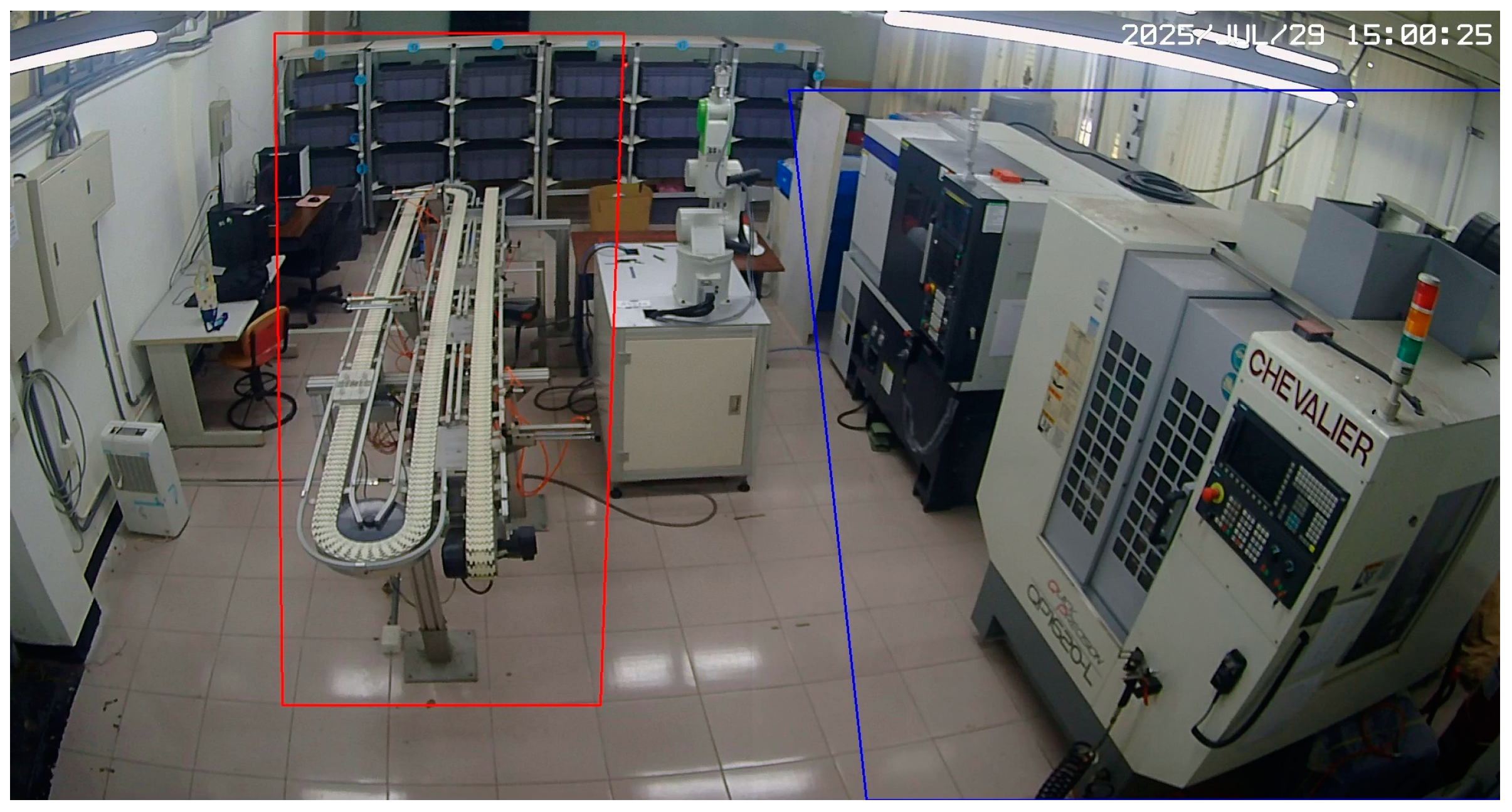
The test equipment consists of a fixed-position IP camera feeding live video to a graphics processing unit-enabled workstation running Python 3.12 and YOLOv8. Detections are parsed against predefined polygonal zones as shown in
Figure 1; each linked to authorized helmet colors. A persistence filter in the Python code eliminates transient false positives, and confirmed violations are written to Boolean OPC UA tags hosted on KEPServerEX. The FX5U PLC located under the conveyor is configured with a static IP, processes these tags to trigger deterministic control actions on the conveyor system.
3.2.2. YOLO Model Processing
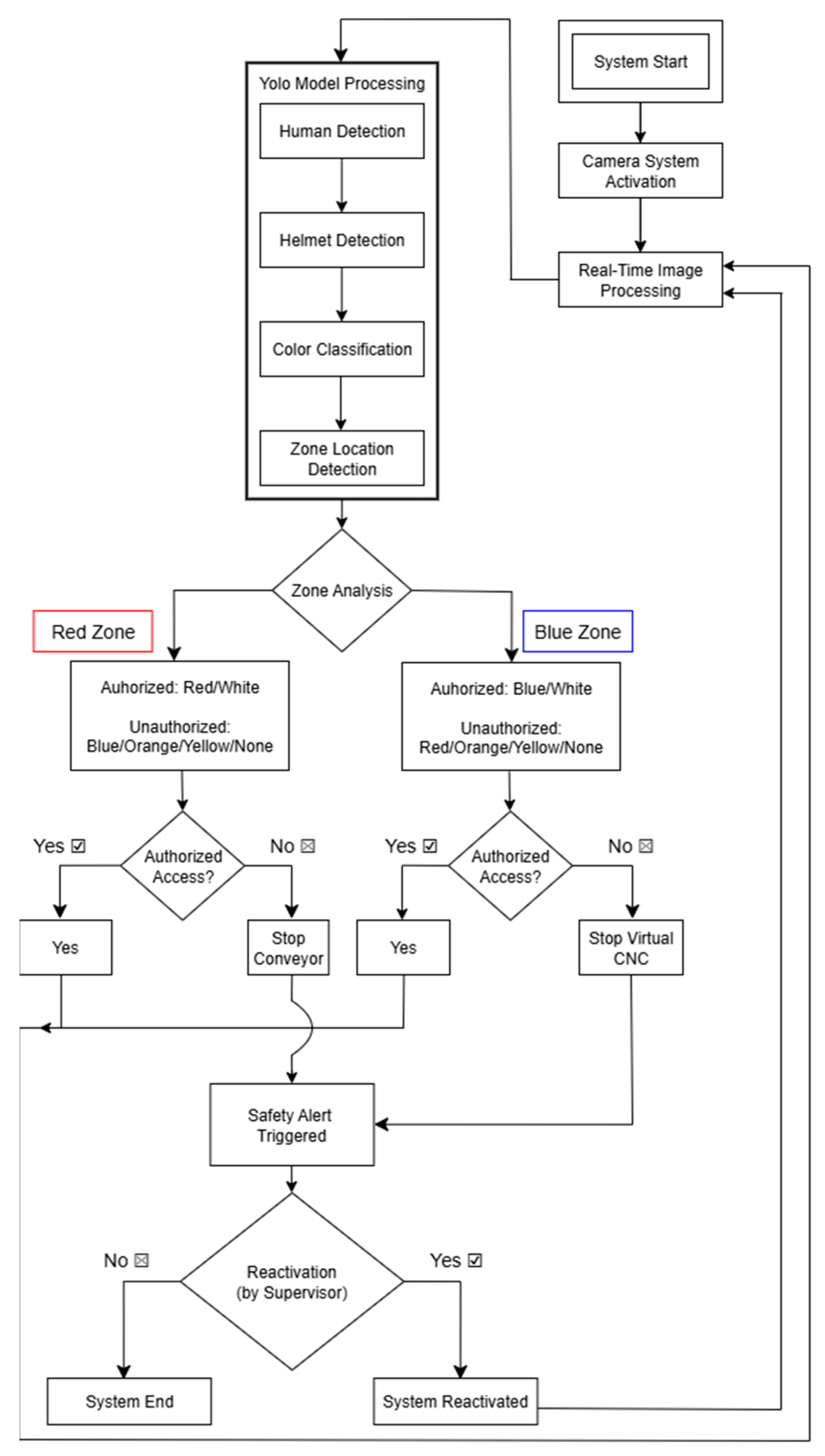
As shown in
Figure 2, the visual compliance detection pipeline begins with real-time image acquisition from the Internet Protocol (IP) camera, streamed to the YOLOv8 inference engine. The processing sequence follows four main stages: human detection, helmet detection, helmet color classification, and zone location detection.
All individuals within the frame are identified using the trained human class, thereby filtering out non-relevant objects. Helmets are subsequently detected as discrete objects to explicitly determine the presence or absence of protective gear. Each helmet is classified into one of five predefined categories (red, blue, yellow, white, orange) to align with site-specific authorization rules. Detected individuals are then mapped to predefined polygonal zones (Red Zone, Blue Zone) based on their image coordinates. The outputs are directed to the zone analysis stage, where compliance is verified against authorized helmet colors, red/white for the red zone and blue/white for the blue zone. Unauthorized entries immediately trigger safety enforcement signals. Operating at video rate, the system achieves near-instantaneous detection-to-decision latency. Decision outputs are transmitted as Boolean compliance variables to the OPC UA server, which are bound to corresponding PLC tags for actuation. Whether deployed in the Automation Studio virtual environment or on physical PLC hardware, these triggers halt the relevant machinery (e.g., conveyor or CNC) and activate a safety alert requiring supervisory clearance before reactivation.
3.2.3. Dataset Preparation and Model Training
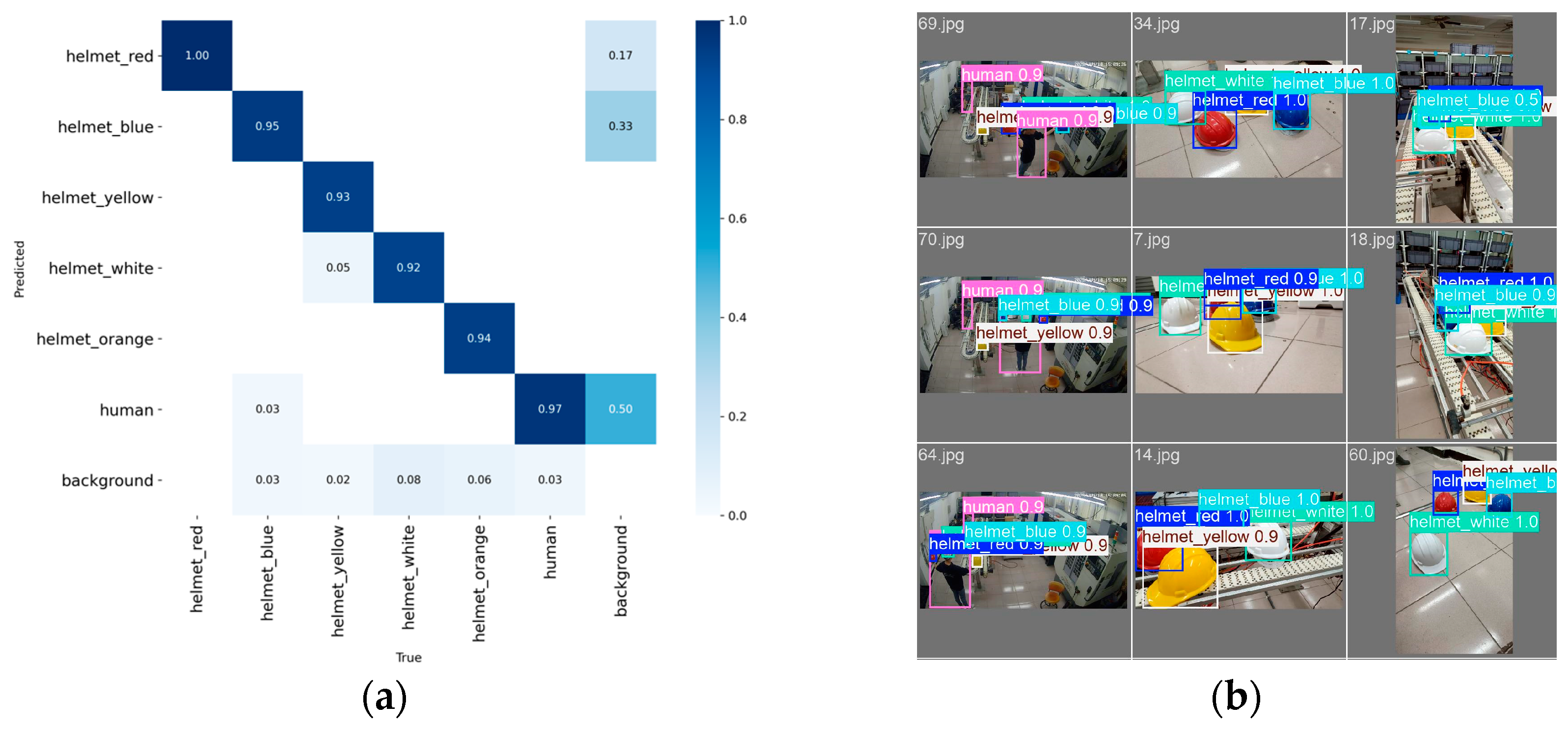
A custom dataset comprising 320 labeled images, including humans and five helmet colors, was prepared using LabelImg and partitioned into training, validation, and testing sets. YOLOv8x was trained for 477 epochs (with early stopping from a 500-epoch target) using an input size of 832 × 832, achieving a precision of 1.000 and a mean average precision at intersection over union (IoU) threshold of 0.5 (mAP@0.5) of 0.968. Class-specific precision scores were 0.986 for red helmet, 0.970 for blue helmet, 0.970 for yellow helmet, 0.915 for white helmet, 0.995 for orange helmet, and 0.973 for human detection. Corresponding recall values exceeded 0.90 across all classes, with orange helmet and red helmet, and the perfor-mance was limited. The model was optimized for real-time inference on NVIDIA RTX hardware, ensuring low-latency operation suitable for production environments. These results reflect validation-set performance and may vary under unseen, real-world conditions.
Figure 3 presents representative inference outputs from the trained model alongside the corresponding confusion matrix, illustrating the system’s high accuracy across classes and the minimal, though observable, instances of misclassification.
3.2.4. PLC and OPC UA Configuration
KEPServerEX was deployed as the central OPC UA server, configured with dedicated channels and devices corresponding to each production area and safety variable. Each monitored zone had its mapped Boolean tag, representing compliance states for helmet detection, zone access, and override conditions. Role-based access control ensured that only authorized clients subscribed to or wrote to safety-critical tags, while transport layer security (TLS) encryption (Basic256Sha256, Sign, and Encrypt) secured all network traffic against interception or tampering. On the PLC, the FX5U ladder logic was not a simple input-output pass-through. It was rewritten to integrate directly with these OPC UA safety triggers. Ethernet Transmission Control Protocol/Internet Protocol settings were tuned for deterministic communication with the server, minimizing scan-to-actuation latency. The resulting architecture allowed PLC to react to a violation detected by the YOLO system within milliseconds, whether running in the Automation Studio virtual environment or on physical hardware, while maintaining traceable, secure, and deterministic control logic.
3.2.5. Validation and Testing
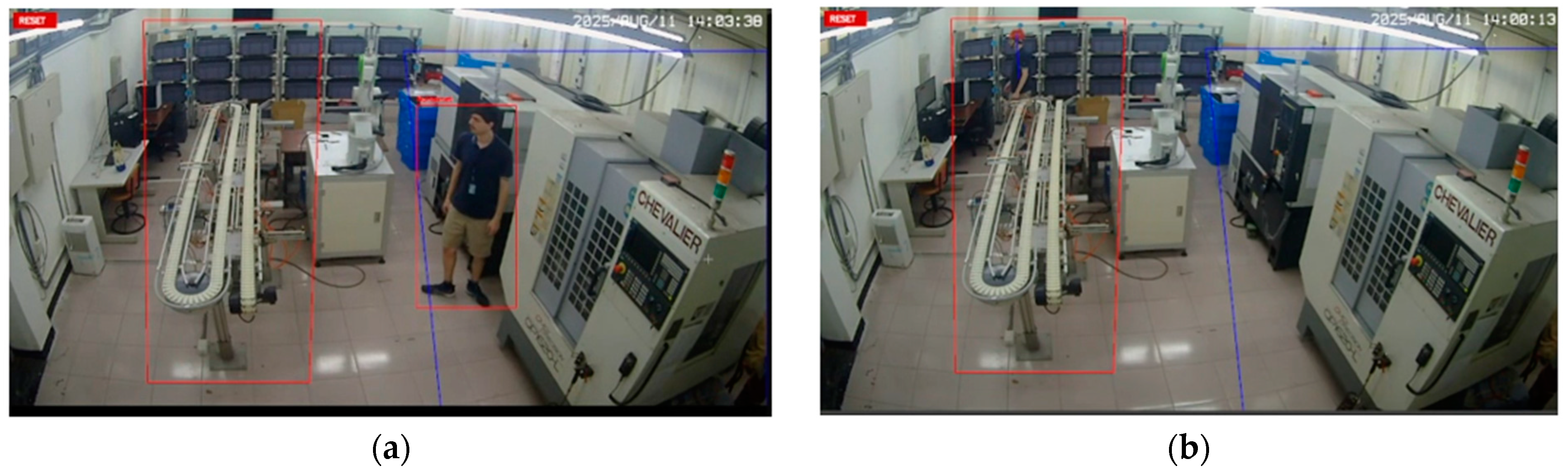
The integrated system was tested in a laboratory environment as shown in
Figure 4, with defined safety zones around the conveyor and computer numerical control (CNC) equipment. Automation Studio™ simulations replicated the physical PLC logic for the CNC machine, while the FX5U PLC controlled the conveyor. This setup enabled virtual validation of shutdown events without interrupting actual production. End-to-end tests confirmed reliable detection, accurate OPC UA variable updates, and immediate PLC-driven safety responses.
4. Experimental Results
Multiple operational scenarios and safety violations were simulated to assess the performance of the YOLOv8-based helmet compliance detection system and its integration with the PLC through OPC UA. The experimental setup replicated an industrial environment with two designated safety zones, each configured with specific helmet color authorization rules. Using a live IP camera feed, the system continuously monitored personnel within these zones, applying polygonal boundaries to enforce zone-specific policies.
The core of the detection pipeline is evaluated for a three-stage compliance: real-time object detection using YOLOv8, policy matching based on zone and helmet color, and deterministic PLC signaling through OPC UA. When an unauthorized presence was detected, the system issued a violation alert, set the corresponding Boolean tag in the PLC, and triggered safety responses as defined in the plant’s ladder logic. This layered approach enables rapid detection and ensures clear traceability. The vision model provides accurate recognition, the policy enforces site-specific rules, and the OPC UA layer delivers deterministic control signals to the automation infrastructure.
5. Conclusions
We developed a closed-loop PPE compliance enforcement system that integrates real-time YOLOv8-based helmet detection with deterministic PLC actuation via OPC UA. The IIoT pipeline from video capture to machine response operated reliably with minimal latency in both the Automation Studio virtual environment and when connected to a physical Mitsubishi FX5U PLC. OPC UA communication, secured through role-based access control and TLS encryption, ensured safe and traceable data exchange, while the ladder logic design enabled precise, millisecond-level responses to non-compliance events.
Experimental validation results confirmed that when an unauthorized helmet color or absence was detected within a designated safety zone, the corresponding Boolean tag was immediately updated in the PLC, triggering safety responses such as conveyor or CNC shutdowns. This direct linkage between AI-driven visual analysis and industrial control infrastructure enforces PPE rules automatically, thereby reducing reliance on human supervision. The system’s modular architecture and vendor-neutral OPC UA backbone further enhance scalability, making it applicable to a wide range of safety-critical scenarios in Industry 4.0 environments. Collectively, these features highlight its potential as a robust, future-ready solution for intelligent safety enforcement.
Author Contributions
Conceptualization, K.-C.H. and M.B.; methodology, K.-C.H., M.B. and W.-N.H.; software, M.B., H.-T.L. and W.-N.H.; validation, M.B., H.-T.L. and W.-N.H.; formal analysis, M.B.; writing—original draft preparation, K.-C.H. and M.B.; writing—review and editing, K.-C.H. and M.B.; visualization, M.B., H.-Y.W.; supervision, K.-C.H.; funding acquisition, K.-C.H. All authors have read and agreed to the published version of the manuscript.
Funding
This research was supported by the National Science and Technology Council (NSTC), Taiwan [grant number: 114-2622-E-033-002-].
Institutional Review Board Statement
Not applicable.
Informed Consent Statement
Not applicable.
Data Availability Statement
The original contributions presented in this study are included in the article. Further inquiries can be directed to the corresponding author.
Conflicts of Interest
The authors declare no conflict of interest.
Abbreviations
The following abbreviations are used in this manuscript:
| IIoT | Industrial internet of things |
| PPE | Personal Protective Equipment |
| OPC UA | Open Platform Communications Unified Architecture |
| PLC | Programmable Logic Controllers |
| CNC | Computer Numerical Control |
| TLS | Transport Layer Security |
References
- Yeh, L.T. Incorporating Workplace Injury to Measure the Safety Performance of Industrial Sectors in Taiwan. Sustainability 2017, 9, 2241. [Google Scholar] [CrossRef]
- Robert Taylor, J. Organizational Failure Analysis for Industrial Safety. ASCE-ASME J. Risk Uncertain. Eng. Syst. Part B Mech. Eng. 2020, 6, 011006. [Google Scholar] [CrossRef]
- Alqahtani, D.K.; Cheema, M.A.; Toosi, A.N. Benchmarking Deep Learning Models for Object Detection on Edge Computing Devices. In International Conference on Service-Oriented Computing; Springer Nature: Singapore, 2024. [Google Scholar] [CrossRef]
- Reis, D.; Kupec, J.; Hong, J.; Daoudi, A. Real-Time Flying Object Detection with YOLOv8. arXiv 2024, arXiv:2305.09972. [Google Scholar] [CrossRef]
- Awalgaonkar, N.M.; Zheng, H.; Gurciullo, C.S. DEEVA: A Deep Learning and IoT Based Computer Vision System to Address Safety and Security of Production Sites in Energy Industry. arXiv 2020, arXiv:2003.01196. [Google Scholar] [CrossRef]
| Disclaimer/Publisher’s Note: The statements, opinions and data contained in all publications are solely those of the individual author(s) and contributor(s) and not of MDPI and/or the editor(s). MDPI and/or the editor(s) disclaim responsibility for any injury to people or property resulting from any ideas, methods, instructions or products referred to in the content. |