Proceeding Paper

Assessment of C-Type Winglet Integration Impact on the Performance of a Fixed-Wing BWB UAV †
by
Stavros Kapsalis
1,2,
Thomas Dimopoulos
1,2,
Pavlos Kaparos
1,2,
Georgios Iatrou
3,
Pericles Panagiotou
1,2,* and
Kyriakos Yakinthos
1,2
1
Laboratory of Fluid Mechanics and Turbomachinery, Department of Mechanical Engineering, Aristotle University of Thessaloniki, 54124 Thessaloniki, Greece
2
UAV Integrated Research Center (UAV-iRC), Center for Interdisciplinary Research and Innovation, Aristotle University of Thessaloniki, 57001 Thessaloniki, Greece
3
Carbon Fiber Technologies, Industrial Area of Stavrochori, 61100 Kilkis, Greece
*
Author to whom correspondence should be addressed.
Presented at the 15th EASN International Conference, Madrid, Spain, 14–17 October 2025.
Eng. Proc. 2026, 133(1), 95; https://doi.org/10.3390/engproc2026133095
Published: 7 May 2026

Abstract

This work examines the aerodynamic efficiency improvement achieved by integrating C-type winglets into a small-scale Blended Wing Body (BWB) Unmanned Aerial Vehicle (UAV). The platform, designated S-3M, is an evolution of the RX-3 1:3 sub-scale demonstrator developed and flight-tested by the Laboratory of Fluid Mechanics and Turbomachinery (LFMT) during the DELAER project. The S-3M is redesigned for catapult launch and Intelligence–Surveillance–Reconnaissance (ISR) missions, supporting a useful payload of up to 5 kg. Strict dimensional, cost, and development constraints posed challenges in preserving aerodynamic efficiency and achieving sufficient stability margins. To meet these requirements, the design incorporates C-type winglets, tailored to enhance aerodynamic performance while providing stabilizing effects. Their integration enabled an increase in gross take-off weight (GTOW) and payload capacity, while ensuring adequate trimming without the need for a conventional horizontal tail. The aerodynamic development of the winglets and the overall configuration is supported by Computational Fluid Dynamics (CFD) analyses, followed by performance calculations. S-3M was manufactured by Carbon Fiber Technologies (CFT) and successfully flight-tested by LFMT, validating the design choices. Overall, the study demonstrates that C-type winglets can significantly improve efficiency and expand the operational envelope of BWB UAVs, highlighting the value of non-planar lifting surfaces in modern UAV design.

1. Introduction

In recent decades, the use and operations of Unmanned Aerial Vehicles (UAVs) have increased significantly and are nowadays used as essential tools for military operations and civilian applications. The wide range of missions that UAVs perform includes Intelligence, Surveillance and Reconnaissance (ISR), border patrol, mapping, wildfire detection, search and rescue, telecommunications support, agricultural monitoring, goods delivery, etc. [1]. The adoption of UAVs continues to expand into new transportation and environmental and industrial and emergency-response sectors because of their flexible deployment capabilities [2]. UAVs operate at higher speeds than ground vehicles because they do not need to follow road networks or navigate through terrain. Furthermore, UAVs provide increased operational safety compared to manned platforms, combined with reduced operating costs and safe operations. The combination of speed, mission versatility, and reduced operational risks makes UAVs important tools for air vehicle operations.
The Blended Wing Body (BWB) represents a novel configuration, which was initially introduced for a commercial airliner platform and delivers substantial performance benefits [3]. By seamlessly integrating the wings with the center body, the BWB configuration can achieve double-digit lift-to-drag ratio (L/D) improvements and provides a higher internal-volume-to-wetted-area ratio compared to conventional tube-and-wing designs [4,5]. Despite those benefits, challenges related to cabin pressurization, passenger evacuation, and overall comfort have limited the development of a full-scale commercial BWB aircraft [6,7]. However, the aforementioned advantages of the BWB platform make it an attractive candidate for UAV applications, where such constraints are absent. Thus, for UAV platforms, the BWB can deliver increased aerodynamic efficiency, leading to increased endurance, as well as higher payload capacity, making it a compelling alternative to traditional configurations [4,8]. BWBs are, by definition, tailless configurations; consequently, their design requires a distinct set of geometric and aerodynamic considerations. One of the most common design choices is the use of aft wing sweep, a feature that even the untrained observer can notice [9,10]. Unlike conventional aircraft, where sweep is primarily introduced to deal with compressibility effects and reduce wave drag at high Mach numbers [11], in BWBs, the wing is swept regardless of cruise speed to enhance stability. Specifically, higher sweep angles shift the aerodynamic center aftwards, improving longitudinal stability, while also providing a natural dihedral effect that benefits lateral stability [12,13]. Furthermore, several studies focus on the effect of winglets on the stability and aerodynamic performance of BWB UAVs [14,15].
A way to tackle the absence of the tail with a BWB configuration is by incorporating C-type winglets. The C-wing configuration is a non-planar lifting system based on Prandtl’s theoretical “best wing system”, which minimizes induced drag through a closed box-wing topology [16]. It was initially adapted for practical application by Kroo and McMasters, offering significant drag reductions under strict fixed-span constraints by redistributing the wingtip vortex [17]. This aerodynamic potential has been conceptualized in the Bauhaus Luftfahrt “Ce-Liner”, which utilizes a C-wing to enable a tailless, fully electric architecture that counters high battery mass with superior lift-to-drag ratios and reduced parasitic drag [18]. Those studies indicate the C-wing configuration as a means of increasing aircraft performance and providing satisfactory stability when wingspan constraints exist. However, widespread adoption remains challenged by multidisciplinary trade-offs, such as the added tip mass, which significantly increases root bending moments, and the appearance of flutter at lower speeds, which often leads to structural weight penalties that can negate the aerodynamic benefits [19,20].
In this study, the integration of C-type winglets to a small-scale fixed BWB UAV, called S-3M, is investigated, targeting the improvement of the UAV aerodynamic efficiency. The effect of the C-type winglets’ incorporation is investigated with the use of Computational Fluid Dynamics (CFD) simulations, to extract the much-needed lift, drag, and pitching moment coefficients. An internal position study is conducted for the UAV subsystems to define the Center of Gravity (CoG), allowing the evaluation of the C-type winglets’ impact on the stability of the S-3M UAV.

2. Reference Platform

For the current study, the 1:3 sub-scale demonstrator of the RX-3 UAV is used as a reference platform. The RX-3 is a tactical BWB UAV designed by LFMT in the framework of the DELAER research project [21], whose mission is to rapidly deliver up to 50 kg of cargo and lifesaving supplies to isolated territories and dispersed islands via airlift methods. The flight behavior and handling qualities of the RX-3 have been evaluated using a scaled-down operating prototype through a series of successful testing campaigns. The geometric characteristics of the RX-3 subscale platform are shown in Table 1.
Following the successful test flights of the RX-3 subscale demonstrator, the LFMT design team was called to develop a BWB UAV, based on the subscale configuration, with extended flight capabilities, e.g., payload capacity and endurance, capable of conducting ISR missions and catapult-assisted takeoff for rapid deployment and mission versatility, in collaboration with Greek Industry. The developed platform is called S-3M, and the mission profile and requirements of the platform are presented in Table 2. The LFMT design team had to face some challenges during the design of S-3M, which were related to the limited time (3 months both for the aerodynamic and the structural design) and the constraints of wingspan and the GTOW. More specifically, the wingspan must not exceed the 2.4 m of the RX-3 subscale model, and the GTOW must be ≤15 kg, as described in Table 2.
To overcome those constraints, the LFMT design team proceeded through a configuration redesign of the RX-3 subscale mode for drag reduction and higher aerodynamic efficiency. Three major keys of this configuration redesign are described below:
  • High wing for safe belly landing.
  • Integration of C-type winglets for minimizing the trim needs.

3. Tools and Method

3.1. Sizing and Performance Analysis

The sizing process of the C-type winglets and the corresponding performance evaluations of the S-3M are conducted using an in-house computational tool, developed on the basis of classical aircraft design methodologies [12,22,23,24]. This tool has been adapted to accommodate the characteristics of the novel BWB configuration, in accordance with literature [21,25]. The tool provides layout guidance, weight estimations, and preliminary performance calculations. Indicatively, Equation (1) is used for estimating the endurance for electrical-powered aircraft, while Equation (2) computes the maximum achievable flight velocity of the platform:
E = m b E s b η b 2 s 1000 P u s e d  
V m a x = T A m a x / W W / S T A m a x / W 2 4 C D , 0 K ρ C D , 0 1 / 2
where m b ,   E s b ,   η b 2 s and P u s e d are the mass of the batteries, the battery specific energy, the total system efficiency from the battery to the motor output shaft, and the average power used during that period of time, respectively. For the performance evaluation of the S-3M UAV, an 1800 W electrical motor is assumed, driving a propeller to generate the required thrust.
Throughout the sizing process, all critical design parameters of the C-type winglets, such as airfoil selection, leading edge sweep, aspect ratio, taper ratio, incidence angle, wingspan, and related geometric attributes, are continuously selected, refined, and re-evaluated, based on literature guidelines relative to the design of aircraft empennage. The primary objective is to identify the combination of parameters that satisfies the initial mission requirements while enhancing the aerodynamic efficiency and stability characteristics of the BWB platform and keeping the trim needs at a minimum.

3.2. Aerodynamic Analysis

To obtain accurate aerodynamic performance data, an extensive series of high-fidelity CFD analyses was performed using the ANSYS CFX commercial solver (ANSYS® Scientific Research, Release 18.2). The Reynolds-Averaged Navier–Stokes (RANS) equations are solved, combined with the Spalart–Allmaras (S-A) turbulence model [26], which is widely adopted in aerospace thanks to its accuracy in predicting flows around airfoils and wings. A second-order upwind discretization scheme is applied to both the momentum and turbulence model equations, while the inlet turbulence boundary conditions follow the guidelines of [27]. A steady-state approach is selected due to computational resource limitations.
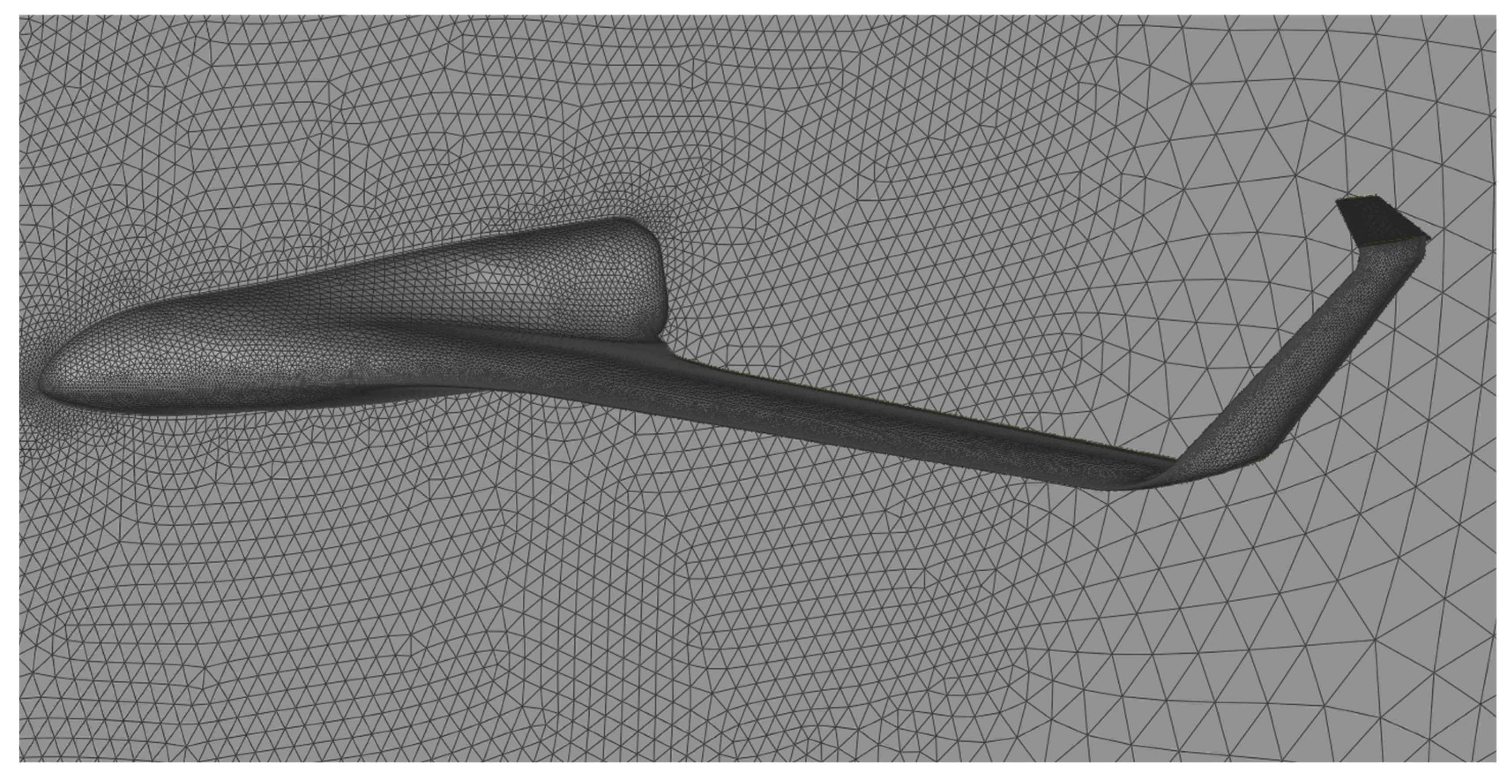
An unstructured mesh of approximately 8 million nodes is generated around the BWB geometry, as shown in Figure 1. Multiple inflation layers are implemented on the walls of the UAV to accurately resolve near-wall low-Reynolds-number behavior. The turbulence inlet conditions are selected to correspond to representative operational flight conditions. The reference geometry used in the simulations is generated through an existing parametric 3D Computer-Aided Design (CAD) tool, developed by the LFMT [4].

3.3. Internal Layout Design

The internal layout design defines the placement and orientation of all onboard systems. Mission requirements introduce a set of subsystems, e.g., structural elements, batteries, avionics, mission electronics, wiring, payload, and propulsion components, that must be integrated within the available internal volume of the S-3M UAV. Each component is represented in CAD software v1.0, with its external geometry and mass properties. Off-the-shelf components—COTS (e.g., avionics, payload, electric motor)—are modeled accurately, while in-house elements (e.g., structural parts, battery modules) begin with approximate dimensions that are refined as the design progresses. The components’ positioning must satisfy spatial, functional, and stability constraints. At each design iteration, a complete assembly is generated in CAD, from which the overall CoG is computed, to allow the designer to evaluate the stability and trim needs of the S-3M UAV. As the external geometry evolves or components are rearranged, the CoG is continuously updated to ensure the platform remains within acceptable stability limits [24].

4. Results

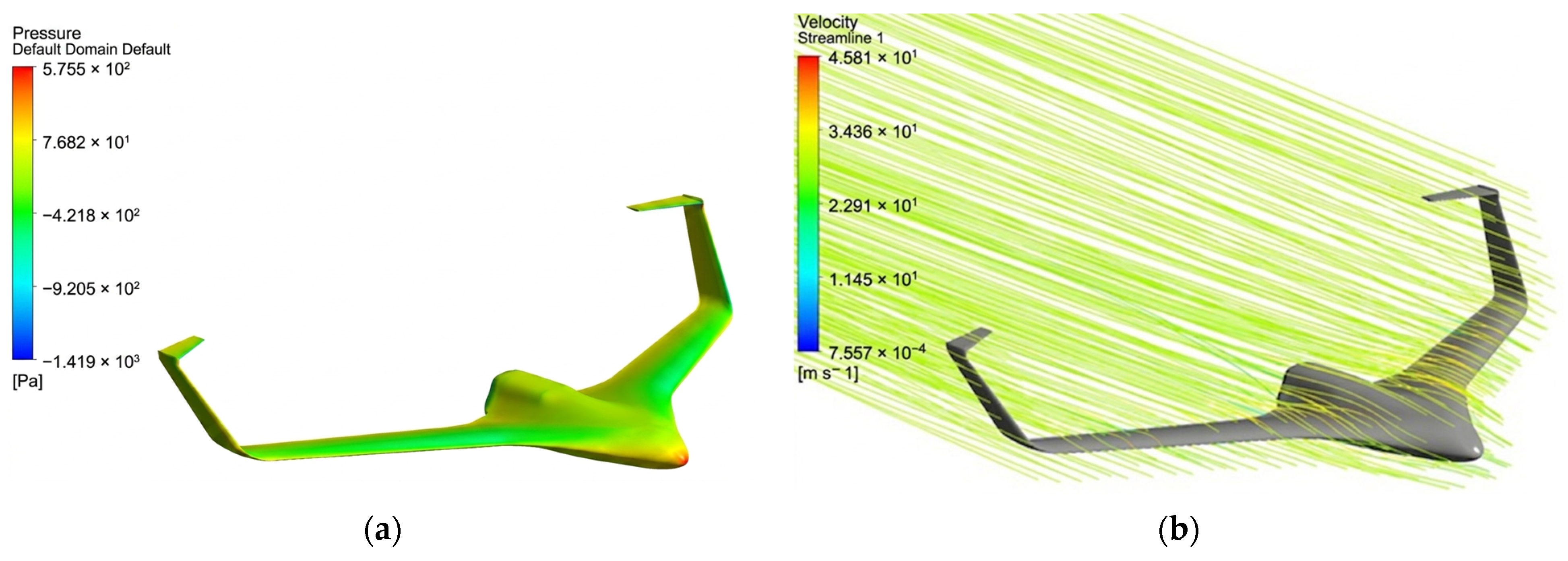
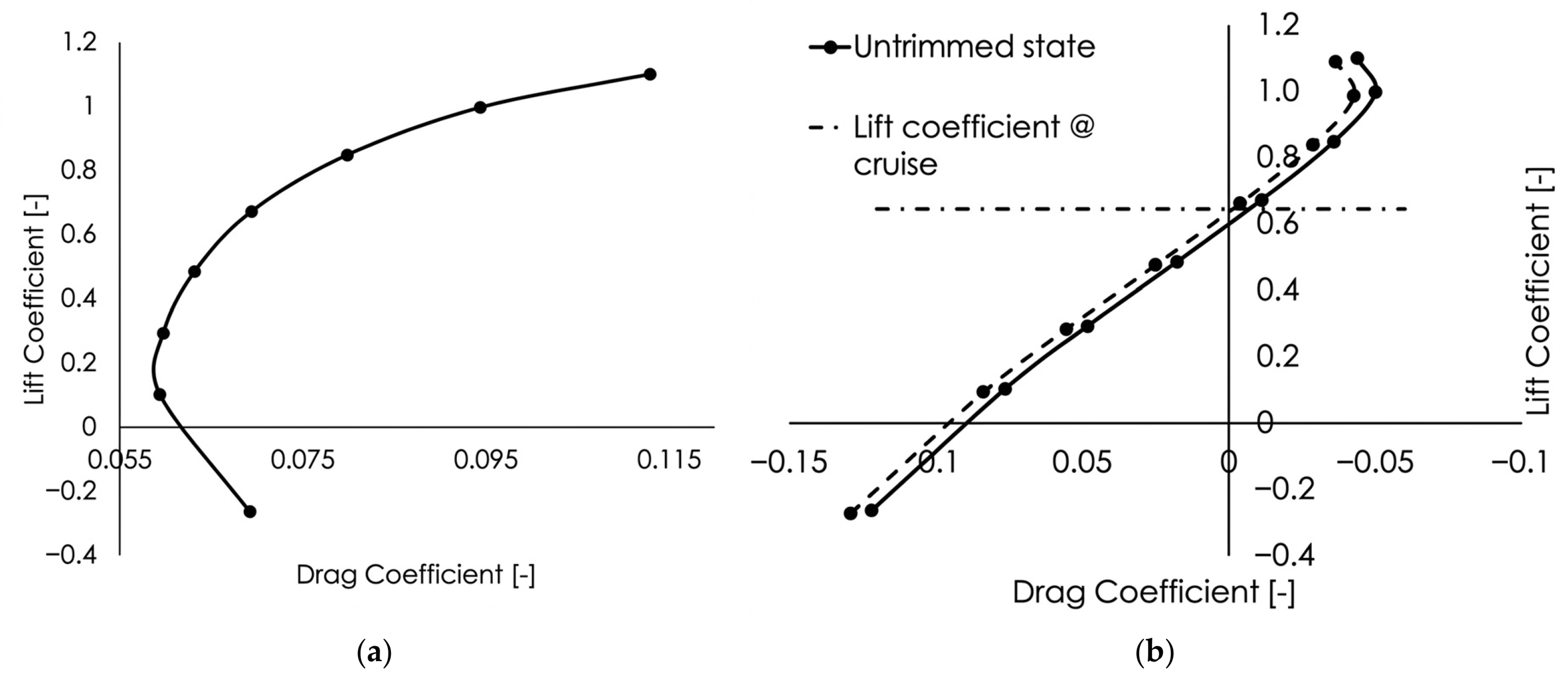
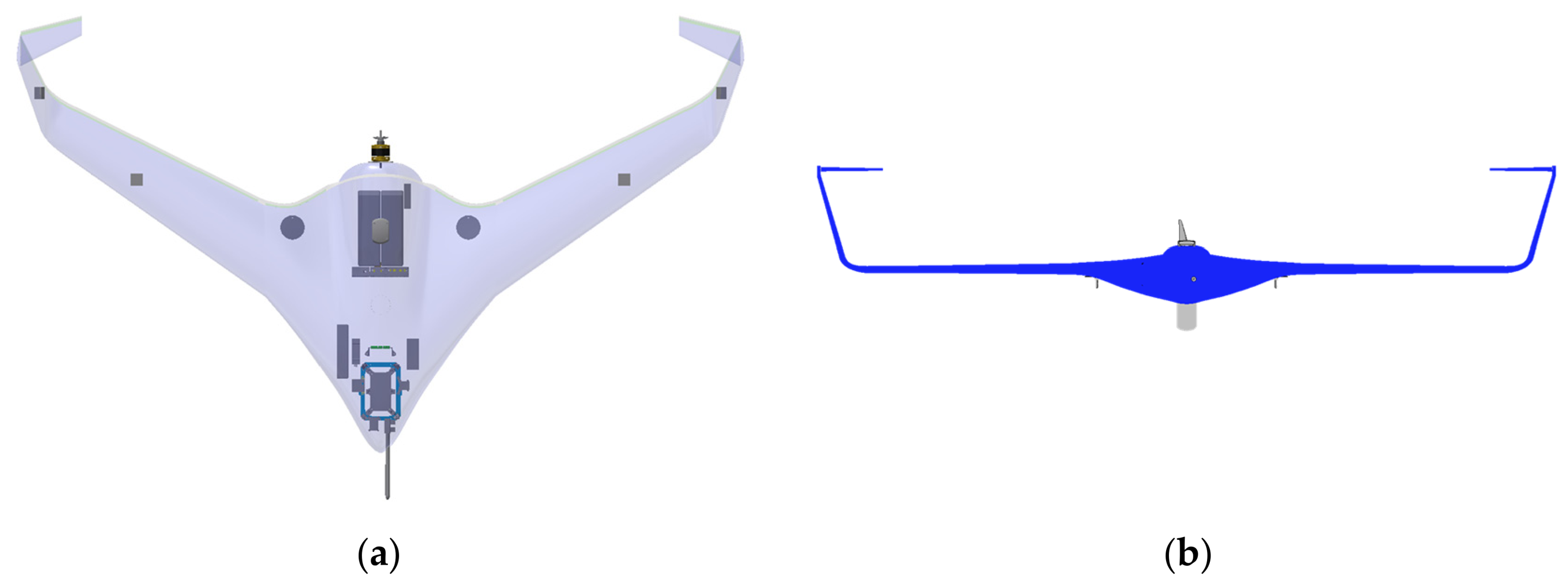
Following the methodology described in Section 3, the CFD is conducted at the operational altitude (1 km) of the S-3M UAV and at the cruise speed to calculate the much-needed aerodynamic (lift, drag, and pitching moment) coefficients. In Figure 2, the pressure contours on the surface of the UAV (left) and streamlines around it (right) are presented, while in Figure 3, the drag polar (left) and the trim diagram (right) of the S-3M UAV are shown. The trim diagram is constructed for the CoG representing the final positioning of the UAV components (Figure 4). Moreover, based on the calculated CoG, it is depicted that S-3M UAV is stable and the trim drag is kept to a minimum with the use of C-type winglets. Especially, the latter is achieved by minimizing the deflection of the UAV elevators during steady flight (−1° during cruise), with the use of C-type winglets.
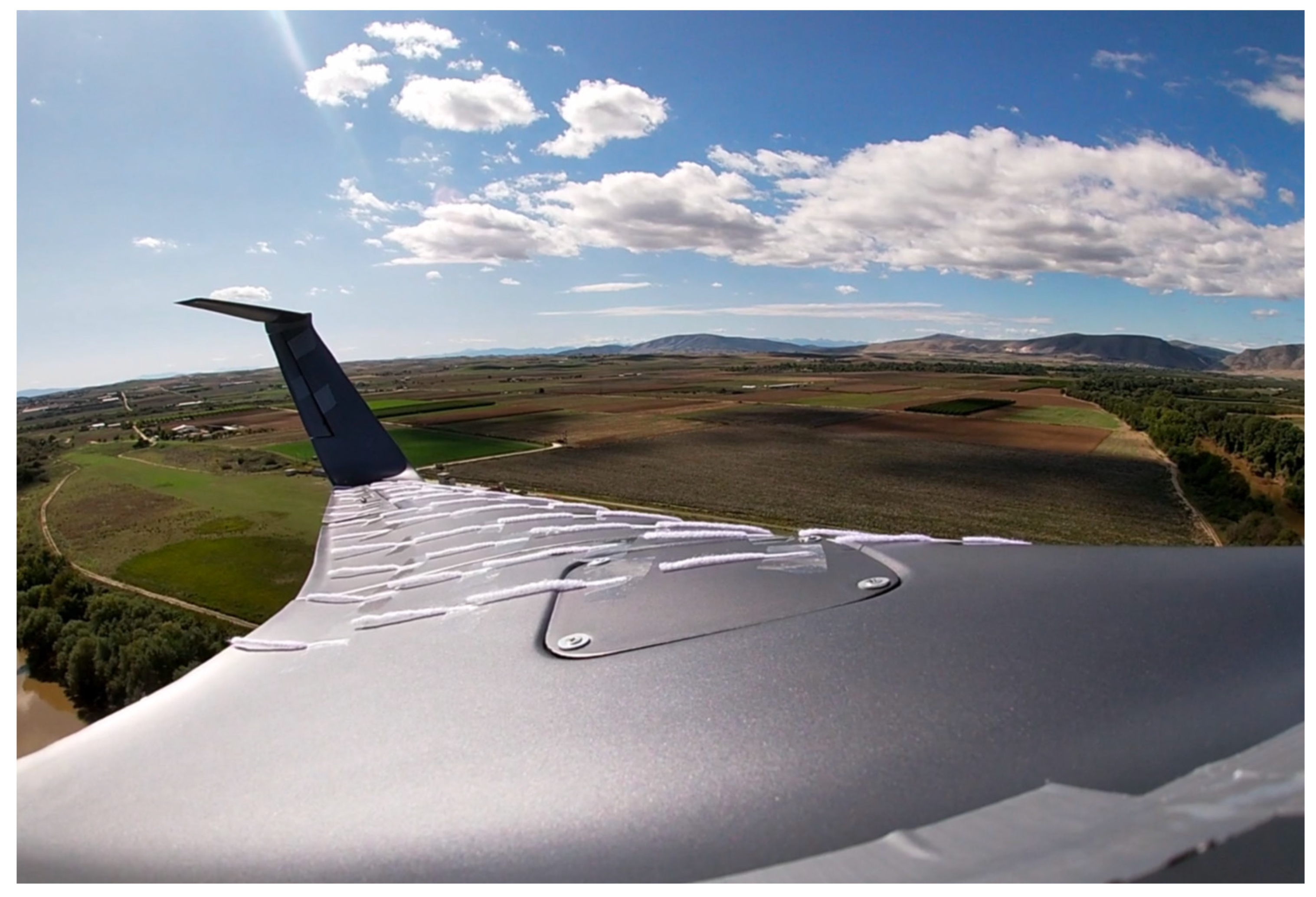
Finally, the optimum configuration is extracted and satisfies all the initial mission requirements (Table 2), considering all the constraints imposed on the design, including wingspan and GTOW limitations. Table 3 summarizes the key geometrical and performance specifications and presents the final configuration of the S-3M BWB UAV with the optimum C-type configuration. Finally, all the above were validated by the successful flight tests of the S-3M UAV prototype, manufactured by the CFT company and flight tested by the LFMT design team in a conventional takeoff configuration (landing gear system is added), as shown in Figure 5.

5. Conclusions

To conclude, the current work investigates C-type winglet integration impact on a small-scale BWB UAV, marked as S-3M. It is a prototype designed by the LFMT team and manufactured by the CFT company. The design focused on the augmentation of the RX-3 1:3 subscale model with the integration of the C-type winglets, without changing the wingspan and keeping the GTOW below 15 kg, without violating the stability constraints imposed by the aircraft design literature. The flow around the UAV is modeled using high-fidelity CFD methods, whereas in-house developed tools are employed for the design of the UAV, the C-type winglets, and the performance and stability of the UAV. All the initial mission requirements were satisfied by the final configuration of the S-3M BWB UAV, and the contribution of the C-type winglets to the minimization of trim drag was validated by the flight test campaigns.
For the further exploitation of the C-type winglets, a dedicated optimization study is suggested using a well-established optimization method to allow the extraction of design trends for C-type winglets on BWB UAVs. Furthermore, control surfaces could be integrated on the horizontal surface of the C-type winglet, and the structural constraints of the interconnection between the horizontal and the vertical surface should be considered.

Author Contributions

Conceptualization, S.K. and P.P.; methodology, S.K. and T.D.; software, T.D. and P.K.; validation, S.K., P.P., G.I. and K.Y.; formal analysis, S.K., T.D. and P.P.; investigation, S.K. and T.D.; resources, K.Y.; data curation, S.K. and P.K.; writing—original draft preparation, S.K., T.D., P.K. and G.I.; writing—review and editing, P.P. and K.Y.; visualization, P.K. and P.P.; supervision, K.Y.; project administration, P.P.; funding acquisition, K.Y. All authors have read and agreed to the published version of the manuscript.

Funding

This research received no external funding.

Institutional Review Board Statement

Not applicable.

Informed Consent Statement

Not applicable.

Data Availability Statement

Data available on request due to restrictions related to the details of the baseline platform. The data presented in this study are available upon request from the corresponding author.

Conflicts of Interest

Author Georgios Iatrou was employed by the company Carbon Fiber Technologies. The remaining authors declare that the research was conducted in the absence of any commercial or financial relationships that could be construed as a potential conflict of interest.

References

  1. Global Unmanned Aerial Vehicle (UAV) Market 2017–2021|Market Research Reports—Industry Analysis Size & Trends—Technavio. Available online: https://www.technavio.com/report/globalaerospace-components-global-uav-market-2017-2021?utm_source=T4&utm_medium=BW&utm_campaign=Media (accessed on 6 January 2018).
  2. Austin, R. Unmanned Aircraft Systems, UAVs Design, Development and Deployment; Wiley: Chichester, West Sussex, UK, 2010. [Google Scholar]
  3. Liebeck, R.H. Design of the Blended Wing Body Subsonic Transport. J. Aircr. 2004, 41, 10–25. [Google Scholar] [CrossRef]
  4. Panagiotou, P.; Fotiadis-Karras, S.; Yakinthos, K. Conceptual Design of a Blended Wing Body MALE UAV. Aerosp. Sci. Technol. 2018, 73, 32–47. [Google Scholar] [CrossRef]
  5. Hileman, J.I.; Spakovszky, Z.S.; Drela, M.; Sargeant, M.A.; Jones, A. Airframe Design for Silent Fuel-Efficient Aircraft. J. Aircr. 2010, 47, 956–969. [Google Scholar] [CrossRef]
  6. Galea, E.R.; Filippidis, L.; Wang, Z.; Ewer, J. Fire and Evacuation Analysis in BWB Aircraft Configurations: Computer Simulations and Large-Scale Evacuation Experiment. Aeronaut. J. 2010, 114, 271–277. [Google Scholar] [CrossRef]
  7. Vos, R.; Geuskens, F.J.J.M.M.; Hoogreef, M.F.M. A New Structural Design Concept for Blended Wing Body Cabins. In Proceedings of the Collection of Technical Papers—AIAA/ASME/ASCE/AHS/ASC Structures, Structural Dynamics and Materials Conference, Honolulu, HI, USA, 23–26 April 2012. [Google Scholar]
  8. Lehmkuehler, K.; Wong, K.C.; Verstraete, D. Design and Test of a UAV Blended Wing Body Configuration. In Proceedings of the 28th Congress of the International Council of the Aeronautical Sciences 2012, ICAS 2012, Brisbane, Australia, 23–28 September 2012; Volume 1, pp. 432–442. [Google Scholar]
  9. Ali, U.; Okasha, M.; Dief, T.N.; ElSayed, M.S.A.; Kamra, M.M. Blended Wing Body Designs for Aerodynamic, Stability, and Control Optimization: A Comprehensive Review. Transp. Eng. 2025, 22, 100397. [Google Scholar] [CrossRef]
  10. Lyu, Z.; Martins, J.R.R.A. Aerodynamic Design Optimization Studies of a Blended-Wing-Body Aircraft. J. Aircr. 2014, 51, 1604–1617. [Google Scholar] [CrossRef]
  11. Anderson, J.D. Fundamentals of Aerodynamics, 5th ed.; McGraw-Hill: New York, NY, USA, 2011. [Google Scholar]
  12. Raymer, D.P. Aircraft Design: A Conceptual Approach, 6th ed.; American Institute of Aeronautics and Astronautics Inc.: Reston, VA, USA, 2018; ISBN 9781624104909. [Google Scholar]
  13. Gudmundsson, S. General Aviation Aircraft Design: Applied Methods and Procedures, 2nd ed.; Butterworth-Heinemann: Oxford, UK, 2022. [Google Scholar]
  14. Kim, J.; Oh, S. Aerodynamic Characteristics of a Blended Wing Body with Various Winglets. J. Mech. Sci. Technol. 2025, 39, 1201–1210. [Google Scholar] [CrossRef]
  15. Panagiotou, P.; Antoniou, S.; Yakinthos, K. Cant Angle Morphing Winglets Investigation for the Enhancement of the Aerodynamic, Stability and Performance Characteristics of a Tactical Blended-Wing-Body UAV. Aerosp. Sci. Technol. 2022, 123, 107467. [Google Scholar] [CrossRef]
  16. Prandtl, L. Induced Drag of Multiplanes; NASA: Washington, DC, USA, 1924.
  17. Kroo, I. Nonplanar Wing Concepts for Increased Aircraft Efficiency. VKI Lecture Series on Innovative Configurations and Advanced Concepts for Future Civil Aircraft. 2005. Available online: https://www.scribd.com/document/138100269/NONPLANAR-WING-CONCEPTS-FOR-INCREASED-AIRCRAFT-EFFICIENCY (accessed on 20 April 2026).
  18. Hornung, M.; Isikveren, A.T.; Cole, M.; Sizmann, A. Ce-Liner—Case Study for EMobility in Air Transportation. In Proceedings of the 2013 Aviation Technology, Integration, and Operations Conference, Los Angeles, CA, USA, 12–14 August 2013; American Institute of Aeronautics and Astronautics Inc.: Los Angeles, CA, USA, 2013. [Google Scholar]
  19. Ning, S.A.; Kroo, I. Tip Extensions, Winglets, and C-Wings: Conceptual Design and Optimization. Available online: https://flowlab.groups.et.byu.net/publications/Ning2008-Extensions-Winglets.pdf (accessed on 20 April 2026).
  20. Naveen, R. Aerodynamic Analysis of C-Wing Aircraft. INCAS Bull. 2018, 10, 157–165. [Google Scholar] [CrossRef]
  21. Panagiotou, P.; Mitridis, D.; Dimopoulos, T.; Kapsalis, S.; Dimitriou, S.; Yakinthos, K. Aerodynamic Design of a Tactical Blended-Wing-Body UAV for the Aerial Delivery of Cargo and Lifesaving Supplies. In Proceedings of the AIAA Scitech 2020 Forum, Orlando, FL, USA, 5 January 2020; American Institute of Aeronautics and Astronautics Inc., AIAA: Reston, VA, USA, 2020; Volume 1, Part F. [Google Scholar]
  22. Anderson, J.D. Aircraft Performance & Design, 1st ed.; McGraw-Hill Education: New York, NY, USA, 1998; ISBN 0-07-001971-1. [Google Scholar]
  23. Roskam, J. Airplane Design; DARcorporation: Lawrence, KS, USA, 2004. [Google Scholar]
  24. Mohammad, H.S. Aircraft Design: A Systems Engineering Approach; Wiley: Chichester, UK, 2013; Volume 40, ISBN 9781119953401. [Google Scholar]
  25. Qin, N.; Vavalle, A.; Le Moigne, A.; Laban, M.; Hackett, K.; Weinerfelt, P. Aerodynamic Considerations of Blended Wing Body Aircraft. Prog. Aerosp. Sci. 2004, 40, 321–343. [Google Scholar] [CrossRef]
  26. Spalart, P.R.; Allmaras, S.R. A One-Equation Turbulence Model for Aerodynamic Flows. In Proceedings of the 30th Aerospace Sciences Meeting and Exhibit, Reno, NV, USA, 6–9 January 1992; p. 439. [Google Scholar]
  27. Spalart, P.R.; Rumsey, C.L. Effective Inflow Conditions for Turbulence Models in Aerodynamic Calculations. AIAA J. 2007, 45, 2544–2553. [Google Scholar] [CrossRef]
Figure 1. Computational mesh around the surface of the UAV.
Engproc 133 00095 g001
Figure 2. Pressure contours on the surface of the S-3M UAV (a) and streamlines around it (b).
Engproc 133 00095 g002
Figure 3. Drag polar (a) and trim diagram (b) of the S-3M UAV.
Engproc 133 00095 g003
Figure 4. Components positioning (a) in the interior (b) and the exterior of the S-3M UAV.
Engproc 133 00095 g004
Figure 5. Footage from the S-3M BWB UAV wing in mid-flight. Tufts are used to indicate flow attachment or separation.
Engproc 133 00095 g005
Table 1. RX-3 1:3 subscale demonstrator.
GTOW6 kgEngproc 133 00095 i001
Wingspan2.4 m
Wing loading11 kg/m2
Cruise speed70 km/h
Maximum speed85 km/h
Endurance0.5 h
Table 2. S-3M mission requirements.
GTOW≤15 kgEngproc 133 00095 i002
Wingspan2.4 m
Cruise speed100 km/h
Endurance2.5 h
Payload capacity4 kg
Take-off methodCatapult launched
MissionISR
Table 3. The S-3M BWB UAV specifications.
GTOW15 kgEngproc 133 00095 i003
Wing loading27 kg/m2
Cruise speed100 km/h
Maximum speed110 km/h
Stall speed75 km/h
Loiter endurance3.5 h
Max Payload capacity5 kg
Disclaimer/Publisher’s Note: The statements, opinions and data contained in all publications are solely those of the individual author(s) and contributor(s) and not of MDPI and/or the editor(s). MDPI and/or the editor(s) disclaim responsibility for any injury to people or property resulting from any ideas, methods, instructions or products referred to in the content.