1. Introduction
Uncertainty Quantification (UQ) is vital for robust and climate-conscious conceptual design of aircraft and launch systems, where early decisions made under uncertain aerodynamic, structural, and mission parameters strongly affect performance and cost. Although Multidisciplinary Design Optimization (MDO) frameworks can address these uncertainties, UQ is often applied inconsistently or too late, resulting in non-robust or overly conservative designs.
Existing UQ tools and libraries offer advanced probabilistic modeling, sampling, and sensitivity analysis capabilities. While several high-quality open-source solutions exist, practical deployment in multidisciplinary engineering environments often remains challenging. Many tools are script-based and require significant expertise in numerical methods and software integration. In addition, commercial UQ software typically involves licensing costs, and integrating either open-source or commercial tools into Model-Based Systems Engineering (MBSE) workflows often requires substantial engineering effort and maintenance [
1,
2,
3,
4].
This paper presents a modular, web-based framework designed to support probabilistic analysis within existing workflows. It comprises two main components: uqFramework, a RESTful backend for sampling, propagation, and sensitivity analysis; and uqStudio, a web-based frontend offering intuitive configuration and visualization. A unified data model (uqDatamodel) ensures consistent definition, storage, and reuse of all study elements.
The framework’s functionality is demonstrated through two benchmarks: the Ishigami function and a multidisciplinary UAV design study, confirming its accuracy, flexibility, and ease of use. The remainder of this paper reviews related tools (
Section 2), outlines the framework architecture (
Section 3), presents validation results (
Section 4), and concludes with future directions (
Section 5).
2. Background and Related Work
2.1. Probabilistic Uncertainty Quantification
Uncertainty Quantification (UQ) systematically assesses how input variability affects model outputs. In probabilistic analysis, inputs are modeled as random variables with defined distributions, and sampling-based approaches such as Monte Carlo, Latin Hypercube Sampling (LHS), and sensitivity-driven schemes (Sobol, FAST, Morris) are widely used for nonlinear and multidisciplinary systems [
5,
6]. The resulting ensembles enable statistical characterization of performance metrics and design robustness. Global Sensitivity Analysis (GSA) quantifies each variable’s influence on output variance through methods such as Sobol indices [
7], FAST [
8,
9], and Morris screening [
10], supporting variable ranking and model simplification in multidisciplinary design optimization (MDO).
2.2. Existing Tools and Limitations
Existing UQ tools, such as
SALib [
11,
12],
OpenTURNS [
1],
UQLab [
3],
Dakota [
2], and commercial software such as
SmartUQ [
4], offer robust algorithms for sampling, surrogates, and analysis but are often fragmented and script-heavy, requiring advanced numerical expertise. Integration within multidisciplinary environments like DLR’s
Remote Component Environment (RCE) [
13] demands manual interfacing and reduces reproducibility. Commercial licensing further limits accessibility. These challenges motivate a unified, modular, and web-accessible framework that combines trusted UQ libraries with an intuitive interface, enabling consistent sampling, propagation, and sensitivity analyses directly within RCE or Python-based workflows.
3. Methods
3.1. Design Objectives
The framework presented in this paper intends to enable efficient, accessible, and reproducible Uncertainty Quantification (UQ) in early-stage engineering design, with four core objectives: providing end-to-end UQ capabilities (sampling, propagation, and sensitivity analysis) within a unified environment; adopting a modular and extensible architecture for easy integration of new methods; ensuring non-intrusive compatibility with existing workflows such as RCE or Python-based studies; and offering a web-based, intuitive interface to make advanced UQ methods accessible to a wider range of users.
3.2. Architecture Overview
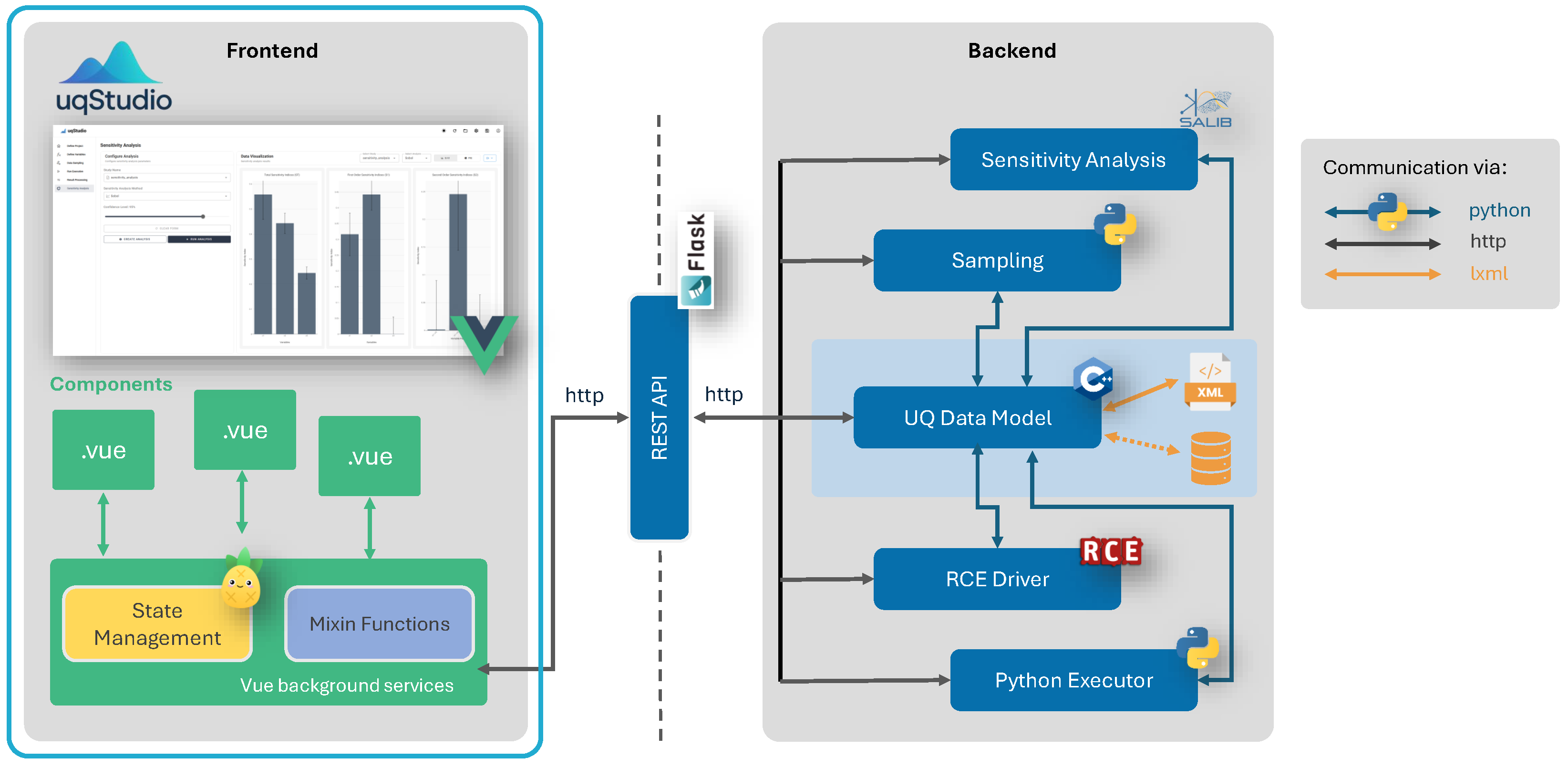
The overall system adopts a modern client–server architecture (
Figure 1) consisting of a backend service, called
uqFramework, and an interactive frontend, called
uqStudio. Communication between both components occurs via a Representational State Transfer (REST) interface, ensuring full decoupling between computation and visualization layers.
The backend provides the computational logic for sampling, propagation, and sensitivity analysis, whereas the frontend offers the user interface, interactive visualizations, and process guidance. This architecture allows deployment on local servers or cloud infrastructure.
3.3. Backend: uqFramework
The
uqFramework acts as the computational core, providing a RESTful backend for sampling, propagation, and sensitivity analysis using established open-source libraries, especially
SALib, a widely known Python library for uncertainty quantification [
11,
12]. By re-using
SALib’s well-tested routines, the correctness of the mathematical implementation in
uqFramework can be verified.
uqFramework includes a sampling engine supporting random sampling, LHS, and sensitivity-driven methods (Saltelli, FAST, Morris).
Workflow execution is automated via parallel RCE executions. In addition to the RCE-based workflow demonstrated in this paper, uqFramework also supports standalone Python-based workflows. In this mode, the framework automatically generates input samples, executes user-provided Python scripts, and collects the resulting outputs for subsequent analysis. The RCE-based workflow was selected for demonstration because it represents a typical multidisciplinary integration environment at DLR.
Post-processing computes global sensitivity metrics (Sobol’, FAST, Morris) validated against Ishigami and UAV benchmarks. All data are managed through the standardized
uqDatamodel, an XML-based structure with C++/Python 3.10+ bindings ensuring consistent handling of probabilistic inputs, samples, and results across studies [
14].
3.4. Frontend: uqStudio
The uqStudio frontend provides a web-based graphical user interface that guides users through the full UQ process. It is implemented as a single-page application (SPA) connected to the uqFramework backend via REST APIs. All plots and visualizations are interactive, built with the Plotly library v. 6.x, and can be customized or exported in multiple formats. Because the interface runs entirely in a browser, no local installation of UQ libraries or dependencies is required.
The user workflow in uqStudio follows a structured, stepwise interaction:
Project definition: Create a new project and specify metadata such as project name, domain XML path, and version.
Input definition: Define uncertain inputs via their statistical moments based on given knowledge (e.g., from literature, expert judgment, etc.), and references to the design variables in the domain file.
Study definition: Each project can host multiple studies, each representing a distinct UQ setup linking selected inputs and outputs.
Sampling: Choose a study and configure a sampling strategy (e.g., LHS, Sobol, or Quasi–Monte Carlo) to generate the DOE.
Run execution: Execute the study using the selected workflow engine (RCE or Python). This corresponds to uncertainty propagation. All simulation outputs are automatically stored in the study directory.
Result processing: Post-process the simulation outputs with statistical summaries and visualizations such as histograms, scatter plots, and cumulative distributions.
Sensitivity analysis: Select the desired method (Sobol, FAST, or Morris) to compute and visualize sensitivity indices. Interactive plots assist in interpreting the most influential parameters.
The interface provides visual validation feedback, exception handling, and progress monitoring throughout each stage, making the UQ process accessible even to non-experts. To manage visualization load for large datasets, uqStudio shows downsampled data in plots, while the backend always operates on the full dataset; users may also download the complete sample set for external analysis. All results and configuration data can be exported locally in the XML-based uqDataModel format, enabling users to reload, edit, or continue their projects in uqStudio at any time.
4. Demonstration and Discussion
4.1. Application Case 1: Ishigami Function
The first application case employs the Ishigami function [
15] as a nonlinear model for testing global sensitivity analysis. It is defined as
where
and
.
4.1.1. Problem Setup
For this demonstration case, each input variable is uniformly distributed over . The goal here is to verify the correct implementation of GSA methods in uqFramework and its linkage to uqStudio by comparing numerical Sobol’ sensitivity indices with analytical reference values.
4.1.2. Implementation in uqStudio
The Ishigami test case was configured in uqStudio using a simple Python workflow coupled with a domain XML file that defines the input and output parameters. This approach is described in detail by Koch et al. [
14].
Uniform input distributions were specified in the
Project definition interface, and Sobol’ sensitivity analysis was selected in
Sensitivity analysis (see
Section 3.4). Sampling was performed using the 2nd order Saltelli scheme with a total of 1024 base samples (
), resulting in
model evaluations for the three-dimensional Ishigami function.
4.1.3. Results
Based on the
uqStudio problem setup,
uqFramework computes both first-order (
) and total-order (
) Sobol’ indices, which were compared to analytical results (see
Table 1). The computed indices closely match the analytical references, with differences below 1%, confirming the numerical correctness of the implementation.
The results confirm that the computed indices reproduce the analytical solution with negligible deviation, verifying the correct implementation of the framework’s sampling and analysis modules. Computational time for this benchmark remained within minutes on a standard laptop using parallel execution.
4.2. Application Case 2: Multidisciplinary Aircraft Design
The second benchmark evaluates the capability of the framework to handle multidisciplinary engineering workflows. The study adopts a nonlinear UAV design case originally introduced by Jiang et al. [
16].
4.2.1. Workflow Description
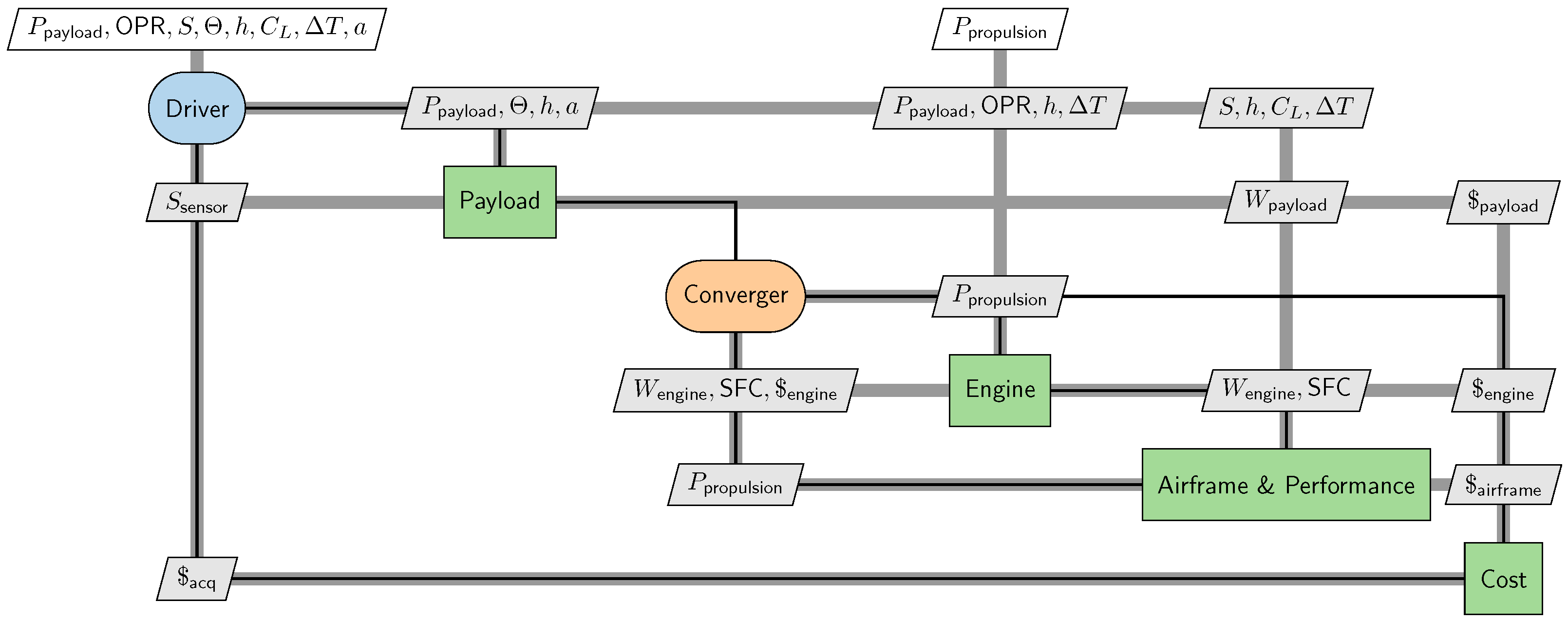
The design process consists of four interconnected disciplines: payload, propulsion, airframe performance, and cost estimation (
Figure 2). The objective is to quantify how uncertainties in input parameters affect the predicted vehicle acquisition cost.
4.2.2. Uncertain Inputs and Sampling
Nine uncertain input factors were defined according to [
16]. Their probability distributions and physical ranges are summarized in
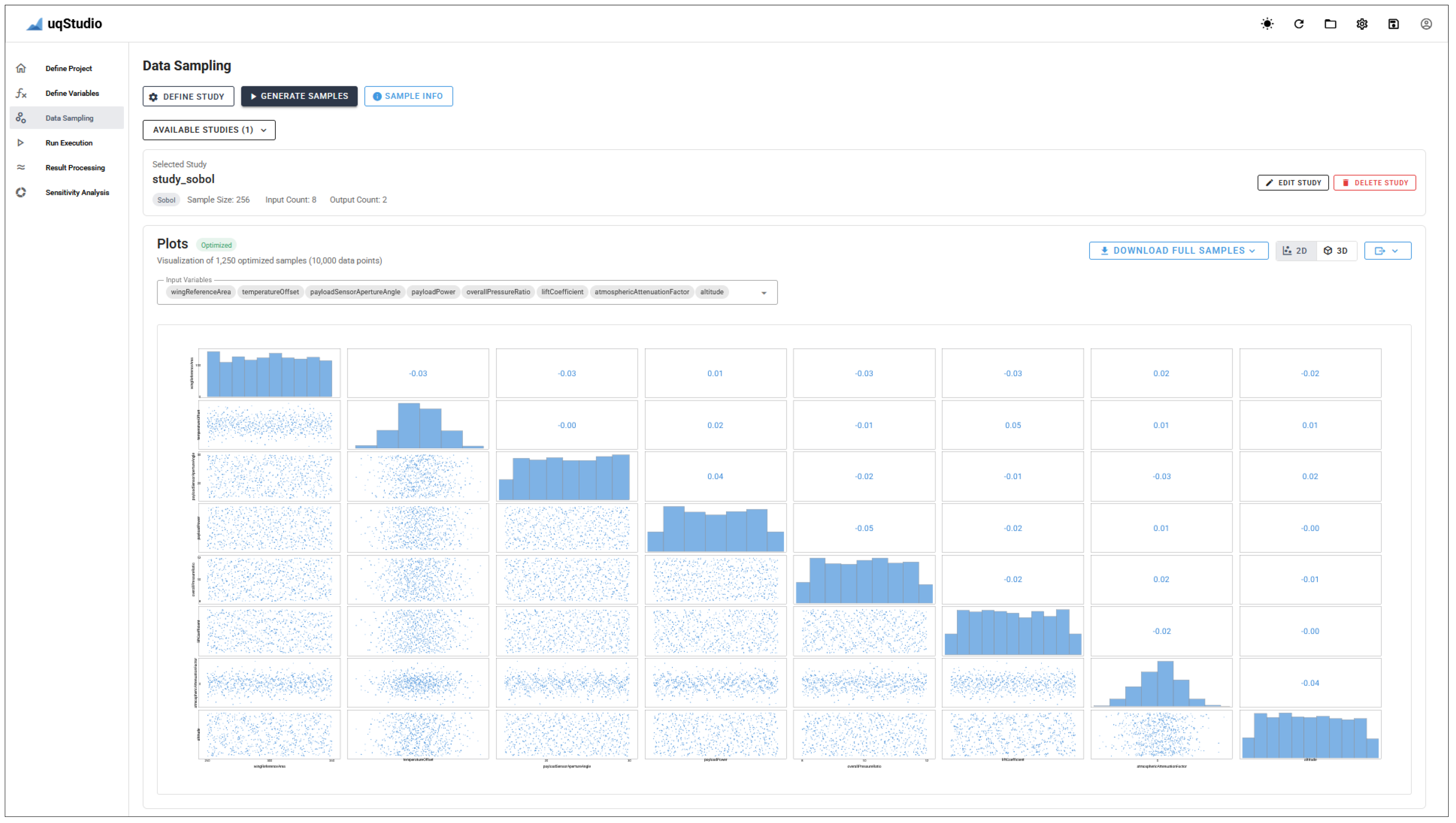
Table 2. Sampling was performed using Saltelli sampling with 1024 samples per input parameter to propagate uncertainties through the UAV workflow (
Figure 3).
The workflow produced two key output quantities: (i) the vehicle acquisition cost, , and (ii) the ground area imaged by the onboard sensor, .
4.2.3. Propagation and Output Analysis
Each generated sample was executed through the coupled UAV workflow from Jiang et al. [
16] within RCE. All results were stored and visualized through
uqStudio, where histograms and scatter plots were generated for cost and sensor area outputs. The resulting acquisition cost distribution exhibited a near-Gaussian trend, consistent with the nonlinear but smooth response surface defined by the workflow.
4.2.4. Global Sensitivity Analysis
Sobol’ total and first-order indices were computed to identify the most influential design parameters. Results (
Table 3) show that wing surface area dominates the output variance, followed by payload power and atmospheric temperature offset that is fully consistent with the reference results of Jiang et al.
The close match between the obtained and reference sensitivities validates both the accuracy and robustness of the framework for handling realistic multidisciplinary workflows.
5. Conclusions and Future Work
This work presented a modular, web-based uncertainty quantification environment composed of the uqFramework (backend) and uqStudio (frontend). The integrated system enables researchers to perform uncertainty propagation and sensitivity analysis within a unified interface.
The framework was successfully validated on the Ishigami benchmark and a multidisciplinary aircraft design study, demonstrating its flexibility and robustness across both analytical and high-fidelity engineering workflows. By combining a low-code graphical user interface with a standardized uqDataModel, the framework significantly lowers the barrier for conducting rigorous UQ studies while maintaining reproducibility and scalability. Typical application cases can be configured and executed within short setup times, and all analyses can be exported as a reusable uqDataModel for later extension or collaborative work.
In its current implementation, the probability distributions used to characterize input uncertainties are selected from a set of standardized distributions (e.g., normal, beta, and uniform) and are typically derived from external sources such as literature values or expert judgment. The framework assumes that uncertainty characterization is performed prior to the UQ study and focuses on providing a consistent environment for specifying, propagating, and analyzing these uncertainties. Future extensions will include statistical inference methods to support data-driven estimation of input distributions, including non-standard distributions, directly within the framework.
Although the framework is designed to support multiple workflow environments, including standalone Python-based workflows, this paper focused on demonstrating integration with RCE as a representative multidisciplinary environment. Future work will include systematic demonstrations with additional workflow tools and environments to further validate the framework’s modularity and interoperability.
Methodologically, future developments will focus on integrating surrogate modeling methods, such as Gaussian Process models and Polynomial Chaos Expansion, and extending the framework to support epistemic and mixed uncertainties.
Author Contributions
Conceptualization, T.A. and M.A.; methodology, T.A. and M.A.; software, T.A. and M.A.; validation, T.A. and M.A.; writing—original draft, T.A.; writing—review and editing, T.A. and M.A.; supervision, M.A. All authors have read and agreed to the published version of the manuscript.
Funding
This research has been funded by the German Aerospace Center (DLR), Germany.
Institutional Review Board Statement
Not applicable.
Informed Consent Statement
Not applicable.
Data Availability Statement
Data and configuration files for the benchmark cases are available from the corresponding author on reasonable request.
Conflicts of Interest
The authors declare no conflict of interest.
References
- Baudin, M.; Dutfoy, A.; Iooss, B.; Popelin, A.L. OpenTURNS: An industrial software for uncertainty quantification in simulation. In Handbook of Uncertainty Quantification; Ghanem, R., Higdon, D., Owhadi, H., Eds.; Springer: Cham, Switzerland, 2017; pp. 2001–2038. [Google Scholar] [CrossRef]
- Adams, B.M.; Bohnhoff, W.J.; Dalbey, K.R.; Eddy, J.P.; Eldred, M.S.; Hough, P.D.; Hu, K.T.; Jakeman, J.D.; Stephens, J.A.; Swiler, L.P.; et al. Dakota, a Multilevel Parallel Object-Oriented Framework for Design Optimization, Parameter Estimation, Uncertainty Quantification, and Sensitivity Analysis: Version 6.12 User’s Manual; Sandia National Laboratories: Albuquerque, NM, USA, 2020.
- Marelli, S.; Sudret, B. UQLab: A framework for uncertainty quantification in MATLAB. In Proceedings of the 2nd International Conference on Vulnerability, Risk Analysis and Management (ICVRAM 2014), Liverpool, UK, 13–16 July 2014; ASCE: Reston, VA, USA, 2014; pp. 2554–2563. [Google Scholar]
- SmartUQ. SmartUQ Software, Version 10.0.0; SmartUQ: Madison, WI, USA, 2023. Available online: https://www.smartuq.com/ (accessed on 30 September 2024).
- Saltelli, A.; Ratto, M.; Andres, T.; Campolongo, F.; Cariboni, J.; Gatelli, D.; Saisana, M.; Tarantola, S. Global Sensitivity Analysis: The Primer; John Wiley & Sons: Chichester, UK, 2008. [Google Scholar]
- Sudret, B. Global sensitivity analysis using polynomial chaos expansions. Reliab. Eng. Syst. Saf. 2008, 93, 964–979. [Google Scholar] [CrossRef]
- Sobol, I.M. Global sensitivity indices for nonlinear mathematical models and their Monte Carlo estimates. Math. Comput. Simul. 2001, 55, 271–280. [Google Scholar] [CrossRef]
- Cukier, R.I.; Fortuin, C.M.; Shuler, K.E.; Petschek, A.G.; Schaibly, J.H. Study of the Sensitivity of Coupled Reaction Systems to Uncertainties in Rate Coefficients. I Theory. J. Chem. Phys. 1973, 59, 3873–3878. [Google Scholar] [CrossRef]
- Cukier, R.I.; Levine, H.B.; Shuler, K.E. Nonlinear Sensitivity Analysis of multiparameter model systems. J. Comput. Phys. 1978, 26, 1–42. [Google Scholar] [CrossRef]
- Morris, M.D. Factorial Sampling Plans for Preliminary Computational Experiments. Technometrics 1991, 33, 161–174. [Google Scholar] [CrossRef]
- Iwanaga, T.; Usher, W.; Herman, J. Toward SALib 2.0: Advancing the accessibility and interpretability of global sensitivity analyses. Socio-Environ. Syst. Model. 2022, 4, 18155. [Google Scholar] [CrossRef]
- Herman, J.; Usher, W. SALib: An open-source Python library for Sensitivity Analysis. J. Open Source Softw. 2017, 2, 97. [Google Scholar] [CrossRef]
- Boden, B.; Flink, J.; Först, N.; Mischke, R.; Schaffert, K.; Weinert, A.; Wohlan, A.; Schreiber, A. RCE: An Integration Environment for Engineering and Science. SoftwareX 2021, 15, 100759. [Google Scholar] [CrossRef]
- Koch, A.D.; Wilken, J.; Alder, M. Uncertainty quantification data model for the probabilistic design of the thermal protection system of a reusable launch vehicle stage. CEAS Space J. 2025, 17, 493–511. [Google Scholar] [CrossRef]
- Ishigami, T.; Homma, T. An Importance Quantification Technique in Uncertainty Analysis for Computer Models. In [1990] Proceedings. First International Symposium on Uncertainty Modeling and Analysis, College Park, MD, USA, 3–5 December 1990; IEEE: Piscataway, NJ, USA, 1990; pp. 398–403. [Google Scholar] [CrossRef]
- Jiang, Z.; Chen, W.; German, B.J. Multidisciplinary Statistical Sensitivity Analysis Considering Both Aleatory and Epistemic Uncertainties. AIAA J. 2016, 54, 1326–1338. [Google Scholar] [CrossRef]
| Disclaimer/Publisher’s Note: The statements, opinions and data contained in all publications are solely those of the individual author(s) and contributor(s) and not of MDPI and/or the editor(s). MDPI and/or the editor(s) disclaim responsibility for any injury to people or property resulting from any ideas, methods, instructions or products referred to in the content. |