Proceeding Paper

Analytical and Experimental Investigation of a Novel Piezoelectric Actuator Configuration for Resonant De-Icing Applications †
by
Yohan Sabathé
1,2,*,‡,
Valérie Pommier-Budinger
1,‡ and
Marc Budinger
2,‡
1
Fédération ENAC ISAE-SUPAERO ONERA, University of Toulouse, 31400 Toulouse, France
2
Institut Clément Ader (ICA), INSA, ISAE-SUPAERO, MINES ALBI, UPS, CNRS, University of Toulouse, 31400 Toulouse, France
*
Author to whom correspondence should be addressed.
Presented at the 15th EASN International Conference, Madrid, Spain, 14–17 October 2025.
These authors contributed equally to this work.
Eng. Proc. 2026, 133(1), 80; https://doi.org/10.3390/engproc2026133080
Published: 7 May 2026

Abstract

Resonant electromechanical de-icing uses piezoelectric actuators to generate stresses high enough to fracture and shed ice, offering an energy-efficient alternative to conventional systems. This work focuses on prestressed piezoelectric actuators composed of a ceramic stack clamped between two brackets, addressing limitations of previous designs such as mechanical losses and screw fatigue. A new architecture is proposed, featuring a variable-cross-section screw that concentrates deformation in a thinned central region and brackets bonded to the structure to reduce losses. An analytical sizing method is developed using multi-beam longitudinal vibration modelling and two de-icing criteria, including a newly introduced one. The analysis shows how actuator geometry and modal shapes influence de-icing performance, required voltage, and mechanical stresses, highlighting key trade-offs. A dedicated prototype is designed and experimentally tested, with results in good agreement with the analytical predictions.

1. Introduction

Conventional ice-protection systems—thermal and pneumatic—are effective but involve significant mass and power penalties [1]. Electromechanical resonant de-icing offers a promising alternative, reducing energy consumption by factors of 3 to 6 compared with pneumatic or thermal systems [2]. The approach relies on structural vibrations to induce ice failure. Two vibration modes can be used (Figure 1). Flexural modes (transverse displacements) operate at a low frequency and require less power, but only achieve partial de-icing. Extensional modes (longitudinal displacements) require more power, but enable complete de-icing of the substrate [3]. The actuator technology must therefore match the targeted vibration mode. Electromagnetic actuators are well-suited for low-frequency operation [4], whereas piezoelectric devices offer broader bandwidth. Compared with piezoelectric patches, prestressed piezoelectric stacks provide higher force output and improved mechanical robustness [5,6]. They are therefore retained for this study.
Previous implementations [7,8] used a stack actuator mounted on two brackets screwed to the substrate. Although simple and robust, this configuration shows three major drawbacks: (i) force transmission by friction increases damping and mechanical losses; (ii) large deformation amplitudes require many ceramics, resulting in significant torsional elastic energy stored in the prestressing screw; and (iii) high-frequency cyclic loads lead to stress accumulation and thread stress concentration, potentially causing screw fatigue. These limitations motivate the new actuator architecture and sizing methodology presented in this paper. This article first presents the novel architecture, the sizing methodology and results for a dedicated prototype studied for extensional modes of ranks 1 and 3. Then, experimental results are shown to validate the proposed architecture.
Figure 1. Modal shape of an extensional mode on a plate (a) and on a leading edge (b), and of a flexural mode on a plate (c) and on a leading edge (d) [9].
Engproc 133 00080 g001

2. Materials and Methods

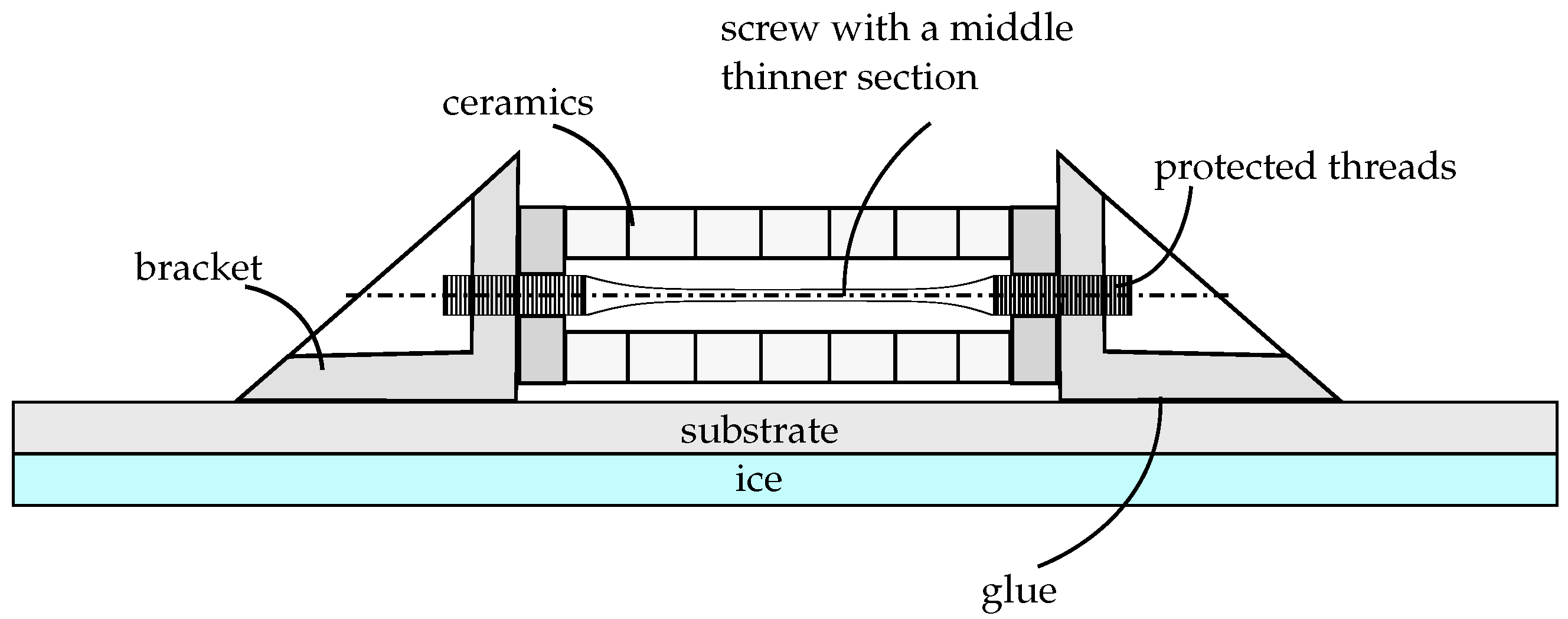
The principle of the novel architecture remains the use of a prestressed piezoelectric actuator. The actuator is made up of a stack of piezoelectric ceramics with an inner hole, and the prestress is created by a crossing screw. To reduce the stress in the threaded sections, the screw’s middle part is thinned, and the threads are removed. Thanks to this design, most of the strain and stress will be concentrated in the reduced section, lowering the stress in the threaded part. Torsional elastic energy is eliminated by prestressing the ceramics with a purely tensile stress to the screw using a tensioning device, rather than by rotating the nuts. The prestressed ceramics are then mounted on brackets that are adhesively bonded to the structure (Figure 2). An epoxy resin is used as an adhesive due to its favorable mechanical properties and low-damping characteristics [10]. In case of failure of the actuator, only the ceramics stack and the prestressing screw need to be changed.
The sizing of the system will be performed on a case study. The actuator is mounted on a plate covered with a uniform ice layer (Figure 2). This simple geometry is selected, as it enables performing a full analytical study. The properties and dimensions of the system are given in Table 1. The ceramic stack used is the PICA P-010.20H from PI Ceramics [11]. The brackets are made of aluminum to provide a good stiffness-to-mass ratio.

2.1. Geometrical Assumptions and Analytical Modal Analysis of the System

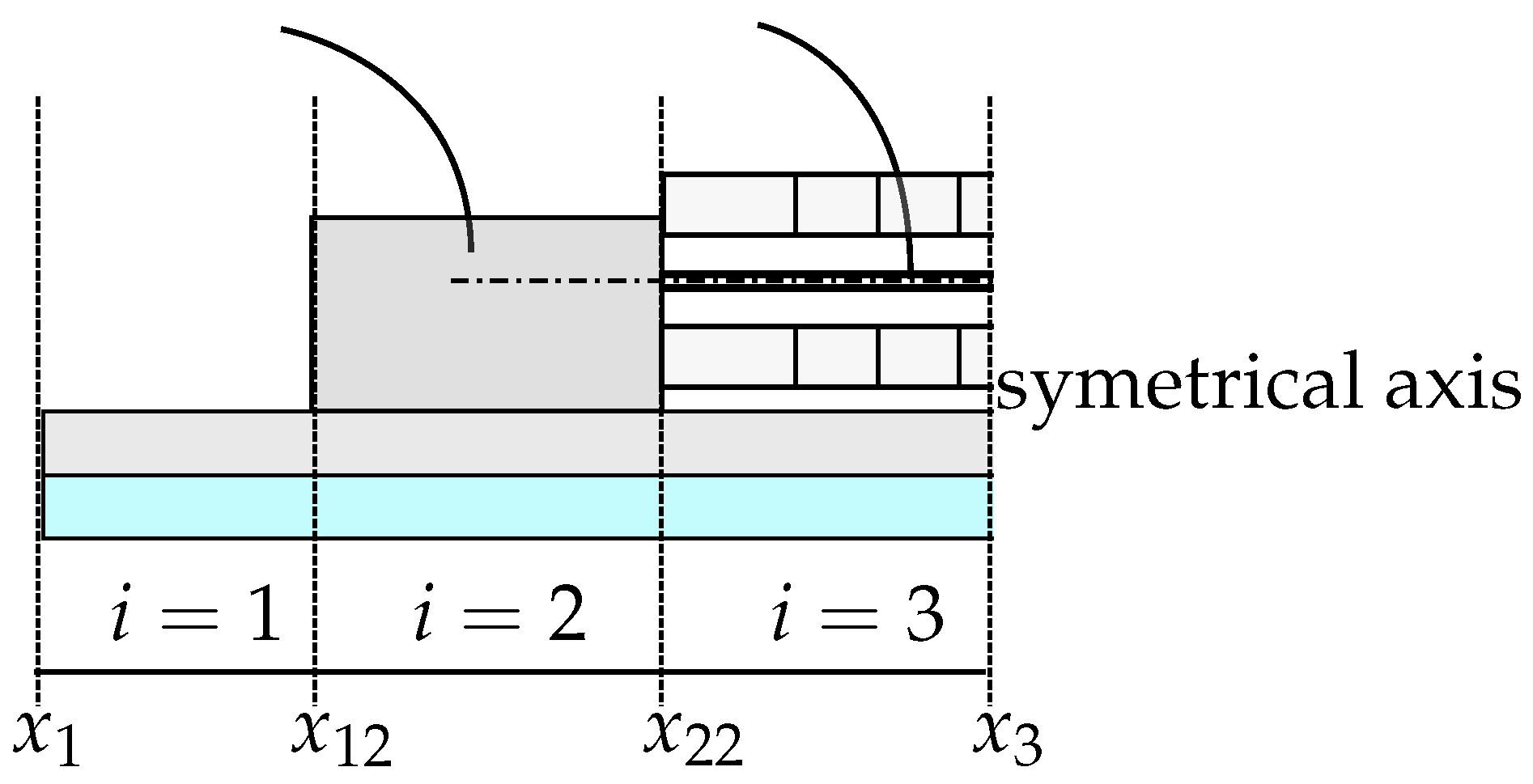
To simplify the analytical calculations, several geometrical assumptions are made and presented in Figure 3. The screw cross-section is considered constant and equal to the middle thinned section, while the triangular brackets are approximated by a constant rectangular cross-section corresponding to the average of the actual profile. Nuts are neglected, and the ceramics are assumed to be in direct contact with the brackets. The system is considered symmetric, so only the left part is analyzed.
The system is divided into three sections ( i = 1 to 3) to calculate extensional modal shapes and frequencies: i = 1 includes the plate and ice layer, i = 2 adds the bracket, and i = 3 includes the ceramics and screw. Each section is modeled as a longitudinally vibrating beam with displacement U i ( x ) = f i ( x ) sin ( ω t ) where f i ( x ) is the modal shape that represents the oscillation amplitude dependence on location x, and the sine function represents the oscillation dependence on time t. f i ( x ) can be written in the form
f i ( x ) = α i cos ( k i x ) + β i sin ( k i x )
The constant α 1 represents the amplitude at x = x 1 = 0 and will be determined later, while α 2 , α 3 , β i and k i are determined for the following boundary conditions: (i) continuity of displacements between the sections i, (ii) continuity of force between the sections i, (iii) zero deformation at the free boundary, (iv) symmetrical condition, (v) same angular frequency for the sections i.

2.2. De-Icing Criteria

The ice delamination process, as discussed in [12], can occur when the energy release rate and the interface/ice stresses exceed their critical values:
τ ( o r σ ) > τ c ( o r σ c ) , Δ S S
G = Δ E s Δ S G c
where E s is the strain energy, S the ice–substrate interface area, τ the interfacial shear stress, and σ the normal ice stress. Once a crack initiates, stress concentration ensures the stress criterion is fulfilled, so only the energy release rate criterion must remain satisfied. In practice, when the first criterion is met, the second one is usually met as well.
In addition to these classical criteria, a new inertial criterion is introduced:
c I = F I τ c S + σ c A > 1
meaning that the inertial force F I must exceed the force required to break both the interface τ c S and the ice cross-section σ c A . Considering all criteria, the de-icing process proceeds in two steps (Figure 4):
1.
Near vibration nodes, high strain energy causes initial delamination via the energy release rate criterion (Equation (3)), leaving alternating de-iced and iced regions.
2.
Remaining ice near anti-nodes experiences strong acceleration and detaches according to the inertial criterion (Equation (4)).
After the first step, the ice block subjected to inertial forces is no longer attached to the rest of the ice, so σ c A = 0 in Equation (4).
To compute the electrical voltage corresponding to these criteria, the energy release rate G ( x ) is assumed to originate mainly from the elastic energy in the ice and is calculated as follows:
G i ( x ) = 1 2 E i c e h i c e d f i d x 2
with E i c e being the Young’s modulus of the ice and h i c e its thickness. For position x around a vibration node such that G i ( x ) > G c , the area is considered to be de-iced.
The inertial force F I of an ice block is given by
F I = ρ i c e h i c e ω 2 b a b i c e f i ( x ) · d x
with ρ i c e being the ice’s density and b i c e its width. Positions a and b are located around a vibration anti-node with high acceleration, as shown in Figure 4. Equations (5) and (6) depend on the constant α 1 , which is calculated to satisfy Equations (3) and (4).

2.3. Actuator Sizing Criteria

The actuator sizing is governed by the capability of the materials to generate the vibrations required for de-icing and the electrical voltage that powers the actuator. The supply voltage is constrained both by the maximum voltage rating of the power source and by the depolarization threshold of the piezoelectric ceramics. Excessive voltage may induce depolarization of the ceramics, resulting in a degradation of performance or even in the complete loss of actuation capability. Moreover, the induced deformation generates tensile stresses within the ceramics. These stresses are compensated by the prestressing screw. However, the resulting stress in the screw must remain below its elastic limit. Finally, owing to the reduced cross-sectional area in the central part of the screw, the stress in the threaded regions remains sufficiently low to neglect fatigue effects. The exciting force F e to be developed by the actuation system at resonance at position x = x 22 can be calculated using the elastic strain energy of the structure:
F e = 1 f ( x 22 ) Q m i = 1 i = 3 E i A i x b x a d f i d x 2 · d x
where Q m is the mechanical quality coefficient of the excited mode. x b x a represents the interval of the section i. The electrical voltage U e to produce the force depends on the force factor N of the actuation system that can be computed using modal analysis, and is given by
U e = F e N
The total stress in the screw σ s , t can be calculated as the sum of σ s , v i b , the vibratory stress in the screw, and σ s , p s , the prestress in the screw:
σ s , v i b = E s c r e w · d f 3 d x
σ s , p s = σ p z t , p s · A c e r a m i c s A s c r e w
with σ p z t , p s being the prestress in the ceramics. As the piezoelectric ceramics are fragile in tensile stress but not in compression, the value of the needed prestress to avoid the failure due to the tensile stress is chosen to be equal to the vibratory stress of the ceramics σ p z t , v i b :
σ p z t , p s = σ p z t , v i b = E c e r a m i c s · d f 3 d x
According to Equations (7) and (8), to minimize U e , the mechanical quality factor Q m , the force factor N and the displacement of the ceramics f 3 ( x 22 ) must be maximized. However, to limit the stress in the ceramics and in the screw, the strain d f 3 d x , and consequently the displacement f 3 ( x 22 ) , must be minimized. This displacement must then be optimized according to the requirements.

2.4. Design Results

Combining the previous equations allows a rapid evaluation of the de-icing capability of a given configuration. This section examines the influence of bracket length and modal rank. The following parameters are considered: G c = 0.5 J · m 2 , σ c = 1 MPa , τ c = 0.5 MPa , Q m = 50 and N = 1 N · V 1 .
The supply voltage U e and total screw stress σ s , t serve as comparison criteria, and each configuration is evaluated based on its ability to achieve full de-icing. For a given amplitude α 1 , the energy release rate criterion (Equation (3)) is computed along x to identify de-iced and residual iced regions (Figure 4), which are then assessed using the inertial criterion (Equation (4)). The amplitude is iteratively adjusted to find the minimum value enabling complete de-icing. This amplitude is then used to calculate the corresponding voltage (Equation (8)) and screw stress (Equations (9) and (10)). In this section, limit values for voltage and stress are not considered, but they will be taken into account in the experimental tests. Results for different bracket lengths, going from 20 mm to 70 mm, and for the first and third natural modes have been evaluated. For the first mode, long brackets reduce the required amplitude α 1 and the driving voltage U e , but raise the resulting stress σ s , t . By contrast, in the third mode, long brackets amplify all three quantities— α 1 , U e and σ s , t —although their values remain lower than in the first mode.
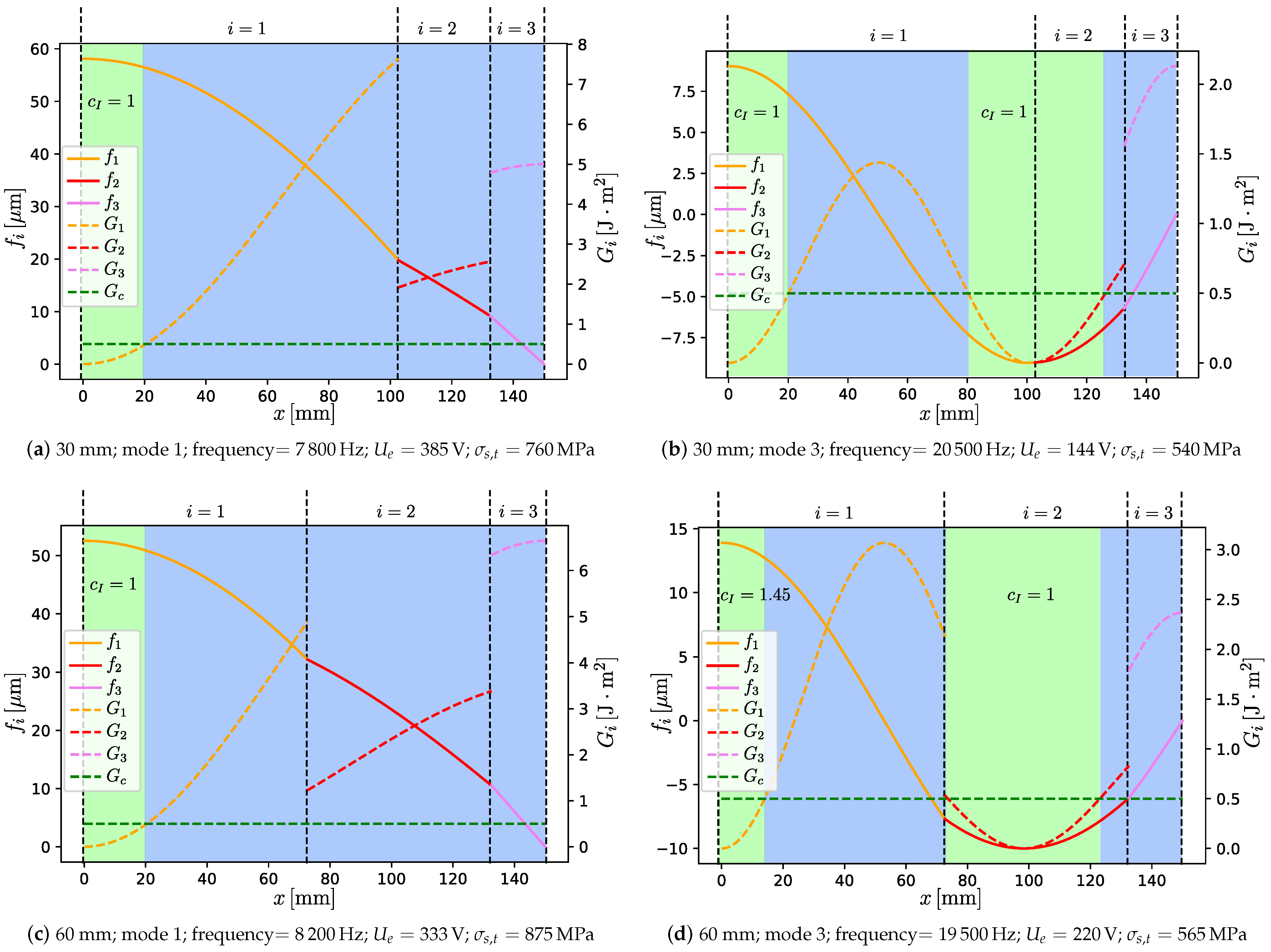
To clarify the effect of the configuration on de-icing performance, Figure 5 shows the modal shape f i ( x ) and the corresponding energy release rate G i ( x ) for both modes and for bracket lengths of 30 mm and 60 mm.
The third mode, due to its higher frequency and shorter wavelength, requires a lower amplitude than the first mode to generate sufficient strain d f i d x and acceleration ω 2 f i ( x ) to satisfy both the energy release rate criterion (Equation (3)) and the inertial criterion (Equation (4)). According to Equations (Equation (7)) and (8), the supply voltage is also lower for the third mode because, relative to the total energy stored in the system i = 1 i = 3 E i A i x b x a d f i d x 2 · d x , the displacement f 3 ( x 22 ) is larger in the third mode than in the first.
For the first mode, G i ( x ) , is more uniform with a 60 mm bracket length (Figure 5c) than with 30 mm (Figure 5a), particularly in section i = 2 , where G 2 ( x ) is much lower for 30 mm. The higher natural frequency with a 60 mm bracket length also improves de-icing via the inertial criterion, explaining the larger required amplitude for 30 mm. For the third mode with a 60 mm bracket length (Figure 5d), the displacement f i ( x ) at the anti-node at x = 100 mm is smaller than at x = 0 , so a higher amplitude is needed to generate sufficient acceleration ω 2 f i ( x ) to de-ice this zone. This explains why, for the third mode, shorter bracket lengths reduce the required amplitude: the regions governed by the inertial criterion then have similar displacement amplitudes.
This analysis highlights the significant impact of the modal rank and component geometry. For this study case, with the material and geometrical parameters listed in Table 1, regarding only the required supply voltage U e and stress in the screw σ s , t , the better configuration would be a combination of the third mode with a small bracket length.

3. Results and Discussion

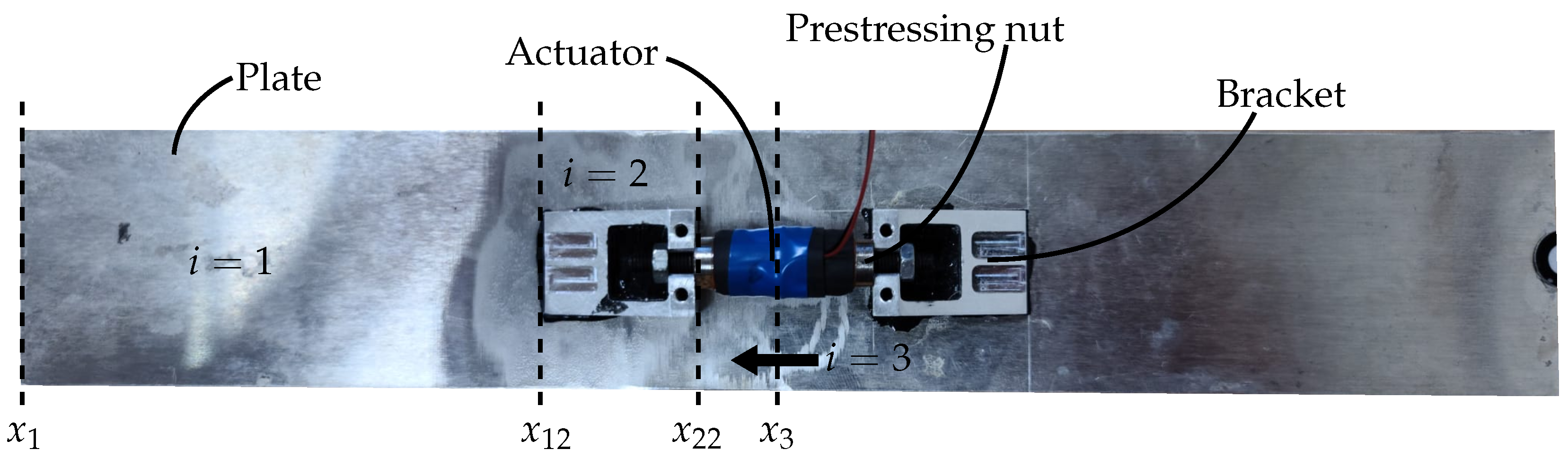
For the experimental tests, only one bracket length will be evaluated due to manufacturing constraints. A length of 30 mm has been selected. Natural modes 1 and 3 will be investigated, corresponding to the configurations shown in Figure 5a,b. The PICA P-010.20H actuator is mounted on the brackets, which are adhesively bonded to the plate (Figure 6).

3.1. Experimental Characterisation

For both modes, the force factor N and the mechanical quality coefficient Q m were measured using a laser vibrometer. For mode 1, the measured frequency is 7.5 kHz, N = 0.8 N · V 1 , and Q m = 50 , while for mode 3, the frequency is 20 kHz, N = 1 N · V 1 , and Q m = 30 . Based on these values, the required voltage for the first mode is U e = 482 V . However, the maximum voltage available during the experiment is U e max = 300 V . At this voltage, complete de-icing of the plate cannot be achieved: with a vibratory amplitude of α 1 = 40 μ m , the inertial criterion Equation (4) is not met, leaving the plate extremities iced. This limitation is not problematic, as the objective of this experimental campaign is to validate the analytical model; therefore, the absence of de-icing at the extremities under this voltage would still confirm the model’s predictions. There is no such difficulty for the third mode, as the required voltage to de-ice the whole substrate is U e = 250 V , leading to a vibratory amplitude of α 1 = 9 μ m .

3.2. Experimental Results

For the experimental tests, the plates were suspended vertically using a string, reproducing the free boundary conditions assumed in the analytical model. De-icing experiments were performed for the first and third natural modes, with applied voltages of U e = 300 V and U e = 250 V , respectively.
For the third mode, the entire plate was instantaneously de-iced at the predicted voltage U e = 250 V .
For the first mode, the de-icing test at U e = 300 V resulted in one extremity of the plate remaining iced, as expected from the analytical prediction. Unexpectedly, the opposite extremity was de-iced, which may be attributed to non-uniformities in ice accretion. A second de-icing attempt was performed at U e = 300 V to try to remove the remaining ice. A new modal calculation with no ice was performed and demonstrated that the global stiffness of the system was reduced compared to the iced configuration and that the resulting vibratory amplitude for 300 V had increased to α 1 = 50 μ m . With this amplitude, the inertial criterion Equation (4) was calculated for the remaining ice and indicated that the residual ice should be removed, which was observed in practice.

4. Conclusions

This work introduces a novel prestressed piezoelectric actuator and an analytical sizing methodology based on multi-beam longitudinal vibrations, including a new inertial-based de-icing criterion explaining why anti-node regions can be efficiently de-iced despite minimal strain energy. Key design constraints such as supply voltage and mechanical stresses are incorporated, enabling realistic system optimisation.
Applied to a plate fully covered with ice tested for extensional modes of ranks 1 and 3, the analysis highlights the strong influence of actuator geometry and mode rank selection: the third mode is more effective than the first, reducing voltage requirements and enhancing inertial ice removal. Experimental tests on two configurations confirm the predictions, with the third mode achieving complete de-icing, while the first mode requires a second excitation to remove residual ice, consistent with the model.
The results are sensitive to the quality of the assembly, interface continuity, and variations in the ice layer properties (thickness, stiffness, and density), which may vary between experiments. Further experimental investigations of different geometries, ice thicknesses, and vibration modes are required to assess the repeatability and validity of the proposed model.

Author Contributions

Conceptualization, Y.S., V.P.-B. and M.B.; methodology, Y.S., V.P.-B. and M.B.; software, Y.S.; formal analysis, Y.S.; investigation, Y.S.; data curation, Y.S.; writing—original draft preparation, Y.S.; writing—review and editing, Y.S., V.P.-B. and M.B.; supervision, V.P.-B. and M.B. All authors have read and agreed to the published version of the manuscript.

Funding

This research received no external funding.

Institutional Review Board Statement

Not applicable.

Informed Consent Statement

Not applicable.

Data Availability Statement

No new data were created or analyzed in this study.

Conflicts of Interest

The authors declare no conflicts of interest.

References

  1. Goraj, Z. An Overview of the De-Icing and Anti-icing Technologies with Prospects for the Future. In Proceedings of the 24th International Council of the Aeronautical Sciences, Paris, France, 24–28 August 1964. [Google Scholar]
  2. Palanque, V.; Planès, T.; Valérie, P.B.; Marc, B.; Scott, D. Piezoelectric resonant ice protection systems—Part2/2: Benefits at aircraft level. Chin. J. Aeronaut. 2024, 37, 50–63. [Google Scholar] [CrossRef]
  3. Budinger, M.; Pommier-Budinger, V.; Reysset, A.; Palanque, V. Electromechanical Resonant Ice Protection Systems: Energetic and Power Considerations. AIAA J. 2021, 59, 2590–2602. [Google Scholar] [CrossRef]
  4. Rafik, Y.; Budinger, M.; Pommier-Budinger, V.; Polaert, H. A structured panorama of electromechanical ice protection systems. In Proceedings of the International Workshop on Atmospheric Icing of Structures, Narvik, Norway, 18–21 June 2024. [Google Scholar]
  5. Gastaldo, G.; Rafik, Y.; Budinger, M.; Pommier-Budinger, V.; Olivier, P.; Navarro, P. Proposition of a new qualification impact test for aerospace smart structures. In Proceedings of the 33rd International Council of the aeronautical Sciences, Stockholm, Sweden, 4–9 September 2022. [Google Scholar]
  6. Budinger, M.; Pommier-Budinger, V.; Napias, G.; Costa Da Silva, A. Ultrasonic Ice Protection Systems: Analytical and Numerical Models for Architecture Tradeoff. J. Aircr. 2016, 53, 680–690. [Google Scholar] [CrossRef]
  7. Moasca, F.; Clement, S.; Aubry, A. Système de Dégivrage pour une Pièce Mécanique, Comprenant au Moins un Actionneur Piézoélectrique. France Patent 3135449.
  8. Andre, A. New Electromechanical Resonant Ice Protection System for Regional Aircraft. In Proceedings of the International Conference on Icing of Aircraft, Engines, and Structures, Vienna, Austria, 20–22 June 2023; SAE: Warrendale, PA, USA, 2023. [Google Scholar]
  9. Valerian, P. Design of Low Consumption Electro-Mechanical De-icing System. Ph.D. Thesis, Institut Supérieur de l’Aéronautique et de l’Espace, Toulouse, France, 2022. [Google Scholar]
  10. Adams, R.D.; Cooper, D.G.A.; Pearson, S. Vibration Damping of Adhesively Bonded Joints. In Handbook of Adhesion Technology; Da Silva, L.F.M., Öchsner, A., Adams, R.D., Eds.; Springer: Berlin/Heidelberg, Germany, 2011; pp. 765–786. [Google Scholar] [CrossRef]
  11. P-010.xxH–P-025.xxH PICA Thru Ring Actuators. Available online: https://www.piceramic.com/en/products/piezoceramic-actuators/stack-actuators/p-010xxh-p-025xxh-pica-thru-ring-actuators-102800 (accessed on 17 November 2025).
  12. Stendardo, L.; Gastaldo, G.; Budinger, M.; Pommier-Budinger, V.; Tagliaro, I.; Ibáñez-Ibáñez, P.F.; Antonini, C. Reframing ice adhesion mechanisms on a solid surface. Appl. Surf. Sci. 2023, 641, 158462. [Google Scholar] [CrossRef]
Figure 2. Prestressed actuator mounted on brackets adhesively bound on a plate covered by ice.
Engproc 133 00080 g002
Figure 3. Scheme of the actuator on the structure with the geometrical assumptions.
Engproc 133 00080 g003
Figure 4. De-icing process, ice delaminated according to the energy release rate criterion Equation (3) near the vibration nodes, and according to the inertial criterion Equation (4) near the anti-nodes.
Engproc 133 00080 g004
Figure 5. Modal shape f i ( x ) and energy release rate G i ( x ) for the first mode with bracket lengths of 30 mm (a) and 60 mm (b), and the third mode with bracket lengths of 30 mm (c) and 60 mm (d). The blue zones are decided with the energy release rate criterion, where G i ( x ) > G c , and the green zones by the inertial criterion c I > 1 .
Engproc 133 00080 g005
Figure 6. Prototype of the prestressed actuator fixed on a plate with two brackets.
Engproc 133 00080 g006
Table 1. Geometry and material properties.
Young’s Modulus
E [MPa]
Density
ρ [kg · m 3 ]
Section
A [mm2]
Length
L [mm]
Width
b [mm]
Thickness
h [mm]
Aluminum plate71,000280050300501
Ice layer9000900100300504
Ceramics35,00078005924//
Steel screw210,00078501.834//
Brackets71,000280080///
Disclaimer/Publisher’s Note: The statements, opinions and data contained in all publications are solely those of the individual author(s) and contributor(s) and not of MDPI and/or the editor(s). MDPI and/or the editor(s) disclaim responsibility for any injury to people or property resulting from any ideas, methods, instructions or products referred to in the content.