Proceeding Paper

Improving Flexibility in Modular Space Robots: An Adapter to Connect a Research-Related Electromechanical Interface with a Commercial One †
by
Jonas Benz
*,
Hilmi Dogu Kücüker
,
Wiebke Brinkmann
,
Mehmed Yüksel
,
Utku Akinci
and
Jonas Eisenmenger
German Research Center for Artificial Intelligence (DFKI) GmbH, 28359 Bremen, Germany
*
Author to whom correspondence should be addressed.
Presented at the 15th EASN International Conference, Madrid, Spain, 14–17 October 2025.
Eng. Proc. 2026, 133(1), 76; https://doi.org/10.3390/engproc2026133076
Published: 7 May 2026

Abstract

With the increasing number of space research projects, systems that can be flexibly adapted to the respective orbital and planetary mission requirements and modified retrospectively as needed are becoming increasingly interesting. One application for this is modular robot systems that can be combined or exchanged as needed via electromechanical interfaces without having to replace the entire system. Due to current activities in the EU, such as the Space USB project, the trend is going towards the development of a universal standard interface (USI) that, among other things, has functions for mechanical coupling and the transmission of electrical energy and data. To be able to couple different USIs with each other, one possible solution will be the use of an adapter. This paper presents such an adapter, as well as tests that have been carried out and the lessons learned from them.

1. Introduction

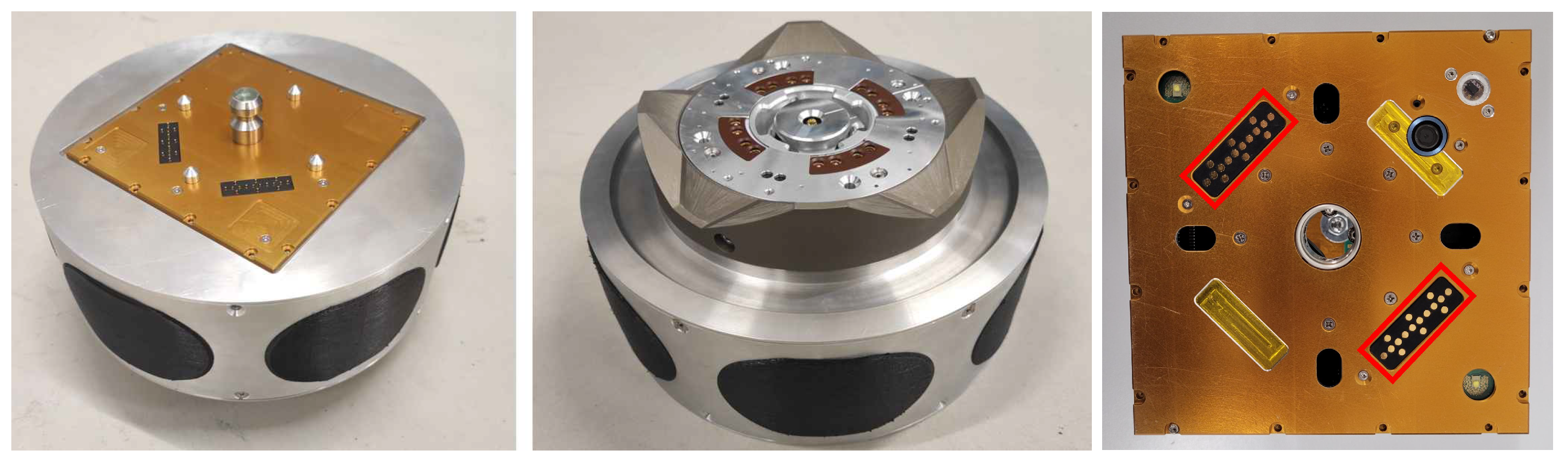
In space applications, the primary goal is to extend the operating life of space systems while maximizing their functionality to optimize resource utilization. This can be achieved through modular design and the integration of subsystems that are essential for system functionality. This also simplifies maintenance and repair by enabling module replacement. This approach is essential for future On-Orbit Servicing (OOS) operations, which enable inspection, repair, refueling, and life extension of spacecraft, as well as for In-Space Assembly and Manufacturing (ISAM), which supports the construction, reconfiguration, and production of large-scale structures directly in space. Thus, it is possible to increase the mission capability of a system in orbit or on a planet by re-configuring it. Such approaches were considered in the development of the modular toolbox in MODKOM [1]. At the heart of it all is a multifunctional interface that allows modules (provided they are equipped with a multifunctional interface) to be connected to each other, thereby enabling the required systems to be built. Multifunctional interfaces suitable for use in orbit are currently being developed worldwide for various scientific and commercial objectives [2,3]. It can be assumed that different multifunctional interconnects will be used in space in the future. To ensure interoperability, adapters will be necessary to connect the different multifunctional interconnects with each other. Such complex adapter solutions for space applications do not yet exist. This paper presents one such solution as well as the conducted tests to verify its functionality under laboratory conditions. It also highlights the challenges of combining different dimensions of the interfaces, data compatibility, electrical transfer, etc., in one adapter. For the presented adapter, the multifunctional interfaces, the EMI-MOD [4], which is developed by the DFKI for scientific applications, and the iSSI® from iBOSS GmbH (Aachen, Germany) [5], as an example for a commercial off-the-shelf product, are used; see Figure 1.

2. Adapter Design Approach and Test Methodology

This section describes the design of the adapter and the experiments conducted.
Both EMI-MOD and iSSI® interfaces consist of two complementary interconnects, named Active and Passive throughout the article. Active parts mean parts that are able to have control over all interfacing operations, including coupling/decoupling mechanisms, enabling/disabling data transfer, and power transmission. Passive parts are designated as payloads that are operated by Active parts.

2.1. Adapter Design

The adapter design suggests three sections for the operation, which are Host, Adapter, and Payload. Payload contains arbitrary instruments for the mission and is designated to be operated by the Host, through the Adapter. The system requirements for the Adapter are given in Table 1, which illustrates the desired behavior of the adapter throughout the operation.
All adapter components are contained in a cylindrical housing with 250 mm diameter and 120 mm height. The cylindrical housing and the components for mechanical integration of the interfaces were milled from aluminum–magnesium alloy. For weight reduction, there are recesses on the side, which are sealed with 3D-printed parts for testing, which brings the total mass to 3.98 kg. The EMI-MOD Passive interface on the top side of the adapter meets requirement MECH-01, while the iSSI Active interface on the bottom side fulfills MECH-02; both are shown in Figure 1 and listed in Table 1.
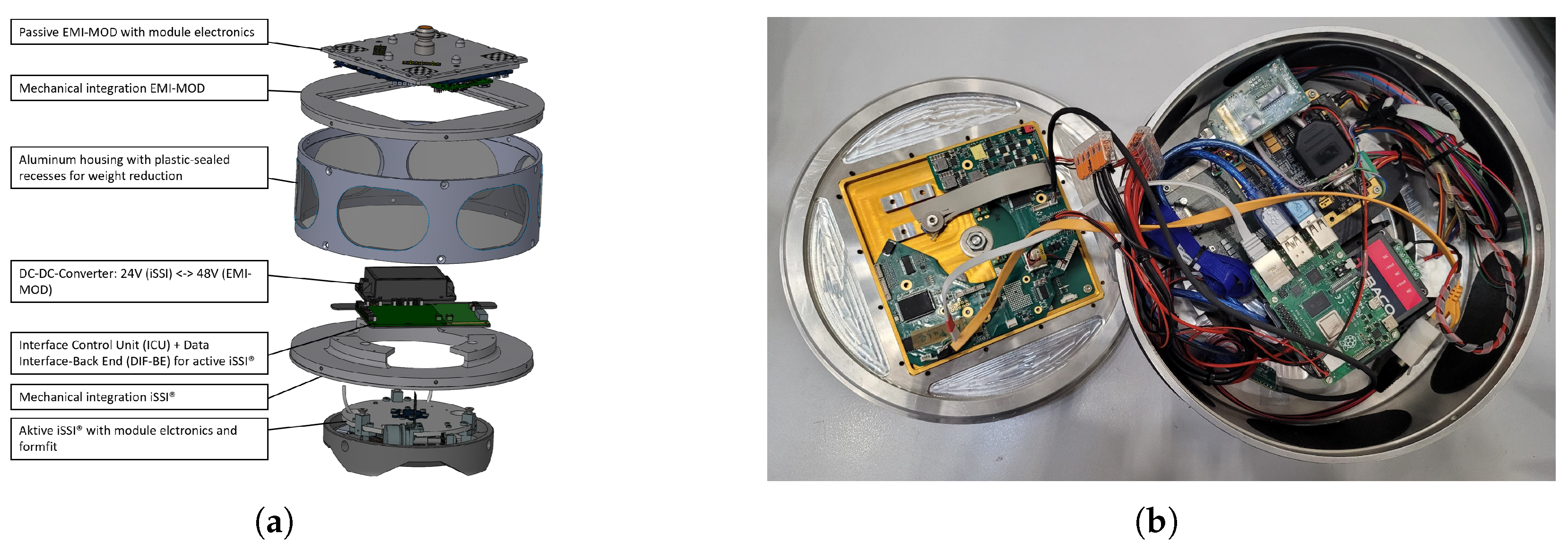
The adapter electronics contains a controller unit (CU) which is responsible for receiving commands from the Host through Ethernet to control Active iSSI® via the CANBUS interface, with a 48 V to 24 V power converter to satisfy ELEC-01in Table 1, and an Ethernet switch to provide Ethernet communication to the Host, Payload, and controller unit at the same time. In addition to electromechanical interconnect, Active iSSI® contains an interface control board for managing the motor and encoder located on the interconnect, interfacing optical communication between iSSI® interconnects to both Ethernet and CANBUS. The adapter CAD design and electronics integration are shown in Figure 2.

2.2. Adapter Test Methodology

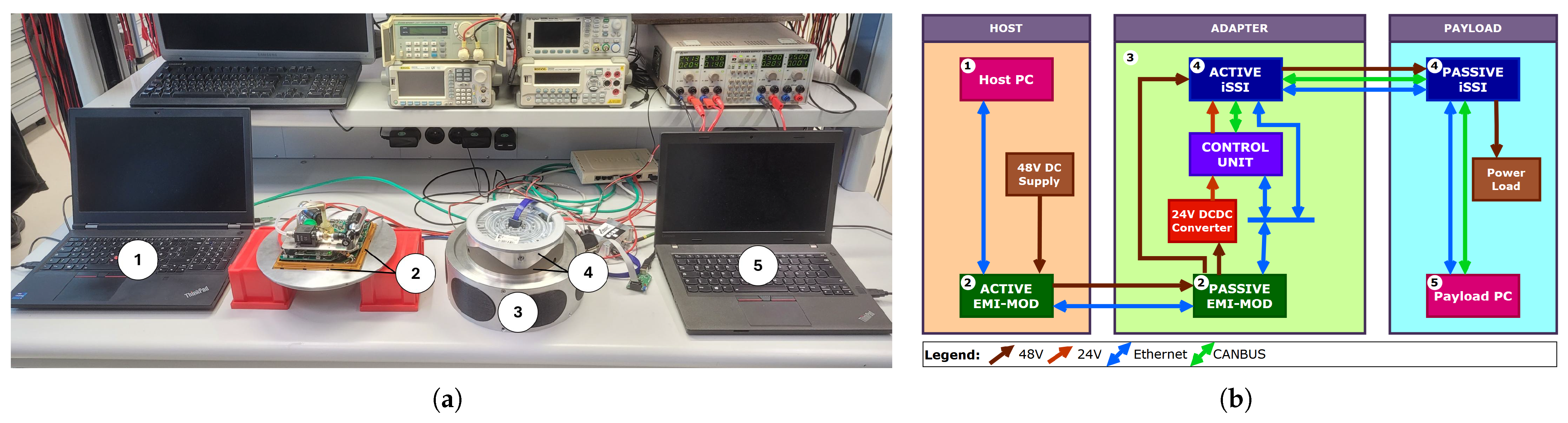
For verification and validation of the system requirements given in Table 1, a test bench has been set up. The overall integrated test setup is given in Figure 3a and the corresponding block diagram is shown in Figure 3b. For the convenience of verification processes, the adapter has been divided into two sides, with one side containing EMI-MOD Passive coupled with EMI-MOD Active and the other side containing the control unit with iSSI® Active coupled with iSSI® Passive. As Table 1 suggests, the test methodology comprises testing functional, mechanical, electrical, and communication aspects of the adapter.

2.2.1. Functional Capabilities Tests

As the first step, Host PC (indicated as (1) in Figure 3a) executes the application for operating the EMI-MOD interface through NDLCom (https://robotik.dfki-bremen.de/en/research/softwaretools/ndlcom, accessed on 28 April 2026) protocol over Ethernet. To verify FUNC-01 in Table 1, Active EMI-MOD operated by Host PC coupled and decoupled Passive EMI-MOD (shown as (2) in Figure 3a) on the adapter side twenty times to test repeatability of the process. Then, the Host PC was able to open a Secure Shell (SSH) Session to operate the CU inside the adapter remotely (shown as (3) in Figure 3a), which operates iSSI® Active.
For the verification of FUNC-03 in Table 1, after opening the SSH session, the Host PC executes couple/decouple commands on iSSI® interfaces twenty times (shown as (4) in Figure 3a) in order to test repeatability of the cycle as well. The results have been logged for further evaluation.

2.2.2. Power Transmission

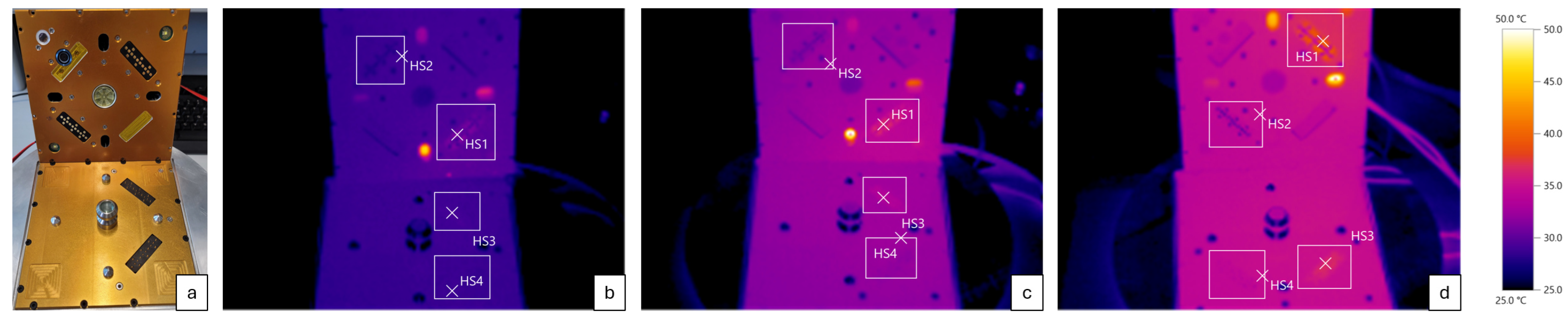
This experiment aims to verify ELEC-02 in Table 1, as well as thermal aspects of power transmission, using the test setup in Figure 3a. For realistic mission scenarios, the adapter is expected to transmit higher currents over a longer period of time. For power transmission purposes, EMI-MOD utilizes Yokowo contact blocks, with the model numbers S-J-6717XG-16-375-0000 (Male) and S-J-2600XG-16-375-0000 (Female) (https://www.yokowoconnector.com/, accessed on 28 April 2026) in Figure 1, which are designed for a nominal operating current of 2 A, which brings the question of durability in higher current flows. Therefore, an important aspect to consider is the heat generation during current flow, which was assessed by measuring the heat generation during the current loads using the TESTO 875-1i thermal camera (https://www.testo.com/de-DE/testo-875-1i/p/0563-0875-V1, accessed on 28 April 2026) to monitor and evaluate local thermal hotspots on the contact surface and mating pads. For this test phase, the current load values were selected as 5 A, 8 A, and 10 A, in order to observe incremental thermal behavior under different current loads.
First, EMI-MOD was exposed to 5 A continuous current load from the Host side. The pictures were taken by a thermal camera after durations of 5 min, 10 min, and 20 min. Then, after cooldown, the same process was applied with 8 A and 10 A. The output images were saved for further evaluation and assessment.
Second, after each step was taken in the heat generation tests, power delivery from the Host to Payload was tested as well on the setup given in Figure 3 to verify ELEC-02. For this purpose, the power transmitted from the 48 V supply on the Host side was measured on the Payload side with the power load, as indicated in Figure 3b).

2.2.3. Data Transmission

The main purpose of this section is to verify COMM-01 and COMM-02 in Table 1, conducting the experiment through the setup in Figure 3a. Throughout this experiment, the iperf3 (https://iperf.fr/, accessed on 28 April 2026) toolkit was utilized for the measurement of communication speed along the adapter and SSH was used to access the controller unit from the Host PC. The results have been logged for further evaluation.
At first, the ‘Host PC ↔ EMI MOD ↔ Adapter CU‘ connection ((1), (2), and (3) in Figure 3a) was tested to verify the EMI-MOD Ethernet data transmission capability. For this test, Host PC ((1) in Figure 3a) ran the iperf3 server and the controller unit (inside (3) in Figure 3a) ran the iperf3 client to complete the speed measurement setup.
Secondly, the ‘Adapter CU ↔ iSSI® ↔ Payload PC‘ connection ((3), (4), and (5) in Figure 3a) was tested to verify the iSSI® Ethernet data transmission capability. This time, Payload PC ((5) in Figure 3a) ran the iperf3 server and the controller unit (inside (3) in Figure 3a) ran the iperf3 client to complete the speed measurement setup.
Finally, ‘Host PC ↔ EMI MOD ↔ Adapter CU ↔ iSSI® ↔ Payload PC‘ was tested to verify the Ethernet data transmission capability for the whole adapter. Host PC ((1) in Figure 3a) ran the iperf3 server and Payload PC ((5) in Figure 3a) ran the iperf3 client to complete the speed measurement setup.

2.2.4. Mission Scenario Campaign

In this section, an experiment was conducted in order to verify the overall capabilities of the adapter in a realistic mission scenario. According to the scenario, the experiment steps are:
  • Host PC connects to the Base Station and then the Manipulator Arm of the MODKOM project [1], which contains EMI-MOD Active as an end-effector.
  • The Manipulator Arm couples with EMI-MOD Passive on the adapter by taking the necessary pose being controlled through Host PC.
  • Host PC connects to the controller unit inside the adapter through SSH.
  • The Manipulator Arm takes the pose to couple with iSSI® Passive on the Payload setup by taking the necessary pose being controlled through Host PC.
  • The adapter couples with iSSI® Passive.
  • Host PC runs the iperf3 server and Payload PC runs the iperf3 client to measure and verify data transmission capability as a whole.

3. Results

This section presents the results of the tests and experiments defined in Section 2.2.

3.1. Functional Capabilities

These tests are intended to demonstrate the basic functionality of the adapter, which includes the coupling/decoupling process of the EMI-MOD at first, and then the coupling/decoupling process of the iSSI®. The average couple/decouple durations for both adapter interconnects are given in Table 2, which were taken from twenty consecutive couple/decouple cycles.

3.2. Power Transmission

This subsection shows the results of the heating through different current strengths on the surface of the EMI-MOD contact blocks. Because of the gendered architecture of EMI-MOD, seen in Figure 1, which allows coupling in every 90° position, there is always only one contact block from Active EMI-MOD connected to one interface block from Passive EMI-MOD, when EMI-MOD is coupled. Interface blocks heat up gradually at higher currents. Maximum values are due to reflections at the openings of the guide pins of the Active EMI-MOD; temperatures at these points are significantly lower in reality. Thermal images taken in Section 2.2.2 are shown in Figure 4, with their investigated areas being HS1, HS2, HS3, and HS4. These areas are located on the contact blocks of the Active and Passive EMI-MOD, whereby the areas HS1 and HS3 contain contact blocks connected during the tests, so the current was transmitted, while the areas HS2 and HS4 include contact blocks which were isolated and did not transmit any current.
Their respective maximum measured temperatures on contact blocks are given in Table 3. In addition, the Active EMI-MOD electronics heat up to 88.9 °C at 10 A.
As for the power transmission tests, the power load on the Payload side in Figure 3b shows 48 V being exactly equal to the power supply voltage at the Host side in Figure 3b, with negligible internal resistance.

3.3. Data Transmission

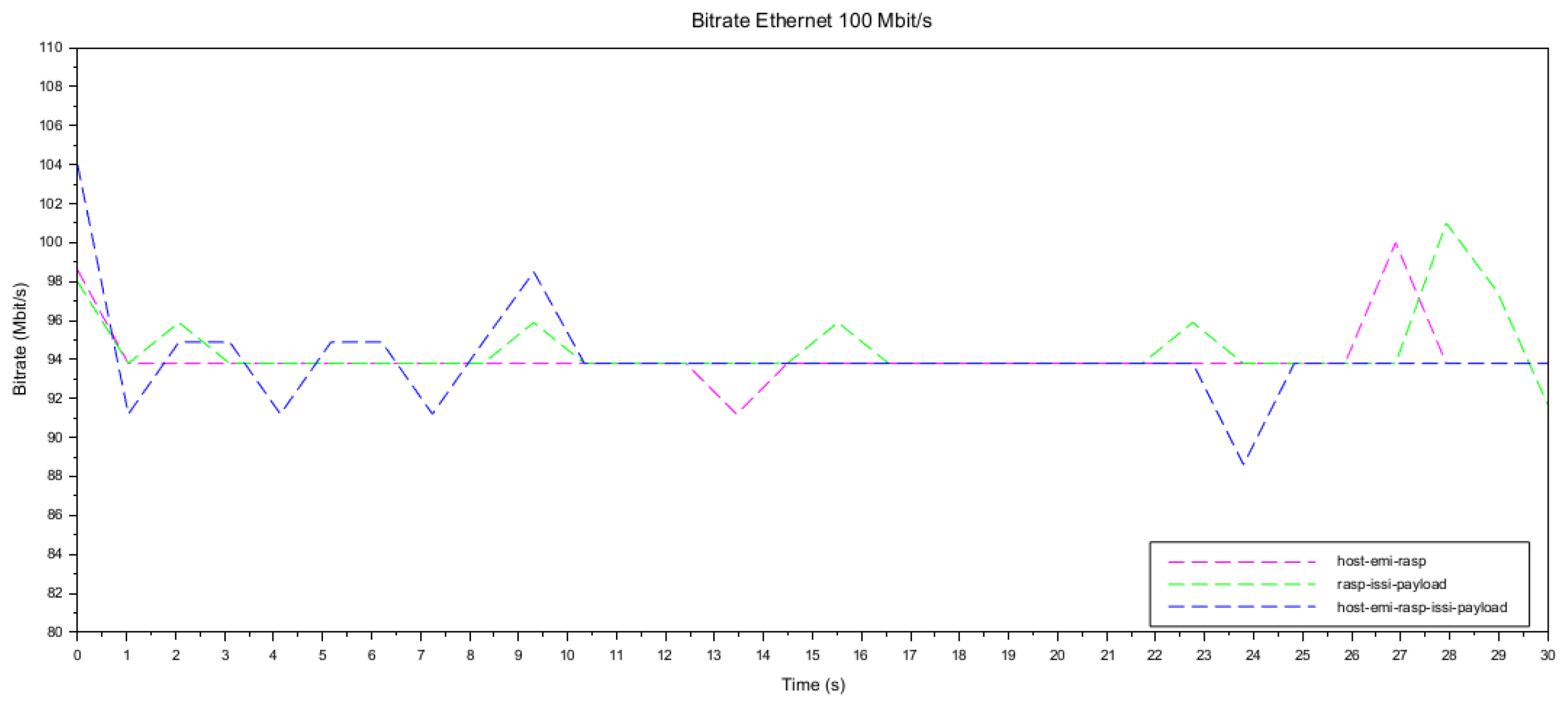
To evaluate the data transfer function, three different scenarios are tested. The results can be seen in Figure 5.
The first test for the circuit ‘Host-EMI-MOD-Adapter CU‘ shows a nominal speed of 91.2–100.0 Mbit/s, with a bitrate of 93.8 Mbit/s being achieved most of the time. It remains stable in this range, with few upward and downward spikes, as can be seen in the magenta-colored graph of Figure 5. The second test in the circuit ‘Adapter CU-iSSI-Payload Unit‘ shows a similar data transfer rate, within 91.7–101.0 Mbit/s (compare to the green graph), with a relative constant bitrate of 93.8 Mbit/s as in the previous test. The final test shows similar results to the previous tests, with a bitrate range of 88.6–104 Mbit/s (compare to the blue graph), whereby a bitrate of 93.8 Mbit/s is achieved most of the time.

3.4. Mission Scenario Campaign

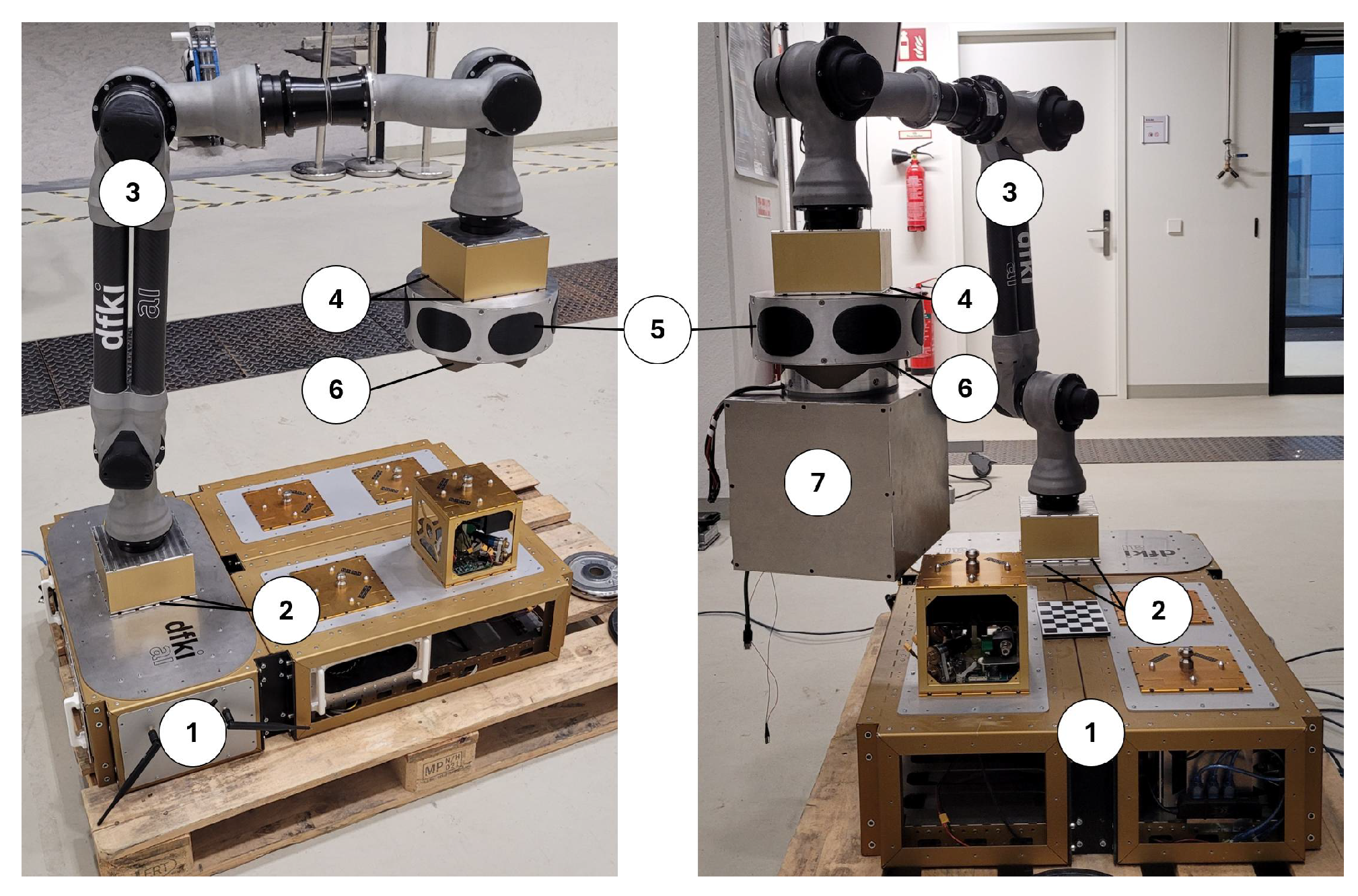
In the mission scenario campaign, the base station (1) in Figure 6 serves as the central platform to control the operation. The operating Manipulator Arm (3) in Figure 6 is docked on the base station via EMI-MOD (2) in Figure 6. The end-effector of the Manipulator Arm is also coupled via EMI-MOD (4) in Figure 6 to the adapter (5) in Figure 6, with Active iSSI® (6) in Figure 6 on the other side. At least the Payload module with Passive iSSI® integrated (7) in Figure 6 is coupled to the adapter and the Manipulator Arm moves freely within its limits in various positions, whereby the connection to the adapter could be maintained.

4. Discussion

The following section discusses and classifies the results from Section 2.2. Table 4 shows that all the requirements listed in Table 1 are fulfilled with the test procedure given in Section 2.2.
Both the EMI-MOD and the iSSI® could be integrated mechanically into the adapter with the controller unit by design, which fulfills MECH-01, MECH-02, and FUNC-02.
The electronic requirements (ELEC-01 and ELEC-02) could also be fulfilled by the functional activation of both Active interfaces within the whole chain. The closing and opening speed, for both EMI-MOD and iSSI®, showed no necessary difference. The power transmission tests showed a raising heating with higher current strength, but only approx. 8 °C for 10 A which is five times higher than recommended by the manufacturer, over 20 min of continuous operation. The investigation of the iSSI® surface under the same conditions did not show any significant thermal anomaly, so the heating of the EMI-MOD electronics up to nearly 90 °C for 20 min of continuous operation is not a source of obstruction in operation, since the electronics are designed for these temperatures, but should be investigated in more detail for future applications. The overall heating of the surface of the EMI-MOD during the test series may be the result of cumulative effects, as the tests were carried out consecutively. Although the contacts were cooled between tests with different current strengths, the surface of the EMI-MOD was not.
The functional requirements (FUNC-01, FUNC-03) are satisfied in the results of Section 3.1, which indicates reliable operation of the adapter. Moreover, the adapter is proven to work in realistic mission scenarios (FUNC-04) in Section 3.4 and provides the required communication interface during the operation, which satisfies COMM-01and COMM-02. As for the data transmission, since Ethernet communication is undertaken through two pairs, the maximum reachable throughput is 100 Mbit/s. The resultant Ethernet throughput of 93.8 Mbit/s is the result that can be expected from Ethernet cables, which means the adapter might function as a cable replacement in means of communication throughout the operation.

5. Conclusions and Outlook

The successful tests prove the basic functionality of the adapter under laboratory conditions, which leads to a TRL 4 level. For reaching higher TRL, the adapter should be prepared for environmental tests like thermal vacuum, Electro-Magnetic Compatibility (EMC), and vibration tests. In particular, the 3D-printed parts and the housing should be investigated from a mechanical point of view and for shielding the electronics from negative effects. The adapter should be able to deal with bigger bandwidths like 100 Mbit/s; therefore, a more intelligent CU like the Raspberry Pi 4B could be implemented. Overall, the successful integration of the adapter in a complete setup with a Manipulator Arm on a base station shows potential for further development.

Author Contributions

J.B., H.D.K., W.B., M.Y., U.A. and J.E. contributed to the work equally. It is a joint work. All authors have read and agreed to the published version of the manuscript.

Funding

This research was funded by the Federal Ministry for Economic Affairs and Climate Action (BMWE) under grant 50RA2107. Partially supported by the German Federal Ministry of Research, Technology and Space (BMFTR) under the Robotics Institute Germany (RIG).

Institutional Review Board Statement

Not applicable.

Informed Consent Statement

Not applicable.

Data Availability Statement

Data is contained within the paper.

Conflicts of Interest

The authors declare no conflicts of interest. The funders had no role in the design of the study; in the collection, analyses, or interpretation of data; in the writing of the manuscript; or in the decision to publish the results.

References

  1. Brinkmann, W.; Schilling, M.; Chowdhury, P.; Eisenmenger, J.; Benz, J.; Langosz, M.; Li, J.; Michelson, E.; Yüksel, M.; Kirchner, F. Toward Sustainable Space Exploration: Designing an AI-Powered Modular Toolbox for Future Planetary Exploration. Eng. Proc. 2025, 90, 26. [Google Scholar] [CrossRef]
  2. Fujii, K.; Rodriguez, I.; Elhardt, F.; Grunwald, G.; Roa, M.A. Comparative Analysis of Connection Interfaces for Space Applications. In Proceedings of the 2024 International Conference on Space Robotics (iSpaRo); IEEE: New York, NY, USA, 2024; pp. 186–193. [Google Scholar]
  3. Yüksel, M.; Brinkmann, W.; Akinci, U.; Boissonnade, R.; Berger, C.; Diaz-Carrasco, M.; Ruiz Perez, A.L.; Schervan, T.A.; Zeis, C.; Letier, P.; et al. Towards Sustainable Space Ecosystem: A State of the Art Survey on Standardizing Spacecraft Service Interfaces for Modular Orbital Systems. In Proceedings of the 76th International Astronautical Congress (IAC), Sydney, Australia, 29 September–3 October 2025. [Google Scholar]
  4. Yüksel, M.; Brinkmann, W.; Jankovic, M.; Küçüker, H.D.; Kirchner, F. Enhanced multifunctional interface for reconfigurability of robotic teams in planetary applications. In Proceedings of the 2024 IEEE International Conference on Robotics and Automation (ICRA); IEEE: New York, NY, USA, 2024; pp. 13509–13515. [Google Scholar]
  5. Kreisel, J.; Schervan, T.A.; Kwast, S.L.; Wingo, D.R.; Barnhart, D. The iSSI (intelligent Space System Interface) Modular Coupling Supporting Modular Architectures and ISAM Development Across the Board. In Proceedings of the ASCEND 2023, Las Vegas, NV, USA, 23–25 October 2023; p. 4702. [Google Scholar]
Figure 1. Adapter with Passive EMI-MOD (left) and Active iSSI® (middle); active EMI-MOD with Yokowo contact blocks marked in red (right).
Engproc 133 00076 g001
Figure 2. MODKOM adapter unit hardware. (a) CAD depiction. (b) Adapter electronics.
Engproc 133 00076 g002
Figure 3. EMI - ISSI® test setup: (a) EMI-MOD - ISSI® test laboratory setup, with (1) Host PC, (2) coupled EMI-MOD (Active EMI-MOD on top, Passive EMI-MOD on bottom), (3) adapter with control unit, (4) coupled ISSI® (Passive ISSI® on top, Active ISSI® on bottom), and (5) Host PC B; (b) EMI-MOD - ISSI® test setup block diagram.
Engproc 133 00076 g003
Figure 4. (a) Setup for the pictures taken by the thermal camera; heat generation on the surface of the EMI-MOD after 20 min (b) 5 A, (c) 8 A, and (d) 10 A test currents.
Engproc 133 00076 g004
Figure 5. Results of the data transmission tests conducted on the MODKOM 100 Mbit/s Ethernet link setup.
Engproc 133 00076 g005
Figure 6. Mission scenario campaign setup: (1) base station, (2) end-effector EMI-MOD (Active on top, Passive on bottom) docked on the base station, (3) Manipulator Arm, (4) end-effector EMI-MOD (Active on top, Passive on bottom) coupled with (5) the adapter, and (6) Active iSSI® coupled to (7) Payload module with Passive iSSI®.
Engproc 133 00076 g006
Table 1. List of Adapter requirements.
IDRequirement
MECH-01The Adapter shall contain EMI-MOD Passive to interface EMI-MOD Active on the Host.
MECH-02The Adapter shall contain iSSI Active to interface iSSI Passive on Payload.
ELEC-01The Adapter shall contain a power converter to convert 48   V input from the EMI-MOD to 24   V ,
which is required by iSSI.
ELEC-02The Adapter shall deliver the power from Host to Payload.
FUNC-01The Adapter shall be able to be coupled/decoupled through the EMI-MOD interface by the Host.
FUNC-02The Adapter shall have a controller unit to operate iSSI Active, depending on input commands
from the Host through Ethernet.
FUNC-03The Adapter shall be able to couple/decouple Payload through the iSSI interface.
FUNC-04The Adapter shall support Manipulator Arm-based operations.
COMM-01The Adapter shall provide 100 Mbit Ethernet communication between the Host and Payload.
COMM-02The Adapter shall support 1 Mbit CANBUS communication with Payload.
Table 2. Average couple/decouple durations of the adapter interconnects.
Couple Duration (s)Decouple Duration (s)
EMI-MOD2.972.14
iSSI®3.002.62
Table 3. Maximum temperature reached for different current loads after 20 min by investigated areas HS1, HS2, HS3, and HS4.
Current (A)HS1 (°C)HS2 (°C)HS3 (°C)HS4 (°C)
531.229.129.328.9
836.532.533.732.5
1039.435.036.735.1
Table 4. Adapter test results.
IDVerification MethodStatus
MECH-01Integration and VisualPass
MECH-02Integration and VisualPass
ELEC-01Integration and Functionality of iSSIPass
ELEC-02Voltage and Current ReadingsPass
FUNC-01Logs and AnalysisPass
FUNC-02iSSI functionality and VisualPass
FUNC-03Logs and AnalysisPass
FUNC-04Logs and AnalysisPass
COMM-01Logs and AnalysisPass
COMM-02Logs and analysisPass
Disclaimer/Publisher’s Note: The statements, opinions and data contained in all publications are solely those of the individual author(s) and contributor(s) and not of MDPI and/or the editor(s). MDPI and/or the editor(s) disclaim responsibility for any injury to people or property resulting from any ideas, methods, instructions or products referred to in the content.