Heatwave Impacts on Airport Operations Under Future Climate Scenarios: A Climate Risk Assessment †
Abstract
1. Introduction
2. Materials and Methods
2.1. Data Selection & Climate Scenario
2.2. Aircraft Performance Modeling and Take-Off Distance Required
2.3. Climate Risk Framework for Airports
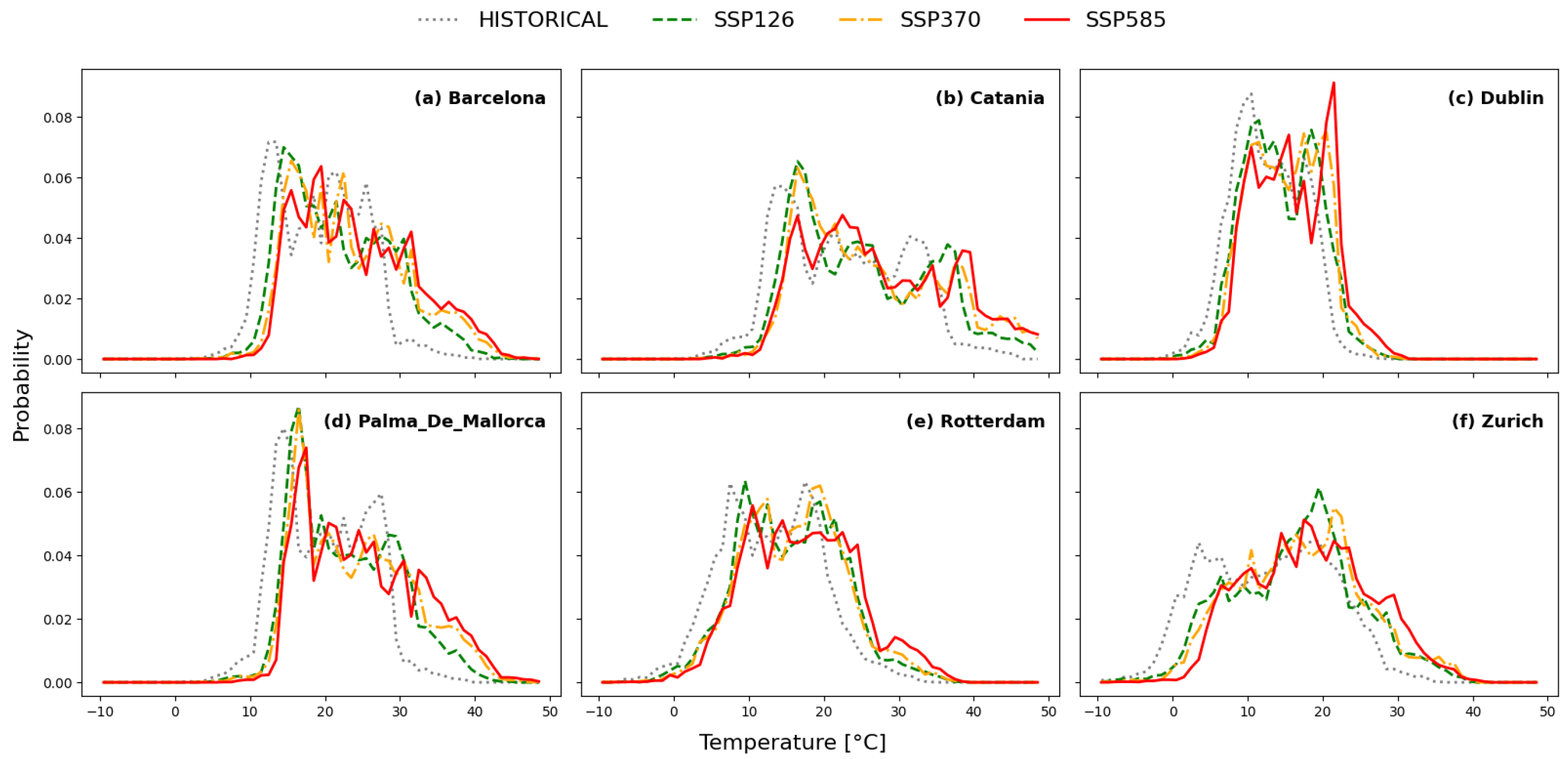
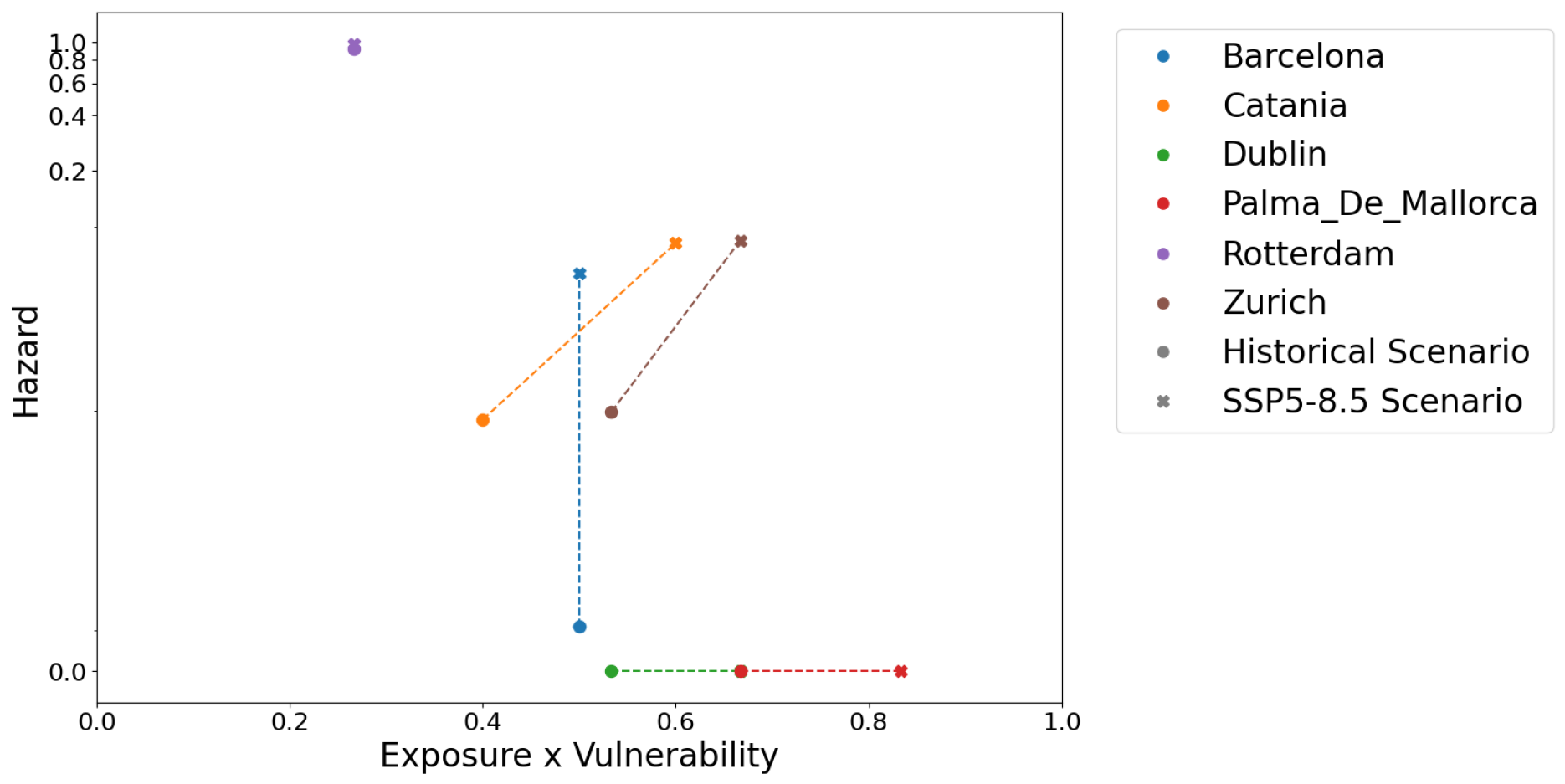
- Hazard (H) is defined as the frequency of days when maximum temperature exceeds threshold temperature for a given airport. For multi-runway airports, the shortest runway is used, except in the case of Dublin, for which the second runway is selected. The presence of additional runways is incorporated in the vulnerability assessment, as it contributes to the ability of the system to cope with hazardous situation.
- Exposure (E) as the number of departures per hour per runway. This metric represents the degree to which airport traffic is exposed to disruption should the hazard occur. Due to constraints in publicly available data, the exposure in this study was estimated based on the annual number of flights for each airport, assuming 50% were departures and a uniform temporal distribution of operations throughout the year. Future exposure (year 2050) was projected using EUROCONTROL’s Average Annual Growth Rate under their base scenario [14]. To integrate exposure into the risk framework, hourly departure rates F were mapped into five exposure classes. Airports with fewer than 3 departures per hour per runway are assigned to level 1; levels 2 to 4 correspond to [3, 5), [5, 7), and [7, 15) departures per hour per runways intervals, respectively; and airports with 15 or more departures per hour fall into level 5. These thresholds correspond approximately to one departure every 20, 12, 8, and 4 min.
- Vulnerability (V) is derived from six binary indicators capturing operational, geographic, and structural constraints. The score increases by for each of the following conditions: peak summer operations (i.e., busiest traffic days are in summer), single runway, mountainous surroundings (i.e., terrain elevation exceeds 800 m within 10 km of the airport), nearby residential areas (i.e., settlements located within 4 km of the airport perimeter), and explicit noise restrictions. Conversely, recent or planned infrastructure investments (e.g., runway extension) reduce vulnerability by 1.
3. Results
3.1. Temperature Trends and Airport Exposure
3.2. TODR Sensitivity to Temperature
3.3. Integrated Climate Risk Profiles
4. Discussion
5. Conclusions
Author Contributions
Funding
Institutional Review Board Statement
Informed Consent Statement
Data Availability Statement
Acknowledgments
Conflicts of Interest
Abbreviations
| ISA | International Standard Atmosphere |
| MTOM | Maximum Take-Off Mass |
| TODR | Take-Off Distance Required |
References
- Kanitkar, T.; Mythri, A.; Jayaraman, T. Equity assessment of global mitigation pathways in the IPCC Sixth Assessment Report. Clim. Policy 2024, 24, 1129–1148. [Google Scholar] [CrossRef]
- Krakauer, N.Y. It Is Normal: The Probability Distribution of Temperature Extremes. Climate 2024, 12, 204. [Google Scholar] [CrossRef]
- Williams, J.; Williams, P.D.; Guerrini, F.; Venturini, M. Quantifying the Effects of Climate Change on Aircraft Take-Off Performance at European Airports. Aerospace 2025, 12, 165. [Google Scholar] [CrossRef]
- Gratton, G.; Padhra, A.; Rapsomanikis, S.; Williams, P.D. The impacts of climate change on Greek airports. Clim. Change 2020, 160, 219–231. [Google Scholar] [CrossRef]
- Zhou, Y.; Zhang, N.; Li, C.; Liu, Y.; Huang, P. Decreased takeoff performance of aircraft due to climate change. Clim. Change 2018, 151, 463–472. [Google Scholar] [CrossRef]
- Airbus, S.A.S. Getting to Grips with Aircraft Performance. Technical Report, SKYbrary Aviation Safety/AIRBUS. 2002. Available online: https://skybrary.aero/sites/default/files/bookshelf/2263.pdf (accessed on 13 November 2025).
- Rowan Kelleher, S. Flight Delays Monday: Extreme Heat Disrupts Air Travel. Forbes, 28 July 2025. Available online: https://www.forbes.com/sites/suzannerowankelleher/2025/07/28/flight-delays-monday-extreme-heat-disrupts-air-travel/ (accessed on 13 November 2025).
- Coffel, E.D.; Thompson, T.R.; Horton, R.M. The impacts of rising temperatures on aircraft takeoff performance. Clim. Change 2017, 144, 381–388. [Google Scholar] [CrossRef]
- Core Writing Team; Pachauri, R.K.; Meyer, L.A. Climate Change 2014: Synthesis Report. Contribution of Working Groups I, II and III to the Fifth Assessment Report of the Intergovernmental Panel on Climate Change; IPCC: Geneva, Switzerland, 2014; p. 151. Available online: https://www.ipcc.ch/site/assets/uploads/2018/02/SYR_AR5_FINAL_full.pdf (accessed on 13 November 2025).
- Trentini, L.; Dal Gesso, S.; Venturini, M.; Guerrini, F.; Calmanti, S.; Petitta, M. A Novel Bias Correction Method for Extreme Events. Climate 2022, 11, 3. [Google Scholar] [CrossRef]
- Trentini, L.; Venturini, M.; Guerrini, F.; Dal Gesso, S.; Calmanti, S.; Petitta, M. Identifying climate extremes in Southern Africa through advanced bias correction of climate projections. Bull. Atmos. Sci. Technol. 2025, 6, 9. [Google Scholar] [CrossRef]
- European Union Aviation Safety Agency. Easy Access Rules for Large Aeroplanes (CS-25). Available online: https://www.easa.europa.eu/en/document-library/easy-access-rules/easy-access-rules-large-aeroplanes-cs-25 (accessed on 13 November 2025).
- Sun, J.; Hoekstra, J.; Ellerbroek, J. OpenAP: An open-source aircraft performance model for air transportation studies and simulations. Aerospace 2020, 7, 104. [Google Scholar] [CrossRef]
- EUROCONTROL. EUROCONTROL Aviation Outlook 2050. Available online: https://www.eurocontrol.int/publication/eurocontrol-aviation-outlook-2050 (accessed on 13 November 2025).
- Moser, A.; Dal Gesso, S.; Venturini, M.; Abate, C.; De Bortoli Vizioli, A. A Climate Risk Assessment Framework for Heatwave Impacts on Airport Operations in Europe. Italian Society for Climate Sciences (SISC), Salerno, Italy. 2025; manuscript in preparation.


Disclaimer/Publisher’s Note: The statements, opinions and data contained in all publications are solely those of the individual author(s) and contributor(s) and not of MDPI and/or the editor(s). MDPI and/or the editor(s) disclaim responsibility for any injury to people or property resulting from any ideas, methods, instructions or products referred to in the content. |
© 2026 by the authors. Licensee MDPI, Basel, Switzerland. This article is an open access article distributed under the terms and conditions of the Creative Commons Attribution (CC BY) license.
Share and Cite
Cane, L.; Abate, C.; Gesso, S.D.; Moser, A.; Maggioni, G. Heatwave Impacts on Airport Operations Under Future Climate Scenarios: A Climate Risk Assessment. Eng. Proc. 2026, 133, 74. https://doi.org/10.3390/engproc2026133074
Cane L, Abate C, Gesso SD, Moser A, Maggioni G. Heatwave Impacts on Airport Operations Under Future Climate Scenarios: A Climate Risk Assessment. Engineering Proceedings. 2026; 133(1):74. https://doi.org/10.3390/engproc2026133074
Chicago/Turabian StyleCane, Lorenzo, Carlo Abate, Sara Dal Gesso, Alessandro Moser, and Giulia Maggioni. 2026. "Heatwave Impacts on Airport Operations Under Future Climate Scenarios: A Climate Risk Assessment" Engineering Proceedings 133, no. 1: 74. https://doi.org/10.3390/engproc2026133074
APA StyleCane, L., Abate, C., Gesso, S. D., Moser, A., & Maggioni, G. (2026). Heatwave Impacts on Airport Operations Under Future Climate Scenarios: A Climate Risk Assessment. Engineering Proceedings, 133(1), 74. https://doi.org/10.3390/engproc2026133074