Proceeding Paper

Spatially Resolved Monitoring of the Curing Degree in the Liquid Resin Infusion Process Using Near-Infrared Hyperspectral Imaging †
1
LORTEK Technological Centre, Basque Research and Technology Alliance (BRTA), Arranomendia Kalea 4A, 20240 Ordizia, Spain
2
Advanced Composites Technologies, R&D Division, AIMEN Technology Centre, Polígono Industrial de Cataboi, Sector 2, Parcela 3, 36418 O Porriño, Spain
3
Smart Systems & Smart Manufacturing, AIMEN Technology Centre, Polígono Industrial de Cataboi, Sector 2, Parcela 3, 36418 O Porriño, Spain
4
Electronics and Computer Science Department, Mondragon Unibertsitatea, Goiru Kalea 2, 20500 Mondragón, Spain
*
Author to whom correspondence should be addressed.
Presented at the 15th EASN International Conference, Madrid, Spain, 14–17 October 2025.
Eng. Proc. 2026, 133(1), 72; https://doi.org/10.3390/engproc2026133072

Published: 6 May 2026

Abstract

To ensure consistent quality in composite aerostructures, advanced non-invasive monitoring techniques are needed to detect global and local deviations during manufacturing. This study presents a real-time, spatially resolved method for monitoring the curing stage of Liquid Resin Infusion (LRI) using Near-Infrared Hyperspectral Imaging (NIR-HSI). Unlike traditional point-based tools such as disposable dielectric sensors, NIR-HSI enables full-field, non-contact assessment of the chemical evolution of the resin, providing valuable spatial information for detecting inhomogeneities caused by temperature gradients or uneven resin flow, factors known to affect the final mechanical properties of composites. Previous investigations demonstrated that hyperspectral data acquired during LRI correlate with the degree of cure estimated from a dielectric sensor. In the present study, we extend this analysis through a new experimental campaign designed to validate our earlier findings and strengthen the predictive model. To improve robustness and generalizability, the curing temperature, a key driver of cure kinetics, was systematically varied to introduce controlled changes in cure behavior. This increased variability enhances model reliability and supports more accurate prediction of curing progression under realistic manufacturing conditions.

1. Introduction

Composite materials are widely used in aerospace, energy, marine, and automotive applications due to their excellent strength-to-weight ratios and design flexibility [1,2,3]. Among the various manufacturing processes, Liquid Resin Infusion (LRI)—a Liquid Composite Moulding (LCM) process in which a dry fiber preform is impregnated with resin under vacuum—is commonly employed for producing large, high-quality components [4,5].
While several stages of LRI influence final part quality, the curing phase is particularly critical. Once the preform is infused, resin cross-linking determines the mechanical performance of the composite, and deviations such as incomplete or non-uniform curing can lead to residual stresses, strength loss, or local defects [6]. Therefore, reliable in situ monitoring of the curing evolution is essential to ensure process consistency and structural integrity.
Existing monitoring techniques for composite curing include dielectric analysis (DEA) and temperature-based methods. DEA offers sensitive, real-time tracking of polymerisation by measuring changes in permittivity or loss factor [7,8,9,10], but it requires direct contact, is prone to sensor wear, and only provides local measurements [11]. Temperature sensors combined with thermo-kinetic models [12,13] can also estimate curing behavior but must be embedded in the part and cannot resolve spatial variations.
Near-Infrared (NIR) spectroscopy has recently emerged as a promising non-contact alternative for estimating the degree of cure [14]. Our previous work [15] further demonstrated that NIR hyperspectral imaging (NIR-HSI) can provide similar information while capturing full-field spectral data, enabling spatially resolved mapping of curing behavior—something point-based spectroscopy cannot achieve.
Building on these findings, the present study investigates the capability of NIR-HSI to track the curing degree with spatial detail during the Liquid Resin Infusion process. Hyperspectral data were collected from two samples cured at different temperatures (160 °C and 180 °C) to introduce controlled variations in cure kinetics. By analyzing both spectral signatures and spatial patterns, we assess whether NIR-HSI can reliably detect local curing differences, supporting its potential as an inline quality-control tool for composite manufacturing.
The remainder of this article is structured as follows: Section 2 describes the experimental setup and methodologies used in this study. It begins with an overview of the LRI process, followed by a description of the reference measurements employed to infer the curing state. The section concludes with a presentation of the hyperspectral imaging system, including the data acquisition and analysis procedures. Section 3 reports the findings of the study, highlighting the hyperspectral imaging analysis. Finally, Section 4 summarizes the main conclusions and outlines potential directions for future work.

2. Materials and Methods

2.1. Liquid Resin Infusion Materials and Process Description

In the Liquid Resin Infusion (LRI) process, a dry fiber layup is stacked according to the part design inside a mold and enclosed within a vacuum-sealed bag. In this study, we used four aerospace-grade carbon-fiber fabrics (Teijin Tenax® E IMS65 E23 24K, Teijin Carbon Europe GmbH, Wuppertal, Germany) arranged in a symmetrical and balanced [ 0 / 90 / 0 / 90 ] 2 s configuration, forming a preform with dimensions of 280 × 200 mm.
Vacuum pressure is then applied through a dedicated port, removing air from the cavity and creating a pressure gradient that draws liquid resin from an inlet tube into the fiber preform. The selected matrix system was Hexcel HexFlow® RTM6-2 (Hexcel Corporation, Duxford, Cambridge, United Kingdom), a two-component epoxy resin designed for high-performance structural applications.
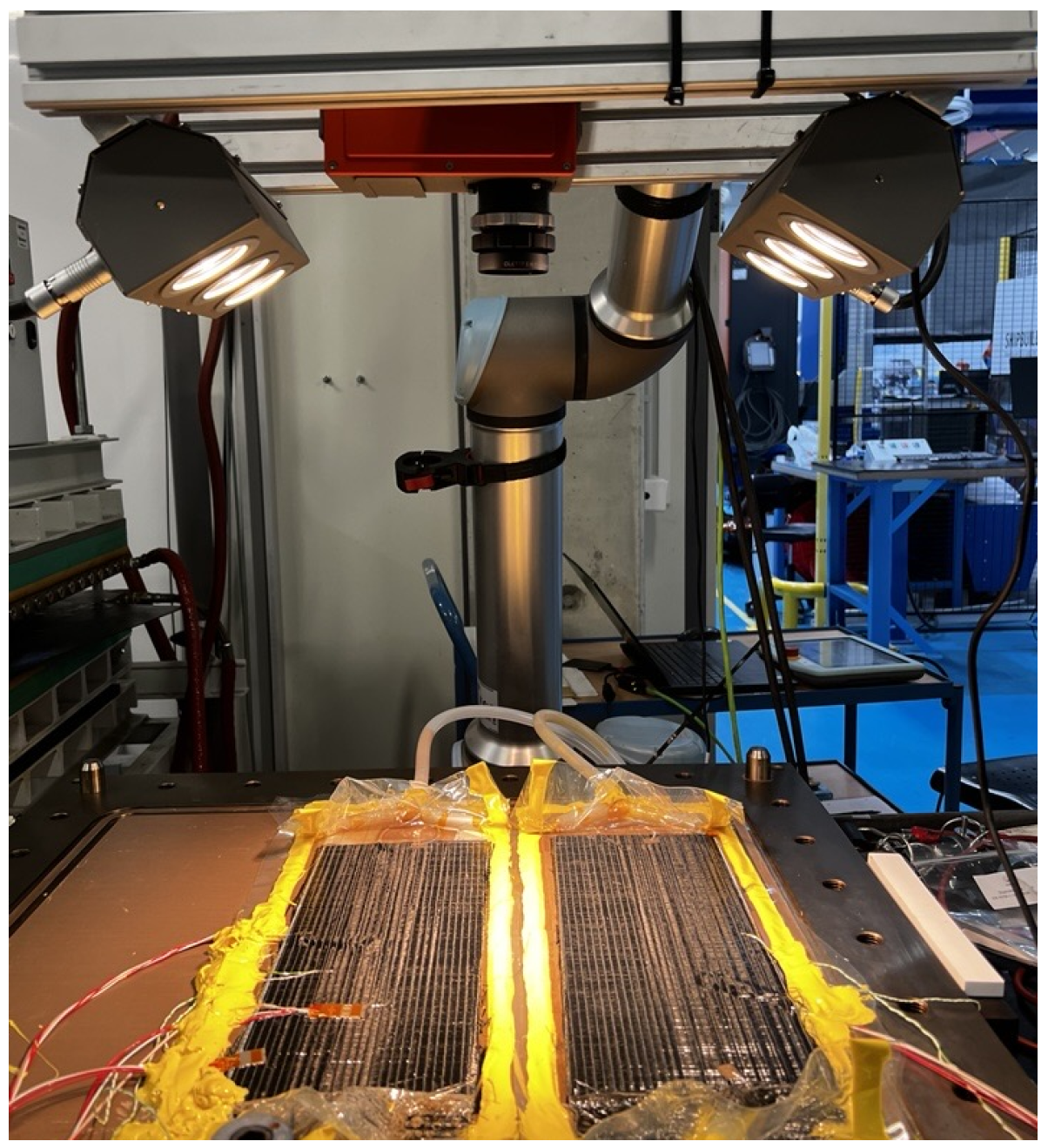
Once the layup is prepared, the composite is infused and cured on a heated plate. For this resin system, the infusion is ideally carried out when the preform reaches 100–120 °C. When the preform reaches this temperature, the inlet valve is opened to start the infusion stage. After complete wet-out of the fibers, the inlet is closed and the temperature is increased to 180 °C for the heating and curing phases. This temperature is typically held for two hours to fully cure the resin. This curing phase is normally performed inside an oven to guarantee controlled and uniform curing conditions. However, for this feasibility study and because the hyperspectral camera cannot operate at oven temperatures the LRI process was carried out on a self-heated open mold using an oil-circulation system. Figure 1 shows the fiber layup on top of the heated mold.
To address the objective of this study, we modified the curing temperature placing an insulator material between the self-heated mold and the preform in one of the samples. Therefore, two samples were manufactured following the same infusion procedure, but they were cured at different temperatures: one at 180 °C (sample 1, the sample at the left on Figure 1) and the other at 160 °C (Sample 2, the sample at the right on Figure 1). This controlled variation in curing conditions allows us to investigate how NIR-HSI captures spatial differences in curing behavior.

2.2. Reference Measurement for Curing State Estimation

The degree of cure is a dimensionless parameter that describes how far a thermosetting resin has progressed in its chemical cross-linking reaction. It is commonly expressed as a fraction between 0 and 1 (or 0–100%), where 0 corresponds to the uncured state and 1 indicates full cure. Although the degree of cure can be measured directly using methods such as Differential Scanning Calorimetry (DSC), it can also be inferred indirectly from material properties that evolve during curing [16].
In this study, Dielectric Analysis (DEA) was used to estimate the curing state through a commercial disposable dielectric sensor from Synthesites [17], acquired using their Optimold system. This equipment is widely recognized for its reliability when monitoring the curing behavior of epoxy systems such as RTM6-2 [16]. The dielectric sensor measures the resin’s electrical resistance, which responds sensitively to changes in molecular mobility, viscosity, and cross-linking—allowing real-time tracking of the curing process during LRI.
For this experiment, two dielectric sensors were placed: one on Sample 1 (DC1) and one on Sample 2 (DC2), each positioned between the mold surface and the fiber stack to ensure continuous resin contact throughout the infusion and curing stages.

2.3. Hyperspectral Imaging System and Data Acquisition

During the curing phase, the HSI system captured images from above, as illustrated in Figure 1. Two broadband halogen lamps, positioned symmetrically at oblique angles, illuminated the sample. The HSI setup includes the Specim FX17e near-infrared hyperspectral camera which was employed to inspect the object under study in reflectance mode. The camera operates in the NIR range (935–1720 nm) with 224 spectral bands, a spatial resolution of 640 pixels, and a 38° field of view (FOV) lens. Following the push-broom principle, it captures one spatial line per frame, therefore to image the entire sample, either the camera or the object must be moved perpendicular to the scan line at a constant speed synchronized with the frame rate and field of view. For this reason, for in-process hyperspectral monitoring, HSI camera was mounted on a 6-axis Omron TM12 robotic arm (Figure 1). In this specific case, to achieve a working distance of 350 mm, the camera was configured with a height of 500 mm, an acquistion rate of 50 FPS and linear scanning speeed of 25 mm/s.
Afterwards, the raw hyperspectral data were converted into reflectance spectra through standard radiometric calibration. Before each acquisition, a 99% Spectralon white reference was recorded under identical illumination to correct for background response, while a dark reference (closed shutter) captured the sensor’s noise offset. The reflectance was then obtained by normalizing the sample’s raw intensity with respect to the white and dark references, following standard procedures [18].

2.4. Hyperspectral Image Analysis

The acquired hyperspectral images require preprocessing before any further analysis to correct for measurement-related artefacts. Typically, hyperspectral datasets undergo both spatial and spectral preprocessing [19]. In this study, spatial preprocessing was performed by defining Regions of Interest (ROIs) within the hyperspectral images. This isolates the relevant spatial areas and reduces the size of the resulting hypercube, thereby lowering the computational load and simplifying data handling.
Spectral preprocessing was subsequently applied to minimize variability unrelated to the material under study, such as sensor noise or light-scattering effects—phenomena that are particularly prominent in near-infrared hyperspectral imaging (e.g., baseline shifts and non-linear responses) [18]. Standard Normal Variate (SNV) transformation was used to mitigate these scattering effects. SNV normalizes each pixel’s spectrum by subtracting its mean and dividing by its standard deviation, ensuring zero-mean, unit-variance spectra for all pixels.
In our previous work [15], the spectra extracted from ROIs aligned with the positions of the dielectric sensors were correlated with the estimated degree of cure using regression models based on Partial Least Squares (PLS) and Support Vector Regression (SVR). These models demonstrated strong predictive performance. In the present study, the previously developed regression models are applied to new hyperspectral data acquired from additional composite samples. This enables evaluation of the model’s generalization capability and serves as an external validation step to confirm the robustness of the findings reported in our earlier work.

3. Results

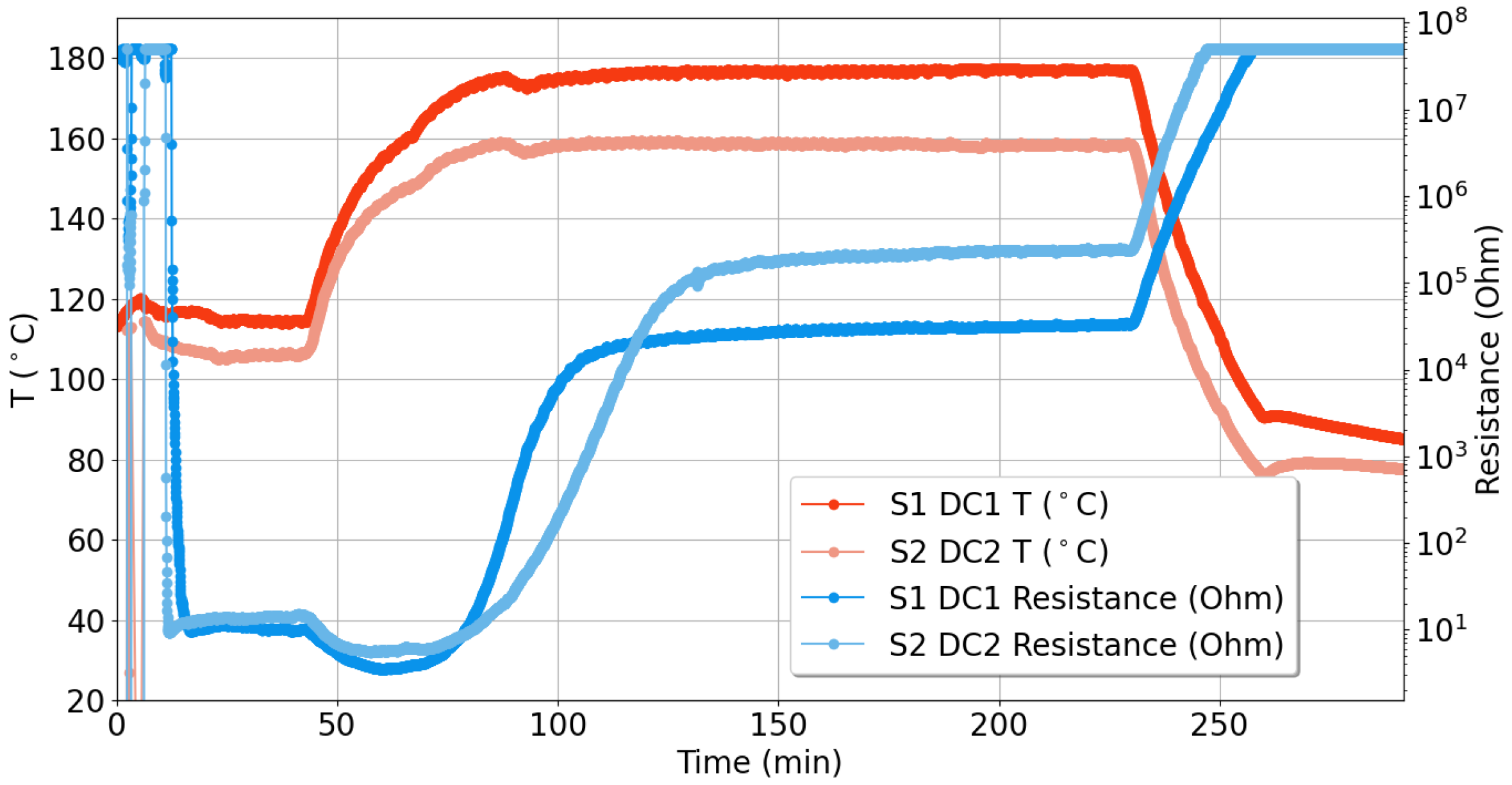
As shown in Figure 2 the dielectric response clearly captures both the infusion and curing phases. When the incoming resin reaches each sensor (impregnation stage), the resistance drops to values near 50 MΩ, confirming that the sensor is fully wetted. Following this, the resistance decreases as the resin approaches its minimum viscosity, then starts increasing again as cross-linking begins and the molecular mobility is progressively restricted. Toward the end of the cycle, the resistance stabilizes, a behavior commonly interpreted by process engineers as an indication that the resin has achieved a sufficient cure level for demolding.
The temperature curves highlight the two curing conditions: 180 °C and 160 °C. These lead to distinct curing dynamics in the resistance signal. The 180 °C sample shows a faster transition from low to high resistance, reflecting accelerated cross-linking, while the 160 °C sample exhibits a slower, more gradual increase. These contrasting behaviors, driven by temperature-dependent cure kinetics, make the samples well suited for assessing whether NIR-HSI can detect spatial differences in curing.
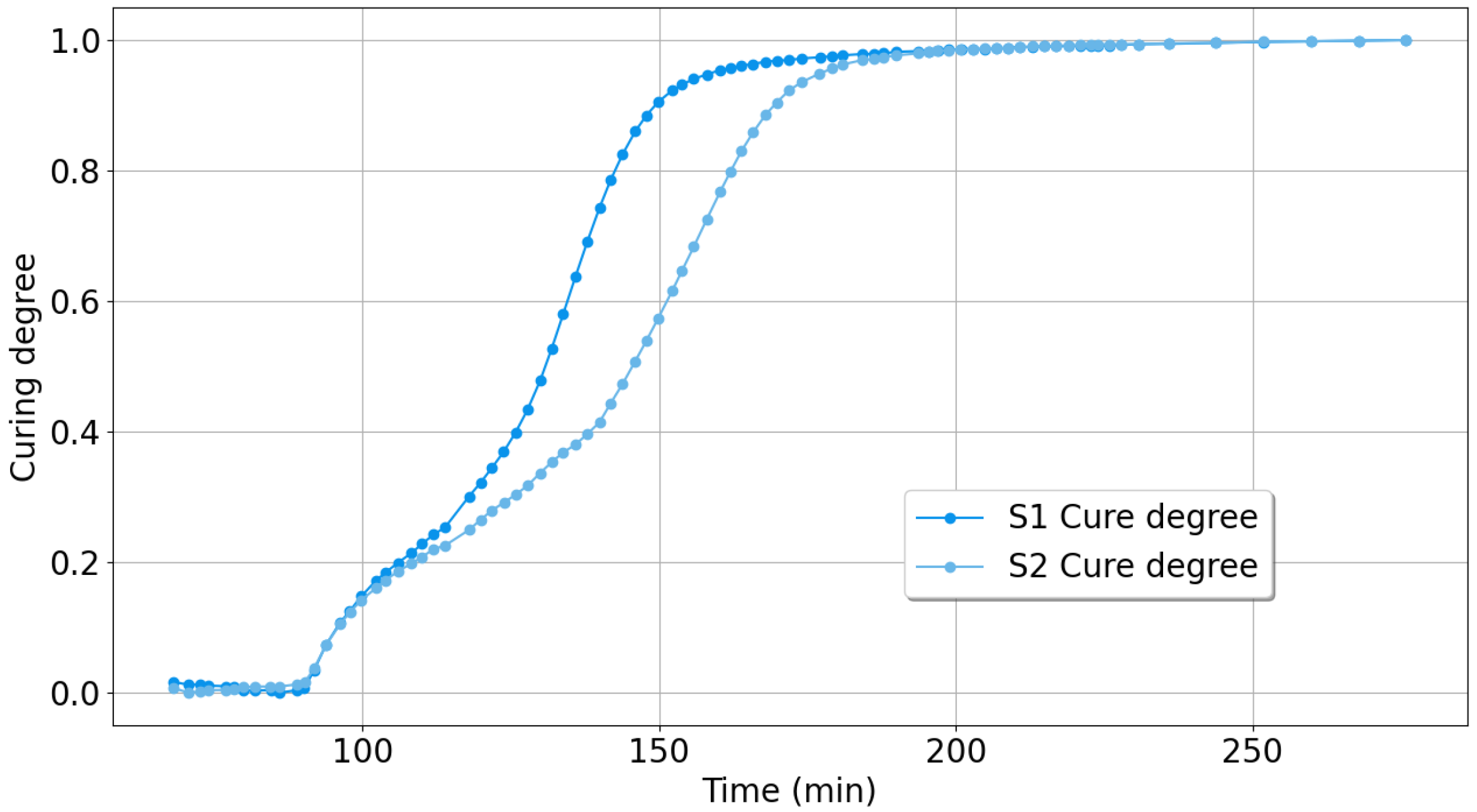
Because dielectric properties depend strongly on temperature, resistance alone cannot be interpreted directly during non-isothermal cycles. To address this, we applied the temperature-compensation method from our previous work [15], separating thermal effects from cure-related changes. After compensation, Figure 3 shows the estimated cure degree for both samples during LRI process curing phase.
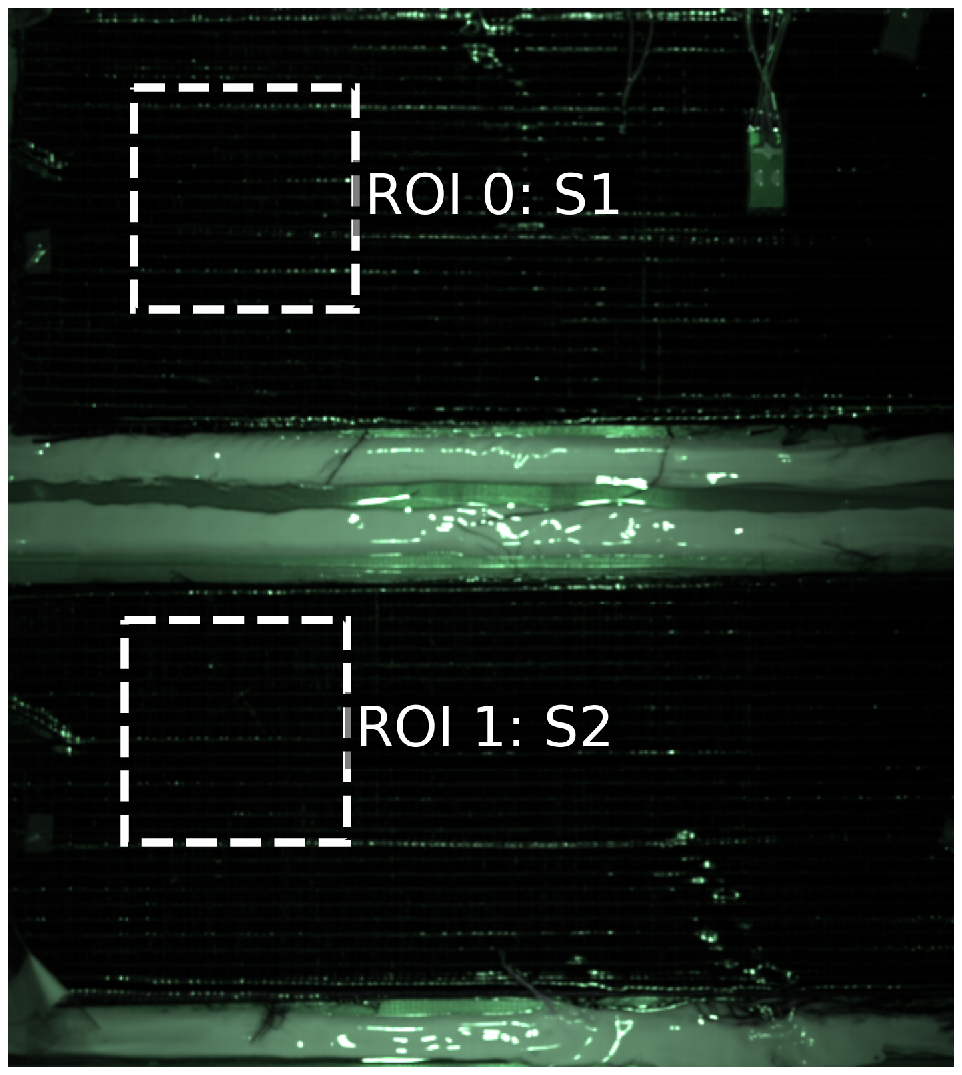
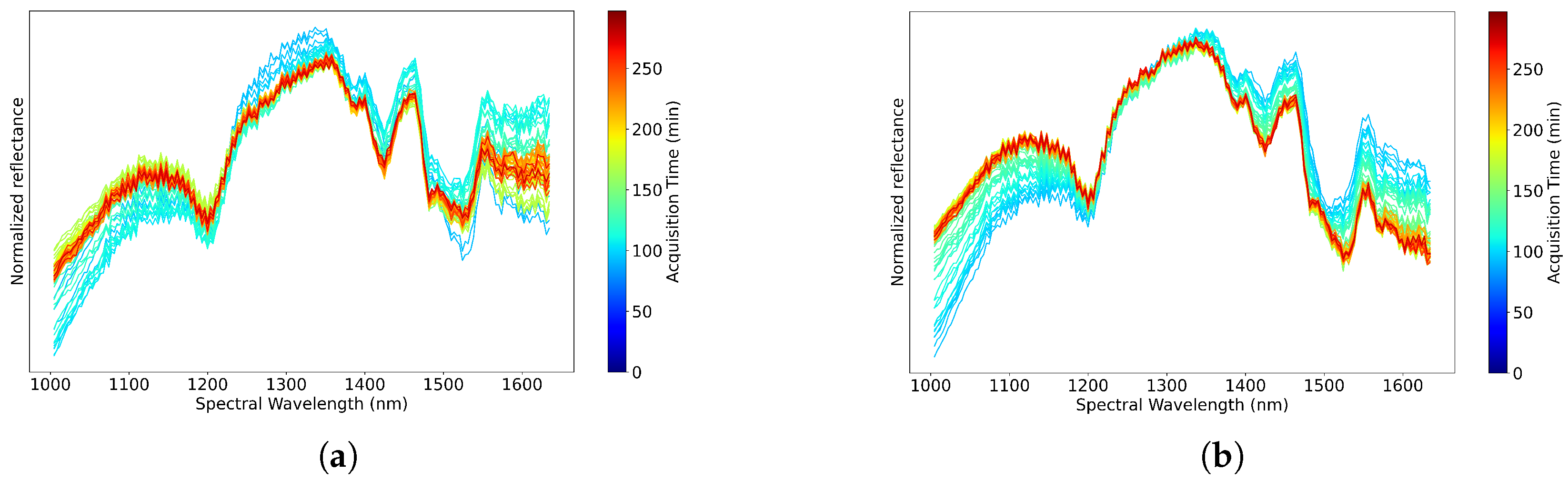
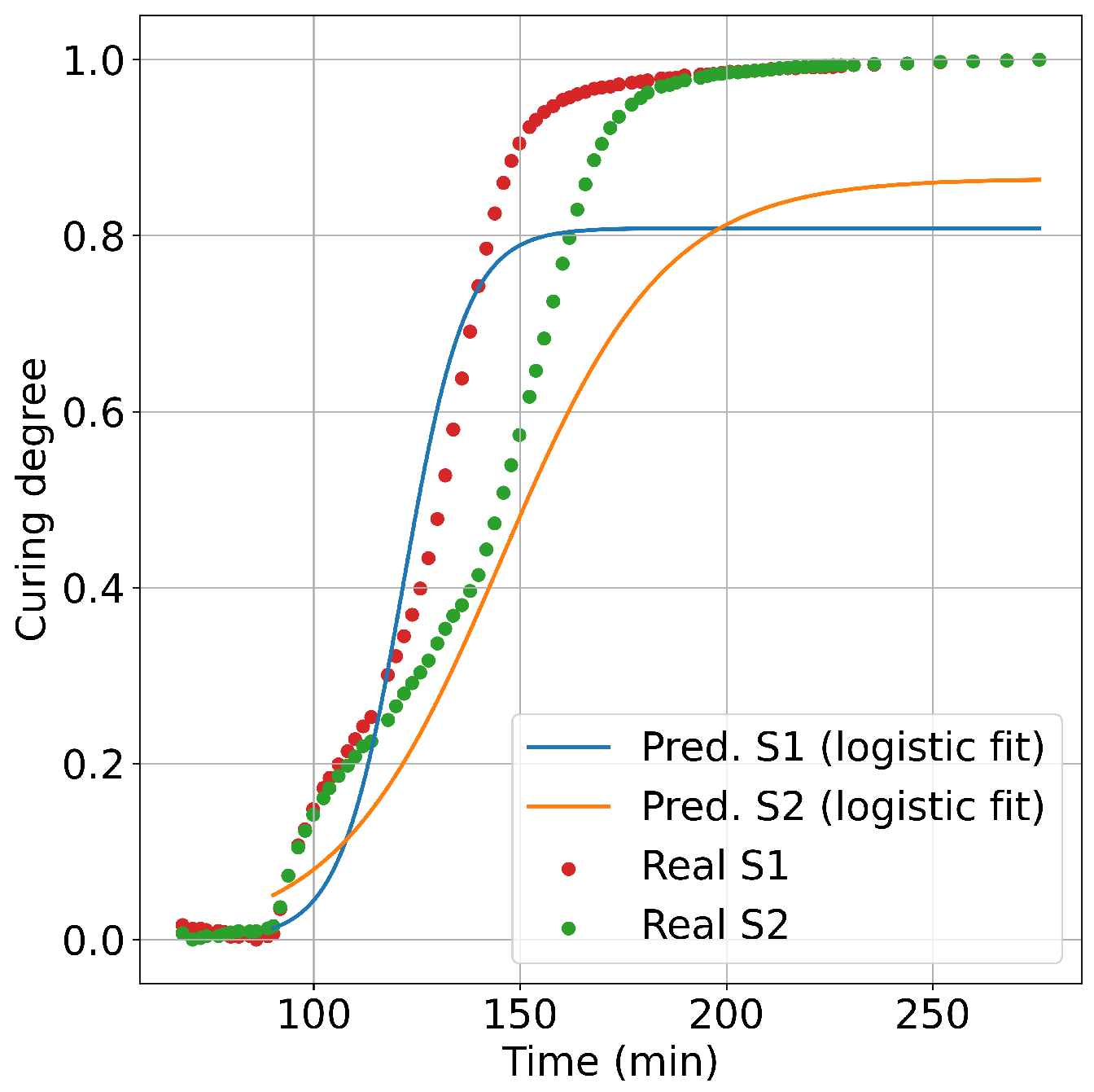
Regarding LRI curing monitoring, a total of 84 hyperspectral images were acquired during the curing experiments. Each image includes both composite samples within the camera’s field of view, enabling simultaneous monitoring under identical conditions. For every acquisition, Regions of Interest (ROIs) were defined for each sample (Figure 4). The mean spectrum from each ROI after applying SNV preprocessing was then used as input to the regression models (Figure 5) developed in our previous work [15] to predict the degree of cure of the spatial region within the ROI for both samples throughout the curing phase (Figure 6).

4. Discussion

The results presented in this study further demonstrate the potential of Near-Infrared Hyperspectral Imaging (NIR-HSI) for monitoring the curing phase of Liquid Resin Infusion, extending the findings of our previous work [15]. By acquiring new hyperspectral data under controlled variations in curing temperature, we were able to evaluate the robustness of the regression models previously developed to correlate NIR-HSI spectra with the degree of cure. The predicted curing degree (Figure 6) closely follows the curing behavior expected from the dielectric reference data (Figure 3), capturing the distinct cure kinetics of both samples cured at different temperatures. At this stage, the comparison focuses on global trends, as the prediction for S2 presents a slight shift relative to S1, while still converging toward a similar ultimate cure level. This indicates that the generalization ability of the regression models requires further investigation to ensure consistent quantitative accuracy across different curing conditions.
From a broader perspective, these results confirm that NIR-HSI can provide real-time, non-contact, spatially resolved information on curing evolution, an important advantage over point-based monitoring techniques. The ability to detect spatial heterogeneity is particularly relevant given that non-uniform temperature gradients or resin flow disturbances can introduce local variations in cross-linking, potentially affecting the final mechanical performance of composite parts.
Despite these promising results, some variability remains in the predicted cure degree, especially when comparing samples cured under different temperature profiles. Several factors may contribute to this behavior, including differences in illumination conditions across the field of view and camera setup for acquisitions. Future work should therefore focus on improving model generalization through strategies such as expanding the training set to include broader temperature ranges or exploring more advanced regression approaches.
Beyond model refinement, additional research should investigate the capability of NIR-HSI to detect spatial curing inhomogeneities within larger or more complex components.
Overall, this study validates the feasibility of using NIR-HSI for inline cure monitoring under varying processing conditions, while also highlighting key directions for future development to enhance prediction robustness and industrial applicability.

Author Contributions

Conceptualization, X.Z. and L.A.; methodology, X.Z., D.M.-W. and L.E.; software, X.Z., D.M.-W. and L.E.; validation, X.Z., L.A. and J.P.; formal analysis, X.Z., L.A. and J.P.; investigation, X.Z., L.A., J.P. and C.B.; data collection, C.B., M.R., T.G., A.N. and R.R.; writing—original draft preparation, X.Z.; writing—review and editing, X.Z. and L.A.; supervision, L.A., D.M.-W. and L.E.; project administration, J.P.; funding acquisition, J.P. and C.B. All authors have read and agreed to the published version of the manuscript.

Funding

This study was conducted within the framework of the FLASH-COMP project (Flawless and Sustainable Production of Composite Parts through a Human-Centred Digital Approach), which receives funding from the European Union’s Horizon Europe research and innovation programme under grant agreement No. 101058458.

Institutional Review Board Statement

Not applicable.

Informed Consent Statement

Not applicable.

Data Availability Statement

The data underlying this article are part of an ongoing research effort and cannot be publicly shared at present. The authors intend to make the dataset available after the completion of the full research program.

Conflicts of Interest

The authors declare no conflicts of interest.

Abbreviations

The following abbreviations are used in this manuscript:
LRILiquid Resin Infusion
NIRNear-Infrared
HSIHyperspectral Imaging
ROIRegion of Interest
SNVStandard Normal Variate
PLSPartial Least Squares
SVRSupport Vector Regression

References

  1. Hull, D.; Clyne, T.W. An Introduction to Composite Materials, 2nd ed.; Cambridge University Press: Cambridge, UK, 1996. [Google Scholar] [CrossRef]
  2. Mallick, P. Fiber-Reinforced Composites: Materials, Manufacturing, and Design, 3rd ed.; CRC Press: Boca Raton, FL, USA, 2007. [Google Scholar] [CrossRef]
  3. Zhang, J.; Lin, G.; Vaidya, U.; Wang, H. Past, present and future prospective of global carbon fibre composite developments and applications. Compos. Part B Eng. 2023, 250, 110463. [Google Scholar] [CrossRef]
  4. Govignon, Q.; Bickerton, S.; Kelly, P. Liquid composite molding processes. In Advanced Fiber-Reinforced Polymer(FRP) Composites for Structural Applications; Elsevier: Amsterdam, The Netherlands, 2023; pp. 101–136. [Google Scholar] [CrossRef]
  5. Hindersmann, A. Confusion about infusion: An overview of infusion processes. Compos. Part A Appl. Sci. Manuf. 2019, 126, 105583. [Google Scholar] [CrossRef]
  6. Stanik, R.; Langkamp, A.; Müller, M.; Gude, M.; Boczkowska, A. Experimental investigation of the curing behaviour of fibre composite structures with snap-cure polymer systems. Int. J. Struct. Integr. 2018, 9, 768–778. [Google Scholar] [CrossRef]
  7. Tajima, Y.A. Monitoring cure viscosity of epoxy composite. Polym. Compos. 1982, 3, 162–169. [Google Scholar] [CrossRef]
  8. Kim, J.S.; Lee, D.G. On-line cure monitoring and viscosity measurement of carbon fiber epoxy composite materials. J. Mater. Process. Technol. 1993, 37, 405–416. [Google Scholar] [CrossRef]
  9. Schwab, S.D.; Levy, R.L.; Glover, G.G. Sensor system for monitoring impregnation and cure during resin transfer molding. Polym. Compos. 1996, 17, 312–316. [Google Scholar] [CrossRef]
  10. Kyriazis, A.; Pommer, C.; Lohuis, D.; Rager, K.; Dietzel, A.; Sinapius, M. Comparison of Different Cure Monitoring Techniques. Sensors 2022, 22, 7301. [Google Scholar] [CrossRef] [PubMed]
  11. Sabu, M.; Bementa, E.; Jaya Vinse Ruban, Y.; Ginil Mon, S. A novel analysis of the dielectric properties of hybrid epoxy composites. Adv. Compos. Hybrid Mater. 2020, 3, 325–335. [Google Scholar] [CrossRef]
  12. Chaloupka, A.; Pflock, T.; Horny, R.; Rudolph, N.; Horn, S.R. Dielectric and rheological study of the molecular dynamics during the cure of an epoxy resin. J. Polym. Sci. Part B Polym. Phys. 2018, 56, 907–913. [Google Scholar] [CrossRef]
  13. Montanini, R.; D’Acquisto, L. Simultaneous measurement of temperature and strain in glass fiber/epoxy composites by embedded fiber optic sensors: I. Cure monitoring. Smart Mater. Struct. 2007, 16, 1718–1726. [Google Scholar] [CrossRef]
  14. Salzmann, M.; Märzinger, W.; Teuchtmann, M.; Ravindran, B.; Kirschnick, U.; Fauster, E. Near-infrared spectroscopy in resin transfer molding—Determination of the degree of cure. Int. J. Adv. Manuf. Technol. 2024, 132, 5557–5565. [Google Scholar] [CrossRef]
  15. Zurutuza Lasa, X.; Arévalo Díaz, L.; Poplawski, J.; Builes Cárdenas, C.; Grandal González, T.; Núñez Cascajero, A.; Ruiz Lombera, R.; Rodriguez Alonso, P.; Román Rodríguez, M.; Maestro-Watson, D.; et al. Potential application of hyperspectral imaging for monitoring resin cure in composite manufacturing via liquid resin infusion. Spectrochim. Acta Part A Mol. Biomol. Spectrosc. 2026, 344, 126676. [Google Scholar] [CrossRef] [PubMed]
  16. Torre-Poza, A.; Pinto, A.M.R.; Grandal, T.; González-Castro, N.; Carral, L.; Rodríguez-Senín, E. Challenges of complex monitoring of the curing parameters in coupons for LRI manufacturing. INCAS Bull. 2021, 13, 203–210. [Google Scholar] [CrossRef]
  17. Aerospace-SOLUTIONS-Cure Monitoring of HexFlow® RTM6-1. Available online: https://www.synthesites.com/ipage.php (accessed on 18 November 2025).
  18. Amigo, J.M. Hyperspectral and multispectral imaging: Setting the scene. In Data Handling in Science and Technology; Elsevier: Amsterdam, The Netherlands, 2019; Volume 32, pp. 3–16. [Google Scholar] [CrossRef]
  19. Vidal, M.; Amigo, J.M. Pre-processing of hyperspectral images. Essential steps before image analysis. Chemom. Intell. Lab. Syst. 2012, 117, 138–148. [Google Scholar] [CrossRef]
Figure 1. Both samples prepared on top of the heated mold and hyperspectral imaging system mounted on a robot arm.
Engproc 133 00072 g001
Figure 2. Temperature and dielectric resistance evolution measured by DC1 and DC2 sensors for the two samples infused and cured at different temperatures.
Engproc 133 00072 g002
Figure 3. Estimated cure degree after applying the compensation method to the raw dielectric data. Each dot represents the moment at which a hyperspectral image was acquired.
Engproc 133 00072 g003
Figure 4. Regions of interest defined for samples S1 and S2, acquired in a hyperspectral image and displayed as a false-RGB image.
Engproc 133 00072 g004
Figure 5. Temporal evolution of the mean spectra of each defined ROI during curing phase of LRI process (a) ROI 0 defined on Sample 1. (b) ROI 1 defined on Sample 2.
Engproc 133 00072 g005
Figure 6. Logistic curved fit of estimaded curing degree predicted by regression model on hyperspectral data.
Engproc 133 00072 g006
Disclaimer/Publisher’s Note: The statements, opinions and data contained in all publications are solely those of the individual author(s) and contributor(s) and not of MDPI and/or the editor(s). MDPI and/or the editor(s) disclaim responsibility for any injury to people or property resulting from any ideas, methods, instructions or products referred to in the content.