


Abstract
Deployable structures offer new solutions in space, and among them, tubular origami-inspired space structures have proven to be a robust solution for packaging problems. This study focuses on the analysis of the Kresling origami pattern, which theoretically offers bi-stability during its folding process. The bi-stability of this pattern is a well-known property for paper models. However, it cannot be generalised for any material or geometry, as this property can be traced back to the manufacturing process and the materials being used. Consequently, we propose and test additive manufacturing models implementing different geometry parameters with the materials of interest. In parallel, a parametrised numerical model was developed in the commercial software Abaqus, replicating the structural behaviour of these test specimens under displacement-controlled compression. The aim is to obtain a final validated numerical model from where the entire behaviour and energetic response of each sample and, thus, their stability can be tested. Combining experimental and numerical results paints a whole picture of bi-stability, verifying this useful property for different space materials and configurations.
1. Introduction
Deployable structures have long offered solutions for space missions, enabling compact launch configurations that later unfold into functional spacecraft components. Among these, origami-inspired systems offer particularly elegant strategies to package large, lightweight, and potentially pressurised structures [1,2].
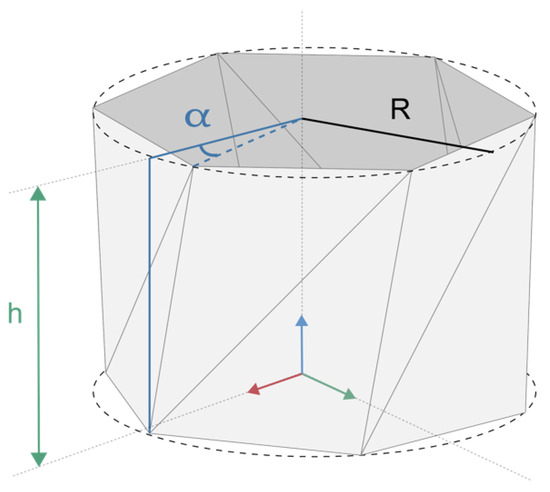
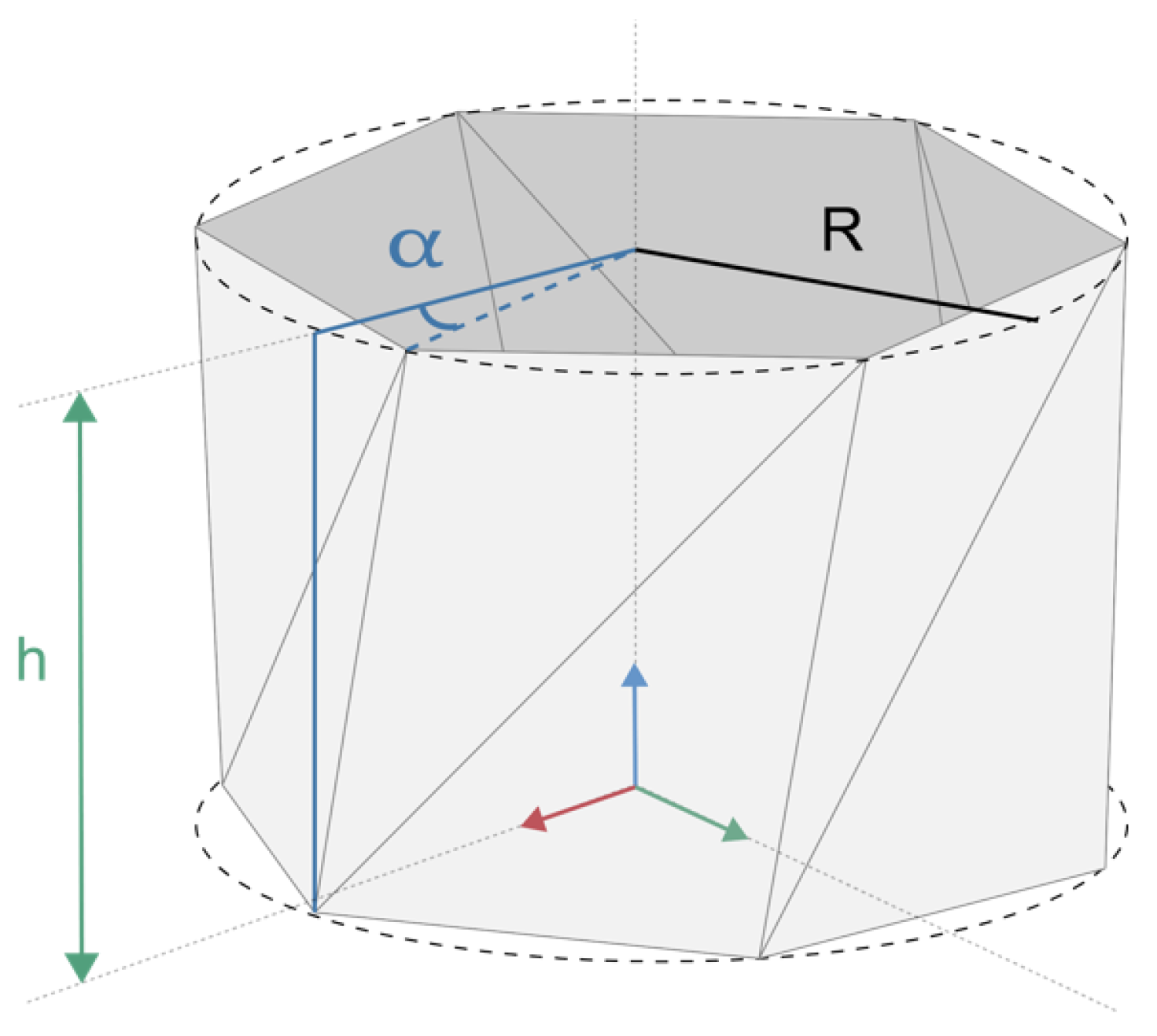
Within this family of deployable structures, the Kresling origami pattern has attracted growing interest [3]. The Kresling pattern is a tubular configuration composed of triangular facets arranged around a regular polygon. For a given regular polygon, such as a hexagon, a single ring Kresling pattern can be defined just by three independent parameters [4]. In this work, as seen in Figure 1, the parameters chosen are the rotation angle (), radius of the circumscribed circle of the polygon (R), and height of the ring (h).
Figure 1.
Geometric independent parameters of the hexagon-shaped Kresling pattern.
One of the advantages of using the Kresling pattern in space applications is that it can behave as a bi-stable structure [2,5]. This means that the structure can have two stable configurations: one deployed and another one stowed [6]. This property has been studied for paper configurations [7] mathematically, numerically, and experimentally, and its behaviour is predictable. Some combinations of the Kresling independent parameters produce this bi-stability. In the work of Masana et al. [8], the equilibria regions from the potential energy equations are obtained as a function of the geometric parameters.
However, bi-stability observed in paper models cannot be assumed to hold for different materials or manufacturing processes. Material stiffness [9], heterogeneity [10], and manufacturing constraints [11] can significantly alter the equilibrium landscape.
For instance, Dalaq et al. [12] proposed a 3D-printed Kresling origami pattern with a dual-material configuration with flexible and rigid materials. The flexible and rigid materials have a difference greater than an order of magnitude between their Young’s Moduli. The flexible material was applied in the bellows of the pattern, allowing for its folding. The configurations were studied with a numerical model in Abaqus simulations and validated experimentally thanks to 3D-printed models. Dalaq et al. [12] defined a design map that revealed four different behaviors: linear spring, quasi-zero stiffness (QZS) spring, nonlinear mono-stable spring, and bi-stable spring.
Interestingly, while comparing the work of Masana et al. [8] and the work of Dalaq et al. [12], shown in Table 1, it can be quickly observed that the bi-stable configuration is not the same. Moreover, the bi-stable configuration for Dalaq et al. [12] falls within the region of equilibria of Masana et al. [8], where it should not be bi-stable.
Table 1.
Comparison of the literature: bi-stable Kresling configurations.
This discrepancy highlights a central challenge: bi-stability in Kresling structures is not solely a geometric phenomenon.
To address this gap, the present work experimentally investigates additively manufactured Kresling prototypes and develops a numerical Abaqus model to replicate and predict Kresling stability behaviour, a single-material configuration versus a dual-material configuration. By validating simulations against physical tests, we establish the conditions under which bi-stability occurs and identify how material selection influences the stability map. Ultimately, the combined computational–experimental framework enables informed design choices for future deployable spacecraft structures.
2. Materials and Methods
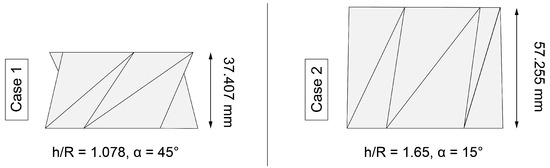
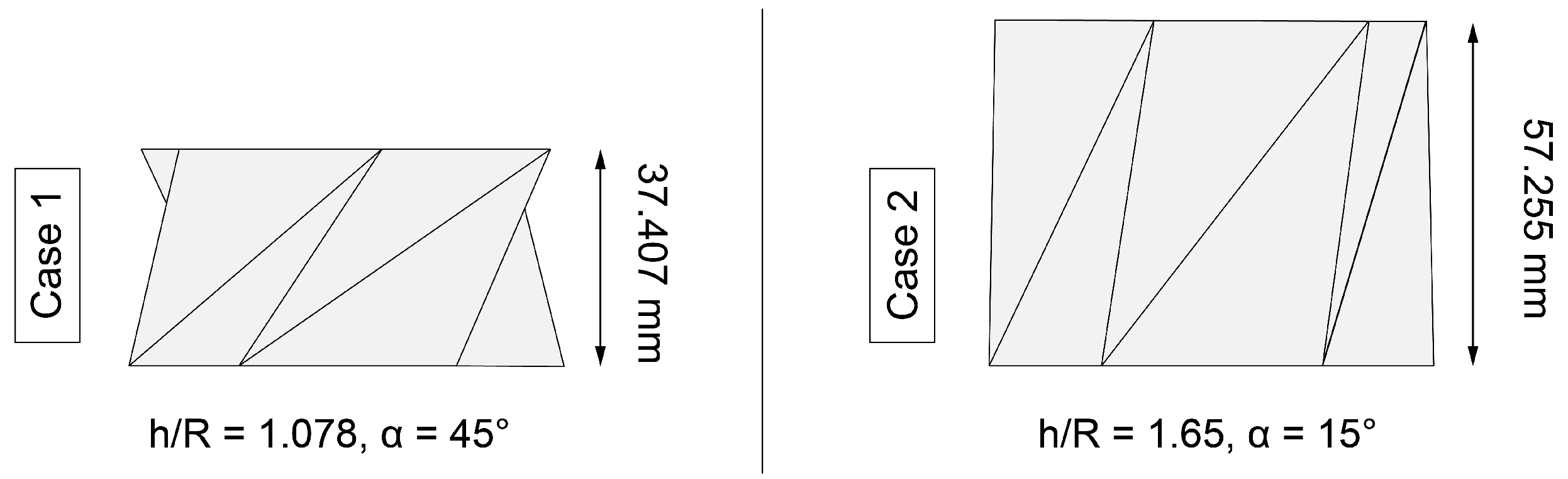
Two geometrical configurations were studied, defined as Case 1 and Case 2 (see Figure 2). These configurations fulfill the different bi-stability criteria found in the literature. In particular, all cases here were tested with a radius of 37.4 mm as the reference. For Case 1, both the single-material configuration and the dual-material configuration were investigated. For Case 2, only the single-material configuration was investigated.
Figure 2.
Geometric configurations of the Kresling pattern ring for Cases 1 and 2.
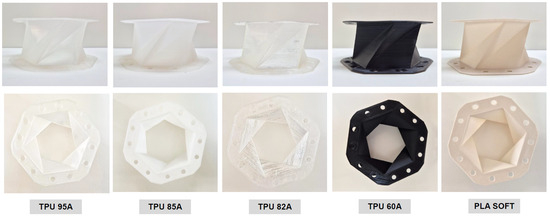
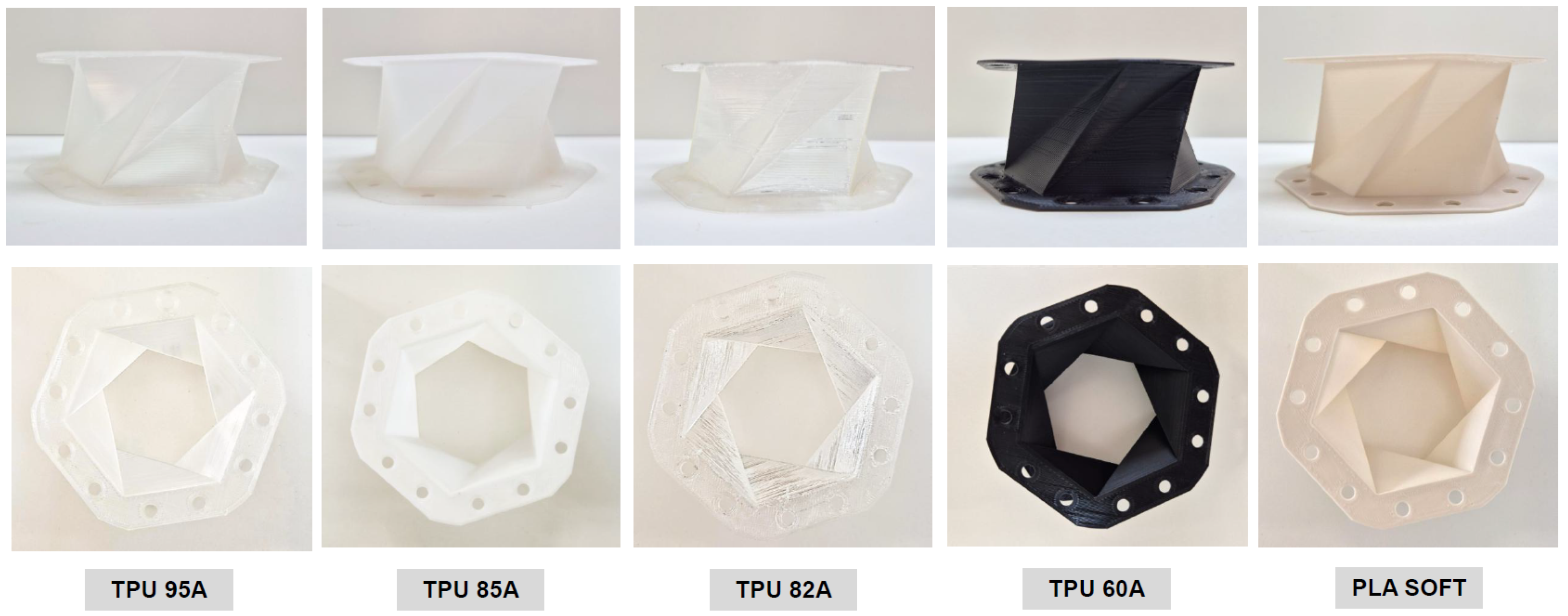
For single materials, five different types of flexible 3D printing materials were used in the prototypes—TPU 95A, TPU 85A, TPU82A, TPU60A, and PLA Soft—as illustrated in Figure 3. These materials have been selected due to their availability, foldability, and versatility during prototyping. For the single-material configuration, the prototypes (see Figure 3) were printed in their deployed configuration. These prototypes were manufactured using a Creality Ender-3 S1 3D printer (Creality, Shenzhen, China).
Figure 3.
Prototype made of different flexible materials.
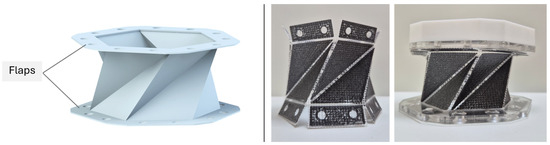
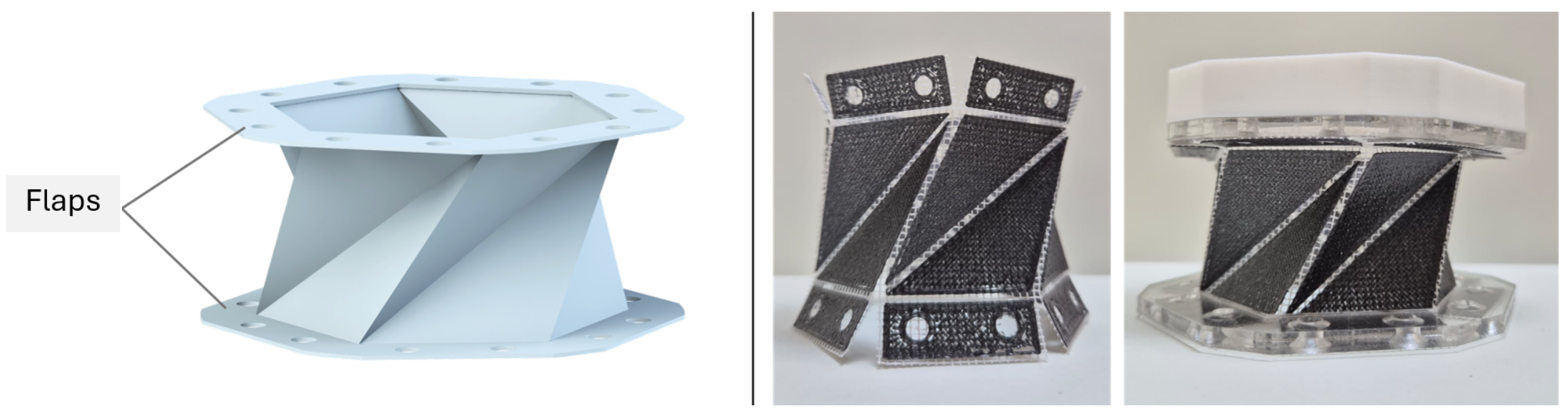
Inspired by the work of Zang et al. [13] and Masana et al. [2] and to facilitate the tests, flaps were added at the top and bottom of the pattern. The flaps for the single-material configurations are illustrated in Figure 4.
Figure 4.
Graphic representation of the flap design implemented in the single-material tests (left) and dual-material prototype (right).
Regarding the dual-material configuration, prototypes were manufactured in a flat configuration, including the flaps for the attachment. The rigid material, in this case, PLA, was printed over a glass fibre mesh resulting in a rigid and flexible composite, as represented in Figure 4. After printing the pattern, it was folded to obtain the 3D shape and sewn manually with a 0.4 mm nylon thread.
All configurations were assessed experimentally and numerically. Both methodologies are outlined in the following sections.
2.1. Experimental Model
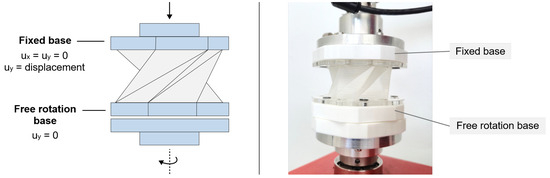
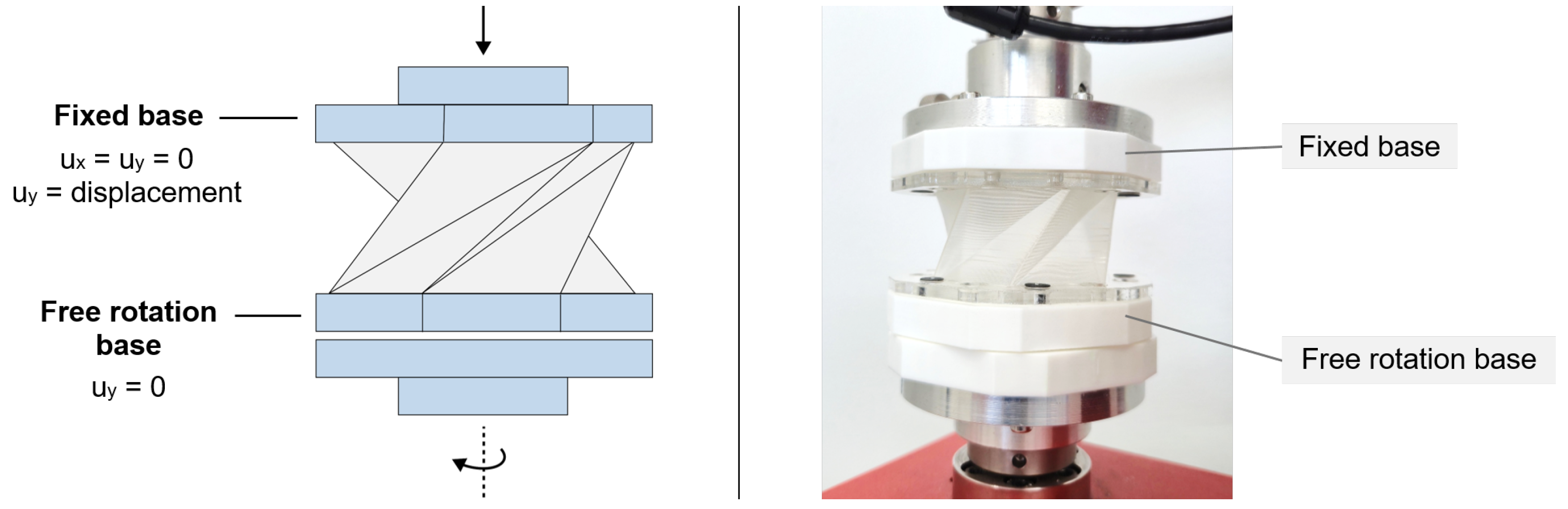
To assess the bi-stability behaviour of the Kresling pattern experimentally, compression tests in a Electromechanical Material Testing Machine MTE-5 (5 kN) (Techlab Systems, Lezo, Spain) were carried out. The movement of the Kresling origami pattern always involves twists during folding and deployment of each ring [5]. Therefore, testing the one-ring pattern requires a free rotation base to allow this twist.
To do so, a mechanical system was developed to fix the pattern on the flaps to the universal testing machine. First, auxiliary cylindrical bases were attached instead of the default clamps (see Figure 5). Second, a bearing mechanism was added within the rotation base, allowing free rotation. Finally, the attachment between the flap of the prototype and the bases was made thanks to the methacrylate shown in Figure 5.
Figure 5.
Experimental set-up. Graphic representation (left) and test photography (right).
All tests were performed under the same conditions: 5 mm/min for velocity and a displacement of 60% of total height (h).
2.2. Numerical Model
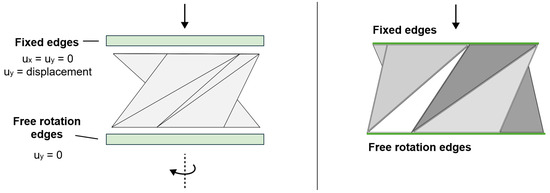
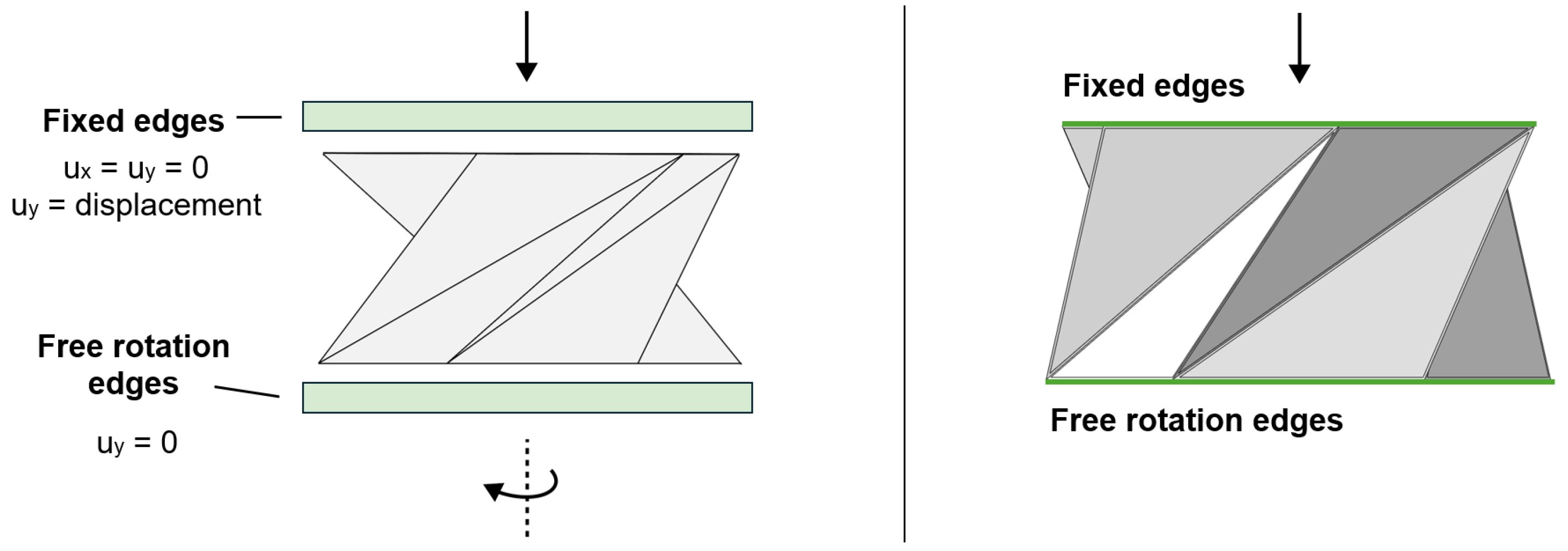
For the numerical model, made with the commercial software Abaqus 2022, the aim was to replicate the conditions of the experimental test. To do so, the boundary conditions represented in Figure 6 were implemented. Here, a vertical displacement with a rate of 25 mm/s was imposed on the edges at the top of the origami pattern. At the bottom edges, the displacement was fixed, except for the rotation required to enable the twist.
Figure 6.
Numerical BC. Graphic representation (left) and Abaqus screenshot (right).
The model is based on an origami pattern with imposed displacement, analysed in implicit mode with tri nodes. The mesh implemented in the model was formed by 21,984 triangle nodes uniformly distributed.
All of the materials defined, for both the single- and dual-material configurations, are defined as isotropic materials. As both models are based on additive manufacturing, anisotropy of the materials might be considered, especially for the flexible materials. Nevertheless, this assumption has been considered as a first-order approximation for this study, trying to reproduce the experimental results. Further analysis will be performed in future works with more accurate models. The properties are shown in Table 2.
Table 2.
Materials properties comparison.
3. Results
In this section, the results of the experimental and numerical models are presented and compared. The variables used for this comparison are the non-dimensional restoring force (as defined in Equation (1)) and non-dimensional potential energy (as defined in Equation (2)) compared with the non-dimensional displacement (defined in Equation (3)).
where F is the restoring force at the top of the origami pattern, E is the Young’s Modulus (with the bigger value used for the dual-material configuration), R is the radius of the circumscribed circumference shown in Figure 1, and U is the potential energy of the origami pattern. These variables were selected to allow for a comparison of the stability behaviour of the Kresling pattern for different material properties and geometries [12].
For the five materials outlined in Figure 3, first, a preliminary test campaign was conducted to assess the experimental methodology. In these tests, the suitability of the material for this type of test was assessed. The configurations made with the more flexible materials (TPU82A and TPU60A) did not hold the shape of the origami and deformed without following the Kresling configuration. In the case of the configurations with PLA Soft, they quickly cracked under compression, not allowing the recovery of fully representative behaviour of the structure.
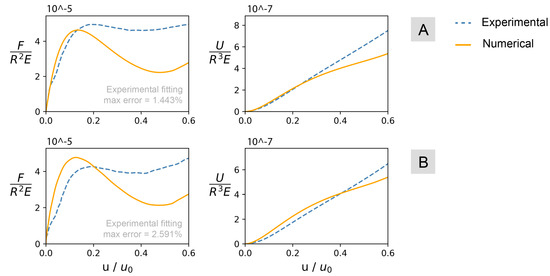
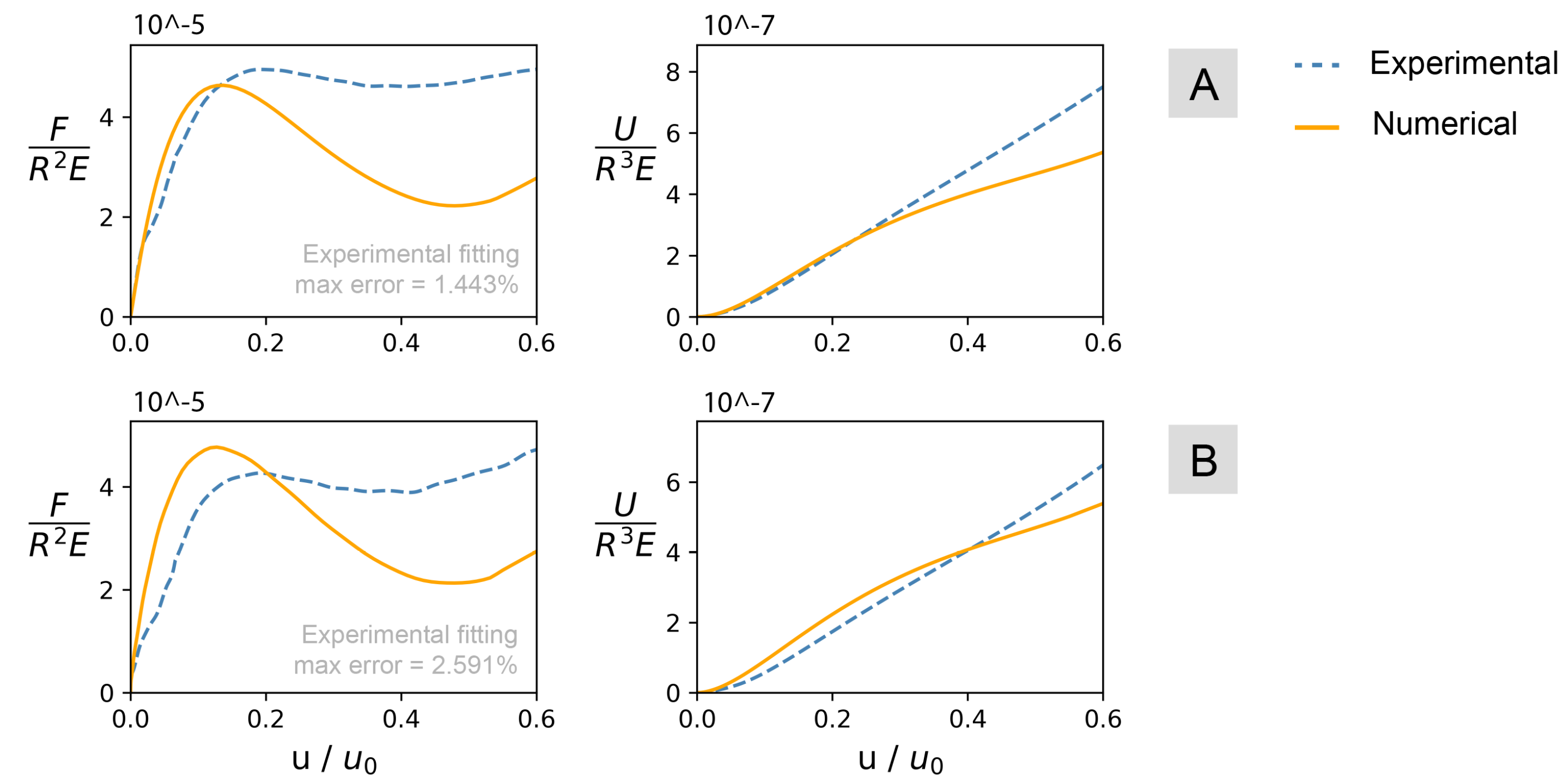
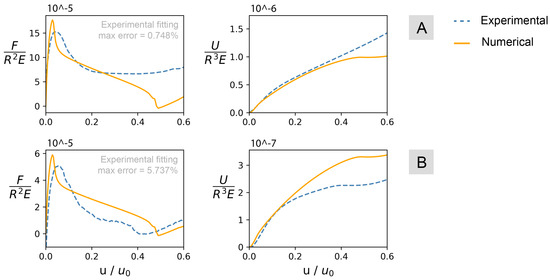
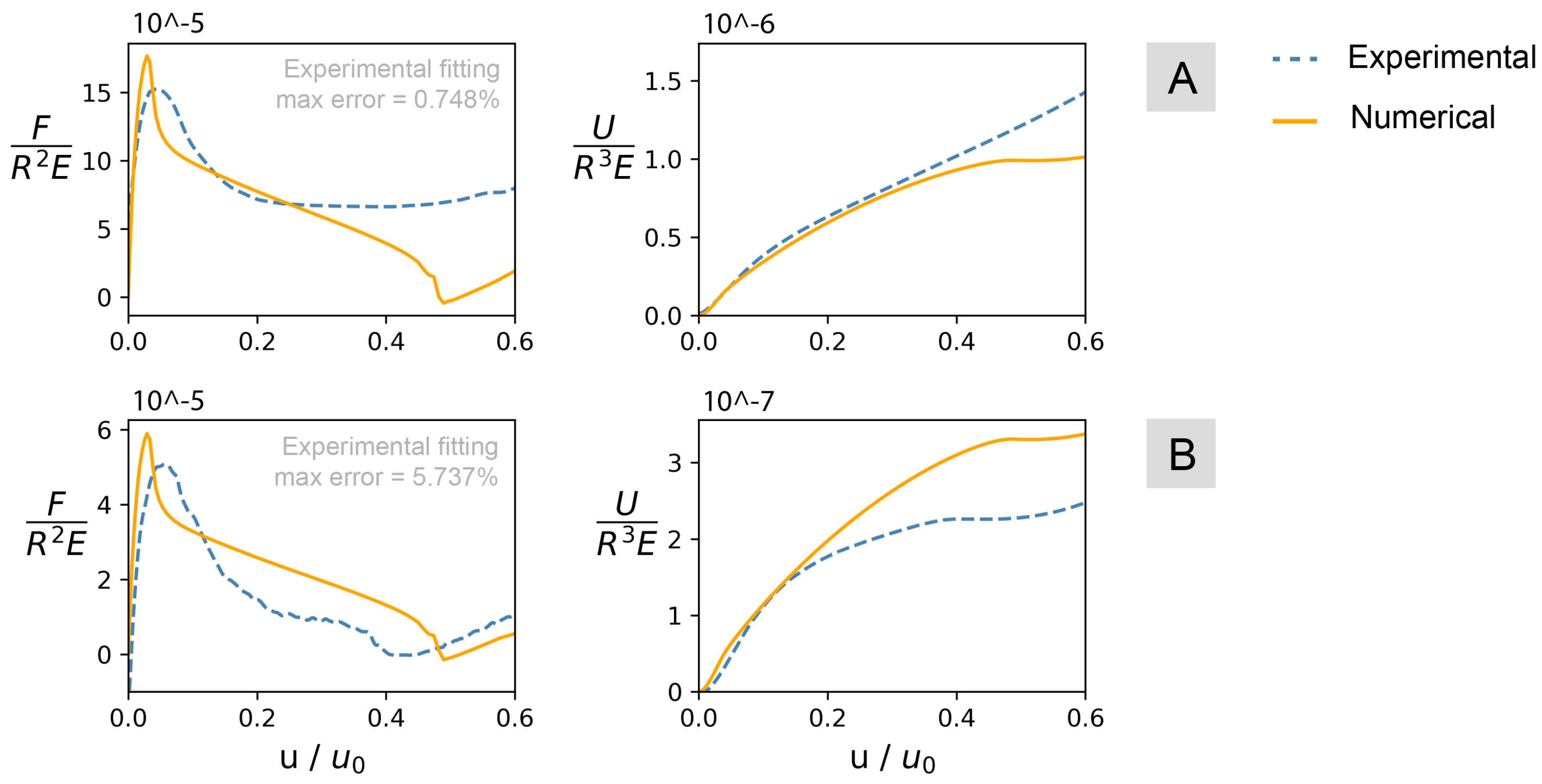
The two remaining material configurations, TPU95A and TPU85A, were found to be suitable and are shown in Figure 7 for Case 1 and in Figure 8 for Case 2. For all the materials and cases, the flexible response offers large discrepancies at large displacement values (>50%), which is related to the large deformation of the elements. Once the creases become highly deformed, the correlation between FEM and the experiments is more difficult to obtain.
Figure 7.
Force reaction (left) and potential energy (right) for flexible materials in Case 1. (A) TPU 95A and (B) TPU 85A.
Figure 8.
Force reaction (left) and potential energy (right) for flexible materials in Case 2. (A) TPU 95A and (B) TPU 85A.
Experimental and numerical results of Case 1 show similar behaviour for both TPU95A and TPU85A (see Figure 7). Observing the almost linear tendency of the non-dimensional potential energy, it can be established that Case 1 shows a quasi-zero stiffness (QZS) behaviour.
Changing the geometry into the Case 2 configuration results in a different behaviour in both the numerical and the experimental results. As can be seen in Figure 8, both TPU95A and TPU85A behave like nonlinear springs and not like QZS ones.
It is important to take into account that for TPU95A Case 2 (Figure 8A), there is a greater discrepancy between FEM and the testing results, with a greater decay at large displacement values. This can be easily seen in the potential energy evolution, with a more stable region in the FEM results compared with the experimental data. For TPU85A Case 2 (Figure 8B), the behaviour evolution is better captured to restore force and energy evolutions.
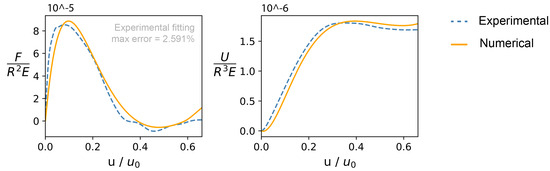
For the results of the dual-material configuration (Figure 9), the numerical model better captures the experimental behaviour. In this case, the model is bi-stable with a clear minimum for the potential energy evolution.
Figure 9.
Force reaction (left) and potential energy (right) for the dual-material configuration.
4. Discussion
Stability maps clearly depend on the material composition and configuration. For some particular test cases, Dalaq et al. [12] demonstrated this behaviour when combining materials with the same thickness but different Young’s Moduli, using a rigid material in the middle and a flexible material in the creases.
Consequently, to assess this property in all the manufacturing processes of interest for this application, we decided to first study a flexible pattern built as a block for analysing the material dependency. Then, we included the dual-material configuration analysis, adding a thickness variation between the rigid and flexible regions to fully explore the different manufacturing possibilities.
For the flexible material, we obtained an additive manufactured structure, while we obtained a better approximation for the lower displacement values: when displacement surpasses 50%, the discrepancy increases. This is manifested into high deformation and stresses localised in the creases.
We firstly believe that this behaviour might be related to filament printing heterogeneity and a possible inherent anisotropy within the origami pattern during the manufacturing process. However, after some additional tests with different test samples, this effect showed persistence. Nonetheless, this discrepancy is reported also in the results of Dalaq et al. [12] in an isotropic prototype, so we point out its presence and leave its detail analysis for a more in-depth study.
On the other hand, the dual-material configuration has shown better agreement. While there are reported results of this kind of testing in the literature for the materials and thickness we studied here, we benefit from its similarity to the paper origami structures. As an example, these results can be compared with the test performed by Masana et al. [8] and Zang et al. [13], showing a similar mechanical evolution.
Hence, the experimental and numerical results can be, with its peculiarities, compared and set in agreement with those of the literature. After testing and simulation campaigns, we report bi-stable candidates that differ from the theoretical parametric stability maps from the references (see Figure 5 from [8]).
The flexible material structures show different agreements with the theoretical maps depending on thickness and materials: we obtain a QZS spring behaviour for Case 1, as expected from theory, yet, for Case 2, we should obtain a mono-stable configuration, but they are closer to bi-stability. This means that we are almost in a bi-stable configuration and the load required to keep the pattern folded is lower. Therefore, under the obtained results, we can confirm that this manufacturing process produces structures whose stability does not directly match theory.
Regarding the dual-material configuration, we recover a more consistent behaviour with the paper theoretical results, as it behaves in a similar manner as paper origami structures [8]. We report a bi-stable behaviour for a model based on the shape of Case 1, which is the same stability expected for a paper geometry with these geometric parameters.
Further research is required to fully determine the correlation between bi-stability, materials, and geometric parameters. Nonetheless, a dual-material configuration shows a more promising compromise for tubular origami-like structures, not only for its simplicity but also for its bi-stable behaviour.
Author Contributions
Conceptualisation, E.V.-N. and P.S.-L.; methodology, E.V.-N. and P.S.-L.; software, M.M.M.; validation, E.V.-N., I.U.B., P.S.-L., and B.M.; formal analysis, E.V.-N. and P.S.-L.; investigation, E.V.-N., I.U.B., and P.S.-L.; resources, S.M.I., P.A., and B.M.; data curation, E.V.-N., I.U.B., and P.S.-L.; writing—original draft preparation, E.V.-N.; writing—review and editing, I.U.B.; visualisation, E.V.-N.; supervision, P.S.-L.; project administration, P.S.-L.; funding acquisition, P.S.-L. All authors have read and agreed to the published version of the manuscript.
Funding
This research was funded by FICS-1 under grant number PID2020-115325GB-C31 MCIN/AEI/10.130 39/501100011033.
Institutional Review Board Statement
Not applicable.
Informed Consent Statement
Not applicable.
Data Availability Statement
Data are contained within the article.
Acknowledgments
The authors acknowledge Ruy Sanz, Jacobo Alcaide, Diego Balmaseda, and Javier Parejo for their help during the manufacturing process. The authors also thank Alexander Uithol for his help with setting up the tests in Delft.
Conflicts of Interest
The authors declare no conflicts of interest. The funders had no role in the design of this study; in the collection, analyses, or interpretation of data; in the writing of the manuscript; or in the decision to publish the results.
Abbreviations
The following abbreviations are used in this manuscript:
| FEM | Finite Element Method |
| PLA | Polylactide |
| QZS | Quasi-Zero Stiffness |
| TPU | Thermoplastic Polyurethane |
References
- Wilson, L.; Pellegrino, S.; Danner, R. Origami Sunshield Concepts for Space Telescopes. In Proceedings of the 54th AIAA/ASME/ASCE/AHS/ASC Structures, Structural Dynamics, and Materials Conference, Boston, MA, USA, 8–11 April 2013. [Google Scholar] [CrossRef] [Scilit]
- Masana, R.; Dalaq, A.S.; Khazaaleh, S.; Daqaq, M.F. The Kresling origami spring: A review and assessment. Smart Mater. Struct. 2024, 33, 043002. [Google Scholar] [CrossRef] [Scilit]
- Meloni, M.; Cai, J.; Zhang, Q.; Sang-Hoon Lee, D.; Li, M.; Ma, R.; Parashkevov, T.E.; Feng, J. Engineering origami: A comprehensive review of recent applications, design methods, and tools. Adv. Sci. 2021, 8, 2000636. [Google Scholar] [CrossRef] [Scilit]
- Velázquez-Navarro, E.; Solano-López, P.; Uriol-Balbin, I. Preliminary Design and Optimization of a CubeSat Demonstrator for an Origami-inspired Deployable Structure. In Proceedings of the AIAA SciTech Forum and Exposition, Orlando, FL, USA, 8–12 January 2024. [Google Scholar] [CrossRef] [Scilit]
- Guest, S.D.; Pellegrino, S. The Folding of Triangulated Cylinders, Part I: Geometric Considerations. J. Appl. Mech. 1994, 61, 773–777. [Google Scholar] [CrossRef] [Scilit]
- Zirbel, S.A.; Tolman, K.A.; Trease, B.P.; Howell, L.L. Bistable mechanisms for space applications. PLoS ONE 2016, 11, e0168218. [Google Scholar] [CrossRef] [Scilit] [PubMed]
- Yang, M.; Grey, S.W.; Scarpa, F.; Schenk, M. Large impact of small vertex cuts on the mechanics of origami bellows. Extrem. Mech. Lett. 2023, 60, 101950. [Google Scholar] [CrossRef] [Scilit]
- Masana, R.; Daqaq, M.F. Equilibria and bifurcations of a foldable paper-based spring inspired by Kresling-pattern origami. Phys. Rev. E 2019, 100, 063001. [Google Scholar] [CrossRef] [Scilit] [PubMed]
- Mirzajanzadeh, M.; Pasini, D. Reprogrammable curved-straight origami: Multimorphability and volumetric tunability. Sci. Adv. 2025, 11, eadu4678. [Google Scholar] [CrossRef] [Scilit] [PubMed]
- Wang, B.; Ye, J.; Zhang, S.; Guan, C.; Zhong, J.; Zhong, S. Viscoelastic mechanics of a bistable composite cylindrical structure. Polym. Compos. 2025, 46, 10604–10618. [Google Scholar] [CrossRef] [Scilit]
- Zhang, Z.; Li, Y.; Yu, X.; Li, X.; Wu, H.; Wu, H.; Jiang, S.; Chai, G. Bistable morphing composite structures: A review. Thin-Walled Struct. 2019, 142, 74–97. [Google Scholar] [CrossRef] [Scilit]
- Dalaq, A.S.; Daqaq, M.F. Experimentally-validated computational modeling and characterization of the quasi-static behavior of functional 3D-printed origami-inspired springs. Mater. Des. 2022, 216, 110541. [Google Scholar] [CrossRef] [Scilit]
- Zang, S.; Misseroni, D.; Zhao, T.; Paulino, G.H. Kresling origami mechanics explained: Experiments and theory. J. Mech. Phys. Solids 2024, 188, 105630. [Google Scholar] [CrossRef] [Scilit]

Disclaimer/Publisher’s Note: The statements, opinions and data contained in all publications are solely those of the individual author(s) and contributor(s) and not of MDPI and/or the editor(s). MDPI and/or the editor(s) disclaim responsibility for any injury to people or property resulting from any ideas, methods, instructions or products referred to in the content. |
© 2026 by the authors. Licensee MDPI, Basel, Switzerland. This article is an open access article distributed under the terms and conditions of the Creative Commons Attribution (CC BY) license.