


On the Assessment of Drone Noise for Sustainable Urban Air Mobility Operations †


Abstract
1. Introduction
2. Noise Assessment Methods
3. Human Factor and Noise Characteristics
4. Assessment Framework
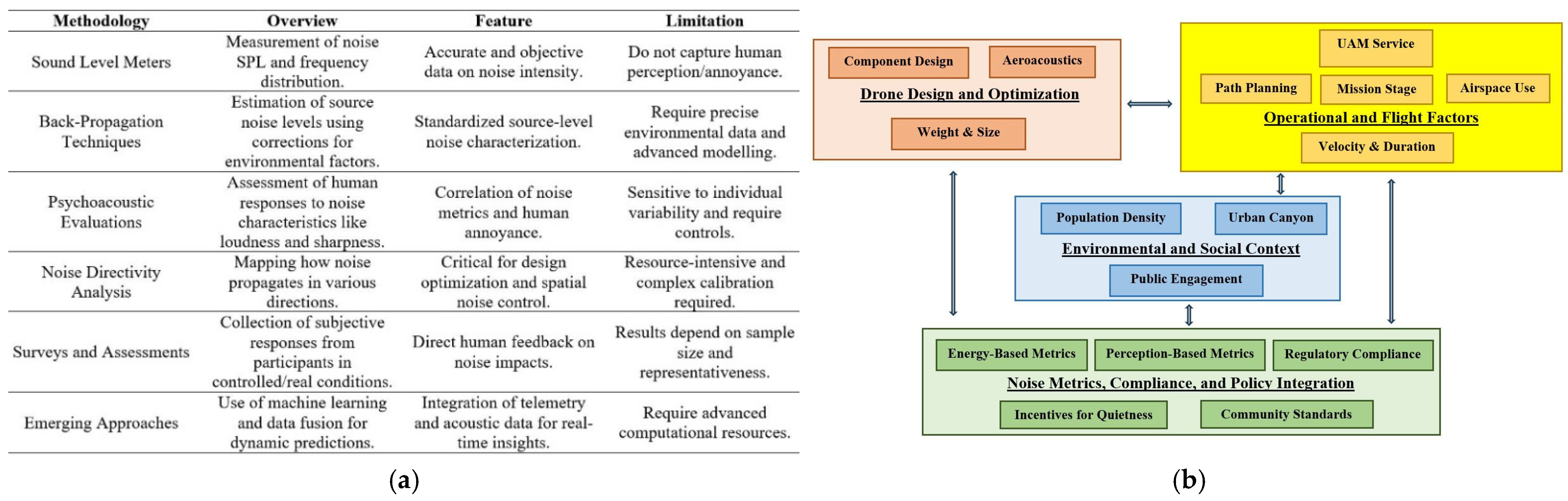
- Component Design: Enhance rotor and propeller designs by optimizing blade pitch, geometry, and materials to reduce aerodynamic noise.
- Weight and Size: Minimize drone weight and dimensions to achieve lower acoustic signatures while maintaining functionality for specific tasks.
- Aeroacoustics: Address tonal and broadband noise components through advanced aeroacoustics modeling, improving noise directivity and reducing annoyance levels.
- UAM Service: Abstract information about the vehicle characteristics, flight stages, and operating and environmental conditions of the UAM service under consideration.
- Path Planning: Develop optimized flight paths that avoid densely populated areas and sensitive zones such as schools, hospitals, and parks. Incorporate real-time data on weather and airspace restrictions to adapt routes dynamically. Develop a comprehensive path planning framework considering both ground risks [28] and noise footprints [9]. In this sense, preliminary optimization can be achieved via metric-based planning of air corridors [29].
- Velocity and Duration: Implement speed adjustments to minimize noise propagation during critical flight stages. Optimize the operational duration to reduce cumulative noise exposure.
- Mission Stage: Focus on noise reduction during take-off, landing, and hovering, which are closer to receptor points. Investigate transition stages for smoother noise profiles.
- Airspace Use: Establish noise-sensitive zones and enforce altitude restrictions to mitigate community noise impacts. Leverage extended visual line-of-sight (EVLOS) and beyond visual line-of-sight (BVLOS) technologies to reduce proximity to receptors.
- Population Density Mapping: Utilize GIS data to identify low-density flight paths for minimized human exposure to noise. Integrate urban and rural soundscapes to adapt operations based on location-specific requirements.
- Urban Canyon Effects: Model urban environments to predict and mitigate noise amplification caused by reflections and diffractions from buildings. Develop noise abatement strategies tailored to complex urban geometries.
- Public Engagement: Conduct community noise trials to gather feedback and refine operations. Incorporate perceptual metrics such as psychoacoustic annoyance models into planning and evaluation.
- Energy-Based Metrics: Quantify cumulative noise exposure with appropriate metrics such as the A-weighted equivalent continuous sound level (LAeq), LAeq over time period T (LAeqT), overall sound pressure level (OASPL), and sound exposure level (SEL). Measure noise directivity and spectral distribution to assess the noise impact comprehensively.
- Perception-Based Metrics: Evaluate sound quality metrics (SQMs) and psychoacoustic models for subjective noise annoyance. Investigate the correlation of noise perception and operational parameters.
- Regulatory Compliance: Align UAM operations with established standards, including LAmax thresholds for urban and rural contexts. Incorporate noise measurement protocols from ISO and other international guidelines.
- Incentives for Quietness: Encourage manufacturers to adopt quieter propulsion systems and noise-optimized designs through subsidies or tax benefits.
- Community Standards: Establish noise-sensitive operational hours and enforce restrictions in high-impact zones.
5. Concluding Remarks
Author Contributions
Funding
Institutional Review Board Statement
Informed Consent Statement
Data Availability Statement
Acknowledgments
Conflicts of Interest
Appendix A
References
- Panov, I.; Haq, A.U. A Critical Review of Information Provision for U-Space Traffic Autonomous Guidance. Aerospace 2024, 11, 471. [Google Scholar] [CrossRef] [Scilit]
- Hua, J.; Mankbadi, R.R. Prediction and Control of Broadband Noise Associated with Advanced Air Mobility—A Review. Appl. Sci. 2024, 14, 8455. [Google Scholar] [CrossRef] [Scilit]
- Yang, C.; Wallace, R.J.; Huang, C. A Review and Bibliometric Analysis of Unmanned Aerial System (UAS) Noise Studies Between 2015 and 2024. Acoustics 2024, 6, 997–1020. [Google Scholar] [CrossRef] [Scilit]
- Candeloro, P.; Ragni, D.; Pagliaroli, T. Small-Scale Rotor Aeroacoustics for Drone Propulsion: A Review of Noise Sources and Control Strategies. Fluids 2022, 7, 279. [Google Scholar] [CrossRef] [Scilit]
- Nt, S.K.; Duba, P.K.; Mannam, N.P.B.; Mutnuri, V.S.; Rajalakshmi, P. Aeroacoustics and Vibration Analysis of Multirotor eVTOL for Sustainable Urban Air Mobility (UAM). IEEE Sens. Lett. 2024, 8, 2000204. [Google Scholar] [CrossRef] [Scilit]
- Araghizadeh, M.S.; Sengupta, B.; Lee, H.; Myong, R.S. Aeroacoustic investigation of side-by-side urban air mobility aircraft in full configuration with ground effect. Phys. Fluids 2024, 36, 87160. [Google Scholar] [CrossRef] [Scilit]
- Schäffer, B.; Pieren, R.; Heutschi, K.; Wunderli, J.M.; Becker, S. Drone Noise Emission Characteristics and Noise Effects on Humans—A Systematic Review. Int. J. Environ. Res. Public Heal. 2021, 18, 5940. [Google Scholar] [CrossRef] [Scilit] [PubMed]
- Tan, Q.; Li, Y.; Wu, H.; Zhou, P.; Lo, H.K.; Zhong, S.; Zhang, X. Enhancing sustainable urban air transportation: Low-noise UAS flight planning using noise assessment simulator. Aerosp. Sci. Technol. 2024, 147, 109071. [Google Scholar] [CrossRef] [Scilit]
- Rinaldi, M.; Primatesta, S.; Guglieri, G. Low-Noise Path Planning for Urban Drone Missions: Acoustic Ray Tracing and DDPG Algorithm. Aeronaut. J. 2025, 129, 3379–3401. [Google Scholar] [CrossRef] [Scilit]
- Ackerman, K.A.; Gregory, I.M.; Theodorou, E.; Hovakimyan, N. A Model Predictive Control Approach for In-Flight Acoustic Constraint Compliance. In Proceedings of the AIAA Scitech 2021 Forum, Online, 11–15 and 19–21 January 2021. [Google Scholar]
- Tan, Q.; Hou, J.; Li, Y.; Qu, R.; Zhou, P.; Zhong, S.; Lo, H.K.; Zhang, X. Exploring noise reduction strategies: Optimizing drone station placement for last-mile delivery. Transp. Res. Part D Transp. Environ. 2024, 133, 104306. [Google Scholar] [CrossRef] [Scilit]
- König, R.; Babetto, L.; Gerlach, A.; Fels, J.; Stumpf, E. Prediction of perceived annoyance caused by an electric drone noise through its technical, operational, and psychoacoustic parameters. J. Acoust. Soc. Am. 2024, 156, 1929–1941. [Google Scholar] [CrossRef] [Scilit] [PubMed]
- Yupa-Villanueva, R.M.; Merino-Martinez, R.; Altena, A.; Snellen, M. Psychoacoustic Characterization of Multirotor Drones in Realistic Flyover Maneuvers. In Proceedings of the 30th AIAA/CEAS Aeroacoustics Conference (2024), Rome, Italy, 4–7 June 2024. [Google Scholar]
- Martinez, A.J.T.; Ramos-Romero, C.A.; Green, N. Acoustic and Psychoacoustic Characterisation of Unmanned Aircraft Systems as a Function of Vehicle Mass and Flight Procedure. In Proceedings of the 30th AIAA/CEAS Aeroacoustics Conference (2024), Rome, Italy, 4–7 June 2024. [Google Scholar]
- Vaughn, A.B.; Christian, A. Individual response trends to urban air mobility noise in a laboratory study. J. Acoust. Soc. Am. 2024, 155, A113. [Google Scholar] [CrossRef] [Scilit]
- Lotinga, M.J.B.; Ramos-Romero, C.; Green, N.; Torija, A.J. Noise from Unconventional Aircraft: A Review of Current Measurement Techniques, Psychoacoustics, Metrics and Regulation. Curr. Pollut. Rep. 2023, 9, 724–745. [Google Scholar] [CrossRef] [Scilit]
- Herold, G.; Sarradj, E. Characterizing Multicopter UAV Noise Emission Through Outdoor Fly-by Measurements With a Microphone Array. In Proceedings of the 30th AIAA/CEAS Aeroacoustics Conference (2024), Rome, Italy, 4–7 June 2024. [Google Scholar]
- Go, Y.-J.; Choi, J.-S. An Investigation of Multi-rotor Drone Noise Based on the Acoustic Hemisphere in an Actual Environment. Int. J. Aeronaut. Space Sci. 2024, 25, 420–434. [Google Scholar] [CrossRef] [Scilit]
- Gill, H.; Lee, S. Development of New Empirical Rotor Broadband Noise Prediction Models for Urban Air Mobility Applications. In Proceedings of the AIAA SCITECH 2024 Forum, Orlando, FL, USA, 8–12 January 2024. [Google Scholar]
- Kim, Y.; Lee, S. Deep learning based prediction of urban air mobility noise propagation in urban environment. J. Acoust. Soc. Am. 2024, 155, 171–187. [Google Scholar] [CrossRef] [Scilit] [PubMed]
- ISO 9613-2:1996; Acoustics—Attenuation of Sound During Propagation Outdoors—Part 2: General Method of Calculation. International Organization for Standardization: Geneva, Switzerland, 1996.
- Ramos-Romero, C.; Green, N.; Asensio, C.; Torija, A.J. Towards a Taxonomy for the Assessment of the Unmanned Aerial Systems Noise Emissions. In Proceedings of the Quiet Drones 2024, Manchester, UK, 8–11 September 2024. [Google Scholar]
- ISO 15666:2003; Acoustics—Assessment of Noise Annoyance by Means of Social and Socio-Acoustic Surveys. International Organization for Standardization: Geneva, Switzerland, 2003.
- Green, N.; Torija, A.J. Comparing the Human Response of Unmanned Aircraft System Noise and Other Transportation Noise. In Proceedings of the Quiet Drones Conference 2024, Manchester, UK, 8–11 September 2024. [Google Scholar]
- Torija, A.J.; Clark, C. A Psychoacoustic Approach to Building Knowledge about Human Response to Noise of Unmanned Aerial Vehicles. Int. J. Environ. Res. Public Health 2021, 18, 682. [Google Scholar] [CrossRef] [Scilit] [PubMed]
- Ramos-Romero, C.; Green, N.; Torija, A.J.; Asensio, C. On-field noise measurements and acoustic characterisation of multi-rotor small unmanned aerial systems. Aerosp. Sci. Technol. 2023, 141, 108537. [Google Scholar] [CrossRef] [Scilit]
- Snellen, M.; Merino-Martínez, R.; Altena, A.; Amiri-Simkooei, A.; Cappagli, C.A.; Morin, A.; Quaroni, L.N.; Yunus, F.; Yupa-Villanueva, R.M. Research on drone and urban air mobility noise: Measurement, modelling, and human perception. In Proceedings of the Quiet Drones 2024 Conference, Manchester, UK, 8–11 September 2024. [Google Scholar]
- Rinaldi, M.; Primatesta, S. Comprehensive Task Optimization Architecture for Urban UAV-Based Intelligent Transportation System. Drones 2024, 8, 473. [Google Scholar] [CrossRef] [Scilit]
- Wang, S.; Liu, H.; Rinaldi, M.; Tsang, Y.P. Evaluating the impact of air corridors on the environment and public interests. Transp. Res. Part D Transp. Environ. 2025, 143, 104732. [Google Scholar] [CrossRef] [Scilit]
Disclaimer/Publisher’s Note: The statements, opinions and data contained in all publications are solely those of the individual author(s) and contributor(s) and not of MDPI and/or the editor(s). MDPI and/or the editor(s) disclaim responsibility for any injury to people or property resulting from any ideas, methods, instructions or products referred to in the content. |
© 2026 by the authors. Licensee MDPI, Basel, Switzerland. This article is an open access article distributed under the terms and conditions of the Creative Commons Attribution (CC BY) license.
Share and Cite
Rinaldi, M.; Maghsoodi, S.; Primatesta, S. On the Assessment of Drone Noise for Sustainable Urban Air Mobility Operations. Eng. Proc. 2026, 133, 43. https://doi.org/10.3390/engproc2026133043
Rinaldi M, Maghsoodi S, Primatesta S. On the Assessment of Drone Noise for Sustainable Urban Air Mobility Operations. Engineering Proceedings. 2026; 133(1):43. https://doi.org/10.3390/engproc2026133043
Chicago/Turabian StyleRinaldi, Marco, Saeed Maghsoodi, and Stefano Primatesta. 2026. "On the Assessment of Drone Noise for Sustainable Urban Air Mobility Operations" Engineering Proceedings 133, no. 1: 43. https://doi.org/10.3390/engproc2026133043
APA StyleRinaldi, M., Maghsoodi, S., & Primatesta, S. (2026). On the Assessment of Drone Noise for Sustainable Urban Air Mobility Operations. Engineering Proceedings, 133(1), 43. https://doi.org/10.3390/engproc2026133043

