Proceeding Paper

Surrogate Modeling of Non-Linear Folding Wing Tip Aerodynamic Coefficients †
by
Andreas Molz
* and
Christian Breitsamter
Chair of Aerodynamics and Fluid Mechanics, School of Engineering and Design, Technical University of Munich, 85748 Garching b. München, Germany
*
Author to whom correspondence should be addressed.
Presented at the 15th EASN International Conference, Madrid, Spain, 14–17 October 2025.
Eng. Proc. 2026, 133(1), 3; https://doi.org/10.3390/engproc2026133003
Published: 14 April 2026

Abstract

The development of sustainable and efficient aircraft concepts, such as those featuring flared folding wing tips (FWTs), introduces both aerodynamic and structural challenges. FWTs have demonstrated strong potential for enhancing aerodynamic performance and alleviating gust-induced loads, making them an attractive option for next-generation transport aircraft. This study investigates the load reduction potential of transonic transport aircraft configurations equipped with hinged FWTs, with particular focus on gust impact. Reynolds Averaged Navier Stokes simulations are combined with Gaussian Process regression to evaluate the influence of the fold angle, flare angle, and angle of attack on key quantities of interest, including lift and wing root bending moment coefficients. The GP surrogate model, developed within the Gust Load Alleviation by Non-linear Folding Wing Tip (GUSTAFO) project, accurately reproduces the high-fidelity data while capturing the underlying system uncertainties. The results show that increasing the flare angle within a given folding deflection can reduce the wing root bending moment by up to 38% for flare angles between 0– 45 and fold angles between 0– 15 . These findings highlight the effectiveness of surrogate-based modeling for early-stage design and emphasize the importance of incorporating FWT behavior to achieve accurate, efficient, and robust load predictions.

1. Introduction

The design of next-generation transonic transport aircraft faces the critical challenge of balancing structural integrity against demanding fuel efficiency targets. A major factor dictating structural weight is the requirement to withstand extreme aerodynamic loads induced by atmospheric turbulence. While conventional control surfaces are currently utilized for modest load alleviation, their inherent limitations in authority and bandwidth restrict their application. Folding wing tips (FWTs) represent a promising avenue for advanced load control. By allowing dynamic, large-scale alterations by wing tip deployment, the lift distribution across the span can effectively alleviate loads under gust impact, thereby reducing the critical bending moment. For a flared FWT, the resulting non-linear change in aerodynamic loading is defined by a complex correlation between several parameters, including the flare angle Λ and the fold angle θ . Accurately predicting this parameterized response remains a crucial challenge for preliminary design and control system development. This study addresses this challenge by investigating the load alleviation potential of a specific hinged FWT, with a particular emphasis on gust-induced load cases. Reynolds Averaged Navier Stokes (RANS) simulations are employed to analyze the influence of the key geometric parameters Λ , θ and the angle of attack (AoA) α on critical quantities of interest (QoI), specifically the lift and the wing root bending moment coefficients. This work focuses on developing a computationally low-cost and robust surrogate model using the Gaussian process (GP) regression technique. This approach accurately captures high-fidelity system behavior, including the underlying uncertainties, and provides an efficient tool for subsequent design optimization and control law synthesis.

2. State of the Art

FWTs have emerged as a promising concept for improving aerodynamic efficiency and gust load alleviation in next-generation transport aircraft. Early investigations at the University of Bristol demonstrated that flexible FWTs can reduce wing-root bending moments and enable span increases without significant load penalties [1,2]. Subsequent studies explored dynamic behavior and gust response, showing measurable load reductions through passive or semi-active folding mechanisms [3]. More recent research addressed structural integration challenges, such as morphing fairings for FWT joints, which improve aerodynamic continuity while maintaining mechanical flexibility [4]. In parallel, surrogate modeling techniques have become essential for accelerating aerodynamic design while retaining high-fidelity accuracy. GP regression, introduced by Rasmussen and Williams [5], has gained wide adoption for its ability to model non-linear aerodynamic responses with limited data while providing inherent uncertainty quantification. Several studies have successfully applied GP-based surrogates to aerodynamic coefficient prediction and aeroelastic analysis, demonstrating an excellent predictive performance and efficiency [6,7]. The integration of such surrogate models with high-fidelity FWT simulations enables rapid exploration of design parameters such as fold angle, flare angle, and AoA, offering a data-driven pathway toward efficient gust load mitigation and early-stage aircraft optimization.

3. Methodology

3.1. Geometry

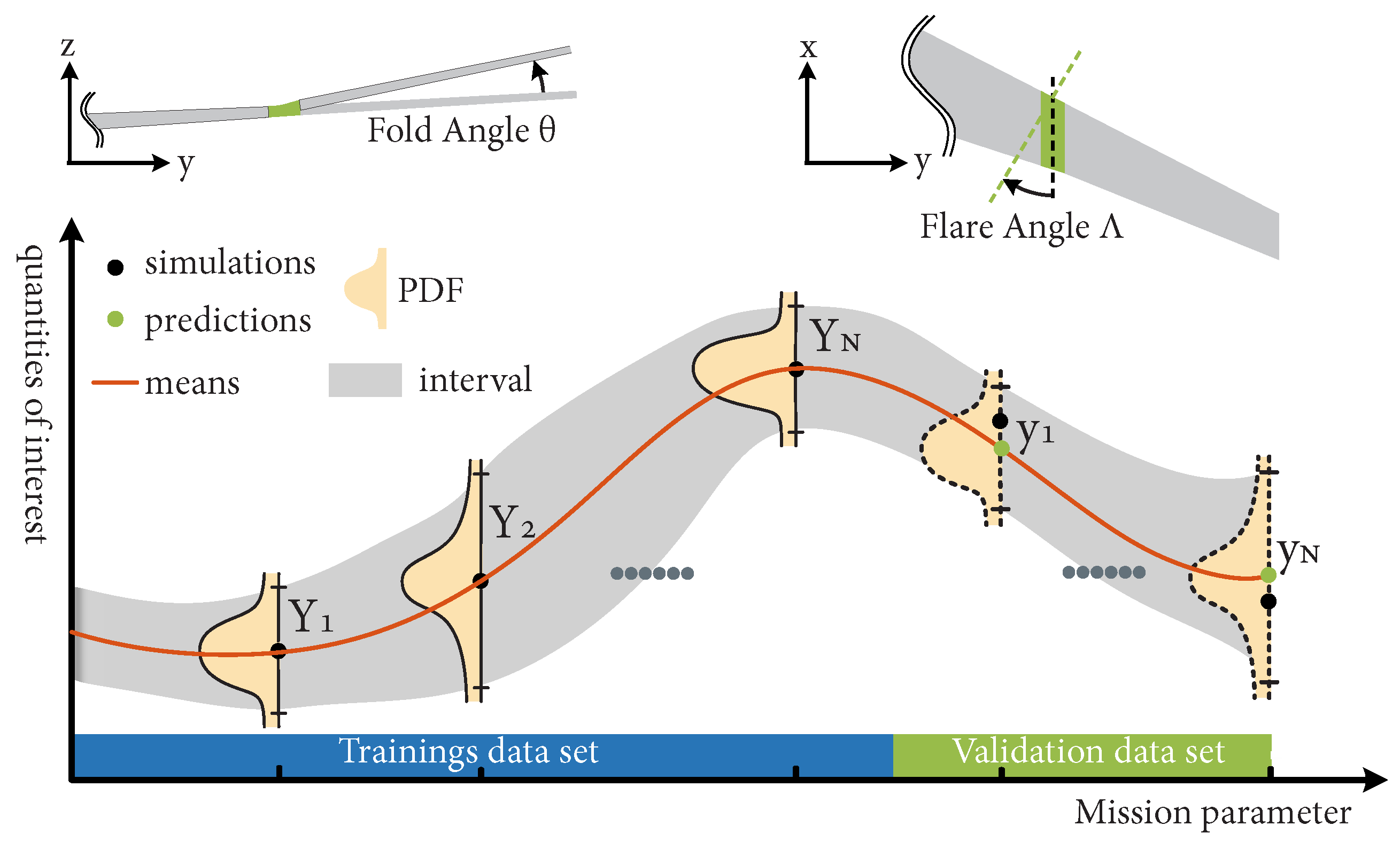
This study evaluates the integration of technology in future aircraft development by focusing solely on the main wing of the GUSTAFO-1.0 configuration [8], specifically analyzing the GUSTAFOWing-1.0 as a half-model. The GUSTAFOWing-1.0 model details are depicted in Figure 1, which illustrates the definition of the fold and the flare angle. A key feature of FWT is the flare angle Λ , which defines the orientation of the hinge axis relative to the freestream direction. The fold angle θ designates to a rotation about the hinge line, respectively, to the wings initial position. For a positive flare angle Λ , the local AoA on the wing tip decreases as the fold angle increases. The correlation between the change in local AoA and the fold angle can be described by
Δ α = arctan ( sin Λ tan θ ) .
To eliminate gaps in the geometry caused by rotation of the FWT, a transition element is introduced, highlighted in green. This element ensures a smooth transition between the wing and FWT segment in deflection.

3.2. Numerical Approach

RANS simulations, using Ansys Fluent 23R1, are employed to evaluate the aerodynamic performance and gust load situation of the GUSTAFOWing-1.0. The flow is assumed steady, compressible, with cruise conditions defined at Mach M a = 0.78 and altitude 35,000 ft. The k ω SST turbulence model is used to capture the flow at the high-aspect-ratio wing. A parametric study over the fold angle θ , flare angle Λ , and AoA α is conducted, providing high-fidelity data for the QoI, such as the lift coefficient C L and wing-root bending moment coefficient C w r b m . These results are used as training and validation data for a stochastic GP surrogate model, enabling efficient predictions of aerodynamic characteristics without repeated CFD simulations.

3.3. Stochastic Surrogate Model

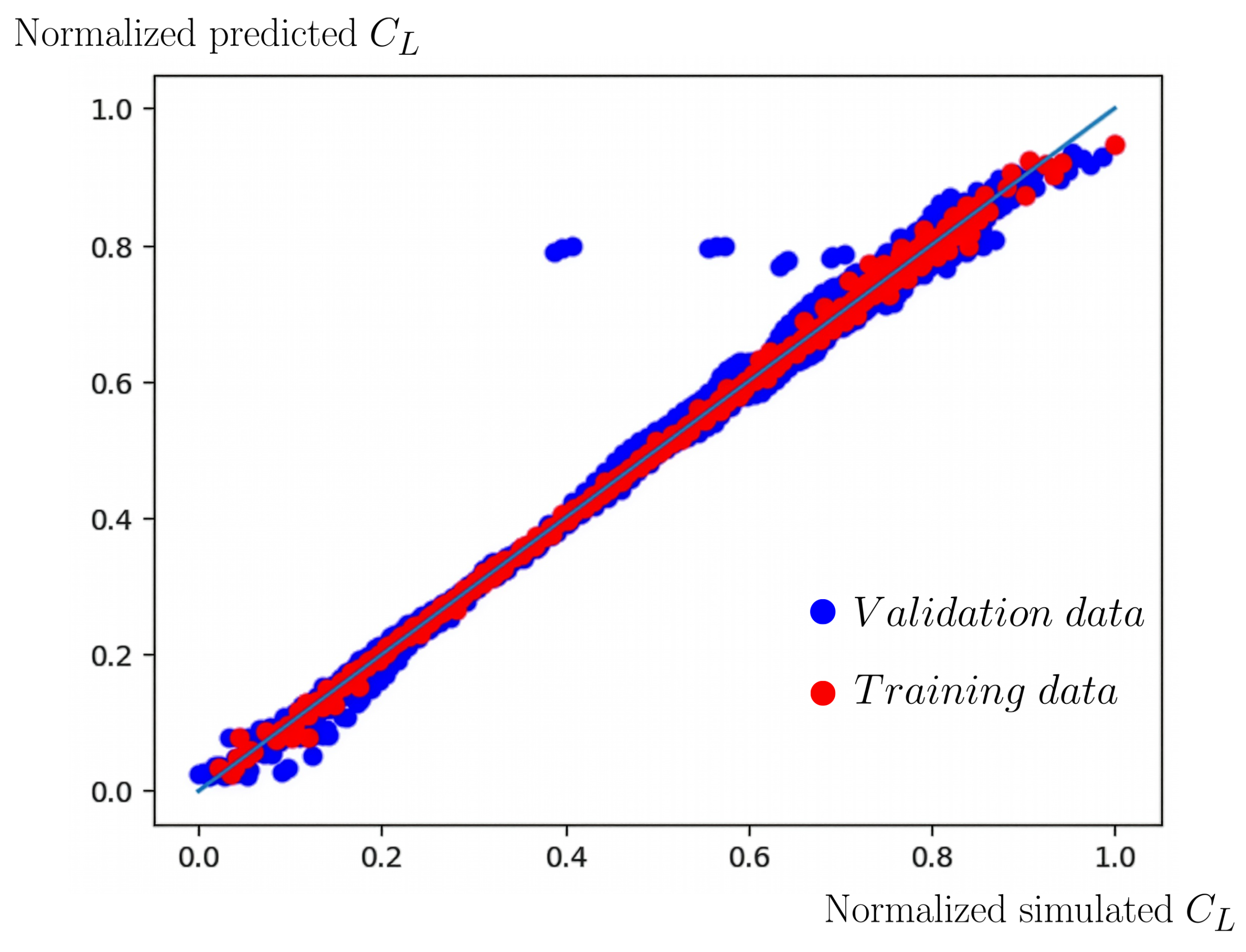
The GP regression tool, previously established as an efficient method for high-fidelity data interpolation and uncertainty quantification, is applied to the FWT design problem [5]. The objective is to create a surrogate model that accurately captures the complex aerodynamic response of the FWT configuration as a function of key mission and folding parameters. In Figure 2, the function value represents the QoI, that the model predicts. Two distinct and critical QoI are identified for model construction: The Lift coefficient, which is associated with steady level flight, and the wing root bending moment coefficient, which is the primary indicator of the aerodynamic loading. These outputs are modeled as independent variables whose values are governed by a set of controlling mission parameters. The input space is defined by three independent angular parameters that characterize the current flight configuration: the fold angle θ , the flare angle Λ , and the AoA α , see Figure 2. Consequently, two separate GP models, one for the lift coefficient and one for the wing root bending moment coefficient, are trained, each mapping these three angular inputs to its respective scalar output. To facilitate efficient training and leverage hardware acceleration capabilities, the GP models were implemented using the GPyTorch library [9], a powerful machine learning framework built upon the underlying PyTorch ecosystem. The specification of these models requires making certain prior assumptions about the target function. The assumption of a constant mean function is made. Furthermore, a Radial Basis Function (RBF) kernel with automatic relevance determination is chosen. This selection is advantageous because it allows the model to have a distinct length scale for each input parameter—the fold angle, flare angle, and AoA—which is crucial for capturing potentially differing sensitivities. This combination of the constant mean function and the anisotropic RBF kernel results in a model governed by four hyperparameters that require optimization to fit the GP. For the dataset employed in this study, the training process converged smoothly, allowing for the attainment of accurate surrogate models. Figure 3 presents a parity plot illustrating the correlation between the RANS simulation data and the GP model’s predicted lift coefficient C L for the training data set (highlighted in red) and the validation data set (depicted in blue). The diagonal line with a slope of unity represents a perfect fit, where points above this line indicate an overprediction, and points below the line correspond to an underprediction of the C L values. The following section will present the specific key findings and the resulting predictions.

4. Results

4.1. Global Aerodynamic Coefficients

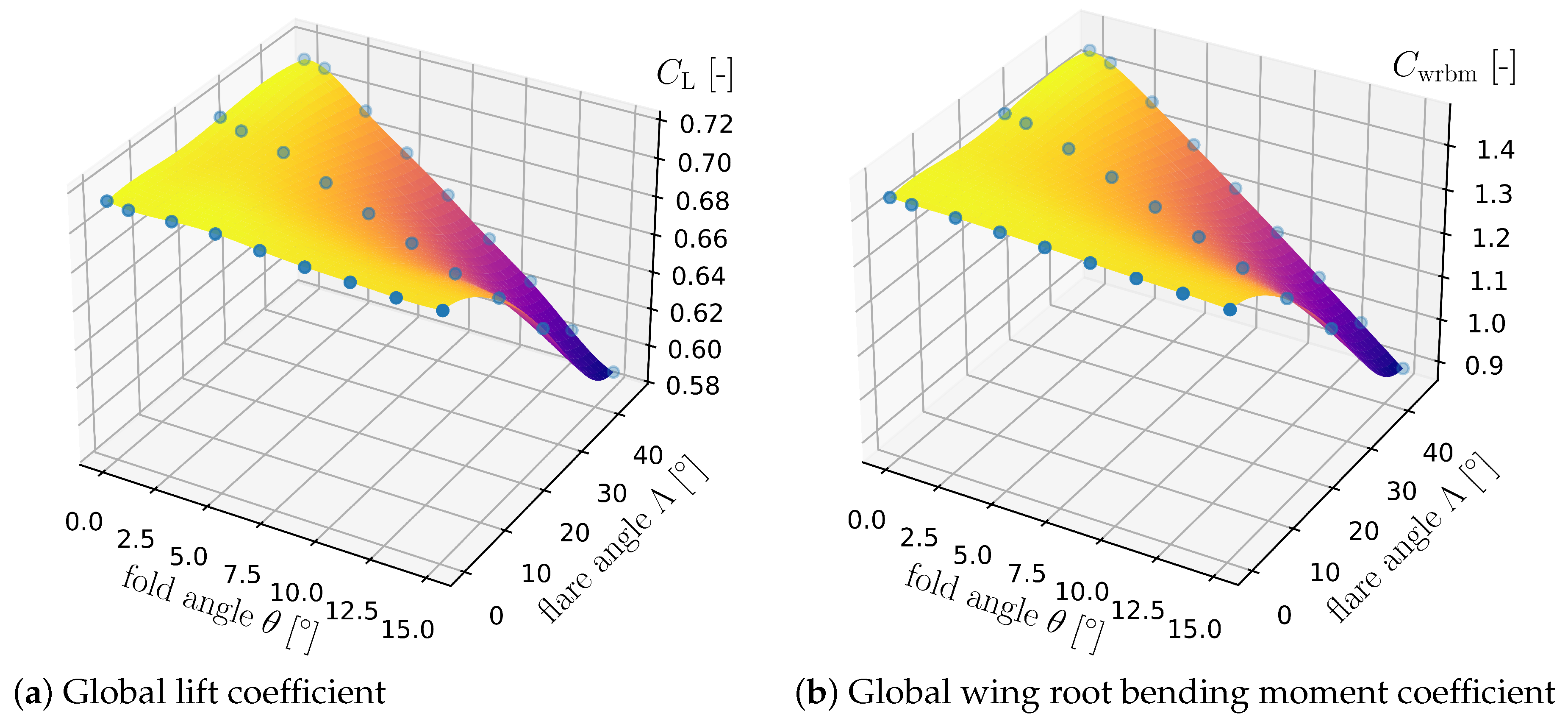
The evaluation of the trained GP surrogate models commences with an analysis of the predicted global aerodynamic coefficients. For this initial discussion, the results are examined for a specific mission case defined by a total AoA of α = 3.2 . This angle is derived from the summation of the necessary cruise flight α c r u i s e = 1.2 and a Δ α g u s t = 2 contribution due to the certification specifications CS 25 mandated gust encounter. The parameter space mapped within Figure 4 covers a folding angle θ range from 0 to 15 at a flare angle range Λ from 0 to 45 . Figure 4 presents the lift coefficient C L and the wing root bending moment coefficient C w r b m prediction across a defined parameter space. This plot synthesizes the discrete high-fidelity simulation points, for discrete flare angles 0 , 25 , and 45 , rendered as data in a contour map, with the continuous, underlying surface generated by the GP model, which represents the interpolated fit. For the undeflected FWT configuration θ = 0 , the lift coefficient C L remains consistent across all three flare angle settings Λ = 0 , 25 , 45 , stabilizing at approximately 0.73 . This value serves as the baseline performance metric for the wing under the specified gust-critical AoA. The introduction of the hinged fold mechanism yields a maximum reduction in C L when operating at the maximum deflected configuration: the flare angle of 45 combined with the maximum folding angle of 15 . The reduction of C L refers to the increased lift coefficient induced by the gust Δ α g u s t = 2 . This specific configuration results in a reduced gust C L value of 0.58 , demonstrating the aerodynamic impact of the morphing geometry. Therefore, a maximum alleviation of the lift coefficient of 20.5 % is obtained. Crucially, this substantial 20.5 % reduction in C L could yield to a potential alleviation of the wing root bending moment, C w r b m . Under a gust impact condition (AoA α = 3.2 ) with the undeflected outer wing tip, a maximum wing root bending moment coefficient of C B M = 1.44 is observed. In the case where the hinge is deflected to 45 flare angle and 15 fold angle, the wing root bending moment coefficient is substantially reduced to C w r b m = 0.895 . This demonstrates a highly effective load alleviation, resulting in a maximum reduction of the bending moment coefficient by 37.9 % . The contour plots Figure 4a,b illustrates the GP model prediction, which shows a perfect agreement with the discrete simulation results, underscoring the model’s high fidelity.

4.2. Local Aerodynamic Coefficients

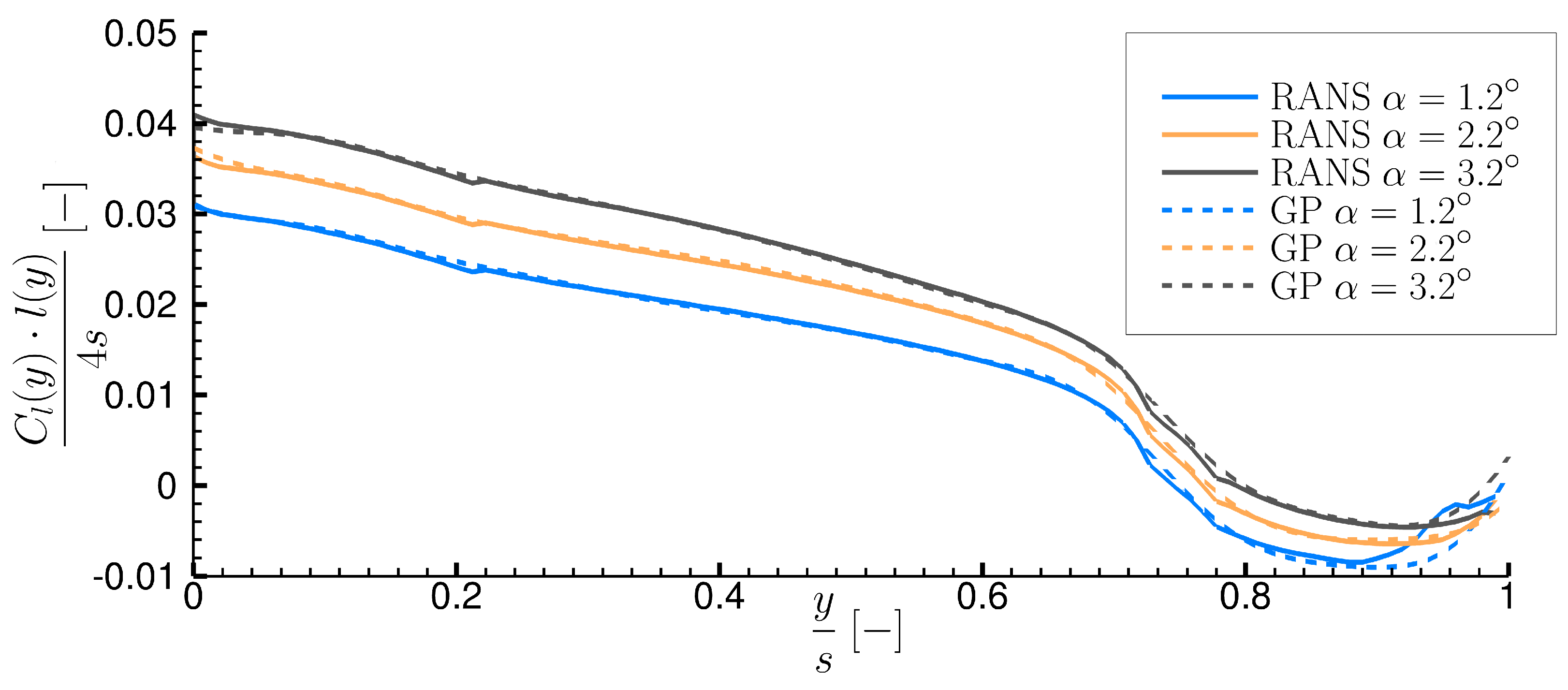
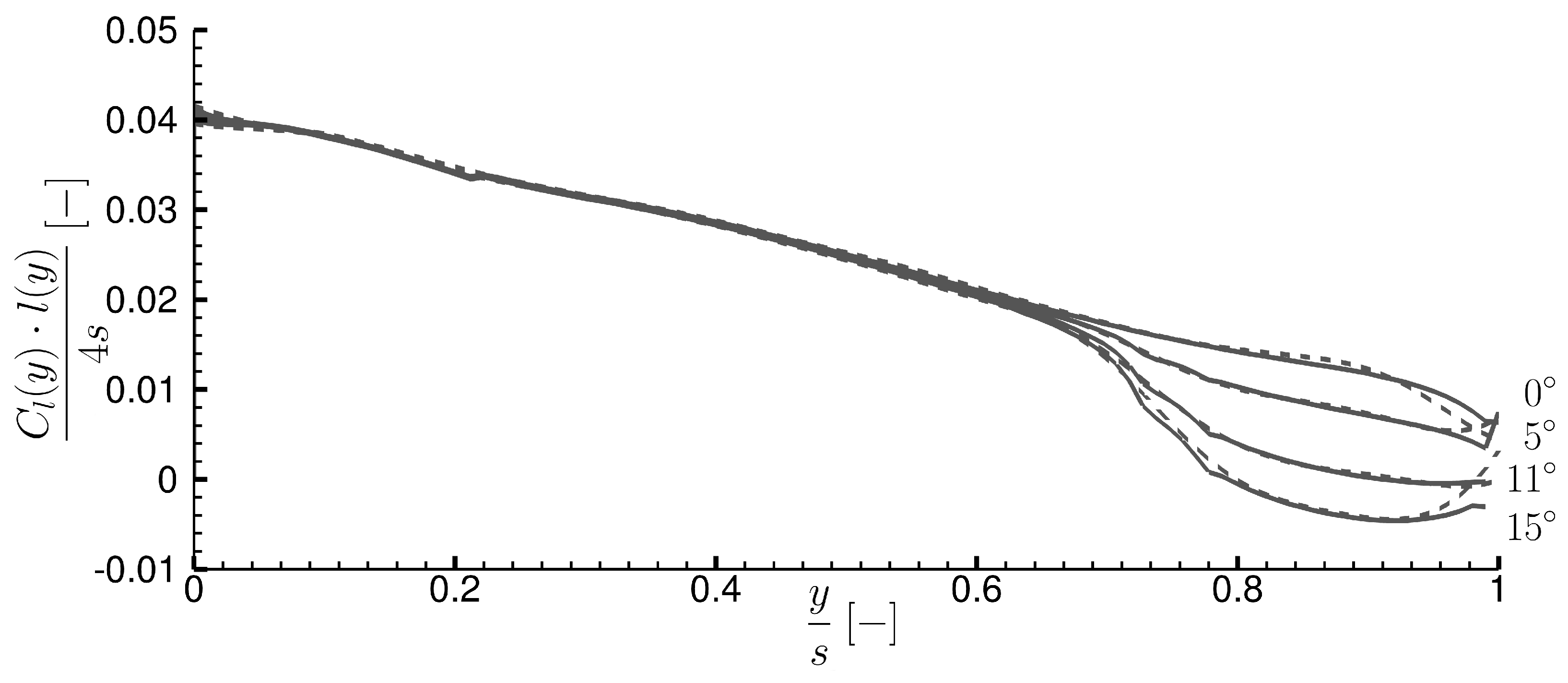
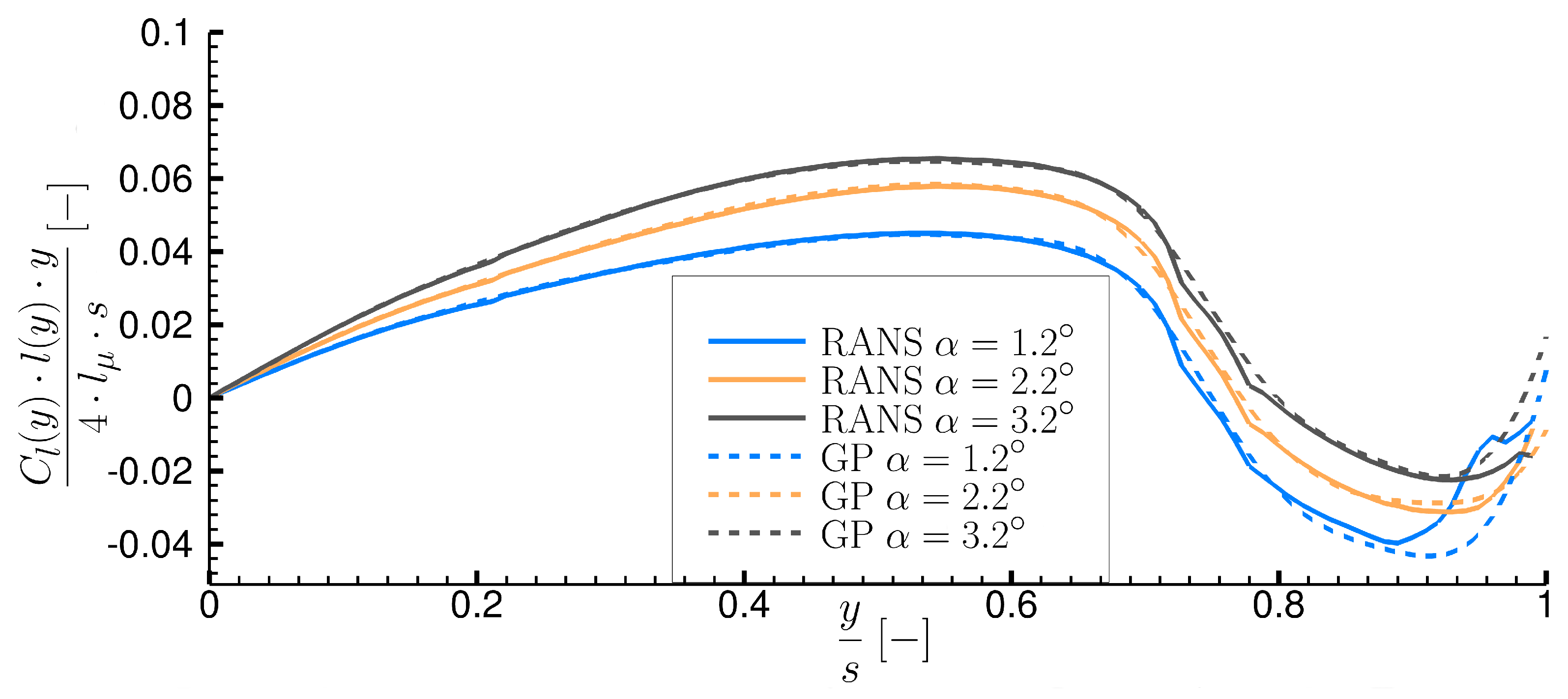
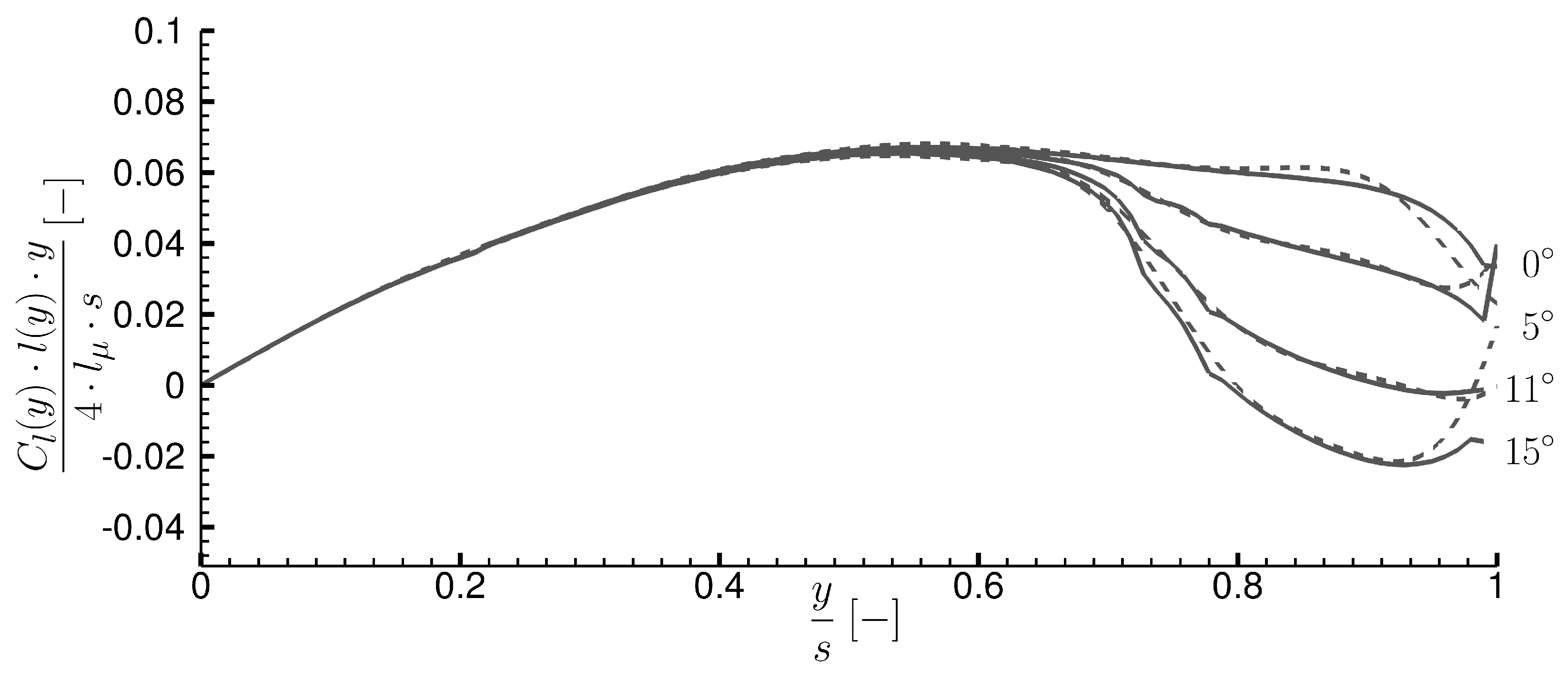
Given the significant alleviation potential demonstrated by FWT, maximum 20.5 % reduction in C L and 37.9 % reduction in C w r b m at gust impact, a detailed local aerodynamic load assessment is warranted. We evaluate the local spanwise aerodynamic loading C l · l ( y ) and the spanwise bending moment distribution as a function of the AoA α and the fold angle θ . Based on the preliminary global results, which showed the maximum load reduction for the case Λ = 45 , the subsequent analysis is restricted to the flare angle Λ = 45 , as this configuration is the most promising for effective load alleviation. This focused evaluation allows for a clear understanding of how the non-linear fold locally reshapes the wing’s lift distribution along with the root bending moment reduction. The influence of AoA α on the local aerodynamic loading is shown in Figure 5. The non-dimensional spanwise lift distribution, C l · l ( y ) / ( 4 s ) , is presented for the fixed, highly-deflected configuration Λ = 45 , θ = 15 across three angles of attack: α = 1.2 , 2.2 , and 3.2 . The results confirm the high fidelity of the GP model, where the GP predictions show excellent agreement with the CFD simulation results for all three cases. However, a slight discrepancy between the GP prediction and the CFD data is observed near the wing tip η > 0.95 , indicating that three-dimensional effects in this highly deflected region pose a challenge for precise GP interpolation. As expected, increasing the AoA from 1.2 to 3.2 results in a uniform increase in the magnitude of the local aerodynamic loading across the entire span of the wing. Crucially, the presence of the hinged fold, η > 0.7 , at the wing tip significantly alters the characteristic shape of the lift distribution compared to a conventional wing. This deflection causes a pronounced and desirable reduction in the local loading towards the wing tip, which is directly related to the observed 20.5 % alleviation of the wing’s lift coefficient C L in gust. The overall profile of the spanwise load remains qualitatively similar as α increases, suggesting that within this operational range, the effect of the folding mechanism remains predictably stable, allowing the flared FWT to effectively mitigate gust loads across investigated flight conditions. Figure 6 presents the spanwise distribution of the non-dimensional local aerodynamic load, C l · l ( y ) / ( 4 s ) , showing the influence of the fold angle θ at the combined cruise and gust condition of Λ = 45 and α = 3.2 . As in the previous analysis, the GP predictions show excellent agreement with the CFD simulations, validating the model’s accuracy across the range of fold deflections. The data clearly show that the fold angle is the primary control for local load modulation. For the undeflected case ( θ = 0 ), the wing exhibits a standard lift distribution, but with a significant load maintained to the wing tip. However, as the fold angle is progressively increasing ( θ from 5 to 15 ), a substantial reduction in local lift is achieved, specifically outboard of the hinge location ( η 0.77 ). The rising deflection drives the local load magnitude towards zero and into the negative regime at the wing tip, confirming the non-linear fold’s role as a highly effective load alleviation device. This capability to selectively redistribute lift from the outboard wing, mainly by the fold angle θ , directly reduces the lever arm of the primary lifting force, thereby minimizing the bending moment. The spanwise bending moment distribution, presented in Figure 7 and Figure 8, directly quantifies the alleviation potential demonstrated by FWT. Figure 7 illustrates the moment distribution for the case ( Λ = 45 , θ = 15 ) across varying angles of attack ( α ), showing that the bending moment is effectively mitigated across the α range, increasing uniformly as expected. Crucially, the distribution peaks around mid-span η 0.5 before decreasing toward the wing tip, confirming the successful shortening of the effective moment arm due to outboard lift reduction. Furthermore, Figure 8 isolates the influence of the fold angle ( θ = 0 to 15 ) at a combined cruise and gust impact condition, demonstrating that θ is the primary control for bending moment reduction. The moment magnitude at the wing root ( η = 0 ) progressively decreases with increasing fold angle θ , directly confirming the findings for the global wing root bending moment coefficient. Additionally, increasing θ causes the point of maximum bending moment to shift slightly inboard and decrease significantly in value, showing how the flared hinge geometry reshapes the bending moment characteristics. In both Figure 7 and Figure 8, the GP prediction shows good correlation with the CFD data across the span, validating the model’s predictive accuracy.

5. Conclusions

The present investigation evaluated the aerodynamic load and bending moment alleviation potential of a flared folding wing tip, primarily focusing on the most effective configuration, Λ = 45 . The Reynolds Averaged Navier Stokes (RANS) analysis demonstrated that the non-linear folding tip mechanism is highly effective as a load alleviation device. The maximum deflected state ( Λ = 45 , θ = 15 ) yielded a 20.5 % reduction in the lift coefficient C L and, especially, a 37.9 % reduction in the wing root bending moment coefficient C w r b m under combined cruise and gust condition. This substantial load alleviation benefit is physically achieved by the deflection, redistributing lift from the outboard wing, thereby shortening the moment arm of the primary lifting force. The detailed analysis of the local spanwise lift distribution C l · l ( y ) and the resulting spanwise bending moment distribution confirmed this mechanism, showing the largest load reductions occurring progressively with the increasing fold angle θ . A central aspect of this study was the generation of cost-effective, high-fidelity surrogate models suitable for downstream applications like control system design. Successfully employing Gaussian processes (GP) to build stochastic surrogate models that accurately predict the QoI ( C L , C w r b m , and local loads) across arbitrary combinations of parameters, like flare angle, fold angle, and angle of attack. The GP predictions showed good agreement with the RANS simulation data across the entire investigated cases, with model divergence only noted near the wing tip ( η > 0.95 ). Looking ahead, future work will focus on enhancing the model efficiency and accuracy per sample. The current approach employs independent GP models for each QoI, despite their known physical interdependence. A promising avenue for optimization is to leverage these correlations using more sophisticated methods, such as Multi-Output Gaussian Processes (MOGPs). The goal is to investigate the application of MOGPs to determine their influence on improving model accuracy while simultaneously reducing the volume of necessary CFD training data, ultimately reducing the computational cost of model generation.

Author Contributions

Conceptualization, methodology, validation, investigation, writing—review and editing, A.M. and C.B.; supervision, C.B. All authors have read and agreed to the published version of the manuscript.

Funding

The authors declare that this study received funding from the Federal Ministry for Economic Affairs and Energy (BMWE) within the LuFo VI-2 project GUSTAFO (Gust Load Alleviation by Folding non-linear Wing Tip, FKZ: 20E2104C). The funder was not involved in the study design, collection, analysis, interpretation of data, the writing of this article or the decision to submit it for publication.

Data Availability Statement

The data presented in this study are available on request from the corresponding author.

Acknowledgments

The authors want to thank ANSYS for providing the flow simulation software used for the numerical investigations and the Gauss Centre for Supercomputing e.V. for funding this project by providing computing time on the SuperMuc at the Leibniz Supercomputing Center.

Conflicts of Interest

The authors declare no conflicts of interest.

References

  1. Castrichini, A.; Hodigere Siddaramaiah, V.; Calderon, D.; Cooper, J.E.; Wilson, T.; Lemmens, Y. Preliminary investigation of use of flexible folding wing tips for static and dynamic load alleviation. Aeronaut. J. 2017, 121, 73–94. [Google Scholar] [CrossRef]
  2. Cheung, R.C.M.; Rezgui, D.; Cooper, J.E.; Wilson, T. Testing of Folding Wingtip for Gust Load Alleviation of a Flexible High Aspect Ratio Wing. J. Aircr. 2020, 57, 341–354. [Google Scholar] [CrossRef]
  3. Gu, J.; Wilson, T.; Cooper, J.E. Sizing of High-Aspect-Ratio Wings with Folding Wingtips. J. Aircr. 2023, 60, 461–475. [Google Scholar] [CrossRef]
  4. Mahid, N.M.; Schenk, M.; Titurus, B.; Woods, B.K.S. Parametric Design Studies of GATOR Morphing Fairings for Folding Wingtip Joints. Smart Mater. Struct. 2025, 34, 025049. [Google Scholar] [CrossRef]
  5. Rasmussen, C.E.; Williams, C.K.I. Gaussian Processes for Machine Learning; MIT Press: Cambridge, MA, USA, 2006. [Google Scholar]
  6. Jentys, M.M.; Breitsamter, C. Surrogate Modeling of Hybrid Laminar Wing Aerodynamic Coefficients. In Notes on Numerical Fluid Mechanics and Multidisciplinary Design; Springer: Berlin/Heidelberg, Germany, 2024; Volume 154. [Google Scholar] [CrossRef]
  7. Andrés-Pérez, E.; Paulete-Periáñez, J. Surrogate Regression Models for Aerodynamic Coefficients. Complex Intell. Syst. 2021, 7, 1241–1256. [Google Scholar] [CrossRef]
  8. Molz, A.; Breitsamter, C. Nonlinear Folding Wing Tips for Gust Loads Alleviation; Deutsche Gesellschaft für Luft-und Raumfahrt-Lilienthal-Oberth eV: Bonn, Germany, 2024. [Google Scholar] [CrossRef]
  9. Gardner, J.R.; Pleiss, G.; Bindel, D.; Weinberger, K.Q.; Wilson, A.G. GPyTorch: Blackbox Matrix-Matrix Gaussian Process Inference with GPU Acceleration. In Advances in Neural Information Processing Systems; MIT Press: Cambridge, MA, USA, 2018. [Google Scholar]
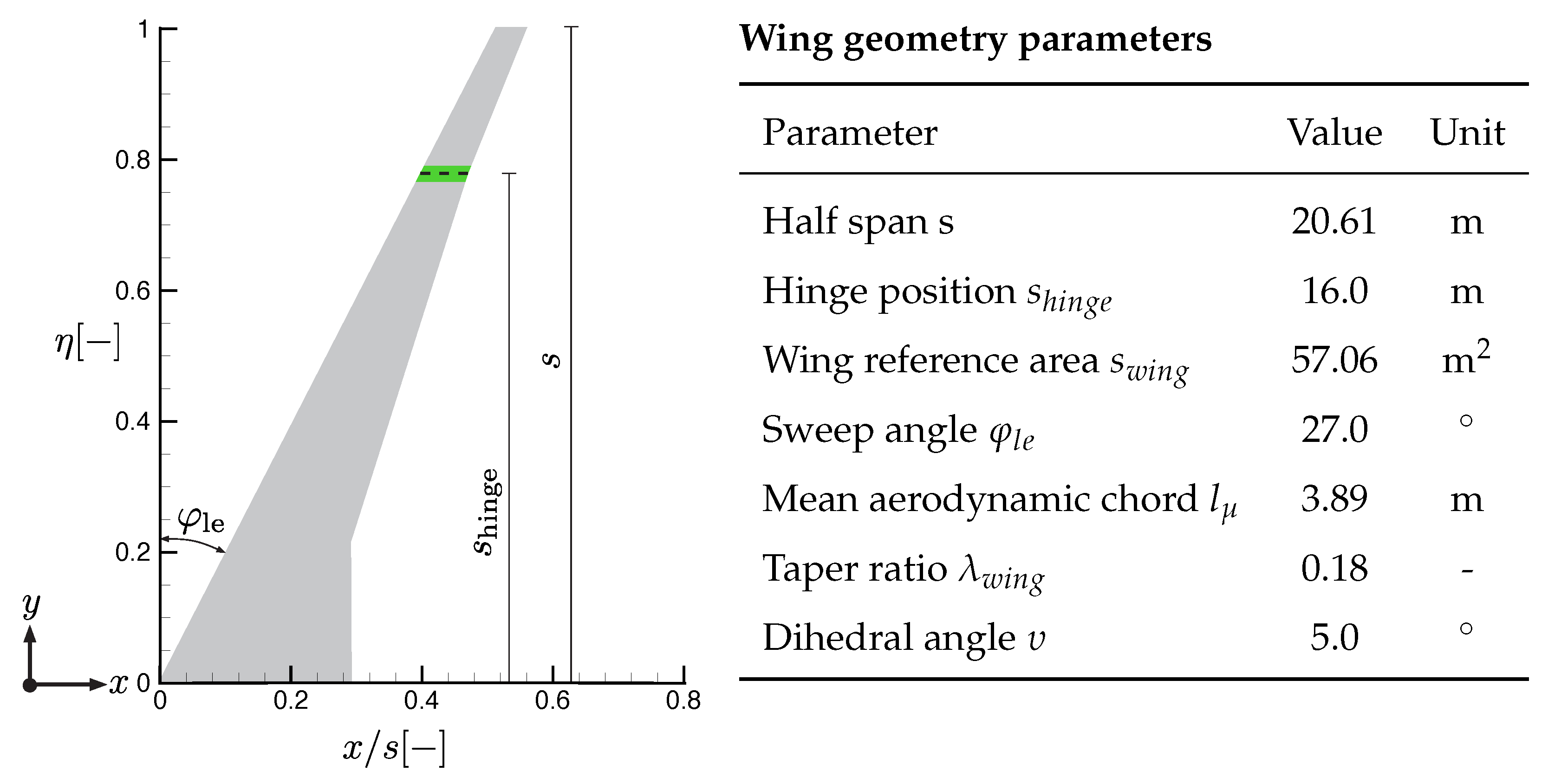
Figure 1. (Left) planform view of the GUSTAFOWing-1.0. The hinge is highlighted at η hinge 0.77 . The transition element is marked in green. (Right) Table with wing geometry parameters.
Engproc 133 00003 g001
Figure 2. (Top): Depiction of the fold and flare angle definition. (Bottom): GP regression with mean line and uncertainty prediction for training and data set validation.
Engproc 133 00003 g002
Figure 3. GP model fit quality for the global lift coefficient C L based on RANS simulations.
Engproc 133 00003 g003
Figure 4. (a) Global lift coefficient, C L , and (b) wing root bending moment coefficient, C w r b m , as a function of the flare angle Λ f and fold angle θ . The contour map illustrates the GP model prediction based on the discrete data points, which mark the CFD simulation results.
Engproc 133 00003 g004
Figure 5. Influence of AoA ( α ) on the spanwise distribution of the non-dimensional local aerodynamic load, C l · l ( y ) / ( 4 s ) , for the fixed configuration Λ = 45 and θ = 15 . Results are shown for α = 1 . 2 , 2 . 2 , and 3 . 2 . The simulation results are represented by the solid lines, while the GP predictions are illustrated by the dashed lines.
Engproc 133 00003 g005
Figure 6. Influence of the fold angle ( θ ) on the spanwise distribution of the non-dimensional local aerodynamic load, C l · l ( y ) / ( 4 s ) , for the fixed configuration Λ = 45 and α = 3 . 2 . Results are shown for θ = 0 , 5 , 11 , and 15 . The simulation results are represented by the solid lines, while the GP predictions are illustrated by the dashed lines.
Engproc 133 00003 g006
Figure 7. Influence of AoA ( α ) on the spanwise distribution of the non-dimensional local bending moment, C l · l ( y ) · y / ( 4 s · l μ ) , for the fixed configuration Λ = 45 and θ = 15 . Results are shown for α = 1 . 2 , 2 . 2 , and 3 . 2 . The simulation results are represented by the solid lines, while the GP predictions are illustrated by the dashed lines.
Engproc 133 00003 g007
Figure 8. Influence of the fold angle ( θ ) on the spanwise distribution of the non-dimensional local bending moment, C l · l ( y ) · y / ( 4 s · l μ ) , for the fixed configuration Λ = 45 and α = 3 . 2 . Results are shown for θ = 0 , 5 , 11 , and 15 . The simulation results are represented by the solid lines, while the GP predictions are illustrated by the dashed lines.
Engproc 133 00003 g008
Disclaimer/Publisher’s Note: The statements, opinions and data contained in all publications are solely those of the individual author(s) and contributor(s) and not of MDPI and/or the editor(s). MDPI and/or the editor(s) disclaim responsibility for any injury to people or property resulting from any ideas, methods, instructions or products referred to in the content.