


Abstract
The accurate anticipation of passenger demand across specific origin–destination (OD) airport routes is a cornerstone of strategic and operational decision-making within the global aviation sector, including airlines optimizing fleet and route management, airports planning infrastructure development, and regulatory bodies overseeing airspace efficiency. However, conventional forecasting techniques frequently encounter limitations when confronted with the inherent complexities and non-linear interdependencies that characterize air travel demand patterns. These patterns are shaped by an array of dynamic variables, including macroeconomic trends, population dynamics, distinct seasonal variations, and emergent phenomena. This investigation evaluates the utility of Artificial Intelligence (AI) paradigms in constructing predictive models for monthly passenger volumes between international OD airport pairs. This work highlights the ongoing transformative impact of AI methodologies on forecasting tasks within the aviation industry.
1. Introduction
Accurate forecasting of air passenger demand is essential for strategic planning across the aviation sector, informing critical decisions by airports, airlines, and regulators regarding long-term infrastructure investments, fleet management, and operational efficiency. The inherent challenge lies in predicting demand for specific origin–destination (OD) airport pairs, which function as complex dynamic systems [1,2].
Forecasting methodologies can be broadly categorized into qualitative and quantitative approaches. Quantitative models are predominantly favored in air transportation forecasting due to their reliance on empirical data and potential for greater objectivity [3]. Within the quantitative realm, two primary model types have commonly been employed: time series and econometric models. Time series models focus on extrapolating historical trends and patterns observed within the demand data itself, using past values to predict future outcomes. In contrast, econometric models aim to establish causal relationships, predicting demand based on its correlation with external independent variables such as Gross Domestic Product (GDP), population, or airfares [2,4]. Among the most established are gravity models, which estimate passenger volume based on the socioeconomic characteristics of the origin and destination (such as GDP and population) and the “friction” between them (such as distance or cost) [5,6]. While widely used, these models can require complex calibration for different route types (e.g., short-haul vs. long-haul) and historically have focused on a fixed set of existing city-pairs, struggling to account for the dynamic evolution of the route network itself [6]. These limitations, coupled with the need to model complex patterns, have led to increased interest in data-driven paradigms including Artificial Intelligence (AI) that aim to learn patterns and dependencies directly from historical demand data.
The forecasting horizon also dictates model choice and application. Short-term forecasts are vital for managing daily operations, whereas long-term forecasts, extending years into the future, are indispensable for guiding the substantial infrastructure and equipment investments characteristic of the air transport industry [2]. Traditional statistical techniques based on time series models like Simple Exponential Smoothing [7] or variations of AutoRegressive Integrated Moving Average (ARIMA) models [8] models have often been applied for such long-term projections. Posterior paradigms, particularly involving Long Short-Term Memory (LSTM) neural networks [9] and gradient boosting (GB) algorithms [10] like XGBoost [11], LightGBM [12], and CatBoost [13], offer promising alternatives to these conventional methods. LSTMs are adept at modeling sequential data with temporal dependencies, while gradient boosting methods are noted for their computational efficiency and ability to effectively integrate multiple variables. These capabilities are particularly relevant for modeling air travel demand, given that demand patterns are influenced by a wide array of dynamic exogenous factors, including macroeconomic trends (e.g., GDP growth), population dynamics and other global phenomena [2,14].
Despite the promise of AI, forecasting remains challenging, especially in the wake of major disruptions like the COVID-19 pandemic, which fundamentally altered historical demand patterns [2]. This underscores the need for models that are not only accurate in stable conditions but also resilient and adaptive. Furthermore, much research targets specific regions, whereas globally applicable forecasting strategies are required.
This investigation contributes by presenting a comparative study of various quantitative forecasting paradigms applied to the challenge of mid-term, monthly passenger demand forecasting for worldwide OD airport pairs. We evaluate a range of models, from naive baselines to classical time series methods and modern Machine Learning (ML) and Deep Learning (DL) architectures, focusing explicitly on pre-pandemic accuracy and post-pandemic resilience. Our goal is to identify practical, globally relevant strategies capable of adapting to the evolving complexities of the modern aviation landscape.
2. Materials and Methods
2.1. Data Sources and Preprocessing
The primary dataset for this study consists of historical monthly passenger (pax) traffic for a worldwide set of origin–destination (OD) airport pairs, spanning the period from January 2010 to June 2024 and sourced from two different data sources, namely SABRE [15] and OAG [16]. Although the data would be ideally expected to be identical in both sources, discrepancies do exist, necessitating a correction process [17].
For the experimental phases involving multivariate models, this primary traffic dataset was augmented with exogenous variables, including airport and route characteristic information. Real Gross Domestic Product (GDP) at Purchasing Power Parity (PPP), sourced from S&P [18], was included with country–year granularity, with historical data and forecasts available from 1990 to 2055. Total population data, also sourced from S&P with country–year granularity and time coverage available from 1990 to 2055, provided the demographic data.
2.2. General Modeling and Evaluation Strategy
To compare different modeling approaches, we defined a two-phase evaluation strategy.
2.2.1. Phase 1: Pre-COVID Benchmarking
To establish a stable performance baseline, we first partitioned the data to isolate pre-pandemic trends. Data from January 2010 to December 2018 was used as training set, with data from January 2019 to December 2019 as test set. This 2019 hold-out set represents a full, recent, pre-pandemic cycle. To facilitate rapid iteration during this exploratory phase, we created a representative subset of the top 1000 OD pairs by total passenger volume, containing the most representative instances from a business perspective while remaining computationally manageable.
2.2.2. Phase 2: Post-COVID Resilience Test
To assess model robustness to the structural break caused by the pandemic, we re-partitioned the data. Based on preliminary analysis of the pandemic’s impact for modeling, it was evident that the unprecedented drop in traffic during the entire year of 2020 was found to corrupt the models’ understanding of normal seasonality and trend. Therefore, for post-pandemic modeling, models were trained on a discontinuous time series, effectively stitching the data from 2010–2019 to the data from 2021–2024. This way, data from [2010–2019] plus [2021–2022] (excluding 2020) constituted the training set, and data from January to December 2023 was used to test how well models trained on pre-pandemic and early-recovery data could predict the more stabilized, “new normal” patterns of 2023.
2.2.3. Evaluation Metrics
The primary metric for comparison is the Passenger-Volume Weighted Average MAPE (WMAPE). This metric is a variant of the Mean Absolute Percentage Error (MAPE) that weights the error for each time series by its total passenger (pax) volume. This ensures that errors on high-traffic, commercially significant routes have a proportionally larger impact on the final score, aligning the metric with business importance.
2.3. Model Prototypes
Our methodology involved an iterative prototyping process, comparing different classes of models. Attending to their nature, the models were categorized as univariate as opposed to multivariate, and as local as opposed to global.
2.3.1. Initial Developments: SARIMA and Custom Neural Network
- SARIMA (Local Univariate): The first approach was to treat each OD pair as an independent time series using the Seasonal AutoRegressive Integrated Moving Average (SARIMA) model [8]. SARIMA is a well-established statistical benchmark that explicitly models trend, seasonality, and autoregressive components. While a strong baseline, this local approach has limitations: it is computationally expensive to fit thousands of individual models, it cannot learn patterns from other similar routes and the basic implementation is purely univariate and therefore unable to incorporate exogenous factors, though variations of the method enable it.
- Custom Neural Network (Global Multivariate): The second prototype represented a shift to a global, multivariate Deep Learning model. LSTMs [9] are specifically designed to capture long-term temporal dependencies. As a global model, trained on all time series simultaneously, it can learn general patterns of seasonality and demand drivers from all routes. The architecture was designed to integrate a set of different types of features, including temporal-dependent (e.g., lagged passengers, GDP, population) and static features (e.g., route distance). Categorical features like origin and destination airport were fed through embedding layers, allowing the model to learn nuanced relationships between locations. Despite its theoretical power, this approach introduced significant practical complexity in feature engineering, architecture design, and hyperparameter tuning. The tuning process was deemed too time-intensive for the benchmarking phase, leading to a pivot towards a more streamlined framework.
2.3.2. Standardized Benchmarking with Darts: Naive Models, Exponential Smoothing, Prophet, LightGBM
To overcome the trade-off between the simplicity of SARIMA and the complexity of a custom LSTM, we adopted the Darts library [19]. Darts provides a unified API for a wide variety of forecasting models, enabling rapid and fair comparison. Within this framework, we benchmarked several key models on the 1000 OD pairs pre-COVID dataset.
- Naive Model Baselines (Local, Univariate): We first established baselines using NaiveMean (projects the mean of the past data—in this case, of the last full year available), NaiveDrift (extrapolates the linear trend), and NaiveSeasonal (repeats the values from the last seasonal period, considering 12-month seasonality).
- Exponential Smoothing (Local, Univariate): The Holt–Winters variant was implemented, which applies exponentially decreasing weights to past observations and can model level, trend and seasonality [20].
- Prophet (Local, Univariate and Multivariate): This is a decompositional model [21], which models a time series as a sum of trend, seasonality, and holiday components. It was tested as a univariate model and with GDP and population as exogenous covariates.
- LightGBM (Global, Multivariate): We implemented a global model of the gradient boosting framework. A single model was trained on all time series, using past lags of passenger data, future covariates (GDP, population), and static covariates, both categorical and numerical (e.g., origin/destination country, route distance), as features.
3. Results
3.1. Pre-COVID Benchmarking
The initial benchmarking on the n = 1000 OD subset using the 2019 test set yielded clear results, summarized in Table 1.
Table 1.
Pre-COVID model performance benchmark. All models were trained on 2010–2018 data and evaluated on 2019 data for the top 1000 OD pairs. The primary metric is the Passenger-Volume Weighted Average MAPE (WMAPE).
The NaiveSeasonal model, which simply repeats the previous year’s values, proved to be a strong baseline for the pre-COVID scenario and the best among the naive model versions implemented, with a WMAPE of 12.40%. This confirms the highly seasonal nature of air travel demand.
The global LightGBM model (11.86%) and the local Exponential Smoothing model (11.41%) both outperformed this baseline. However, the most striking finding was the failure of models with exogenous covariates. The Prophet model’s performance worsened when GDP and population data were added (12.84% vs. 12.49%). The LightGBM model was likely hindered by this same data. The underlying cause originating this behaviour is reviewed in Section 3.2.
3.2. Covariate Data Analysis
The failure of the covariate-based models is explained by two critical flaws in the time dependent exogenous variables that were used, namely population and GDP of origin and destination countries. These variables did not have enough geographical coverage and the series was mostly incomplete or nonexistent. The sourced population data, for example, had coverage for only approximately 10 countries within the subset. For the vast majority of OD pairs, this feature was missing. Pearson’s correlation analysis between the (available) exogenous variables and the target variable (passengers) of the subset revealed an extremely weak linear relationship. The correlation for all variables was below 0.08 in absolute value.
This analysis demonstrates that the poor performance of the multivariate models was not due to a flaw in the algorithms themselves, but rather a direct consequence of low-quality, incomplete, and weakly predictive input data.
The local Exponential Smoothing model, relying only on the historical passenger data, achieved the best performance despite its simplicity, which coupled with its interpretability makes it the most robust choice given the data limitations.
3.3. Post-COVID Resilience
The second phase of evaluation tested the models’ resilience to the pandemic-induced structural break. We compared the 2019 (pre-COVID) WMAPE to the 2023 (post-COVID) WMAPE. The results are shown in Table 2.
Table 2.
Post-COVID resilience test. Compares pre-COVID (2019) and post-COVID (2023) WMAPE scores. The post-COVID models were trained on 2010–2019 and 2021–2022 data, excluding 2020.
The performance of the naive models collapsed. The error of the best-performing naive model, NaiveSeasonal, more than tripled (from 12.40% to 41.55%). This proves that the stable seasonal and linear trend patterns from the pre-2020 era are no longer a reliable guide for forecasting.
In contrast, Exponential Smoothing’s error increased from 11.41% to 18.23%. This shows that the model, by giving exponential weight to more recent observations, was able to adapt to the new post-pandemic recovery trends and revived seasonality. This result validated the choice of ES.
3.4. Final Modeling and Forecast Analysis
Based on the analysis of the results, the final model implementation was a local (per-time series) Holt–Winters Exponential Smoothing model [20] with a 12-month seasonal period to capture yearly seasonality and incorporating a damping parameter that prevents the trend component from growing or shrinking unboundedly over the long-term forecast horizon, resulting in more realistic long-term predictions.
The model was trained on the full available dataset (January 2010–June 2024, with 2020 excluded) and used to generate a 11-year forecast for every origin–destination pair series that passed validation checks (e.g., minimum number of observations in the time series and recent data availability), which prevented the model from generating unreliable forecasts for data-sparse routes and ensured model convergence. An analysis on the forecast coverage reveals that for these filtered-out series the mean passenger volume was only ∼160 passengers, therefore being commercially insignificant. The forecast’s geographical coverage is very heterogeneous. Many nations affected by conflict or political instability have low or no coverage, likely attributable to data reporting disruptions.
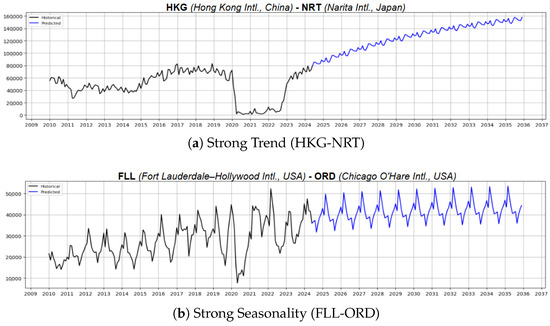
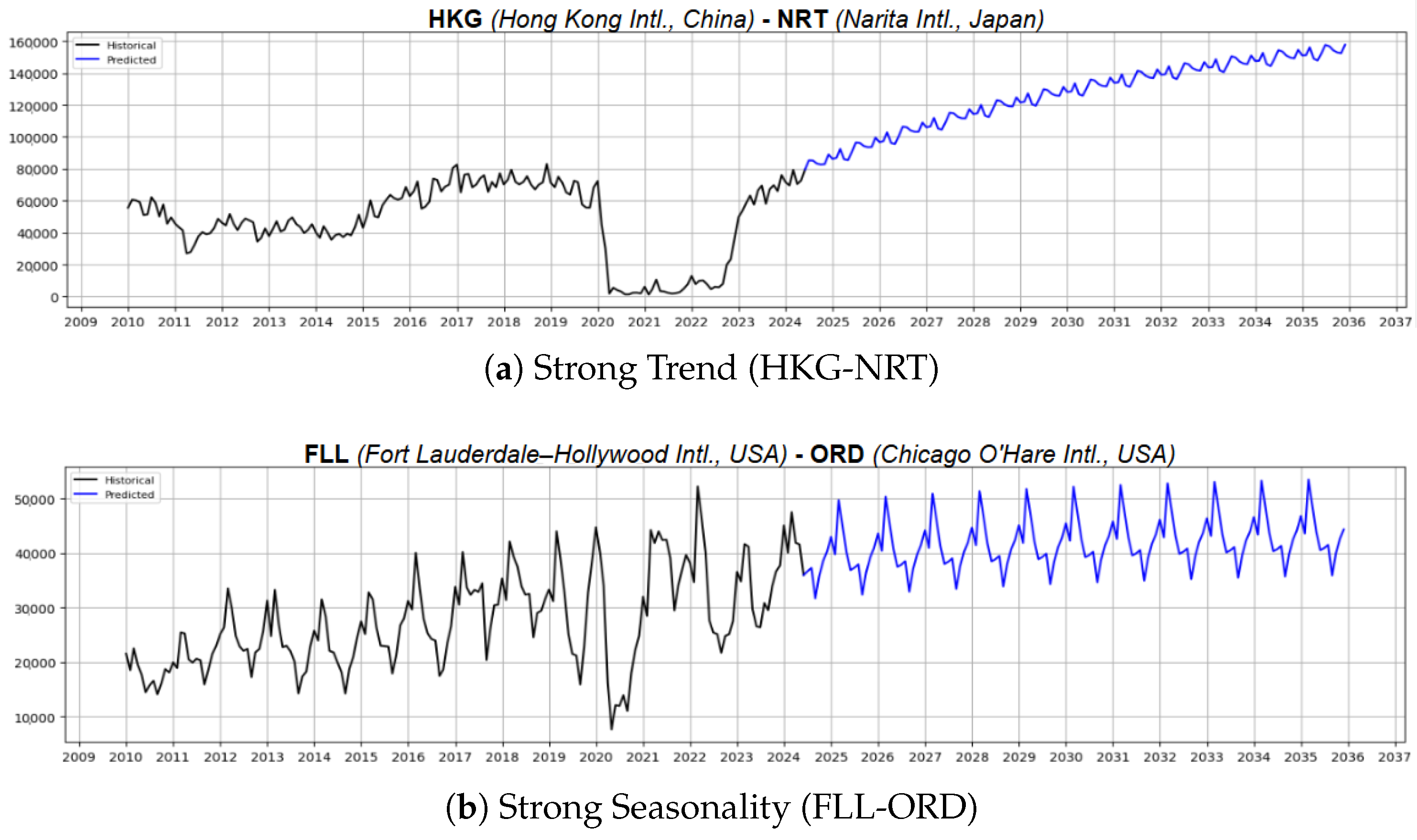
A qualitative analysis of the resulting forecasts, shown in Figure 1, confirms the model’s adaptability:
Figure 1.
Sample forecasts from the final Exponential Smoothing (Holt–Winters) models. The model adapts to diverse time series profiles—(a) capturing and projecting a strong upward trend with a dampening effect; (b) identifying and extrapolating strong, regular seasonality—while fitting the recovery observed from 2021 onwards for the two OD pairs. Historical data is in black and the forecast is in blue.
- Strong Trend: On routes with consistent growth (Figure 1a), the model captures the momentum and projects it forward. It is visible that the trend flattens, preventing unrealistic exponential growth.
- Strong Seasonality: The model effectively identifies and extrapolates regular seasonal patterns, a core strength of the Holt–Winters method (Figure 1b).
- Post-COVID Recovery: The model successfully fits the sharp recovery trend observed from 2021, interpreting this recent steep growth as the new prevailing trend and blending it with historical seasonality (Figure 1a,b).
4. Discussion
This research conducted a comparative study of statistical and Artificial Intelligence paradigms for the long-term, monthly forecasting of passenger demand on global origin–destination airport pairs. Our analysis focused on both pre-pandemic accuracy and post-pandemic resilience. The results of the study provide key insights into the practical challenges of air traffic forecasting, especially in the post-pandemic landscape.
The most significant finding is the structural break caused by the COVID-19 pandemic. The striking drop in accuracy of the naive models, with WMAPE tripling in the best-performing of them, demonstrates that pre-2020 seasonal patterns, once a reliable guide, are no longer sufficient for accurate forecasting. This necessitates the use of adaptive models that can learn from and adjust to new, emerging trends. In this context, the resilience of the classical Holt–Winters Exponential Smoothing model, given its ability to adapt to the post-pandemic recovery data and produce a reasonable error given the volatility, validates the decision to select it for the initial implementation.
While advanced AI models like LSTMs and LightGBM offer theoretical advantages in their ability to process complex patterns and exogenous variables, their potential was unrealized in our study, with a simpler univariate model performing best. This was attributable to the low coverage and granularity of the available macroeconomic and demographic data. However, the LightGBM model’s ability to achieve almost the same pre-COVID result as the best-performing model despite this shows its potential.
The limitation of the current solution is its reactive nature. As a purely univariate model, it can adapt to new trends after they appear in the traffic data, but it cannot anticipate them based on external drivers.
The current modeling approach provides a robust and reliable baseline. Future work will focus on unlocking the potential of global, multivariate AI models. This is not primarily an algorithmic challenge, but a data-sourcing one. The next iteration of this research will be dedicated to sourcing and integrating more granular and more predictive exogenous datasets—such as the population of airport surroundings, regional economic indicators, and labor, consumption, investment, production and tourism data—to build a dynamic and anticipatory forecasting system that can model the complex drivers of air travel demand.
Author Contributions
Conceptualization, A.S.O., A.R.M. and C.A.M.; methodology, A.S.O.; software, A.S.O.; validation, A.S.O., A.R.M. and C.A.M.; formal analysis, A.S.O.; investigation, A.S.O.; data curation, A.S.O. and A.R.M.; writing—original draft preparation, A.S.O.; writing—review and editing, A.R.M. and C.A.M.; visualization, A.S.O. All authors have read and agreed to the published version of the manuscript.
Funding
This research received no external funding.
Institutional Review Board Statement
Not applicable.
Informed Consent Statement
Not applicable.
Data Availability Statement
The data used in this study are proprietary and are not publicly available due to commercial sensitivity.
Acknowledgments
The authors would like to acknowledge the support of the internal research, data and platform Airline Science teams for providing the necessary capabilities, data and computational infrastructure.
Conflicts of Interest
Authors Alicia Serrano Ortega, Albert Ruiz Martín and Clara Argerich Martín were employed by the company Airbus.
References
- OECD/ITF. Airport Demand Forecasting for Long-Term Planning; ITF Round Tables, No. 159; OECD Publishing: Paris, France, 2016. [Google Scholar]
- Javanmard, M.E.; Tang, Y.; Martínez-Hernández, J.A. Forecasting air transportation demand and its impacts on energy consumption and emission. Appl. Energy 2024, 364, 123031. [Google Scholar] [CrossRef] [Scilit]
- Banerjee, N.; Morton, A.; Akartunalı, K. Passenger demand forecasting in scheduled transportation. Eur. J. Oper. Res. 2020, 286, 797–810. [Google Scholar] [CrossRef] [Scilit]
- Kincaid, I.; Tretheway, M.; Gros, S.; Lewis, D. Addressing Uncertainty About Future Airport Activity Levels in Airport Decision Making; ACRP Report 76; Transportation Research Board: Washington, DC, USA, 2012. [Google Scholar]
- Grosche, T.; Rothlauf, F.; Heinzl, A. Gravity models for airline passenger volume estimation. J. Air Transp. Manag. 2007, 13, 175–183. [Google Scholar] [CrossRef] [Scilit]
- Terekhov, I.; Gollnick, V. A concept of forecasting origin-destination air passenger demand between global city pairs using future socio-economic scenarios. In Proceedings of the 53rd AIAA Aerospace Sciences Meeting, Kissimmee, FL, USA, 5–9 January 2015. AIAA 2015-1640. [Google Scholar]
- Brown, R.G. Exponential Smoothing for Predicting Demand and Short-Range Forecasting; Research Paper No. 15; Office of Naval Research, U.S. Navy: Washington, DC, USA, 1959. [Google Scholar]
- Box, G.E.P.; Jenkins, G.M. Time Series Analysis: Forecasting and Control; Holden-Day: San Francisco, CA, USA, 1970. [Google Scholar]
- Hochreiter, S.; Schmidhuber, J. Long short-term memory. Neural Comput. 1997, 9, 1735–1780. [Google Scholar] [CrossRef] [Scilit] [PubMed]
- Friedman, J.H. Greedy Function Approximation: A Gradient Boosting Machine. Ann. Stat. 2001, 29, 1189–1232. [Google Scholar] [CrossRef] [Scilit]
- Chen, T.; Guestrin, C. XGBoost: A Scalable Tree Boosting System. In Proceedings of the 22nd ACM SIGKDD International Conference on Knowledge Discovery and Data Mining, San Francisco, CA, USA, 13–17 August 2016; pp. 785–794. [Google Scholar]
- Ke, G.; Meng, Q.; Finley, T.; Wang, T.; Chen, W.; Ma, W.; Liu, T.Y. LightGBM: A highly efficient gradient boosting decision tree. In Proceedings of the 31st Conference on Neural Information Processing Systems (NIPS 2017), Long Beach, CA, USA, 4–9 December 2017. [Google Scholar]
- Prokhorenkova, L.; Gusev, G.; Vorobev, A.; Dorogush, A.V.; Gulin, A. CatBoost: Unbiased boosting with categorical features. In Proceedings of the 32nd Conference on Neural Information Processing Systems (NeurIPS 2018), Montréal, QC, Canada, 3–8 December 2018. [Google Scholar]
- Nochai, R.; Titisa, P.; Kerdprasop, N.; Kerdprasop, K. Deep Learning vs. Gradient Boosting: Optimizing Transport Energy Forecasts in Thailand Through LSTM and XGBoost. Energies 2024, 17, 1685. [Google Scholar]
- Sabre Inc. Available online: https://www.sabreairlinesolutions.com (accessed on 1 October 2025).
- OAG Aviation Worldwide Limited. Available online: https://www.oag.com/ (accessed on 1 October 2025).
- Curto, J.; Hernández, G.; Alonso-García, M.; Serrano-Ortega, A.; Toledo-Garrote, A.; Chamoso, P. Flow disaggregation: Underdetermined non-negative linear systems. In International Symposium on Ambient Intelligence; Springer Nature: Cham, Switzerland, 2023; pp. 22–32. [Google Scholar]
- S&P Global Market Intelligence. Available online: https://www.spglobal.com/marketintelligence/en/ (accessed on 1 October 2025).
- Herzen, J.; Lässig, F.; Piazzetta, S.G.; Neuer, T.; Tafti, L.; Raille, G.; Van Pottelbergh, T.; Pasieka, M.; Skrodzki, A.; Huguenin, N.; et al. Darts: User-Friendly Modern Machine Learning for Time Series. J. Mach. Learn. Res. 2022, 23, 1–6. [Google Scholar]
- Winters, P.R. Forecasting Sales by Exponentially Weighted Moving Averages. Manag. Sci. 1960, 6, 324–342. [Google Scholar] [CrossRef] [Scilit]
- Taylor, S.J.; Letham, B. Forecasting at scale. Am. Stat. 2017, 72, 37–45. [Google Scholar] [CrossRef] [Scilit]

Disclaimer/Publisher’s Note: The statements, opinions and data contained in all publications are solely those of the individual author(s) and contributor(s) and not of MDPI and/or the editor(s). MDPI and/or the editor(s) disclaim responsibility for any injury to people or property resulting from any ideas, methods, instructions or products referred to in the content. |
© 2026 by the authors. Licensee MDPI, Basel, Switzerland. This article is an open access article distributed under the terms and conditions of the Creative Commons Attribution (CC BY) license.