Proceeding Paper

Multi-Agent Deep Reinforcement Learning Framework for Efficient Aerial Wildfire Fighting †
by
Leonard Bardtke
1,2,*,
Nabih Naeem
1,*,
Nikolaos Kalliatakis
1,
Prajwal Shiva Prakasha
1 and
Thomas Clemen
2
1
German Aerospace Center (DLR), Institute of System Architectures in Aeronautics, Hein-Saß-Weg 22, 21129 Hamburg, Germany
2
Department of Computer Science, Hamburg University of Applied Sciences, Berliner Tor 7, 20099 Hamburg, Germany
*
Authors to whom correspondence should be addressed.
Presented at the 15th EASN International Conference, Madrid, Spain, 14–17 October 2025.
Eng. Proc. 2026, 133(1), 188; https://doi.org/10.3390/engproc2026133188

Published: 2 June 2026

Abstract

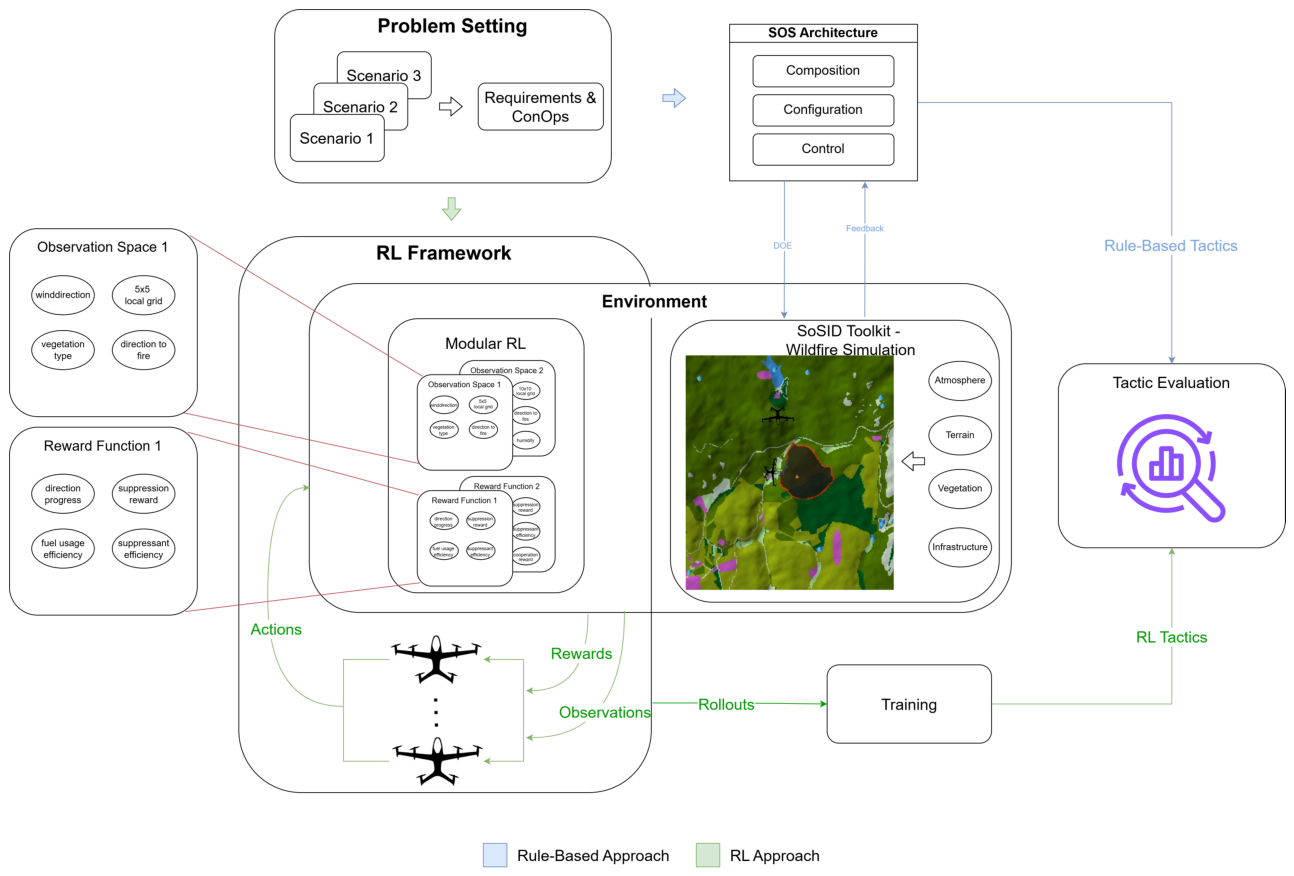
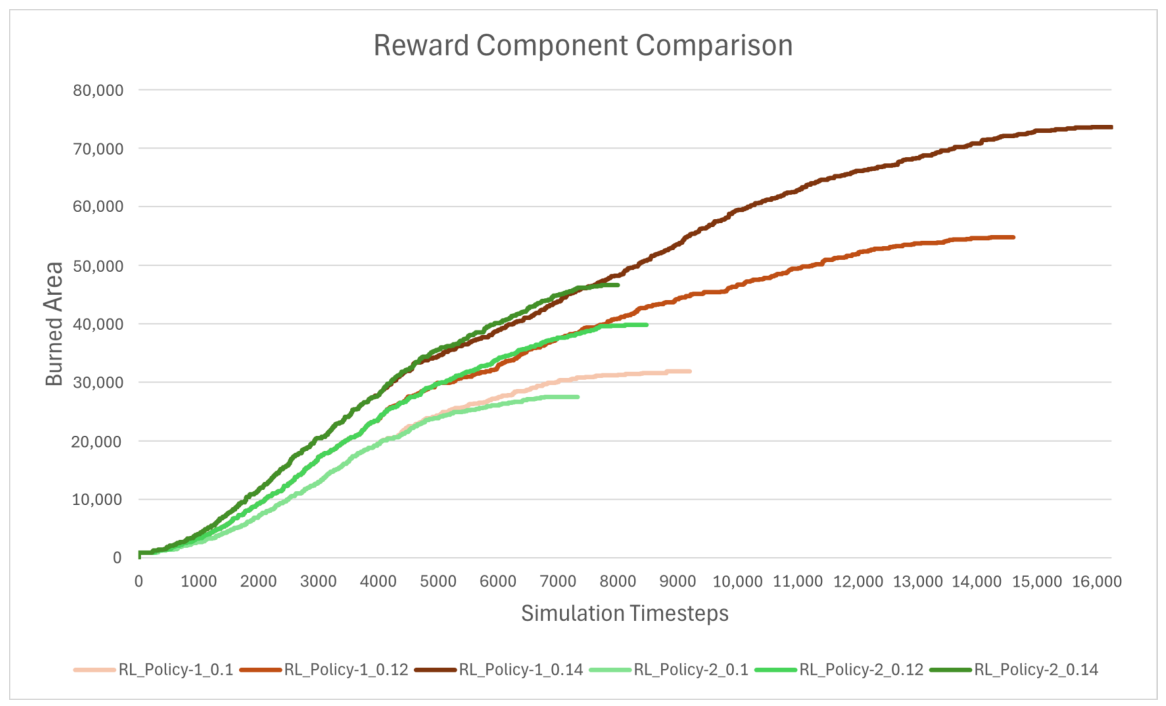
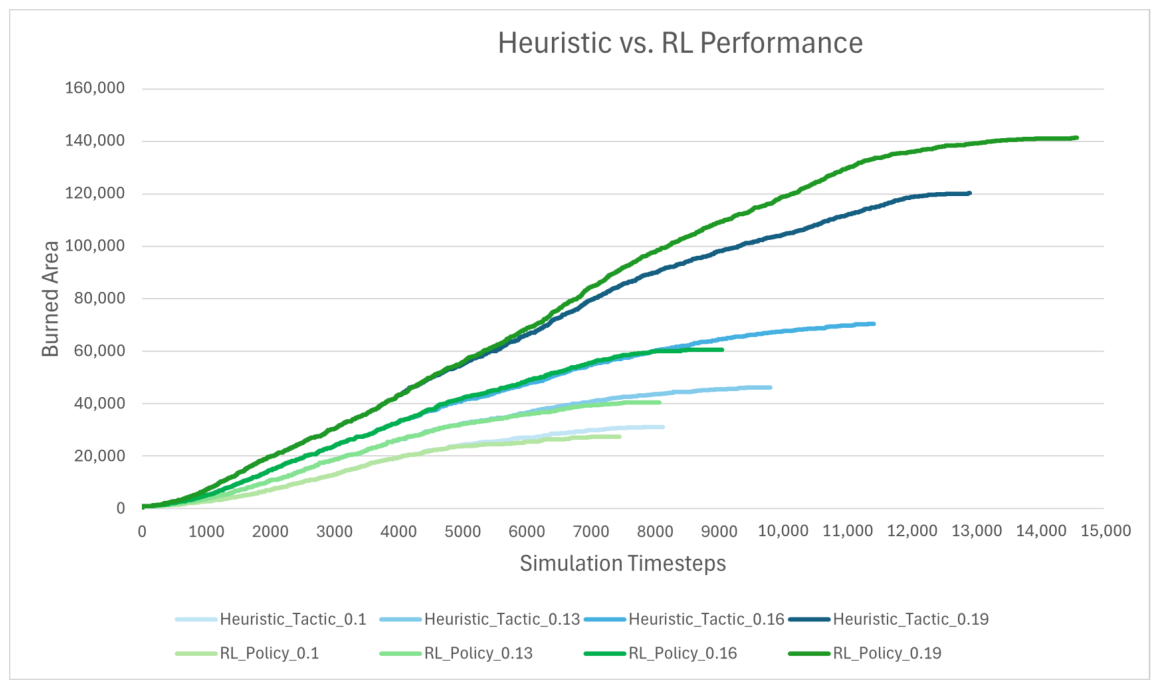
The increasing severity of global wildfires requires advanced suppression strategies to mitigate impacts on the environment and human life. This work investigates the applicability of Multi-Agent Reinforcement Learning (MARL) to aerial wildfire suppression using the SoSID Toolkit, an agent-based grid simulation grounded in cellular-automata-based fire propagation. To enhance interpretability and support the reconstruction of learned tactics, this work introduces the Dual Decomposition Framework, providing a modular structure for both the reward function and the observation space. This design enables the systematic evaluation of individual components, allowing the identification of the elements most relevant to effective wildfire suppression. The learned MARL policy is compared against a heuristic strategy inspired by real-world firefighting practice. The reward analysis confirms that the Dual Decomposition Framework enhances transparency in agent behavior by analyzing the contribution of individual components. The experiments further show that the learned policy can outperform the heuristic approach in terms of burned-area reduction when fire spread sensitivity is low, demonstrating the potential of MARL for effective suppression strategies. However, performance declines as spread sensitivity increases, indicating limited generalization and signs of overfitting to training conditions. The findings suggest that approaches such as curriculum learning may improve robustness under faster-spreading fire dynamics.
Keywords: reinforcement learning; multi-agent reinforcement learning; multi-agent deep reinforcement learning; agent-based simulation; wildfire fighting; explainable reinforcement learning; reward decomposition; observation decomposition reinforcement learning; multi-agent reinforcement learning; multi-agent deep reinforcement learning; agent-based simulation; wildfire fighting; explainable reinforcement learning; reward decomposition; observation decomposition