Satellite and Mobile Network Operator Cooperation Models for Efficient Handover in 6G-TN-NTN †

 ,
,  , ,
, ,
Abstract
1. Introduction
2. Handover or Roaming?
2.1. Handover
- Baseline HO (BHO): The UE measures signals from multiple cells, which include the source gNB and neighboring gNBs. It then sends a measurement report to the source gNB. When the source gNB decides to initiate an HO, it selects a target gNB from the list of neighboring gNBs and sends an HO request via the 5G Xn/N2 interface. The target gNB performs admission control, and if it has available resources, it responds with an HO request acknowledgment to the source gNB. Then, the source gNB sends an HO command to the UE to initiate HO with the target gNB. Subsequently, the UE detaches from its current source gNB and connects to the new target gNB.
- Conditional HO (CHO): In BHO, the network decides when to initiate the HO, which can lead to HO failure if the UE fails to receive the HO command or, after receiving the HO command, if the signal strength between the UE and the target gNB drops quickly. The UE lacks flexibility in choosing the target gNB, as it receives only one target gNB from the source gNB, thereby increasing the HO failure probability. To mitigate this, the CHO technique is employed; the UE receives an HO command in advance during a good channel signal, which includes multiple target gNB configuration parameters and execution conditions. This allows the UE to evaluate these conditions, and when the execution conditions are met, it detaches and connects to the best target gNB.
- L1/L2 Triggered Mobility (LTM): In BHO and CHO, which rely on L3 measurements, the UE detaches from the source cell/gNB to synchronize with the target cell/gNB, leading to delays due to reconfiguration and synchronization. This increases service interruption time. To minimize this, LTM HO can be employed, allowing the UE to use L1 measurement reports for synchronization with the target cell while remaining connected to the source cell, though LTM mainly supports intra-gNB handovers.
- RACH-less HO (RHO): In RHO, during the BHO or CHO procedure, the random access channel (RACH) procedure is skipped, allowing a UE to have dedicated RACH resources that can directly connect with the target cell. This approach reduces the interruption time that occurs during the RACH procedure.
2.2. Roaming
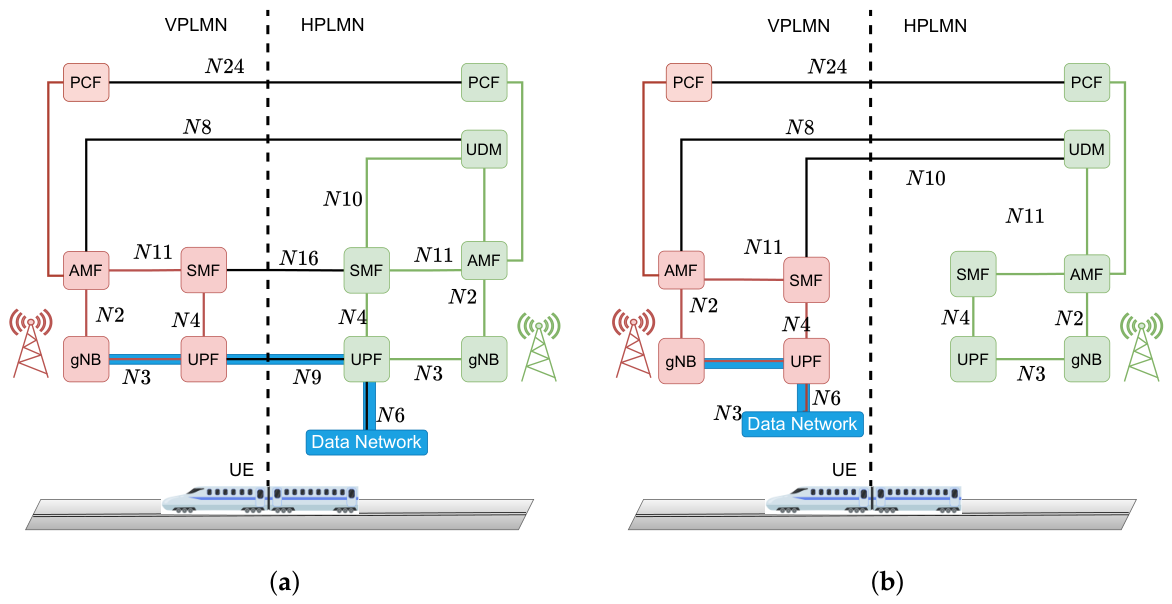
- Home-routed (HR) roaming: In HR roaming, the data traffic is redirected from the HPLMN to VLPMN via the N9 reference point, and both Session Management Functions (SMFs) V-SMF and H-SMF are communicated via the N16 reference point as shown in Figure 1a [5,6]. In this case, the SMF in the HLPMN (H-SMF) selects the User Plane Function (UPF) in the HLPMN, and the SMF in the VLPMN (V-SMF in this case) selects the UPF in the VLPMN.
3. Discussion on Mobility Solutions
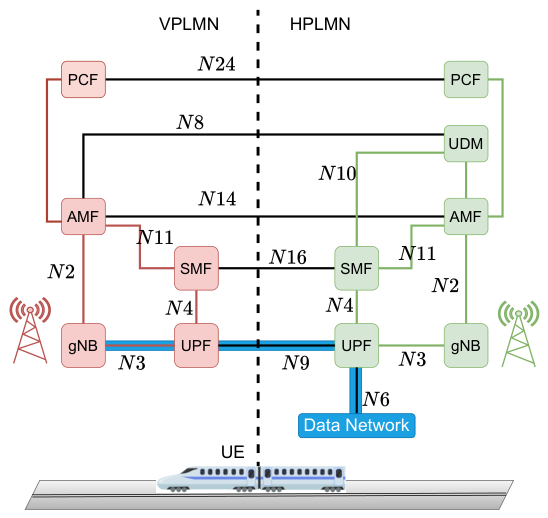
- Release with redirect (RwR) with or without N14: RwR is a procedure where the UE is actively sent to idle mode and then executes the idle-mode mobility procedure. Compared to the conventional HR roaming procedure, RwR removes the interruption time until the UE connection is completely lost and, also, the UE network searching time. The procedure requires the UE to re-attach and re-authenticate to the visited network, which can be done with or without the N14 interface (in the absence of N14, using the N8, N9, and N16 interfaces to connect between the home and visited network) as shown in Figure 2.
- Inter-PLMN handover: Here, in addition to the interfaces of RwR with N14, it includes the N2 interface to exchange the UE context information between the source gNB of the home network and the target gNB of the visited network; see Figure 2. This N2 interface allows the UE to remain in connected mode, thus reducing interruption time.
4. Challenges and Proposed Enhancements
4.1. Latency Associated with Mobility Signaling
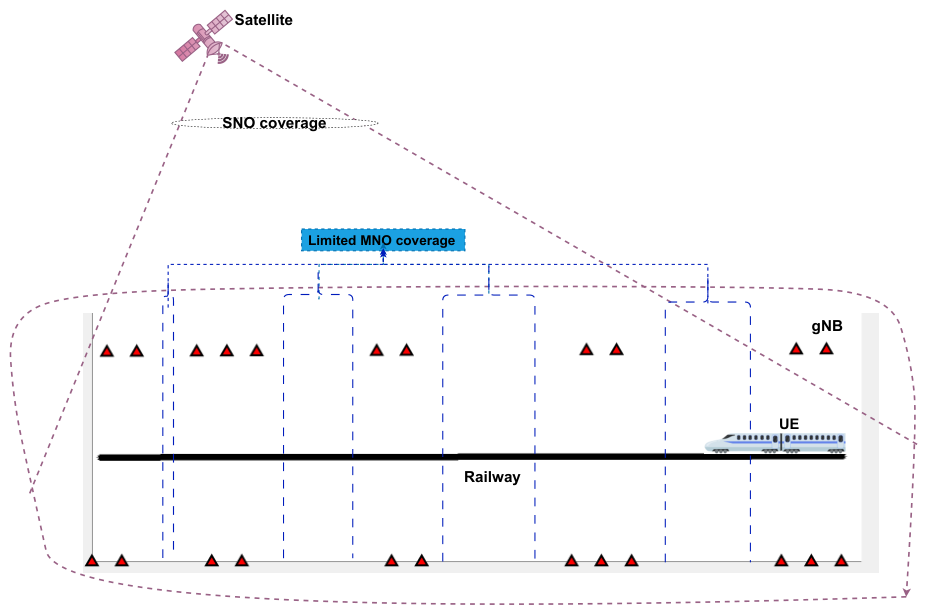
- Unified 5G core with RHO: This allows the SNO to use the 5G core of the MNO infrastructure as a gateway, instead of having a dedicated 5G core for the SNO. In this case, the satellite acts as a gNB, like MNO gNBs, and a handover procedure can be carried out. To minimize the signaling propagation delay needed to connect the UE to the SNO, it is preferable to use an RHO procedure where a dedicated RACH resource is allocated to the UE.
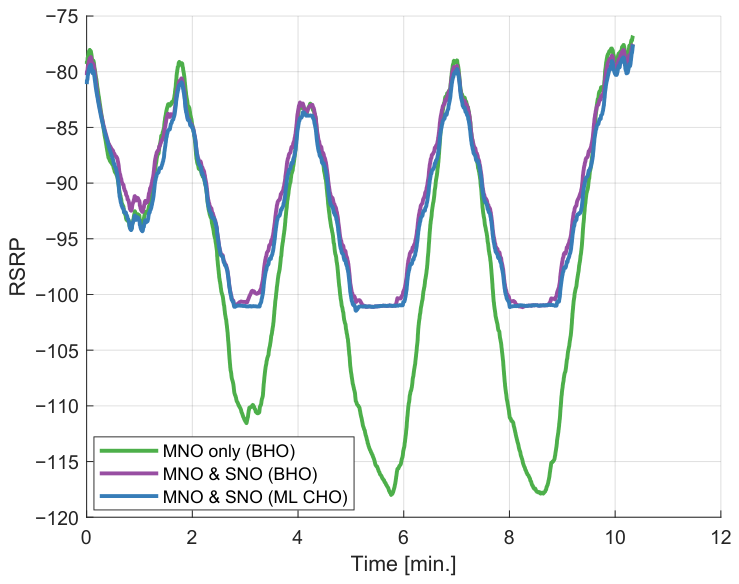
- ML-assisted Inter-PLMN handover: In this case, an ML prediction technique can be used to predict in advance when the UE is required to switch from the MNO to SNO. The prediction can be a function of user location, speed, and signal strength. Hence, while the UE is still connected with the MNO, the MNO can send all the required information in advance via the N14 interface to the SNO. As a result, the UE can establish a connection with the satellite more quickly.
4.2. Mobility Issues
5. Numerical Results
5.1. Mobility Interruption Time Analysis
5.2. ML-Based MNO and SNO Cooperation Analysis
6. Conclusions
Author Contributions
Funding
Institutional Review Board Statement
Informed Consent Statement
Data Availability Statement
Acknowledgments
Conflicts of Interest
References
- Geraci, G.; López-Pérez, D.; Benzaghta, M.; Chatzinotas, S. Integrating Terrestrial and Non-Terrestrial Networks: 3D Opportunities and Challenges. IEEE Commun. Mag. 2023, 61, 42–48. [Google Scholar] [CrossRef] [Scilit]
- Lagunas, E.; Chatzinotas, S.; Ottersten, B. Low-Earth Orbit Satellite Constellations for Global Communication Network Connectivity. Nat. Rev. Electr. Eng. 2024, 1, 656–665. [Google Scholar] [CrossRef] [Scilit]
- 3GPP TS 38.300; NR and NG-RAN Overall Description; Stage 2 (Release 18). ETSI: Valbonne, France, 2024.
- 3GPP TS 23.501; System Architecture for the 5G System (5GS); Stage 2 (Release 19). ETSI: Valbonne, France, 2025.
- GSMA. Official Document NG.113, “5GS Roaming Guidelines”; Technical Report; GSMA: London, UK, 2021. [Google Scholar]
- 5GMED. Handover Test Results. 2025. Available online: https://5gmed.eu/5gmed-handover-test-results/ (accessed on 14 March 2025).
- 5GMED. D3.1 Analysis of 5GMED Infrastructure Requirements and 5G Handover Between Networks and Cross-Border; Technical Report 951947; European Union: Barcelona, Spain, 1 September 2020. [Google Scholar]
- 5GMOBIX. D3.7 Final Report on Development, Integration and Roll-Out. Available online: https://www.5g-mobix.com/assets/files/5G-MOBIX-D3.7_Final-report-on-development-integration-and-roll-out_V2.0.pdf (accessed on 14 March 2025).
- 3GPP TS 36.133; E-UTRA; Requirements for Support of radio Resource Management (Release 18). ETSI: Valbonne, France, 2024.
- 3GPP TR 38.821; Solutions for NR to Support Non-Terrestrial Networks (NTN) (Release 16). ETSI: Valbonne, France, 2023.
- 3GPP TR 38.901; Study on Channel Model for Frequencies from 0.5 to 100 GHz (Release 18). ETSI: Valbonne, France, 2024.



| Network Avaliablity | Techniques | TTT (ms) Configuration Values | hys (dB) Configuration Values | HO Success Rate (%) | HO PP Rate (%) | HOF Rate (%) |
|---|---|---|---|---|---|---|
| MNO only | BHO | 256 | 3 | 13.828 | 7.2144 | 86.172 |
| MNO & SNO | BHO | 256 | 3 | 92.982 | 35.088 | 7.0175 |
| MNO & SNO | ML-based CHO | 256 | 3 | 94.872 | 17.949 | 5.1282 |
Disclaimer/Publisher’s Note: The statements, opinions and data contained in all publications are solely those of the individual author(s) and contributor(s) and not of MDPI and/or the editor(s). MDPI and/or the editor(s) disclaim responsibility for any injury to people or property resulting from any ideas, methods, instructions or products referred to in the content. |
© 2026 by the authors. Licensee MDPI, Basel, Switzerland. This article is an open access article distributed under the terms and conditions of the Creative Commons Attribution (CC BY) license.
Share and Cite
Abdu, T.S.; Lagunas, E.; Ortiz, F.; Querol, J.; Grotz, J.; Mendonça, M.O.K.; Aouedi, O.; Chatzinotas, S. Satellite and Mobile Network Operator Cooperation Models for Efficient Handover in 6G-TN-NTN. Eng. Proc. 2026, 133, 187. https://doi.org/10.3390/engproc2026133187
Abdu TS, Lagunas E, Ortiz F, Querol J, Grotz J, Mendonça MOK, Aouedi O, Chatzinotas S. Satellite and Mobile Network Operator Cooperation Models for Efficient Handover in 6G-TN-NTN. Engineering Proceedings. 2026; 133(1):187. https://doi.org/10.3390/engproc2026133187
Chicago/Turabian StyleAbdu, Tedros Salih, Eva Lagunas, Flor Ortiz, Jorge Querol, Joel Grotz, Marcele O. K. Mendonça, Ons Aouedi, and Symeon Chatzinotas. 2026. "Satellite and Mobile Network Operator Cooperation Models for Efficient Handover in 6G-TN-NTN" Engineering Proceedings 133, no. 1: 187. https://doi.org/10.3390/engproc2026133187
APA StyleAbdu, T. S., Lagunas, E., Ortiz, F., Querol, J., Grotz, J., Mendonça, M. O. K., Aouedi, O., & Chatzinotas, S. (2026). Satellite and Mobile Network Operator Cooperation Models for Efficient Handover in 6G-TN-NTN. Engineering Proceedings, 133(1), 187. https://doi.org/10.3390/engproc2026133187