1. Introduction
Achieving truly sustainable and efficient door-to-door transportation remains one of the most complex challenges in modern mobility planning. While public transport networks have expanded and private car use is being reevaluated in light of climate goals, significant limitations still exist regarding first- and last-mile connectivity, regional accessibility, and cross-modal integration. Advanced air mobility (AAM), made possible by electric Vertical Take-Off and Landing (eVTOL) vehicles, has emerged as a potential solution to bridge these gaps. AAM offers the prospect of fast, low-/zero-emission aerial travel that can connect urban centers, transport hubs, and remote areas with minimal ground infrastructure. However, realizing these benefits in practice depends on AAM’s integration into existing multimodal transport systems, i.e., how AAM is connected to the existing transport system in terms of accessibility. This requires not only technological readiness, but also detailed system-of-systems-level evaluation of passenger behavior, infrastructure constraints, and operational feasibility [
1].
A growing body of literature has explored partial aspects of AAM’s potential. Goyal et al. [
2] applied Monte Carlo simulations and demand modeling to demonstrate that the air taxi and airport shuttle markets could capture up to 0.5% mode share, provided that AAM services offer significant time savings and align with passengers’ willingness to pay. Sun et al. [
3] demonstrated through a high-resolution, grid-based simulation from Paris to Madrid that air taxi services have the potential to significantly reduce urban travel times. Their findings showed that eVTOL services could be competitive with car or rail trips depending on the range, and region. The region in particular was found to impact the competitiveness of eVTOLs, where regions with poor rail connections had a higher potential. Di Vito et al. [
4] developed a detailed operational concept (ConOps) for integrating Urban Air Mobility (UAM) into public transportation systems to support multimodal, door-to-door journeys. Their work, grounded in European use cases such as airport access, business commuting, and regional travel, emphasized the importance of aligning AAM services with existing public transport networks. It concluded that AAM’s success depends not only on air vehicle performance, but also on its integration into the broader mobility ecosystem, considering infrastructure readiness, regulations, and passenger-oriented service design.
Operational studies have emphasized that the success of AAM deployment relies on careful planning of vertiport locations, fleet size, and integration into existing transportation networks. For instance, operational studies have emphasized that the success of AAM deployment hinges on careful planning of vertiport locations, fleet size, and integration into existing transportation networks. For instance, Wille [
5] presented a discrete-event simulation framework to evaluate the capacity and performance of different vertiport topologies. The study assessed both throughput capacity and practical capacity, showing that the choice of vertiport layout significantly affects overall efficiency and scalability. It demonstrated that poorly optimized topologies introduce delays and limit capacity, whereas well-designed layouts improve flow, utilization, and operational reliability. Their findings also show that fleet size must be carefully balanced. For example, undersized fleets increase wait times, while oversized fleets lead to low utilization and higher operational costs. Similarly, research by Shihab et al. [
6] highlights that the combination of strategic vertiport location and schedule-based vs. on-demand service modes plays a major role in determining operational feasibility and user satisfaction. These studies confirm that AAM viability is not solely a matter of aircraft performance, but is fundamentally shaped by the broader mobility ecosystem into which it is deployed.
This study addresses the need to evaluate AAM not in isolation, but as part of a broader intermodal mobility framework. It investigates whether AAM can meaningfully improve travel when integrated into existing systems that include rail, bus, airline, and urban public transportation. Specifically, it focuses on door-to-door intermodal journeys, modeling how AAM competes with or complements ground-based options for intracity access while intercity segments are served by fixed-schedule long-distance transport.
The research is guided by two primary questions: (1) From the passenger’s perspective, does AAM integration improve travel time, cost, and environmental performance? (2) From the operator’s perspective, under what conditions is AAM operationally and economically viable?
To address these questions, a system-of-systems simulation framework is deployed that is capable of modeling passenger behavior, infrastructure constraints, and operator strategies across multiple modes and geographies. This paper outlines the structure of the simulation and presents the product push paradigm and its application on AAM.
3. Product Push Paradigm
The product push paradigm boils down to the question: “How can a product be integrated into an existing system-of-systems to create value and satisfy stakeholder requirements?” In contrast to the product pull paradigm, it does not entail the tailored design of a product as part of a SoS, to solve a problem, with the difference primarily being that in the former, the product itself is fixed, but its integration and role in the SoS are open. By nature of an SoS, the architectural design space, even when limited to operational decisions, is large. Architecture in an SoS context describes the structure of the systems involved, their interfaces and relationships between different systems. Architecture, in the stakeholder context, comprises all the choices that the stakeholder can make with respect to their role in the SoS. Therefore, a systematic approach to the product push paradigm is proposed in this work.
5. Scenario Definition
To apply the product push paradigm described in
Section 3 and
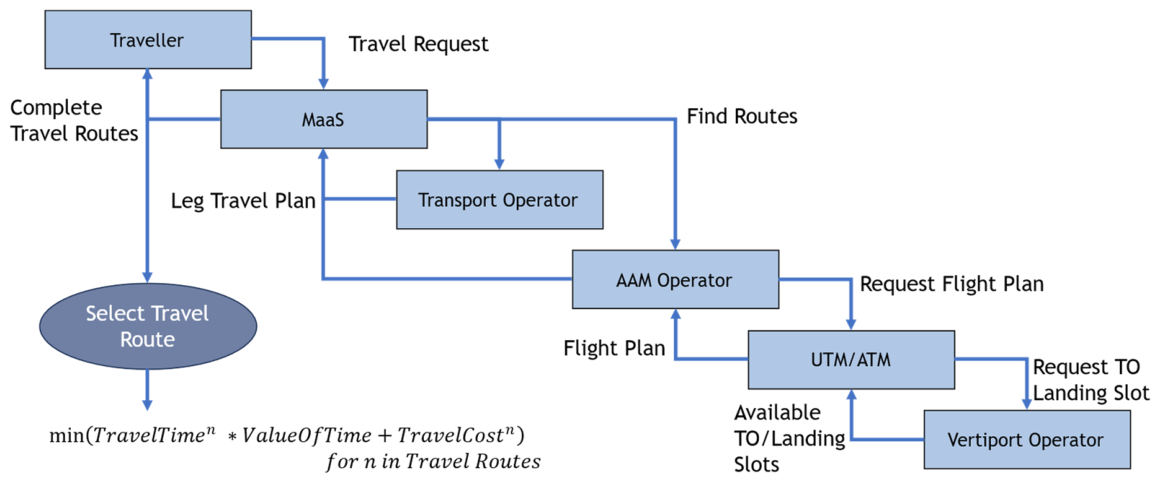
Section 4, a scenario definition is required for the simulation framework described in
Section 2. An exemplary intercity scenario is considered based on the Greater Munich and Greater Rijeka areas. The scenario was selected for a multitude of reasons. Munich Airport (MUC) is a major airport hub with a large catchment area, offering opportunities for eVTOLs to act as feeders to and from neighboring regions. Croatia is a popular tourist destination, and therefore tourists and business travelers moving between the two cities and within the regions may be more inclined to take eVTOL due to their higher value of time. Lastly, as the study area around Rijeka is coastal and has islands, the average transport speed in the area is reduced. Therefore, eVTOLs may offer higher-speed connections, thereby increasing their attractiveness. For the aforementioned reasons, the Munich–Rijeka scenario was chosen for further evaluation.
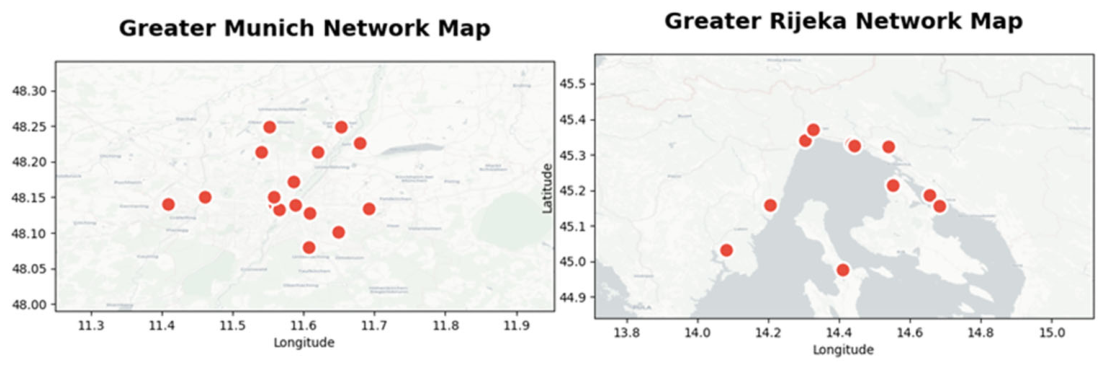
For the given scenario, the vertiports are distributed as shown in
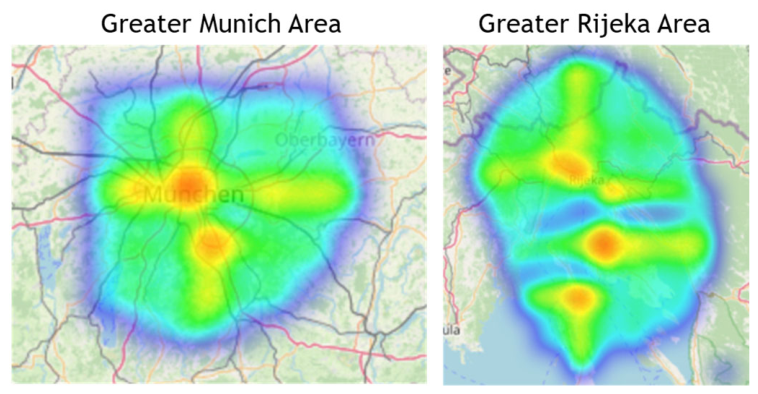
Figure 2. The vertiport placement within the framework are completely parametric, and can be changed rapidly and easily. The considerations in the placement were to target transport hubs and population centers. Furthermore, intercity and intracity demands were generated based on a simple model considering the demand’s geographic distribution within a region (
Figure 3), and a temporal distribution between regions. The end result was a synthetic demand distribution of ~4000 door-to-door travelers within the study area. In this study, the focus is not to achieve an accurate model of demand, but rather to understand the impact of demand and other variables on AAM usage, and so this simple synthetic demand is considered to be sufficient.
6. Results and Conclusions
Section 3 highlighted the generic product push paradigm as it was proposed, whereas
Section 4 highlighted its application to the advanced air mobility SoS from the perspective of an AAM operator. This section contains the application of the product push paradigm to the scenario described in
Section 5.
6.1. Understanding the Ideal Value
As highlighted in
Section 4, the objective of the transport SoS is mobility. Therefore, the value addition from the introduction of eVTOLs can be measured by the improvement it offers in mobility. The improvements to mobility can be quantified by time, cost, and emissions. In this work, the time aspect is analyzed as a representation of the improvement in mobility.
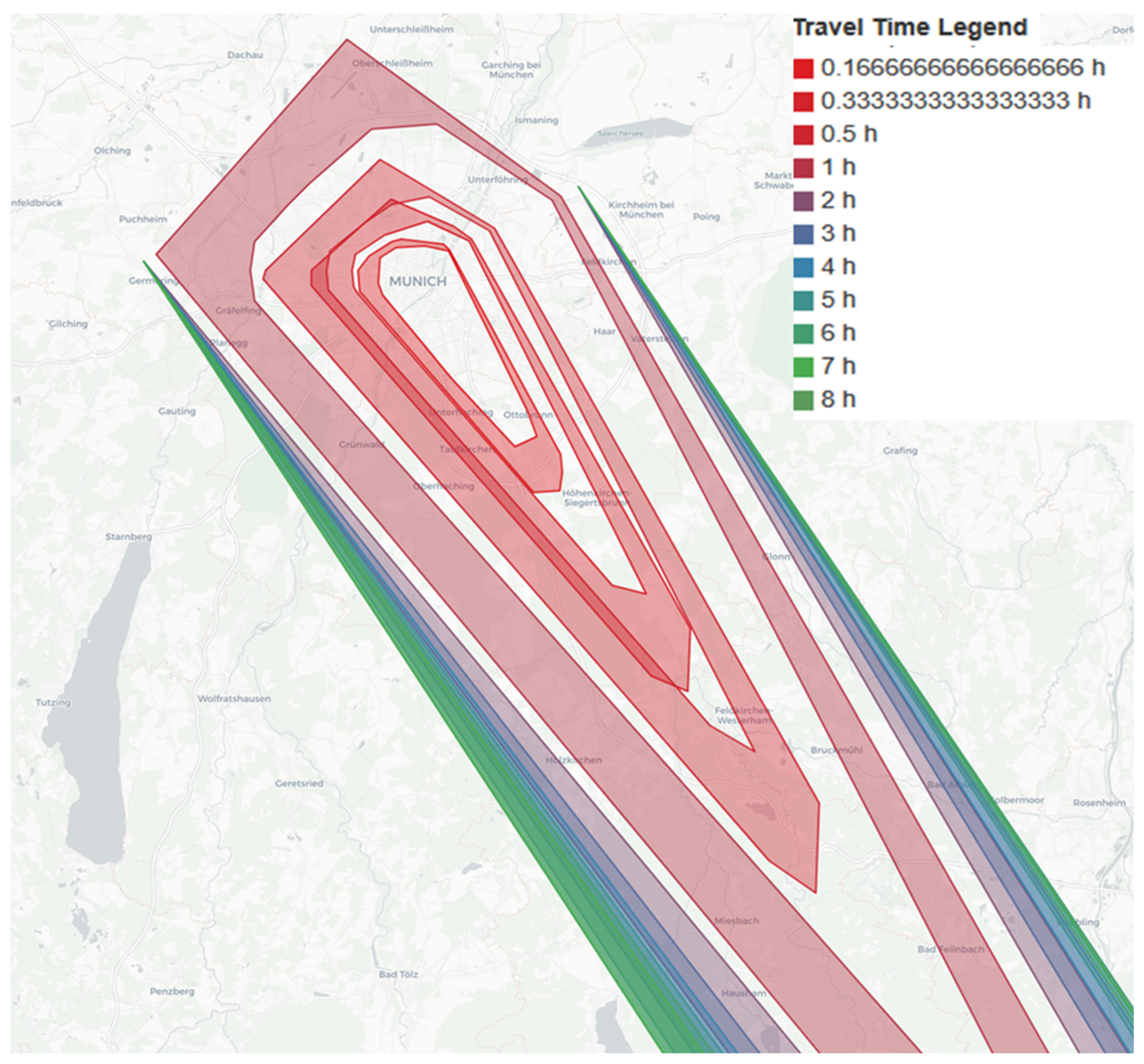
Figure 4 demonstrates the additional distance traversable by people after the introduction of eVTOLs from central Munich, both within Munich and towards Rijeka. The result is generated based on ideal conditions, where no fleet limitations, ticket price impacts, or aircraft capacity limits are considered, thereby capturing the maximum value creation in this scenario. The incorporation of these limits will reduce the value creation, depending on the operational choices made by the AAM operator. Such impacts are explored in
Section 6.3.
6.2. Understanding the Market
The market to be captured must first be understood by the operator to focus their business model on the right segment. Several factors define the market, and here, the average value of time of the population, the number of travelers in the region, the average speed of the public transport network, and the ticket fares of the public transport operator are considered. For the operator, these insights will help us to understand the target customer base for AAM, as well as identify the characteristics of target regions that are suitable for AAM. For such analysis, the idealized assumptions used in
Section 6.1 are not used.
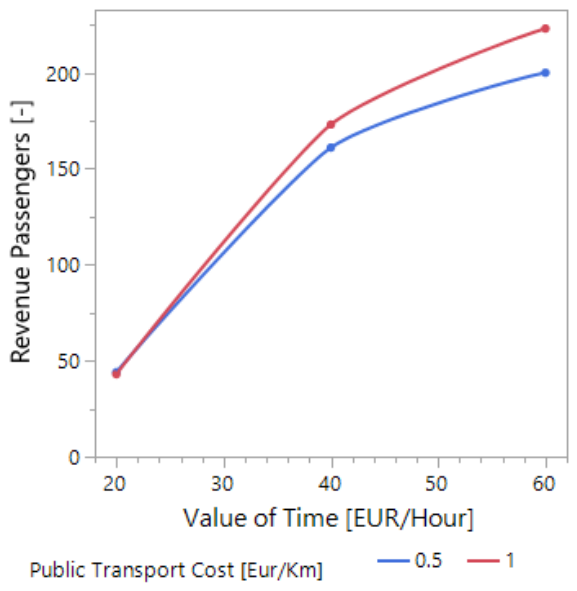
Figure 5 demonstrates the impact of the VOT and public transport cost on AAM usage. An increase in the value of time results in a higher AAM usage. This is as expected, as higher VOT indicates an inclination towards the time savings offered by AAM over the increase in cost. The cost of public transport also has an impact on AAM usage, as higher public transport costs make it less attractive and push some travelers to use AAM. This behavior becomes more apparent at higher VOT. From this example alone, several insights can be derived for the AAM operator; areas with higher public transport costs can be more attractive for AAM introduction, and people with higher VOT are more inclined to use AAM when offered time savings.
6.3. Capturing the Market
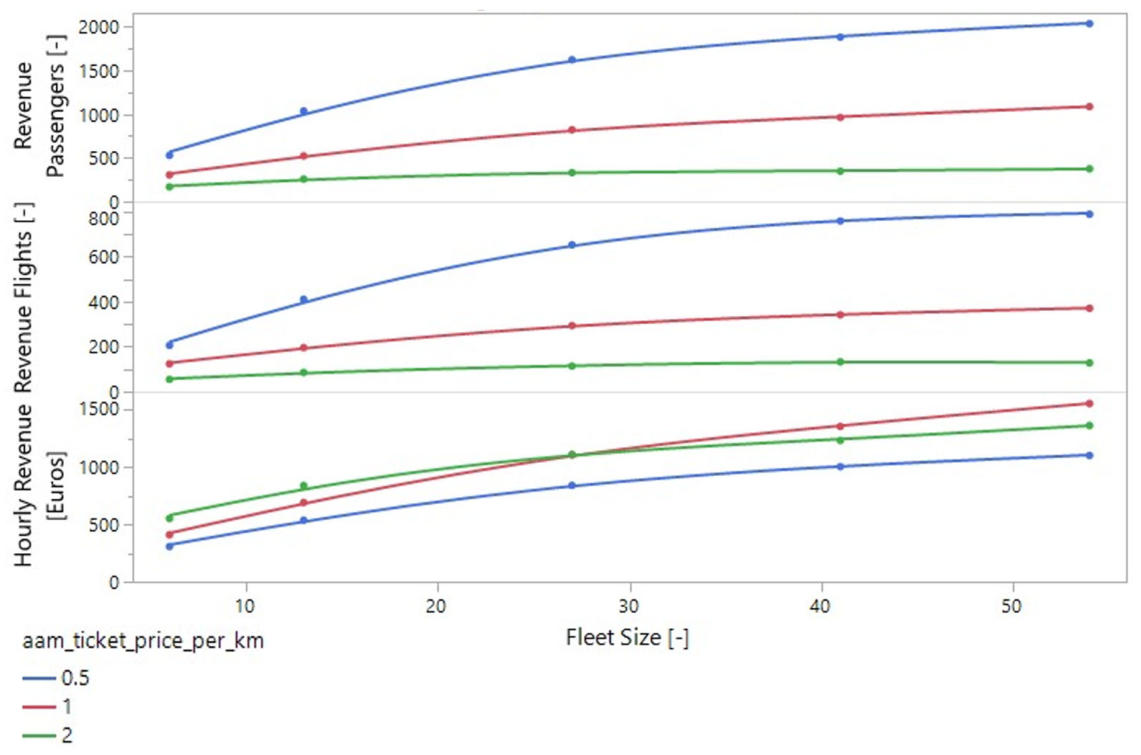
Once the target market is understood, the AAM operator can act to capture the market. The architectural choices at the hands of the AAM operator, and how they operate their business, are crucial in terms of how much of the potential market can be captured. The architecture choices that the AAM operator has to make include the fleet size to deploy into an area, the ticket pricing structure, the vehicle allocation approach, and the mode of operations. Each of these choices at a high level represents multiple choices at a lower level. For example, the fleet size decision leads to the decision on how to distribute them. Vehicle allocation approaches involve decisions such as the priorities set in selecting one vehicle over another, and whether or not a scheduling delay is enforced to trade-off passenger wait time for potentially increasing load factor on the flight, when to offer a passenger a seat on a scheduled flight as opposed to scheduling a new flight, and so on. The ticket price structure represents several different options, such as whether a linear price-per-km ticket pricing model or a logarithmic curve-based ticketing structure is used. Furthermore, underlying those choices, if a linear price-per-km ticket price structure is chosen, the decision on the price-per-km and whether or not a base fare is introduced also arises. To demonstrate the impact of such choices, the ticket pricing and fleet sizing impacts on AAM usage are shown in
Figure 6. Several insights can be derived from the figure. Firstly, when fleet size increases (x-axis), the number of passengers for AAM also increases, indicating that at lower fleet sizes, there is a shortage of aircraft to serve all the potential demand. At higher fleet sizes, however, the curve starts to flatten, indicating that the fleet size is sufficient to serve the demand. This is highly related to the number of passengers; the ticket price has a large impact on the resulting AAM demand. The lowest ticket price results in the highest usage, and as the ticket price is increased, the AAM demand and flights both decrease. The price point at 0.5 euro/km, however, also has the lowest revenue despite having the highest usage.
This demonstrates the significance of the AAM operator’s architectural choices on market capture. The results presented in this section provide trends of how different parameters impact the AAM SoS. The exact numbers are highly dependent on the demand modeling, and as a simplistic approach is taken in this work to understand the overall behavior of the SoS, the results only indicate trends.
6.4. Stakeholder Interest Trade-Off
The trade-off between the AAM operator and other stakeholders is an important aspect of the product push paradigm. The trade-off could be achieved by representing the stakeholder interests quantitatively, and either performing single-criteria decision making through the combination of stakeholder interests into a single expression, or multi-criteria decision-making methods. In addition, certain stakeholders may enforce requirements on the AAM SoS, and these can be directly represented as limits on the stakeholder interest expression. This aspect is part of future work and is not demonstrated in this paper.
6.5. Conclusions and Future Work
The SoS framework for intermodal mobility analysis demonstrated in this study enables the rapid exploration of the SoS design space and insight generation. The product push paradigm results indicate an initial path forward for how new products can be integrated into an existing SoS. While a glimpse of the potential results was demonstrated in this work, the framework offers significantly more exploratory capabilities. Future work includes the evaluation of different traveler segments for AAM, including business travelers, regional travelers, tourists and commuters. The stakeholder trade-off analysis presents an important aspect of future work, as often with SoS, stakeholders are interlinked. The extension of this approach to new scenarios, as well as to seaplanes, is also noted as a key ongoing activity.