1. Introduction
The growing number of drones operating in civilian and commercial airspace has demonstrated the importance of counter-unmanned aerial systems to ensure airspace safety, privacy, and critical infrastructure protection. In the European Union, these efforts are closely aligned with the development of U-space [
1], a regulatory framework to enable safe and efficient integration of drones into low-altitude airspace. Effective C-UAS solutions that can interact with U-space services are therefore essential for coordinated detection, interception, and traffic management of unauthorized drones.
Autonomous multi-agent systems have revolutionized applications such as aerial surveillance, disaster response, and environmental monitoring. Especially, drone swarms offer scalable, flexible platforms for real-time decision-making in dynamic environments. However, decentralized coordination remains challenging due to partial observability, spatial constraints, and limited communication.
Multi-Agent Reinforcement Learning (MARL) provides a promising framework for developing such coordination policies by enabling agents to learn optimal behaviors by interacting with their environment [
2]. However, MARL presents several challenges: learning stable policies in the presence of multiple learners, dealing with sparse and delayed rewards, and ensuring effective collaboration without explicit communication.
Recent studies have explored reinforcement learning (RL) and drone swarm intelligence for aerial systems, including drone control systems, swarm coordination, and counter-drone technologies. For instance, Gergal [
3] investigates drone swarming tactics using reinforcement learning like proximal policy optimization and soft actor-critic. Additionally, Gavin et al. [
4] explored the benefits of hardware acceleration and parallelization for multi-agent reinforcement learning in swarm systems. In addition, drone swarms are also utilized in disaster relief. Ref. [
5] explores the development of a decentralized drone swarm system designed for the dynamic search, detection, and monitoring of wildfires. This study demonstrates that the proposed system can handle increases or decreases in the number of drones, with the swarm dynamically adjusting to the available agents.
In counter-unmanned aerial systems (C-UAS), Yang et al. [
6] conduct a bibliometric analysis and scoping review of recent developments of C-UAS technologies. The findings of their review highlight key topics and emerging trends, focusing on multisensory fusion and machine-learning approaches for enhancing drone detection and mitigation. Additionally, Castrillo et al. [
7] review cooperative defensive drone team technologies for countering drones and suggest improvements for real-time swarm defense in terms of team coordination, communication network, and simulation framework. Moreover, Simonjan et al. [
8] studied RL-based countermeasures against target-oriented attacks of intelligent unmanned aerial vehicle (UAV) swarms.
This paper extends the previous research on counter drones [
9,
10] to a multi-agent framework using Multi-Agent Proximal Policy Optimization. This paper integrates a centralized critic and decentralized actor architecture to train cooperative drone agents in the AirSim simulator. To promote collaboration among the agents, PettingZoo and Ray RLlib are used for supporting scalable distributed training with shared policies. The objective is to evaluate how increasing the number of agents influences performance metrics such as interception success rate, collision frequency, and geofence violations, and to establish a foundation for scalable real-world C-UAS drone swarm deployment.
2. Methods
2.1. Reinforcement Learning
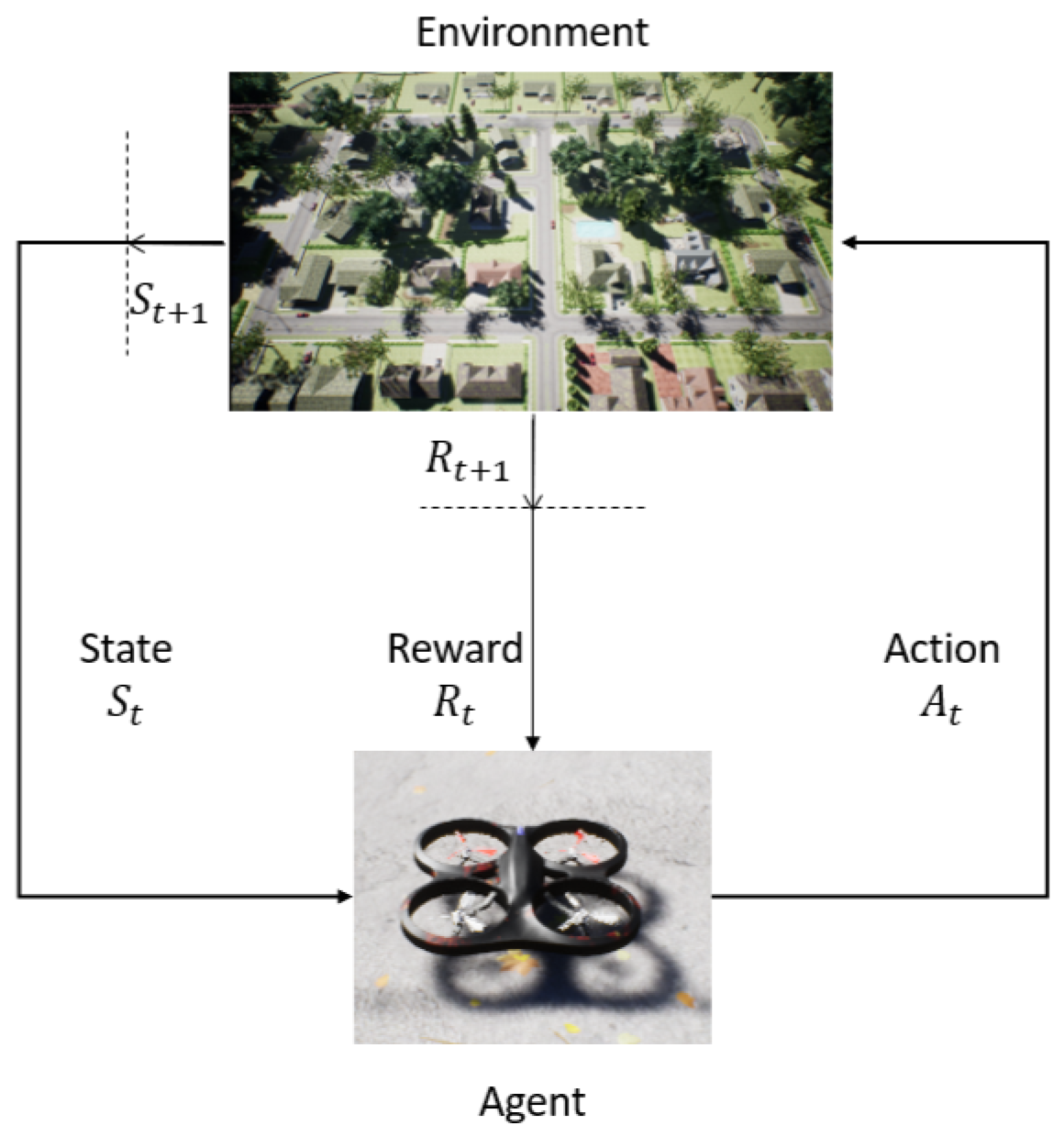
Reinforcement learning is an approach to AI based on trial-and-error experiences. In RL, the agent makes a decision and takes an action. The agent interacts with the environment. The environment provides states, which are information about the current status of the agent. Each action updates the environment and its state. Finally, a reward is submitted by the environment, informing about the benefit of using the action at that moment. The objective of the agent is to maximize the final reward value. The interaction between the agent and the environment is shown in
Figure 1. State is represented as
, and the state space is represented as
S. The interaction between the agent and the environment is in discrete time steps
t. Action and action space are represented as
and
respectively. Reward values are updated each time,
, and a new state becomes
.
In RL, states are mapped to the probability of the possible actions in each time step
t, and this is called a policy. The policy is chosen to maximize the cumulative reward over time. The fundamental concepts for RL are explained in detail in [
2].
2.2. Proximal Policy Optimization
Proximal Policy Optimization (PPO) [
11] is a model-free on-policy RL algorithm that works well for both discrete and continuous action space environments. PPO utilizes an actor-critic framework, where there are two networks: an actor (policy network) and a critic network (value function). The PPO algorithm is a highly sample-efficient method that learns from each interaction with the environment. This is important in our case since our environment is computationally expensive (i.e., slow), and we aim for the drone agents to learn as much as possible from fewer interactions with the environment.
The PPO algorithm that uses fixed-length trajectory segments is shown in Algorithm 1 below. At each iteration, each of N (parallel) actors collects T timesteps of data. Then PPO constructs the surrogate loss function on these NT timesteps of data and optimizes it with minibatch Stochastic Gradient Descent (SGD) or the Adam method for stochastic optimization [
12], for K epochs.
| Algorithm 1 PPO, Actor-Critic Style |
- 1:
for iteration = 1, 2, … do - 2:
for actor = 1, 2, …, N do - 3:
Run policy in environment for T timesteps - 4:
Compute advantage estimates - 5:
end for - 6:
Optimize surrogate L w.r.t. , with K epochs and minibatch size - 7:
- 8:
end for
|
2.3. Simulation and Framework Integration
The training environment is implemented in AirSim [
13], a high-fidelity simulator for autonomous vehicles. In this paper, the neighborhood environment is selected for training and testing the deep reinforcement learning algorithm. The custom AirSim environment follows the Gymnasium API [
14], the modern continuation of OpenAI Gym [
15], which is utilized for compatibility with reinforcement learning frameworks to integrate into the multi-agent training framework.
The multi-agent environment follows the PettingZoo Parallel API [
16] interfaced with Ray RLlib [
17,
18] to enable scalable distributed MARL training by connecting PettingZoo’s multi-agent API with RLlib’s distributed PPO training loop. Agents share a common policy to promote cooperative behavior while maintaining decentralized execution.
Figure 2 illustrates the experimental setup.
The experimental setup diagram is illustrated in
Figure 2.
2.4. Multi-Agent DRL Model
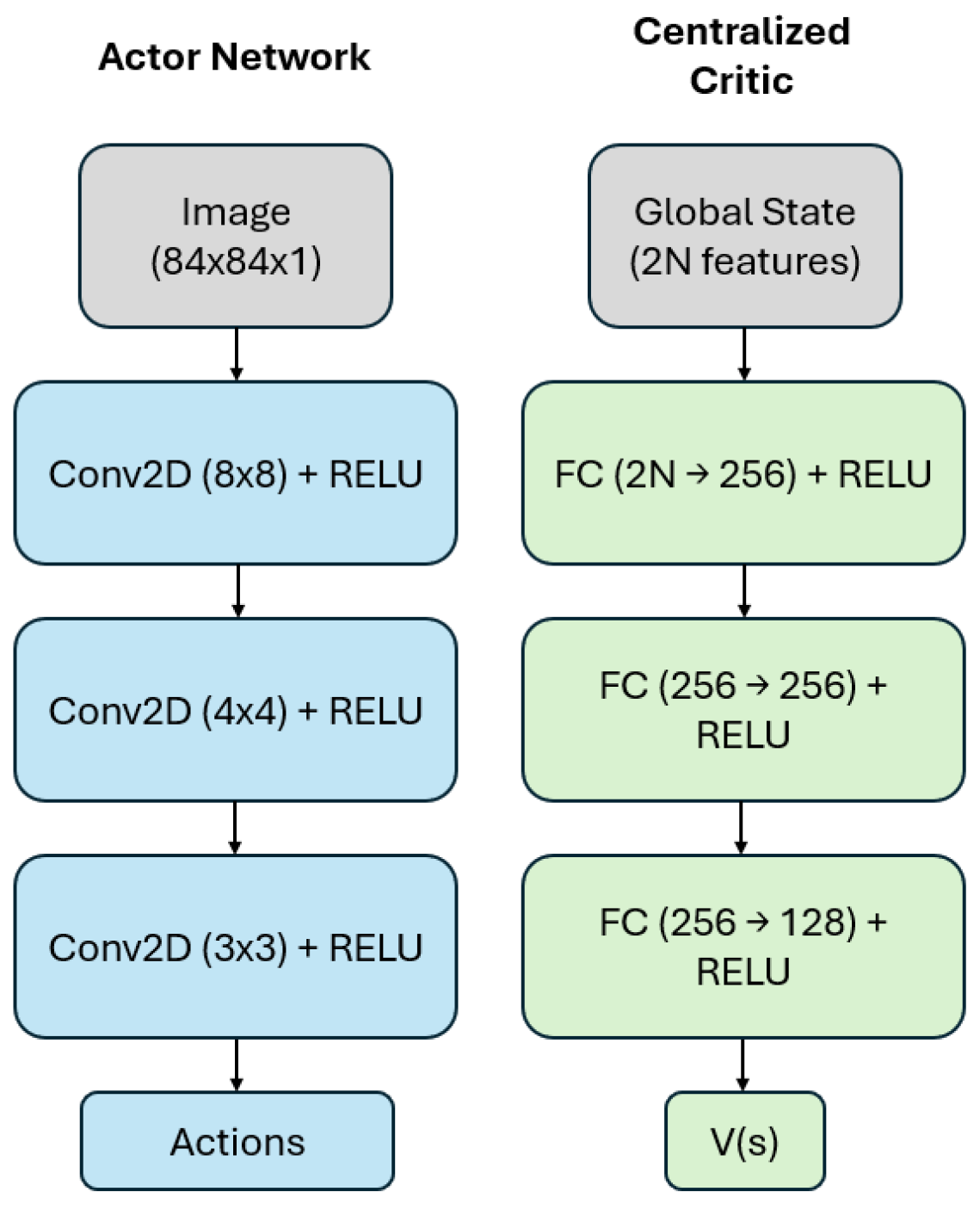
DRL Model includes Multi-Agent Proximal Policy Optimization (MAPPO) with a centralized critic and decentralized execution. The actor processes the local image of the agent, and the centralized critic utilizes the concatenated global state of all agents. Actor and critic do not share weights since image features are unrelated to global state features. In other words, drone agents act based only on the local images, but the critic uses the full global state to stabilize learning in the multi-agent setting. A shared policy is implemented for all the agents.
The Neural Network Architecture of the actor consists of a convolutional neural network (CNN) with three convolutional layers with rectified linear unit (ReLU) activation functions and a 512-unit fully connected layer, mapping local images to action logits. Neural Network (NN) critic has four Multilayer Perceptron (MLP) with three hidden layers, mapping global state to value estimate
, the state value function, shared across all agents. MAPPO architecture is shown in
Figure 3. If there are N agents, the full global state is a concatenation of all their positions in x and y coordinates, such as global_state
.
2.4.1. Drone Agent States
Each agent observes a local depth image from AirSim () and a global state vector containing the normalized 2D positions of all agents.
2.4.2. Drone Control Actions
Each agent performs three discrete 2D actions: moving forward with fixed speed, yawing left (rotate counter-clockwise (CCW)), and right (rotate clockwise (CW)). The actions are represented in detail in
Table 1. The target drone is stationary and keeps its altitude at 4 m.
2.4.3. Reward Function
The reward function, as detailed in
Table 2 and
Table 3, includes both intermediate rewards and terminal rewards that reward or penalize the agent during the episode. Reward shaping is designed to encourage agents to move closer to the target (progress), maintain an optimal distance (proximity), and spread out around the target (coverage), while penalizing sudden turns (smoothness) and time elapsed (efficiency). The intermediate rewards are clipped to
for stability.
Terminal rewards include team-level rewards: a large bonus for capturing the target, penalties for collisions or geofence violations, and a time limit penalty. The geofence extends from −5 to +25 along the x-axis and from −10 to +15 along the y-axis. Rewards from terminal events are shared equally among agents. This design is implemented to balance each agent’s individual movements with team cooperation.
The reward function for each time step becomes
Terminal rewards are as follows:
3. Results
The drone agents are trained by utilizing a different number of agents. By using the same MAPPO setup, training is accomplished with two scenarios: one with two drone agents and another with five drone agents.
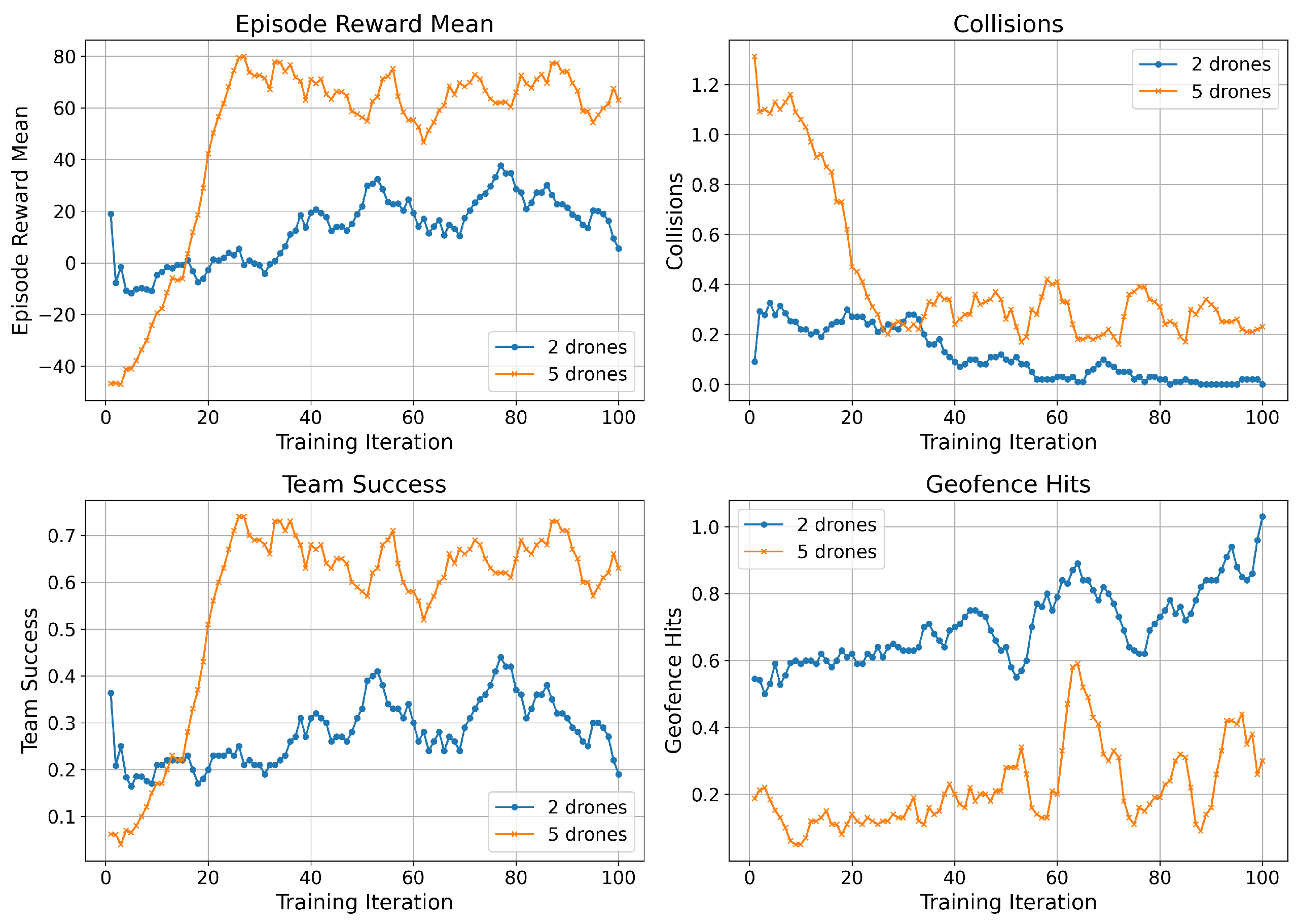
The drone agent’s performances are evaluated by using the performance metrics such as episode reward mean, team success rate, geofence violations, and collision frequency. The training results of two scenarios are shown in
Figure 4 and
Table 4.
The results show that the increasing number of cooperative drones improves performance, with a 42% improvement in team success rate. For example, the episode reward mean graph shows that the five drone agents performed higher average episode rewards than the two drone agents, demonstrating efficient cooperation catching the target with a performance improvement of approximately 66.7%. Additionally, the team’s success rate was higher with the five drone agents as the training proceeded, although two drones had a higher success rate at the beginning. Moreover, the agents learned to remain within the operational area, and the five-drone agent scenario had fewer geofence violations in the later stage of the training, achieving a 65% decrease in geofence hits. Collisions caused by environmental obstacles, such as trees, or by colliding with other drone agents, also decreased over training in both cases. Collision rates were initially higher with five drone agents due to a higher exploration rate but dropped significantly as coordination improved. Both configurations demonstrate a massive reduction in collisions. Even in the more complex five-drone agent scenario, the system successfully eliminated nearly 79% of initial accidents by the 100th iteration. In summary, the training results show that increasing the number of cooperating drones improves target elimination performance, providing higher rewards, fewer collisions, and better team success rates. Reward shaping and centralized critic are also effective in coordinating multi-agent, counter-drone systems.
Our results suggest that effective counter-drone swarm defense can be achieved without a one-to-one ratio between defenders and intruders, considering the 42% improvement in team success rate after increasing the defender count from two to five drones. A relatively small team of cooperative, intelligent drone agents can counter larger intruding drones by allowing the system to scale sub-linearly, achieving higher operational safety and mission success through collective intelligence.
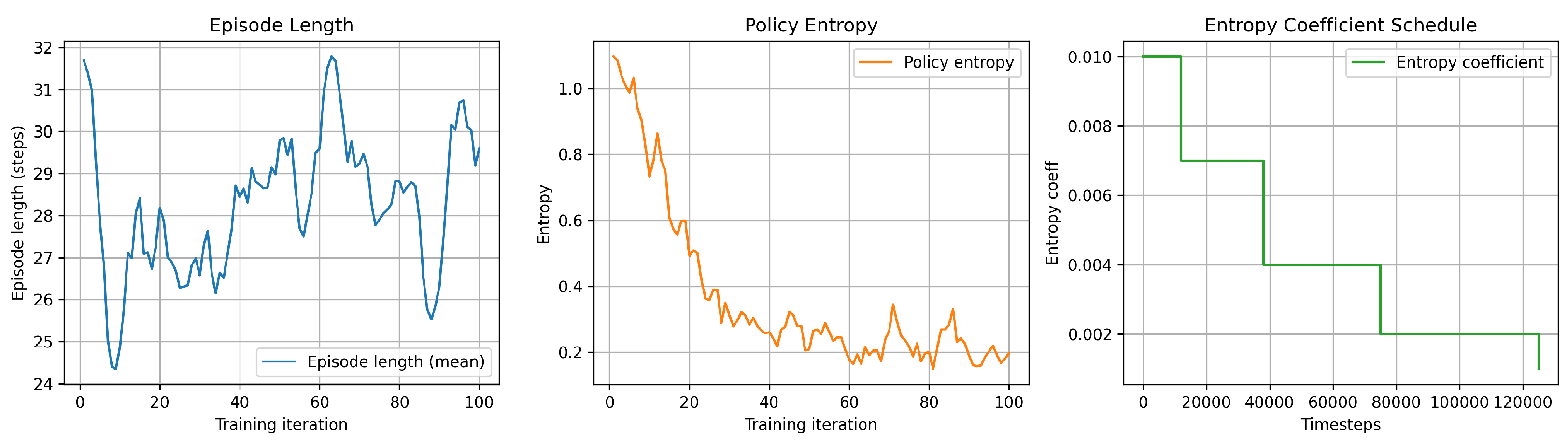
Figure 5 also shows convergence trends during training. To balance exploration and exploitation, an entropy coefficient schedule was implemented, decaying linearly from 0.010 to 0.001 over the course of training. It is seen that as entropy regularization decays, policy entropy decreases, and episode length mean stays between 26 and 32 steps, which indicates more consistent and efficient pursuit behavior.
Hyperparameters
The hyperparameters presented in
Table 5 represent a customized configuration rather than standard default values. These parameters are tuned for training the MAPPO-based multi-agent system within AirSim to ensure stable convergence and efficient learning, while maintaining computational efficiency.
4. Conclusions and Future Work
This study presents a cooperative counter-drone system trained by the MAPPO algorithm. We have observed that cooperative drone swarms for countering drones powered by multi-agent DRL significantly enhance learning in complex urban environments, achieving higher episode rewards and a significant improvement in team success rate. This provides a robust foundation for transitioning from simulation to real-world deployment.
With coordinated positioning, coverage control, and collective reward structures, the system exhibits sub-linear scaling between defender count and intruder swarm size. As a direction for future work, we plan to investigate the extent to which these properties generalize to large-scale scenarios involving hundreds or thousands of intruding drones.
Future research will also focus on enhancing the proposed counter-drone solution. Firstly, a drone detection model will be implemented to enable real-time identification, classification, localization, and tracking of unauthorized drones within controlled airspace. This model is expected to improve drone detection accuracy by using advanced AI techniques under different environmental and operational conditions. Moreover, alternative algorithms will be explored to improve sample efficiency with off-policy methods or to enhance coordination in discrete action settings with value-decomposition approaches. Finally, U-Space services with counter-drone systems will be integrated. This integration aims to establish a coordinated framework that supports safe and secure low-altitude air traffic management. By linking U-Space with counter-drone operations, authorities can respond faster to potential drone threats.
Author Contributions
Conceptualization, E.Ç. and C.B.; methodology, E.Ç.; software, E.Ç.; validation, E.Ç., C.B. and J.L.M.G.; formal analysis, E.Ç.; investigation, E.Ç., C.B. and J.L.M.G.; resources, E.Ç.; data curation, E.Ç.; writing—original draft preparation, E.Ç.; writing—review and editing, E.Ç., C.B. and J.L.M.G.; visualization, E.Ç.; supervision, E.Ç.; project administration, J.J.R.G.; funding acquisition, J.J.R.G. All authors have read and agreed to the published version of the manuscript.
Funding
This research is part of the national Spanish project: “Improving the planning and management of flight contingencies in the scalable deployment of drone operations” (grant PID2023-152053OB-C22 funded by MCIN/AEI/10.13039/501100011033). Opinions expressed in this article reflect only the author’s views.
Institutional Review Board Statement
Not applicable.
Informed Consent Statement
Not applicable.
Data Availability Statement
No new data were created or analyzed in this study.
Conflicts of Interest
The authors declare no conflicts of interest.
References
- Sesar-JU. U-Space. 2025. Available online: https://www.sesarju.eu/U-space (accessed on 27 October 2025).
- Sutton, R.S.; Barto, A.G. Reinforcement Learning: An Introduction; MIT Press: Cambridge, MA, USA, 2018. [Google Scholar]
- Gergal, E.K. Drone Swarming Tactics Using Reinforcement Learning and Policy Optimization 2021; Trident Scholar Report 506; U.S. Naval Academy: Annapolis, MD, USA, 2021. Available online: https://apps.dtic.mil/sti/html/trecms/AD1149672/ (accessed on 27 October 2025).
- Gavin, T.; Lacroix, S.; Bronz, M. Accelerating Swarms: Harnessing Hardware Acceleration and Parallelization in Multi-Agent Reinforcement Learning. In Proceedings of the 15th Annual International Micro Air Vehicle Conference and Competition, Bristol, UK, 16–20 September 2024; pp. 80–87. [Google Scholar]
- Coffeng, S. Decentralised Drone Swarm for Wildfire Detection and Monitoring. Master’s Thesis, Aalto University School of Engineering, Espoo, Finland, 2024. [Google Scholar]
- Yang, C.; Huang, C.; Zhao, Y. The intellectual structure and the future of counter-uncrewed aerial systems (UAS) research: A bibliometric and a scoping review. Int. J. Aviat. Aeronaut. Aerosp. 2024, 11, 3. [Google Scholar] [CrossRef]
- Castrillo, V.U.; Manco, A.; Pascarella, D.; Gigante, G. A review of counter-UAS technologies for cooperative defensive teams of drones. Drones 2022, 6, 65. [Google Scholar] [CrossRef]
- Simonjan, J.; Harshina, K.; Schranz, M. Reinforcement Learning-based Countermeasures against Attacking UAV Swarms. In Proceedings of the 2023 19th International Conference on Distributed Computing in Smart Systems and the Internet of Things (DCOSS-IoT), Piscataway, United States, 2023; IEEE: Piscataway, NJ, USA, 2023; pp. 647–653. [Google Scholar]
- Çetin, E.; Barrado, C.; Pastor, E. Countering a Drone in a 3D Space: Analyzing Deep Reinforcement Learning Methods. Sensors 2022, 22, 8863. [Google Scholar] [CrossRef] [PubMed]
- Çetin, E. Counter a Drone via Deep Reinforcement Learning. Ph.D. Thesis, UPC BarcelonaTech, Northeastern, Spain, 2023. [Google Scholar] [CrossRef]
- Schulman, J.; Wolski, F.; Dhariwal, P.; Radford, A.; Klimov, O. Proximal Policy Optimization Algorithms. arXiv 2017, arXiv:1707.06347. [Google Scholar] [CrossRef]
- Kinga, D.; Adam, J.B. A method for stochastic optimization. In Proceedings of the International Conference on Learning Representations (ICLR), San Diego, CA, USA, 7–9 May 2015; Volume 5, p. 6. [Google Scholar]
- Shah, S.; Dey, D.; Lovett, C.; Kapoor, A. Airsim: High-fidelity visual and physical simulation for autonomous vehicles. In Proceedings of the Field and Service Robotics: Results of the 11th International Conference; Springer: Berlin/Heidelberg, Germany, 2018; pp. 621–635. [Google Scholar]
- Towers, M.; Kwiatkowski, A.; Terry, J.; Balis, J.U.; De Cola, G.; Deleu, T.; Goulão, M.; Kallinteris, A.; Krimmel, M.; KG, A. Gymnasium: A Standard API for Reinforcement Learning Environments. 2023. Farama Foundation. Available online: https://github.com/Farama-Foundation/Gymnasium (accessed on 27 October 2025).
- Brockman, G.; Cheung, V.; Pettersson, L.; Schneider, J.; Schulman, J.; Tang, J.; Zaremba, W. OpenAI Gym, 2016. Available online: http://arxiv.org/abs/arXiv:1606.01540 (accessed on 27 October 2025).
- Terry, J.; Black, B.; Hari, K.L.; Santos, R.; Gabel, T.; Bhatia, S.; Faust, A. PettingZoo: Gym for multi-agent reinforcement learning. arXiv 2020, arXiv:2009.14471. [Google Scholar]
- Anyscale, I. Ray: A System for Scalable and Distributed Python. 2023.Version 2.x. Available online: https://docs.ray.io/ (accessed on 27 October 2025).
- Liang, E.; Liaw, R.; Nishihara, R.; Moritz, P.; Fox, R.; Goldberg, K.; Gonzalez, J.E.; Jordan, M.I.; Stoica, I. RLlib: Abstractions for distributed reinforcement learning. In Proceedings of the International Conference on Machine Learning, PMLR, Stockholm, Sweden, 10–15 July 2018; pp. 3053–3062. [Google Scholar]
| Disclaimer/Publisher’s Note: The statements, opinions and data contained in all publications are solely those of the individual author(s) and contributor(s) and not of MDPI and/or the editor(s). MDPI and/or the editor(s) disclaim responsibility for any injury to people or property resulting from any ideas, methods, instructions or products referred to in the content. |