1. Introduction
Accurate characterisation of aircraft structural dynamics is essential for airworthiness and aeroelastic validation [
1]. Ground Vibration Testing (GVT) is a key experimental procedure used to determine natural frequencies (
), damping ratios (
), and mode shapes (
) needed to update finite element models and predict flutter onset. System identification (SI) techniques enable the extraction of these parameters from the experimental data. While single-input multiple-output (SIMO) methods are sufficient for most applications, in aerospace structures, multiple-input multiple-output (MIMO) analyses are required to capture complex dynamic response. Traditional MIMO approaches, such as the Least Squares Complex Exponential (LSCE), can be sensitive to noise and closely spaced modes. Fast and Relaxed Vector Fitting (FRVF), originally developed for electrical systems [
2] and later extended for modal analysis in structural dynamics [
3,
4], offers a robust and efficient frequency domain alternative for system identification [
5,
6].
In this work, FRVF is extended to MIMO modal parameter extraction from structures. This is achieved by extending its applicability to non-square input–output configurations, which are common in aircraft Ground Vibration Tests (GVTs). By combining a rational approximation with enhanced input stacking, the method enables scalable and noise-resilient modal identification, paving the way for its integration into real-aircraft applications. Thus, the objectives of this study are as follows:
Extend FRVF to non-square MIMO systems with a proposed enhanced input stacking;
Validate the method through a numerical beam model under varying noise conditions;
Demonstrate performance on experimental aircraft GVT data against established SI methods.
2. Methodology
Classical SI methods for modal analysis aim to extract the
,
, and
of a structure from experimental frequency response function (FRF) data or time domain data. Among the former, Vector Fitting (VF) and its variants have been receiving some attention in the last few years, due to their robust frequency domain framework and ability to model broadband dynamic behaviour [
7].
2.1. Fast and Relaxed Vector Fitting
The original VF algorithm approximates measured FRFs with rational functions by iteratively relocating a set of poles until convergence [
2]. The identified model takes the following form:
where
and
are the poles and residues of the system, while
d and
e are constant and proportional terms. Modal parameters are derived from the poles:
and the residues
contain the mode shape information for each output channel.
Later, Relaxed Vector Fitting (RVF) introduces a pole-relaxation strategy, which decouples the pole relocation step from the strict requirement of preserving the initial pole grid [
6]. This improves convergence and reduces the method sensitivity to the choice of initial pole locations, which is particularly beneficial when handling noisy data. However, RVF alone does not fully resolve the large computing time.
Then, FRVF further improves RVF by integrating:
QR-based residue estimation, which enhances robustness against noisy measurements and reduces computational and memory cost for large MIMO datasets.
Weak inverse-magnitude weighting, which prioritises fitting lower-magnitude regions without over-amplifying noise.
Efficient pole stabilisation, where a small number of iterations is sufficient for the convergence of poles and residues.
These allow FRVF to achieve accurate identifications, even in high-noise scenarios, while requiring fewer model orders than classical VF.
2.2. Enhanced Input Stacking
The enhanced version developed in this study is based on the MIMO extension introduced in [
5] (As of the writing of this work (25 November 2025), a MATLAB implementation is available at
https://www.sintef.no/en/software/vector-fitting/downloads/matrix-fitting-toolbox/, accessed on 1 March 2025). This classical implementation was designed under the assumption of
square (same number of input and output channels) FRF matrices, where the number of measured outputs equals the number of excitation inputs. In practice, GVTs rarely satisfy this constraint: the number of sensors is often an order of magnitude larger than the available shakers. To overcome this limitation, an
enhanced input stacking strategy is proposed that allows FRVF to process arbitrary non-square MIMO configurations efficiently. The enhanced stacking procedure can be summarised as follows:
- 1.
The dimensions of the loops are adapted to handle non-square MIMO configurations efficiently;
- 2.
The original three-dimensional FRF tensor, with dimensions , is reshaped into a two-dimensional array suitable for Vector Fitting;
- 3.
The input channels are combined in a superposition framework to construct amplified FRFs for each output.
Subsequently, the FRF set is fed to FRVF for the extraction of the modal parameters, where physical meaningfulness is enforced using stabilisation diagrams.
3. Numerical Case Study
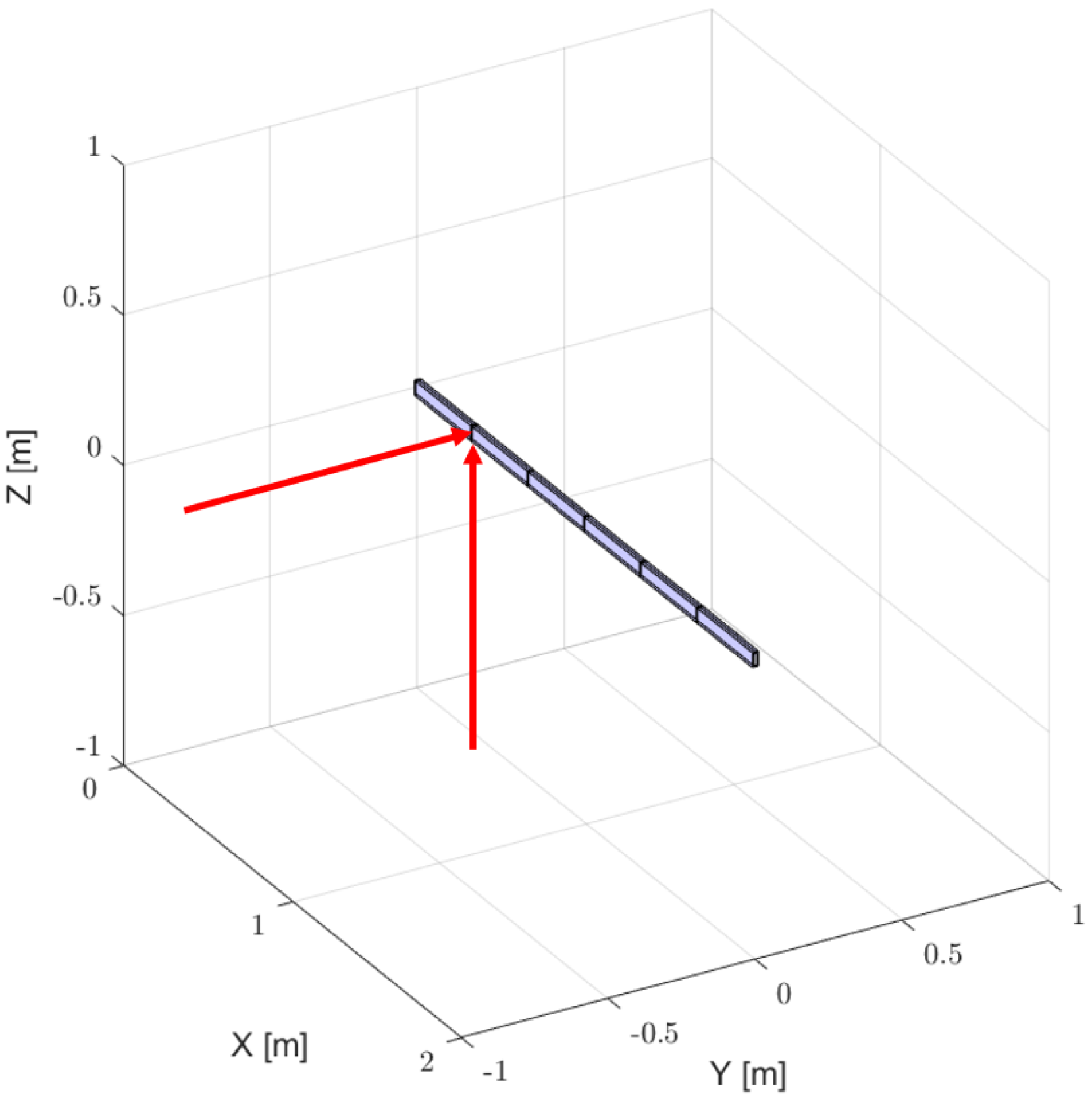
A preliminary numerical example is considered to validate the extended FRVF approach: a 2D MIMO beam model is chosen to demonstrate the fundamental modal identification capability under controlled conditions. This consists of a hollow rectangular aluminium beam excited with multiple excitations in the vertical and horizontal directions. The configuration is represented in
Figure 1.
In
Table 1, the analytical, FRVF, and LSCE estimates of the modal parameters for the 2D MIMO beam are compared. For FRVF-based identification, the Modal Assurance Criterion (MAC) values are equal to or very close to 1 for all identified modes, indicating an almost perfect agreement between the estimated and analytical mode shapes. The corresponding frequency estimates exhibit negligible discrepancies, while the identified damping ratios depart from the analytical value of 0.03 by at most 9.96% in the worst case for the noise-free configuration. In contrast, the LSCE method recovers only a subset of the modes and, for those that are identified, the MAC values and damping estimates show a significantly poorer agreement with the analytical reference, particularly for the higher modes, which highlights its limited reliability for this 2D MIMO configuration.
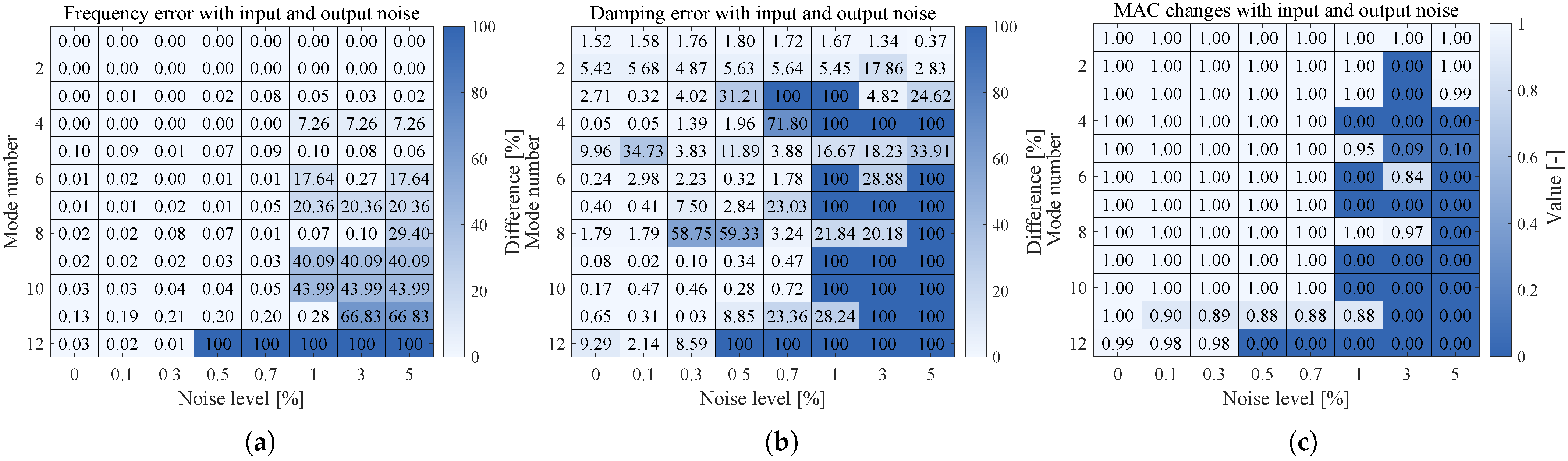
To better understand the influence of noise, a sensitivity analysis is performed by incrementally introducing noise to (i) the input, (ii) the output, and (iii) both simultaneously. This allows us to evaluate how disturbances affect the identification of system parameters in different ways.
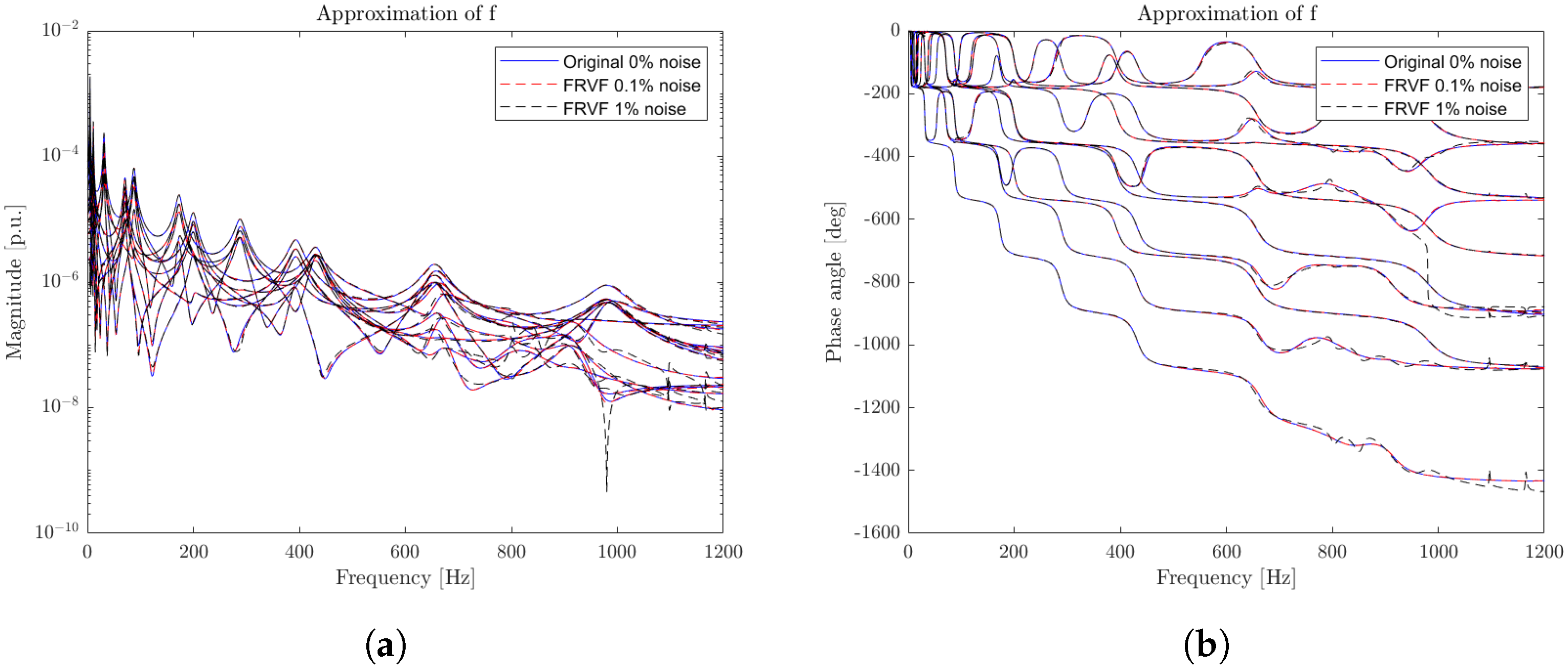
As shown in
Figure 2, the fitting maintains the general profile of the FRF and successfully identifies the system modes even under moderate noise levels up to approximately 1%, applied to both input and output, with the fitted response closely aligning with the noise-free reference. Such noise levels are considered relatively high for real-world scenarios.
To assess the fitting quality in more detail, the absolute values of the gain and phase are plotted for three cases: the original (0% noise) and the responses fitted by FRVF under 0.1% and 1% noise applied to both input and output signals.
As shown in
Figure 3, the modified FRVF demonstrates robust performance across the entire configuration, reliably identifying nearly all vibration modes with frequency errors below 1% and MAC values above 0.88 for noise levels up to 0.7%. It remains effective in capturing dominant FRF peaks even under higher noise conditions.
4. BAE Systems Hawk T1A Ground Vibration Testing
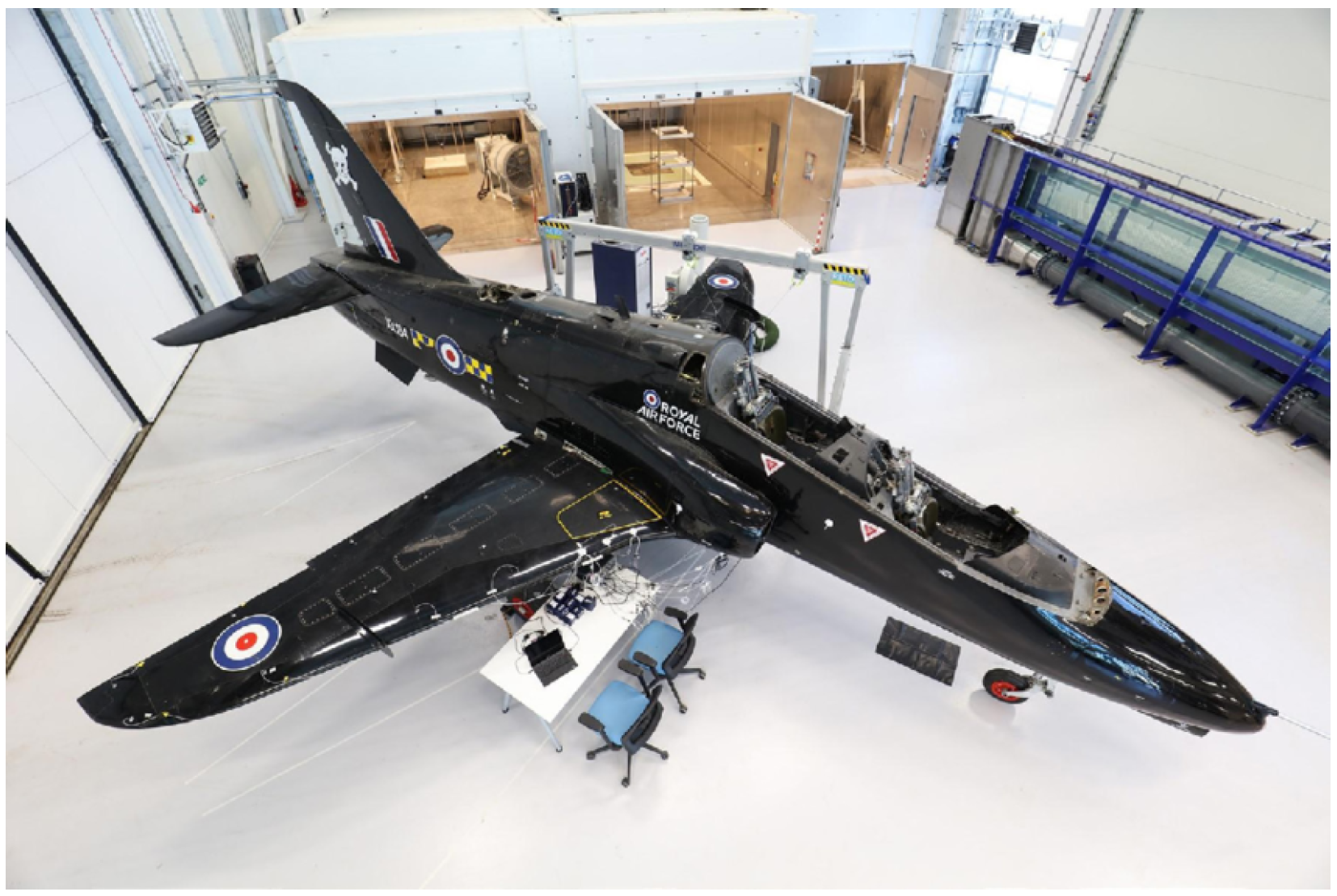
This experimental case study is based on a BAE Systems Hawk T1A (see
Figure 4), commonly referred to as the Hawk, which was donated to the University of Sheffield by the Defence Science and Technology Laboratory of the Royal Air Force (RAF, UK). The aircraft is currently located within the University Laboratory for Verification and Validation (LVV). Formerly operated by the British RAF for advanced pilot instruction, the Hawk has since been decommissioned. Although the airframe remains largely intact, certain components have been removed, including the engine, cockpit canopy, some wing flaps, avionics, and auxiliary systems. The aircraft rests on its landing gear in a stationary position on the facility floor.
The testing configuration incorporates five excitation sources strategically located across the aircraft structure: one modal shaker on each wing (port and starboard), one on the vertical tail, and one on each side of the horizontal stabiliser. To capture the structural response, a total of 85 accelerometers are deployed throughout the airframe, including both uniaxial and triaxial models, resulting in 91 response channels.
4.1. Dataset
The measured FRFs originally cover a frequency range up to 1024 Hz. In this work, the FRFs are truncated to 5–165 Hz to ensure comparability with the results reported in [
9], where the improved Loewner Framework (iLF) algorithm was applied to a similar frequency band.
After truncation, the FRF dataset has the following structure: 91 outputs by five inputs by Nfreq, where corresponds to the number of frequency samples in the 5–165 Hz range. The average over ten test realisation FRFs is used to carry out the identification. This increases the signal-to-noise ratio and smooths any disturbances in the frequency domain data.
4.2. Starboard Wing Sub-Dataset
The FRVF was obtained using only the channels from the 21 starboard wing accelerometers, arranged in two lines, respectively parallel to the leading and trailing edge of the wing.
In
Table 2, the results are compared with the modes identified by the iLF algorithm in [
10] and LSCE, both using the same sensor subset.
The FRVF is clearly capable of detecting the three wing modes, accurately matching the natural frequencies and damping ratios reported in [
10].
4.3. Full Airframe Sub-Dataset
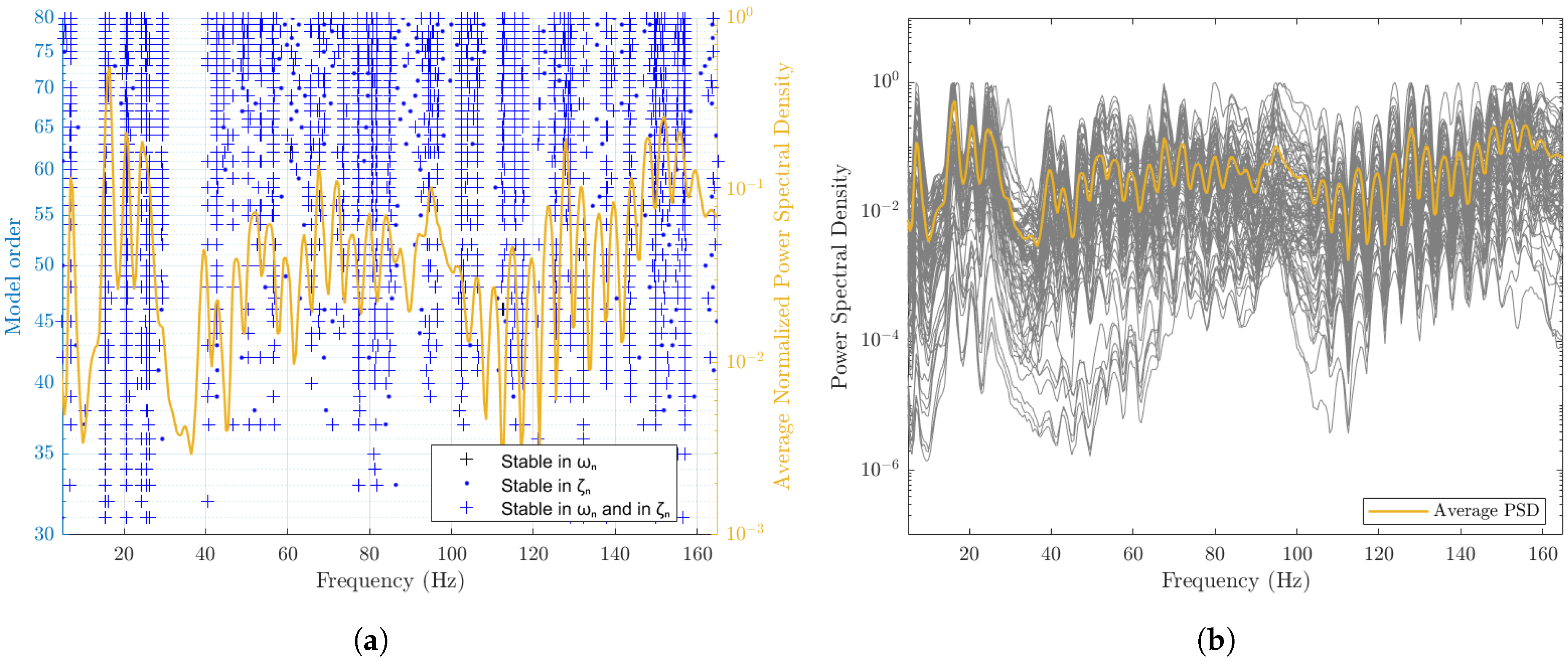
For the truncated frequency range, using the full dataset, model orders between 30 and 80 were deemed sufficient, given the linear spacing of the initial poles and the relatively small number of modes to be identified (slightly more than 30). The corresponding stabilisation diagram is shown in
Figure 5a.
The first three identified modes are summarised in
Table 3, which compares the FRVF results with those of the iLF method in [
9] and LSCE, using all 91 output channels. All MAC values are relative to the iLF reference modes. The modes reported here were manually selected based on their relevance and clarity.
The FRVF successfully identifies the majority of the expected modes within the frequency range of interest. In contrast, LSCE performs poorly, with extremely low MAC values.
Before analysing the results in detail, it is important to note that the average Power Spectral Density (PSD) shown in
Figure 5b exhibits an unusual shape. In particular, the data quality deteriorates around 30 Hz, which negatively affects the performance of FRVF. This is reflected in the reduced MAC value observed for mode 3 in
Table 3, and is expected to affect the higher identified modes beyond those reported here.
5. Discussion
The FRVF method with enhanced input stacking demonstrates excellent performance across all validation scenarios. In the 2D MIMO beam case, FRVF accurately estimates the modes, achieving MAC values close to 1 for most modes even under synthetic noise up to 0.7%, while LSCE exhibits noticeable degradation, as summarised in
Table 1. FRVF also maintains low natural frequency and damping ratio errors up to 0.7% numerical noise in both input and output signals.
For the Hawk T1A GVT experiment, FRVF identification compares well with results from the literature [
9,
10]. In large experimental datasets, noise can adversely affect stabilisation diagrams, making it more challenging to distinguish stable modal patterns. However, as shown in
Table 2 and
Table 3, FRVF consistently delivers more satisfactory results than LSCE, which fails to identify most modes detected by iLF.
Overall, the method is robust to noise, accurate in estimating natural frequencies and damping ratios, and computationally efficient when the frequency range is chosen appropriately. These findings confirm that FRVF is a practical solution for aircraft GVT applications.
6. Conclusions and Future Work
Fast and Relaxed Vector Fitting (FRVF) was successfully extended to accommodate data from non-square multiple-input multiple-output structural systems through enhanced input stacking. Numerical validation confirms its high accuracy and strong resilience to noise. The experimental analysis on the BAE Systems Hawk T1A trainer jet demonstrates that the method can be applied efficiently in practical Ground Vibration Testing scenarios. In general, stacking-enhanced FRVF shows clear potential as a reliable and efficient tool for modal analysis under realistic experimental conditions.
Future work could focus on developing automated mode selection criteria, which was beyond the scope of this study, and on implementing dynamic initial pole placement to further improve convergence and accuracy.
Author Contributions
Conceptualisation, B.E.B.M., G.D. and M.C.; methodology, B.E.B.M., G.D. and M.C.; software, B.E.B.M. and M.C.; validation, B.E.B.M., G.D. and M.C.; formal analysis, B.E.B.M.; investigation, B.E.B.M.; resources, G.D., M.C. and O.E.B.-M.; data curation, B.E.B.M.; writing—original draft preparation, B.E.B.M.; writing—review and editing, B.E.B.M., G.D., M.C. and O.E.B.-M.; visualisation, B.E.B.M., G.D. and M.C.; supervision, G.D. and M.C.; project administration, G.D. and M.C.; funding acquisition, G.D., M.C. and O.E.B.-M. All authors have read and agreed to the published version of the manuscript.
Funding
The first author’s international research stay during her graduate thesis was funded by the Erasmus+ Programme of the European Union through a student mobility grant. The second and fourth authors are supported by the Madrid Government (Comunidad de Madrid, Spain) under the Multiannual Agreement with the UC3M (IA_aCTRl-CM-UC3M). The third author is supported by the Centro Nazionale per la Mobilità Sostenibile (MOST–Sustainable Mobility Center), Spoke 7 (Cooperative Connected and Automated Mobility and Smart Infrastructures), Work Package 4 (Resilience of Networks, Structural Health Monitoring and Asset Management).
Data Availability Statement
Conflicts of Interest
The authors declare no conflicts of interest.
References
- De Florio, F. Airworthiness; Elsevier: Amsterdam, The Netherlands, 2011. [Google Scholar] [CrossRef] [Scilit]
- Gustavsen, B.; Semlyen, A. Rational approximation of frequency domain responses by vector fitting. IEEE Trans. Power Deliv. 1999, 14, 1052–1061. [Google Scholar] [CrossRef] [Scilit]
- Civera, M.; Calamai, G.; Zanotti Fragonara, L. System identification via Fast Relaxed Vector Fitting for the Structural Health Monitoring of masonry bridges. Structures 2021, 30, 277–293. [Google Scholar] [CrossRef] [Scilit]
- Civera, M.; Calamai, G.; Zanotti Fragonara, L. Experimental modal analysis of structural systems by using the fast relaxed vector fitting method. Struct. Control Health Monit. 2021, 28, e2695. [Google Scholar] [CrossRef] [Scilit]
- Deschrijver, D.; Mrozowski, M.; Dhaene, T.; De Zutter, D. Macromodeling of multiport systems using a fast implementation of the vector fitting method. IEEE Microw. Wirel. Compon. Lett. 2008, 18, 383–385. [Google Scholar] [CrossRef] [Scilit]
- Gustavsen, B. Improving the pole relocating properties of vector fitting. In Proceedings of the 2006 IEEE Power Engineering Society General Meeting; IEEE: Piscataway, NJ, USA, 2006; Volume 21. [Google Scholar] [CrossRef] [Scilit]
- Civera, M.; Chiaia, B. The fast relaxed vector fitting (FRVF) method and its applications for dynamic identification and structural health monitoring. In Proceedings of the XXVI AIMETA Congress, Naples, Italy, 2–6 September 2024; p. 6. [Google Scholar]
- Wilson, J.; Champneys, M.D.; Tipuric, M.; Mills, R.; Wagg, D.J.; Rogers, T.J. Multiple-input, multiple-output modal testing of a Hawk T1A aircraft: A new full-scale dataset for structural health monitoring. Struct. Health Monit. 2024, 25, 1136–1149. [Google Scholar] [CrossRef] [Scilit]
- Dessena, G.; Civera, M. Improved tangential interpolation-based multi-input multi-output modal analysis of a full aircraft. Eur. J. Mech.-A/Solids 2025, 110, 105495. [Google Scholar] [CrossRef] [Scilit]
- Dessena, G.; Civera, M.; Marcos, A.; Chiaia, B.; Bonilla-Manrique, O.E. Multiple input tangential interpolation-driven damage detection of a jet trainer aircraft. Aerosp. Sci. Technol. 2026, 168, 111032. [Google Scholar] [CrossRef] [Scilit]
| Disclaimer/Publisher’s Note: The statements, opinions and data contained in all publications are solely those of the individual author(s) and contributor(s) and not of MDPI and/or the editor(s). MDPI and/or the editor(s) disclaim responsibility for any injury to people or property resulting from any ideas, methods, instructions or products referred to in the content. |




 ,
,