1. Introduction
The air transport system is crucial for global connectivity and economic growth, but it also faces significant challenges due to its contribution to greenhouse gas emissions. Aviation emits large volumes of CO
2 and produces non-CO
2 effects that exacerbate climate change [
1]. Growing public concern over aviation’s environmental footprint has encouraged governments to enforce stricter regulatory measures on the industry.
Liquid hydrogen-powered aircraft (LH
2 aircraft) offer a promising alternative, providing roughly three times the gravimetric energy density of jet fuel and enabling a zero-carbon footprint when the hydrogen is produced from renewable sources [
2]. Hydrogen fuel cells or hydrogen combustion may also reduce non-CO
2 effects. Several original equipment manufacturers (OEMs) have proposed concepts for LH
2 aircraft, with the first models expected to enter service around 2035 for short-haul routes [
3].
Various regulations and initiatives are expected to promote the adoption of hydrogen in aviation, such as carbon-emission constraints and carbon-tax schemes [
4]. In anticipation of these measures, investments in LH
2 aircraft and infrastructure are highly capital-intensive and cannot be planned in isolation. They must be coordinated in an integrated, network-wide manner. This requires establishing hydrogen refueling bases at key airports, referred to as LH
2 hubs [
5], together with new operational strategies.
A promising operational strategy is hydrogen tankering, in which aircraft carry enough hydrogen for a round trip and therefore do not need to refuel at the destination [
6]. This strategy, used in combination with LH
2 hubs, can help overcome several challenges expected during the early introduction of first-generation LH
2 aircraft. Tankering can mitigate differences in LH
2 supply costs between airports, for example, those arising from their proximity to renewable energy sources. It can also reduce dependence on airports that are not yet fully equipped with LH
2 infrastructure [
3].
The operational decisions of tankering and aircraft routing are closely linked to tactical flight scheduling, as well as the strategic placement of LH2 hubs and fleet sizing. For the effective and cost-efficient planning of an air transport system with LH2 aircraft, computational models are required that integrate these decision levels. These models should assist decision-makers in finding the optimal balance between total costs and environmental benefits for various regulatory measures.
However, existing models rarely address these decision levels simultaneously. Studies on the strategic design of the LH
2 infrastructure network [
7,
8] consider the geographical differences in supply costs for LH
2 but neglect the interaction with downstream LH
2 operations. Tactical/operational studies [
5,
6] focus on the potential of hydrogen tankering, but take the network of airports with LH
2 infrastructure as given.
The contributions of this paper are twofold: (i) To develop a mathematical model to determine the LH2 refueling hubs and operational strategy in a network. The model considers fleet size and composition, flight schedules, downstream flight and refueling operations, while evaluating the trade-off between environmental benefits and system costs for different regulatory measures. (ii) To apply the proposed methodology for planning and operations in a real-world air transport system in the Baltic Sea Region.
The remainder of this paper is organized as follows.
Section 2 presents the problem setting and mathematical formulation.
Section 3 presents the results of the application of the model on the Baltic Sea region case study. To conclude,
Section 4 presents the conclusions and future research directions.
2. Model Description
This section describes the modeling assumptions and mathematical formulation of the time–space–fuel flow-based integer programming (IP) model based on previous works [
9].
2.1. Modeling Assumptions
First, we present a set of assumptions upon which the model is built.
Planning perspective: It is assumed that there is the existence of an air transport system with LH2 aircraft controlled by a central operator. The operator assigns tasks to the fleet while fulfilling the demand between airport pairs. The tasks include carrying out flights, being idle, or refueling. This study employs a network perspective. This is without considering airline-specific factors, since placing LH2 infrastructure at airports and emissions reduction is a system-wide issue. The model is applied to a typical day in operations.
Airport: Both hub and regional commercial airports are assumed capable of handling first-generation LH2 aircraft. To capture differences in suitability for LH2 operations at airports, two factors are considered: (1) supply costs of LH2, reflecting local geographical characteristics, and (2) LH2 infrastructure costs, limited to the operations at the airport: refueling trucks and LH2 storage facilities.
Aircraft fleet: A mixed fleet of narrow-body conventional and first-generation LH2 aircraft is considered. Aircraft are categorized by propulsion type, range, maximum speed, CO2 emissions, and seating capacity. Each type has limits on daily utilization hours and is characterized by daily operating costs, including CAPEX, crew, and maintenance.
Demand: We assume that average daily demand estimates are available for every pair of airports and time period, and assume that all the trip requests are served by the air transport system. We do not model mode choice explicitly.
Policy regulations: For the policy measure to promote the adoption of sustainable LH2 aircraft, a system-wide carbon tax is considered. The tax is applied to the CO2 emissions of all flights in the air transport system.
Objective: The model is formulated as a minimization problem consisting of three components. The first captures the operating costs of the aircraft fleet, including LH2 and Jet A-1 fuel, tankering penalties, ATC and airport fees, CAPEX, maintenance, and crew costs. The second represents costs for LH2 infrastructure, including refueling trucks and storage facilities. Together, these two components form the total system costs. Finally, a policy component is incorporated through a carbon tax, resulting in a total CO2 cost.
2.2. Mathematical Formulation
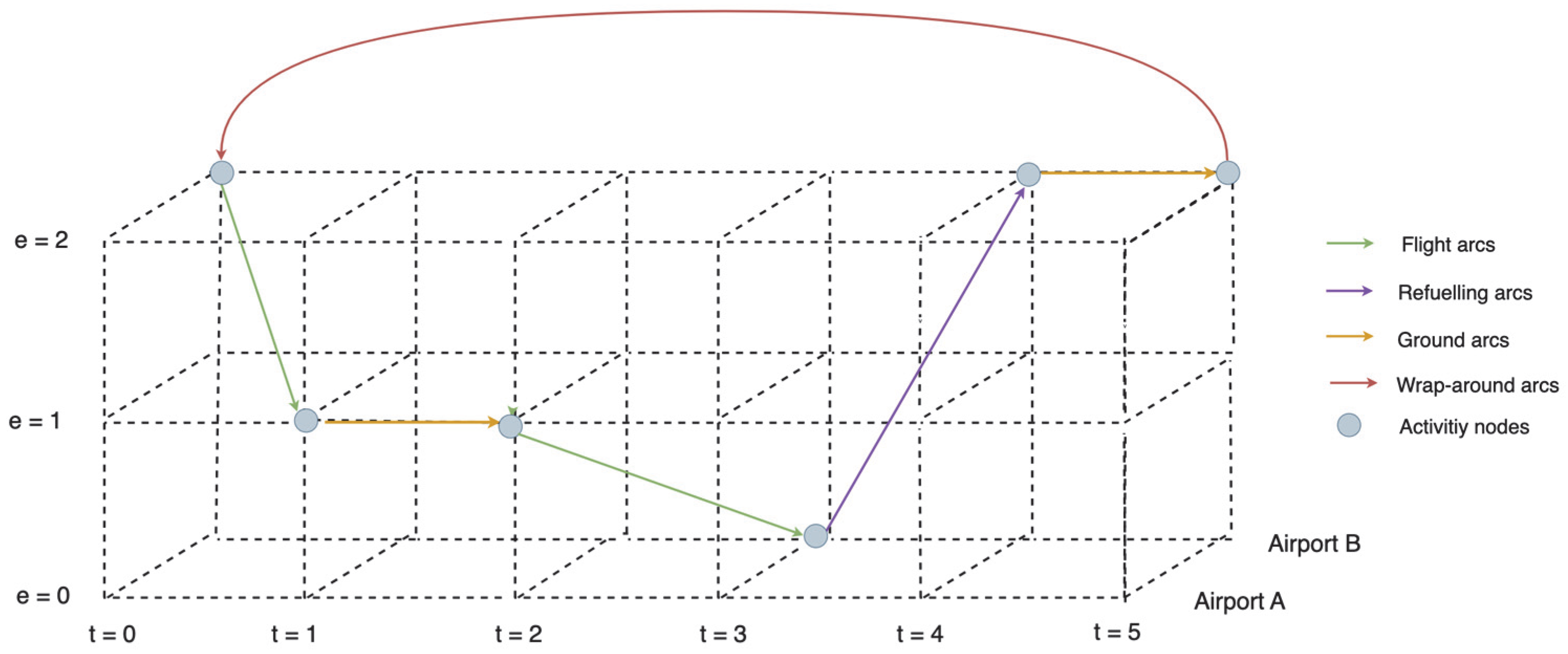
Based on the previous assumptions, a time–space–fuel network is defined with a set of airports
, a set of timesteps
, and a set of discrete (hydrogen) fuel levels
. The intersections of these three dimensions create a three-dimensional network, see
Figure 1.
We define the set of aircraft types as . Since conventional aircraft do not apply tankering in this study, the remaining fuel levels of conventional aircraft do not need to be considered, thereby reducing computational complexity. Furthermore, we translate the origin–destination demand to a set of demand markets , each characterized by a distinct tuple showing the travel demand between airports and at timestep . Finally, the set of vertices in the network is represented as activity nodes . The nodes act either as start or end vertices of an aircraft activity. These activities are represented by three types of arcs in the network:
Flight arcs : Connect activity nodes at different airports, fuel levels and timesteps. Each flight arc is represented by f = (, , , , , ) where , and . The arrival time is defined as , where is the time (in timesteps) needed to fly from by aircraft type . Arrival fuel level is defined as , in which , is the fuel consumption between airport pairs, depending on the initial energy level , to account for the tankering penalty. The set of potential flight arcs respects the range of aircraft type .
Ground arcs
: These arcs connect the first and last activity node at any airport, ensuring schedule repeatability. Each ground arc is represented by g = (, , , , , ) where Next to the set of ground arcs, a set of wrap-around ground arcs is defined as W.
Refueling arcs
: The refueling arcs connect activity nodes at the same airports, but different timesteps and fuel levels. Each refueling arc is represented by h = (, , , , , ), with and The energy level at the timestep is with being the flow rate which shows the fuel levels that are being refueled per timestep for aircraft type u.
Additional sets:
Inbound/outbound flight arcs to activity node for aircraft type u
Set of flight arcs that serve demand market for aircraft type u
Inbound/outbound idle arcs to activity node for aircraft type u
Inbound/outbound refuel arcs to activity node for aircraft type
Inbound/outbound wrap-around arcs to activity node for aircraft type
Set of refuel and ground arcs intersecting with vertical line c at timestep t
Parameters
| Daily fixed costs per aircraft type (capex, maintenance and crew) [€] |
| Daily fixed costs of operating a hydrogen refueling truck [€] |
| Daily costs of operating the hydrogen storage unit [€] |
| Movement cost of an aircraft of type of serving flight arc (ATC and airport fees) [€] |
| Cost of hydrogen and kerosene for refueling arc for aircraft [€] |
| CO2 emissions of flight arc for aircraft type [ton CO2] |
| Carbon tax [€/ton CO2] |
| Vector of the turnaround periods after flight arc for aircraft type at airport [-] |
| Block hours of performing flight arc f for aircraft type [hours] |
| Maximum utilization hours per day for aircraft type [hours] |
| Maximum number of aircraft that can be handled at airport per timestep [#] |
| Distance of flight arc [km] |
| Seating capacity of aircraft type [#] |
| Demand, in number of passengers, for demand market [#] |
Decision variables
| Number of aircraft of type
on flight arc |
| Number of aircraft of type on refueling arc |
| Number of aircraft of type on idle arc |
| Number of aircraft of type on wrap-around arc |
| Number of LH2 refueling trucks at airport |
| Binary variable indicating whether LH2 storage facilities are available at airport |
| Number of aircraft of type in the system |
The model is described in Equations (1)–(11). The objective (1) contains the components as outlined in the modeling assumptions. Constraints (2) enforce flow conservation by ensuring that, at each activity node n, the number of incoming aircraft is equal to the number of outgoing aircraft, maintaining network equilibrium for each aircraft type. Constraints (3) ensure that demand is satisfied for each demand market, considering the seating capacity of the aircraft. Constraints (4) track the number of aircraft in the system per aircraft type using the wrap-around arcs. Constraints (5) and (6) focus on the LH2 infrastructure, limiting the number of aircraft that can simultaneously refuel to the number of refueling trucks and coupling the refueling trucks to the presence of LH2 storage. Constraints (7) ensure that the capacity of the airport is not exceeded per timestep. Constraints (8) account for the maximum utilization hours of aircraft in the system. Finally, constraints (9) ensure that aircraft stay on the ground after a flight, either refueling or idling to account for the turnaround time.
3. Case Study
For the real-world case study, the Baltic Sea region is selected due to its strong reliance on air transport for regional connectivity and its dense network of short-haul routes.
3.1. Study Data
To apply the model for the planning of an air transport system with LH2 aircraft in the Baltic Sea region, we need to collect the following data types: (1) set of potential airports with associated LH2 supply costs; (2) origin–destination (OD) matrix between airport pairs; (3) costs of operating fleet of aircraft; and (4) costs of LH2 infrastructure at the airport.
The set of potential airports is selected based on the number of daily flights departing/arriving at the airport, with a minimum of five flights per day. LH
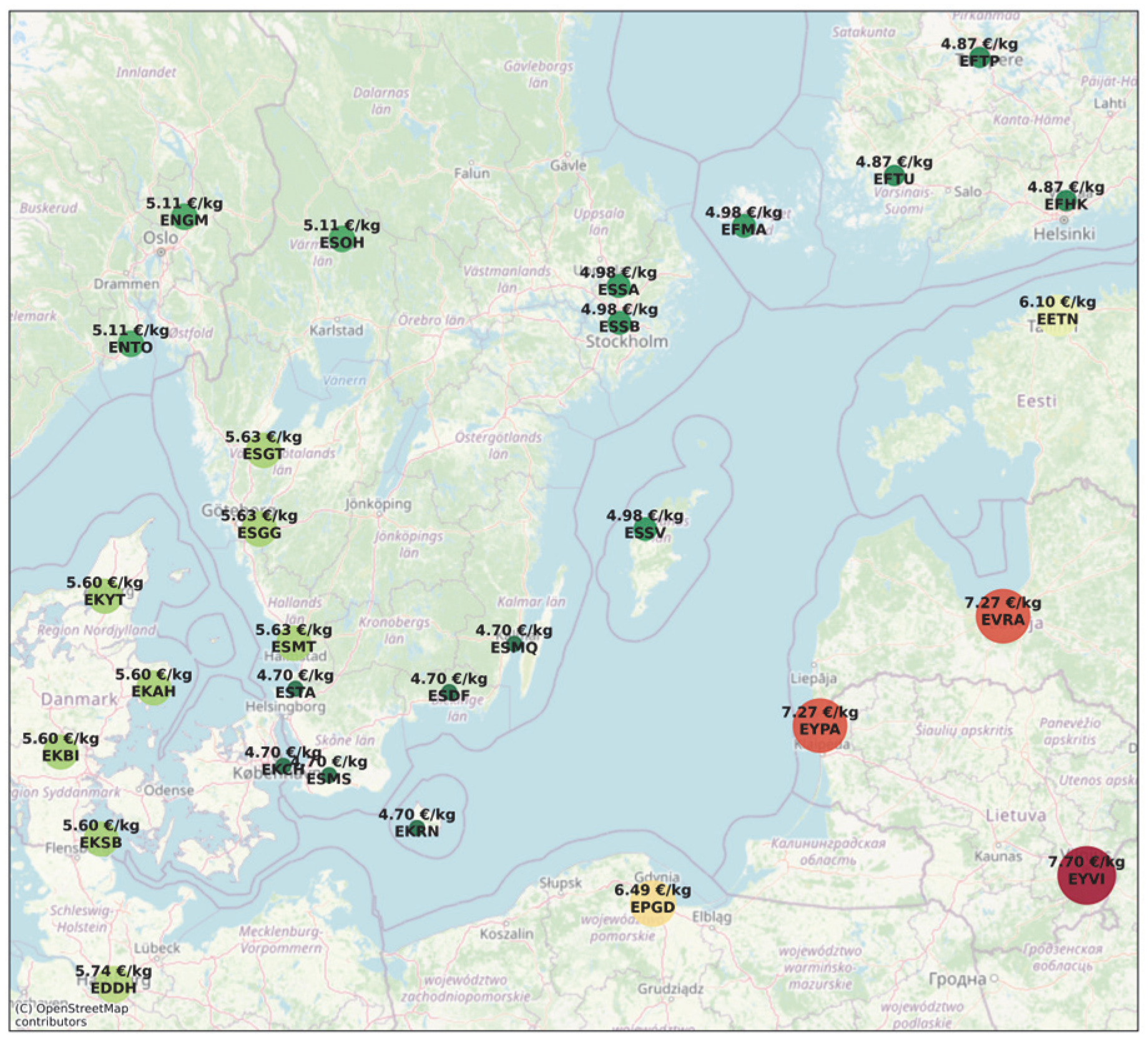
2 supply costs for these airports are taken from the study by Hoelzen et al. [
5]. For airports not covered in the study, costs from the nearest available airport are assigned.
Figure 2 presents the selected airports and their corresponding LH
2 costs for 2035. Daily origin and destination demand between airport pairs is estimated using an open-source pipeline [
10] based on Eurostat data. These flows are then scaled to a distribution over the day using existing flight schedules, creating the required demand markets.
Table 1 summarizes the aircraft types included in the heterogeneous fleet. Conventional aircraft are selected based on their prevalence in the case study region, with technical specifications partially sourced from the OpenAP database [
11]. Considering the case study and intended time horizon, the short-range LH
2 aircraft is selected based on OEM concept proposals with their expected entry into service, design range, and seating capacity [
3]. Daily fixed costs, ATC fees, airport fees, and the resulting direct operating costs are calculated using the TU Berlin DOC method [
12]. The fuel consumption reported in
Table 1 reflects average values, while in the model, it varies with the remaining fuel in the tank, to account for tankering penalties [
13]. Finally, the daily costs of operating LH
2 refueling trucks and storage facilities at each airport are taken from previous studies [
5,
14].
3.2. Model Solving
In this study, an analysis is conducted across 79 scenarios.
Table 2 summarizes the model settings and corresponding GAPs for each scenario. Each scenario is executed with 29 airports and 38 timesteps, representing 30-minute intervals between 5:00 a.m. and 12:00 p.m. The set of scenarios evaluates the trade-off between system costs and environmental benefits, with and without tankering, under the application of a carbon tax.
3.3. Study Results
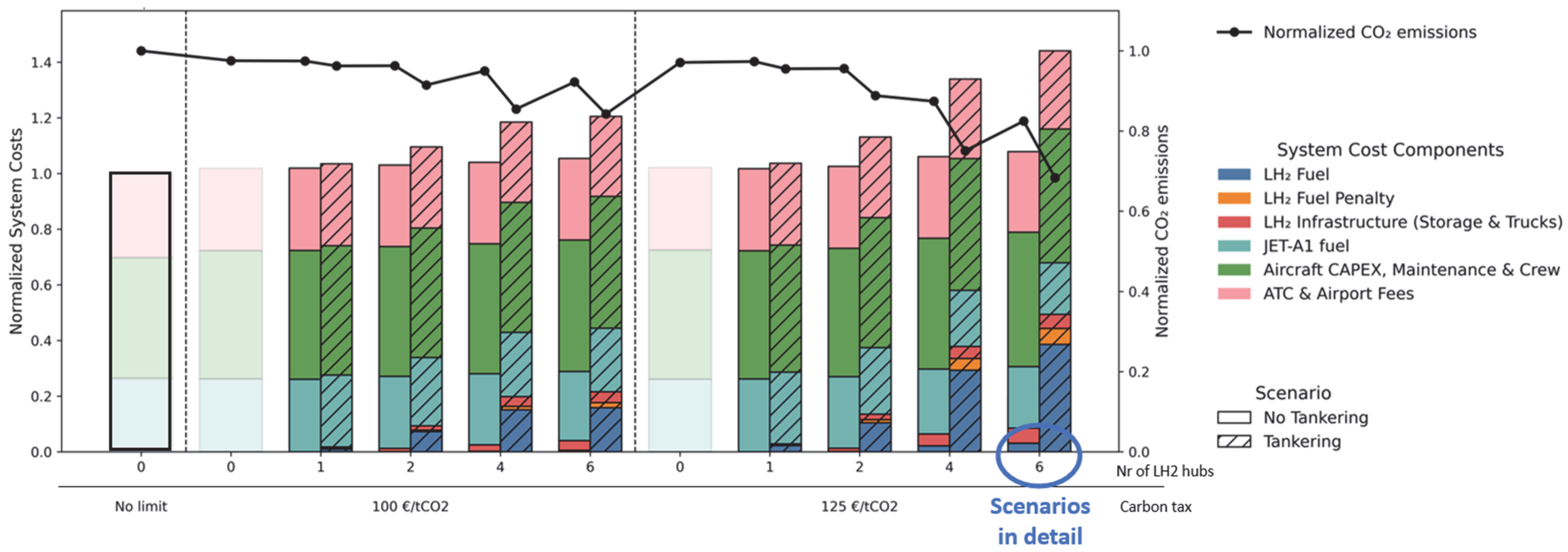
Figure 3 illustrates the relationship between total system costs and CO
2 emissions, with and without tankering. The results are obtained by varying the number of LH
2 hubs in the system and the carbon tax. The costs and emissions are normalized relative to the baseline scenario with no hubs and no tax. Multiple observations can be made:
I. Without LH2 hubs, implementing a carbon tax has a marginal effect, slightly reducing CO2 emissions and increasing system costs. Since LH2 aircraft are not available, the conventional fleet adjusts minimally, shifting toward more environmentally friendly turboprops with slightly lower emissions but higher operating costs.
II. In scenarios with only a single LH2 hub and without tankering, the system costs and CO2 emissions are similar to those in the scenario without any hubs. No tankering requires the availability of LH2 infrastructure at both the origin and destination airports.
III. In scenarios that include LH2 hubs, there is a positive correlation between system costs, the carbon tax, and the number of LH2 hubs. In contrast, a negative correlation is observed with CO2 emissions. The carbon tax incentivizes a shift toward the now available environmentally friendly LH2 aircraft. However, these aircraft are associated with higher capital expenditures, as well as additional expenses related to LH2 fuel and infrastructure. Moreover, the price of LH2 is higher than that of Jet A-1. It should be noted that a greater number of LH2 hubs enables more routes to be operated by LH2 aircraft, which increases the potential to avoid carbon taxes but also leads to higher overall system costs.
IV. For policymakers and operators, it is important to understand that the effect of tankering is not constant across different numbers of hubs and carbon-tax levels. Tankering generally leads to more efficient use of the LH2 fleet and availability infrastructure. This encourages greater use of LH2 aircraft in the system. This shift contributes to lower CO2 emissions and decreases Jet A-1 fuel consumption. At the same time, tankering increases LH2 fuel consumption and infrastructure demands at LH2 hubs. In addition, it introduces a fuel penalty because of the extra weight carried on board.
In scenarios with high carbon taxes and multiple hubs, the additional LH2 consumption, including the penalties and infrastructure requirements, is offset by the benefits of lower CO2 emissions and reduced Jet A-1 use compared to scenarios without tankering. The combined total of system costs and CO2-related costs is lower in the tankering scenario.
4. Conclusions and Further Work
The framework proposed in this paper addresses a gap in the existing literature by providing a model that simultaneously integrates strategic decisions on hydrogen infrastructure placement and fleet size, tactical decisions on flight scheduling, and operational decisions related to aircraft routing and refueling. This model allows the evaluation of tankering strategies and regulatory measures.
A generalizable result is that the potential of tankering increases with higher carbon taxes and a greater number of open hubs. Under these conditions, comparable CO2 reductions can be achieved at lower system costs while enabling broader network expansion than in scenarios without tankering. In scenarios with high carbon taxes and multiple hubs, the additional LH2 consumption, including penalties and infrastructure requirements, is offset by the benefits of lower CO2 emissions and reduced Jet A-1 use.
In summary, the model provides a valuable tool for a range of stakeholders. It enables operators and airports to analyze how the introduction of LH2 aircraft may affect future air transport systems, allows policymakers to perform sensitivity analyses on regulatory measures such as carbon taxes, and assists OEMs in defining the minimum required design characteristics of LH2 aircraft in terms of range and seating capacity.
Despite its promising potential, key parameters in this study, including the design characteristics of LH2 aircraft and the LH2 fuel costs, are subject to such high levels of uncertainty without available probability distributions. This stresses the need for a systematic approach to deal with uncertainty and for efficient model solving.