Proceeding Paper

Engine-Airframe Integration—From Froude Theorem to Numerical Flow Simulation †

Institute of Aircraft Propulsion Systems, University of Stuttgart, 70569 Stuttgart, Germany
*
Author to whom correspondence should be addressed.
Presented at the 15th EASN International Conference, Madrid, Spain, 14–17 October 2025.
Eng. Proc. 2026, 133(1), 151; https://doi.org/10.3390/engproc2026133151
Published: 15 May 2026

Abstract

The reduction of the overall emissions of the aviation sector require the improvement of the overall aircraft efficiency. In the current aircraft design, the airframe and the propulsion system are designed separately and expected to reach limits for the overall aircraft efficiency. The integration of the engine into the airframe and the implementation of boundary layer ingestion (BLI) is a promising concept to improve the overall aircraft efficiency. However, this integration alters the engine intake flow and influences the intake characteristics significantly. In this study, numerical simulations as well as water channel experiments are performed to get insights into the challenges that occur due to BLI. An actuator disc simulation is performed to validate the Froude theorem with the numerical simulations. The water channel experiments are used to perform BLI experiments for different fuselage contours and operation points of the engine. In the last step, numerical simulations of the flow into an under-wing intake are compared to an BLI intake. The studies show that the BLI can cause flow separation in different regions of the intake and the intake characteristic is altered.

1. Introduction

In the modern aviation industry the turbofan engine is the preferred propulsion system. The continuous engine development process has improved the overall engine and aircraft efficiency [1]. These enhanced efficiencies are attained through engines with higher bypass ratios [2]. However, this process is expected to reach efficiency limits due to the increased weight and drag of the engine caused by the larger fan diameters [3]. To further increase the overall aircraft efficiency and meet the requirements of the National Aeronautics and Space Administration and the European Union Aviation Agency for the reduction in fuel consumption and emissions revolutionary aircraft designs are required [3]. A promising concept to achieve this goal is the use of boundary layer ingestion (BLI) [4]. This concept integrates the engine into the fuselage and uses synergies between both the fuselage and the engine. The boundary layer is ingested by the engine, which reduces the drag of the fuselage [5]. Additionally, the boundary layer fluid has lower momentum, which reduces the engine inflow velocity [6]. This reduced inflow velocity is beneficial for an increase of the effective thrust [7]. Nevertheless, the BLI will cause a distortion of the fluid field that enters the fan [8]. This will cause an additional loss mechanism in the BLI fan and is challenging for the structural integrity of the fan blades [9]. To improve the understanding of the BLI aerodynamics, this study performs water channel experiments and numerical simulations to understand the BLI intake inflow and the altered intake characteristics. To access this topic, first an actuator disc simulation of a free propeller is performed. Then water channel experiments for different BLI contours at various operation points are performed and analyzed. The intake aerodynamics from an under-wing engine and a BLI engine are compared through numerical simulation at various flight Mach numbers and different operation points.

2. Theoretical Background

2.1. Propeller Theory and Froude Theorem

The thrust in a turboprop engine is generated mainly by the propeller. The propeller accelerates the fluid to generate thrust [10]. The idealized propeller theory is based on the assumption of an inviscid, swirl free fluid flow, and is independent on the shape and number of propeller blades [11]. As indicated in Figure 1, the propeller is modelled as an actuator disc with a certain increase in pressure over the propeller. The lower pressure in front of the propeller accelerates the fluid and the high pressure accelerates the fluid after the propeller. This changes the fluid velocity from the flight velocity w 0 to the jet velocity w 9 by a specific velocity increase Δ w [11]. To fulfill the mass conservation, the stream tube constricts. The final jet velocity is defined as
w 9 = w 0 + 2 Δ w .
The velocity increase Δ w of the propeller is a function of the pressure jump Δ p and the fluid velocity w 0 . The velocity increase is determined as
Δ w = 2 Δ p ρ + w 0 2 w 0 2 .
This theoretical analysis is known as the Froude theorem [11].
Figure 1. Idealized propeller theory based on the actuator disc approach adopted from [11].
Engproc 133 00151 g001

2.2. Numerical Simulation

The numerical simulations in this study are based on the Reynolds-averages Navier-Stokes equations with the gas properties representative for air. The Reynolds stress tensor is modelled with the eddy-viscosity assumption and the k ω SST turbulence model is used [12]. The resulting set of equations is discretized with the Finite-Volume-Method and the open-source simulation software OpenFOAM. The simulations are done with with the steady-state solver rhoSimpleFoam. The discretization is done with a blending between first order and second order schemes. The blending coefficient is specified individually for the different simulations and given in the individual sections.

3. Results

3.1. Actuator Disc Simulation

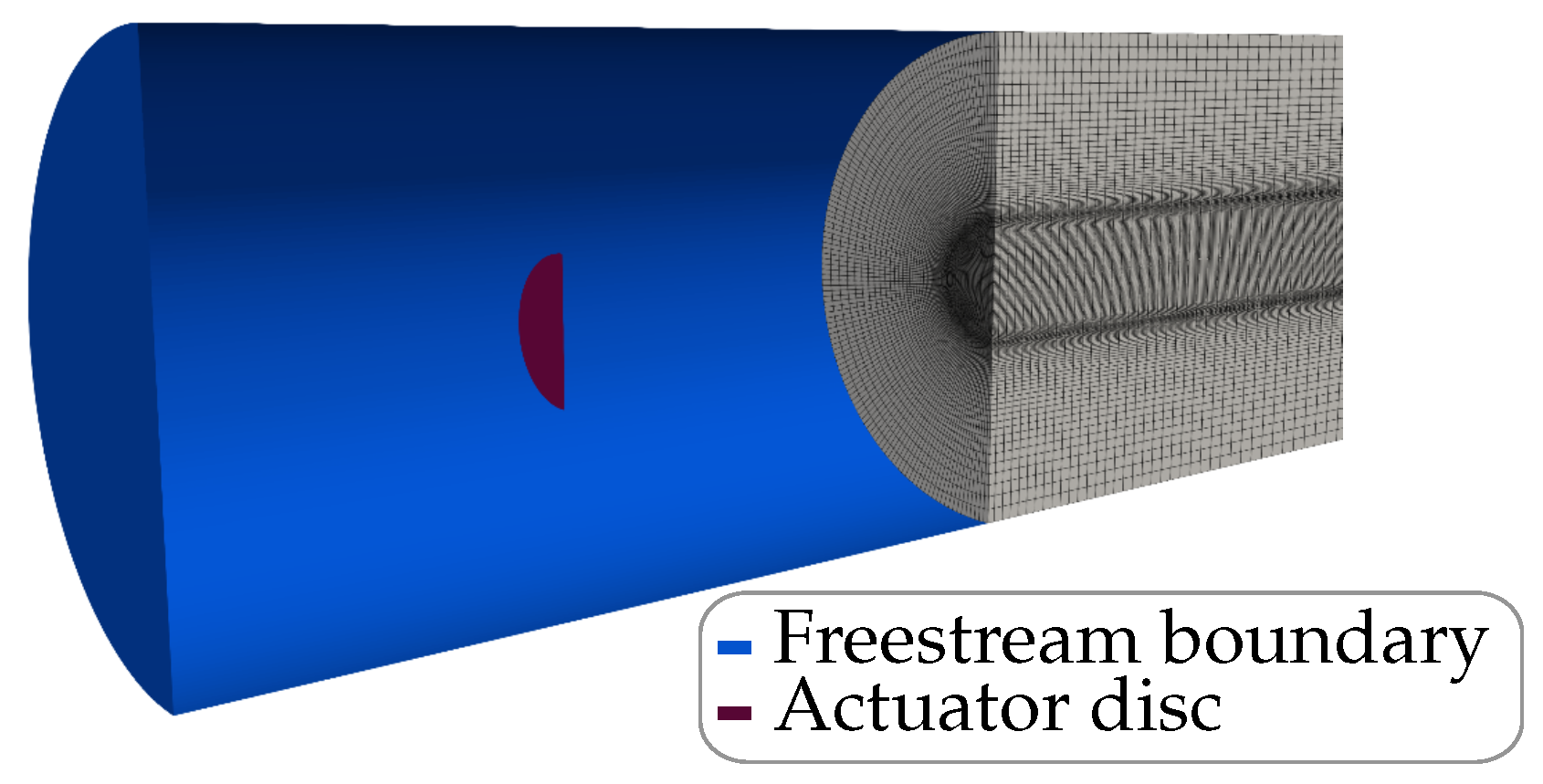
The numerical simulation of the propeller is done with the actuator disc approach. The simulation domain is shown in Figure 2. The radius of the actuator disc is specified to r a d = 1.05 m and located 6 m after the domain inlet. The cylindrical domain is designed based on the actuator disc radius with r = 3 · r a d and the length is given as l = 46 · r a d . The boundaries of the domain are defined as free stream boundaries with specified values for temperature T 0 = 298 K, pressure p 0 = 100,000 Pa, and a flight velocity of w 0 . The flight velocity is modified for the different simulations. The simulation domain is meshed with a structured mesh and has 4 million cells. The mesh is generated with the open-source software classy blocks version 1.6 [13].At the actuator disc, the pressure jump Δ p is specified. In this study, the pressure jump is defined as Δ p = 5000 Pa and the flight velocity is varied in the range w 0 = 1 200 m/s. The blending coefficient for the numerical schemes is set to 0.7 . This specifies that 70% of the discretization is done with a second order scheme.
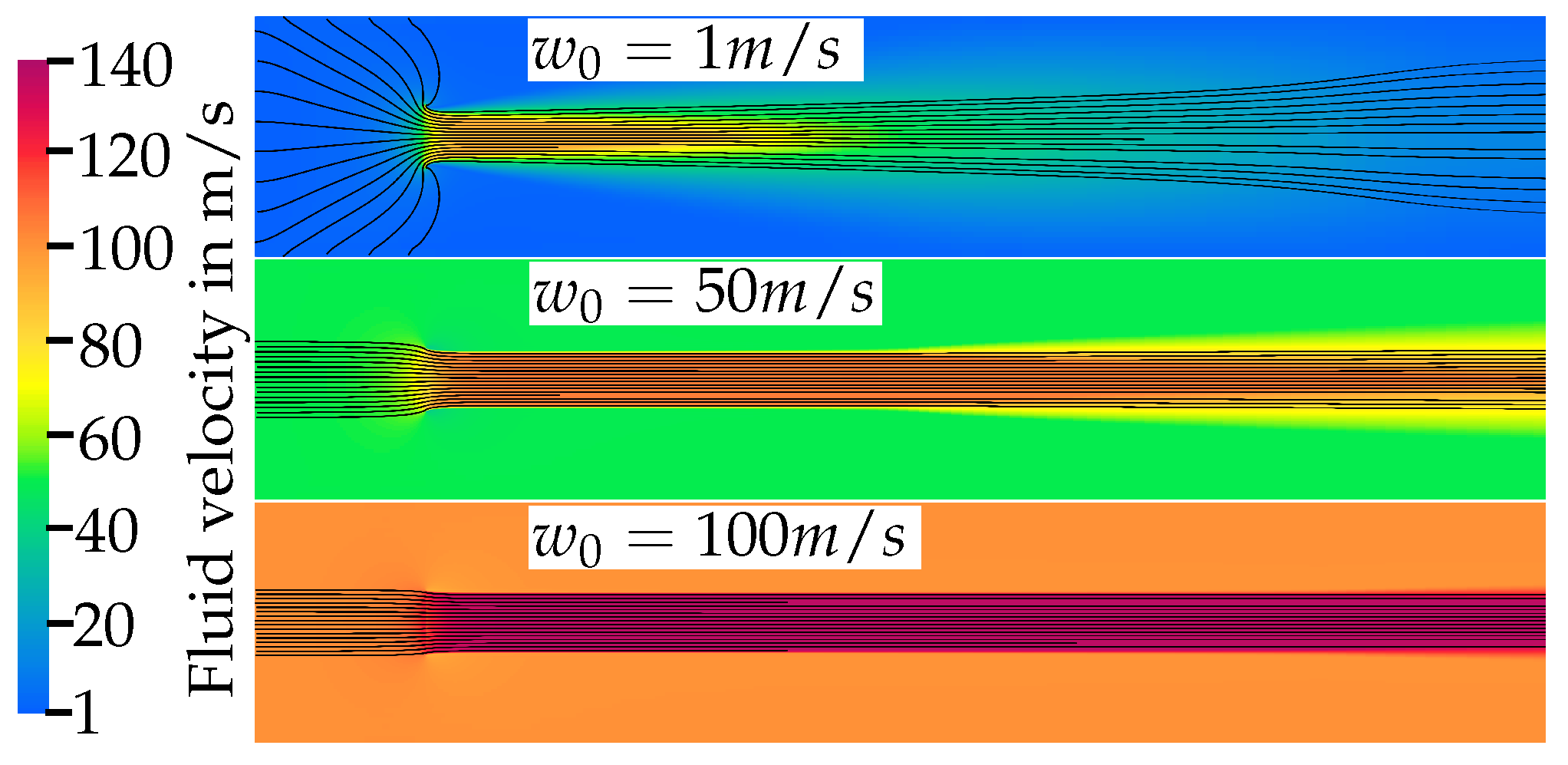
Figure 3 shows the velocity solution and the streamlines for the symmetry plane at three different flight velocities. For the flight velocity of w 0 = 1 m/s the actuator disc accelerates fluid from a large region in front of the actuator disc. The stream tube constricts and the air is strongly accelerated in front and after the actuator disc. Close to the end of the domain the stream tube widens again. The result for a flight velocity of w 0 = 50 m/s shows that the size of the incoming stream tube decreases with an increase in flight velocity. The pressure jump still accelerates the fluid, but the velocity increase Δ w decreases. The result also shows that the fluid jet persists for a longer distance at this increased flight velocity. The simulation at the flight velocity of w 0 = 100 m/s shows that this trend continuous. The incoming stream tube decreases again and is only slightly larger than the actuator disc. The velocity increase is reduced and the fluid jet with higher velocity now reaches the end of the simulation domain.

3.2. Water Channel Experiments

The water channel facility of the institute of aircraft propulsion systems is used to perform BLI intake experiments. The facility uses a large water reservoir, which is filled by a pump. The water flows from the reservoir through pipes into a calming section and enters the measurement section. After the measurement section, the water flows into a lower reservoir, from which the pump refills the large reservoir. The flow velocity is adjusted by the valve settings of the pipes, which connect the large reservoir with the calming section. SLR cameras are used to generate pictures of the flow field. The flow visualization is done with the injection of ink through a probe rake directly in front of the measurement section. The ink has the same density as the water and enables the visualization of the streaklines. Details about the test facility and the specific setup are given in [14,15].
The operation point of the intake is specified by the use of water sieves. These water sieves block the flow and increase the local pressure. The placement of water sieves outside of the intake increases the environmental pressure. This is equivalent to a take-off operation in which the intake accelerates the air. The placement of the water sieve inside the intake increases the intake pressure. This blocks the flow and intake decelerates the flow. The inflow of the water is set to w 0 = 0.064 m/s, which corresponds to Reynolds number of R e = 7150 .
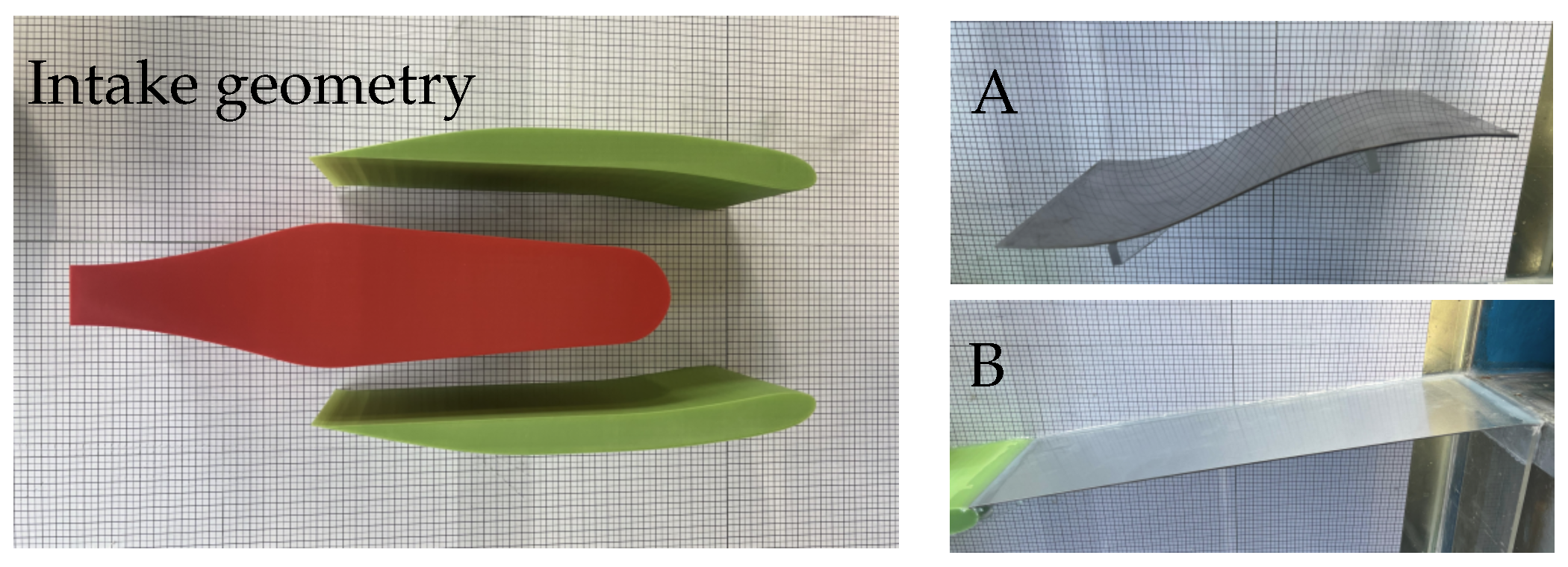
Figure 4 displays the symmetric intake model, that is derived from a modern engine intake and The specific contour of the fuselage influences the flow into the intake. In this study, two different fuselage contours are analyzed and for both cases the fuselage covers 50% of the intake area. Contour B is a linear profile with a length of 350 mm. Both contours are manufactured from 1 mm sheet steel.
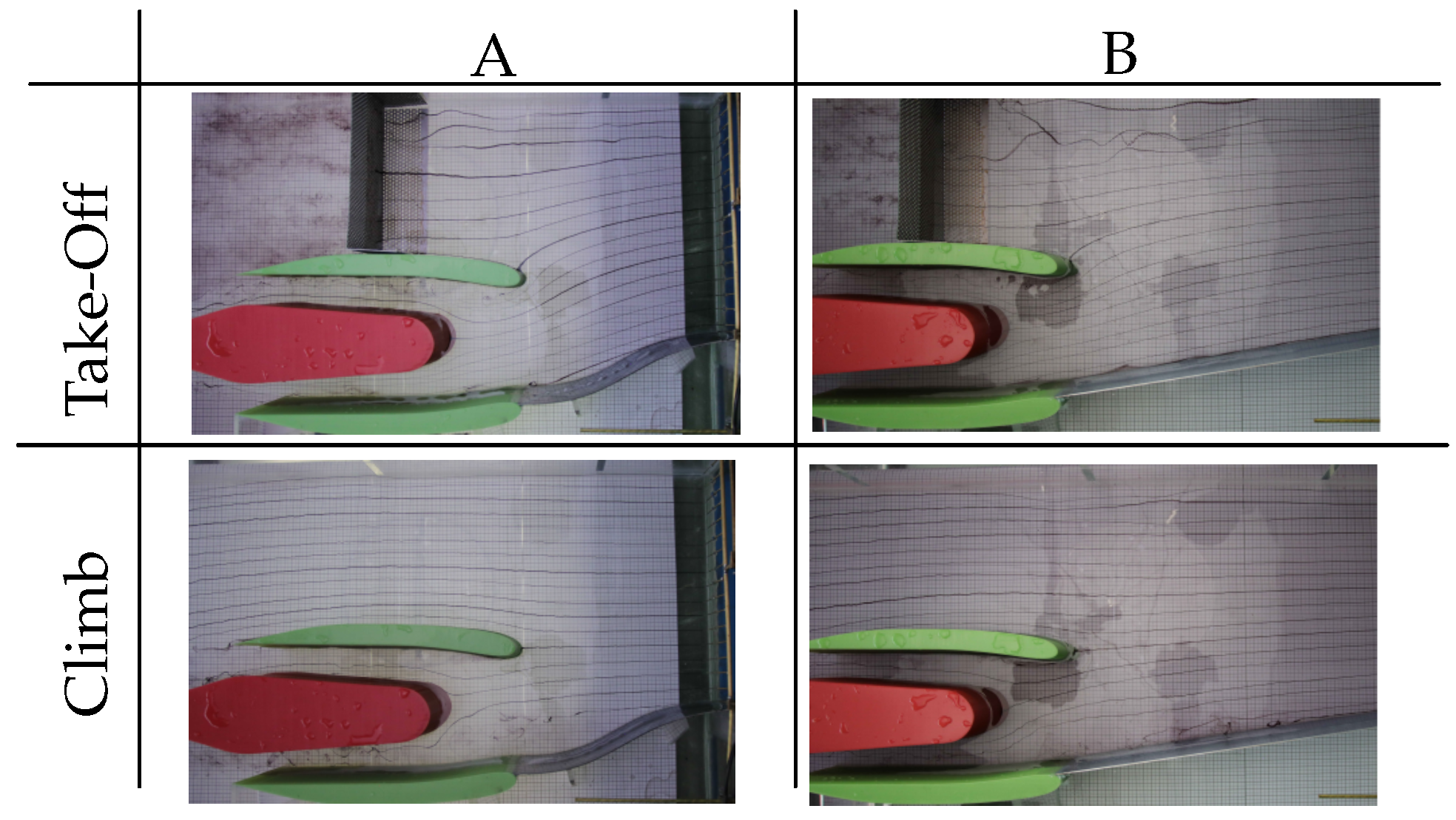
The experimental results for both BLI contours at two operation points are displayed in Figure 5. In the take-off operation for both contours a large stream tube enters the intake and is accelerated within the intake. The stagnation point is located at the outer location of the upper lip. At both configurations the flow separates at the upper lip and a small separation bubble enters the upper region of the intake. In this operation the engine sucks in air. Therefore, the flow at the fuselage contour is accelerated and does not separate. In these types of operation the contour of the BLI has negligible effects on the inflow. In the climb operation the incoming stream tube is smaller, and the intake decelerates the flow. The stagnation point is located at the forward position of the upper lip. The flow acceleration around the upper lip is reduced, and consequently the flow stays attached to the surface. However, at the fuselage contour different flow phenomena are observed for the two BLI contours. In the case of the sinus shape the surface profile has a turning point and an increase in adverse pressure gradient. This increased adverse pressure gradient causes a flow separation and the separated flow enters the intake. In the case of the linear profile the adverse pressure gradient is weaker. Therefore, the boundary layer is able to stay attached to the surface and does not separate. The analysis reveals that in operations where the intake accelerates the flow, the critical design region is the upper lip. In the case of an operation with a deceleration of the flow in the intake the critical region is the BLI contour.

3.3. Numerical Intake Simulations

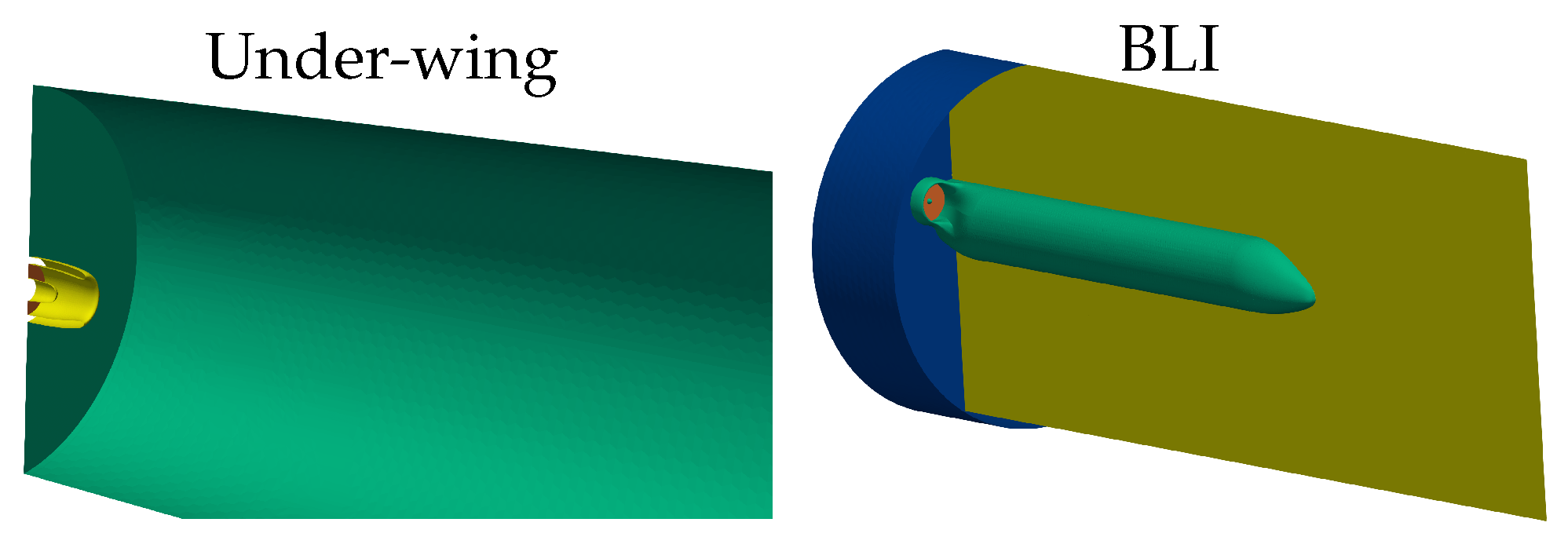
The numerical simulations are performed for the under-wing intake and the BLI intake. The intakes are simulated within cylindrical domains, that are shown in Figure 6. In the case of the under-wing intake the domain radius is specified as r = 6 m and in the case of the BLI intake the radius is given as r = 10 m. The length of the domain is specified to l = 30 m for the under-wing intake and l = 50 m for the BLI intake. The under-wing intake geometry is derived from the experimental geometry and the inlet radius is set to r = 1.05 m. The BLI configuration is derived from a conceptual design of the SynTrac transport aircraft and also has an intake radius of r = 1.05 m [16]. The BLI configuration is simulated with the fuselage, but the wings are removed to improve the mesh quality. Additionally, a symmetric boundary condition is used to reduce the computational effort.
The domains are initially meshed with an unstructured tetrahedral mesh and boundary layers at the walls. Afterwards, the mesh is dualized with the OpenFOAM functionality polyDualMesh. This step produces a polyhedral mesh with a reduced amount of cells and improved numerical capabilities [17]. The boundaries of the cylindrical domain are specified as free stream boundary conditions and the temperature T 0 , the pressure p 0 and the flight velocity w 0 are given. The specific values depend on the flight Mach number and are derived for ISA standard conditions. The outlet boundary of the intake p 2 is specified relative to the environmental pressure p 0 . The exact boundary conditions for all simulated operation points are given in Table 1. First order schemes are used for the numerical discretization in this study.
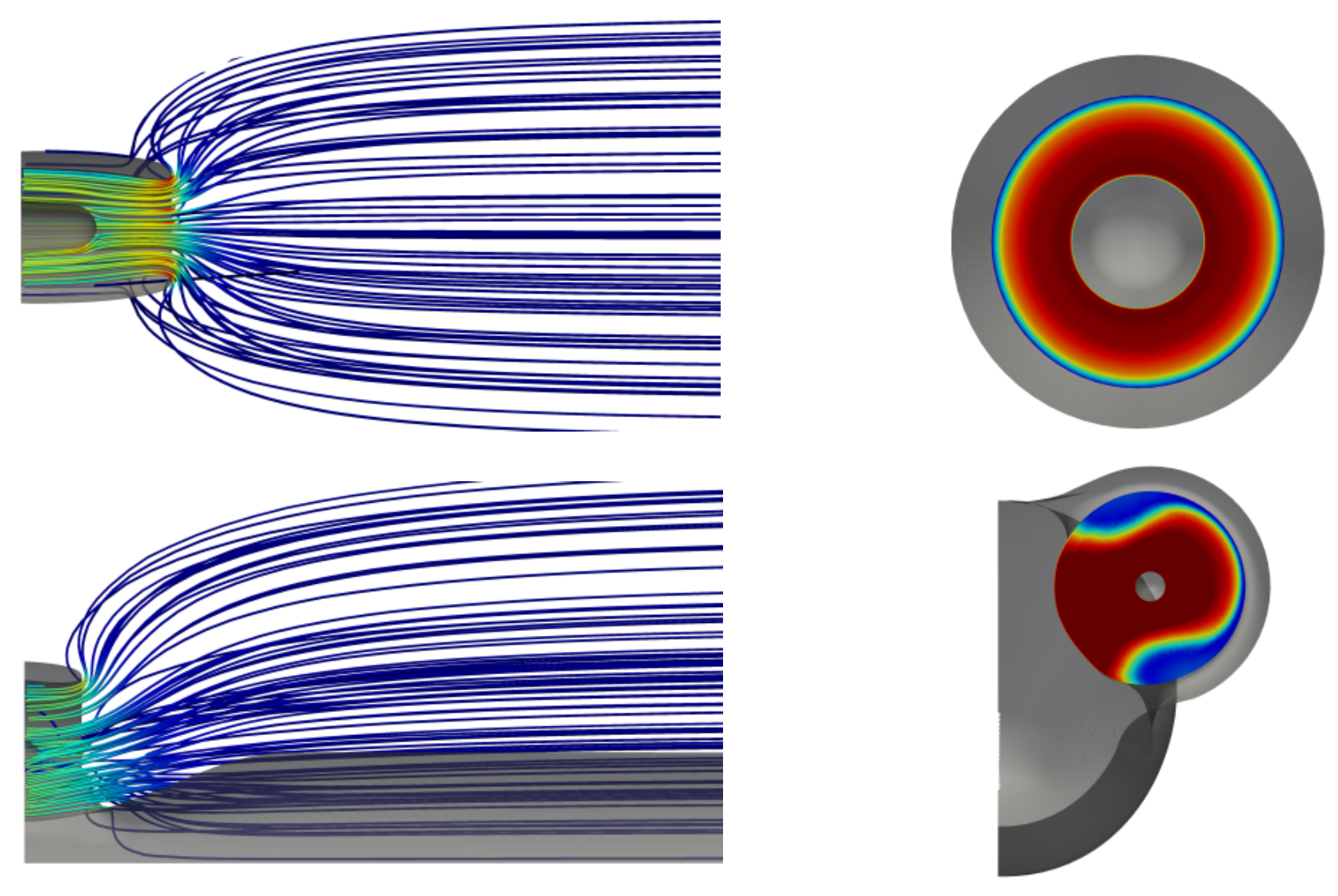
The streamlines and the total pressure distribution at the fan inlet for both geometries at take-off are shown in Figure 7. The Mach number is given as M a = 0.0 and the operation point is set as p 2 / p 0 = 0.98 for the under-wing intake and p 2 / p 0 = 0.985 for the BLI intake. This operation point is equivalent to a high thrust setting during the take-off. The engine requires a large mass flow and consequently the intake sucks in a large stream tube. The air is accelerated around the intake lips. In the case of the BLI intake the fuselage blocks a large amount of the intake. Therefore, the acceleration around the upper lip is increased. This increased acceleration causes an increased adverse pressure gradient, that causes flow separation. The flow separation is observed for the total pressure distribution at the fan inlet stage. The under-wing intake has a symmetrical total pressure field and does not show flow separation. At the walls, a boundary layer is present. In the case of the BLI the flow separates at the upper lip and a region of low total pressure enters the fan. This causes separation losses and the fan will undergo oscillating pressure fields. The flow separation at the upper lip during take-off is also observed in the water channel experiments. For a BLI, the upper lip is critical for flow separation during take-off.
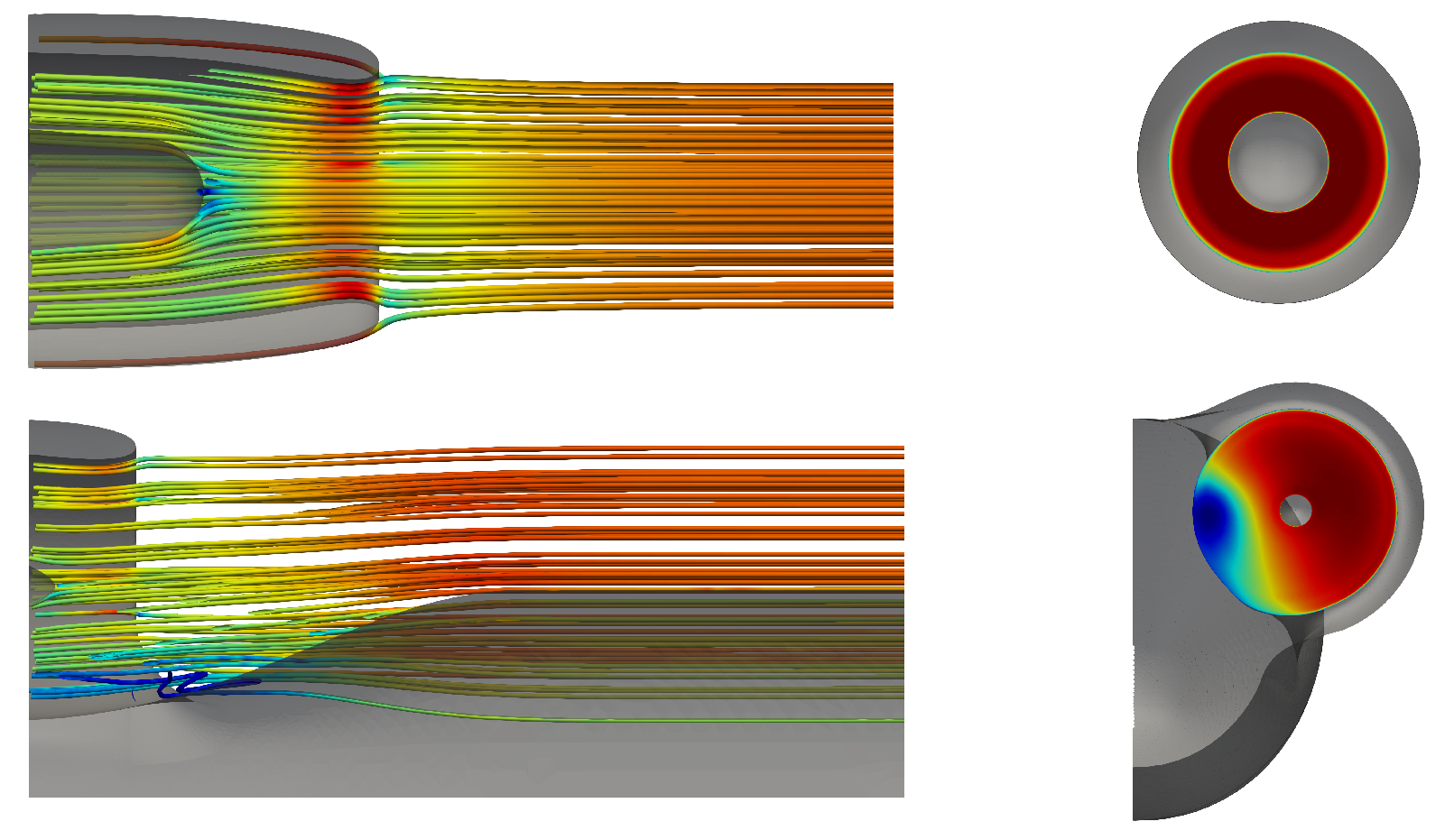
The streamlines and the total pressure distribution for both geometries during cruise are shown in Figure 8. For both geometries, the Mach number is specified as M a = 0.8 and the operation point is set as p 2 / p 0 = 1.2 . In this operation, the engine blocks the flow and the intake decelerates the fluid. The stagnation point moves to the front region of the intake lip. The under-wing intake has a symmetrical inflow and the flow stays attached to the walls. This is also observable for the total pressure distribution at the fan intake. At the walls symmetric boundary layers develop, and they are thinner than during the take-off operation. At this operation point the intake is highly efficient. The BLI intake also decelerates the fluid. However, the adverse pressure gradient causes flow separation at the fuselage. This separated flow enters the fan, which is also indicated by the large separation shown in the total pressure field. The separation causes losses and additionally the fan undergoes oscillating pressure fields. In the cruise or climb operation the region with the risk of flow separation is the fuselage contour.
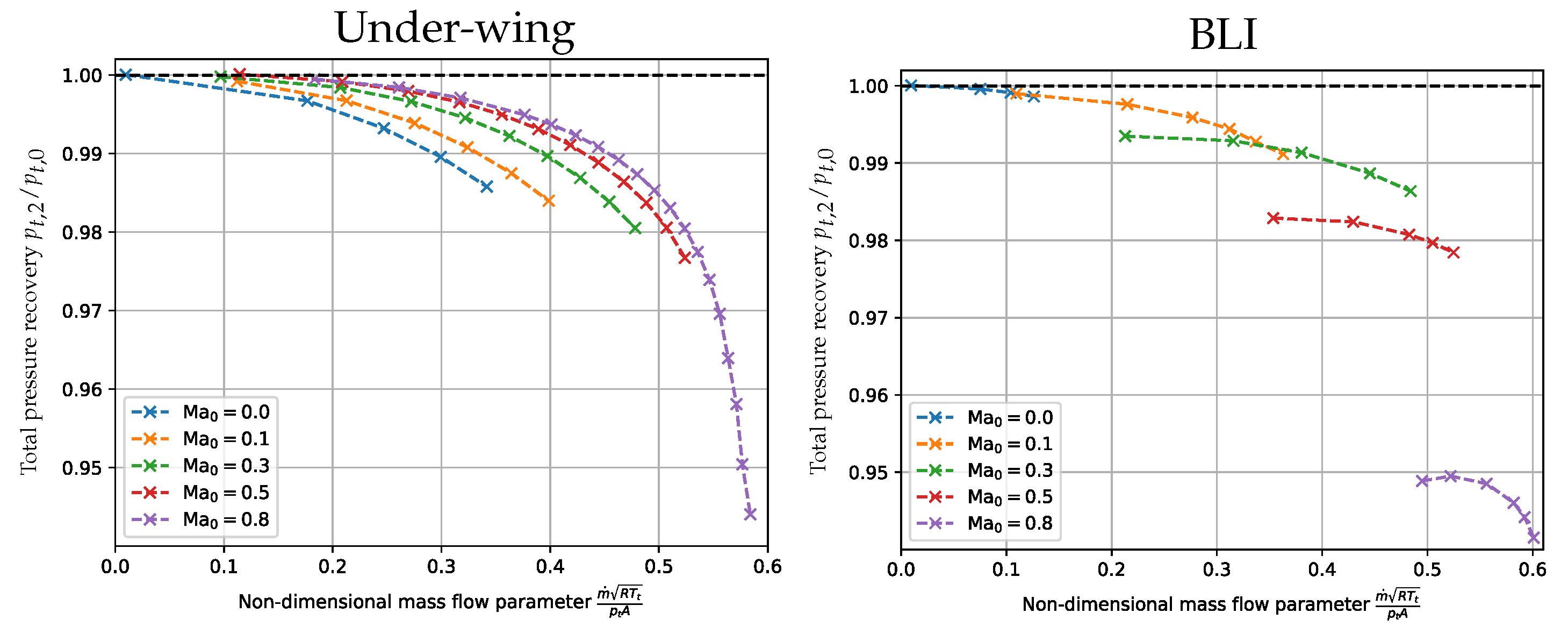
The numerical simulation of the different flight Mach numbers and operation points enable the determination of the intake map. The intake performance is analyzed based on the total pressure recovery p t , 2 / p t , 0 at various non-dimensional mass flow parameters m ˙ R T t p t A . The intake map for the under-wing intake and the BLI intake are shown in Figure 9. In the figure, each marker represents a converged operation point of the simulated intakes. For the under-wing intake the total pressure recovery decreases with an increase in non-dimensional mass flow parameter. It is also observed that an increase in flight Mach number improves the total pressure recovery. This is caused by the position of the stagnation point. An increase in the flight Mach number moves the stagnation into the intake. Consequently, the air is already decelerated friction-free in the streamtube and this improves the total pressure recovery. In the case of the BLI intake the intake sucks in the boundary layer of the fuselage, which alters the pressure recovery significantly. For low flight Mach numbers the curves are comparable to the under-wing intake characteristics. However, a further increase in the flight Mach number causes a significant drop of the total pressure recovery. Additionally, the individual characteristics intersect each other, which is challenging for the performance calculation. At the highest flight Mach number of M a = 0.8 the boundary layer of the fuselage causes a high reduction in the total pressure recovery of about 5 % . Also, the operation range of the BLI intake is smaller than the under-wing intake. This is caused by the low momentum of the boundary layer and affects the engine performance. Nevertheless, it is not possible to determine the full influence of this altered characteristic on the overall aircraft efficiency. The BLI improves the fuselage drag, so a full evaluation requires the analysis of the overall aircraft performance.


4. Discussion

The integration of the engine into the airframe and the use of boundary layer ingestion (BLI) is a promising concept to improve the overall aircraft efficiency. This study analyzes the influence of the BLI on the intake characteristic of turbofan engines. The numerical simulation of an actuator disc validates the Froude theorem for propellers and shows the capability of the numerical method. The water channel test facility is used to perform experiments of different fuselage contours for the BLI. The experiments at different operation points determines different regions of flow separation. In the case of a take-off procedure, the BLI has the risk of flow separation at the upper lip of the intake. In the case of a climb operation, the BLI separates at the fuselage and a linear fuselage design can delay the boundary layer separation. The numerical simulation of the under-wing intake and the BLI intake gives insights into the altered intake characteristics. In the case of a take-off operation, the flow separates at the upper lip and the separation enters the fan stage. This can negatively influence the fan performance. In the case of a climb or cruise operation the separation occurs at the fuselage, which again influences the fan performance. The analysis also shows that the characteristics of the under-wing intake and the BLI intake differ significantly. It is mandatory to consider this altered characteristic in performance calculations of BLI engines.

Author Contributions

Conceptualization, J.H. and S.S.; methodology, J.H.; formal analysis, J.H.; investigation, J.H.; resources, J.H.; data curation, J.H.; writing—original draft preparation, J.H.; writing—review and editing, S.S.; visualization, J.H.; supervision, S.S.; project administration, J.H.; funding acquisition, S.S. All authors have read and agreed to the published version of the manuscript.

Funding

This work was funded by the Deutsche Forschungsgemeinschaft (DFG, German Research Foundation)–Project ID 498601949–TRR 364 (Syntrac).

Institutional Review Board Statement

Not applicable.

Informed Consent Statement

Not applicable.

Data Availability Statement

The result data of the study are openly available in DaRUS at https:/doi.org/10.18419/DARUS-5556. Additional data and simulation setups are available on request.

Conflicts of Interest

The authors declare no conflicts of interest.

Abbreviations

The following abbreviations are used in this manuscript:
BLIBoundary Layer Ingestion

References

  1. Epstein, A.H. Aeropropulsion for Commercial Aviation in the Twenty-First Century and Research Directions Needed. AIAA J. 2014, 52, 901–911. [Google Scholar] [CrossRef]
  2. Ma, T.; Lu, H.; Li, Q. A systematic review of boundary layer ingestion (BLI) fan: Current Status and future perspectives. Prog. Aerosp. Sci. 2025, 154, 101082. [Google Scholar] [CrossRef]
  3. Moirou, N.G.; Sanders, D.S.; Laskaridis, P. Advancements and prospects of boundary layer ingestion propulsion concepts. Prog. Aerosp. Sci. 2023, 138, 100897. [Google Scholar] [CrossRef]
  4. Uranga, A.; Drela, M.; Greitzer, E.; Titchener, N.; Lieu, M.; Siu, N.; Huang, A.; Gatlin, G.M.; Hannon, J. Preliminary Experimental Assessment of the Boundary Layer Ingestion Benefit for the D8 Aircraft. In Proceedings of the 52nd Aerospace Sciences Meeting, American Institute of Aeronautics and Astronautics, National Harbor, MD, USA, 13–17 January 2014. [Google Scholar] [CrossRef]
  5. Plas, A.; Crichton, D.; Sargeant, M.; Hynes, T.; Greitzer, E.; Hall, C.; Madani, V. Performance of a Boundary Layer Ingesting (BLI) Propulsion System. In Proceedings of the 45th AIAA Aerospace Sciences Meeting and Exhibit, American Institute of Aeronautics and Astronautics, Reno, NV, USA, 8–11 January 2007. [Google Scholar] [CrossRef]
  6. Hall, D.K.; Huang, A.C.; Uranga, A.; Greitzer, E.M.; Drela, M.; Sato, S. Boundary Layer Ingestion Propulsion Benefit for Transport Aircraft. J. Propuls. Power 2017, 33, 1118–1129. [Google Scholar] [CrossRef]
  7. Uranga, A.; Drela, M.; Greitzer, E.M.; Hall, D.K.; Titchener, N.A.; Lieu, M.K.; Siu, N.M.; Casses, C.; Huang, A.C.; Gatlin, G.M.; et al. Boundary Layer Ingestion Benefit of the D8 Transport Aircraft. AIAA J. 2017, 55, 3693–3708. [Google Scholar] [CrossRef]
  8. Deng, H.; Xia, K.; Qiang, X.; Zhu, M.; Teng, J.; Li, H. Investigation on the inflow distortion of a propulsive fuselage aircraft and its impact on the propulsion fan performance. Phys. Fluids 2023, 35, 057107. [Google Scholar] [CrossRef]
  9. Mennicken, M.; Schoenweitz, D.; Schnoes, M.; Schnell, R. Fan design assessment for BLI propulsion systems. CEAS Aeronaut. J. 2021, 13, 3–19. [Google Scholar] [CrossRef]
  10. Rolls Royce, P. The Jet Engine; John Wiley & Sons: Hoboken, NJ, USA, 2015. [Google Scholar]
  11. Rick, H. Gasturbinen und Flugantriebe: Grundlagen, Betriebsverhalten und Simulation; Springer: Berlin/Heidelberg, Germany, 2013. [Google Scholar] [CrossRef]
  12. Menter, F.R. Two-equation eddy-viscosity turbulence models for engineering applications. AIAA J. 1994, 32, 1598–1605. [Google Scholar] [CrossRef] [PubMed]
  13. Jurkovič, N. classy_blocks. 2025. Available online: https://zenodo.org/records/19599558 (accessed on 30 November 2025).
  14. Leitner, M.; Zippel, M.; Staudacher, S. The Interaction of Tip Leakage Flow with Incoming Flow in a Compressor Cascade; Deutsche Gesellschaft für Luft-und Raumfahrt-Lilienthal-Oberth eV: Bonn, Germany, 2016. [Google Scholar]
  15. Stein, T.; Leitner, M.W.; Staudacher, S. Effect of Leading Edge Erosion on the Tip Leakage Flow in a Compressor Cascade. J. Turbomach. 2025, 147, 081015. [Google Scholar] [CrossRef]
  16. Syntrac TRR 364. 2025. Available online: https://www.trr-syntrac.com (accessed on 24 November 2025).
  17. Sosnowski, M. The influence of computational domain discretization on CFD results concerning aerodynamics of a vehicle. J. Appl. Math. Comput. Mech. 2018, 17, 79–88. [Google Scholar] [CrossRef]
Figure 2. Simulation domain for the actuator disc simulation.
Engproc 133 00151 g002
Figure 3. Simulation results for different fluid velocities at a constant pressure jump of Δ p = 5000 Pa.
Engproc 133 00151 g003
Figure 4. Geometry of the engine intake and the BLI contours. Contour A represents a sinus shape for the fuselage, while B represents a linear contour.
Engproc 133 00151 g004
Figure 5. Results of the water channel experiments for the two BLI contours at two operating points. Contour A represents a sinus shape for the fuselage, while B represents a linear contour.
Engproc 133 00151 g005
Figure 6. Simulation domains for the under-wing intake and the BLI intake.
Engproc 133 00151 g006
Figure 7. Simulation results for both geometries for a take-off operation.
Engproc 133 00151 g007
Figure 8. Simulation results for both geometries for a cruise operation.
Engproc 133 00151 g008
Figure 9. Total pressure recovery for the under-wing intake and the BLI intake.
Engproc 133 00151 g009
Table 1. Boundary conditions for the intake simulation.
Flight
Mach Number
Temperature T 0 in KPressure p 0 in PaUnder-Wing Outlet
Pressure p 2 / p 0
BLI Outlet Pressure p 2 / p 0
0.0288.15101,3250.92–1.00.985–1.0
0.1288.15101,3250.9–1.00.9–1.0
0.3288.15101,3250.9–1.060.9–1.03
0.5288.15101,3250.96–1.20.96–1.08
0.8223.1526,4291.1–1.51.06–1.2
Disclaimer/Publisher’s Note: The statements, opinions and data contained in all publications are solely those of the individual author(s) and contributor(s) and not of MDPI and/or the editor(s). MDPI and/or the editor(s) disclaim responsibility for any injury to people or property resulting from any ideas, methods, instructions or products referred to in the content.