1. Introduction
The global aviation sector is undergoing a profound transformation driven by the simultaneous need to meet increasing air traffic demand and to meet ambitious climate neutrality targets. Commercial aircraft manufacturers are therefore challenged to improve the environmental performance of future fleets throughout their entire life cycle, from raw material extraction to End-of-Life (EOL) processing. Historically, the environmental footprint of aircraft has been dominated by operational fuel burn, representing nearly 90% of total life-cycle emissions for conventional tube and wing configurations [
1]. Advances in aerodynamics, high-bypass propulsion systems, and lightweight composite structures have significantly reduced operational emissions in recent decades. However, when these ongoing industry efforts are coupled with disruptive technologies ranging from alternative fuel pathways to novel aircraft configurations, the proportion of environmental impact attributed to manufacturing and EOL stages is projected to increase, making material production, scrap generation, and recycling efficiency increasingly critical [
2,
3].
The extensive use of carbon fiber reinforced polymers (CFRP) in modern airframes exceeding 50% by mass in aircraft, such as the Airbus A350 [
4] and Boeing 787 [
5], has enhanced operational efficiency but also introduced new environmental challenges [
6]. CFRP manufacturing is highly energy-intensive, produces limited recyclable output, and results in substantial non-recyclable waste [
1,
7].Conversely, traditional aluminum alloys remain attractive due to their low energy intensity, high recyclability, and well-established supply chains, despite their higher structural weight compared with composites [
7]. In this context, determining the optimal material composition for aircraft structures requires a holistic life-cycle perspective rather than a purely performance-driven one.
Previous studies [
8,
9] have primarily integrated life-cycle assessment with Overall Aircraft Design (OAD) to support decisions such as fuel selection or range optimization, relying largely on empirical aircraft sizing and mass-estimation methods. In contrast, the present work introduces a material-based aerostructural approach that links life-cycle impacts directly to structural design choices.
This work addresses this gap by developing a low-fidelity aerostructural optimization framework for high aspect ratio wings that incorporates life-cycle metrics into material selection. Aluminum and CFRP are evaluated as baseline materials for wing skins and spars, enabling a systematic comparison of mass, structural behavior, fuel burn, Carbon Dioxide Equivalent (CO2eq) emissions, and waste generation.influence of Sustainable Aviation Fuel (SAF) blending is also examined as a complementary operational decarbonization strategy. In addition, a preliminary multi-objective material optimization is proposed using an “effective material” representing continuous mixtures of metallic and composite properties.
Overall, this methodology supports environmentally informed conceptual aircraft design by quantifying trade-offs between structural performance and life-cycle sustainability.
2. Materials and Methods
The methodology developed in this study integrates physics-based low-fidelity aerostructural optimization with the environmental implications of material choices for the design of a wingbox for comparing aluminum and CFRP material architectures.
2.1. Aerostructural Optimization Framework
The aerostructural analyses are performed using
OpenAeroStruct, an open-source framework that couples a vortex lattice aerodynamic model with a finite-element representation of the wingbox, enabling rapid estimation of aerodynamic performance, structural deflections, wingbox mass, and fuel burn [
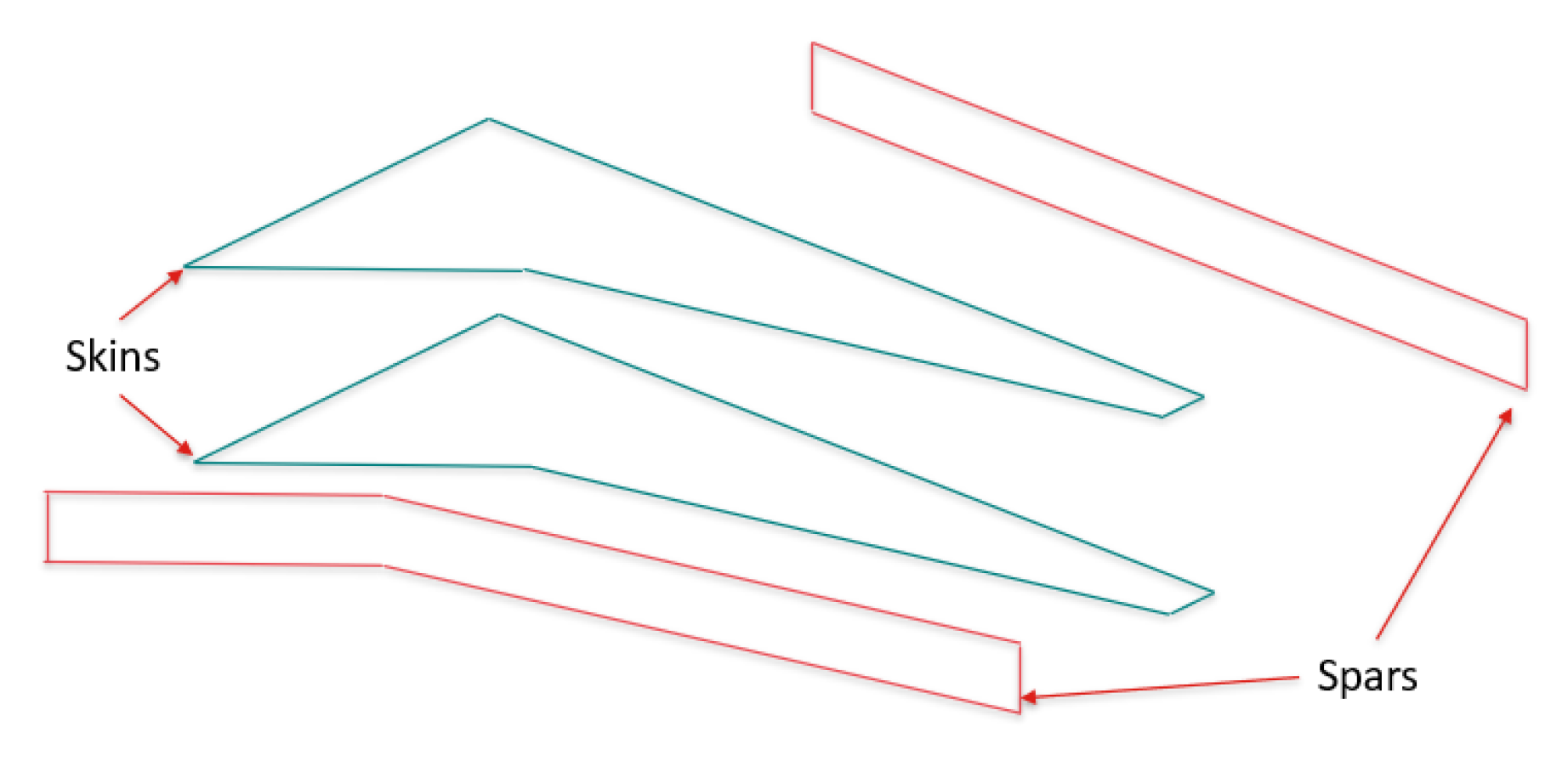
10]. The optimization minimizes fuel burn and wingbox mass by sizing the skin and spar web thicknesses. While high-fidelity effects such as detailed stress concentrations, nonlinear material behavior, and viscous aerodynamics are not explicitly captured, the framework is appropriate for comparative studies at the conceptual design stage. The default OpenAeroStruct formulation assumes a homogeneous wingbox material and was therefore modified to allow independent material assignments for the skins and spars, as shown in
Figure 1.
Material-dependent properties such as density , Young’s modulus E, shear modulus G, and allowable stress are incorporated directly into the sizing algorithm.
The output of this program gives the fuel burn and the masses of the spars and the skins. Accordingly, 4 possible configurations were analyzed:
Full Aluminum Wingbox (Al-Al)
Full CFRP Wingbox (CFRP-CFRP)
Aluminum skins, CFRP Spars (Al-CFRP)
CFRP skins, Aluminum Spars (CFRP-Al)
The results from this step were then used to determine the manufacturing and the EOL environmental impacts based on the mass fraction of materials on the structure and their respective environmental properties, as explained in the subsequent subsection. High aspect ratio wings have been demonstrated as an effective means of improving aerodynamic efficiency and are regarded as an important design phase lever towards sustainable aviation. Consequently, the uCRM 13.5 [
11] research model was selected as the reference for this study, as it provides a representative high aspect ratio wing geometry of a long-range aircraft suitable for aerostructural analysis and comparative assessment. The mechanical and environmental properties of materials used in this study are given in
Table 1.
2.2. Environmental Impact
To provide a unified metric for environmental assessment, the impact is expressed in terms of CO2eq emissions released in each selected phase. The environmental impact is quantified across three principal phases:
Material production (cradle-to-gate), including embodied energy, CO2 intensity (kg/kg), buy-to-fly ratios, and manufacturing scrap.
Operations, where fuel burn predicted by the aerostructural model is converted to CO
2 emissions using a standard conversion factor (1 kg fuel → 3.16 kg CO
2eq) [
13].
End-of-Life (EoL), including recycling efficiency, non-recyclable waste, and CO2eq emissions associated with disposal.
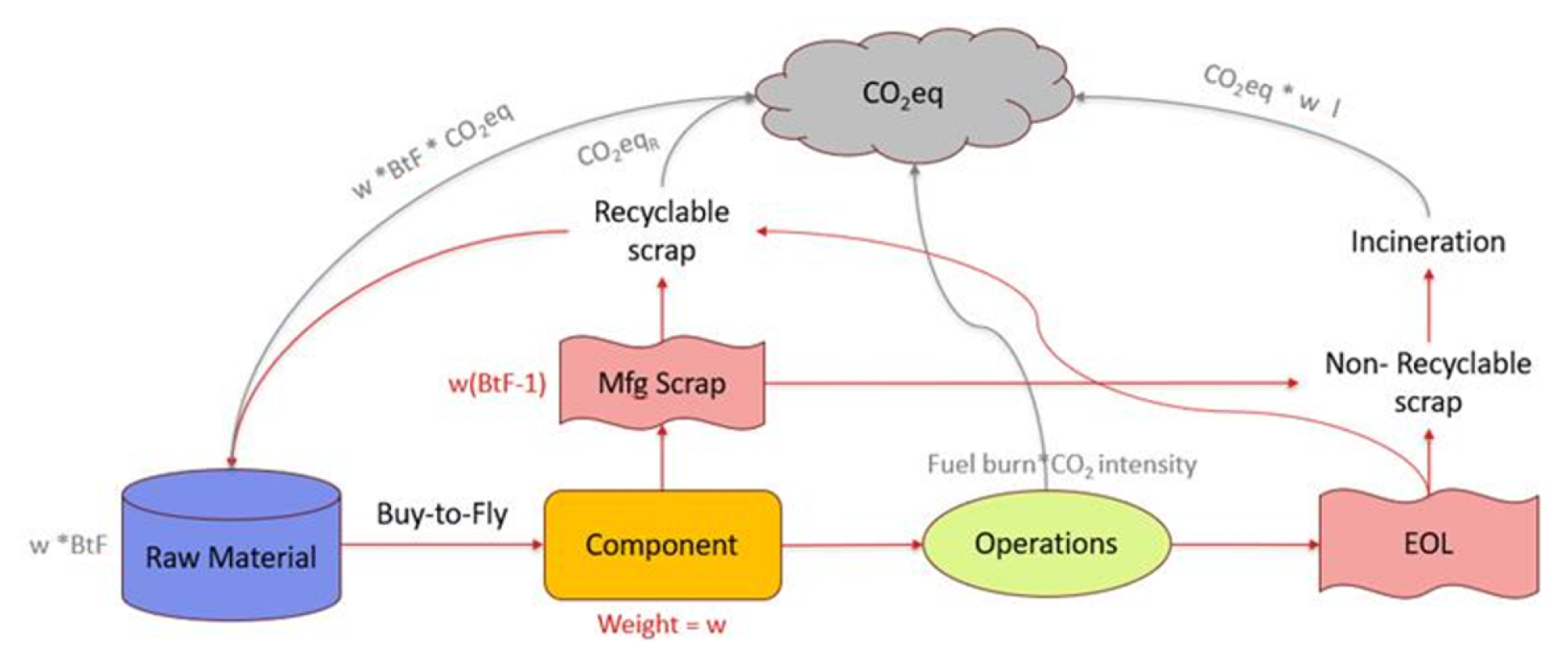
The workflow for estimating emissions is illustrated in
Figure 2 below.
The process begins with the optimized component weight derived from OpenAeroStruct results. The raw material mass required for manufacturing is estimated by multiplying the component weight by the material’s average Buy-to-Fly (BtF) ratio. The CO2eq emissions for the material stage are then derived by multiplying this raw mass by the material’s carbon intensity.
Simultaneously, the volume of manufacturing scrap is calculated. Depending on the material properties, this scrap either re-enters the loop (recycling, with an associated reprocessing footprint) or becomes non-recoverable waste sent for incineration.
In the operational phase, the component’s contribution to fuel burn, driven by its weight and aerodynamic drag, is converted to emissions (3.16 × Fuel Mass). Finally, at the End-of-Life (EOL), the component is treated similarly to manufacturing scrap: partitioned into recyclable and non-recyclable streams based on recycling efficiency, determining the final carbon footprint.
2.3. Multi-Objective Optimization for Material Composition
Initial OpenAeroStruct analyses of four Aluminum–CFRP wingbox configurations showed that wingbox mass varies non-linearly with material substitution due to coupled structural effects such as stiffness redistribution and resulting aeroelastic deflections. Because simple interpolation could not capture this behavior, a physics-informed surrogate was constructed using a shape-preserving Piecewise Cubic Hermite Interpolating Polynomial (PCHIP) fit through the computed masses, providing a continuous and physically consistent mass function across the design space.
The remaining life-cycle metrics, material-stage
CO2eq emissions and non-recoverable manufacturing/EOL scrap were modeled using mixture rules based on material mass fractions. Together, these components define a three-objective optimization problem with material weight fractions as the design variables:
Material properties for each composition were computed using the Voigt rule of mixtures,
with volume fractions derived from mass fractions and densities. Validation against two hybrid configurations showed mass-prediction discrepancies below 5%, confirming that the homogenized properties provide sufficient fidelity for optimization.
The optimization was solved using the NSGA-II algorithm, with non-dominated sorting performed in the full three-objective space. A solution is considered non-dominated if no other solution improves at least one objective without degrading at least one of the remaining objectives. The resulting Pareto-optimal set therefore represents the trade-off surface among all three objectives simultaneously. For visualization, two-dimensional projections are shown, with the third objective encoded via a color gradient, restricted to lower percentiles to highlight the minimum cradle-to-gate emissions.
2.4. Hypothesis for Material Composition and SAF Blending for Reducing Environmental Impact
To explore whether the operational advantages of the CFRP can be compensated through alternative decarbonization pathways, this part of the study examines the combined influence of circularity-oriented material choices and Sustainable Aviation Fuel (SAF) blending.
The central question addressed is as follows: If the wing structure were designed using a more circular, aluminum-rich material composition, what level of SAF blending would be required for its operational CO2eq emissions to match those of a fully CFRP wing operating solely on conventional fuel?
For this analysis, a simplified assumption is adopted whereby a 100% SAF blend yields an 80% reduction in effective
CO2eq emissions [
14,
15]. Based on this assumption, operational
CO2eq emissions were recalculated using effective emission factors corresponding to SAF blending ratios up to 50%, reflecting the current certified technological limit for drop-in SAF usage [
13]. By comparing the resulting operational
CO2eq levels with those of the baseline CFRP configuration, the SAF blending percentage required to achieve equivalent operational performance was identified. Subsequently, a balanced material configuration was selected from the previously generated Pareto front, and its effective material properties were implemented within OpenAeroStruct. This enabled the computation of the corresponding fuel burn and provided a consistent basis for evaluating combined material–fuel decarbonization strategies.
3. Results and Discussions
The first subsection presents the results of the aerostructural optimization for various material combinations and evaluates their associated environmental impacts. The second subsection provides projections for the hybrid approach described in the previous section.
3.1. Aerostructural Optimization and Environmental Impact
The results from the analyses of the four wingbox configurations are summarized in
Table 2. Material selection significantly influences the mass and aerodynamic performance (CL/CD), which together impact fuel consumption over the mission range.
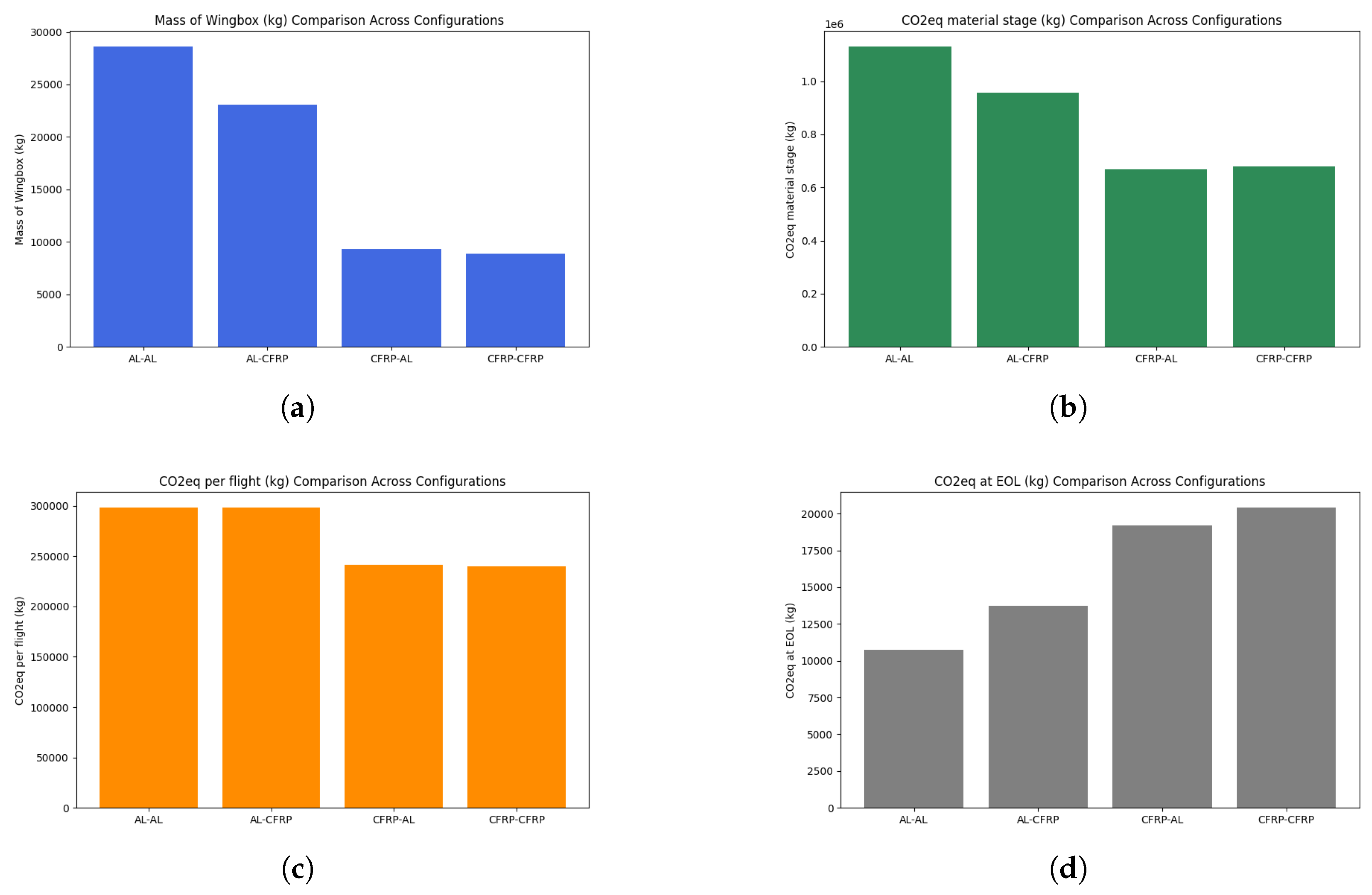
These results were further extended to study their environmental tradeoffs. The summary of these assessments is given in
Figure 3. It was observed that CO
2eq emissions during the material production stage (b) closely follow the trend in wingbox mass (a), indicating a mass-dependent impact. However, it is important to note that, although the full Al structure is more than three times heavier than the full CFRP structure, its CO
2eq emissions in the material stage are only about 1.6 times higher than those of CFRP. This discrepancy is primarily due to Al’s high BtF ratio. If the BtF ratios were equalized, the Al structure would produce significantly lower emissions in the material production stage. During the operational phase, CFRP offers an advantage over Al, resulting in approximately 20% lower emissions (c). At the EOL stage, however, the scenario is reversed. Under the current assumptions that CFRP is fully non-recyclable due to its thermoset nature, it becomes the less favorable option. In contrast, Al, being mostly recyclable, requires less energy and generates fewer emissions during reintegration into the production cycle, making it more circularity-friendly (d).
3.2. Hybrid Material and SAF Approach
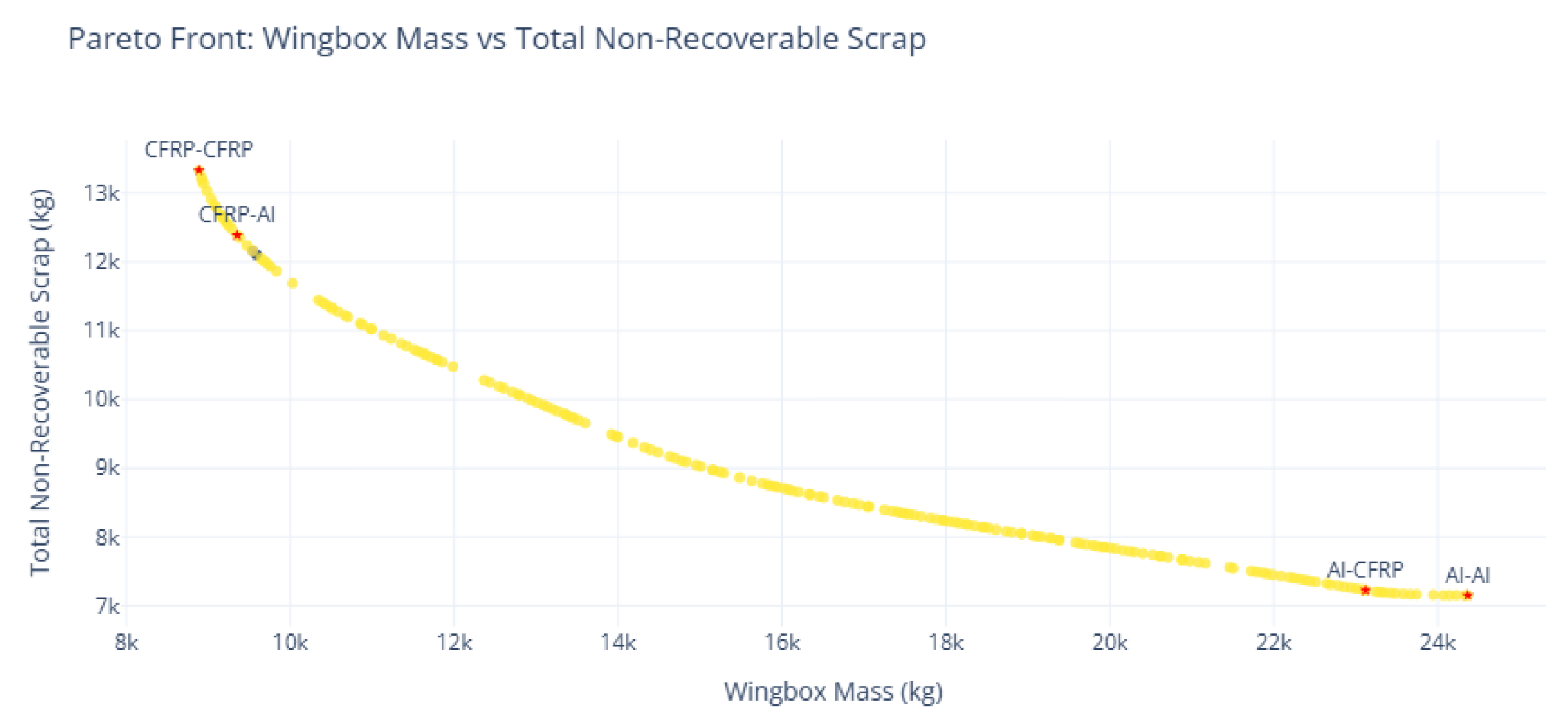
The Pareto-optimal solutions from the multi-objective optimization are shown in
Figure 4. The point just below the CFRP–Al case (marked in blue) corresponds to the blend with the lowest cradle-to-gate CO
2eq emissions. To verify the surrogate material-property model, several Pareto points were re-evaluated in OpenAeroStruct; wingbox masses differed by under 5%, confirming adequate accuracy.
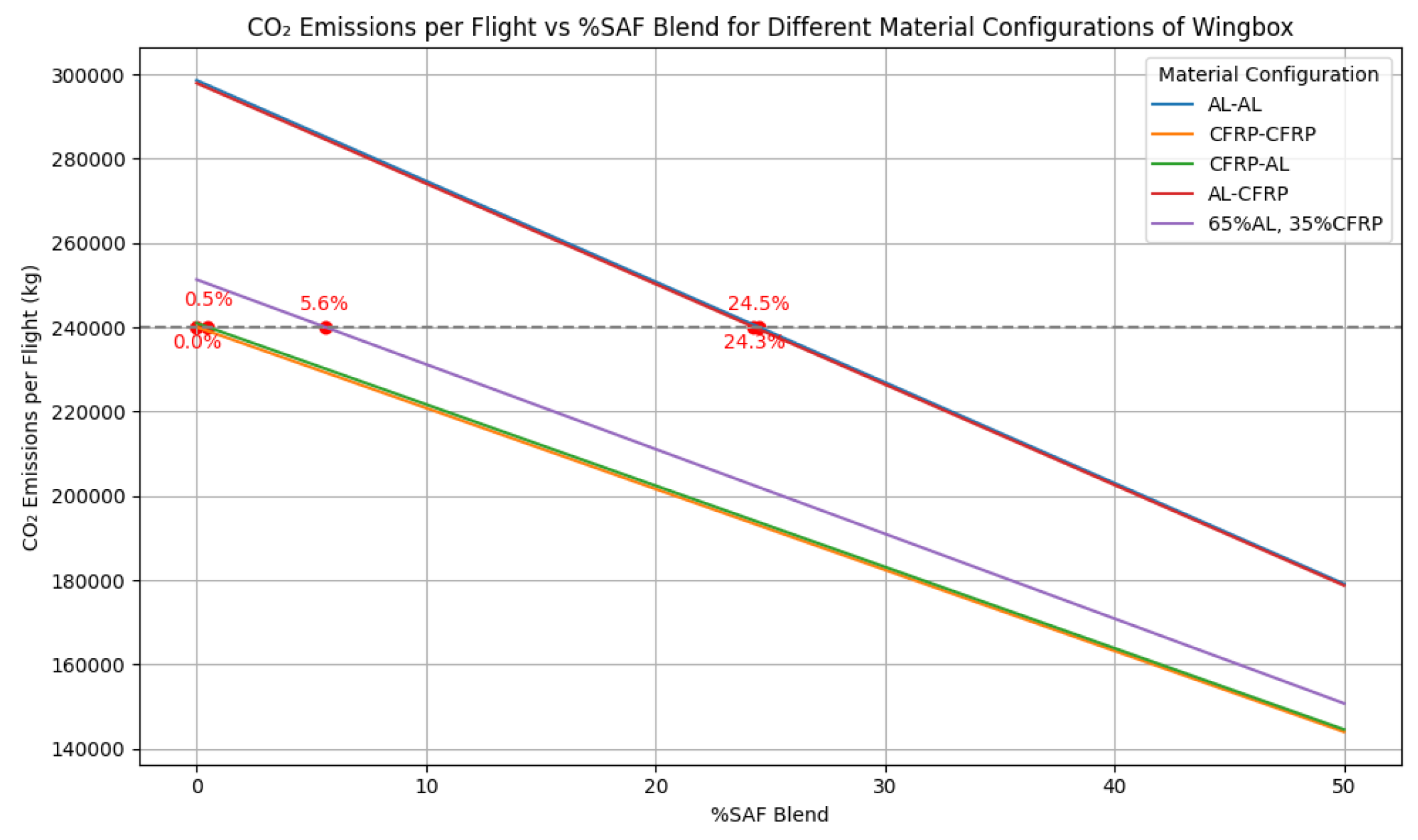
For an operational assessment, a representative hybrid composition (65% Al, 35% CFRP) from the central Pareto region was analyzed to obtain its mission fuel burn and CO
2 emissions. These emissions were then combined with the SAF-blend model to compute mission CO
2 across the full SAF range.
Figure 5 compares this hybrid design with the four baseline configurations.
Annotations in the figure indicate the SAF level at which each design matches the operational emissions of the full-CFRP wingbox. The aluminum wingbox requires about 24.5% SAF—an ambitious target given current supply, whereas the 65% Al/35% CFRP composition needs only 5.6% SAF.
This demonstrates that a hybrid material + SAF blend solution can reduce manufacturing and EOL waste relative to full CFRP while also achieving competitive operational emissions under realistic SAF availability.
4. Conclusions
This study presented an integrated aerostructural and life-cycle based framework to evaluate the environmental implications of material choice for preliminary aircraft component design. The methodology provides quantitative insight into the trade-offs between operational performance, manufacturing, and End-of-Life impacts in a low-fidelity setting.
The results indicate that CFRP-rich designs substantially reduce structural mass and operational fuel burn, but generate significantly higher non-recoverable waste compared with aluminum structures.Aluminum, in contrast, offers superior recyclability and End-of-Life performance at the expense of operational efficiency. The effective material formulation demonstrates how multi-objective optimization can identify balanced material compositions that improve sustainability across multiple life-cycle phases. CFRP is conservatively assumed to be non-recyclable at End-of-Life; accounting for emerging recycling pathways would reduce the associated CO2eq burden and shift the Pareto front towards higher CFRP content.
The integration of SAF further demonstrated a pathway where significant operational CO2 reductions can partially offset the structural mass disadvantages of heavier metallic materials, which are otherwise favorable for achieving circularity.
Future work will focus on increasing the fidelity of the aerostructural analysis to better capture nonlinear effects, detailed stress distributions, and aeroelastic interactions. The optimized material compositions will also be assessed from a manufacturing feasibility perspective, including compatibility between materials on adjacent components. In addition, the material dataset will be expanded to include a broader range of aerospace-relevant materials, enabling additional objectives such as cost, supply criticality, and recyclability to support more realistic decision-making.
Author Contributions
Conceptualization, S.S. and O.S.; methodology, S.S.; software, S.S. and O.S.; validation, S.S. and O.S.; formal analysis, S.S.; investigation, S.S. and O.S.; resources, S.S.; data curation, S.S. and O.S.; writing—original draft preparation, S.S.; writing—review and editing, J.M., C.G. and E.B.; visualization, S.S.; supervision, J.M., C.G. and E.B.; project administration, J.M. and C.G. All authors have read and agreed to the published version of the manuscript.
Funding
This research received no external funding.
Institutional Review Board Statement
Not applicable.
Informed Consent Statement
Not applicable.
Data Availability Statement
The data presented in this study are available on request from the corresponding author.
Conflicts of Interest
The authors declare no conflicts of interest.
References
- Pierrat, E.; Rupcic, L.; Hauschild, M.Z.; Laurent, A. Global environmental mapping of the aeronautics manufacturing sector. J. Clean. Prod. 2021, 297, 126603. [Google Scholar] [CrossRef] [Scilit]
- Thonemann, N.; Pierrat, E.; Dudka, K.M.; Saavedra-Rubio, K.; Tromer Dragsdahl, A.L.S.; Laurent, A. Towards sustainable regional aviation: Environmental potential of hybrid-electric aircraft and alternative fuels. Sustain. Prod. Consum. 2024, 45, 371–385. [Google Scholar] [CrossRef] [Scilit]
- Rupcic, L.; Pierrat, E.; Saavedra-Rubio, K.; Thonemann, N.; Ogugua, C.; Laurent, A. Environmental impacts in the civil aviation sector: Current state and guidance. Transp. Res. Part D Transp. Environ. 2023, 119, 103717. [Google Scholar] [CrossRef] [Scilit]
- Airbus. A350 Family—Passenger Aircraft. Airbus Commercial Aircraft. Available online: https://www.airbus.com/en/products-services/commercial-aircraft/passenger-aircraft/a350-family (accessed on 20 November 2025).
- Boeing. 787 Dreamliner—By Design. Boeing Commercial Airplanes. Available online: https://www.boeing.com/commercial/787/by-design (accessed on 20 November 2025).
- van Grootel, A.; Chang, J.; Wardle, B.L.; Olivetti, E. Manufacturing variability drives significant environmental and economic impact: The case of carbon fiber reinforced polymer composites in the aerospace industry. J. Clean. Prod. 2020, 261, 121087. [Google Scholar] [CrossRef] [Scilit]
- Sapre, S.; Morlier, J.; Gogu, C. Green Aviation Manufacturing: Addressing Environmental Impacts with MDO Methodologies. In Proceedings of the AeroBest 2025—III ECCOMAS Thematic Conference on Multidisciplinary Design Optimization of Aerospace Systems, Lisbon, Portugal, 22–24 April 2025; p. hal-05078644. [Google Scholar]
- Fabre, A.; Planès, T.; Delbecq, S.; Budinger, V.; Lafforgue, G. Life cycle assessment models for overall aircraft design. In Proceedings of the AIAA SCITECH 2022 Forum, San Diego, CA, USA, 3–7 January 2022. [Google Scholar]
- Pollet, F.; Lutz, F.; Planès, T.; Delbecq, S.; Budinger, M. A generic life cycle assessment tool for overall aircraft design. Appl. Energy 2025, 399, 126514. [Google Scholar] [CrossRef] [Scilit]
- Jasa, J.P.; Hwang, J.T.; Martins, J.R.R.A. Open-source coupled aerostructural optimization using Python. Struct. Multidiscip. Optim. 2018, 57, 1815–1827. [Google Scholar] [CrossRef] [Scilit]
- Brooks, T.; Kenway, G.; Martins, J.R.R.A. Benchmark aerostructural models for the study of transonic aircraft wings. AIAA J. 2018, 56, 2840–2855. [Google Scholar] [CrossRef] [Scilit]
- ANSYS Granta EduPack 2024 R1, ANSYS, Inc.: Canonsburg, PA, USA, 2024.
- Aerospace Technology Institute (ATI) & Airports Council International (ACI). Integration of Sustainable Aviation Fuels into the Air Transport System. In ACI and ATI Report; Aerospace Technology Institute (ATI) & Airports Council International (ACI): London, UK; Montreal, QC, Canada, 2022. [Google Scholar]
- Airbus. Our Commitment to Sustainable Aviation Fuel—SAF. Available online: https://www.airbus.com/en/innovation/energy-transition/our-commitment-to-saf (accessed on 20 November 2025).
- IATA. Developing Sustainable Aviation Fuel. Available online: https://www.iata.org/en/programs/sustainability/sustainable-aviation-fuels/ (accessed on 28 January 2026).
| Disclaimer/Publisher’s Note: The statements, opinions and data contained in all publications are solely those of the individual author(s) and contributor(s) and not of MDPI and/or the editor(s). MDPI and/or the editor(s) disclaim responsibility for any injury to people or property resulting from any ideas, methods, instructions or products referred to in the content. |