1. Introduction
Astronauts on space missions are exposed to different challenges, one being the adaptation to microgravity. Once on a mission, they must immediately deal with the changed gravitational forces. Therefore, training before a mission is mandatory but very complex and cost-intensive. Today there are two main ways to train astronauts for coping with the absence of gravity while performing motor tasks. First there are parabolic flights, where it is possible to establish microgravity for short time periods of about 22 s with two additional phases of hypergravity with approximately 1.8G before and after the 22 s of zero gravity. In addition to the fact that the time periods are rather short in which the actual training in a microgravity state is possible, the hypergravity phases interfere with the brain’s ability to adapt to microgravity [
1]. The second possibility is training in big water basins where the astronauts wear their space suits. Due to the buoyancy effect astronauts do not feel their weight but need to overcome the water resistance which makes the weightlessness feeling not comparable to real microgravity [
2].
Besides the short time of zero gravity during parabolic flights and the inaccurate simulation of zero gravity in water basins, both possibilities are costly as they need expensive infrastructures. To overcome the problems, we propose a method to compensate for the weight of a human arm with an active upper-body exoskeleton and thus simulate the state of microgravity on earth.
While compensating for the gravity terms of the rigid-body robotic system using the Recursive Newton–Euler Algorithm (RNEA) for model-based control [
3] is well established in robotics, including the human body in these algorithms is still a challenging task [
4]. The main reason is the variety of body shapes making it necessary to create an individual model for each subject [
5]. There is also a trade-off between model complexity and therefore possible correctness of the model and the difficulty to identify the corresponding parameters [
6]. Another factor using model-based control is the computational demand. With increasing complexity of the models, the computational demand increases significantly and can become prohibitive for real-time control. For these reasons simple models are often preferred. A basic approach to include the human arm into the model is to use a simplified model with two rigid bodies based on an anthropometric table for upper arm and forearm [
7]. Just et al. later proposed two additional methods to improve the compensation of the human arm. The first method estimates the mass and the center of mass of two independent rigid bodies for the human arm with force torque sensors. The second method uses the quasistatic equilibrium at each cuff [
8]. Li et al. proposed an off-line approach using recorded motor torques of a lower-limb exoskeleton to identify the parameters using an optimization-based inverse dynamics simulation [
5].
In this paper, we propose a new method to identify the parameters of the human arm model integrated into the robot model as a closed loop in real time.
2. Materials and Methods
In this chapter we describe the study setup as well as the hardware used. We start with the exoskeleton and its software component and control technique, followed by the paradigm used to train the subjects followed by the study protocol.
2.1. Recupera REHA Exoskeleton
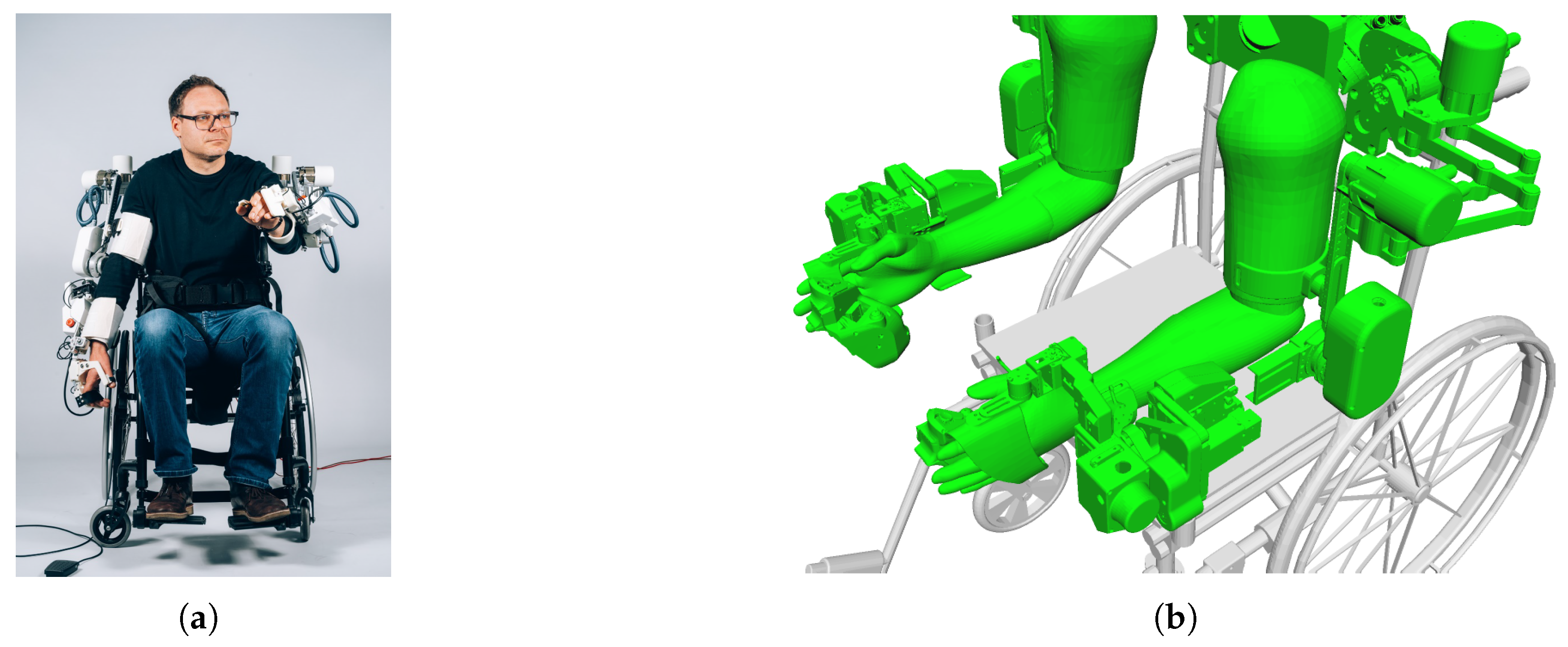
The Recupera Reha exoskeleton (
Figure 1) is an active upper-limb exoskeleton originally designed for the rehabilitation of stroke patients [
9]. It has up to 7 active degrees of freedom (DOF) per arm, 3 for the shoulder, 1 for the elbow, 1 for the rotation of the lower arm and 2 for the wrist. Here we used a configuration with 4 DOF per arm (only shoulder and elbow). The system was designed to carry the weight of a subject’s arm with an additional weight of 1 kg in the hand. For the present study we only utilized the active shoulder and elbow DOFs and added a new passive forearm, to reduce weight and to increase the dynamic of the system. The software of the system is implemented in RoCK (Robot Construction Kit), (
https://www.rock-robotics.org/) a robot framework designed by the DFKI. In this study we used the gravity compensation mode of the system. In this model-based control mode the system is torque-controlled and every joint generates the exact needed torque to keep the remaining structure in place. It is a virtual equilibrium between the gravitational forces and the exerted torques of the actuators. To further compensate the weight of a subject’s arm we added scalable arm model to the URDF (Unified Robot Description Format), an XML-based file with the kinematic description of the exoskeleton. The human arm was modeled as rigid bodies in parallel to the exoskeleton forming kinematic loops which allow the calculation of the inverse dynamics [
10].
For compensating the weight of a subject’s arm we need to specify the right weight and distribution as accurate as possible. This is done in two steps: first we made an educated guess based on anthropometric tables [
11]. Based on the height the length of the upper and lower arm and the weight of the subject, estimates of the arms weight were generated. From there in the second step we automatically fine tuned the parameters of the arm model. For this, the subject arm was actively moved in predefined trajectories. The subjects were asked to relax their arm in the system. Based on the model and by using the Recursive Newton–Euler Algorithm (RNEA) we calculated the torques needed for following the trajectories. A weak PD controller reduces the position error between the actual position of each joint reached by applying the predicted torque from our model and the expected position from the predefined trajectory. Since the inverse dynamics algorithm was implemented using a framework with automatic differentiation engine, the computational graph was automatically created [
12]. This allows us to compute the gradients of our model with respect to the parameters. The gradient descent method then adjusts the parameters according to our loss function. The loss function uses the Mean Squared Error (MSE) between the expected torque and the real torque of the system, with the latter consisting of the model-predicted torque and the correcting output of the PD controller. The torque of each joint was calculated based on the current consumption with respect to the gear ratio and the motor constant. To reduce the influence of friction, we used a simple friction model based on static and Coulomb friction.
This approach can only be used in real time with the feedback of the real system and the subject in the exoskeleton. We utilized a just-in-time compiler (JIT) for a higher frequency of model predictions allowing us to actually control the system based on the model in real time. By doing this, we are able to gradually identify model parameters which closely resembles the physical properties of the real human arm and thus allows us to calculate the torques needed to compensate the weight of the human arm based on the current kinematic state and without forcing a specific pose or trajectory. The subject can freely move the arm in the exoskeleton only restricted by the friction not captured by the friction model.
For validating the approach we tested it by adding known weights to the system. These weights could be identified by our algorithm and we were able to compensate for the gravity forces afterwards.
2.2. Paradigm
We used fine motor task in order to train subjects in simulated microgravity using the exoskeleton and evaluated the performance of these trained subjects performing the same task in microgravity during a parabolic flight. We compared the performance of these trained subjects with untrained subjects to validate our result.
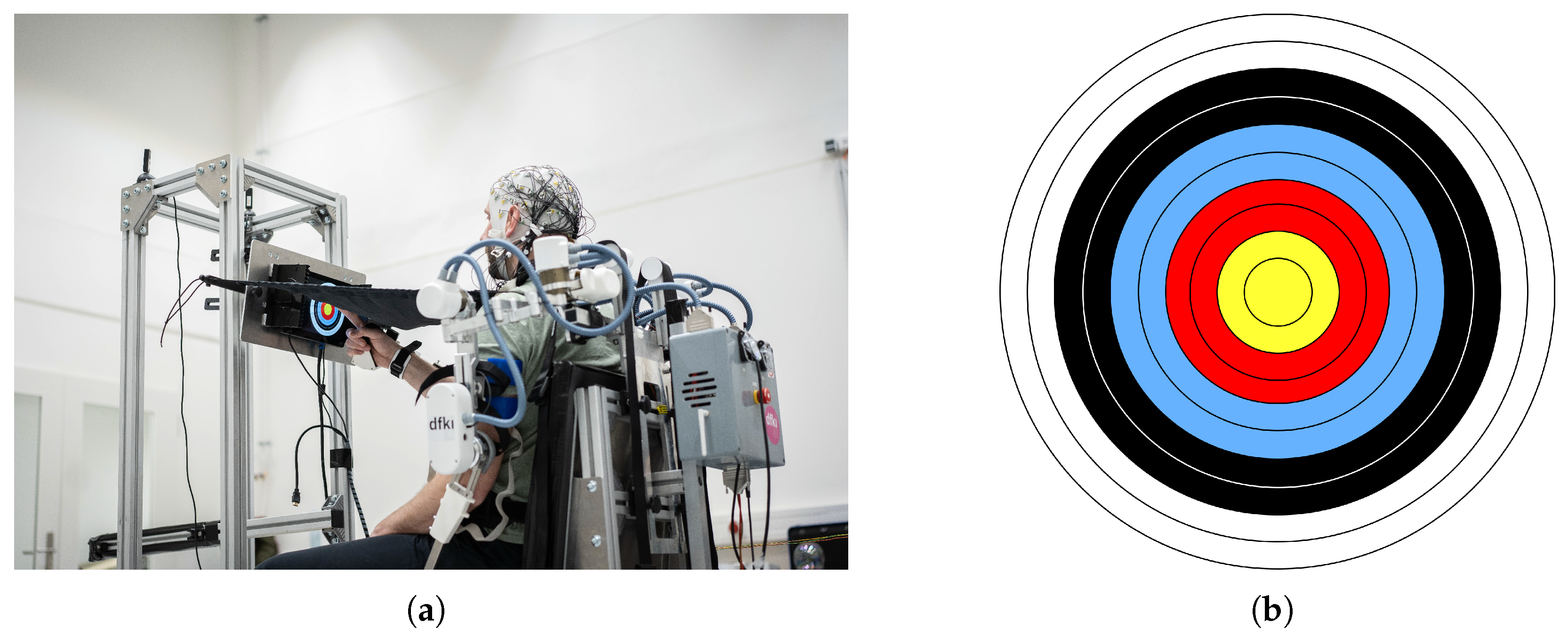
Subjects performed 16 training sessions under the simulated microgravity condition induced by the exoskeleton. Subjects were asked to perform a simple pointing task; they were instructed to touch the center of a target (
Figure 2) on a touch screen repeatedly and after each touch they were asked to move the arm back to a resting position near the lap. We recorded the deviation of the contact point from the center of the target. A parabolic flight consists of multiple microgravity phases of 22 s with shorter hypergravity phases before and after the microgravity phase. To mimic the conditions during parabolic flights, the training was also divided in 31 × 22 s windows with movement, followed by resting phases of different lengths reflecting the different phases during parabolic flights. To ensure a similar number of touches during the 22 s period, subjects during training and familiarization received feedback with a red or green arrow indicating if the time period since the last touch was too short or to long. We targeted 8 touches during the 22 s movement period. A second group of subjects performed four familiarization sessions before the flight with a passive exoskeleton without simulated microgravity to get used to the movement. The same passive exoskeleton was used during the parabolic flight to record detailed movement data. The subjects were not able to see their arm during training, familiarization and during the parabolic flight to prohibit visual feedback during the movement. The arm was covered with a curtain and the target disk was half visible allowing the subjects to see their fingertip only in the last moment before the finger reached the touch display. We assume subjects who trained this pointing task by moving their arm in a state of artificial microgravity induced by our exoskeleton are able to adapt faster to the state of real microgravity and achieve a higher target accuracy when trying to touch the center of the target.
3. Results
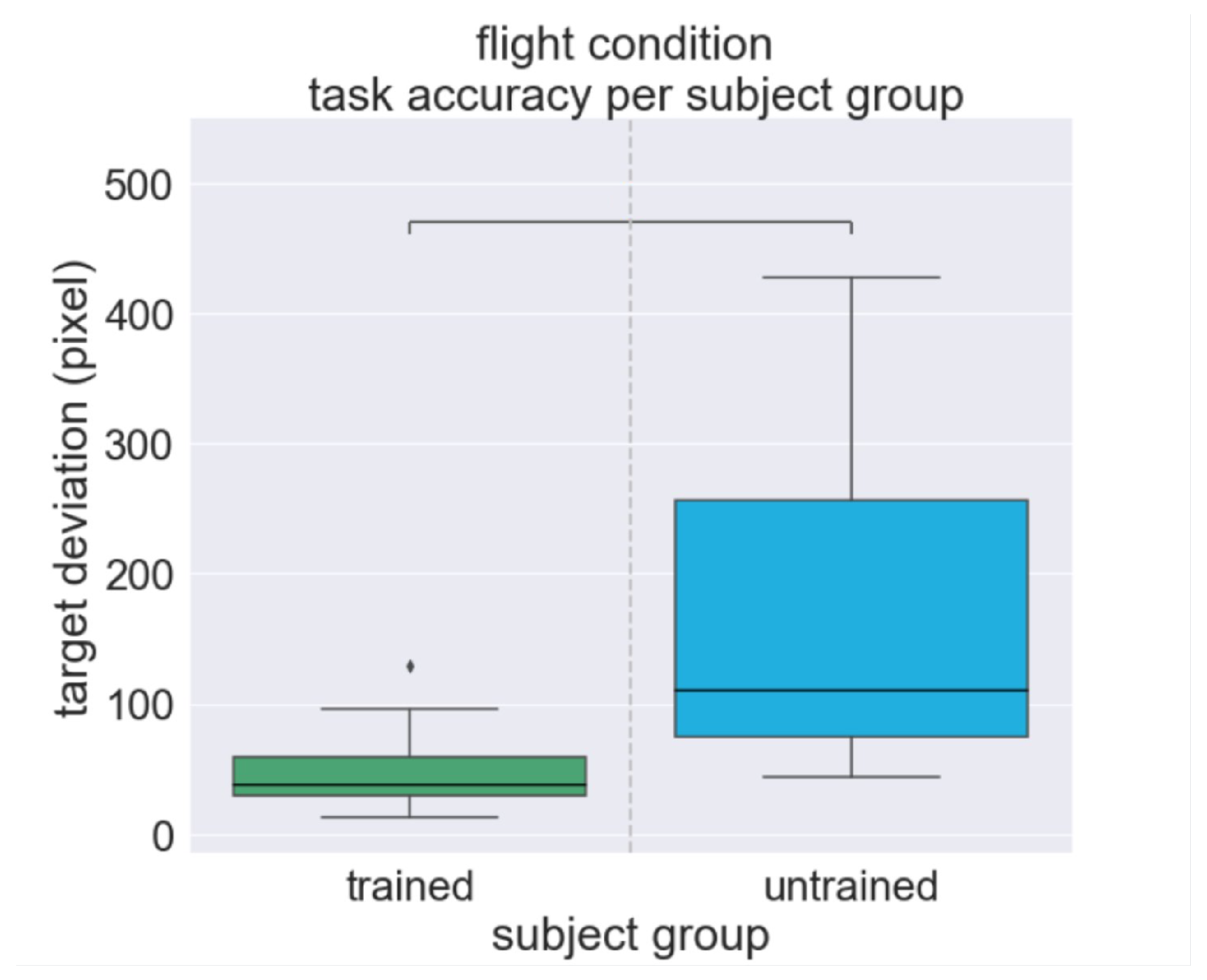
We compared the data of the untrained subject group with the trained subject group of one parabolic flight. Accuracy is measured as the deviation from the center of the target in pixel. There were three trained and three untrained subjects.
Figure 3 shows that the trained subject group performed the task during real microgravity with a higher accuracy compared to the subject group which only received a familiarization. A lower median under 50 pixels and a lower span for the trained subject group compared to a median above 100 and a bigger span overall for the untrained subject group. However, these are preliminary results, since we only have data from three individuals in each group. Further flights are planed in order to validate these findings.
4. Discussion
The results show that the active Recupera REHA exoskeleton can simulate microgravity for the upper limbs of a human. With the combination of a starting model of the human arm based on anthropomorphic tables and the learning-based fine tuning of the model parameters, very accurate models can be realized. Furthermore, preliminary data suggest that subjects trained in simulated microgravity via the active exoskeleton perform better on fine motor tasks in real microgravity than the untrained group. These findings indicate that in the future astronauts could train fine motor movement tasks pre-mission with an active exoskeleton to adjust to microgravity. In comparison to existing methods, namely parabolic flights and big water basins, this training method is less complex and more cost and labor-efficient. Besides this there are no time constraints for using an active exoskeleton. In case of parabolic flights only up to 22 s of continuous microgravity can be realized whereas with the exoskeleton one could train for several hours. However, still a lot of research must be done, as the exoskeleton in its used configuration supported the arm in four axes, three in the shoulder and one in the elbow. The approach needs to be extended to more degrees of freedom to also support the supination and pronation as well as wrist movements. And even beyond full-body exoskeletons should be utilized for even better training. Additionally, the space applications the approach can also be used in the field of heath care specifically in the field of rehabilitation of neurological disease like stroke. In stroke therapy absence of gravity may let patients move their affected limb. This is because the patients are not paralyzed but suffer from a strong reduction of muscle force due to the stroke. If the arm is weightless due to the simulated microgravity, the remaining muscle forces may be enough to move the arm and enhance the rehabilitation chances.
Author Contributions
Conceptualization, M.T. (Mathias Trampler), M.T. (Marc Tabie), J.H. and E.A.K.; methodology, M.T. (Mathias Trampler) and M.T. (Marc Tabie); software, M.T. (Mathias Trampler); validation, J.H.; formal analysis, M.T. (Mathias Trampler) and M.T. (Marc Tabie); investigation, M.T. (Mathias Trampler) and M.T. (Marc Tabie); resources, M.T. (Mathias Trampler) and M.T. (Marc Tabie); data curation, M.T. (Mathias Trampler) and M.T. (Marc Tabie); writing—original draft preparation, M.T. (Mathias Trampler) and M.T. (Marc Tabie); writing—review and editing, M.T. (Mathias Trampler) M.T. (Marc Tabie) J.H. and E.A.K.; visualization, M.T. (Mathias Trampler) and J.H.; supervision, E.A.K.; project administration, M.T. (Marc Tabie) and E.A.K.; funding acquisition, M.T. (Marc Tabie) and E.A.K. All authors have read and agreed to the published version of the manuscript.
Funding
This research was funded by the German Federal Ministry for Economic Affairs and Energy (BMWE), grant number 50RP2470B.
Institutional Review Board Statement
The study was conducted in accordance with the Declaration of Helsinki, and approved by the Institutional Ethics Committee of the Department of Computer Science and Applied Cognitive Science of the University of Duisburg-Essen, Germany (ID 2304SMHJ5751, date of approval: 04.05.2023) and by the Comité de protection des personnes Sud-Est I, France (ID 24.00483.000403-MS01, date of approval: 06.03.2024).
Informed Consent Statement
Informed consent was obtained from all subjects involved in the study.
Data Availability Statement
The data presented in this study is available upon request from the corresponding author due to privacy and confidentiality concerns.
Conflicts of Interest
The authors declare that the research was conducted in the absence of any commercial or financial relationships that could be construed as a potential conflict of interest.
Abbreviations
The following abbreviations are used in this manuscript:
| DOF | Degree of Freedom |
| JIT | Just-In-Time Compilation |
| MSE | Mean Squared Error |
| RNEA | Recursive Newton–Euler Algorithm |
| URDF | Unified Robot Description Format |
References
- Shelhamer, M. Parabolic flight as a spaceflight analog. J. Appl. Physiol. 2016, 120, 1442–1448. [Google Scholar] [CrossRef]
- Weber, M.B.; Schätzle, S.; Rieke, C. Comparing the effects of space flight and water immersion on sensorimotor performance. In Proceedings of the Human Factors and Ergonomics Society Europe, Annual Conference, Rome, Italy, 28–30 September 2017. [Google Scholar]
- Featherstone, R. Rigid Body Dynamics Algorithms; Springer: Berlin/Heidelberg, Germany, 2008. [Google Scholar]
- Rosen, J.; Perry, J.C.; Manning, N.; Burns, S.; Hannaford, B. The human arm kinematics and dynamics during daily activities–Toward a 7 DOF upper limb powered exoskeleton. In Proceedings of the 12th International Conference on Advanced Robotics (ICAR), Seattle, WA, USA, 18–20 July 2005; pp. 532–539. [Google Scholar]
- Li, Z.; Guan, X. Dynamic Parameter Identification of a Human-Exoskeleton System with the Motor Torque Data. IEEE Robot. Autom. Lett. 2022, 7, 2365–2372. [Google Scholar] [CrossRef]
- Hatze, H. The fundamental problem of myoskeletal inverse dynamics and its implications. J. Biomech. 2002, 35, 109–115. [Google Scholar] [CrossRef] [PubMed]
- Just, F.; Özen, Ö.; Tortora, S.; Riener, R.; Rauter, G. Feedforward model based arm weight compensation with the rehabilitation robot ARMin. In Proceedings of the 2017 International Conference on Rehabilitation Robotics (ICORR), London, UK, 17–20 July 2017; pp. 72–77. [Google Scholar]
- Just, F.; Özen, Ö.; Tortora, S.; Klamroth-Marganska, V.; Riener, R.; Rauter, G. Human arm weight compensation in rehabilitation robotics: Efficacy of three distinct methods. J. Neuroeng. Rehabil. 2020, 17, 13. [Google Scholar] [CrossRef] [PubMed]
- Kumar, S.; Wöhrle, H.; Trampler, M.; Simnofske, M.; Peters, H.; Mallwitz, M.; Kirchner, E.A.; Kirchner, F. Modular Design and Decentralized Control of the Recupera Exoskeleton for Stroke Rehabilitation. Appl. Sci. 2019, 9, 626. [Google Scholar] [CrossRef]
- Kumar, S.; Simnofske, M.; Bongardt, B.; Müller, A.; Kirchner, F. Integrating mimic joints into dynamics algorithms: Exemplified by the hybrid recupera exoskeleton. In Proceedings of the 2017 3rd International Conference on Advances in Robotics, New Delhi, India, 28 June–2 July 2017; pp. 1–6. [Google Scholar]
- Winter, D.A. Biomechanics and Motor Control of Human Movement; John Wiley & Sons, Inc.: Hoboken, NJ, USA, 2009. [Google Scholar]
- Sutanto, G.; Wang, A.; Lin, Y.; Mukadam, M.; Sukhatme, G.; Rai, A.; Meier, F. Encoding physical constraints in differentiable newton-euler algorithm. In Proceedings of the 2nd Conference on Learning for Dynamics and Control (L4DC), Berkeley, CA, USA, 10–11 June 2020; pp. 804–813. [Google Scholar]
| Disclaimer/Publisher’s Note: The statements, opinions and data contained in all publications are solely those of the individual author(s) and contributor(s) and not of MDPI and/or the editor(s). MDPI and/or the editor(s) disclaim responsibility for any injury to people or property resulting from any ideas, methods, instructions or products referred to in the content. |