Proceeding Paper

Numerical Modeling of Annular-Mist Flow Within a Water Recovery Unit †
1
Institute of Aerospace Thermodynamics, University of Stuttgart, 70569 Stuttgart, Germany
2
Department of Mechanical Engineering, Kogakuin University of Technology & Engineering, Tokyo 163-8677, Japan
*
Author to whom correspondence should be addressed.
Presented at the 15th EASN International Conference, Madrid, Spain, 14–17 October 2025.
Eng. Proc. 2026, 133(1), 109; https://doi.org/10.3390/engproc2026133109
Published: 9 May 2026

Abstract

Future aircraft propulsion concepts (e.g., water-enhanced engines and fuel cells) will depend on efficient water recovery to enhance cycle efficiency and environmental performance. Operating conditions commonly involve droplet (mist) transport in turbulent air and wall-bounded films formed by droplet–wall interactions. This work develops an Eulerian–Lagrangian model within the RANS/URANS framework that accounts for air–droplet–wall phenomena—interfacial shear, impingement, and film advection. A dynamic contact-angle model, implemented and calibrated from static contact angle measurements performed in this study, represents wall wetting at the liquid–solid interface. The model is validated against experiments using two design metrics: pressure loss across the unit and recovered water mass fraction. At a low Mach number ( M a = 0.1 ), saturated and dry air produce nearly identical pressure losses in the circular test section, whereas the separation lip geometry exerts a strong influence via local acceleration and separation. The simulations reproduce measured pressure drops and water mass recovery with close agreement.

1. Introduction

The contribution of the aerospace sector to global emissions is expected to increase more rapidly in the coming years compared to the road and marine transport sectors [1]. Therefore, the development of new propulsion concepts with a reduced environmental footprint is of critical importance. One such promising concept is the Water-Enhanced Turbofan (WET), which is based on a Cheng cycle configuration. In this system, hot exhaust gases are cooled, and the condensed water is recovered and recirculated to be reintroduced as steam in the combustion chamber [2]. Consequently, water recovery is essential to close the system loop, improve overall thermal efficiency, and mitigate contrail formation. In addition, airplane designs using fuel cells are heavily researched because of their reduced environmental impact. In Proton Exchange Membrane (PEM) fuel cells, liquid water droplets or vapor are generated at the cathode, depending on local temperature and relative humidity ( R H ). Effective water treatment is therefore required to prevent flooding and to maintain adequate membrane hydration [3].
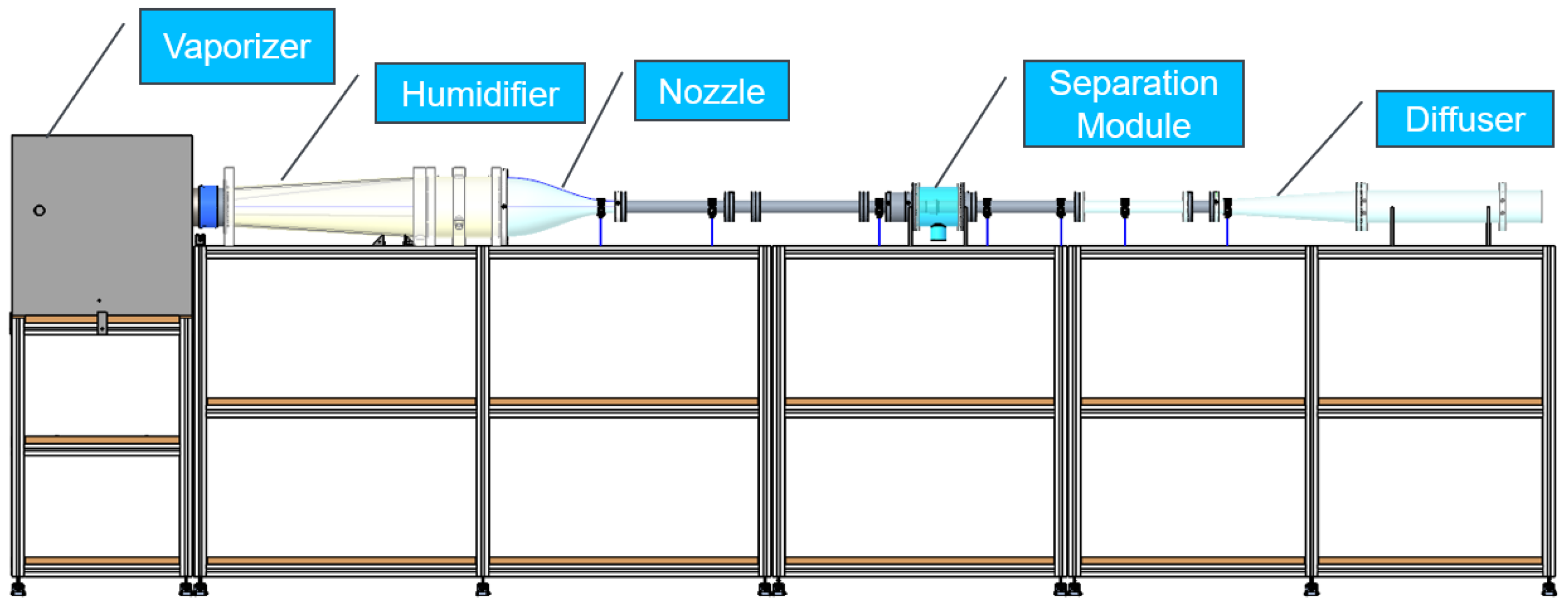
The Institute of Aerospace Thermodynamics (ITLR) at the University of Stuttgart investigates different configurations for efficient water subtraction for WET engine and flying fuel cell operating conditions. For that purpose, a test rig made of plexiglass and stainless steel was constructed in order to establish a supersaturated flow within a circular cross-sectional pipe setup (Figure 1). The saturation level was regulated via a vaporizer, and a polydisperse hollow cone spray downstream injects water droplets, establishing annular-mist flow conditions with the aim of draining the resulting film into the separation module [4].
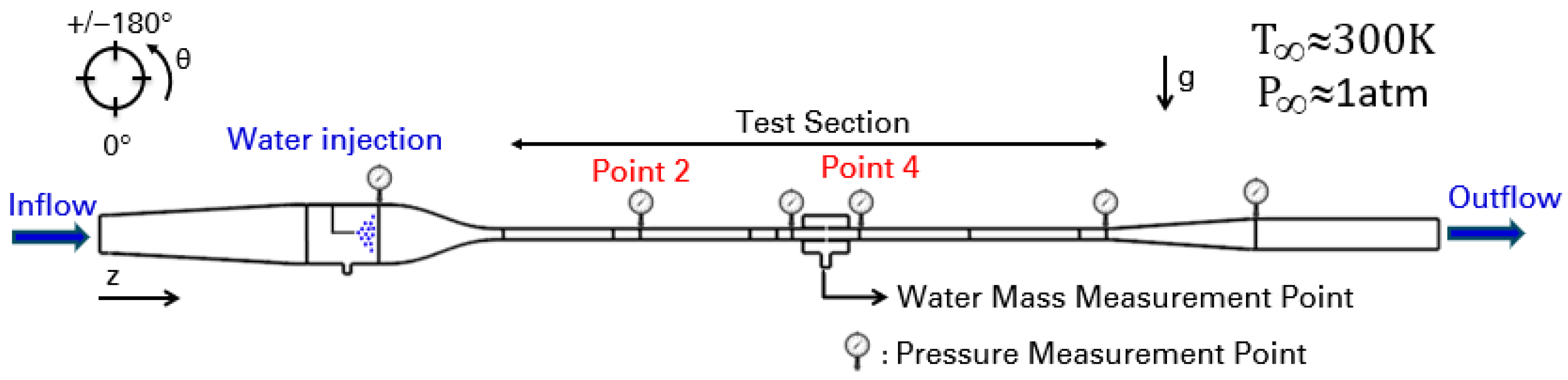
In numerical studies of separation devices, Eulerian surface film formulations have been widely used, achieving plausible results. Wang [5] investigated oil-droplet separation in cyclones using an Eulerian wall film model, while Ding [6] proposed a modified Eulerian–Lagrangian–Eulerian framework for swirling flows with condensation. An Eulerian film formulation has also been applied to analyze the performance of zigzag vane-plate droplet separators [7]. In contrast, the present work employs a rough-wall thin-film model coupled to a Lagrangian droplet-tracking scheme and validates its predictions against the experimental measurements (Figure 2).

2. Governing Equations

A Water Recovery Unit (WRU) operates under subsonic and oversaturated flow conditions, where a precise description of thermodynamic state is essential for accurate modeling. To characterize this state, the following governing relations are introduced.
The Mach number ( M a ) expresses the ratio of the local flow velocity (v) to the speed of sound (a) in a medium:
M a = v a = v κ R T .
In Equation (1), κ denotes the specific heat capacity ratio of a gas mixture, while R and T correspond to its specific gas constant and absolute temperature, respectively.
Relative humidity (or saturation level) is defined as the ratio between the partial pressure of water vapor ( p v ) and the saturation vapor pressure ( p v s ) at the same temperature:
R H = p v p v s × 100 % .
Oversaturation is then achieved by injecting water into fully saturated air, which is expressed through the liquid water mass fraction ( ξ H 2 O , l ):
ξ H 2 O , l = m ˙ H 2 O , l m ˙ H 2 O , l + m ˙ H 2 O , g + m ˙ air .
Here, ξ H 2 O , l represents the ratio of the liquid water mass flow rate ( m ˙ H 2 O , l ) to the total mass flow rate of the mixture, comprising liquid water ( m ˙ H 2 O , l ), water vapor ( m ˙ H 2 O , g ), and dry air ( m ˙ air ).
Model validation was conducted for a flow condition of M a = 0.1 and a liquid water mass fraction of ξ H 2 O , l = 0.3 . The comparison focuses on two primary engine performance indicators: the Water Recovery Factor ( WRF ) and the relative pressure loss ( Δ p ˜ ). The WRF quantifies the efficiency of the water separation and recovery process within the WRU. It is defined as the time-averaged ratio of the recovered liquid water mass flow rate to the injected liquid water mass flow rate, expressed as
W R F = i = 1 n m ˙ w , i Δ t i i = 1 n m ˙ w , inj Δ t i m w , sys × 100 % .
Here, the total liquid water mass exiting through the outlet boundaries is accumulated over each time step Δ t i and normalized by the total injected liquid water mass during the same interval, corrected by the instantaneous water mass m w , sys retained within the computational domain.
The relative pressure loss across the WRU is defined as
Δ p ˜ = Δ p 24 p t ,
where Δ p 24 denotes the static pressure difference between points 2 and 4 (Figure 2) and p t is the absolute total pressure at the inlet of the nozzle.

3. Numerical Modeling

3.1. Continuous Phase

Air constitutes the Eulerian phase and obeys the ideal-gas law. For single phase cases, the steady-state conservation equations of mass, momentum, and energy are solved. Turbulence is modeled by the Reynolds-averaged Navier–Stokes (RANS) framework using the LAG Elliptic Blending k ε turbulence model [8]. For two-phase cases, unsteady effects are captured using the implicit Unsteady RANS (URANS) formulation with first-order temporal discretization. All the interaction phenomena are accurately captured within a time-step of 1.0 × 10 4 s .
Wall roughness is modeled by modifying the near-wall velocity profile. The logarithmic region of the turbulent boundary layer is shifted toward the wall through the application of a wall-roughness correction function [9]. This function is formulated in terms of an equivalent sand-grain roughness height ( k s ).
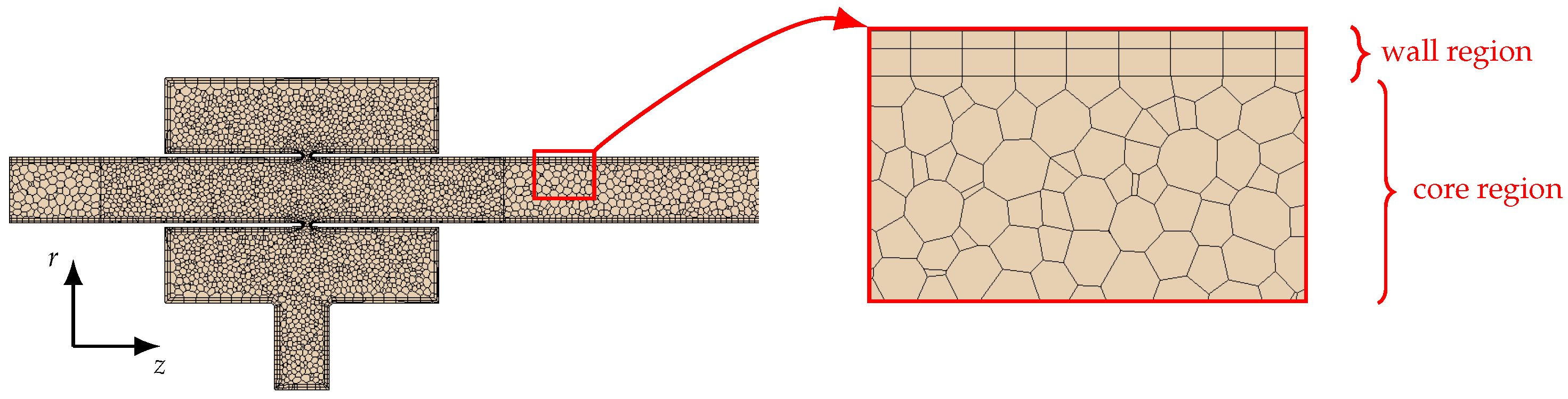
Unstructured polyhedral mesh is employed in the core region, while near the wall there are two prism layers, which enable the implementation of the fluid film model (Section 3.3) and the applied wall treatment (Figure 3). The selection of the mesh was based on a mesh independence study.

3.2. Discrete Phase

The injected droplets are modeled as spherical Lagrangian particles using the parcel concept. The governing equations within the Lagrangian framework are as follows:
d x p d t = u p ,
m p d u p d t = i F i ,
where x p and u p are the position and velocity of the parcel, m p is the parcel mass, and F i denotes the acting forces. The pressure gradient, turbulent dispersion [10], gravitational force, and drag force [11] are considered to drive the particles. According to Sommerfeld [12], the virtual mass force and the Basset force can be neglected since ρ g ρ l 1 . The lift force can be neglected as well, since the injected droplet size does not exceed 80 μm. The mist is considered dense inside the test section; therefore, a four-way coupling interaction between the air and the droplets is established.

3.3. Fluid Film

Preliminary experiments indicated that the liquid film was sufficiently thin to justify a thin-film approximation. Therefore, a parabolic velocity profile is assumed for the laminar film flow. The kinematic and dynamic boundary conditions at the interface between the liquid film and the surrounding air are
v air | int = v film | int
τ air · d A + P air d A int = τ film · d A + P film d A int
where τ air and τ film denote the viscous stress tensors of the air and liquid film phases, respectively.
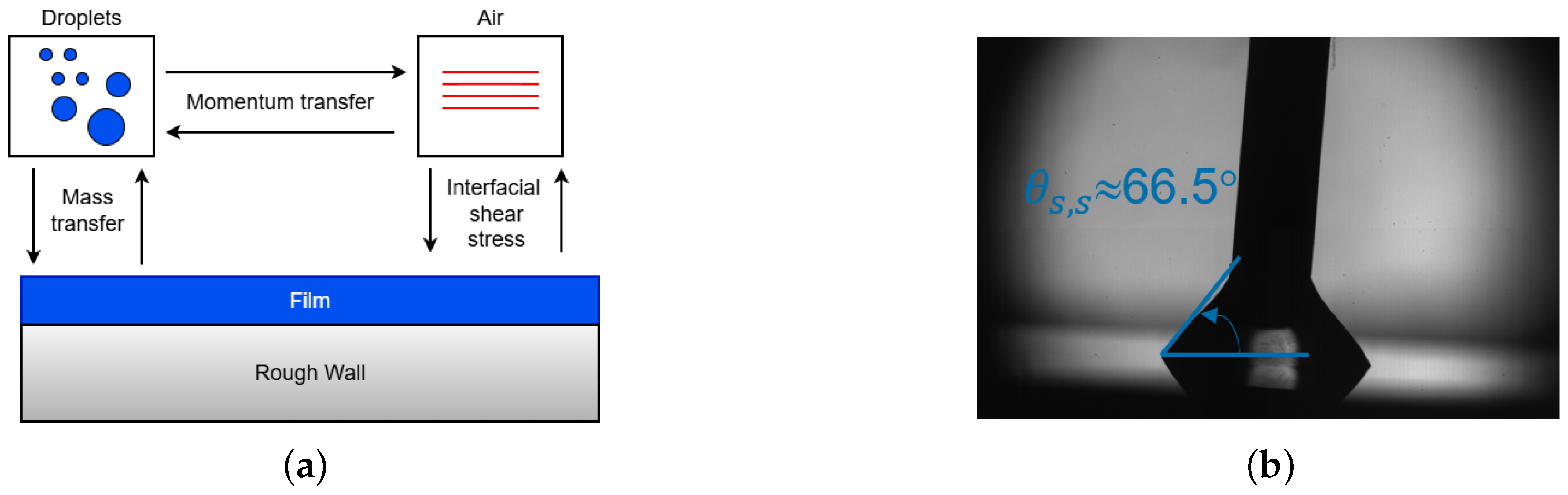
The fluid film mass is conserved by enabling mass gain due to droplet impingement and mass loss due to wave formation, which leads to droplet entrainment. The film also experiences interfacial stress, expressing the resistance of the rough wall via the air velocity adaptation (Figure 4). For non volatile liquids, the dynamics of partial wetting systems can be expressed as a function of the Capillary number ( Ca ) , which is the ratio between viscous and capillary forces. The present model adopts the expression for the dynamic contact angle detailed by Kistler [13], and the static contact angles assumed for water–plexiglass ( θ s , p ) and water–stainless steel ( θ s , s ) were measured as θ s , p = 81 and θ s , s = 66 . 5 , respectively, (Figure 4).

4. Results

4.1. Single Phase Flow

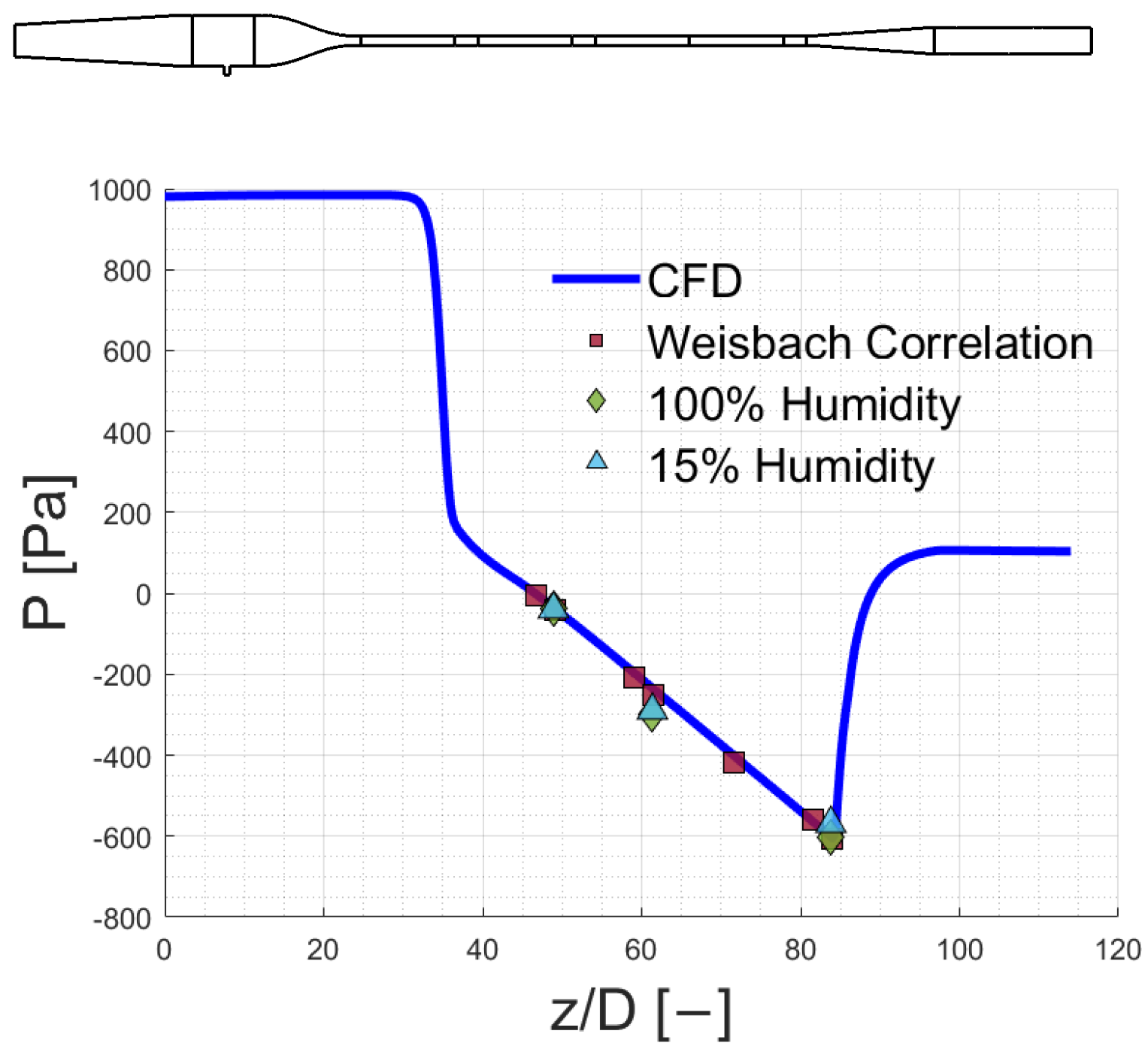
For the saturated case, the gas phase is moist air at 100% relative humidity, i.e., it contains the maximum permitted water-vapor content at the imposed temperature. Saturation modifies the vapor’s partial pressure and thus the mixture’s gas constant and density, which can influence the static pressure via the ideal-gas equation:
p = ρ R T .
To isolate this effect, we analyzed a baseline configuration without the separation module: a straight circular channel of diameter D, with all other conditions held fixed.
Figure 5 shows that the dry-air numerical model is in very good agreement with both the measured relative static pressure and the standard empirical correlation [14] across the entire humidity range considered. This insensitivity to R H is expected at a low Mach number ( M a = 0.1 ), where compressibility effects are small and
ρ R dry ρ R mix
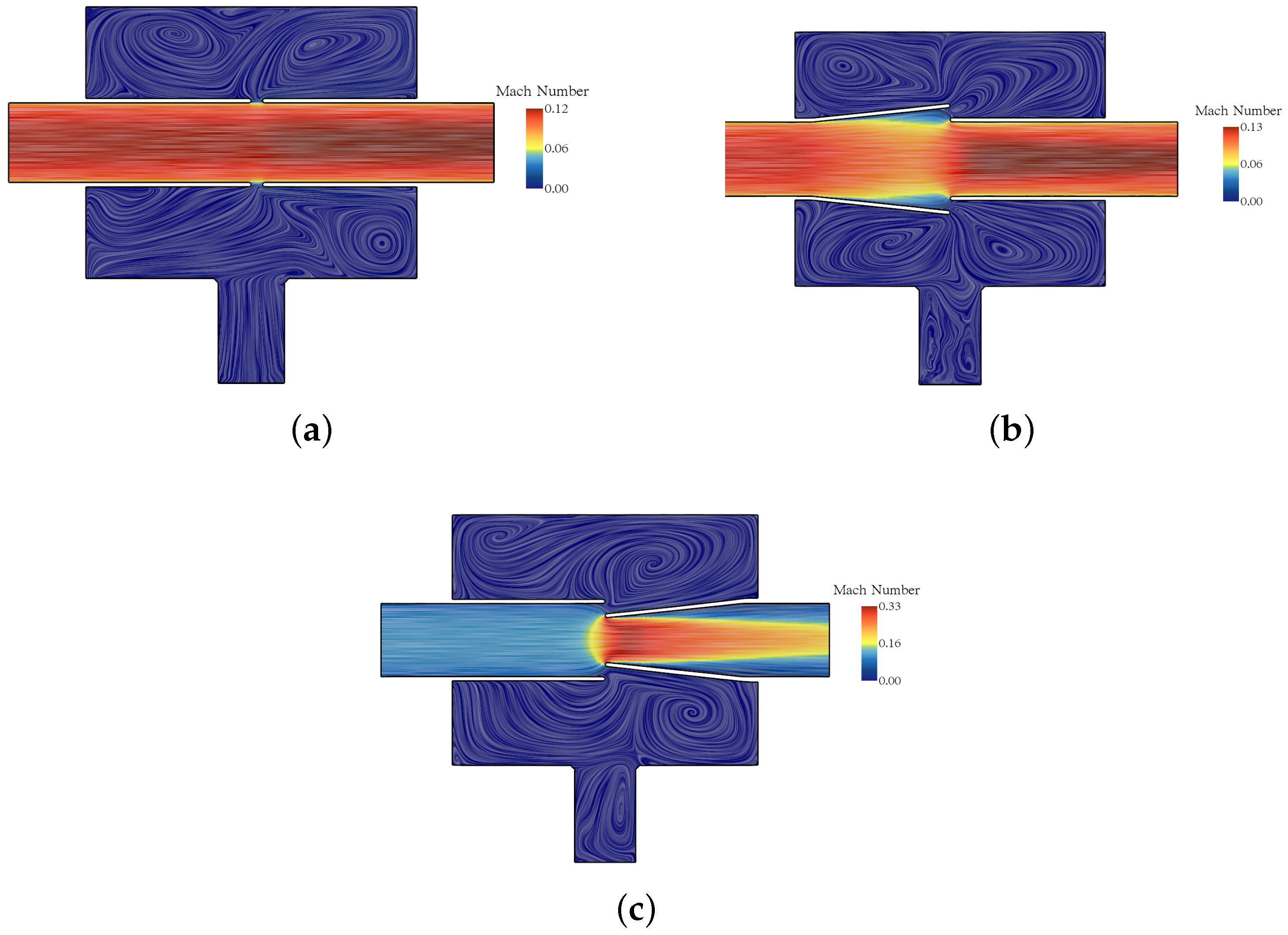
As a next step, three lip configurations in the separation module were examined, assembled from two general archetypes: a constant cross-section lip (Ct) and a divergent cross-section lip (Dv). The tested combinations are summarized in Table 1.
The geometries (a)–(c) in Figure 6 induce recirculating vortices within the separation pocket. Consistent with the experiment, the drainage outlet is treated as a no-slip (tapped) wall, suppressing air discharge and accelerating the core flow along the lips. Case (a) perturbs the main stream least, whereas cases (b) and (c) promote earlier separation due to local cross-section variation (expansion/contraction). In the Ct–Dv configuration, the peak Mach number reaches M a 0.33 , rendering compressibility effects non-negligible.

4.2. Two Phase Flow

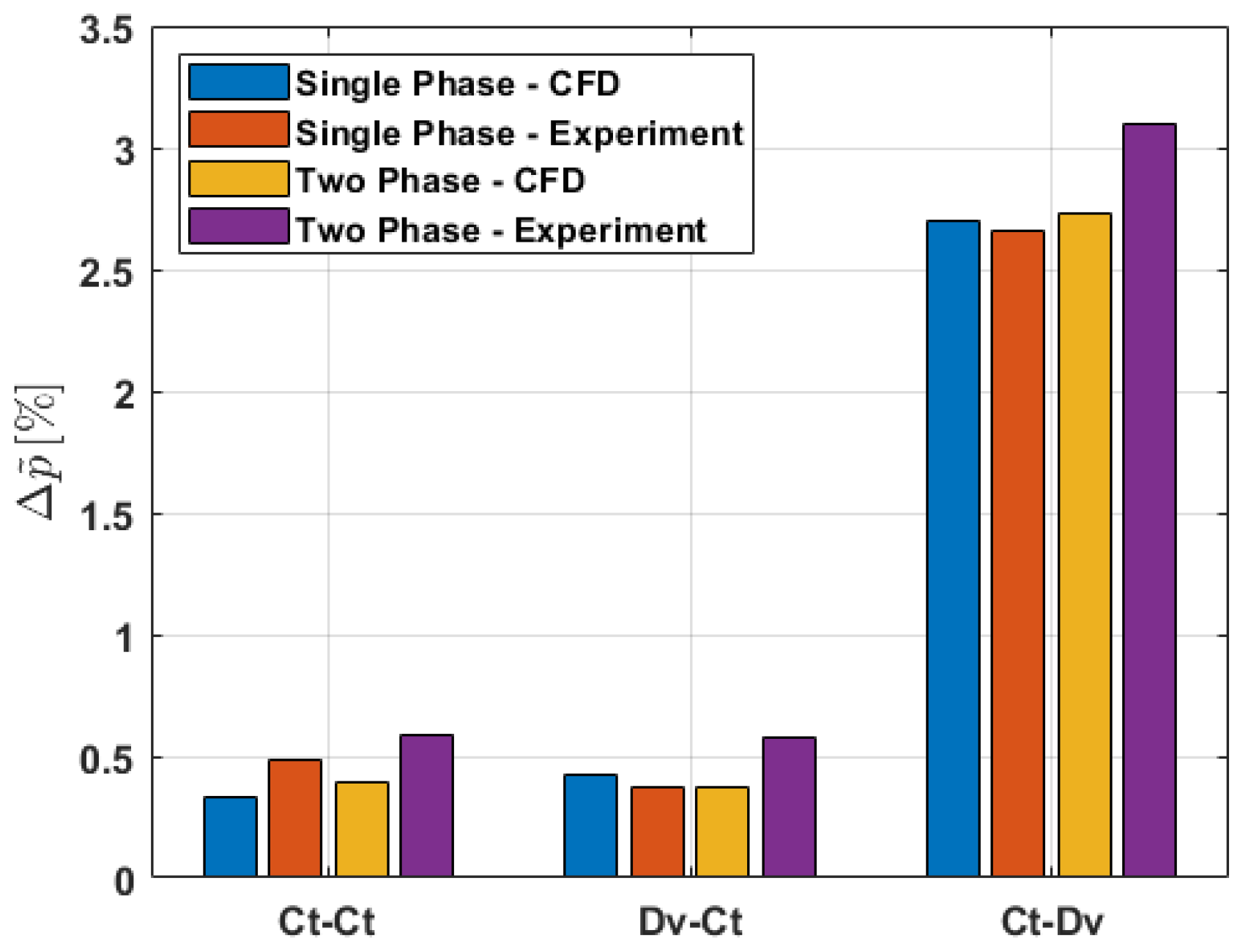
The two-phase flow exhibits a larger pressure drop than the single-phase flow (Figure 7) due to added interfacial shear and droplet holdup. The numerical model matches measurements with an absolute error of <1%. Ct–Ct and Dv–Ct yield similar Δ p ˜ , while Ct–Dv shows a larger Δ p ˜ owing to lip-induced cross-sectional contraction and flow acceleration (Figure 5).
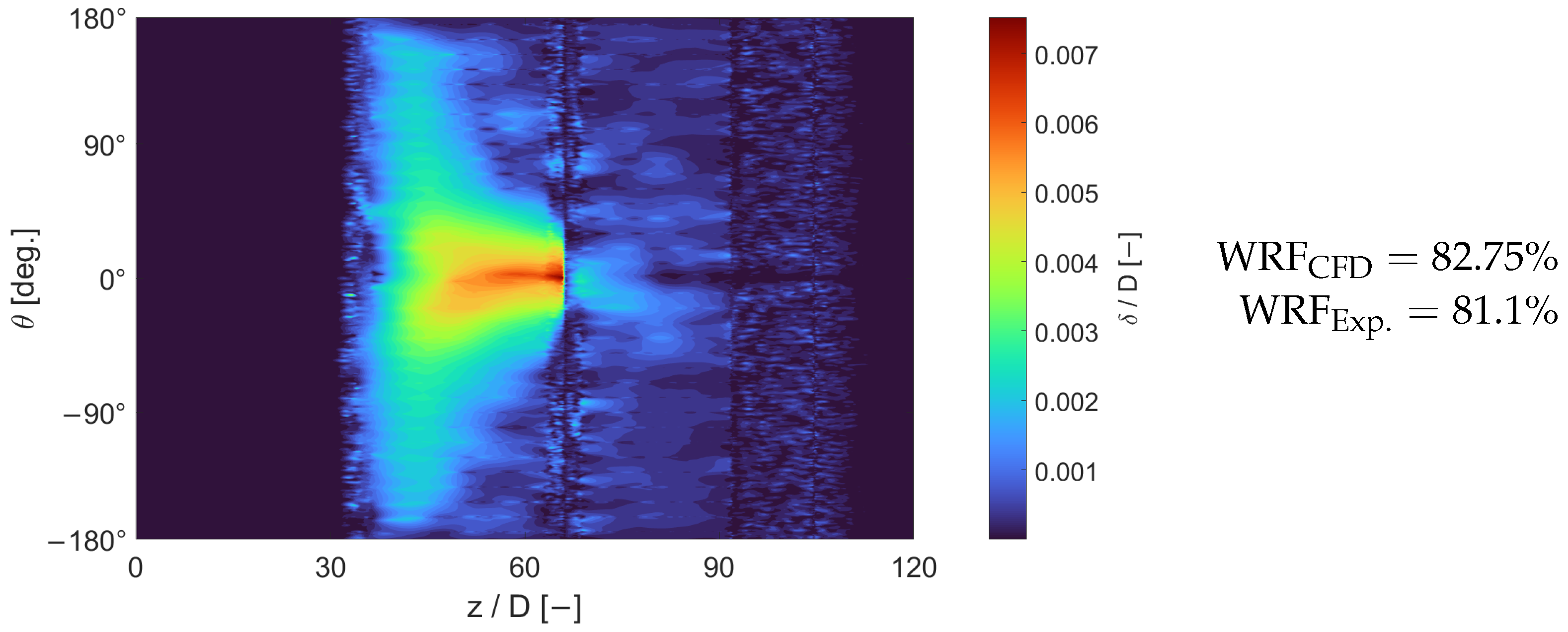
The contour plot in Figure 8 depicts the liquid film thickness distribution ( δ / D ) in relation to the longitudinal direction of the unit ( z / D ). 0 z / D 30 corresponds to the humidifier before the spray injector; thus, the film thickness is almost zero. At position z / D 30 , a liquid film starts to form due to the droplet–wall interaction and then develops circumferentially. Further downstream, the maximum film thickness appears at the pipe bottom (0°) due to the effect of gravity. The film shows a circumferential symmetry around 0°. At the lip gap ( z / D 65 ), the water film drains into the separation module, where it is collected. Thus, the film thickness drops sharply and then builds up again due to the droplet impingement. The model-predicted WRF is in close agreement with the experimental one.

5. Conclusions

Water treatment and recovery will be integral elements of the next-generation propulsion architectures. Under this scope, this work presents a numerical validation study against experiments. It demonstrates that RANS/URANS can accurately predict pressure drop and recovered water mass fraction. The simulations capture key flow features—lip-induced acceleration, separation, and gravity-driven film drainage—that are relevant to water recovery units. It is shown that under incompressible conditions, humidity exerts only a marginal influence on relative static pressure, whereas lip geometry strongly governs pressure losses.

Author Contributions

Conceptualization, G.I.; methodology, G.I. and B.W.; validation, G.I. and R.H.; investigation, G.I., R.H. and K.H.; writing—original draft preparation, G.I.; writing—review and editing, G.I., R.H., K.H. and B.W.; supervision, B.W. All authors have read and agreed to the published version of the manuscript.

Funding

This research was funded by the Clean Aviation Joint Undertaking grant agreement 101102006.

Data Availability Statement

Not applicable.

Acknowledgments

The authors would like to thank the Clean Aviation Joint Undertaking of the European Union’s Horizon Europe research and innovation programme, under the grant agreement number 101102006.

Conflicts of Interest

The authors declare no conflicts of interest.

Abbreviations

The following abbreviations are used in this manuscript:
RANSReynolds-Averaged Navier–Stokes
URANSUnsteady Reynolds-Averaged Navier–Stokes
WETWater Enhanced Turbofan
WRUWater Recovery Unit
WRFWater Recovery Factor

References

  1. Ram, M.; Bogdanov, D.; Aghahosseini, A.; Khalili, S.; Child, M.; Fasihi, M.; Traber, T. European Energy System Based on 100% Renewable Energy–Transport Sector. In Mobilität der Zukunft; Lund, H., Mathiesen, B.V., Eds.; Springer: Berlin/Heidelberg, Germany, 2021; pp. 519–562. [Google Scholar] [CrossRef]
  2. Schmitz, O.; Klingels, H.; Kufner, P. Aero Engine Concepts Beyond 2030: Part 1—The Steam Injecting and Recovering Aero Engine. J. Eng. Gas Turbines Power 2021, 143, 021001. [Google Scholar] [CrossRef]
  3. Zakhvatkin, L.; Schechter, A.; Avrahami, I. Water Recuperation from Hydrogen Fuel Cell during Aerial Mission. Energies 2022, 15, 6848. [Google Scholar] [CrossRef]
  4. Haidl, R.; Weigand, B. Experimental Setup for the Investigation of Water Separation in Annular Flow Within a Circular Channel. In Proceedings of the 34th Congress of the International Council of the Aeronautical Sciences, Florence, Italy, 9–13 September 2024; Available online: https://www.icas.org/icas_archive/icas2024/data/papers/icas2024_0969_paper.pdf (accessed on 1 October 2025).
  5. Wang, L.; Du, W.; Liu, R.; Feng, J.; Peng, X.; Cao, F. Multi-Objective Optimization of Oil–Gas Cyclone Separators Considering Liquid Storage in the Tank Bottom. Sep. Purif. Technol. 2025, 374, 133521. [Google Scholar] [CrossRef]
  6. Ding, H.; Zhang, Y.; Yang, Y.; Wen, C. A Modified Euler–Lagrange–Euler Approach for Modelling Homogeneous and Heterogeneous Condensing Droplets and Films in Supersonic Flows. Int. J. Heat Mass Transf. 2023, 200, 123537. [Google Scholar] [CrossRef]
  7. Wang, P.; Wan, L.; Tu, J.; Zhang, X.; Luo, X.; Tang, Z.; Zhao, W. Separation Performance Investigation on the Influence of Typical Structural Parameters of Zigzag Vane Plate Droplet Separator. Chem. Eng. Sci. 2025, 310, 121565. [Google Scholar] [CrossRef]
  8. Lardeau, S.; Billard, F. Development of an Elliptic-Blending LAG Model for Industrial Applications. In Proceedings of the 54th AIAA Aerospace Sciences Meeting, San Diego, CA, USA, 4–8 January 2016. [Google Scholar] [CrossRef]
  9. Jayatilleke, C. The Influence of Prandtl Number and Surface Roughness on the Resistance of the Laminar Sub-Layer to Momentum and Heat Transfer. In Proceedings of the Momentum and Heat Transfer in Turbulent Flow, 1966. Available online: https://api.semanticscholar.org/CorpusID:125204648 (accessed on 1 October 2025).
  10. Gosman, A.D.; Ioannides, E. Aspects of Computer Simulation of Liquid-Fuelled Combustors. In Proceedings of the 19th Aerospace Sciences Meeting, St. Louis, MO, USA, 12–15 January 1981. [Google Scholar] [CrossRef]
  11. Schiller, L.; Naumann, A. Über die grundlegenden Berechnungen bei der Schwerkraftaufbereitung. Z. Vereines Dtsch. Ingenieure 1933, 77, 318–320. [Google Scholar]
  12. Sommerfeld, M.; van Wachem, B.; Oliemans, R. Best Practice Guidelines for Computational Fluid Dynamics of Dispersed Multi-Phase Flows, 1st ed.; European Research Community on Flow, Turbulence and Combustion (ERCOFTAC): Brussels, Belgium, 2008. [Google Scholar]
  13. Kistler, S.F. Hydrodynamics of Wetting. In Wettability; Surfactant Science Series; Berg, J.C., Ed.; Marcel Dekker: New York, NY, USA, 1993; Volume 49, pp. 311–429. [Google Scholar]
  14. Weisbach, J. Lehrbuch der Ingenieur-und Maschinen-Mechanik; Friedrich Vieweg und Sohn: Braunschweig, Germany, 1845. [Google Scholar]
Figure 1. Side view of the test bench parts.
Engproc 133 00109 g001
Figure 2. 2D sketch of the simulation domain with its static pressure and water mass measurement points.
Engproc 133 00109 g002
Figure 3. 2D view of the computational mesh around the separation module.
Engproc 133 00109 g003
Figure 4. Graphic sketch of the interaction phenomena (a) and the static contact angle measurement of the liquid water droplet on the stainless steel substrate (b).
Engproc 133 00109 g004
Figure 5. Pressure variation along the baseline configuration for different R H levels.
Engproc 133 00109 g005
Figure 6. Mach number and streamline plot around the separation module for three different lip geometries: (a) Ct–Ct, (b) Dv–Ct and (c) Ct–Dv.
Engproc 133 00109 g006
Figure 7. Comparison of numerical and experimental pressure drop estimation along the WRU.
Engproc 133 00109 g007
Figure 8. Liquid film thickness distribution ( δ / D ) along the WRU with the Ct–Ct lips and the corresponding WRF .
Engproc 133 00109 g008
Table 1. Different lip geometries for the water separation module.
Ct–CtDv–CtCt–Dv
Engproc 133 00109 i001Engproc 133 00109 i002Engproc 133 00109 i003
Disclaimer/Publisher’s Note: The statements, opinions and data contained in all publications are solely those of the individual author(s) and contributor(s) and not of MDPI and/or the editor(s). MDPI and/or the editor(s) disclaim responsibility for any injury to people or property resulting from any ideas, methods, instructions or products referred to in the content.