Performance Analysis of a Commercial Aircraft Liquid Hydrogen Storage System †
Abstract
1. Introduction
2. Modelling of a Cryogenic Tank and Simulation Scenarios
2.1. Cryogenic Tank Modelling and Validation Setup
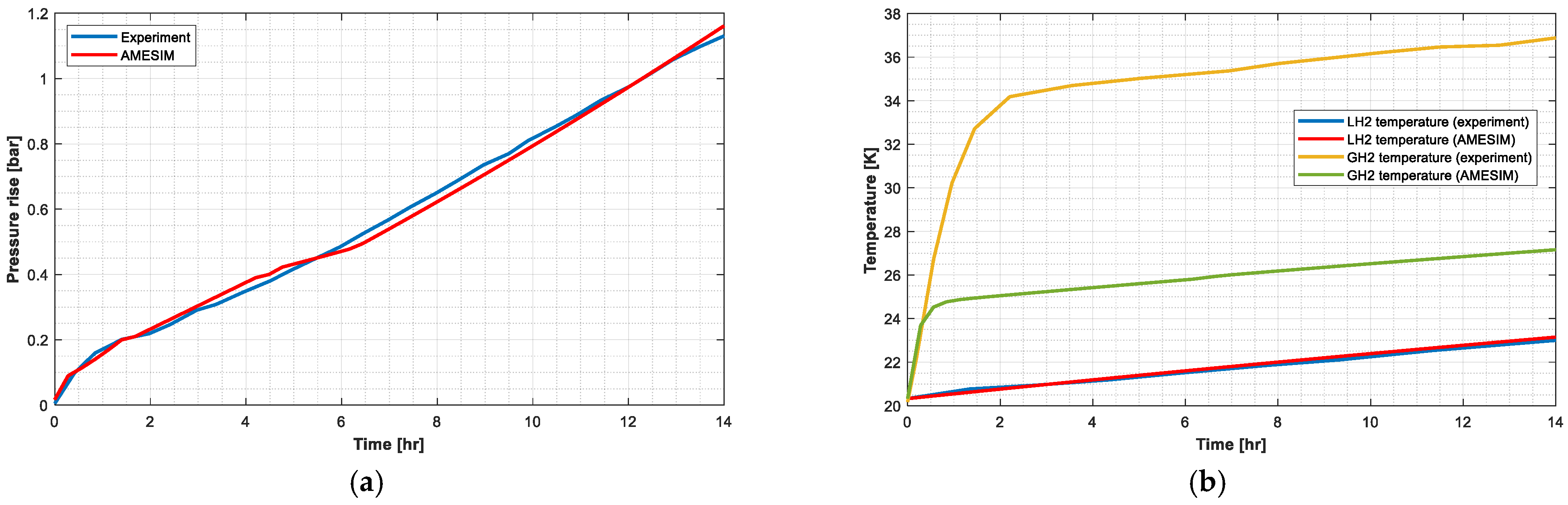
- The real tank geometry was not completely spherical. In other words, it was the ellipsoidal volume that affected the height distribution as a function of volume.
- The homogenous tank model does not account for temperature stratification. It assumes only two temperatures: one for the liquid phase and one for the gaseous phase, thereby neglecting the temperature profile expected in the vapor phase. As the distance from the liquid surface increases, the temperature of the gas should also increase. Because the temperature sensor was positioned in the upper region of the ullage, the measured vapor temperature in the experiment reflected the warm region of the headspace. This value is expected to be higher than the average vapor temperature or the temperature near the liquid-vapor interface.
- Amesim uses a simplified 0D modelling approach. Nevertheless, in the experiment, complicated physics in the 3D domain takes place.
2.2. Simulation Scenarios Explanation
3. Results


4. Discussion
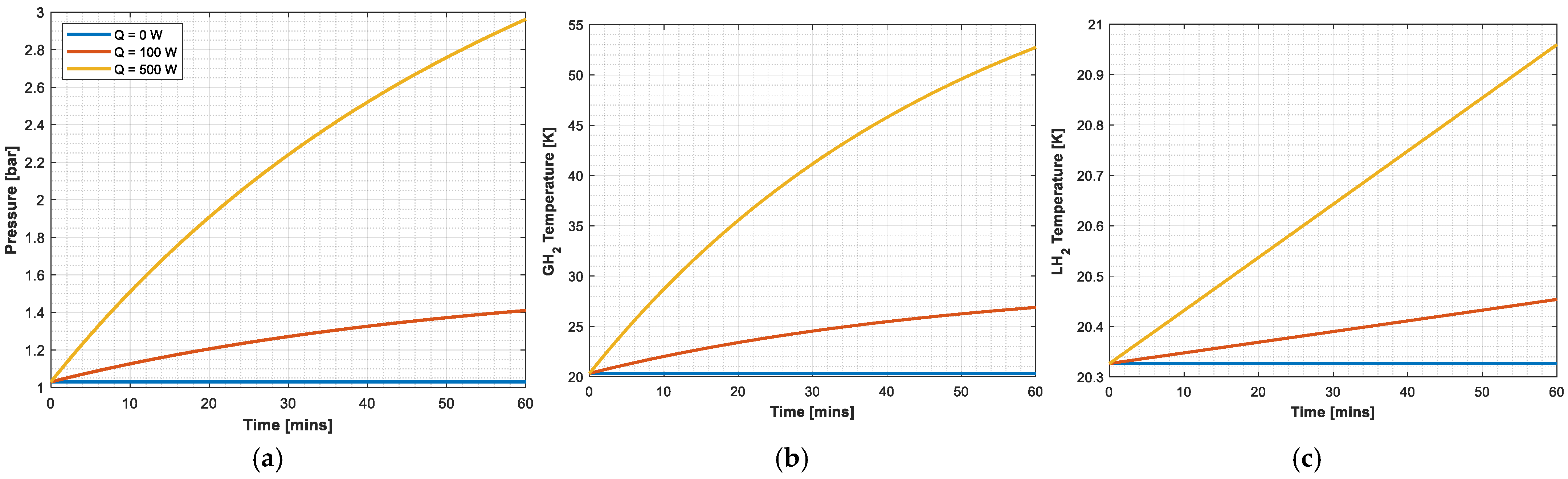
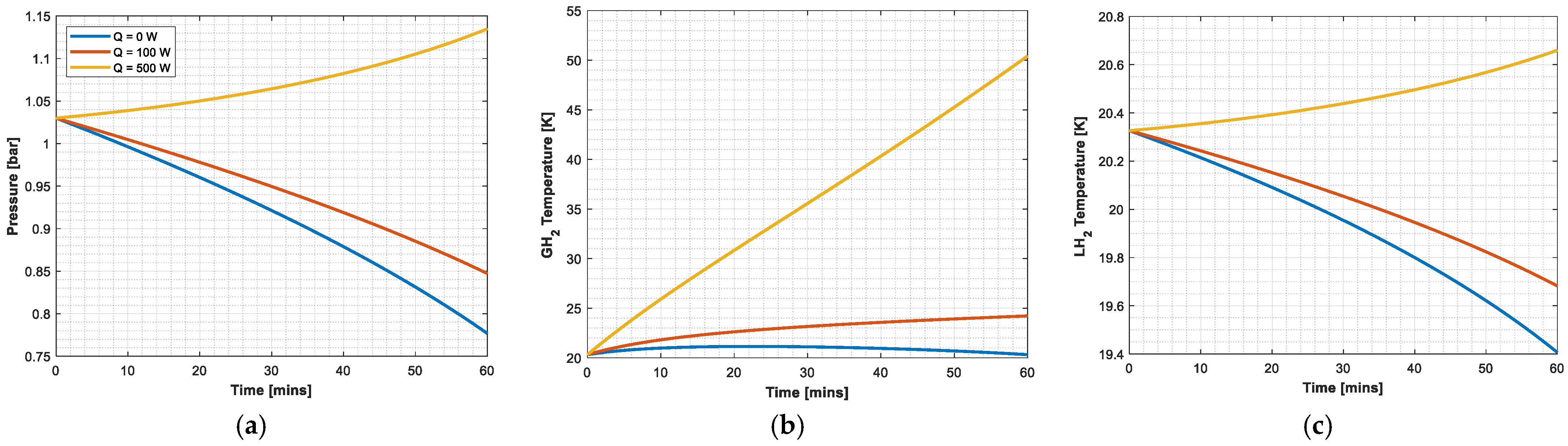
- In Scenario #1, the tank pressure rose continuously over time, while the GH2 temperature increased faster than the LH2 temperature. Physically, this occurs because most of the heat entering through the upper dry wall warms the vapor first, raising its temperature and pressure. On the other hand, the liquid has a much higher thermal capacity and weak natural convection at cryogenic temperatures, so it warms much more slowly. Therefore, the bulk LH2 temperature was below the saturation temperature corresponding to the measured pressure and hence, slightly subcooled (Figure 4). In this condition, the system was not at thermodynamic equilibrium.
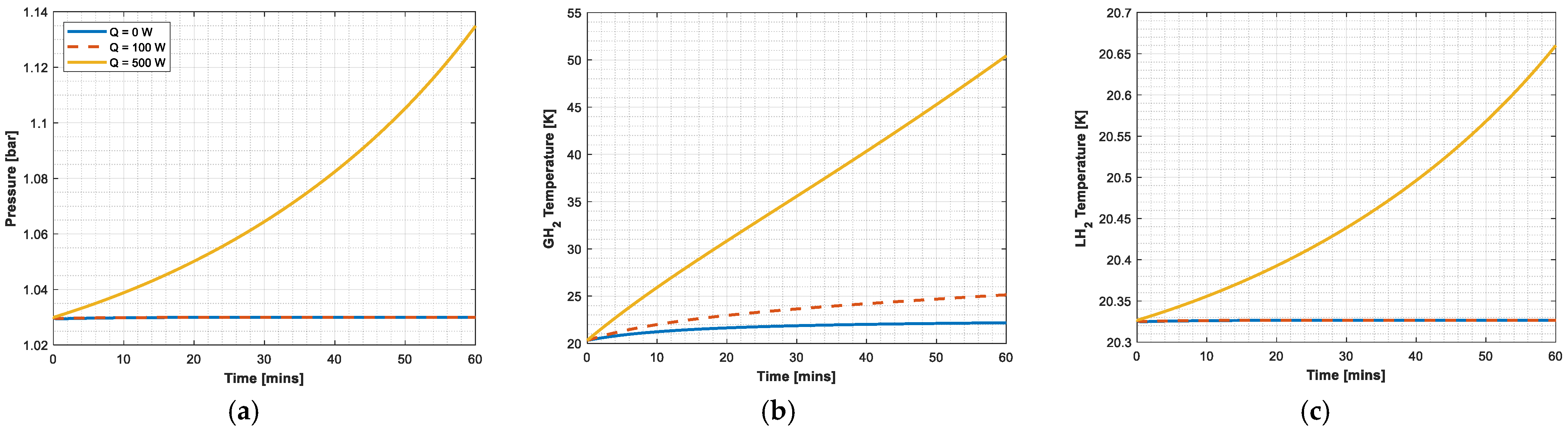
- In Scenario #2, the tank was considered an open system. The tank received the same heat input as Scenario #1, but LH2 was continuously removed at 60 g/s. As LH2 was withdrawn, the total liquid volume decreased, thereby increasing the vapor space volume in the tank. However, by increasing the total heat flow rate from 100 W to 500 W, the pressure drop caused by LH2 extraction would be reduced. It is evident that at a 500 W heat flow rate, the tank pressure increased (Figure 5a), even with liquid fuel being withdrawn at 60 g/s. The LH2 temperatures were in a saturated condition, as the tank was no longer a closed system.
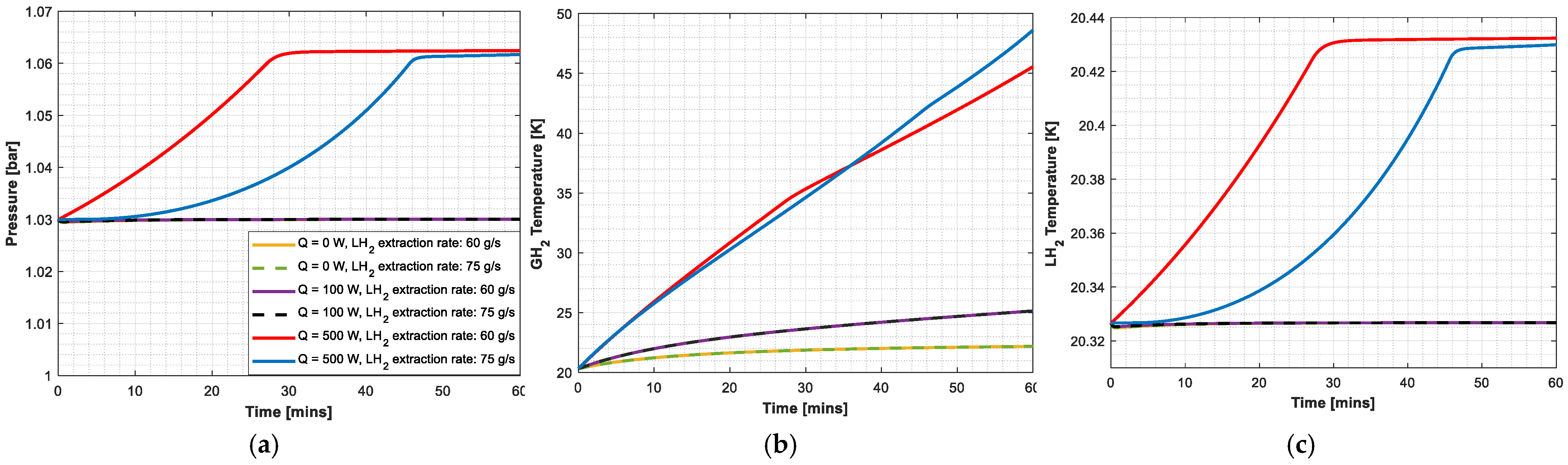
- In Scenario #3, a minimum pressure maintenance system was implemented by injecting regulated, superheated GH2 to stabilize and maintain the tank pressure at the desired level of 1.03 bar. The system successfully maintained constant pressure (Figure 6a) for heat flow rates between 0 and 100 W. However, at a heat flow rate of 500 W, the thermal input exceeded the compensating effect of fuel withdrawal (see also Figure 5). Under these conditions, injecting additional superheated GH2 from the minimum pressure maintenance system would have been unwanted and counterproductive. This demonstrates that a pressure control system relying solely on regulated GH2 injection is insufficient to maintain the tank pressure within acceptable limits under high levels of heat ingress. The LH2 temperatures were in a saturated state, similar to Scenario #3.
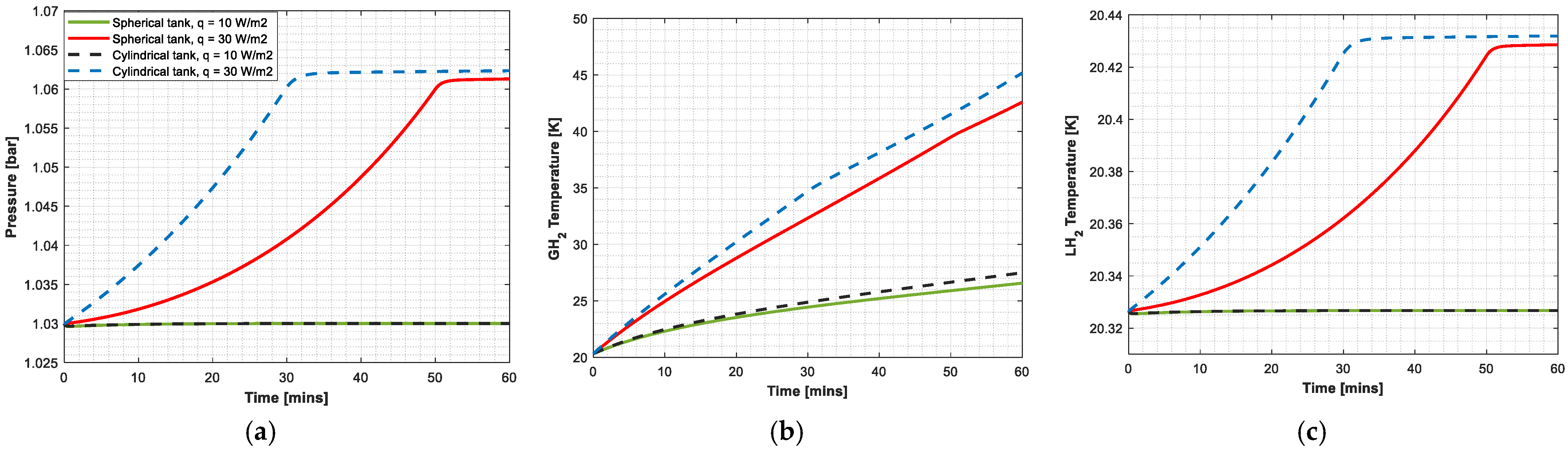
- In Scenario #4, by introducing a venting system, the tank achieved a completely regulated pressure condition (Figure 7). For 0–100 W heat loads, the pressure and LH2 temperature curves were identical for both 60 g/s and 75 g/s LH2 withdrawal rates, as the effects of heat input and fuel removal compensated each other. For the 500 W heat load, increasing the mass withdrawal rate moderated the pressure increase behavior, acting as a cooling mechanism through convective and latent heat removal. For the GH2 temperature, after some time, the GH2 temperature in the 75 g/s case surpassed that of the 60 g/s case because the higher LH2 withdrawal rate led to a smaller available liquid mass to absorb heat, resulting in more heat being retained in the vapor space, which pushed the GH2 temperature higher. The LH2 temperature followed the same trend as pressure, remaining in the saturated state.
- In Scenario #5, under identical heat flux conditions, the spherical tank shows a slower increase in pressure and temperatures for both gaseous and liquid phases (Figure 8). This is due to the sphere’s lower ratio of surface area to volume, which reduces heat ingress. For the low heat flux of 10 W/m2, both the spherical and cylindrical tanks showed almost constant pressure of ~1.03 bar, indicating that the heat input was sufficiently low to be balanced by internal energy redistribution. The cylindrical tank, by contrast, received more heat per stored mass and developed stronger stratification in the vapor and liquid phases. In turn, this led to a steeper pressure rise, higher GH2 temperature, and correspondingly faster LH2 warming at the higher flux of 30 W/m2 since LH2 temperature closely followed the saturation temperature tied to pressure. Thus, the tank shape and the magnitude of the heat flux together significantly influence the transient pressurization and thermal behavior of cryogenic LH2 storage systems. Tank orientation did not reveal first-order effects on the results.
5. Conclusions
Author Contributions
Funding
Data Availability Statement
Acknowledgments
Conflicts of Interest
References
- IATA. Hydrogen for Aviation—A Future Decarbonization Solution for Air Travel? International Air Transport Association: Montreal, QC, Canada, 2025. [Google Scholar]
- Job, S.; Campbell, M.; Hall, B.; Hamadache, Z.; Kumar, N. Sustainability Report: The Lifecycle Impact of Hydrogen-Powered Aircraft; FZO-STY-REP-0005; Aerospace Technology Institute—FlyZero: Beford, UK, 2022. [Google Scholar]
- Ebrahimi, A.; Rolt, A.; Jafari, S.; Anton, J.H. A review on liquid hydrogen fuel systems in aircraft applications for gas turbine engines. Int. J. Hydrogen Energy 2024, 91, 88–105. [Google Scholar] [CrossRef]
- Giannis, S.; Salmeron-Perez, N.; Spetsieris, N. Challenges in Realising Composite Liquid Hydrogen Cryogenic Storage: A Materials and Standards Perspective; National Physical Laboratory: Middlesex, UK, 2023. [Google Scholar] [CrossRef]
- Aerospace Technology Institute, FlyZero. Available online: https://www.ati.org.uk/flyzero/ (accessed on 15 November 2022).
- Airbus, ZEROe. Available online: https://www.airbus.com/en/innovation/energy-transition/hydrogen/zeroe-our-hydrogen-powered-aircraft (accessed on 1 November 2025).
- Xisto, C.; Lundbladh, A. Design and Performance of Liquid Hydrogen Fuelled Aircraft for Year 2050 EIS. In Proceedings of the ICAS 2022 Congress, Stockholm, Sweden, 4–11 September 2022. [Google Scholar]
- Huete, J.; Pilidis, P. Parametric Study on Tank Integration for Hydrogen Civil Aviation Propulsion Liquid Hydrogen MLI Multi-Layer Insulation VC Vacuum SAF Sustainable Aviation Fuel. Int. J. Hydrogen Energy 2021, 46, 37049–37062. [Google Scholar] [CrossRef]
- Lvovich, V.F.; Johnson, W.L.; Vivod, S.L. Cryogenic Hydrogen Studies and Testing for Advanced Aircraft at NASA, 2025. Available online: https://ntrs.nasa.gov/citations/20250002550 (accessed on 5 November 2025).
- Burschyk, T.; Fröhler, B.; Alder, M.; Zill, T. Global Sensitivity Analysis of Liquid Hydrogen Storage Design Parameters for Overall Aircraft Design. In Proceedings of the ICAS 2024 Congress, Florence, Italy, 9–13 September 2024. [Google Scholar]
- Adler, E.J.; Martins, J.R.R.A. Liquid Hydrogen Tank Boil-off Model for Design and Optimization. J. Thermophys. Heat Transf. 2025, 39, T7005. [Google Scholar] [CrossRef]
- Simcenter Amesim | Siemens Software. 2025. Available online: https://plm.sw.siemens.com/en-US/simcenter/systems-simulation/amesim/ (accessed on 1 November 2025).
- Ebrahimi, A.; Sanders, D.; Rolt, A.; Sethi, V. Report on System Architecture Performance Analysis and Control, ZEST1 D1.4.3a.3, 2025.
- Lin, C.-S.; Van Dresar, N.T.; Hasan, M.M. A Pressure Control Analysis of Cryogenic Storage Systems, 1991. Available online: https://ntrs.nasa.gov/citations/19910015147 (accessed on 10 October 2023).
- Hasan, M.M.; Lin, C.S.; Van Dresar, N.T. Self-Pressurization of a Flightweight Liquid Hydrogen Storage Tank Subjected to Low Heat Flux. 1991. Available online: https://ntrs.nasa.gov/citations/19910011011 (accessed on 10 October 2023).
- Leachman, J.; Jacobson, B.; Penoncello, S.; Lemmon, E. Fundamental Equations of State for Parahydrogen, Normal Hydrogen, and Orthohydrogen. J. Phys. Chem. Ref. Data 2009, 38, 721–748. [Google Scholar] [CrossRef]


| Shape/Parameter | Spherical Tank | Horizontal Cylindrical Tank |
|---|---|---|
| Wetted area | ||
| Dry area | ||
| Additional parameter | = 1.05 m | = 1.05 m |
| Scenario # | Description | Key Features/Conditions |
|---|---|---|
| 1 | LH2 tank with constant heat flow rate without fuel withdrawal or pressure control system. | Closed system; only heat input considered. |
| 2 | Tank with constant heat flow rate and fuel withdrawal (from the tank) of 60 g/s, but no pressure control. | Heat input + steady fuel extraction; no active pressure regulation. |
| 3 | Tank with constant heat flow rate, fuel withdrawal of 60 g/s, and pressure control system, but no venting. | Includes pressure regulation; venting excluded. |
| 4 | Tank with constant heat flow rate, fuel withdrawal rates of 60 g/s and 75 g/s, pressure control, and venting system. | Relief valve activates at 1.06 bar; variable LH2 withdrawal rates. |
| 5 | Comparison of two tank geometries (spherical and horizontal cylindrical) with identical volume and diameter. | = 60 g/s |
Disclaimer/Publisher’s Note: The statements, opinions and data contained in all publications are solely those of the individual author(s) and contributor(s) and not of MDPI and/or the editor(s). MDPI and/or the editor(s) disclaim responsibility for any injury to people or property resulting from any ideas, methods, instructions or products referred to in the content. |
© 2026 by the authors. Licensee MDPI, Basel, Switzerland. This article is an open access article distributed under the terms and conditions of the Creative Commons Attribution (CC BY) license.
Share and Cite
Ebrahimi, A.; Rolt, A.; Sanders, D.; Schreiner, B.D.J. Performance Analysis of a Commercial Aircraft Liquid Hydrogen Storage System. Eng. Proc. 2026, 133, 10. https://doi.org/10.3390/engproc2026133010
Ebrahimi A, Rolt A, Sanders D, Schreiner BDJ. Performance Analysis of a Commercial Aircraft Liquid Hydrogen Storage System. Engineering Proceedings. 2026; 133(1):10. https://doi.org/10.3390/engproc2026133010
Chicago/Turabian StyleEbrahimi, Alireza, Andrew Rolt, Drewan Sanders, and B. Deneys J. Schreiner. 2026. "Performance Analysis of a Commercial Aircraft Liquid Hydrogen Storage System" Engineering Proceedings 133, no. 1: 10. https://doi.org/10.3390/engproc2026133010
APA StyleEbrahimi, A., Rolt, A., Sanders, D., & Schreiner, B. D. J. (2026). Performance Analysis of a Commercial Aircraft Liquid Hydrogen Storage System. Engineering Proceedings, 133(1), 10. https://doi.org/10.3390/engproc2026133010