Proceeding Paper

Cutting Performance and Damage Metrics in Abrasive Waterjet Machining of Delrin–Ramie Fiber Composites †

by
Natarajan Senthilkumar
1,
Subramanian Thirumalvalavan
2,*,
Saminathan Selvarasu
2 and
Ganapathy Perumal
3
1
Department of Mechanical Engineering, Saveetha School of Engineering, Saveetha Institute of Medical and Technical Sciences (SIMATS), Chennai 602105, India
2
Department of Mechanical Engineering, Arunai Engineering College, Tiruvannamalai 606603, India
3
Department of Mechanical Engineering, V.R.S. College of Engineering and Technology, Villupuram 607107, India
*
Author to whom correspondence should be addressed.
Presented at the 19th Global Congress on Manufacturing and Management (GCMM 2025), Vellore, India, 10–12 December 2025.
Eng. Proc. 2026, 130(1), 8; https://doi.org/10.3390/engproc2026130008

Published: 17 April 2026
(This article belongs to the Proceedings of The 19th Global Congress on Manufacturing and Management (GCMM 2025))

Abstract

In this study, Delrin® (POM) polymer was reinforced with 15 wt.% chopped ramie fiber (RF) to develop a sustainable composite, which was injection-molded and machined using abrasive waterjet machining (AWJM). SEM revealed a skin-core morphology with flow-induced RF alignment and small voids at bundle crossovers, indicating interfacial adhesion. A Taguchi L9 (33) design evaluated waterjet pressure (WJP: 100–300 MPa), traverse speed (TS: 100–200 mm/min), and stand-off distance (SoD: 1–3 mm) on kerf width (KW) and surface roughness (SR). Increasing WJP from 100 to 300 MPa lowered mean SR from 6.23 to 4.80 µm (23% reduction) and KW from 1.31 to 1.07 mm (reduction of 18%); enlarging SoD from 1 to 3 mm raised SR from 4.98 to 5.55 µm (an 11% increase) and KW from 1.12 to 1.20 mm (a of 7% increase); and raising TS from 100 to 200 mm/min narrowed KW from 1.24 to 1.11 mm (a 10.5% reduction) with a modest SR decrease from 5.45 to 5.28 µm. ANOVA confirmed WJP as the dominant factor for SR (79.8%), as well as a significant SoD (18.3%). For KW, the influence of WJP (68.8%) was substantial, followed by TS (19.9%) and SoD (11%). Linear models captured the trends well (SR: R2 = 88.29%; KW: R2 = 93.36%). A desirability-based multi-response optimizer yielded ideal conditions for TS (200 mm/min), WJP (300 MPa), and SoD (1 mm), predicting a KW of 0.94 mm and an SR of 4.1567 µm. Confirmation tests produced a KW (0.970 ± 0.01 mm) and SR (4.27 ± 0.05 µm), which are within 3.19% and 2.73% of the predicted values, validating the DoE regression approach.

1. Introduction

Delrin® (polyoxymethylene, POM)-based polymer composites combine a highly crystalline engineering thermoplastic matrix renowned for low friction, excellent wear resistance, high fatigue/creep strength, tight dimensional stability, and very low moisture uptake with tailored reinforcements to deliver performance that typically surpasses commodity thermoplastics, such as PP or ABS, and can rival or exceed unfilled nylons by avoiding water-induced swelling and modulus loss [1]. While neat POM already offers a tensile strength of 60–75 MPa, a modulus of 2.5–3.0 GPa, and accurate molding with low shrink variation, reinforcement is introduced to address specific limitations—boosting stiffness and load-bearing capacity (glass/carbon/mineral fibers and whiskers)—improving long-term creep resistance and heat deflection temperature, lowering the coefficient of thermal expansion and warpage for precision tolerances, tuning tribology (for a lower friction coefficient and wear; natural fibers like ramie/flax for high specific stiffness and sustainability), and enhancing dimensional stability and fatigue in thin, gear-like geometries [2].
These composite architectures also mitigate edge smearing and thermal softening seen in softer matrices, enabling cleaner machining/finishing and longer service life under sliding or oscillatory loads [3]. As a result, POM composites are preferred in precision motion and power-transmission components (gears, cams, racks, bushings, sliders), automotive interior/under-hood non-hot mechanisms (HVAC blend doors, cable guides, latch modules), fluid-handling and valve parts (seats, pump rotors, manifolds), electrical/electronic hardware (connector bodies, switch actuators, low-creep housings), robotics/UAV structures and fixtures (lightweight brackets, panel systems), and select medical/diagnostic devices (instrument guides, pump cartridges) where tight tolerances, low noise, low wear, and environmental stability are critical [4].
Recent work shows POM’s crystallinity and chemical resistance provide a robust matrix platform, while appropriate natural fillers/fibers (e.g., wood flour, flax, ramie) can raise stiffness, stabilize dimensions (lower CTE/warpage), and improve tribology when surfaces are properly treated/sized without the moisture-sensitivity penalties seen in nylons. POM blends reinforced with natural fillers (cellulose/wood flour/husks) have demonstrated mechanical improvements and are being advanced as sustainable technical grades, especially when melt-blended or hybridized with biopolymers (e.g., PLA) [5]. Reinforcement is needed to tailor POM’s properties for higher load-bearing and precision: fibers increase modulus/heat deflection temperature (HDT), reduce creep and shrinkage scatter, and can lower wear/friction (with suitable coupling/finishes), while keeping parts lightweight and recyclable; flax fiber reinforced POM and related studies report meaningful gains in mechanical response and wear behavior when interface treatments are optimized [6]. Ramie fiber (RF) offers high specific strength/modulus and good alkali resistance among bast fibers. Surface modification further enhances composite performance, making RF-POM a viable, bio-content alternative for precision sliding components, gears/cams, HVAC flaps, UAV/robotics brackets, and instrument fixtures, as cold cutting preserves edge quality [7].
Abrasive waterjet machining (AWJM) is ideal for natural fiber (NF) strengthened composite plates that require intricate contours and burr-free, heat-affected zone-free edges, such as aircraft cabin trim rings, avionics/sensor brackets, UAV payload trays, and dense cable-routing or electronics faceplates. AWJM avoids melting, fiber fuzzing, and delamination, which are common in other machining processes, enabling tight integration with minimal damage while maintaining consistent kerf and feature accuracy. AWJM removes material by high-energy particle erosion, offering advantages such as negligible HAZ, low cutting forces, and minimal burrs, repeatedly confirmed on polymer and NF/carbon-fiber composites [8]. Raising waterjet pressure (WJP) increases particle velocity (∝√P), stabilizes the core jet, and shifts removal toward micro-cutting rather than plowing. In thermoplastic and FRP studies, this consistently reduces surface roughness (SR), narrows kerf width (KW) and kerf taper (Ka), and can lower delamination in laminates [9]. Moderate abrasive flow rate (AFR) maximizes energy transfer; excess can cause particle-particle shielding and striation, whereas too little undercuts. Finer grits improve SR but may reduce penetration; coarser grits raise MRR at the expense of SR/KW [10].
Higher traverse speed (TS) shortens dwell, reducing lateral erosion and kerf spread, but it risks incomplete penetration or striations if too high. Lower TS improves penetration but can worsen SR through secondary abrasion. Studies on CFR-PLA and NF laminates report optimal TS at intermediate levels for best SR/KW [11]. Larger stand-off distance (SoD) increases jet divergence and momentum decay, which in turn increases SR and KW and exacerbates taper; SoD 1–2 mm is typically favored for thin/medium polymer sections [12]. A larger, worn, or misaligned focusing tube broadens the jet and raises KW/Ka and SR; nozzle life must be tracked in any quality study [13]. Fiber type/orientation, fiber volume, and moisture strongly influence cut quality: aligned, stiffer fibers can promote fiber breakout if jet coherence is low; good fiber-matrix adhesion and dry stock reduce pull-out and wall fuzzing. These trends were documented on PLA/CFR-PLA and NF reinforced polymers and transferred directly to POM-based systems [14].
SR decreases with higher WJP, moderate AFR, and shorter SoD; it varies non-monotonically with TS (optimal at mid-range). CFR-PLA showed SR reductions higher than 20% at optimized WJP/TS/SoD vs. low-pressure baselines [15]. KW/Ka decreases with higher WJP and TS but increases with SoD and nozzle wear; finer grit reduces KW but may decrease MRR. Multivariate analyses and interaction plots often show WJP and SoD synergy (pressure compensates for larger SoD) [16]. High WJP minimized delamination with short SoD and moderate TS; Taguchi/RSM work on jute-FRP confirmed pressure and SoD as dominant factors for delamination [17]. MRR and penetration increase with WJP and AFR but decrease with very fine grit or large SoD; TS balances MRR with quality [8]. For PLA vs. CFR-PLA plates, optimal AWJM settings yielded 23% SR and 15% kerf-taper reductions relative to lower-pressure conditions; similar monotonic benefits of WJP and detrimental effects of SoD are reported across polymer-composite families [18].
Compared with AWJM on glass/carbon-epoxy laminates, POM + RF composite achieves similar kerf control and surface finish at lower pressures with less nozzle wear, since POM and RF are less abrasive and dissipate impact without severe fiber breakout. When compared with mineral-filled or glass-filled thermoplastics, POM+RF shows reduced edge chipping and kerf taper, with smoother cut faces when SoD and TS are tuned. Relative to thermoset NF epoxies, POM’s ductility lowers brittle matrix cracking and delamination while still enabling tight radii and thin webs. Sustainability also improves as renewable NF with a water-based process avoids tool burrs/melt from routing or laser, with the main caution being moisture control for RF to maintain SR.
Recent studies employ Taguchi array, RSM, and increasingly AI/ML (ANN, ANFIS) and evolutionary search (GA/PSO/NSGA-II) to predict and jointly optimize SR, KW/Ka, and MRR; desirability-based multi-response optimization is common to balance SR and KW minimization (and sometimes MRR maximization). Reviews and comparative studies disclose substantial gains from hybrid DOE+ML approaches and confirm desirability as a transparent way to deliver a single implementable set-point [19]. The current AWJM literature focuses on composites, with little to no systematic work on POM reinforced with natural bast fibers. Consequently, the simultaneous optimization of SR and KW for POM systems remains underreported. Our study is novel in targeting the POM-RF pairing to quantify WJP/TS/SoD effects via Taguchi/ANOVA and regression, delivering a single, implementable optimum through multi-response desirability. This establishes a reproducible process window for AWJM of POM-RF composite and a transferable optimization template for heat-sensitive, bio-reinforced engineering thermoplastics.

2. Materials and Methods

2.1. Materials and Fabrication of Composite

POM (Dupont Delrin® 500P NC010, Wilmington, DE, USA) is a semicrystalline engineering thermoplastic valued for its high stiffness, low friction, and excellent creep-fatigue resistance, making it suitable for precision parts that require dimensional stability and wear performance [20]. Ramie (Boehmeria nivea) is a bast fiber with low density (1.55 g/cm3) and high specific strength, with good thermal stability for NFs (onset 240–260 °C) and superior alkali resistance and whiteness compared with jute or hemp [7]. Incorporating 15 wt.% RM into POM offers a favorable stiffness-to-weight ratio, enhanced damping and wear resistance, reduced thermal expansion, and a lower environmental footprint relative to glass-fiber-filled counterparts. The composite was fabricated via an injection-molding route: RFs were cleaned and cut to 3–5 mm, 80 °C oven-dried (2 h) to eliminate moisture, and alkaline-treated (5 wt.% NaOH, 1 h) to improve interfacial adhesion [21]. POM pellets were desiccated for 2 h at 80 °C, then pre-compounded with the dried RFs at a target 15 wt.% on a co-rotating twin-screw extruder, adding a small amount of compatibilizer as needed for dispersion. The strand was water-cooled, pelletized, redried (80 °C, 2 h), and injection-molded on a reciprocating-screw machine with a melt temperature of 210 °C, a mold temperature of 80 °C, and an injection pressure of 100 MPa, followed by controlled cooling to minimize residual stress [22].

2.2. Abrasive Waterjet Machining

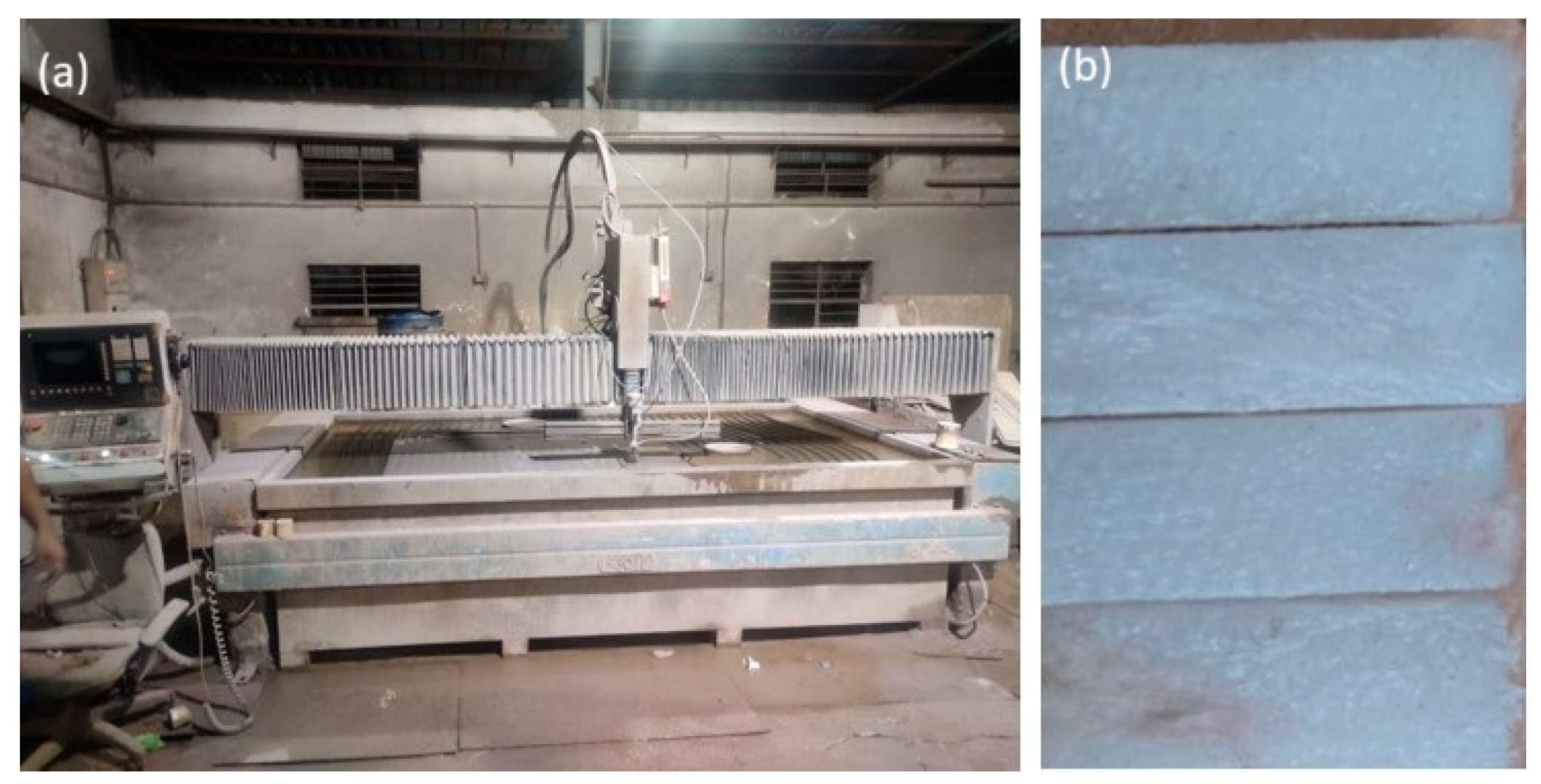
AWJM is preferred for POM + 15 wt.% RF because the composite is heat-sensitive and prone to melting, burning, fiber pull-out, and thermal degradation under conventional cutting. In contrast, AWJM provides a cold, force-reduced process with a minimal heat-affected zone, good edge integrity, and the ability to slice fiber-reinforced polymers without smearing the matrix. Using 75 µm garnet particles balances cutting aggressiveness and surface finish for this composite [23]. The sample is positioned over a sacrificial backing (HDPE) board and fixture, with compliant clamps to avoid local crushing. In AWJM, ultra-high-pressure water forms a coherent micro-jet through a jewel (sapphire) orifice. The jet creates a Venturi vacuum that entrains abrasive particles, then accelerates and collimates them in a carbide focusing tube. High-velocity particles strike the workpiece, causing micro-cutting/plowing (ductile) and micro-cracking/spalling (brittle), removing material by erosion. Cut quality and penetration depend mainly on process variables, with a minimal heat-affected zone [24]. Figure 1 presents the AWJM setup and machined sample.

2.3. Taguchi’s Methodology

Taguchi’s design of experiments emphasizes robust performance by using orthogonal arrays (OAs) to categorize factor settings that minimize variability (quality loss) with the fewest trials. For three control factors each at three levels, a full factorial needs 33 (27 runs); the L9 (33) OA reduces this to 9 balanced, independent trials while still allowing unbiased estimation of main effects. The choice of L9 is justified because the total degrees of freedom (DoF) towards variables is 3 × (3 − 1) = 6, which fits within the L9 OA 8 DoF (leaving 2 DoF for error/confirmation or a limited interaction check) [25]. This saves time, material, and cost without sacrificing clear insight into the dominant factors, provided that interactions are small or intentionally confounded. In this study, 3 AWJM parameters, WJP (100–300 MPa), TS (100–200 mm/min), and SoD (1–3 mm), were considered for experimentation to analyze SR and KW. SR was measured using Mitutoyo (Kawasaki, Japan) make Surftest SJ-410, and KW is quantified using an optical microscope. Three readings were taken at the entry (KWentry) and exit (KWexit) faces by spanning the two cut edges. The formula used to calculate KW is [26]:
K W   ( m m ) = K W e n t r y + K W e x i t 2

3. Results and Discussion

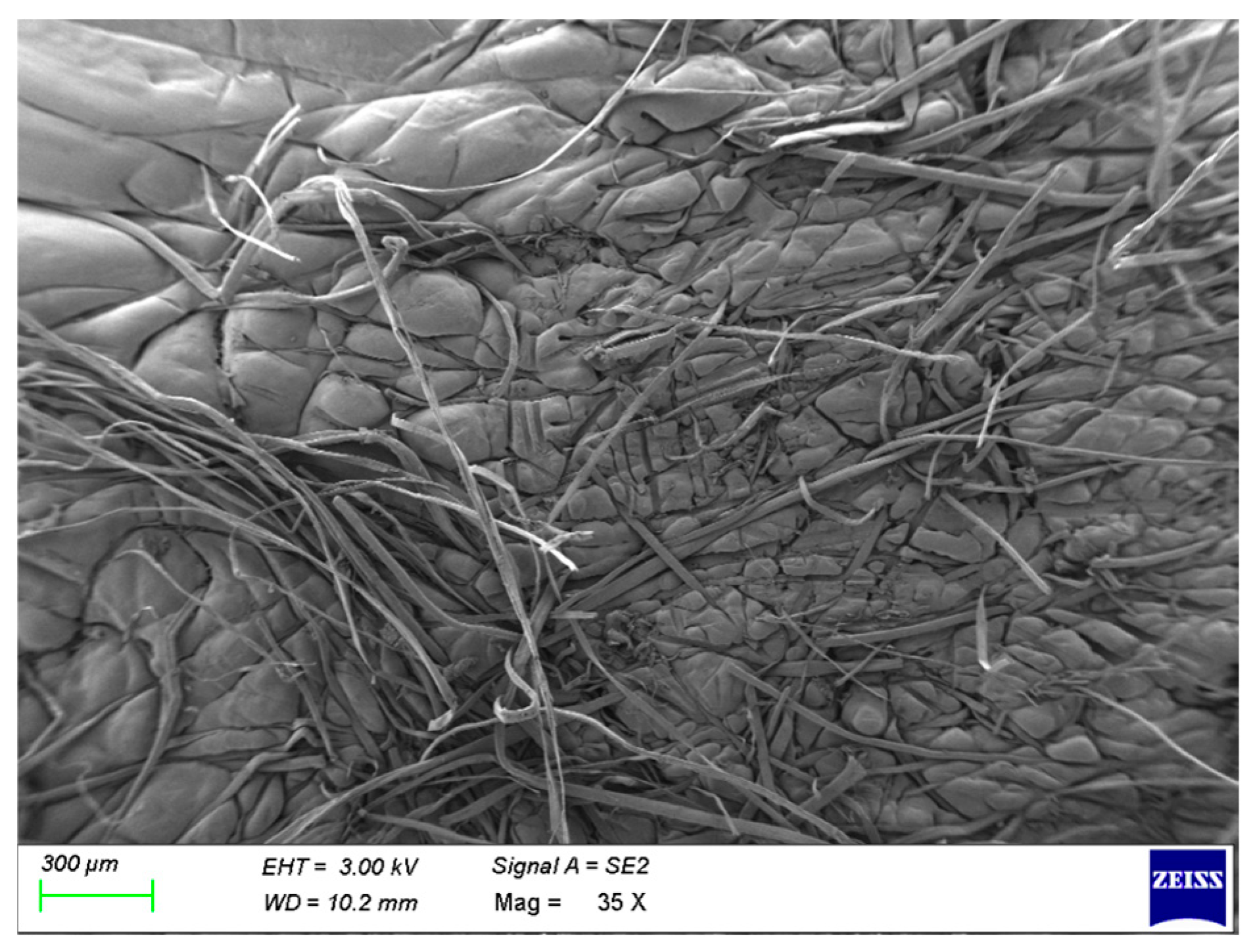
The SEM micrograph of the injection-molded POM + 15 wt.% RF (Figure 2) shows a typical skin-core morphology and flow-induced fiber orientation. The matrix surface exhibits flattened, lamellar flow skins and shear bands, while RF bundles appear as fibrillated strands with occasional lumen collapse, mostly preferentially aligned along the mold-fill direction with some local waviness. Evidence of interfacial phenomena is visible where the RFs are partially sheathed by matrix, indicating wetting and mechanical interlocking; discrete pull-out imprints and debonded gaps at some sites, consistent with interfacial shear failure under loading; and limited POM-rich pockets and small voids at bundle cross-overs, likely from entrapped air [27].
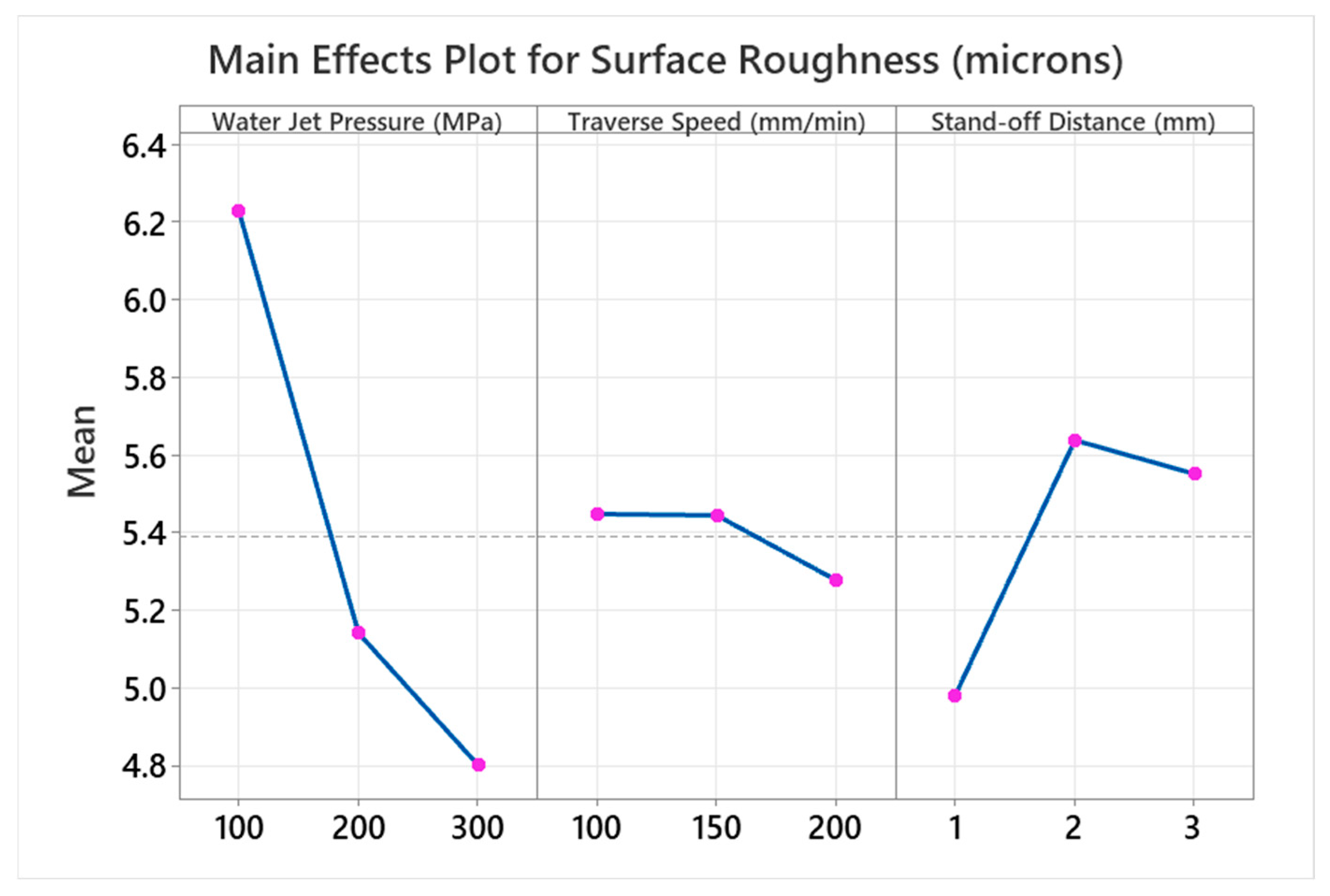
The L9 data presented in Table 1 show WJP as the primary determinant of quality. Increasing WJP from 100 to 300 MPa reduces mean SR from 6.23 to 4.80 µm (23% reduction) and mean KW from 1.31 to 1.07 mm (18% reduction). Higher WJP raises particle kinetic energy and preserves a tighter, more coherent core jet, promoting micro-cutting over plowing/smearing of the POM matrix and limiting RF breakout, which together lower striation amplitude and kerf spread [28]. SoD is the next most influential factor: enlarging SoD from 1 to 3 mm increases SR from 4.98 to 5.55 µm (11% higher) and KW from 1.12 to 1.20 mm (7% higher) due to jet divergence and momentum decay before impact, which broadens the cut and intensifies secondary erosion. TS has a comparatively more minor effect on SR but still contracts the kerf: raising TS from 100 to 200 mm/min narrows mean KW by 10.5% (1.24 to 1.11 mm), while SR changes modestly (5.45 to 5.28 µm), consistent with reduced dwell limiting lateral wall erosion; overly slow TS widens the kerf, whereas too fast risks undercutting and striations [29]. The obtained results align with classic AWJM mechanisms in polymers/composites; concentrating WJP at a short SoD facilitates clean micro-cutting of the matrix and fibers with minimal thermal effects, while adequate TS curtails secondary abrasion and taper development.

3.1. Analysis of Surface Roughness

The main-effects plot (Figure 3) shows that WJP dominates surface finish: SR drops monotonically as WJP rises from 100 to 300 MPa, evidencing the benefit of higher particle kinetic energy and a tighter jet core that promotes micro-cutting over polymer smearing and fiber plowing. TS has a more negligible but favorable effect, SR decreases slightly as TS increases to 200 mm/min, consistent with reduced dwell and suppressed secondary wall erosion. SoD is detrimental beyond a short gap: SR is lowest at SoD of 1 mm and rises at 2 to 3 mm as jet divergence and momentum decay increase striation amplitude [30].
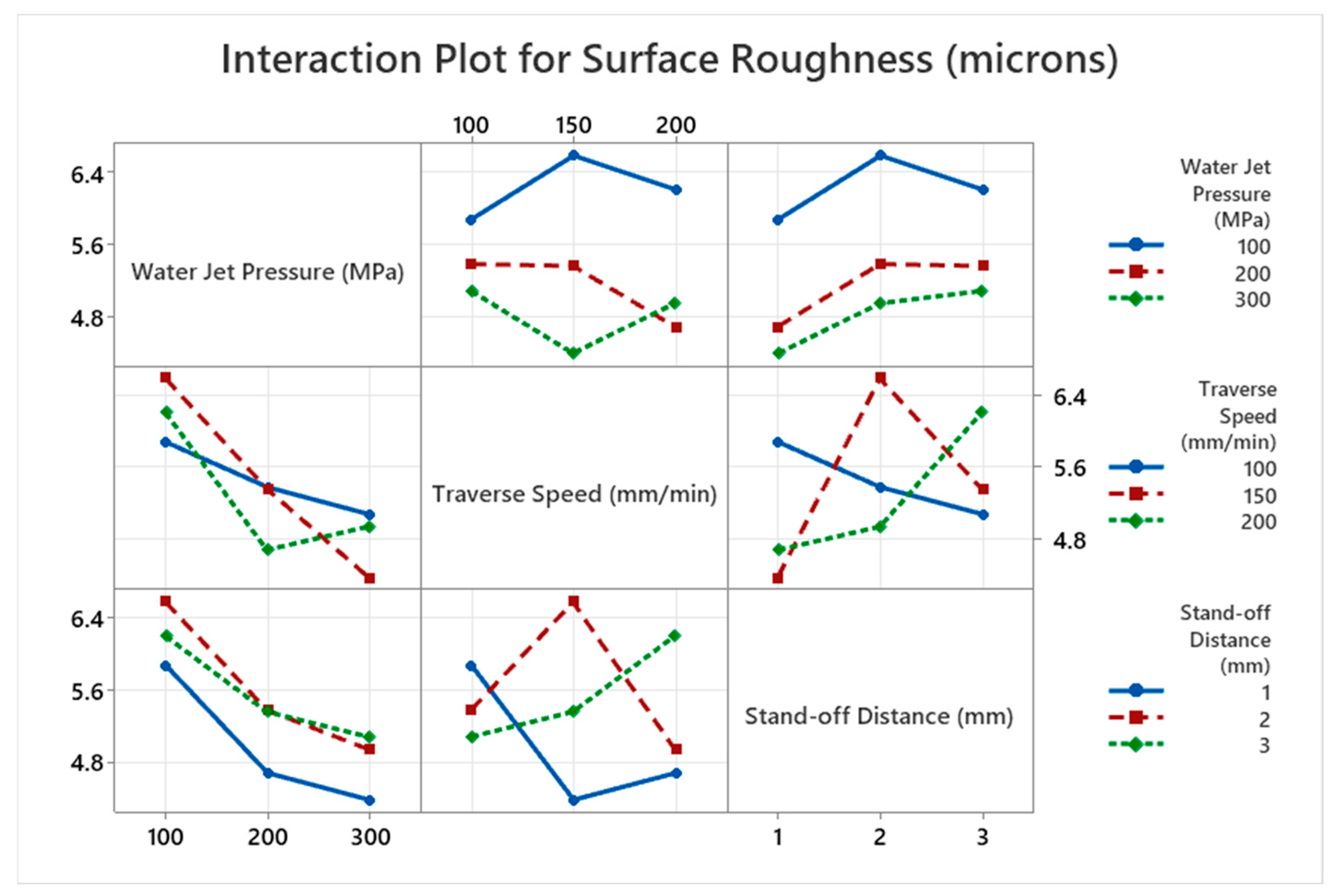
The interaction plots (Figure 4) reveal notable non-additivity. The benefit of high WJP is strongest at larger SoD (non-parallel WJP-SoD lines), indicating that higher WJP partly compensates for jet spread. The TS interacts with SoD. At SoD of 2 mm, the SR response to TS reverses relative to SoD of 1 mm, implying dwell-time effects are amplified when the jet is less coherent. In WJP × TS interactions are mild, suggesting speed regulation is secondary when pressure is high [31]. High WJP, short SoD, and moderate-high TS yield the best SR for POM-RF composite in AWJM. The ANOVA model for SR (Table 2) is significant (F = 57.30, p = 0.0173) with low variance (residual MS = 0.0121, S = 0.110 μm; coefficient of variation (C.V.) = 2.04%), indicating precise estimates. WJP is the dominant contributor to SR (79.8%), which is highly significant (p = 0.0072). Higher WJP reduces SR by increasing particle kinetic energy and promoting micro-cutting over polymer smearing [32]. SoD is also substantial (18.3%, p = 0.0307), with larger SoD worsening SR via jet divergence and momentum decay. TS has a small, statistically non-significant effect (1.36%, p = 0.299), consistent with only modest changes in dwell-related secondary erosion across the tested range. Good model fidelity is supported by an R2 value of 0.994, an Adj-R2 of 0.977, a Pred-R2 of 0.883, and an Adequate precision of 21.50 (>4), showing a strong signal and acceptable predictive agreement.
The fitted model Equation (2) for SR during analysis matches process physics: higher WJP and TS reduce SR, while larger SoD worsens it. Coefficient magnitudes indicate sensitivity ranking: SoD > WJP > TS.: A 1 mm rise in SoD worsens SR by 0.285 µm, while more than 100 MPa WJP improves SR by 0.713 µm, and more than 100 mm/min TS by 0.17 µm. A good fit is indicated by an R2 value of 85.8% and a standard deviation of 0.344 µm, with an Adj-R2 value of 77.3% and a Pred-R2 value of 64.2% showing moderate predictive strength.
S R = 6.501 0.00713 × W J P 0.0017 × T S + 0.285 × S o D

3.2. Analysis of Kerf Width

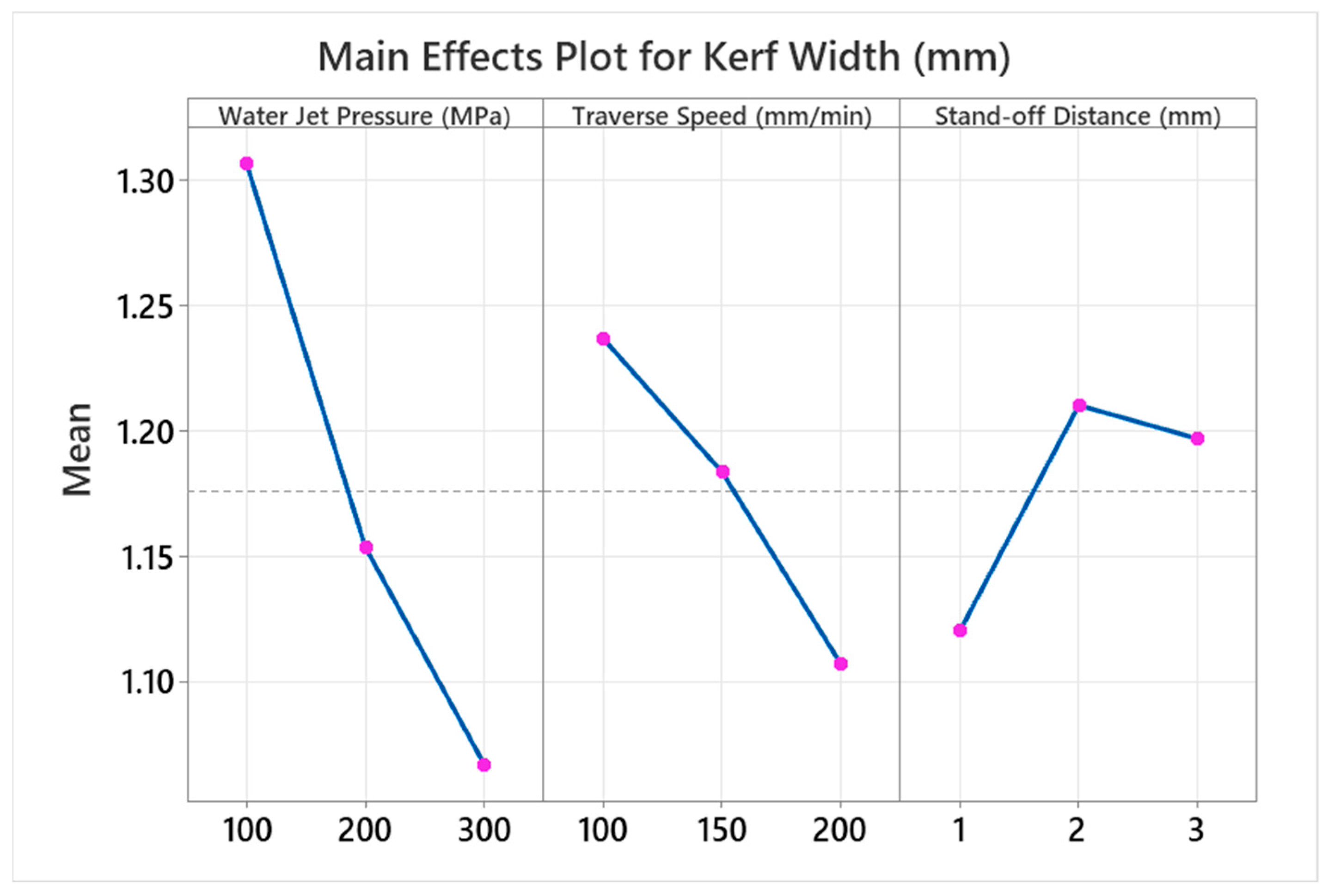
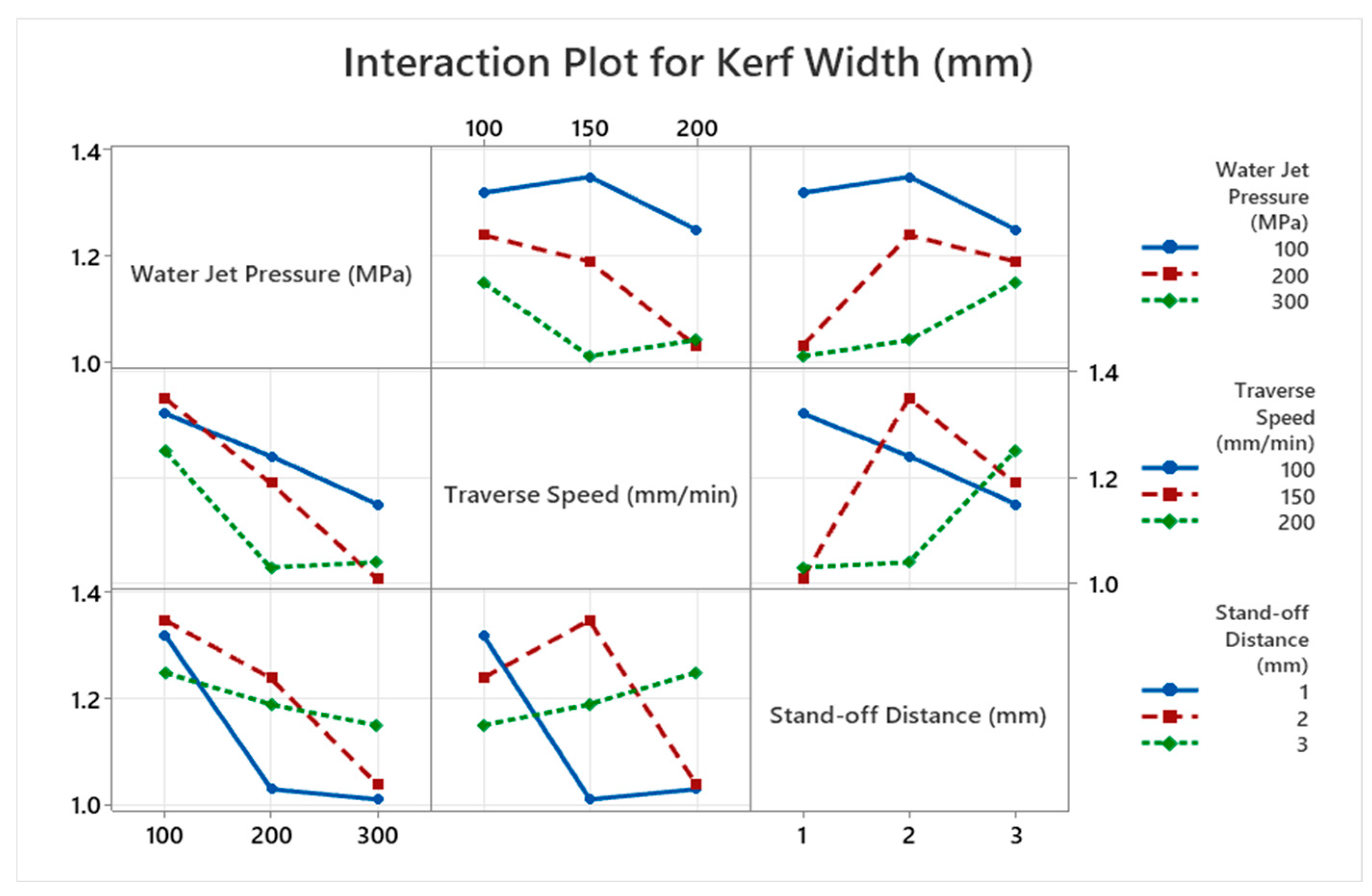
The main-effects plot of KW (Figure 5) shows that WJP is the principal control: increasing WJP from 100 to 300 MPa narrows the KW markedly, reflecting higher particle kinetic energy and a tighter core that limits lateral erosion. TS also reduces KW as it rises to 200 mm/min, consistent with shorter dwell suppressing sidewall undercut [33]. By contrast, SoD enlarges the KW; minimum KW occurs at SoD of 1 mm and increases at 2 and 3 mm due to jet divergence and momentum decay. Interaction plots (Figure 6) reveal non-parallel trends. The benefit of high WJP is greatest at larger SoD, indicating that pressure partly compensates for jet spread. The interaction between TS and SoD is strong, at SoD of 2 mm, raising TS sharply contracts KW, whereas at SoD of 1 mm the TS effect is modest. The WJP and TS interactions are weaker, but the narrowing with TS is most pronounced when WJP is low [34].
Table 3 presents the ANOVA data obtained for KW. The model is statistically significant with F and p values of 101.37 and 0.0098 with very low variance (residual MS = 0.000211; S = 0.0145 mm; C.V. = 1.24%), indicating precise estimation. Factor contributions from SS indicate that WJP is dominant (68.8%), followed by TS (9.9%) and SoD (11.0%), all of which are significant. Higher WJP tightens the jet and curbs lateral erosion, while faster TS cuts dwell and undercut. Larger SoD broadens the jet and thus widens KW [35]. Model quality metrics are excellent, with an R2 of 0.9967, an Adj-R2 of 0.9869, a Pred-R2 of 0.9336, and an Adeq Precision of 25.75, confirming strong explanatory and predictive power.
The KW modeled as in Equation (3) indicates that greater WJP and TS reduce kerf spread, whereas larger SoD increases it. Parameter sensitivities are −0.12 mm per 100 MPa (WJP), −0.13 mm per 100 mm/min (TS), and +0.038 mm per 1 mm (SoD). The model exhibits robust descriptive influence with an R2 value of 93.59%, an Adj-R2 value of 89.75% and acceptable predictive capability (Pred-R2 value of 81.71%) with low residual scatter (S = 0.0406 mm). These results substantiate selecting high WJP, higher TS, and short SoD to minimize KW.
K W = 1.534 0.001200 × W J P 0.0013 × T S + 0.0383 × S o D

3.3. Multi-Response Optimizer

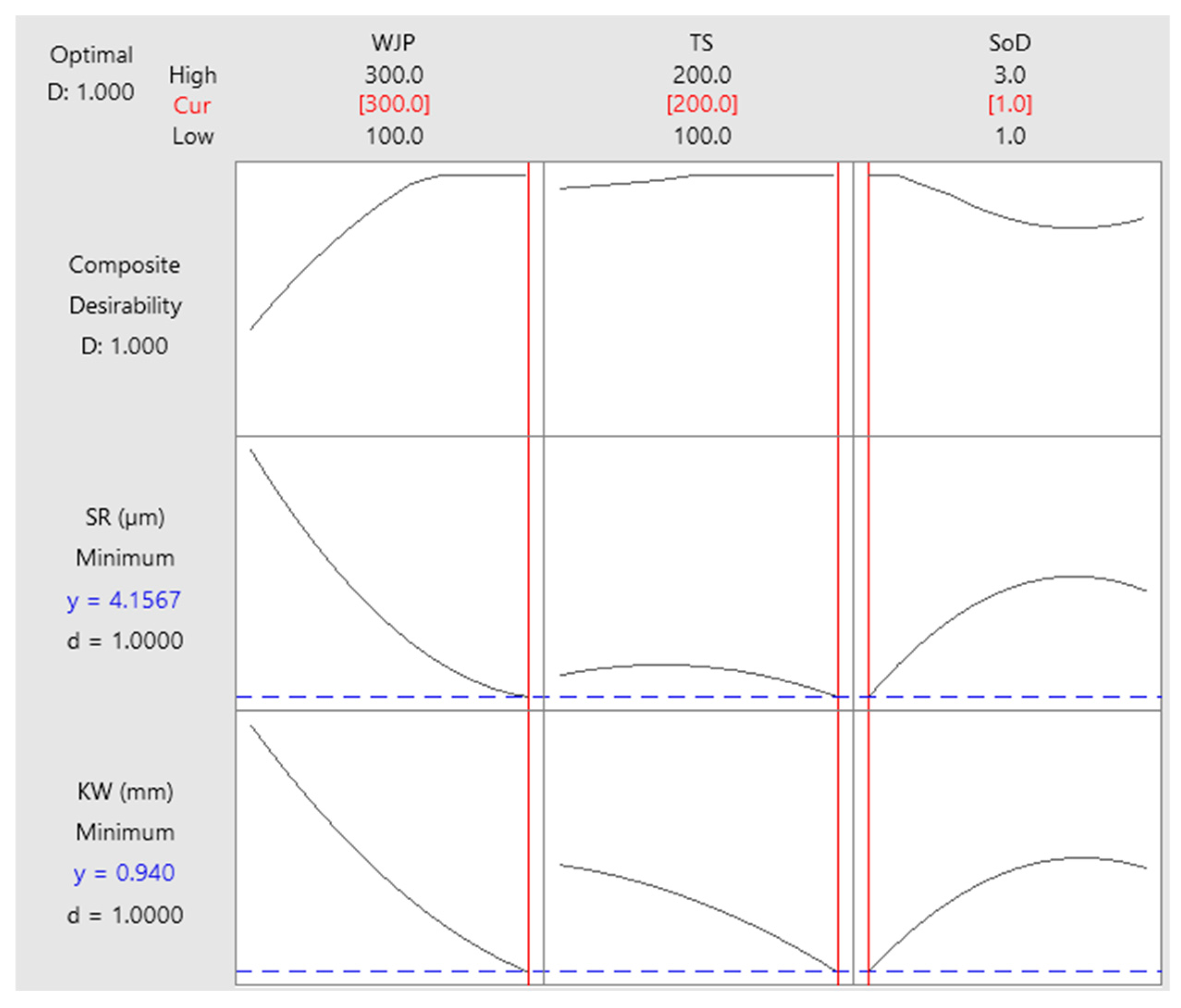
A multi-response optimizer with desirability functions enables simultaneous minimization/targeting of responses that trade off (SR vs. KW) by transforming each output to a standard 0–1 scale and combining them into a composite desirability to be maximized. This approach reconciles different units and magnitudes, encodes priorities through weights/importance, yields a single, implementable setting on the Pareto front instead of many incomparable optima, and supports constraint handling and sensitivity analysis [36]. The optimizer recommended WJP of 300 MPa, TS of 200 mm/min, and SoD of 1 mm, yielding a composite desirability of 1, with a predicted KW of 0.94 mm and SR of 4.1567 µm, as presented in Figure 7. This setting concentrates jet energy while limiting dwell and divergence, thus jointly minimizing kerf spread and roughness.
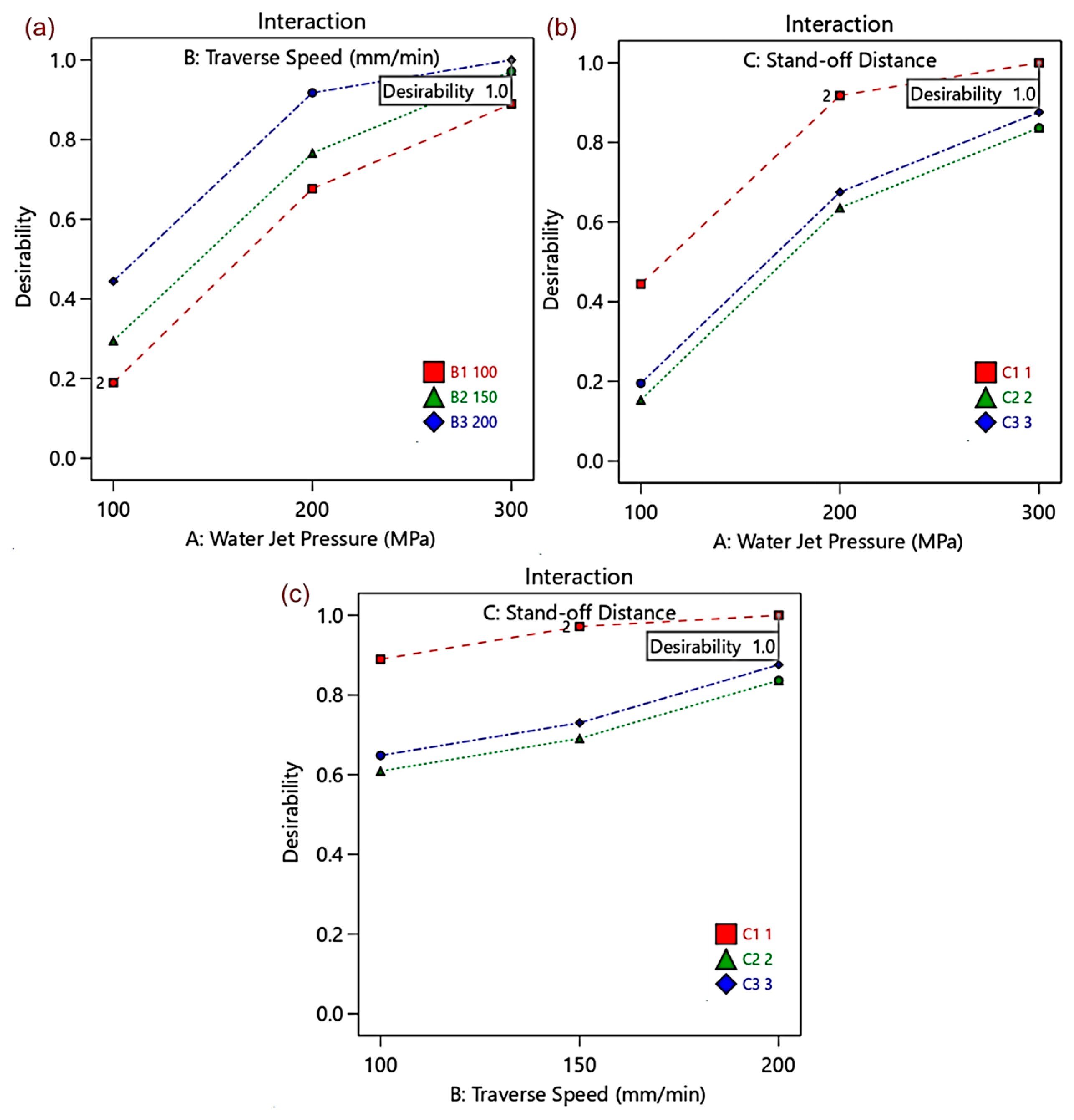
The desirability interaction plots (Figure 8) show strong synergy with WJP: desirability rises monotonically with WJP, and the gain from increasing TS is largest at low WJP but saturates near WJP of 300 MPa, indicating a ceiling effect once particle kinetic energy is high [37]. In contrast, SoD interacts antagonistically with both WJP and TS: desirability is consistently highest at SoD of 1 mm, and the penalty of moving to 2–3 mm is most significant when WJP and TS are low (non-parallel slopes), reflecting compounded jet divergence and dwell-driven side erosion [38]. Across panels, the most favorable region is A3-B3-C1 (300 MPa, 200 mm/min, 1 mm), which yields a composite desirability value of 1. Any relaxation (lower WJP, lower TS, or larger SoD) results in a decrease in D, with SoD causing the steepest decline at sub-optimal WJP/TS.

3.4. Confirmation Experiment

A confirmation trial was planned with the desirability-optimal parameters (300 MPa, 200 mm/min, 1 mm). Three replications were made, and the mean values obtained are: KW of 0.970 mm and SR of 4.27 µm, which agree well with model predictions (deviations 3.19% and 2.73%), validating the regression/DoE-based optimizer as presented in Table 4. The slight positive bias in KW and SR is consistent with limited fiber rebound at the cut front but remains within expected experimental variability [39].

4. Conclusions

The inferences made after AWJM of POM + 15 wt.% RF composite fabricated via injection molding are as follows.
  • The POM + 15 wt.% RF composite exhibits skin-core flow features with predominantly flow-aligned, partly sheathed fibers; limited pull-out sites and voids suggest better adhesion due to improved drying/sizing and gentler compounding.
  • AWJM surface finish is governed chiefly by WJP, then SoD, and secondary by TS. High WJP tightens the jet and promotes micro-cutting, whereas larger SoD causes jet divergence and momentum decay, raising striation amplitude. KW is significantly affected by all three factors, with WJP ranked higher than TS and SoD. Higher WJP and TS contract KW by increasing particle kinetic energy and reducing dwell; larger SoD widens KW.
  • Across the tested ranges, SR decreased by 23% and KW by 18% with WJP increase; SoD increase raised SR by 11% and KW by 7%; TS increase narrowed KW by 10.5% with a slight SR decrease.
  • ANOVA and regression show strong explanatory/predictive capability (SR: R2 = 99.42%, Pred-R2 = 88.29%; KW: R2 = 99.67, Pred-R2 = 93.36), supporting process understanding and control. Multi-response desirability identified 300 MPa (WJP), 200 mm/min (TS), and 1 mm (SoD) as a robust setting (composite desirability = 1), balancing minimal SR and KW.
  • Confirmation runs matched predictions within ≤3.2%, demonstrating deployable processability. Practically, operating at high WJP, short SoD, and moderate-high TS to obtain clean edges with low taper and roughness in POM-RF laminates.
The future scope of study related to POM-RF composite includes expanding the experimental design space beyond L9 by varying ramie content/length, considering different surface treatments, and other AWJM parameters (abrasive flow rate, abrasive size, nozzle diameter, impingement angle, etc.). In addition to the considered responses, SR and KW, delamination/fiber pull-out, dimensional accuracy, kerf taper, and material removal rate are determined and optimized using metaheuristic algorithms and predicted with machine learning and artificial intelligence approaches.

Author Contributions

Conceptualization, N.S. and S.T.; methodology, N.S. and G.P.; software, S.T. and S.S.; validation, N.S., S.T. and G.P.; formal analysis, N.S. and G.P.; investigation, S.T. and S.S.; resources, N.S. and S.T.; data curation, N.S. and S.T.; writing—original draft preparation, N.S. and G.P.; writing—review and editing, N.S. and S.T.; visualization, S.T. and S.S.; supervision, N.S.; project administration, N.S. and S.T. All authors have read and agreed to the published version of the manuscript.

Funding

This research received no external funding.

Institutional Review Board Statement

Not applicable.

Informed Consent Statement

Not applicable.

Data Availability Statement

All data related to this study is available in the manuscript itself.

Conflicts of Interest

The authors declare no conflicts of interest.

Abbreviations

The following abbreviations are used in this manuscript:
AWJMAbrasive Water Jet Machining
RFRamie Fiber
WJPWater Jet Pressure
TSTraverse Speed
SoDStand-Off Distance
AFRAbrasive Flow Rate
MRRMaterial Removal Rate
SRSurface Roughness
KWKerf Width
ANOVAAnalysis of Variance
OAOrthogonal Array
SEMScanning Electron Microscope
C.V.Coefficient of Variation

References

  1. Soćko, A.; Andrzejewski, J. The Development of Sustainable Polyoxymethylene (POM)-Based Composites by the Introduction of Natural Fillers and Melt Blending with Poly(Lactic Acid)-PLA. J. Compos. Sci. 2024, 8, 315. [Google Scholar] [CrossRef]
  2. Deepanraj, B.; Thirumalvalavan, S.; Selvarasu, S.; Senthilkumar, N.; Shaik, F. Investigation and Optimization of Wear Properties of Flax Fiber Reinforced Delrin Polymer Composite. Mater. Today Proc. 2023; in press. [CrossRef]
  3. Hamzat, A.K.; Murad, M.S.; Adediran, I.A.; Asmatulu, E.; Asmatulu, R. Fiber-Reinforced Composites for Aerospace, Energy, and Marine Applications: An Insight into Failure Mechanisms under Chemical, Thermal, Oxidative, and Mechanical Load Conditions. J. Thermoplast. Compos. Mater. 2025, 8, 152. [Google Scholar] [CrossRef]
  4. Pon, A.; Subramanian, K.; Gopal, P.; Palanikumar, K. Optimal Shape Selection of Pseudo-Rigid-Body Model Compliant Centrifugal Clutch Manufactured by Thermoplastics Using TOPSIS Approach. J. Thermoplast. Compos. Mater. 2023, 36, 4430–4456. [Google Scholar] [CrossRef]
  5. Kong, W.; Zhang, Z.; Zhao, X.; Ye, L. Formation of Highly Oriented Crystalline Structure for Polyoxymethylene Fiber Enables Superior Intrinsic Thermal Conductivity. Polymer 2024, 290, 126499. [Google Scholar] [CrossRef]
  6. Thirumalvalavan, S.; Senthilkumar, N.; Deepanraj, B.; Syam Sundar, L. Assessment of Mechanical Properties of Flax Fiber Reinforced with Delrin Polymer Composite. Mater. Today Proc. 2023; in press. [CrossRef]
  7. Shakir, M.H.; Singh, A.K. Ramie Fiber and Its Composites: A Review. Polym. Compos. 2025, 46, 6813–6841. [Google Scholar] [CrossRef]
  8. Wang, H.; Yuan, R.; Zhang, X.; Zai, P.; Deng, J. Research Progress in Abrasive Water Jet Processing Technology. Micromachines 2023, 14, 1526. [Google Scholar] [CrossRef]
  9. de la Rosa, S.; Rodríguez-Parada, L.; Ponce, M.B.; Mayuet Ares, P.F. The Abrasive Water Jet Cutting Process of Carbon-Fiber-Reinforced Polylactic Acid Samples Obtained by Additive Manufacturing: A Comparative Analysis. J. Compos. Sci. 2024, 8, 437. [Google Scholar] [CrossRef]
  10. Subramani, K.; Vasudevan, A.; Karthik, K.; Kolappan, S. Insights of Abrasive Water Jet Polishing Process Characteristics and Its Advancements. Mater. Today Proc. 2022, 52, 1113–1120. [Google Scholar] [CrossRef]
  11. Hejjaji, A.; Zitoune, R.; Crouzeix, L.; Le Roux, S.; Collombet, F. Surface and Machining Induced Damage Characterization of Abrasive Water Jet Milled Carbon/Epoxy Composite Specimens and Their Impact on Tensile Behavior. Wear 2017, 376–377, 1356–1364. [Google Scholar] [CrossRef]
  12. Shanmugam, D.K.; Masood, S.H. An Investigation on Kerf Characteristics in Abrasive Waterjet Cutting of Layered Composites. J. Mater. Process. Technol. 2009, 209, 3887–3893. [Google Scholar] [CrossRef]
  13. Gupta, V.; Pandey, P.M.; Garg, M.P.; Khanna, R.; Batra, N.K. Minimization of Kerf Taper Angle and Kerf Width Using Taguchi’s Method in Abrasive Water Jet Machining of Marble. Procedia Mater. Sci. 2014, 6, 140–149. [Google Scholar] [CrossRef]
  14. Varma, M.; Chandran, S.; Vijay Kumar, V.; Suyambulingam, I.; Siengchin, S. A Comprehensive Review on the Machining and Joining Characteristics of Natural Fiber-reinforced Polymeric Composites. Polym. Compos. 2024, 45, 4850–4875. [Google Scholar] [CrossRef]
  15. Bhat, R.; Tandon, V.; Ahmad, S.A.S. Optimizing Abrasive Water Jet Machining for Enhanced Machining of 316 Stainless Steel. J. Comput. Mech. Manag. 2024, 3, 1–7. [Google Scholar] [CrossRef]
  16. Karmiris-Obratański, P.; Karkalos, N.E.; Kudelski, R.; Papazoglou, E.L.; Markopoulos, A.P. On the Effect of Multiple Passes on Kerf Characteristics and Efficiency of Abrasive Waterjet Cutting. Metals 2021, 11, 74. [Google Scholar] [CrossRef]
  17. Murthy, B.R.N.; Rao, U.S.; Naik, N.; Potti, S.R.; Nambiar, S.S. A Study to Investigate the Influence of Machining Parameters on Delamination in the Abrasive Waterjet Machining of Jute-Fiber-Reinforced Polymer Composites: An Integrated Taguchi and Response Surface Methodology (RSM) Optimization to Minimize Delamination. J. Compos. Sci. 2023, 7, 475. [Google Scholar] [CrossRef]
  18. Kartal, F. Abrasive Water Jet Machining of Carbon Fiber-Reinforced PLA Composites: Optimization of Machinability and Surface Integrity for High-Precision Applications. Polymers 2025, 17, 445. [Google Scholar] [CrossRef]
  19. Khudhir, W.; Abbood, M.; Shukur, J. Multi-Criteria Decision Making of Abrasive Water Jet Machining Process for 2024-T3 Alloy Using Hybrid Approach. Adv. Sci. Technol. Res. J. 2022, 16, 155–162. [Google Scholar] [CrossRef]
  20. Pious, C.V.; Thomas, S. Polymeric Materials—Structure, Properties, and Applications. In Printing on Polymers; Elsevier: Amsterdam, The Netherlands, 2016; pp. 21–39. [Google Scholar]
  21. Cai, M.; Takagi, H.; Nakagaito, A.N.; Li, Y.; Waterhouse, G.I.N. Effect of Alkali Treatment on Interfacial Bonding in Abaca Fiber-Reinforced Composites. Compos. Part A Appl. Sci. Manuf. 2016, 90, 589–597. [Google Scholar] [CrossRef]
  22. Rabbi, M.S.; Islam, T.; Islam, G.M.S. Injection-Molded Natural Fiber-Reinforced Polymer Composites—A Review. Int. J. Mech. Mater. Eng. 2021, 16, 15. [Google Scholar] [CrossRef]
  23. Vasanthkumar, P.; Perumal, G.; Deepanraj, B.; Senthilkumar, N. Abrasive Waterjet Machining Characteristics of Nylon 6 Polymer Matrix Reinforced with Seashell Biofillers: Experimental Analysis, Optimization, and Prediction. Int. J. Interact. Des. Manuf. (IJIDeM) 2026, 20, 93–115. [Google Scholar] [CrossRef]
  24. Mieszala, M.; Torrubia, P.L.; Axinte, D.A.; Schwiedrzik, J.J.; Guo, Y.; Mischler, S.; Michler, J.; Philippe, L. Erosion Mechanisms during Abrasive Waterjet Machining: Model Microstructures and Single Particle Experiments. J. Mater. Process. Technol. 2017, 247, 92–102. [Google Scholar] [CrossRef]
  25. Rasu, K.; Shanmugam, V.; Davim, J.P. Multi-Objective Optimisation of Hybrid Banana/Sisal/Red Mud Composites Using Taguchi–Grey Relational Analysis. J. Compos. Sci. 2025, 9, 357. [Google Scholar] [CrossRef]
  26. Kishore, S.; Teja, P.; Eshwariaha, B.; Reddy, K. Experimental Control of Kerf Width Taper during Abrasive Water Jet Machining. FME Trans. 2019, 47, 585–590. [Google Scholar] [CrossRef]
  27. Amiandamhen, S.O.; Meincken, M.; Tyhoda, L. Natural Fibre Modification and Its Influence on Fibre-Matrix Interfacial Properties in Biocomposite Materials. Fibers Polym. 2020, 21, 677–689. [Google Scholar] [CrossRef]
  28. Natarajan, Y.; Murugesan, P.K.; Mohan, M.; Liyakath Ali Khan, S.A. Abrasive Water Jet Machining Process: A State of Art of Review. J. Manuf. Process. 2020, 49, 271–322. [Google Scholar] [CrossRef]
  29. Hascalik, A.; Çaydaş, U.; Gürün, H. Effect of Traverse Speed on Abrasive Waterjet Machining of Ti–6Al–4V Alloy. Mater. Des. 2007, 28, 1953–1957. [Google Scholar] [CrossRef]
  30. Karthikeyan, R.; Madhu, S.; Geo Varuvel, E.; Pethuthraj, M. Influence of Brown Algae Filler and Process Parameters on the Surface Roughness and MRR of Jute Fiber Polymeric Composite Machined by Abrasive Water Jet. Proc. Inst. Mech. Eng. Part E J. Process Mech. Eng. 2024; in press. [CrossRef]
  31. Kartal, F.; Kaptan, A. Comprehensive and Essential Review of Advanced Researches Abrasive Waterjet Machining. Int. Adv. Res. Eng. J. 2025, 9, 50–69. [Google Scholar] [CrossRef]
  32. Nader, A.J.; Saad, K.S. Influence of Abrasive Water Jet (AWJ) on Surface Roughness. Int. J. Eng. Mater. Manuf. 2021, 6, 132–140. [Google Scholar] [CrossRef]
  33. Llanto, J.M.; Tolouei-Rad, M.; Vafadar, A.; Aamir, M. Impacts of Traverse Speed and Material Thickness on Abrasive Waterjet Contour Cutting of Austenitic Stainless Steel AISI 304L. Appl. Sci. 2021, 11, 4925. [Google Scholar] [CrossRef]
  34. Anu Kuttan, A.; Rajesh, R.; Dev Anand, M. Abrasive Water Jet Machining Techniques and Parameters: A State of the Art, Open Issue Challenges and Research Directions. J. Braz. Soc. Mech. Sci. Eng. 2021, 43, 220. [Google Scholar] [CrossRef]
  35. Holmberg, J.; Wretland, A.; Berglund, J. Abrasive Water Jet Milling as An Efficient Manufacturing Method for Superalloy Gas Turbine Components. J. Manuf. Mater. Process. 2022, 6, 124. [Google Scholar] [CrossRef]
  36. Arunachalam, S.J.; Saravanan, R.; Sathish, T.; Alarfaj, A.A.; Giri, J.; Kumar, A. Enhancing Mechanical Performance of MWCNT Filler with Jute/Kenaf/Glass Composite: A Statistical Optimization Study Using RSM and ANN. Mater. Technol. 2024, 39, 2381156. [Google Scholar] [CrossRef]
  37. Aich, U.; Banerjee, S.; Bandyopadhyay, A.; Das, P.K. Multi-Objective Optimisation of Abrasive Water Jet Machining Responses by Simulated Annealing and Particle Swarm. Int. J. Mechatron. Manuf. Syst. 2014, 7, 38. [Google Scholar] [CrossRef]
  38. Jagadish; Gupta, K. Abrasive Water Jet Machining of Polymer Composites. In Abrasive Water Jet Machining of Engineering Materials; Springer: Cham, Switzerland, 2020; pp. 33–49. [Google Scholar]
  39. Pahuja, R.; Ramulu, M.; Hashish, M. Surface Quality and Kerf Width Prediction in Abrasive Water Jet Machining of Metal-Composite Stacks. Compos. Part B Eng. 2019, 175, 107134. [Google Scholar] [CrossRef]
Figure 1. (a) AWJM setup. (b) Machined sample.
Engproc 130 00008 g001
Figure 2. SEM picture of fabricated composite.
Engproc 130 00008 g002
Figure 3. SR main-effects graph.
Engproc 130 00008 g003
Figure 4. SR Interaction graph.
Engproc 130 00008 g004
Figure 5. KW main-effects graph.
Engproc 130 00008 g005
Figure 6. KW interaction graph.
Engproc 130 00008 g006
Figure 7. Multi-response optimized for SR and KW minimization.
Engproc 130 00008 g007
Figure 8. Desirability values with interaction effects. (a) The desirability interaction plots: WJP and TS, (b) The desirability interaction plots: WJP and SoD, (c) The desirability interaction plots: TS and SoD.
Engproc 130 00008 g008
Table 1. L9 OA input and responses.
Exp. No.WJP (MPa)TS (mm/min)SoD (mm)SR (µm)KW (mm)
110010015.881.32
210015026.591.35
310020036.211.25
420010025.381.24
520015035.361.19
620020014.681.03
730010035.081.15
830015014.381.01
930020024.941.04
Table 2. ANOVA data for SR.
SourceSSDoFMSSF-Valuep-Value
Model4.15213360.69202257.297150.0173significant
WJP3.33182221.665911137.93190.0072
TS0.05668920.0283442.3468260.299
SoD0.76362220.38181131.61270.031
Residual0.02415620.012078
Cor Total4.1762898
Std. Dev.0.109899 R20.994216
Mean5.388889 Adj. R20.976864
C.V. %2.039362 Pred. R20.882874
Adeq Precision21.495
Table 3. ANOVA data for KW.
SourceSSDoFMSF-Valuep-Value
Model0.128460.0214101.36840.0098significant
WJP0.08862220.044311209.89470.0047
TS0.02562220.01281160.684210.0162
SoD0.01415620.00707833.526320.029
Residual0.00042220.000211
Cor Total0.1288228
Std. Dev.0.01453 R20.996722
Mean1.175556 Adjusted R20.98689
C.V. %1.235983 Predicted R20.933629
Adeq Precision25.75317
Table 4. Confirmation results.
ResponsePredictedMeasured% Deviation
KW (mm)0.940.970 ± 0.013.19
SR (µm)4.15674.27 ± 0.052.73
Disclaimer/Publisher’s Note: The statements, opinions and data contained in all publications are solely those of the individual author(s) and contributor(s) and not of MDPI and/or the editor(s). MDPI and/or the editor(s) disclaim responsibility for any injury to people or property resulting from any ideas, methods, instructions or products referred to in the content.