1. Introduction
Mechanical anisotropy, namely the directional dependence of material properties, is a desirable feature in many structural applications. Since practical loading scenarios are rarely equiaxial, the ability to tailor stiffness or strength along specific orientations of architected metamaterials represents a clear functional advantage. Traditional periodic lattices have attempted to capture this behavior by tuning geometric parameters [
1,
2,
3] or by reorienting unit cells [
4,
5]. Nonetheless, despite considerable progress, the achievable degree of anisotropy continues to be constrained. This limitation arises from the inherent periodicity of these architectures, which restricts tessellation to a finite set of orientations and precludes continuous variation in directional properties [
6]. Consequently, periodic lattices often fall short when strong anisotropy is required.
The rapid development of Additive Manufacturing (AM) technologies provides new opportunities to effectively tackle this limitation. AM enables the direct fabrication of extremely complex geometries that were previously unattainable, closing the loop between digital design and physical fabrication [
7,
8,
9,
10]. This ability has boosted the advent of mechanical metamaterials, defined as artificial materials whose unconventional behavior is mostly controlled by their geometry and structure [
2,
11,
12,
13,
14]. Within this rapidly evolving field, non-periodic metamaterials have become increasingly attractive, as they markedly expand the design space compared to traditional lattices. Notably, spinodal-based metamaterials inspired by the phase separation process, mathematically described through the Cahn–Hilliard equation, offer irregular yet continuous topologies that can be systematically controlled. Their non-periodic nature makes them especially promising for generating strong directional properties [
6,
15,
16]. Recent research has demonstrated that spinodal architectures can be tuned to exhibit strong anisotropic responses, thereby overcoming the geometric limitations of periodic structures [
16,
17,
18,
19].
Motivated by these findings, this work presents a novel computational framework for designing spinodal metamaterials with maximized anisotropy. The proposed workflow integrates three key steps: (i) simulation of spinodal decomposition to generate metamaterial topologies, (ii) finite element-based homogenization to evaluate their mechanical performance, and (iii) multi-objective optimization via a genetic algorithm to identify the parameter set maximizing directional stiffness differences. The goal is to obtain spinodal topologies with improved stiffness along a prescribed direction (x) while reducing it along orthogonal directions (y, z).
The paper is organized as follows:
Section 2 introduces the adopted methodology.
Section 3 reports and discusses the main results, and
Section 4 concludes the work with final remarks and outlook.
2. Methodology
This section outlines the overall workflow of the study. First, the mathematical model that simulates spinodal decomposition, i.e., the physical phenomenon inspiring our metamaterials, is introduced in
Section 2.1. Next, the Finite Element (FE) model and the homogenization framework are detailed in
Section 2.2. Finally, the optimization strategy developed to design a spinodal metamaterial with the maximum attainable degree of anisotropy is presented in
Section 2.3.
2.1. Mathematical Model: Cahn–Hilliard Equation
The process of spinodal decomposition involves the spontaneous separation of a homogeneous mixture into two phases, while preserving the initial 50:50 volume fraction. This process is mathematically described by the Cahn–Hilliard equation [
20,
21,
22,
23,
24,
25], widely recognized as computationally challenging due to its nonlinearity and stiffness. In this section, a concise overview of the numerical method adopted to solve the equation is provided, while a complete exposition can be found in [
26].
Following the approach of [
17] with the goal of reducing the number of design parameters, which is critical for the subsequent optimization process, the Cahn–Hilliard equation has been made dimensionless for both isotropic and anisotropic diffusion processes. For brevity, only the dimensionless forms of the equations are presented here.
For the isotropic case, the governing equation becomes:
where
is the phase-field solution;
and
are the dimensionless time and space, respectively;
and
are the dimensionless independent parameters for the isotropic case.
In the anisotropic case, which allows modeling direction-dependent diffusional behavior, the equation reads:
where the additional dimensionless parameters
,
and
account for the anisotropic diffusion.
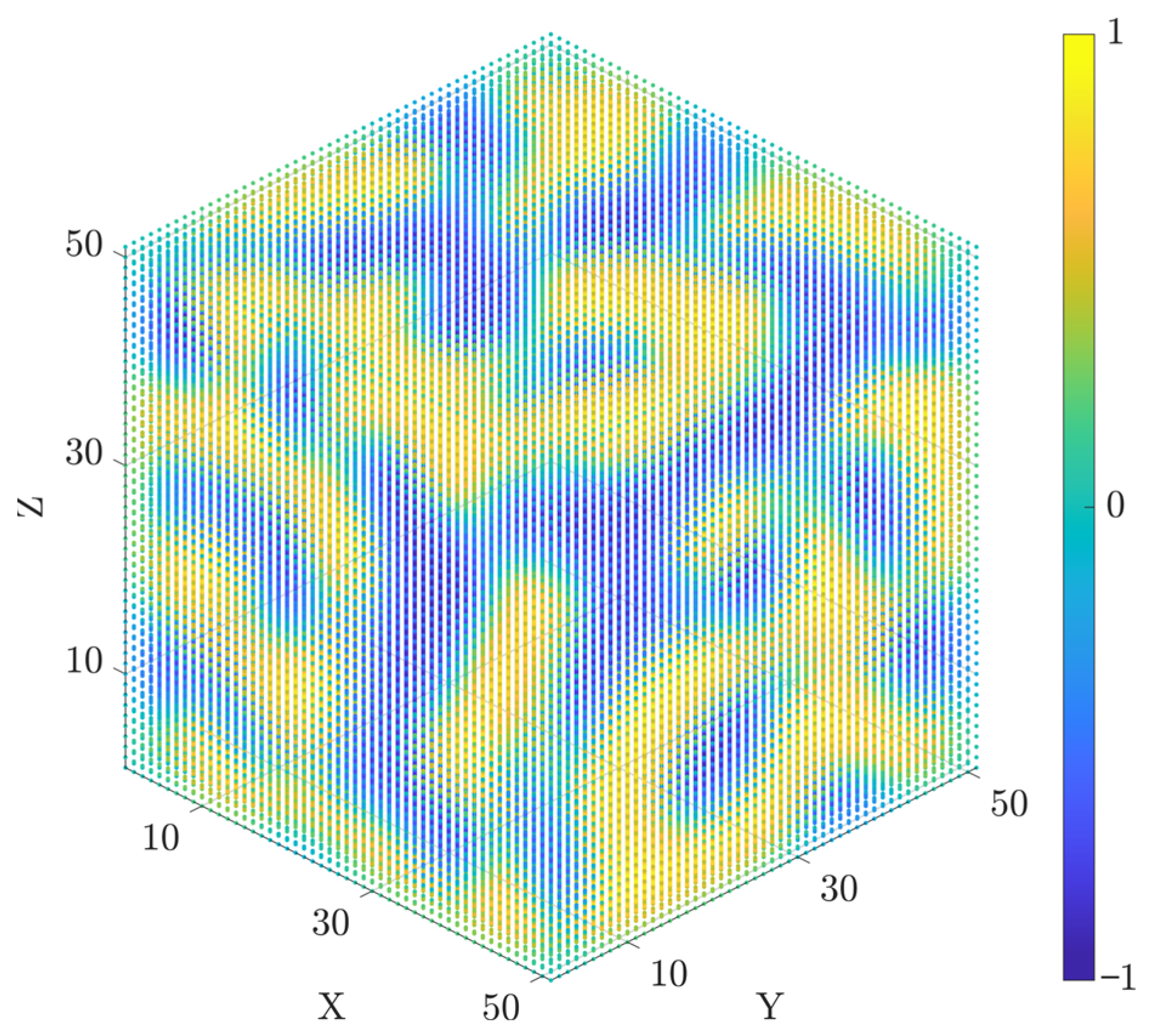
The equations described above have been solved using the Finite Difference Method (FDM). Specifically, the time derivative is treated using an explicit forward Euler scheme, while the Laplacian operator is evaluated with a 27-point stencil [
27]. The numerical implementation was carried out in MATLAB
® R2025b. An example of the resulting phase-field solution, which serves as the starting point for the metamaterial design process discussed in the following section, is shown in
Figure 1.
2.2. Computational Framework: FE Model and Mechanical Homogenization
The FE model of the spinodal metamaterial is constructed directly from the phase-field solution
(similar to that shown in
Figure 1), obtained by solving the Cahn–Hilliard equation in either isotropic (Equation (1)) or anisotropic form (Equation (2)). In our work, the material domain is defined where
is negative.
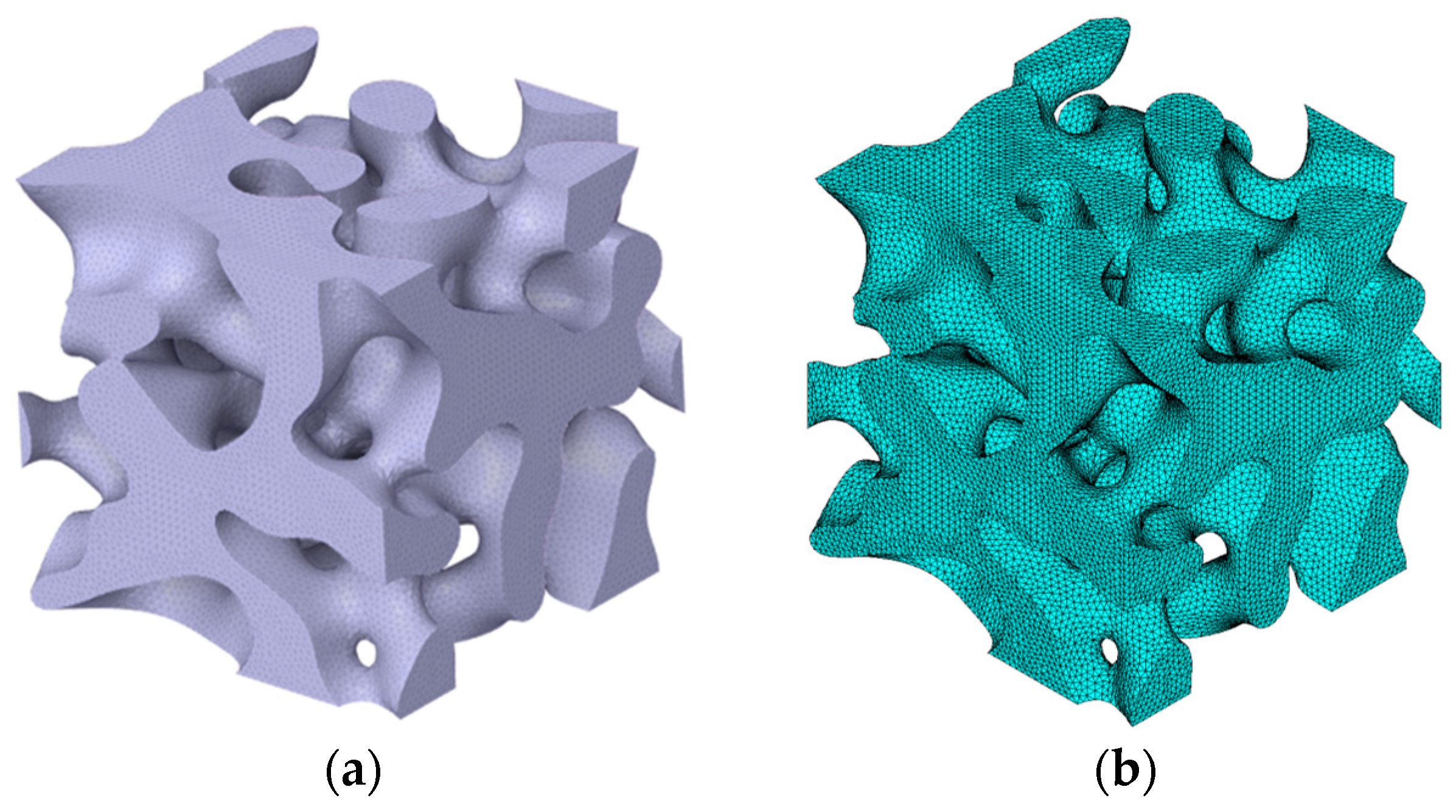
In order to transform the raw phase-field solution into a robust computational mesh, an automated workflow has been implemented in MATLAB®: first, an iso-surface is extracted and exported as an STL geometry, which is then subjected to a cleaning and correction process to eliminate potential topological inconsistencies and enhance tessellation uniformity.
The corrected surface is subsequently discretized into a volume mesh using high-order tetrahedral elements via Gmsh 4.14 [
28], allowing direct meshing from the triangulated surface without requiring an underlying CAD model. The resulting mesh is finally exported in a solver-compatible format for FE simulations (CDB format in this work).
Figure 2 provides an example of the obtained STL model (a) and the FE mesh (b).
The mechanical characterization of the metamaterial is carried out via computational homogenization, a well-established technique to determine the behavior of non-homogeneous materials. The key step in this method is the definition of a Representative Volume Element (RVE), from which averaged stress and strain fields are extracted and subsequently used to compute effective elastic constants [
29,
30,
31,
32]. Among the boundary conditions that can be applied, periodic boundary conditions (PBCs) are generally regarded as the most reliable, as they provide a realistic representation of the material response [
30,
31,
33,
34,
35]. However, their implementation requires establishing node-to-node correspondence on the opposite faces of the RVE and introducing constraint equations to couple the displacements of these nodes in order to simulate the behavior of a unit cell embedded in an infinite domain. This predictably results in a significant increase in the computational cost of the homogenization procedure. In contrast, displacement boundary conditions (DBCs) are simpler to implement and widely used in homogenization procedures, particularly when the objective is to determine Young’s moduli. This has been extensively documented in the literature [
36,
37], and we have previously shown that, even in the case of spinodal metamaterials, DBCs yield Young’s modulus values equivalent to those obtained with PBCs [
26]. For this reason, DBCs have been adopted throughout the present study.
2.3. Unconstrained Optimization of Mechanical Anisotropy
The modeling and FE-homogenization framework described above was integrated into an optimization workflow, including 250 iterations, aimed at identifying spinodal metamaterial configurations that maximize mechanical anisotropy. The optimization is unconstrained, focusing solely on enhancing the contrast between the stiffnesses along the principal directions, both for metamaterials derived from isotropic and anisotropic spinodal processes.
Due to the complexity of the design space, a gradient-free (Heuristic) optimization strategy was employed. Therefore, a Genetic Algorithm (GA) was chosen for its ability to explore design spaces without relying on gradient information and to converge toward near-optimal solutions through stochastic operations.
The design variables are α and β in the isotropic case (from Equation (1)), and α together with the direction-dependent parameters β
x, β
y, and β
z in the anisotropic case (from Equation (2)). These parameters directly control the morphology of the spinodal metamaterial, and thus its mechanical behavior. Their admissible ranges are adopted from our previous study [
26].
For each candidate solution, the Young’s moduli Exx, Eyy, and Ezz are extracted. The optimization objective is expressed as the maximization of two anisotropy indices: the ratios of the Young’s modulus along the x direction to those along the y and z directions (Exx/Eyy and Exx/Ezz, respectively). The GA seeks to maximize these indices without imposing additional constraints on the absolute values of the moduli. This unconstrained optimization is intended to demonstrate the ability of spinodal metamaterials to generate directional stiffness, providing a clear framework for analyzing how isotropic and anisotropic diffusional processes influence mechanical performance. The results of the optimization process are presented in the next section.
3. Results and Discussion
In this section, the results are presented and discussed to assess whether introducing anisotropy into the underlying diffusional process of spinodal metamaterials effectively promotes mechanical anisotropy in the resulting material properties.
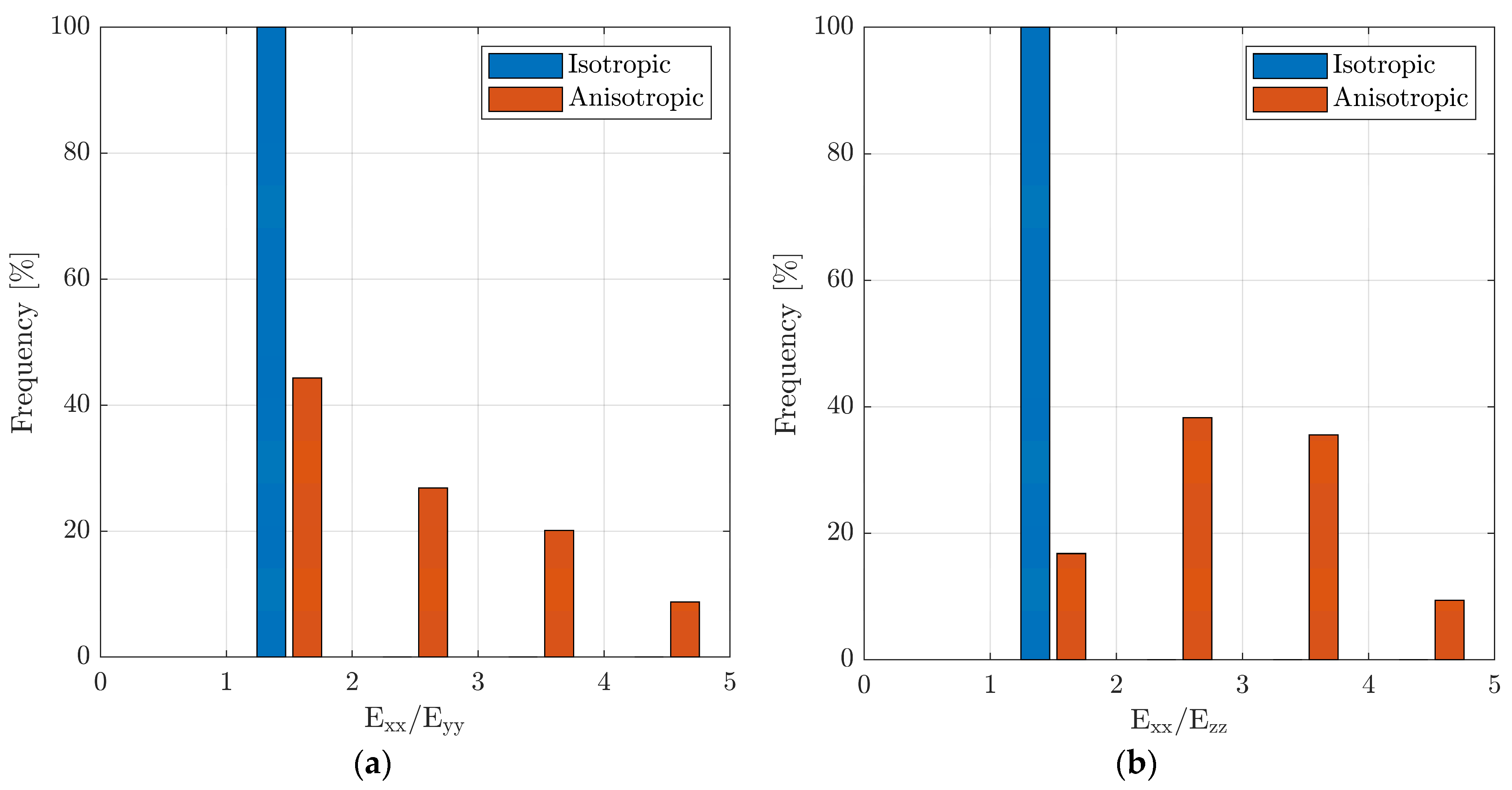
Figure 3 shows the distribution of mechanical anisotropy ratios (i.e., E
xx/E
yy and E
xx/E
zz) for metamaterials derived from both isotropic and anisotropic spinodal processes. In the isotropic case, the ratios E
xx/E
yy and E
xx/E
zz are always limited to values below 1.5, reflecting a nearly uniform mechanical response along the three principal directions. In sharp contrast, in the anisotropic case these ratios can reach values of up to 5, indicating a significant mechanical anisotropy. These trends are numerically summarized in
Table 1, which reports the maximum values of anisotropy ratios obtained for both cases.
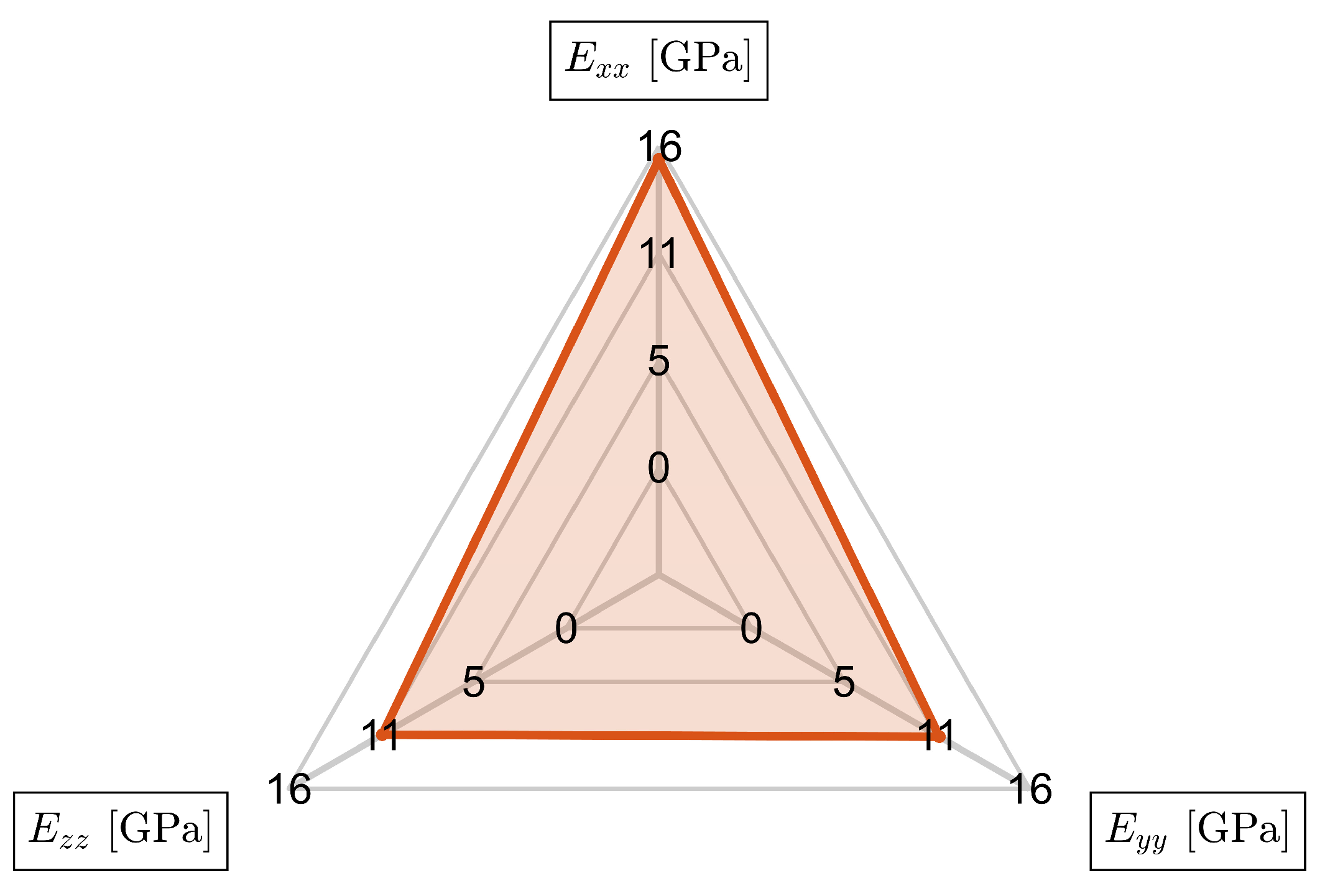
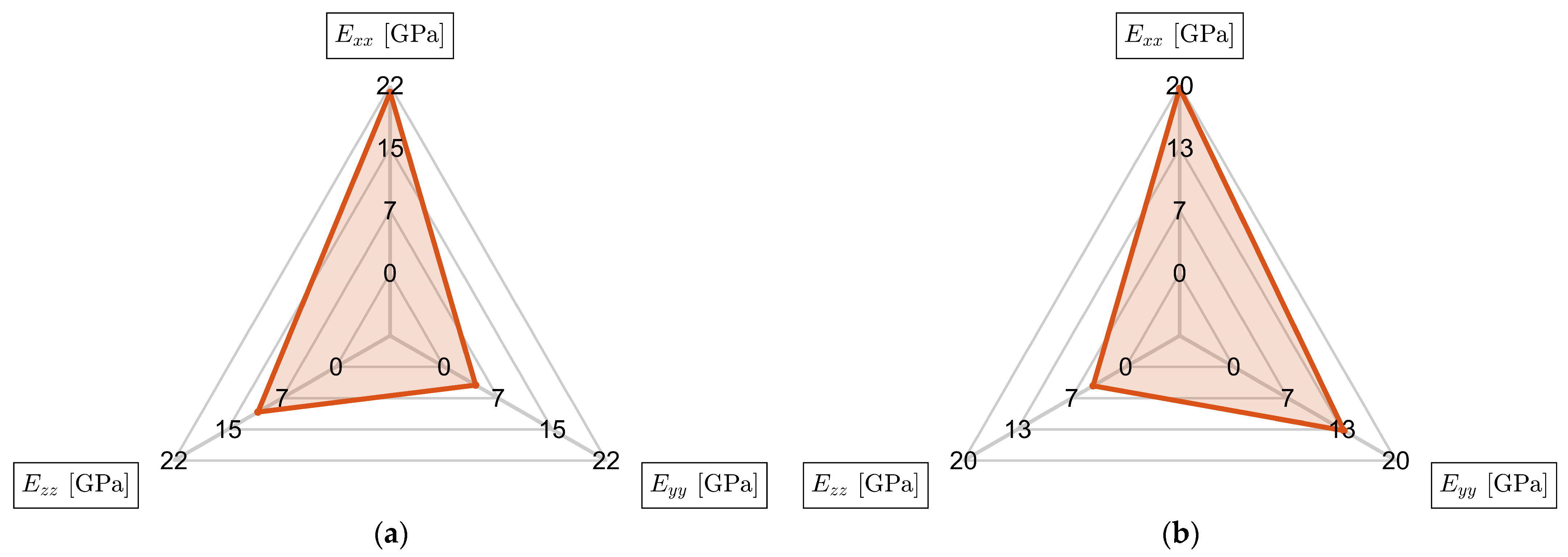
Figure 4 and
Figure 5 show spider plots of the Young’s moduli for the isotropic and anisotropic cases, respectively. This representation provides an immediate visual understanding of the directional mechanical response of the selected metamaterials.
Figure 4 shows the metamaterial derived from Equation (1) with maximum E
xx/E
yy, displaying nearly identical values along the y and z directions: E
xx is only approximately 45% higher than E
yy and E
zz. This is consistent with the limited anisotropy observed in this case (
Figure 3a).
Figure 5 shows the metamaterial derived from Equation (2) with maximum E
xx/E
yy (
Figure 5a) and E
xx/E
zz (
Figure 5b), highlighting a pronounced directional mechanical behavior: E
xx is approximately 300% higher than E
yy and E
zz.
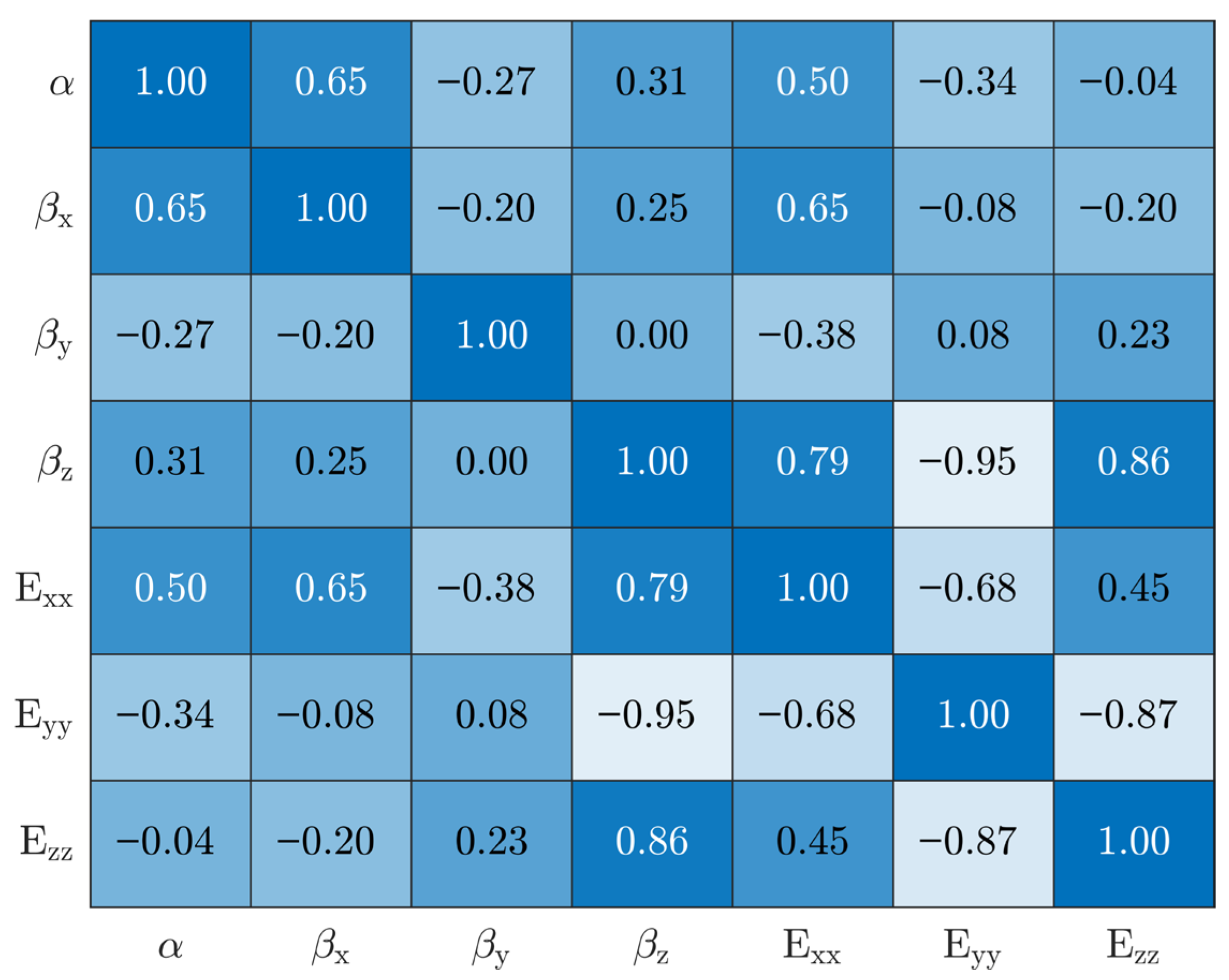
To better understand how mechanical anisotropy is affected by the design parameters,
Figure 6 shows the correlation matrix between the design parameters and the anisotropic ratios for metamaterials derived from Equation (2). This representation provides insight into the influence of α, β
x, β
y, and β
z on the mechanical properties and guides parameter tuning to achieve desired stiffness distributions. The matrix reveals that β
z exhibits the strongest correlations with the directional moduli: positively with E
xx (0.79) and E
zz (0.86), and negatively with E
yy (−0.95), confirming its critical role in controlling the stiffness contrast along the three axes. Similarly, β
x shows a moderate positive correlation with E
xx (0.65), suggesting that increasing β
x enhances stiffness along the x direction. In contrast, β
y has weaker correlations with the directional moduli, indicating a more limited influence on the overall mechanical anisotropy. The global parameter α shows only moderate correlations with E
xx (0.50) and smaller correlations with E
yy (−0.34) and E
zz (−0.04).
Overall, these results quantitatively demonstrate that isotropic spinodal processes produce nearly uniform material stiffness, whereas anisotropic processes allow the design of metamaterials with highly directional mechanical properties. In addition, these correlations confirm that the anisotropic mobility parameters directly govern the directional mechanical properties: proper adjustment of βx, βy and βz allows fine-tuning of the stiffness along each principal direction.
4. Conclusions
This work investigates whether modeling an anisotropic spinodal decomposition process can produce metamaterials with a pronounced anisotropic mechanical response. To this end, a computational framework was developed, consisting of three main steps:
Solution of the non-linear Cahn–Hilliard PDE using a finite difference numerical algorithm, yielding a phase-field solution that serves as the starting point for the spinodal-inspired metamaterial design process.
FE modeling and homogenization to calculate the Young’s moduli of the resulting metamaterial.
Unconstrained optimization based on a genetic algorithm, aimed at maximizing anisotropy ratios (Exx/Eyy and Exx/Ezz).
The results demonstrate that isotropic spinodal processes yield a quasi-isotropic mechanical response, with only residual anisotropy along the principal directions. In contrast, introducing anisotropy into the underlying diffusion process significantly enhances directional mechanical response, with stiffness ratios (Exx/Eyy and Exx/Ezz) up to five times greater than those in the isotropic case. Correlation analysis further reveals that the directional mobility parameters (βx, βy, βz) play a pivotal role in governing the mechanical response along each axis. In particular, βz was identified as the most influential parameter, strongly controlling stiffness contrast among the three directions, while βx and βy provide additional tuning capabilities. These findings offer preliminary design guidelines for spinodal-inspired metamaterials with tailored anisotropic response.
Overall, this work shows that incorporating anisotropy into spinodal decomposition provides a powerful strategy for creating metamaterials with enhanced directional stiffness and tunable mechanical properties.
As future developments, the proposed design approach could be extended to multifunctional spinodal-inspired metamaterials, for instance, by simultaneously targeting anisotropic thermal conductivity alongside mechanical anisotropy. The ability to tune diffusional parameters to achieve specific mechanical and thermal behaviors could unlock new opportunities in both structural and energy-related applications. Furthermore, incorporating more sophisticated optimization objectives, including multi-physics constraints, would further broaden the versatility of spinodal-inspired metamaterial design.
Author Contributions
Conceptualization, B.M., C.I. and V.G.B.; methodology, B.M., C.I. and V.G.B.; software, B.M., C.I. and V.G.B.; validation, B.M., C.I. and V.G.B.; formal analysis, B.M.; investigation, B.M. and C.I.; resources, F.V.; data curation, B.M.; writing—original draft preparation, B.M. and C.I.; writing—review and editing, B.M., C.I., V.G.B. and F.V.; visualization, B.M.; supervision, F.V.; project administration, F.V. All authors have read and agreed to the published version of the manuscript.
Funding
European Union—NextGenerationEU, Project ECS 0000024 Rome Technopole.
Institutional Review Board Statement
Not applicable.
Informed Consent Statement
Not applicable.
Data Availability Statement
Data are contained within the article.
Acknowledgments
This study was supported by the Project ECS 0000024 Rome Technopole,—CUP B83C22002820006, NRP Mission 4 Component 2 Investment 1.5, Funded by the European Union—NextGenerationEU.
Conflicts of Interest
The authors declare no conflicts of interest.
References
- Iandiorio, C.; Mattei, G.; Marotta, E.; Costanza, G.; Tata, M.E.; Salvini, P. The Beneficial Effect of a TPMS-Based Fillet Shape on the Mechanical Strength of Metal Cubic Lattice Structures. Materials 2024, 17, 1553. [Google Scholar] [CrossRef] [Scilit] [PubMed]
- Surjadi, J.U.; Gao, L.; Du, H.; Li, X.; Xiong, X.; Fang, N.X.; Lu, Y. Mechanical Metamaterials and Their Engineering Applications. Adv. Eng. Mater. 2019, 21, 1800864. [Google Scholar] [CrossRef] [Scilit]
- Jia, Z.; Liu, F.; Jiang, X.; Wang, L. Engineering Lattice Metamaterials for Extreme Property, Programmability, and Multifunctionality. J. Appl. Phys. 2020, 127, 150901. [Google Scholar] [CrossRef] [Scilit]
- Xu, S.; Shen, J.; Zhou, S.; Huang, X.; Xie, Y.M. Design of Lattice Structures with Controlled Anisotropy. Mater. Des. 2016, 93, 443–447. [Google Scholar] [CrossRef] [Scilit]
- Jiang, H.; Bednarcyk, B.A.; Le Barbenchon, L.; Chen, Y. Elastically Anisotropic Architected Metamaterials with Enhanced Energy Absorption. Thin-Walled Struct. 2023, 192, 111115. [Google Scholar] [CrossRef] [Scilit]
- Zheng, L.; Kumar, S.; Kochmann, D.M. Data-Driven Topology Optimization of Spinodoid Metamaterials with Seamlessly Tunable Anisotropy. Comput. Methods Appl. Mech. Eng. 2021, 383, 113894. [Google Scholar] [CrossRef] [Scilit]
- Askari, M.; Hutchins, D.A.; Thomas, P.J.; Astolfi, L.; Watson, R.L.; Abdi, M.; Ricci, M.; Laureti, S.; Nie, L.; Freear, S.; et al. Additive Manufacturing of Metamaterials: A Review. Addit. Manuf. 2020, 36, 101562. [Google Scholar] [CrossRef] [Scilit]
- Song, B.; Zhang, S.; Zhang, L.; Shi, Y. Development Trends and Challenges of Additive Manufacturing Metamaterials. Engineering 2025, 44, 2–6. [Google Scholar] [CrossRef] [Scilit]
- Xiong, Y.; Tang, Y.; Zhou, Q.; Ma, Y.; Rosen, D.W. Intelligent Additive Manufacturing and Design: State of the Art and Future Perspectives. Addit. Manuf. 2022, 59, 103139. [Google Scholar] [CrossRef] [Scilit]
- Wu, X.; Su, Y.; Shi, J. Perspective of Additive Manufacturing for Metamaterials Development. Smart Mater. Struct. 2019, 28, 093001. [Google Scholar] [CrossRef] [Scilit]
- Barchiesi, E.; Spagnuolo, M.; Placidi, L. Mechanical Metamaterials: A State of the Art. Math. Mech. Solids 2018, 24, 212–234. [Google Scholar] [CrossRef] [Scilit]
- Christensen, J.; Kadic, M.; Wegener, M.; Kraft, O.; Wegener, M. Vibrant Times for Mechanical Metamaterials. MRS Commun. 2015, 5, 453–462. [Google Scholar] [CrossRef] [Scilit]
- Jiao, P.; Mueller, J.; Raney, J.R.; Zheng, X.; Alavi, A.H. Mechanical Metamaterials and Beyond. Nat. Commun. 2023, 14, 6004. [Google Scholar] [CrossRef] [Scilit] [PubMed]
- Yu, X.; Zhou, J.; Liang, H.; Jiang, Z.; Wu, L. Mechanical Metamaterials Associated with Stiffness, Rigidity and Compressibility: A Brief Review. Prog. Mater. Sci. 2018, 94, 114–173. [Google Scholar] [CrossRef] [Scilit]
- Vidyasagar, A.; Krödel, S.; Kochmann, D.M. Microstructural Patterns with Tunable Mechanical Anisotropy Obtained by Simulating Anisotropic Spinodal Decomposition. Proc. R. Soc. A Math. Phys. Eng. Sci. 2018, 474, 20180535. [Google Scholar] [CrossRef] [Scilit]
- Kumar, S.; Tan, S.; Zheng, L.; Kochmann, D.M. Inverse-Designed Spinodoid Metamaterials. npj Comput. Mater. 2020, 6, 73. [Google Scholar] [CrossRef] [Scilit]
- Mandolesi, B.; Iandiorio, C.; Belardi, V.G.; Vivio, F. Modelling and Mechanical Characterization of a Metamaterial Inspired by the Spinodal Decomposition. Eng. Proc. 2025, 85, 40. [Google Scholar] [CrossRef] [Scilit]
- Golnary, F.; Asghari, M. Data-Driven Analysis of Spinodoid Topologies: Anisotropy, Inverse Design, and Elasticity Tensor Distribution. Int. J. Mech. Mater. Des. 2024, 20, 1029–1051. [Google Scholar] [CrossRef] [Scilit]
- Mandolesi, B.; Iandiorio, C.; Belardi, V.G.; Vivio, F. Spinodal Decomposition-Inspired Metamaterial: Tailored Homogenized Elastic Properties via the Dimensionless Cahn-Hilliard Equation. Eur. J. Mech.-A/Solids 2025, 112, 105615. [Google Scholar] [CrossRef] [Scilit]
- Cahn, J.W.; Hilliard, J.E. Free Energy of a Nonuniform System. I. Interfacial Free Energy. J. Chem. Phys. 1958, 28, 258–267. [Google Scholar] [CrossRef] [Scilit]
- Cahn, J.W. Free Energy of a Nonuniform System. II. Thermodynamic Basis. J. Chem. Phys. 1959, 30, 1121–1124. [Google Scholar] [CrossRef] [Scilit]
- Cahn, J.W. On Spinodal Decomposition in Cubic Crystals. Acta Met. 1962, 10, 179–183. [Google Scholar] [CrossRef] [Scilit]
- Cahn, J.W. On Spinodal Decomposition. Acta Met. 1961, 9, 795–801. [Google Scholar] [CrossRef] [Scilit]
- Bray, A.J. Theory of Phase-Ordering Kinetics. Adv. Phys. 2002, 51, 481–587. [Google Scholar] [CrossRef] [Scilit]
- Yang, K.; Wang, Y.; Tang, J.; Wang, Z.; Zhang, D.; Dai, Y.; Lin, J. Phase Field Study on the Spinodal Decomposition of β Phase in Zr–Nb-Ti Alloys. Materials 2023, 16, 2969. [Google Scholar] [CrossRef] [Scilit] [PubMed]
- Mandolesi, B.; Iandiorio, C.; Belardi, V.G.; Vivio, F. Spinodal Metamaterials Optimization Based on Genetic Algorithm: Controlling Mechanical Anisotropy via Dimensionless Cahn-Hilliard Equation. Eur. J. Mech.-A/Solids 2026, 116, 105881. [Google Scholar] [CrossRef] [Scilit]
- Spotz, W. High-Order Compact Finite Difference Schemes for Computational Mechanics. Ph.D. Thesis, The University of Texas at Austin, Austin, TX, USA, 1996. [Google Scholar]
- Geuzaine, C.; Remacle, J. Gmsh: A 3-D Finite Element Mesh Generator with Built-in Pre- and Post-processing Facilities. Int. J. Numer. Methods Eng. 2009, 79, 1309–1331. [Google Scholar] [CrossRef] [Scilit]
- Aboudi, J.; Arnold, S.M.; Bednarcyk, B.A. Micromechanics of Composite Materials: A Generalized Multiscale Analysis Approach, 1st ed.; Elsevier: Amsterdam, The Netherlands; Butterworth-Heinemann: Oxford, UK, 2013. [Google Scholar]
- Yvonnet, J. Computational Homogenization of Heterogeneous Materials with Finite Elements; Solid Mechanics and Its Applications; Springer International Publishing: Cham, Switzerland, 2019; Volume 258. [Google Scholar]
- Okereke, M.; Keates, S. Finite Element Applications; Springer Tracts in Mechanical Engineering; Springer International Publishing: Cham, Switzerland, 2018. [Google Scholar]
- Mandolesi, B.; Iandiorio, C.; Belardi, V.G.; Bovesecchi, G.; Vivio, F. Effective Thermal Conductivity Prediction and Thermomechanical Cross-Property Relation of Spinodal Metamaterials. Int. J. Eng. Sci. 2026, 228, 104617. [Google Scholar] [CrossRef] [Scilit]
- Belardi, V.G.; Trupiano, S.; Fanelli, P.; Vivio, F. Overall Elastic Characterization of Equivalent FE Models for Aluminum Foams through Computational Homogenization Approach and Genetic Algorithm Optimization. Eur. J. Mech.-A/Solids 2024, 103, 105189. [Google Scholar] [CrossRef] [Scilit]
- Xia, Z.; Zhang, Y.; Ellyin, F. A Unified Periodical Boundary Conditions for Representative Volume Elements of Composites and Applications. Int. J. Solids Struct. 2003, 40, 1907–1921. [Google Scholar] [CrossRef] [Scilit]
- Belardi, V.G.; Fanelli, P.; Trupiano, S.; Vivio, F. Multiscale Analysis and Mechanical Characterization of Open-Cell Foams by Simplified FE Modeling. Eur. J. Mech.-A/Solids 2021, 89, 104291. [Google Scholar] [CrossRef] [Scilit]
- Denisiewicz, A.; Kuczma, M.; Kula, K.; Socha, T. Influence of Boundary Conditions on Numerical Homogenization of High Performance Concrete. Materials 2021, 14, 1009. [Google Scholar] [CrossRef] [Scilit] [PubMed]
- Espadas-Escalante, J.J.; Van Dijk, N.P.; Isaksson, P. A Study on the Influence of Boundary Conditions in Computational Homogenization of Periodic Structures with Application to Woven Composites. Compos. Struct. 2017, 160, 529–537. [Google Scholar] [CrossRef] [Scilit]
| Disclaimer/Publisher’s Note: The statements, opinions and data contained in all publications are solely those of the individual author(s) and contributor(s) and not of MDPI and/or the editor(s). MDPI and/or the editor(s) disclaim responsibility for any injury to people or property resulting from any ideas, methods, instructions or products referred to in the content. |