Proceeding Paper

An Efficient Hybrid Framework for Weld Defect Detection Using GAN, CNN and XGBoost †
1
Department of Information Security, School of Computer Science and Engineering, Vellore Institute of Technology, Vellore 632 014, TN, India
2
School of Computer Science and Engineering, Vellore Institute of Technology, Vellore 632 014, TN, India
*
Author to whom correspondence should be addressed.
Presented at the 19th Global Congress on Manufacturing and Management (GCMM 2025), Vellore, India, 10–12 December 2025.
Eng. Proc. 2026, 130(1), 9; https://doi.org/10.3390/engproc2026130009

Published: 22 April 2026
(This article belongs to the Proceedings of The 19th Global Congress on Manufacturing and Management (GCMM 2025))

Abstract

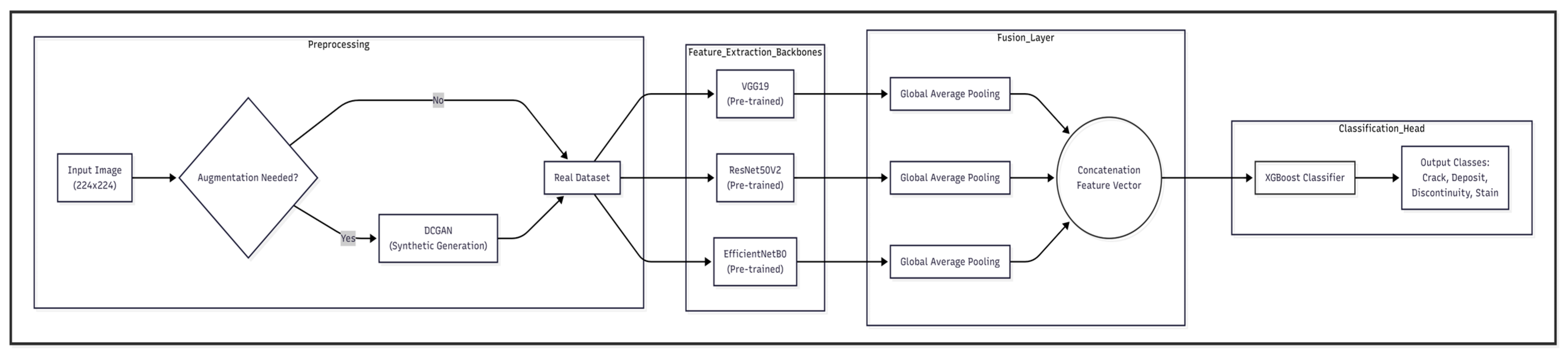
Automated detection of defects in welds are inevitable in the assurance of structural integrity, but this faces serious challenges due to the microscopic characteristics of the discontinuities, low visual contrast and infrequent occurrence of defect samples. Conventional deep learning methods, while accurate, often lack interpretability and exhibit low recall for rare defects. This paper proposes a novel hybrid system combining a Generative Adversarial Network (GAN), a Convolutional Neural Network (CNN), and Extreme Gradient Boosting (XGBoost 2.0.0) to enhance weld defect classification performance and transparency. Firstly, a Deep Convolutional GAN (DCGAN) creates synthetic images of the minority classes; thus, the problem of class imbalance is resolved. Then, a pretrained ResNet50V2 CNN is used to extract features of the deep layers from the original images as well as from the generated ones. After that, these features are fed into an XGBoost classifier, which uses tree-based learning to optimize classification results and make the process more understandable to the user. Furthermore, interpretation is also facilitated by Grad-CAM rendering of the CNN regions of interest and SHAP analysis to measure the involvement of the features in XGBoost. Experiments using the available LoHi-WELD datasets show that the overall accuracy is significantly improved, the per-class recall of the rare defects is also enhanced, and the robustness is also improved. The proposed hybrid method not only achieves better results but also generates visual/explainable output, which is very valuable when the system is implemented in industrial welding inspection systems. This paper serves as a liaison between the latest AI technology and the practical interpretability requirements of the mechanical and welding engineering fields.
Keywords: weld defect classification; hybrid model; Convolutional Neural Network (CNN); XGBoost; feature fusion; Generative Adversarial Network (GAN); SHAP (SHapley Additive exPlanations); LIME (Local Interpretable Model-agnostic Explanations) weld defect classification; hybrid model; Convolutional Neural Network (CNN); XGBoost; feature fusion; Generative Adversarial Network (GAN); SHAP (SHapley Additive exPlanations); LIME (Local Interpretable Model-agnostic Explanations)