1. Introduction
The decarbonization of government fleets has become a critical energy and environmental policy goal in many developing countries. The Philippines’ energy plan for 2023–2050 sets ambitious targets for electrification by 2030. The directive pushes public institutions toward electric vehicle (EV) adoption, supporting climate objectives and the broader EV ecosystem [
1].
EV adoption in the public sector faces non-negligible challenges, particularly in terms of investment cost, maintenance needs, and readiness of supporting infrastructure. Constrained by rigid procurement processes and limited fiscal flexibility, public institutions require rigorous planning tools to align long-term electrification goals with available budgets. Traditional approaches often fail to integrate qualitative strategic criteria—such as environmental impact or inter-agency replicability—into quantitative resource optimization models [
2].
In response to these complexities, we developed a hybrid decision-support framework combining the analytic hierarchy process (AHP) with linear programming (LP) to evaluate and prioritize investment decisions for the country’s vehicle fleet modernization. AHP is widely used for structuring multi-criteria problems and capturing expert preferences through pairwise comparisons. At the same time, LP has proven effective in optimizing discrete resource allocations under constraints such as cost, fleet mix, and policy compliance [
3,
4].
The results of this study assist in determining the most cost-effective mix of EVs and hybrid EVs, using a structured optimization model that integrates policy priorities with fiscal realities. The framework applies to any global government agencies seeking to balance sustainability, operational efficiency, and public accountability in their transition to low-emission transport systems [
5].
2. Materials and Methods
We applied to a hybrid decision-support framework integrating AHP and LP to determine the optimal composition of fuel technologies in the Philippines’ vehicle fleet, mandating the gradual shift to cleaner vehicle technologies across the public sector. The model assumes a fixed total fleet size of 135 vehicles, all internal combustion engine (ICE) units in the 2025 baseline. By 2030, at least 70% (≥95 units) must be converted to alternate fuel vehicles (AFVs)—comprising battery electric vehicles (BEVs), hybrid electric vehicles (HEVs), and plug-in hybrid electric vehicles (PHEVs)—without exceeding the original fleet size.
2.1. AHP
AHP, developed by Saaty [
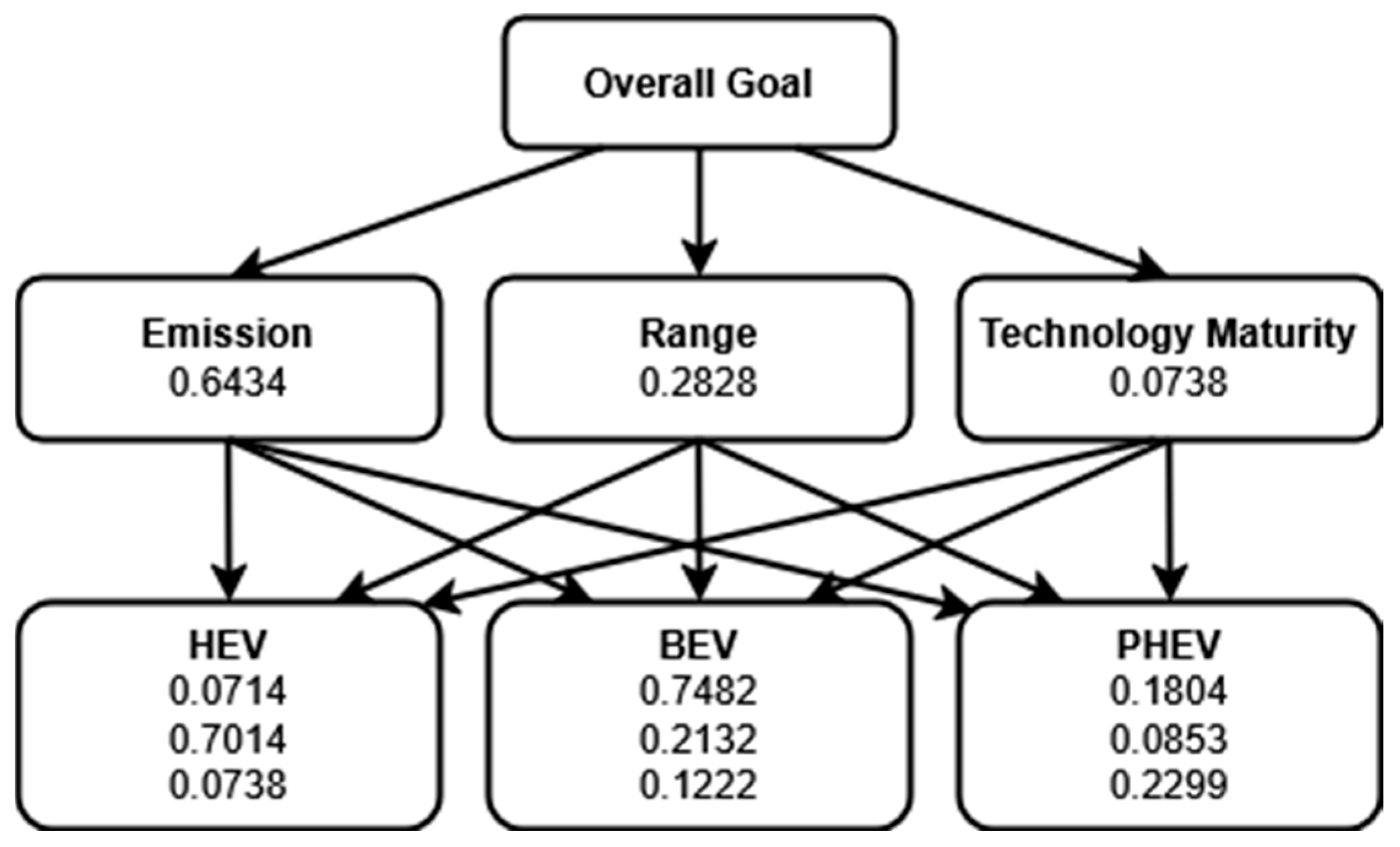
4], was used to quantify the relative importance of three decision criteria: emission, range, and technology maturity. Expert input was gathered through pairwise comparisons using a 1–9 scale, which captures the relative importance of each criterion. The structure of the AHP decision process is illustrated in
Figure 1.
The criteria were compared in pairs, and a normalized matrix was constructed. The weight vector was derived from this matrix using the principal eigenvector method. The process included consistency verification using the consistency ratio (CR). A resulting CR of 0.0564 confirmed that the judgments were consistent. These weights were then used to score the decision alternatives—HEV, BEV, and PHEV—under each criterion, and a final utility score for each alternative was calculated through weighted summation. These utility scores were used as coefficients in the LP objective function [
2,
4].
2.2. LP
The linear programming model was formulated to maximize objective value using the AHP-derived weights while satisfying operational, financial, and policy constraints. Let xi ∈ Z+ represent the number of vehicles of fuel type i ∈ {HEV, BEV, PHEV, BEV}. The model does not classify vehicles by size or type (e.g., MPV, pickup), focusing instead on optimizing the fuel technology mix.
2.2.1. Objective Function
The objective function is used to maximize the objective value and is calculated as the weighted sum of selected units for each fuel type.
such that
denotes the number of HEVs,
denotes the number of BEVs, and
denotes the number of PHEVs.
2.2.2. Constraints
To ensure feasibility, the following constraints were applied.
The integer linear programming model was solved using the branch and bound method to guarantee whole-number solutions and ensure compliance with the country’s fleet transition guidelines.
2.3. Assumptions and Cost Estimation
The Philippines’ 2025 baseline consists of 135 ICE vehicles. The optimization does not classify vehicles by type but focuses on the technology mix. The final fleet will combine HEV, BEV, PHEV, and ICE units. The number of BEVs ranges from 9, matching the number of charging stations available, to 54, assuming each station serves 2 BEVs per day and that each vehicle charges every 3 days without exceeding service limits. Annual fuel cost and repair and maintenance (R&M) budget caps are USD 140,000 and USD 103,000, respectively. The total procurement budget is USD 4.6 million.
Table 1 summarizes each fuel type’s assumed unit costs, fuel consumption, and R&M values.
3. Results
AHP was used to evaluate three AFV technologies: HEV, BEV, and PHEV. Expert judgments were elicited using a structured pairwise comparison matrix across three criteria: emission, range, and technology maturity. The resulting criteria weights were emission (0.6434), range (0.2828), and technology maturity (0.0738). Each alternative was then rated under these criteria. The resulting local priorities and weighted aggregation yielded the following overall scores: BEV = 0.5507, HEV = 0.2933, and PHEV = 0.1572.
This indicates that experts preferred BEVs due to their strong performance in emission reduction, while HEVs ranked second mainly due to their superior range. Though offering dual-fuel flexibility, PHEVs ranked lowest among the three alternatives due to a limited advantage in any criterion. This prioritization reflects similar applications of AHP in sustainable fleet planning, where emissions and operational reliability have been emphasized over cost in public sector decision frameworks [
2,
4].
Using the AHP-derived priority weights, an integer LP model was solved using the branch and bound method to determine the optimal number of HEVs, BEVs, PHEVs, and remaining ICE units. The objective was to maximize the objective value of the fleet while satisfying constraints on fleet size (135 vehicles), minimum AFV share (≥95), BEV limit (9 < BEV ≤ 54), and budget ceilings for fuel, procurement, and maintenance. The resulting objective value was 44.5050 with an optimal fleet mix consisting of the following: (1) BEVs: 54 units; (2) HEVs: 50 units; (3) PHEVs: 1 unit; and (4) ICEs: 30 units.
This configuration satisfies all policy and technical requirements. It achieves 77.78% AFV penetration, well above the 70% minimum threshold. The BEV count reached the upper bound limit of 54 units under a charging station’s capability assumption. Moreover, it can reach up to 70 units if the upper bound limit is removed. Each AFV technology was capped at 70% to retain diversity, leading to a balanced mix; BEVs were selected more frequently due to high AHP overall weight and compatibility with existing fuel infrastructure. This result supports earlier findings that hybrid decision models combining AHP and LP can balance qualitative sustainability criteria with quantitative operational constraints in fleet decision-making [
2].
4. Discussion
4.1. Preference Structure
The prioritization of emission reduction within the AHP framework reinforced alignment with the Philippines’ sustainability goals. The high weight assigned to the emission criteria ensured that technologies with lower environmental impact were structurally preferred, even when their costs or range performance were inferior. This mirrors global fleet decarbonization priorities and emphasizes the utility of integrating policy values into multi-criteria models. References [
2,
4] support this methodology, showing that decision-makers can rationalize technology selection beyond mere cost comparison when explicit environmental and operational priorities are made.
4.2. Strategic Role of Constraints
Accounting for the operational realities in the Philippines, the constraints were carefully chosen to represent these factors in the integer linear programming model. For instance, the BEV charger cap (a minimum of 9 units, which can go up to 54 units) greatly affected its deployment. If paired with expanded charging availability, a relaxed infrastructure constraint could theoretically yield a higher objective value—potentially raising it by 6.5%, based on a scenario with unrestricted BEV allocation. These trade-offs reflect the importance of infrastructure-readiness pacing policy ambition.
4.3. Utility and Replicability of AHP–LP
The integration of AHP and LP provided both methodological rigor and policy practicality. AHP reflected the nuanced judgments of experts in the industry, while LP translated those preferences into effective decisions under actual resource constraints. Moreover, each allocation decision could be correlated to explicit preferences and constraints. Also, the modular structure of the framework facilitates straightforward updating in the face of costs and technological or infrastructure changes. As a result, it is equally well-suited to strategic, long-term fleet planning and short-term budgeting. It can be modified by other public agencies seeking to introduce structured electrification plans. Additionally, the framework promotes policy feedback mechanisms. Its open design enhances continuous improvement through stakeholder feedback to provide a firm analytical foundation for institutional decision-making.
4.4. Limitations
While the model effectively determines a high-level technology mix, it does not disaggregate vehicles by class (e.g., sedan, multi-purpose vehicles, van, pickup). This limits its ability to inform logistics-specific planning or infrastructure deployment strategies. Additionally, the model uses static assumptions for cost, operation and management, and infrastructure, subject to fluctuations. Finally, AHP reflects a fixed stakeholder perspective; outcomes may shift with the participation of top management, domain experts, or other relevant decision-makers, as well as with changing priorities. Given these limitations, the framework still offers a valid and well-structured approach to optimizing fleet transitions under multiple constraints while also serving as a replicable tool for policy-aligned decision-making.
5. Conclusions
We developed the AHP–LP hybrid method to guide the Philippines’ transition toward a strategically optimized vehicle fleet. AHP was used to capture expert-based preferences across emissions, range, and technology maturity, producing a structured utility ranking of AFV technologies. These preferences were then operationalized through LP, which identified an objective value-maximizing mix of HEVs, BEVs, and PHEVs under budgetary, infrastructure, and policy constraints. The final fleet allocation surpassed the 70% AFV target while remaining fully compliant with resource and diversity limits.
The developed method’s advantage is its ability to link institutional objectives to quantitative planning mechanisms in a clear and defendable way. It is modular, flexible, and responsive to changing planning environments. The model provides a replicable decision-making aid for public agencies seeking greener initiatives by codifying value decisions and operating compromises. Future improvements may include a more detailed criteria evaluation, vehicle class type breakdown, and employing scenario and sensitivity analysis to improve the framework’s flexibility to changes in policy, costs, and infrastructure landscape.
Author Contributions
Conceptualization, methodology, validation, L.G.O.R., L.A.M.R., D.L.U. and Y.B.K.; formal analysis, L.G.O.R., D.L.U. and Y.B.K.; investigation, L.A.M.R. and D.L.U.; resources, L.A.M.R. and D.L.U.; writing—original draft preparation, L.G.O.R., L.A.M.R. and D.L.U.; writing—review and editing, L.G.O.R., L.A.M.R., D.L.U. and Y.B.K.; visualization, L.G.O.R.; supervision, Y.B.K.; project administration, Y.B.K. All authors have read and agreed to the published version of the manuscript.
Funding
This research received no external funding.
Institutional Review Board Statement
Not applicable.
Informed Consent Statement
Not applicable.
Data Availability Statement
The data used in this study are not publicly available due to limited access. Interested parties may obtain the data by contacting the corresponding author upon request and appropriate confirmation.
Conflicts of Interest
The authors declare no conflicts of interest.
References
- Varghese, A.M.; Pradhan, R.P. Roadmap for transitioning India’s privately owned bus fleets to electric fleets. Transp. Res. Part D Transp. Environ. 2025, 140, 104623. [Google Scholar] [CrossRef]
- Bai, C.; Fahimnia, B.; Sarkis, J. Sustainable transport fleet appraisal using a hybrid multi-objective decision-making approach. Ann. Oper. Res. 2016, 358, 691–715. [Google Scholar] [CrossRef]
- Cinar, A.P.; Eren, T. A large-scale integer linear programming to the daily fleet assignment problem: A case study in Turkey. In Proceedings of the 2019 International Conference Industrial Engineering and Operations Management, Bangkok, Thailand, 5–7 March 2019. [Google Scholar]
- Saaty, T.L. Decision making with the analytic hierarchy process. Int. J. Serv. Sci. 2008, 1, 83–98. [Google Scholar] [CrossRef]
- Behdani, B.; Mahdavi, M.R.; Cinar, A.P. Strategic public transport planning using multi-objective optimization: Application to a mixed-fleet scenario. In Proceedings of the IEEE International Conference Industrial Engineering and Engineering Management (IEEM), Singapore, 10–13 December 2017. [Google Scholar]
| Disclaimer/Publisher’s Note: The statements, opinions and data contained in all publications are solely those of the individual author(s) and contributor(s) and not of MDPI and/or the editor(s). MDPI and/or the editor(s) disclaim responsibility for any injury to people or property resulting from any ideas, methods, instructions or products referred to in the content. |