Skip to Content
Engineering ProceedingsEngineering Proceedings
  • Proceeding Paper
  • Open Access

6 March 2026

3D-Printed Antenna Arrays and Interconnects for Millimeter-Wave Applications †
,
,
,
,
,
and
1
School of Electrical and Electronic Engineering, University of Sheffield, Sheffield S1 3JD, UK
2
James Watt School of Engineering, University of Glasgow, Glasgow G12 8QQ, UK
*
Author to whom correspondence should be addressed.
Presented at the International Conference on Responsible Electronics and Circular Technologies (REACT 2025), Glasgow, UK, 11–12 November 2025.

Abstract

Additive manufacturing is transforming high-frequency electronics prototyping by offering a sustainable and cost-effective alternative to traditional methods. This work addresses and demonstrates two areas: the use of 3D printing for millimeter-wave (mmWave) antennas, and chip-to-chip or chip-to-PCB interconnects. Both approaches facilitate reduced material waste. A 47 GHz series-fed microstrip patch array was printed on flexible Kapton using aerosol jet technology, showing performance comparable to etched arrays on Roger’s substrates. Crucially, the Kapton film can be peeled off after testing, allowing the reuse of expensive low-loss substrates. Therefore, this method supports rapid, low-waste prototyping. To address future chip-to-chip and chip-to-PCB mmWave interconnect limitations, XTPL’s Ultra-Precise Dispensing (UPD) was used to fabricate 3D-printed micro-interconnects. At 73 GHz, these interconnect structures achieved return loss better than 10 dB and insertion loss under 1 dB—outperforming traditional bondwires. Together, these results show 3D printing’s potential to enable sustainable, high-performance mmWave RF systems.

1. Introduction

In the pursuit of ‘greener’ and more adaptable electronic systems, sustainable fabrication techniques have become central to next-generation millimeter-wave (mmWave) antenna development. Traditional lithographic and etching-based processes, while precise, are material-intensive, costly, producing hazardous chemical waste, and often non-reusable. In contrast, additive manufacturing (AM) and 3D-printing approaches enable low-waste production, rapid design iteration, and the reuse of high-value substrates—thereby aligning with the principles of sustainable electronics [1,2].
Microstrip patch antennas, known for their low profile, low cost, and planar integration, remain key candidates for mmWave front ends [3]. However, at high frequencies, achieving wide bandwidth, low side-lobe levels (SLLs), and stable radiation patterns requires careful feed network design and precise interconnect engineering. Series-fed architectures are particularly advantageous for AM because of their simplicity, reduced loss, and compatibility with flexible substrates [4,5]. This work presents a holistic study on sustainable 3D-printed antenna arrays and interconnect bonds, combining additive antenna fabrication with novel printed interconnection techniques to minimize waste and improve electrical performance. This paper is organized as follows: Section 2 outlines the 3D-printed antenna array design, Section 3 covers the integration of 3D-printed interconnect bonds, Section 4 discusses key findings, and Section 5 concludes the work.

2. Sustainable Design of a 3D-Printed Series-Fed Antenna Array

To explore low-cost and reusable fabrication methods for mmWave antennas, a prototype array was developed using a Kapton-based carrier and additive printing. A 47 GHz series-fed microstrip patch array was developed to evaluate additive fabrication for mmWave systems. The array comprises nine radiating elements, spaced approximately one guided wavelength (λg) apart to maintain in-phase excitation. Both the patch and feedline lengths were designed as 0.5λg, ensuring resonance and efficient coupling. To suppress side lobes, Dolph–Chebyshev amplitude tapering was applied, implemented by varying each patch width according to the corresponding taper coefficient [6,7]. Symmetrical geometry was maintained about the central element for pattern uniformity. Broadband impedance matching was achieved using a quarter-wavelength transformer. The antenna was fabricated on a Rogers RO4003C substrate (Rogers Corp., Chandler, AZ, USA) with parameters εr = 3.55, h = 0.5 mm, tan δ = 0.0027 and with copper metallization of conductivity 5.96 × 10⁷ S/m. The design was simulated using CST Studio Suite (Dassault Systèmes, Vélizy-Villacoublay, France), showing a reflection coefficient (|S11|) better than 10 dB across a 3 GHz bandwidth (45–48 GHz).
To validate the concept, two prototypes were fabricated:
  • A conventional etched array on Rogers 4003C;
  • A silver-printed array on Kapton film (DuPont, Wilmington, DE, USA) using Aerosol Jet Printing (AJP) system (Optomec, Albuquerque, NM, USA).
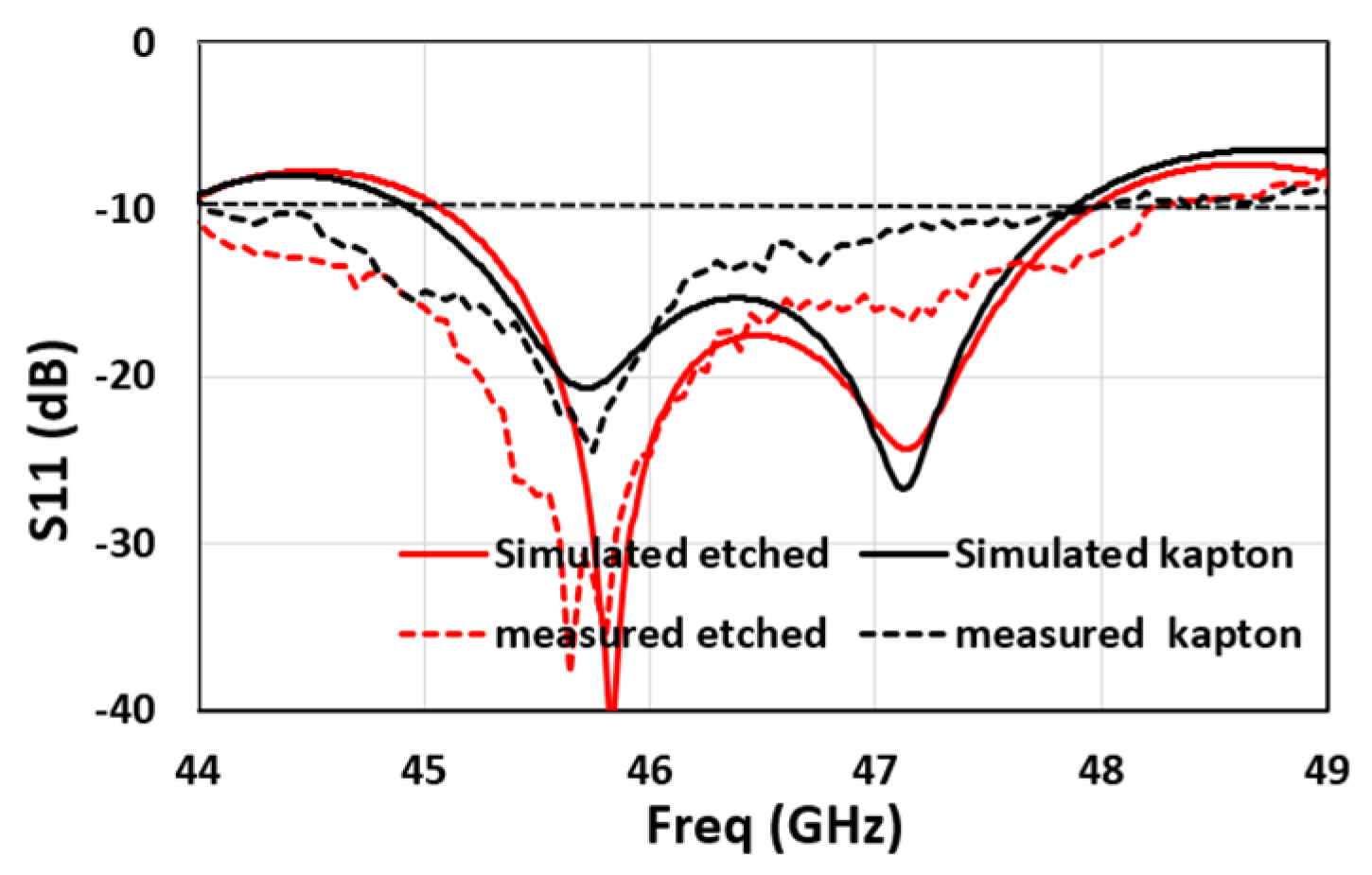
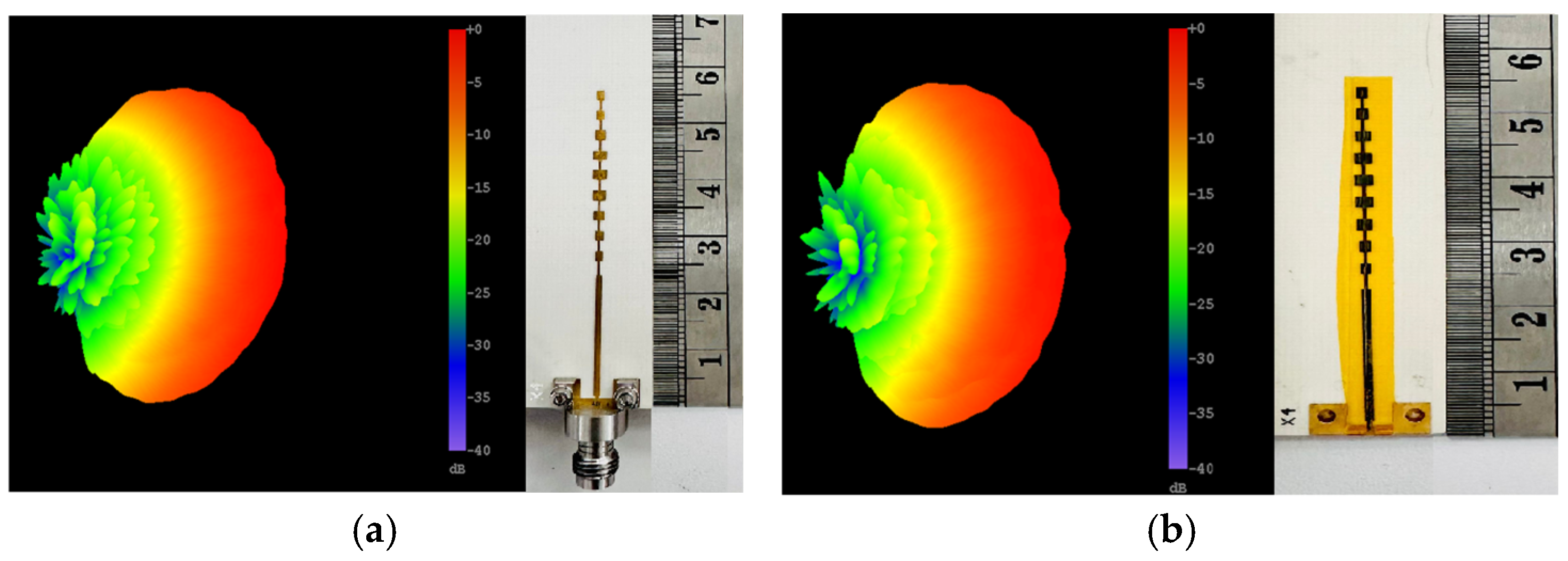
The printed Kapton film was self-adhesive, so it formed a laminate with the Rogers substrate, overall demonstrating mechanical flexibility and reusability. Measurements conducted at the University of Sheffield mmWave Laboratory [8] revealed comparable performance between the etched and AJP-based antennas. Measured S11 exhibits a slightly wider bandwidth compared to the simulation, as shown in Figure 1, where the horizontal dashed line indicates the −10 dB S11 bandwidth. The 3D radiation patterns of both prototypes are stable fan-shaped patterns with consistent gain over 45–49 GHz, as shown in Figure 2. Radiation efficiencies of 74 and 73% are obtained for etched and Kapton antenna, respectively. Slight deviations were attributed to minor irregularities in the Kapton attachment and printing process. These findings highlight that additively printed Kapton-based antennas can serve as sustainable, reconfigurable, and low-cost alternatives to conventional etched arrays [9]. The ability to replace or modify only the printed film—without discarding the substrate—enables substrate reuse and material circularity, making this approach ideal for rapid prototyping and scalable eco-electronic manufacturing.
Figure 1. Simulated and measured S11 of etched and Kapton antenna array.
Figure 2. Measured 3D pattern and fabricated prototype of (a) conventional etched antenna array and (b) proposed AJP Kapton antenna array.

3. Integration of 3D-Printed Interconnect Bonds

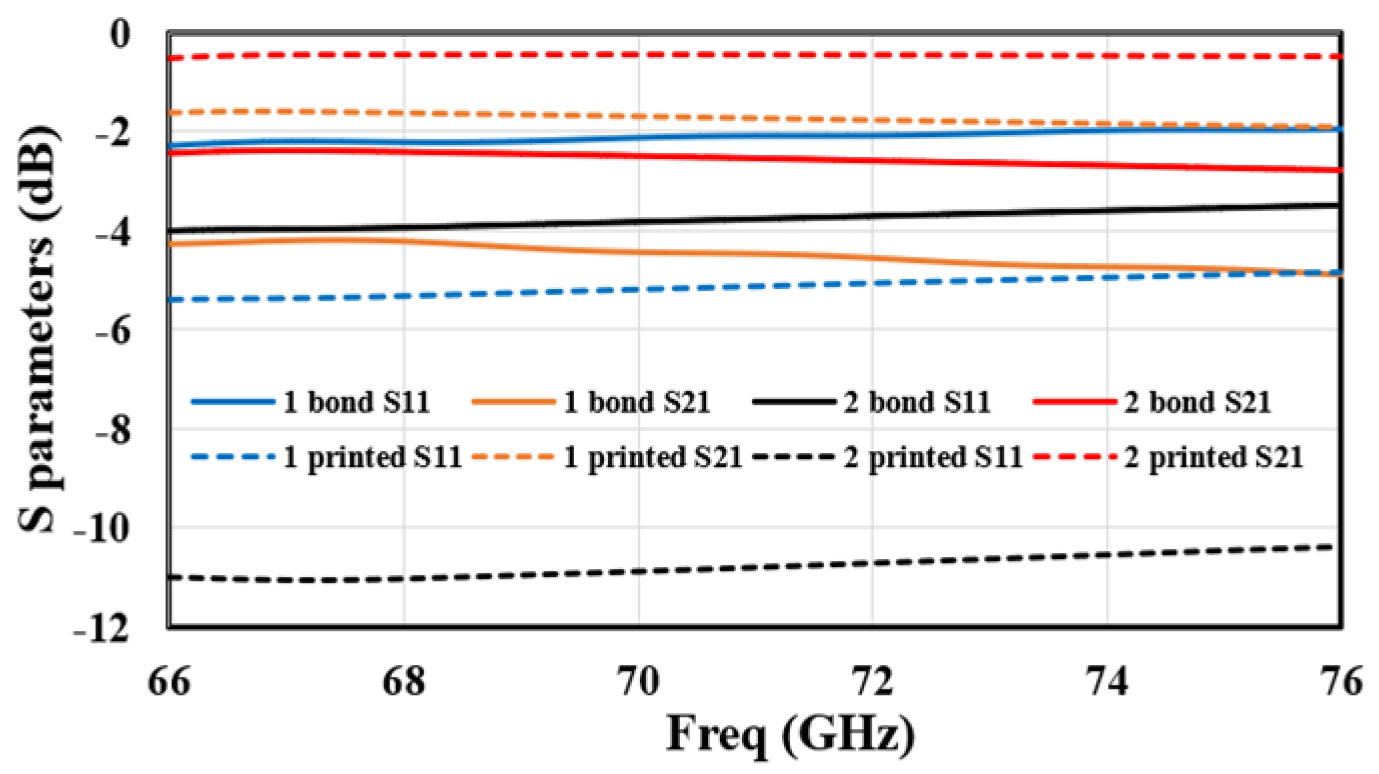
To further advance the sustainability and integration of high-frequency modules, this work also explores 3D-printed interconnect bonds as a replacement for traditional gold wire bonds. Conventional bond wires often suffer from high parasitic inductance, limited impedance control, and mechanical variability, which degrade performance at mmWave and E-band frequencies [10]. Here, the interconnects were fabricated using XTPL’s Ultra-Precise Deposition (UPD) system (XTPL S.A., Wrocław, Poland) at the University of Glasgow, which enables micron-scale control of free-standing metallic structures. This additive micro-fabrication process produces extremely short, accurately positioned conductive bridges between components—significantly reducing parasitic effects and enhancing signal integrity. The technique also offers high reproducibility and alignment precision, making it suitable for use in compact and repeatable mmWave packaging. Both single and double 3D-printed interconnect geometries were simulated to evaluate performance, as shown in Figure 3. The separation between the two pads is maintained at 320 µm and the overall length of bondwire is approximately 480 µm. The double-bond configuration exhibited superior impedance matching, achieving a simulated return loss (S11) of about −11 dB and insertion loss (S21) below 0.5 dB at 72 GHz—demonstrating a clear advantage over traditional wire bonds. The significantly reduced transmission loss eliminates the need for complex impedance-matching networks, simplifying circuit design and minimizing layout footprint.
Figure 3. Simulated S parameters of single and double bondwires and 3D-printed bonds.
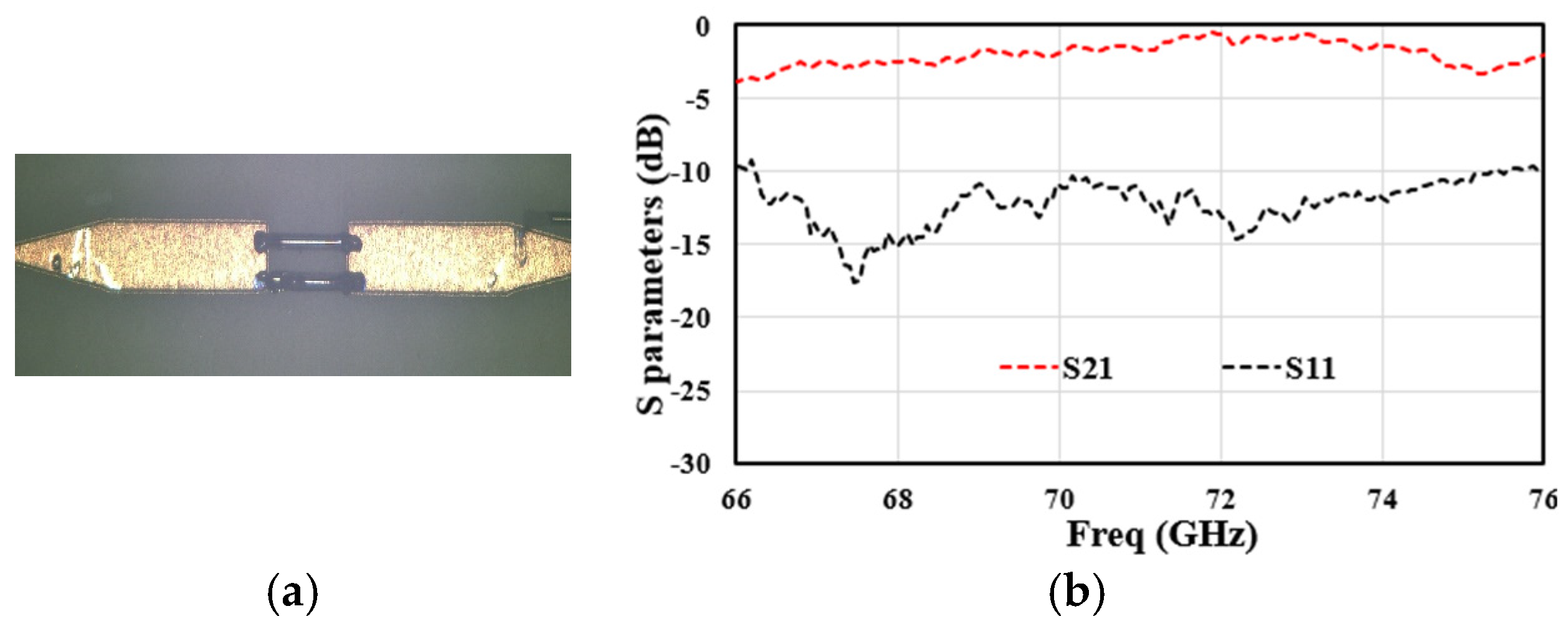
Additionally, physical prototypes of the double-bond structures were fabricated using silver ink via UPD, as shown in Figure 4a, and characterized at the UKRI Millimeter-Wave Measurement Laboratory, University of Sheffield [8], employing a Keysight PNA N5245B analyzer (Keysight Technologies, Santa Rosa, CA, USA) with WR15 VDI extenders (Virginia Diodes Inc., Charlottesville, VA, USA) and 100 µm GSG Picoprobes (GGB Industries, Inc., Naples, FL, USA). Measurements confirmed return losses better than –10 dB and insertion losses below 2 dB across the 69–74 GHz band, closely matching simulation results, as shown in Figure 4b. The 3D-printed interconnects also showed excellent dimensional uniformity and mechanical stability.
Figure 4. Double 3D-printed interconnects: (a) fabricated prototype; (b) measured S parameters.

4. Discussion and Implications

The combination of AJP-printed antenna arrays and UPD-based interconnects demonstrates a promising step toward fully additively manufactured mmWave front ends. This dual approach enables:
  • Substantial material savings and recyclability;
  • Reduced RF loss and parasitic impedance;
  • Simplified assembly and integration for compact modules;
  • Enhanced sustainability and reconfigurability in electronic hardware;
  • Reduced time to first prototype test and faster iteration.
By uniting additive antenna fabrication with precision 3D-printed interconnections, this methodology paves the way for environmentally responsible, high-performance electronics suitable for 5G/6G front ends, phased arrays, and radar applications. It highlights the emerging paradigm where sustainability and RF performance coexist through digital, additive manufacturing technologies.

5. Conclusions

This study presents an environmentally more sustainable and high-performance approach to mmWave hardware design through the use of 3D-printed antenna arrays and interconnect bonds. The findings confirm that both the AJP-based Kapton on substrate antenna arrays and UPD-fabricated interconnects offer comparable—or even superior—electrical characteristics to traditional etched and bonded structures, while drastically improving manufacturing flexibility, cost-efficiency, and substrate reusability. Such additive fabrication techniques are poised to transform the landscape of high-frequency packaging, assembly and prototyping—leading to a new generation of eco-efficient, modular, and reconfigurable wireless systems.

Author Contributions

Conceptualization, S.D.J., E.A.B., J.R.W. and J.K.; methodology, S.D.J., E.A.B., B.D., M.D., J.R.W. and J.H.; validation, S.D.J. and E.A.B.; writing—original draft preparation, S.D.J.; writing—review and editing, E.A.B. and J.K.; supervision, E.A.B.; funding acquisition, E.A.B. and J.R.W. All authors have read and agreed to the published version of the manuscript.

Funding

This research was funded by UK Defence and Security Accelerator, under Award ACC6022436 and UKRI, grant number MR/T043164/1.

Institutional Review Board Statement

Not applicable.

Data Availability Statement

The raw data supporting the conclusions of this article will be made available by the authors on request.

Conflicts of Interest

The authors declare no conflict of interest.

References

  1. Wang, J.C.; Dommati, H.; Hsieh, S.J. Review of additive manufacturing methods for high-performance ceramic materials. Int. J. Adv. Manuf. Technol. 2019, 103, 2627–2647. [Google Scholar] [CrossRef]
  2. Singh, N.; Singh, G. Advances in polymers for bio-additive manufacturing: A state of art review. J. Manuf. Process 2021, 72, 439–457. [Google Scholar] [CrossRef]
  3. Al-Alem, Y.; Kishk, A.A. Efficient millimeter-wave antenna based on the exploitation of microstrip line discontinuity radiation. IEEE Trans. Antennas Propag. 2018, 66, 2844–2852. [Google Scholar] [CrossRef]
  4. Joseph, S.D.; Ball, E.A. Series-Fed Millimeter-Wave Antenna Array Based on Microstrip Line Structure. IEEE Open J. Antennas Propag. 2023, 4, 254–261. [Google Scholar] [CrossRef]
  5. Yuan, T.; Yuan, N.; Li, L.-W. A novel series-fed taper antenna array design. IEEE Antennas Wirel. Propag. Lett. 2008, 7, 362–365. [Google Scholar] [CrossRef]
  6. Yuan, T.; Li, J.-Y.; Li, L.-W.; Zhang, L.; Leong, M.S. A novel series-fed taper antenna array design and analysis. In Proceedings of the 2005 Asia-Pacific Microwave Conference (APMC), Suzhou, China, 4–7 December 2005. [Google Scholar]
  7. Wahid, M.S.A.; Sreenivasan, M.; Rao, P.H. Design optmization of low sidelobe level microstrip array. In Proceedings of the 2013 IEEE Applied Electromagnetics Conference (AEMC), Bhubaneswar, India, 18–20 December 2013. [Google Scholar]
  8. The National mmWave Measurement Laboratory. Available online: https://www.sheffield.ac.uk/mm-wave (accessed on 20 February 2026).
  9. Joseph, S.D.; Davies, B.; Davies, M.; Ball, E.A.; Willmott, J.R. Additive manufacturing on kapton substrate for rapid prototyping of low-cost mmWave antennas. IEEE Open J. Antennas Propag. 2025, 6, 1717–1727. [Google Scholar] [CrossRef]
  10. Xue, H. Numerical solution for accurate bondwire modeling. IEEE Trans. Semicond. Manuf. 2018, 31, 258–265. [Google Scholar] [CrossRef]
Disclaimer/Publisher’s Note: The statements, opinions and data contained in all publications are solely those of the individual author(s) and contributor(s) and not of MDPI and/or the editor(s). MDPI and/or the editor(s) disclaim responsibility for any injury to people or property resulting from any ideas, methods, instructions or products referred to in the content.

Article Metrics

Citations

Article Access Statistics

Multiple requests from the same IP address are counted as one view.