Abstract
Traditionally, harmonic RADAR has tracked insects using a non-linear diode tag, illuminated by an extremely high-power (up to 20 kW) radio signal. This work introduces a battery-less, semiconductor-free passively modulating tag that operates with low incident power and stands out against clutter. This metamaterial-inspired tag is unique, using an animal’s movement to vary its resonant frequency and modulating the backscattered signal for enhanced detection. This means that the tag does not require its own power source, while still allowing inference about the subject’s behaviour. It consists of two coupled elements; the resonant scattering frequency is defined by the angle between them. This tag can be manufactured easily since it consists solely of two substrates and copper tracks. At a 0° angle, the tag is modelled and measured with an RCS of −31 dBsm at 3.6 GHz (50 dB greater than a bee), and its frequency tunes from 3.75 to 3.95 GHz over the angle variation.
1. Introduction
As a result of human activities, ecosystems worldwide are experiencing a large decrease in insect pollinators. Insects are responsible for pollinating 87.5% of angiosperms, 70% of tropical trees, and 30–40% of temperate trees. Without insect pollinators, these may not be able to reproduce as well, which could lead to ecosystem collapse [1]. What is more, the number of plants dependent on insect pollination is far larger in lower-income countries; since plants such as cocoa and soy are pollinated heavily by insects, the cultivation of these plants is relied on heavily by these countries’ economies [2]. A method to stop the decline of pollinators is tracking.
Historically, harmonic RADAR was commonly used to track insects. This system entailed a RADAR transceiver and a harmonic tag consisting of an antenna loaded with a diode. The transmitter would send out a signal of frequency f, which would excite the tag and induce a rectified harmonic-rich current. This harmonic (particularly at 2f) would then be re-radiated into space and detected by the receiver. This removes unwanted clutter from RADAR processing, as the only source of the 2f signal is the tag. Whilst harmonic RADAR allowed for a high range (100 s of metres), the peak power was around 20 kW due to poor and non-linear up-conversion efficiencies [3]. Further, this involved releasing the semiconductor device into the environment with no guarantee of clean-up being feasible. Contemporary methods include computer vision (CV) and radio frequency identification (RFID), which have high accuracies but low ranges, as well as large carbon footprints. In the case of CV, the processing power required sometimes even requires separate cooling units [4]. Whilst using lower duty cycles in RFID reduces the power consumption [5], RFID requires many integrated circuits (ICs) on the tag. Not only do these increase the weight of the tag since a battery is required, but the carbon footprint also increases greatly since an IC is one of the worst polluters in electronics [6]. Again, there is no guarantee of tag retrieval, meaning that these ICs are often discarded in the natural environment.
The purpose of up-conversion to the second harmonic in harmonic RADAR was to increase the detectability against other reflections. However, a modulated signal also introduces a frequency shift, performing the same function without non-linear semiconductor devices. SoDAR was introduced as a method of insect tracking accidentally, since the wingbeats of insects known to be in the area were detected due to the motion modulating the reflected signal [7]. This wingbeat analysis has been used in recent times with LiDAR [8], and not only does this allow for greater detectability, but it also allows for behavioural analysis. However, wingbeat modulation is a tiny effect that requires the wavelength to be within a similar magnitude as the insect, while insect pollinators are typically smaller than RF wavelengths. This paper proposes a resonant tag with a high radar cross-section (RCS), which could be tuned by the wingbeat action, causing modulation of the signal and making it much more visible to the receiver.
Many methods of mechanical tuning have been used, including stretching of dielectric resonators [9] and slot antennas [10], turning of tuning screws to alter the electric shape [11], rotations of tuning flaps [12], and Venetian blind-inspired designs [13]. By using the mechanical motion of the insect, the need for batteries and ICs would be circumvented, reducing the environmental impact of the scatterer over its lifetime.
This conference paper presents a tuneable battery-less and semiconductor-free tag that is lightweight and of small physical dimensions. When implemented on a small insect, this could produce a strong, modulated backscatter signal, allowing low-power RADAR to track and classify insect behaviour over a wide area. The tag is a new form of a battery-less and semiconductor-free sensor which could be fabricated with entirely biodegradable or recyclable substrates and conductors, representing a significant advance in the sustainability of insect tracking tags.
2. Materials and Methods
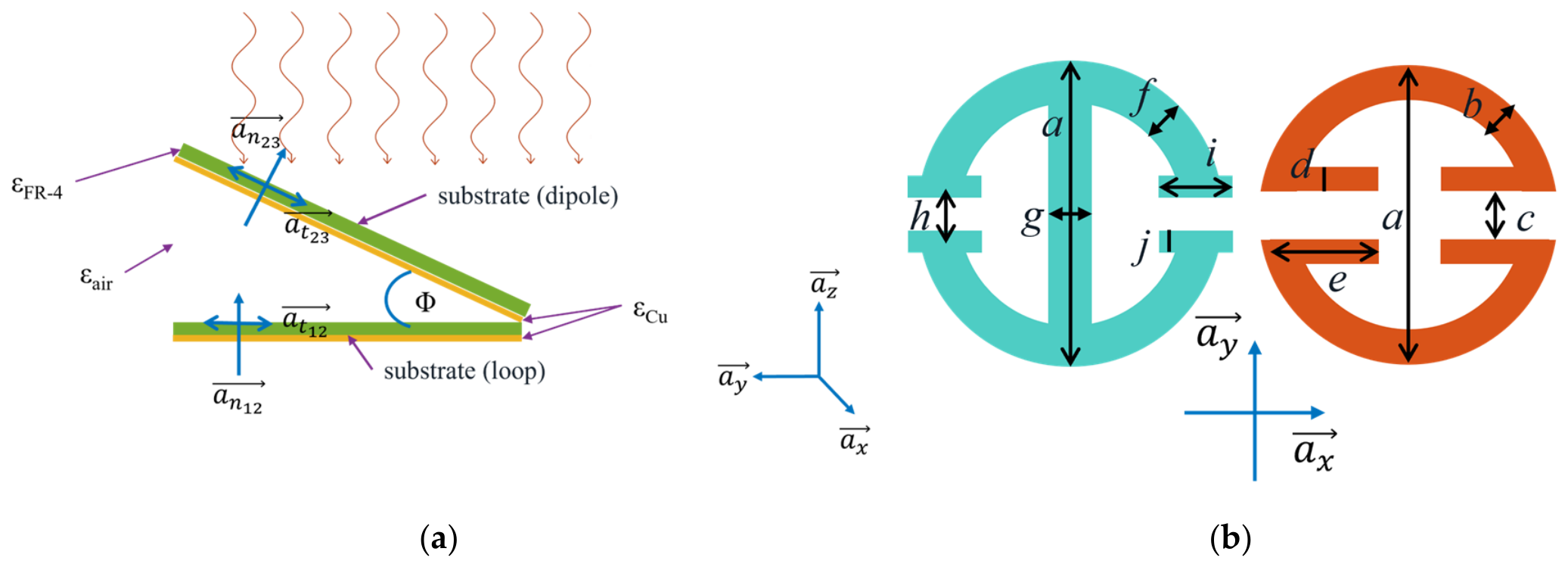
The proposed tag is tuned by changing the angle between two components of a Huygens scatterer [14]. A Huygens scatterer contains both an electric element (dipole) and a magnetic element (loop) and is well studied as a type of electrically small antenna or scatterer. By changing the angle, the coupling between the electric and magnetic elements is changed, causing a shift in resonant frequency. A visual representation is shown in Figure 1a. A wingbeat causes a displacement in the air, which can in turn displace a lightweight film. To allow for this movement, the tag would be placed between the wings on the thorax of a bumblebee, with the y-axis of the tag pointing upwards away from the bee.
Figure 1.
(a): Method of tuning: by varying Φ, a range of resonant frequencies can be obtained. (b): The geometry of copper tracks on the scatterer.
The design was inspired by the well-studied combination of an Egyptian axe electric dipole element with a capacitively loaded loop magnetic element [14]. To be suitable for a bee thorax, the design was 1 cm × 1 cm in area. Fringes (dimensions i and j in Figure 1b) were added to the electric dipole as a means of increasing the linkage within the magnetic loop. The dimensions of the tag are shown in Table 1.
Table 1.
Dimensions of the scatterer in Figure 1b.
The loop was designed on a piece of 50 µm thick polyimide (εr = 3.5, tan δ = 0.0027), whereas the dipole was simulated on lossy FR-4 (εr = 4.3, tan δ = 0.025) of 1.2 mm thickness. In the simulation, probes were placed at (0,0,100), measuring the absolute RCS as well as the co-polar () electric far field. The plane wave used was polarised in , and adaptive mesh refinement was used such that the adaptation would cease when the probe values were within 0.05 of each other. The angle between the elements (Φ) was swept between 0° and 10° to allow for the sensitivity and proof of concept to be tested. Note that this is not necessarily correlated with the displacement that would be caused by an insect wingbeat.
3. Results and Discussion
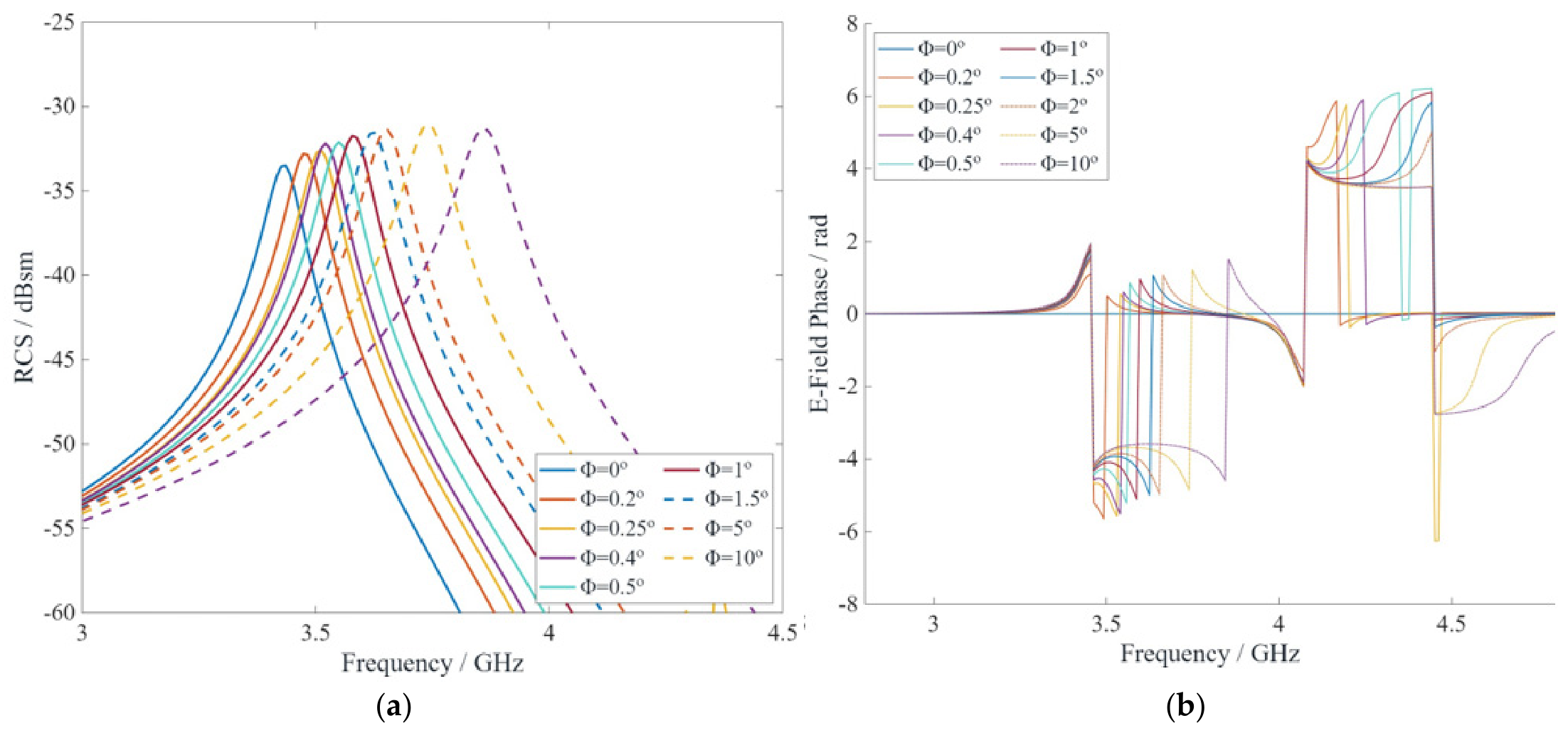
It is shown in Figure 2a that an increase in the angle Φ results in a higher resonant frequency, and the RCS at the resonant frequency also increases. When there is an angle of Φ = 0°, the resonant frequency and RCS are 3.43 GHz and 33.6 dBsm. From Φ = 0° to Φ = 1.5°, there is a similar change in resonant frequency as there is between Φ = 0.5° and Φ = 10°, showing that the scatterer is most sensitive to tuning in very small angles (the change is non-linear). When Φ = 10°, the resonant frequency is 3.86 GHz and has an RCS of 31.3 dBsm. In Figure 2b, from 3.45 GHz to 3.85 GHz, there is a large amount of phase splitting, where, as the angle increases, the bandwidth of the negative phase also increases. When Φ = 0.2°, the bandwidth is 28 MHz, whereas when Φ = 10°, the bandwidth is 200 MHz. There is also similar behaviour from 4.18 GHz to 4.45 GHz in the positive direction. This shows that the tag could also produce phase modulation as well as amplitude modulation.
Figure 2.
Simulations of angle variation: (a) RCS profile. (b) Phase shift in ay normalised to Φ = 0°.
4. Conclusions
This article has explored the mechanical modulation of RADAR tags to increase the detectability of insect pollinators whilst avoiding the use of semiconductor devices that have a large carbon footprint and would be released into the environment when performing field trials. Simulation validation has been used to good effect to ensure more confident design results. Mechanical tuning at static angles was performed, showing a shift in resonant frequency, especially in the region of 0–10°. Future work should fabricate and measure the tags, perform mechanical modulation, and finally implement the results in field trials. The work could also be extended with biodegradable substrates and conductors.
Author Contributions
Conceptualization, R.F.B., K.L.F. and S.D.H.; methodology, R.F.B., K.L.F. and S.D.H.; software, R.F.B.; validation, R.F.B., K.L.F. and S.D.H.; formal analysis, R.F.B., K.L.F. and S.D.H. investigation, R.F.B., K.L.F. and S.D.H.; resources, K.L.F. and S.D.H.; data curation, R.F.B., K.L.F. and S.D.H.; writing—original draft preparation, R.F.B.; writing—review and editing, R.F.B., K.L.F. and S.D.H.; visualization, R.F.B.; supervision, K.L.F. and S.D.H.; project administration, S.D.H.; funding acquisition, S.D.H. All authors have read and agreed to the published version of the manuscript.
Funding
This work is supported by an EPSRC Doctoral Landscape Award.
Institutional Review Board Statement
Not Applicable.
Informed Consent Statement
Not Applicable.
Data Availability Statement
Data for this investigation is not available due to continuing analysis.
Conflicts of Interest
The authors declare no conflict of interest.
References
- Neuschulz, E.L.; Mueller, T.; Schleuning, M.; Böhning-Gaese, K. Pollination and Seed Dispersal Are the Most Threatened Processes of Plant Regeneration. Sci. Rep. 2016, 6, 29839. [Google Scholar] [CrossRef] [Scilit] [PubMed]
- Aizen, M.A.; Garibaldi, L.A.; Cunningham, S.A.; Klein, A.M. How Much Does Agriculture Depend on Pollinators? Lessons from Long-term Trends in Crop Production. Ann. Bot. 2009, 103, 1579–1588. [Google Scholar] [CrossRef] [Scilit] [PubMed]
- Riley, J.; Smith, A. Design Considerations for an Harmonic RADAR to Investigate the Flight of Insects at Low Altitude. Comput. Electron. Agric. 2002, 35, 151–169. [Google Scholar] [CrossRef] [Scilit]
- Bjerge, K.; Mann, H.M.R.; Høye, T.T. Real-time Insect Tracking and Monitoring with Computer Vision and Deep Learning. Remote Sens. Ecol. Conserv. 2021, 8, 315–327. [Google Scholar] [CrossRef] [Scilit]
- Kumari, M.; Bhattacharyya, B.K.; Hasan, S.M.R. First Ever Lowest Duty Cycle for Periodic Burst Mode Signals for Insect Telemeter Package Design. IEEE Trans. Compon. Packag. Manuf. Technol. 2019, 9, 2006–2015. [Google Scholar] [CrossRef] [Scilit]
- Wagih, M.; Bainbridge, A.; Alsulami, B.; Kettle, J. Environmental Life-Cycle Assessment (LCA) of Wireless RF Systems: A Comparative Sustainability Analysis and a Microwave Engineers’ Guide to LCA. IEEE J. Microw. 2024, 4, 987–1000. [Google Scholar] [CrossRef] [Scilit]
- Kallistratova, M.A.; Petenko, I.V.; Kouznetsov, R.D.; Kulichkov, S.N.; Chkhetiani, O.G.; Chunchusov, I.P.; Lyulyukin, V.S.; Zaitseva, D.V.; Vazaeva, N.V.; Kuznetsov, D.D.; et al. SoDAR Sounding of the Atmospheric Boundary Layer: Review of Studies at the Obukhov Institute of Atmospheric Physics, Russian Academy of Sciences. Izv. Atmos. Ocean. Phys. 2018, 54, 242–256. [Google Scholar] [CrossRef] [Scilit]
- Lu, J.; Li, Y.; Yuan, Y.; Zhu, S.; Duan, Z.; Zhao, G.; Svanberg, S. Monitoring of Flying Insects Using a Dual-Wavelength CW LiDAR System. In Proceedings of the Asia Communications and Photonics Conference (ACPC) 2019; Optica Publishing Group: Washington, DC, USA, 2019; p. M4A.4. [Google Scholar]
- Sheen, J. A dielectric resonator method of measuring dielectric properties of low loss materials in the microwave region. Meas. Sci. Technol. 2008, 19, 055701. [Google Scholar] [CrossRef] [Scilit]
- Jamaluddin, M.I.; Zainal Abidin, I.S.; Aziz, A.A.; Riduwan Ramli, M. Investigating the Effects of Mechanical Strain on the Performance of Stretchable Microstrip Slot Antenna at mmWave. In Proceedings of the 2024 IEEE Asia-Pacific Conference on Applied Electromagnetics (APACE), Langkawi, Malaysia, 21–23 December 2024; pp. 389–392. [Google Scholar] [CrossRef] [Scilit]
- Sanchez-Olivares, P.; Masa-Campos, J.L.; Muriel-Barrado, A.T.; Villena-Medina, R.; Fernandez-Romero, G.M. Mechanically Reconfigurable Linear Array Antenna Fed by a Tunable Corporate Waveguide Network with Tuning Screws. IEEE Antennas Wirel. Propag. Lett. 2018, 17, 1430–1434. [Google Scholar] [CrossRef] [Scilit]
- Collado, A.; Mira, F.; Georgiadis, A. Mechanically Tunable Substrate Integrated Waveguide (SIW) Cavity Based Oscillator. IEEE Microw. Wirel. Compon. Lett. 2013, 23, 489–491. [Google Scholar] [CrossRef] [Scilit]
- Ferreira, D.; Cuiñas, I.; Caldeirinha, R.F.S.; Fernandes, T.R. 3-D Mechanically Tunable Square Slot FSS. Antennas Propag. 2017, 65, 242–250. [Google Scholar] [CrossRef] [Scilit]
- Jin, P.; Ziolkowski, R.W. Metamaterial-Inspired, Electrically Small Huygens Sources. IEEE Antennas Wirel. Propag. Lett. 2010, 9, 501–505. [Google Scholar] [CrossRef] [Scilit]
Disclaimer/Publisher’s Note: The statements, opinions and data contained in all publications are solely those of the individual author(s) and contributor(s) and not of MDPI and/or the editor(s). MDPI and/or the editor(s) disclaim responsibility for any injury to people or property resulting from any ideas, methods, instructions or products referred to in the content. |
© 2026 by the authors. Licensee MDPI, Basel, Switzerland. This article is an open access article distributed under the terms and conditions of the Creative Commons Attribution (CC BY) license.