Proceeding Paper

Component Recycling in Chipless Devices for Low-Cost, Circular Wireless Temperature Sensors †
Green RF-Enabled Electronics Lab, James Watt School of Engineering, University of Glasgow, Rankine Building, Oakfield Avenue, Glasgow G12 8LT, UK
*
Author to whom correspondence should be addressed.
Presented at the International Conference on Responsible Electronics and Circular Technologies (REACT 2025), Glasgow, UK, 11–12 November 2025.
Eng. Proc. 2026, 127(1), 18; https://doi.org/10.3390/engproc2026127018
Published: 30 March 2026

Abstract

With the rapid development of smart devices for body area networks and smart packaging, there is a significant demand for low-waste and low-impact electronic systems in industries such as healthcare and transportation. We demonstrate that the dielectric material from capacitors in resistor-inductor-capacitor (RLC) wireless, chipless, resonant temperature sensors can be successfully recovered from flexible PCBs, with pristine sensors re-introduced to the tag’s sensor loading. First, we demonstrate that replacing the dielectric in a parallel plate capacitor with a pristine component, with recycled electrodes and sub-miniature-A (SMA) adaptor, results in only a 3% change in broadband capacitance. An identical substitution of the sensing element in an RLC circuit tuned to resonate at 21.0 MHz, with recycled parallel plates, a resistor, and an inductive PCB coil, results in a change of only 7.6% in the resonant frequency of the tag to 19.4 MHz. This work demonstrates the recyclability of chipless tags for temperature sensing for the first time, offering sustainability gains in smart packaging applications, with the potential to be expanded to other sensing tags for pH, humidity, and chemical analytes, towards chipless product passports.

1. Introduction

With the rapid development of smart devices for body area networks and smart packaging, there is a significant demand for lightweight and conformable electronic devices, which can transmit or receive large quantities of data in industries such as healthcare and transportation [1]. However, the fabrication of these devices at industrial scales results in significant emissions and waste electrical and electronic equipment (WEEE), less than 20% of which is recycled in the United Kingdom [2]. In conventional antenna and radio frequency identification (RFID) devices, a key source of emissions is from the manufacturing of chips [3], which requires a substantial number of processing steps, including photolithography and etching. A recent life cycle assessment (LCA) by our group demonstrated that a 90 nm IC chip accounts for more than five times the global warming potential of all the other components combined [4]. Therefore, a transition from chipped devices for wireless communications and sensor networks is needed to reduce the burden of WEEE and emissions produced by the global semiconductor industry.
Chipless RFID has been proposed as an alternative to traditional RFID in the transition to low-waste and sustainable systems, primarily since it does not rely on microfabricated chips [5,6]. A recent life cycle assessment (LCA) of chipless RFID compared to UHF RFID estimated that chipless tags require over 10 times less water use, and result in both less critical minerals depletion and a two-thirds reduction in global warming potential [3]. Such tags are underpinned by printed circuit board (PCB) technology, which is typically not directly re-usable due to their composition, as they typically contain brominated flame retardants, which are challenging to separate [7]. Flexible PCBs (FPCBs) are an alternative commercial PCB technology that enables lightweight, wearable, and conformable electronics [8]. However, FPCBs are typically fabricated on polyimide (PI) substrates, which are challenging to recycle due to their chemical composition, increasing the burden of WEEE [9]. Some studies have explored the transformation of PI substrates into high-value products such as activated carbon [10,11] and flame-retardant polyesters [12].
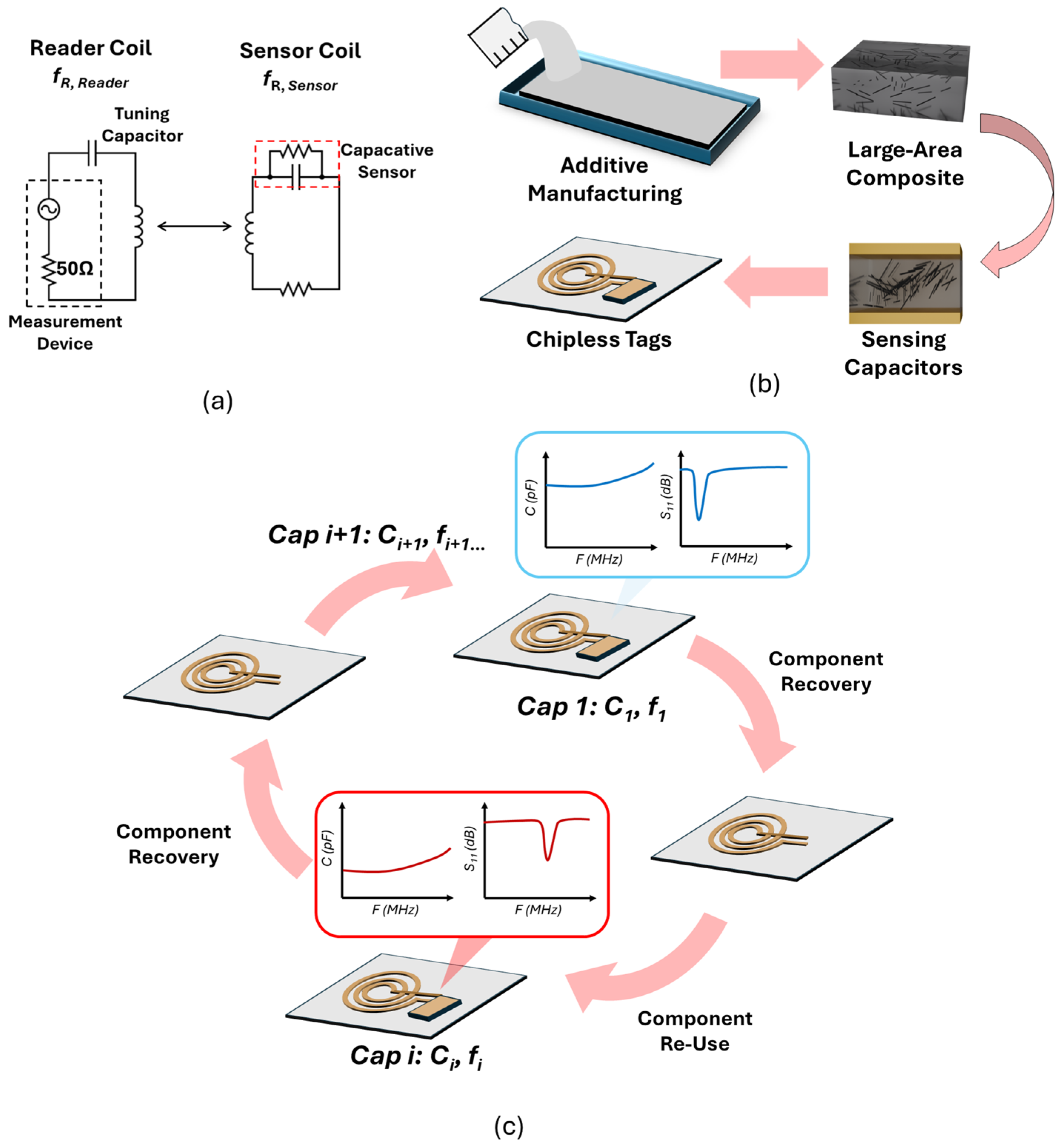
We recently developed chipless electromagnetic temperature sensors on a flexible PCB, which outperform state-of-the-art radio-frequency temperature sensors [13]. To date, the recovery and redeployment of flexible PCBs have not been explored, which will be critical for diverting additional WEEE from landfill. To address this, we fabricated chipless circuits on flexible PCB using additively manufactured conductor-loaded dielectrics (Figure 1a) for passive, wireless sensors, and investigated the recovery and redeployment of the flexible PCB substrate and coil with pristine sensing tags. The composites were fabricated with pristine polydimethylsiloxane (PDMS) or PDMS loaded with milled carbon fiber (PDMS–CF) using a mould (Figure 1b), with capacitors fabricated by placing the composite between copper tape. PDMS–CF was selected as one of the fillers since it has been shown to enhance the temperature sensitivity of the tags in the range of 20–60 °C. We then completed the fabrication of the circuit by connecting capacitors in series with a 50 Ω resistor and a 5 cm, 10-turn inductive coil.

2. Materials and Methods

2.1. Materials

Milled carbon fiber powder (D = 7.5 µm, L = 100 µm, FP-MCF-004) was purchased from Easy Composites (Stoke on Trent, UK). SYLGARD 184 Silicone Elastomer Kit, including polydimethylsiloxane (PDMS) and curing agent, was purchased from Farnell (Leeds, UK); the materials’ properties were previously investigated mechanically and electrically [14]. PI FPCBs with a 25-µm-thick PI layer and 12-μm-thick copper tracks were purchased from JLCPCB (Shenzhen, China).

2.2. Capacitor Fabrication

A composite with 10 wt% CF was fabricated according to the literature procedures [13]. First, the requisite mass fraction of PDMS and filler is loaded into a beaker and stirred until combined. Next, the PDMS curing agent is added in a ratio of 1 part catalyst to 10 parts PDMS by volume and stirred until combined. The resulting mixture was degassed in a glass desiccator for 30 min to remove air bubbles. The composite was cast into a glass petri dish, allowed to settle and degassed for an additional 10 min prior to being loaded into an oven where it was cured at 100 °C for 1 h. Finally, parallel plate capacitors were fabricated by cutting out rectangular sections of the composite and placing them between two pieces of conductive copper tape. The capacitor was then connected to a sub-miniature-A (SMA) RF Connector by soldering signal and ground pins directly onto the copper tape.

2.3. Capacitor Characterization

The capacitor samples were characterized using a Vector Network Analyzer (VNA) from Pico Technology (Eaton Socon, UK, PicoVNA 106, covering 300 kHz–6 GHz) connected to a phase-stable Mini-Circuits CBL-1.5M-SMSM+ cable (L = 1.5 m) and a braided copper cable (L = 15 cm). The VNA was calibrated using a full two-port Short, Open, Load, Through (SOLT) traceable calibration kit (TA345 SOLT-STD-F). The capacitance was extracted from the reflection coefficient (S11) data using Equation (1)
C = 1 I m { Z } · 2 π f ,
where Im{Z} is the imaginary component of the measured complex impedance, and f is the frequency. At lower frequencies, it can be assumed that the parasitic inductance is not significant below the self-resonant frequency, where there is a transition between capacitance being dominant and inductance being dominant [15].

2.4. LC Resonant Circuit Characterization

A passive sensor tag was fabricated by integrating a PDMS–CF capacitor with an area of 4 cm2 (4 cm length by 1 cm width) into an LC circuit. The coils have trace widths of 0.7 mm, with separation distances of 1 mm. The resonant frequency (f) of the LC network changes in response to capacitance according to Equation (2), where L is the inductance, and C is the capacitance of the circuit.
f = 1 2 π L C

3. Results and Discussion

3.1. Recycling of PDMS–CF Capacitors

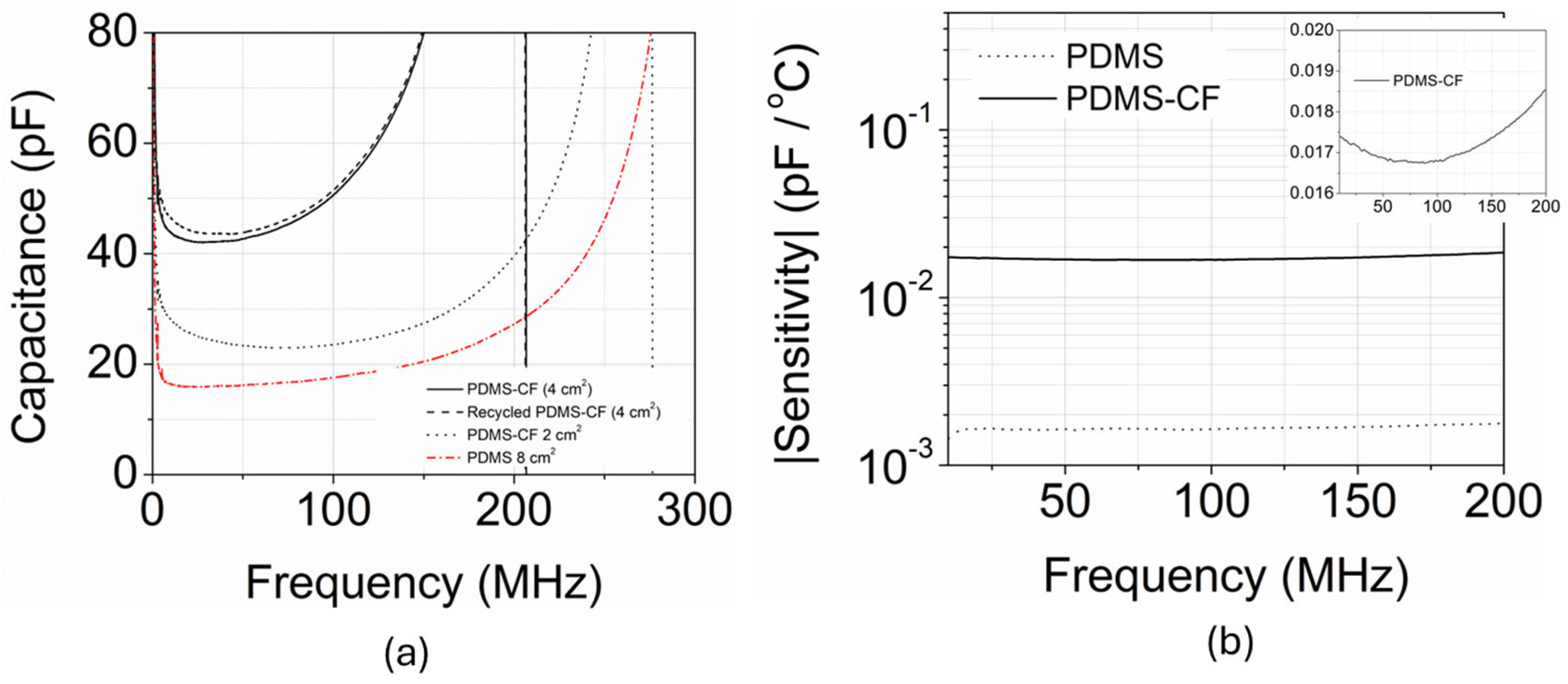
The PDMS–CF parallel plate capacitors (Figure 2a) were characterized using a VNA from 300 kHz to 300 MHz to establish a baseline performance for capacitors sized from 2 to 4 cm2 and to confirm that the performance of the material is consistent and scales with area. The areal capacitance of PDMS–CF capacitors is 22 pF/cm2, which is consistent with our previous report [13]. Following initial measurement of the 4 cm2 capacitor, we disassembled the device and redeployed the electrodes and SMA with a pristine 4 cm2 block of PDMS–CF and recharacterized it under identical conditions (Figure 2a, black dashed line). The difference in capacitance between assemblies is almost negligible, demonstrating that components, including the copper electrodes, can be recycled and redeployed.
The broadband temperature sensitivity of a pristine PDMS capacitor and a PDMS–CF capacitor is evaluated between 20 and 60 °C in Figure 2b, which is where the increase in capacitance is approximately linear with temperature. The addition of the conductive carbon fiber filler results in a sensitivity enhancement of the sensor to temperature that is near-frequency-independent up to its self-resonant frequency, demonstrating that these sensors have a broad frequency operating range as one-port devices.

3.2. Recycling and Re-Use of FlexPCB in LC Resonant Circuits

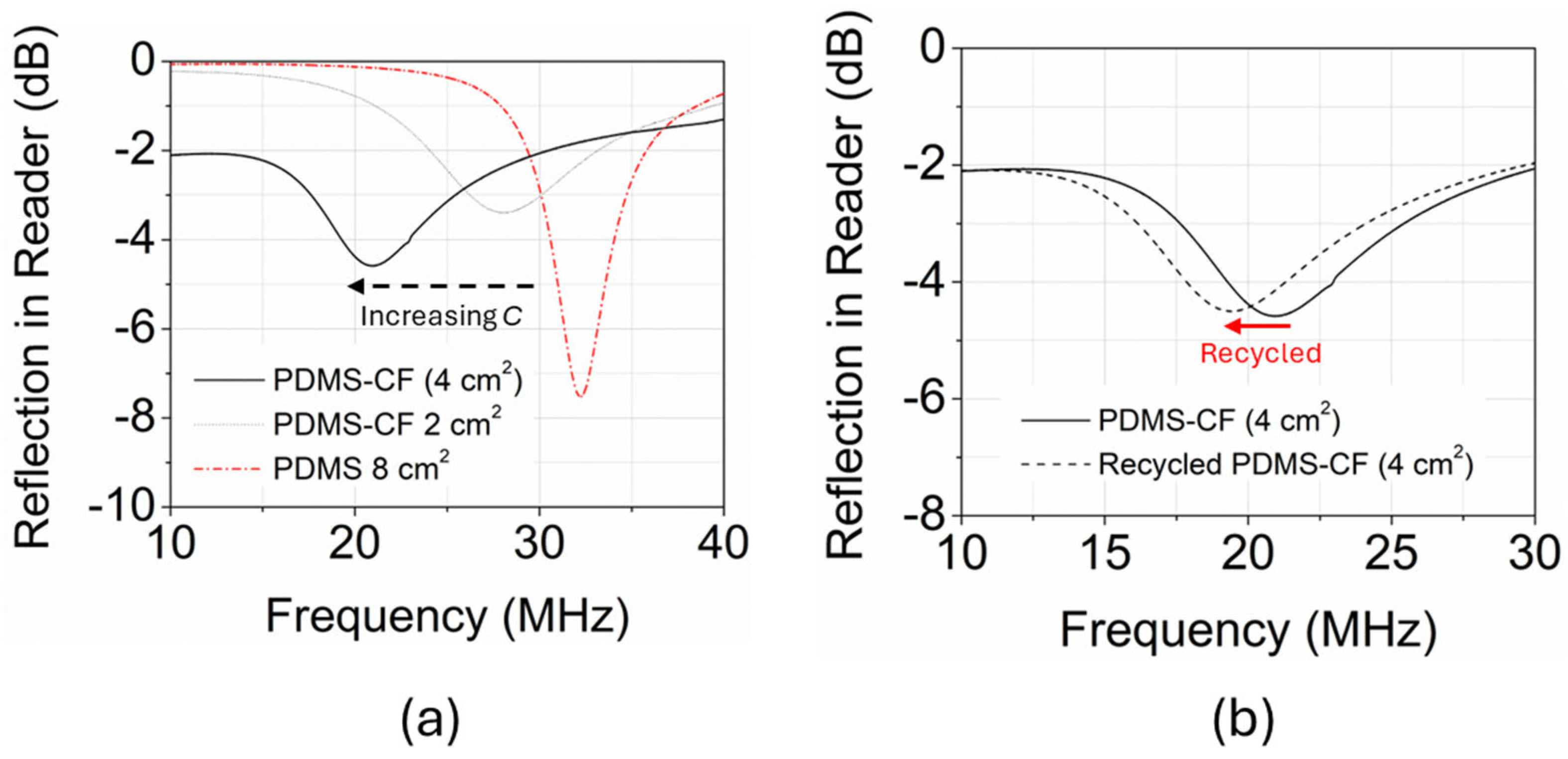
The performance of pristine PDMS and the 2–4 cm2 PDMS–CF capacitors from Figure 2a in RLC resonant circuits is presented in Table 1 and Figure 3a. To demonstrate the recyclability of capacitors in different tags, we fabricated RLC resonant circuits with 4 cm2 PDMS–CF capacitors and a five-turn circular inductive coil with a total diameter of 5 cm. The resonant frequency of the pristine and recycled tags is presented in Table 1 and Figure 3b, respectively. Changing the PDMS–CF dielectric for the second sample resulted in a change in resonant frequency of the tag from 21.0 MHz to 19.4 MHz, or approximately 7.6%. This change is attributed to the slightly increased capacitance of the second dielectric component (“Recycled 4 cm2 PDMS–CF”), resulting in a shift in resonant frequency. Additionally, changes in the adhesion of the copper tape electrodes to the dielectric could result in changes in the capacitance of the circuit. To address this, future iterations of the RLC circuit should have printed electrodes, which would result in direct ohmic contacts to both the dielectric and the FPCB.

4. Conclusions

In summary, our work demonstrates that reusing capacitive sensing resonators can be successfully implemented with pristine dielectrics, resulting in negligible changes to the performance of parallel plate capacitors. The measured frequency response shows under 8% shift with the re-used components compared to the pristine sample. The proposed additive approach, where the capacitors’ electrodes are separated from the PCB, allows chipless tags to be retuned using the same PCBs, avoiding material waste and chemical recycling processes. This work demonstrates the recyclability of chipless tags for temperature sensing, with the potential to be expanded to other sensing tags for pH, humidity, and chemical analytes. Future work in this area could focus on fabricating compatible printed electrodes for the top and bottom plates of the capacitor, to minimize variance in contact resistance and overall height, with the functional dielectric sensor.

Author Contributions

Conceptualization, M.W. and B.K.; methodology, B.K., N.B., and M.W.; data curation, B.K.; writing—original draft preparation, B.K.; writing—review and editing, B.K., N.B., and M.W.; supervision, M.W.; project administration, B.K.; funding acquisition, M.W. All authors have read and agreed to the published version of the manuscript.

Funding

This work was supported by the UK Engineering and Physical Sciences Research Council (EPSRC) through grants EP/W025752/1 and EP/Y002008/1.

Institutional Review Board Statement

Not applicable.

Informed Consent Statement

Not applicable.

Data Availability Statement

An open access dataset is hosted at https://doi.org/10.5525/gla.researchdata.2200.

Acknowledgments

The authors would like to acknowledge Joseph G. Manion (CGFigures) for their open-access Blender asset library (https://www.cgfigures.ca/assetlibrary, accessed 6 November 2024) used in the production of Figure 1b. This research made use of scikit-rf, an open-source Python 3.8+ package for RF and Microwave applications (https://www.scikit-rf.org/, accessed 1 July 2025).

Conflicts of Interest

The authors declare no conflicts of interest.

References

  1. Preethichandra, D.M.G.; Piyathilaka, L.; Izhar, U.; Samarasinghe, R.; De Silva, L.C. Wireless Body Area Networks and Their Applications—A Review. IEEE Access 2023, 11, 9202–9220. [Google Scholar] [CrossRef]
  2. Sundar, D.; Mathiyazhagan, K.; Agarwal, V.; Janardhanan, M.; Appolloni, A. From Linear to a Circular Economy in the E-Waste Management Sector: Experience from the Transition Barriers in the United Kingdom. Bus. Strategy Environ. 2023, 32, 4282–4298. [Google Scholar] [CrossRef]
  3. Nguyen, L.Q.H.; Perret, E. Life Cycle Assessment of UHF and Chipless RFID. IEEE J. Radio Freq. Identif. 2024, 8, 154–167. [Google Scholar] [CrossRef]
  4. Wagih, M.; Bainbridge, A.; Alsulami, B.; Kettle, J. Environmental Life-Cycle Assessment (LCA) of Wireless RF Systems: A Comparative Sustainability Analysis and a Microwave Engineers’ Guide to LCA. IEEE J. Microw. 2024, 4, 987–1000. [Google Scholar] [CrossRef]
  5. Lopez-Iturri, P.; Ruiz-Feliú, R.; Guembe, I.P.; Klaina, H.; Francés, F.J.T.; Martinez, P.; Amado, I.N.; Basarte, E.; Morentin, J.; Saenz, A.G.; et al. Implementation of a Low-Cost Chipless RFID System With Paper-Based Substrates Printed Tags for Traceability Applications in the Packaging Sector. IEEE Sens. J. 2023, 23, 14923–14937. [Google Scholar] [CrossRef]
  6. Patre, S.R. Passive Chipless RFID Sensors: Concept to Applications—A Review. IEEE J. Radio Freq. Identif. 2022, 6, 64–76. [Google Scholar] [CrossRef]
  7. Tavakoli, M.; Alhais Lopes, P.; Hajalilou, A.; Silva, A.F.; Reis Carneiro, M.; Carvalheiro, J.; Marques Pereira, J.; de Almeida, A.T. 3R Electronics: Scalable Fabrication of Resilient, Repairable, and Recyclable Soft-Matter Electronics. Adv. Mater. 2022, 34, 2203266. [Google Scholar] [CrossRef] [PubMed]
  8. Wicaksono, I.; Tucker, C.I.; Sun, T.; Guerrero, C.A.; Liu, C.; Woo, W.M.; Pence, E.J.; Dagdeviren, C. A Tailored, Electronic Textile Conformable Suit for Large-Scale Spatiotemporal Physiological Sensing in Vivo. npj Flex. Electron. 2020, 4, 5. [Google Scholar] [CrossRef] [PubMed]
  9. Tian, Z.; Zhao, Q.; Liu, X.; Wang, Y.; Zhao, J.; Wang, Y.; Hou, X. Efficient Aminolysis of Polyimide for Chemical Recovery of Flexible Printed Circuit Boards. ACS Sustain. Chem. Eng. 2023, 11, 11590–11600. [Google Scholar] [CrossRef]
  10. Hossain, R.; Sahajwalla, V. Microrecycling of Waste Flexible Printed Circuit Boards for In-Situ Generation of O- and N-Doped Activated Carbon with Outstanding Supercapacitance Performance. Resour. Conserv. Recycl. 2021, 167, 105221. [Google Scholar] [CrossRef]
  11. Shen, Y. Waste plastic-derived carbon materials for supercapacitors and rechargeable batteries. Renew. Sustain. Energy Rev. 2026, 225, 116206. [Google Scholar] [CrossRef]
  12. Chen, H.; Liu, X.; Zhang, S.; Xu, S.; Fu, T.; Wang, Y.-Z. Full Recovery of Polyimide Wastes Into High-Value Products Through Break and Reconstruction of Imide Ring. Adv. Sci. 2025, 12, 2414416. [Google Scholar] [CrossRef] [PubMed]
  13. King, B.; Bruce, N.; Wagih, M. Large-Area Conductor-Loaded PDMS Flexible Composites for Wireless and Chipless Electromagnetic Multiplexed Temperature Sensors. Adv. Sci. 2025, 12, 2412066. [Google Scholar] [CrossRef] [PubMed]
  14. Wagih, M.; Shi, J.; Li, M.; Komolafe, A.; Whittaker, T.; Schneider, J.; Kumar, S.; Whittow, W.; Beeby, S. Wide-Range Soft Anisotropic Thermistor with a Direct Wireless Radio Frequency Interface. Nat. Commun. 2024, 15, 452. [Google Scholar] [CrossRef] [PubMed]
  15. Mariotti, C.; Cook, B.S.; Roselli, L.; Tentzeris, M.M. State-of-the-Art Inkjet-Printed Metal-Insulator-Metal (MIM) Capacitors on Silicon Substrate. IEEE Microw. Wirel. Compon. Lett. 2015, 25, 13–15. [Google Scholar] [CrossRef]
Figure 1. (a) Schematic of a chipless circuit with a capacitive sensing component. (b) Large-area additive manufacturing of sensing composites and chipless circuits. (c) Example recycling and redeployment cycle of FlexPCB in a chipless tag having a reduced capacitance, shifting the resonant frequency of the tag.
Engproc 127 00018 g001
Figure 2. (a) Broadband capacitance of parallel-plate capacitors: 4 cm2 PDMS–CF (solid black line) replaced by an identical 4 cm2 PDMS–CF (dashed line), 2 cm2 PDMS–CF (black dotted line), and an 8 cm2 pristine PDMS dielectric (red dash-dot line). (b) Frequency-domain sensitivity of 4 cm2 PDMS–CF and 8 cm2 pristine PDMS composites up to 200 MHz between 20 and 60 °C.
Engproc 127 00018 g002
Figure 3. (a) Broadband reflection coefficient (S11) of chipless temperature sensor tag with (a) parallel-plate capacitors in Figure 1a and (b) comparison of the tag performance between the original sensor loading and new sensor loading with recycled components.
Engproc 127 00018 g003
Table 1. Resonant frequency of RLC circuits with PDMS–CF parallel plate capacitors and 50 Ω resistors before and after dielectric recycling.
Dielectric IDMeasured Capacitance (pF)Measured Resonant Frequency in RLC (MHz) 1
2 cm2 PDMS–CF24.032.2
4 cm2 PDMS–CF42.321.0
Recycled 4 cm2 PDMS–CF43.619.4
8 cm2 PDMS16.024.3
1 Circuit consists of a 5 cm 10-turn inductor (4 µH) and a 50 Ω resistor.
Disclaimer/Publisher’s Note: The statements, opinions and data contained in all publications are solely those of the individual author(s) and contributor(s) and not of MDPI and/or the editor(s). MDPI and/or the editor(s) disclaim responsibility for any injury to people or property resulting from any ideas, methods, instructions or products referred to in the content.