Proceeding Paper

Environmental Hotspots in Semiconductor-Based Diabetes Care: Green ICs and Circular Economy Approaches †
1
Fritz-Hüttinger Chair for Energy-Efficient High-Frequency Electronics (EEH), Department for Sustainable Systems Engineering (INATECH), University of Freiburg, 79098 Freiburg, Germany
2
Power Sensors and Innovation, Infineon Technologies AG, 85579 Neubiberg, Germany
3
Fraunhofer Institute for Reliability and Microintegration (IZM), 13355 Berlin, Germany
4
Fraunhofer Institute of Applied Solid-State Physics (IAF) Freiburg, 79108 Freiburg, Germany
*
Author to whom correspondence should be addressed.
Presented at the International Conference on Responsible Electronics and Circular Technologies (REACT 2025), Glasgow, UK, 11–12 November 2025.
Eng. Proc. 2026, 127(1), 10; https://doi.org/10.3390/engproc2026127010
Published: 10 March 2026

Abstract

Diabetes, projected to affect over 1.3 billion people by 2050, presents significant healthcare burdens and environmental challenges, necessitating innovative and sustainable solutions to manage complications effectively. This study applies life cycle assessment to evaluate the environmental impacts of two semiconductor-enabled diabetes care devices: (1) a single-use urine-based C-peptide measurement strip aligned with the reduce strategy and (2) a reusable smart wound dressing for chronic wound monitoring under the reuse strategy. Integrating green electricity reduced the total lifecycle global warming potential by 16.2% for the urine strip and 0.4% for the smart wound dressing. The results emphasize the importance of tailored design strategies, showing that the impact of green integrated circuits is substantial for single-use reduce systems, while long-term treatments benefit more from reuse strategies paired with durable, complex designs that extend component lifespan and limit new manufacturing burdens.

1. Introduction

Diabetes is a growing global health challenge, with 589 million people affected by this disease in 2024. This number is expected to rise to over 1.3 billion by 2050 due to aging populations, rising obesity, and sedentary lifestyles [1]. Without proper management, the disease leads to life-threatening complications such as cardiovascular issues, kidney failure, and amputations due to infected chronic wounds. Global diabetes care expenditures exceeded $1.015 trillion in 2024, accounting for nearly 12% of healthcare spending [1], underscoring the urgent need for innovative and sustainable treatment technologies. Advances in electronics-enabled healthcare tools, including continuous glucose monitors (CGMs), insulin pumps, and smart wound dressings, have revolutionized diabetes management, offering personalized glucose monitoring and long-term complication management [2,3]. Despite these benefits, these tools contribute to environmental challenges, including greenhouse gas (GHG) emissions from energy-intensive semiconductor manufacturing [4] and the waste generated by single-use electronic tools [5]. The global healthcare sector is already responsible for nearly 5% of global GHG emissions [1,6]. Addressing these challenges requires sustainable systems designed to balance functionality, hygiene standards, and reduced environmental impact [5]. The circular economy framework, incorporating strategies like reduce and reuse, guides sustainable design [7]. Reduce strategies prioritize lightweight, single-use components, while reuse strategies emphasize durable designs that extend the lifespan of critical components. Among the electronic components added to healthcare devices, integrated circuits (ICs) are significant environmental hotspots, with energy-intensive manufacturing processes in which electricity accounts for 80% of their total energy demand [4]. Transitioning to renewable electricity in semiconductor manufacturing represents a promising opportunity to mitigate GHG emissions. This study employs life cycle assessment (LCA) to evaluate the environmental performance of two semiconductor-enabled diabetes care devices under the 9-R circular economy framework [7]: (1) a single-use urine-based C-peptide measurement strip aligned with the reduce strategy and (2) a reusable smart wound dressing for diabetic foot ulcers designed with the reuse strategy. The analysis focuses on identifying environmental hotspots in IC manufacturing and explores the potential for green electricity utilization to mitigate impacts at both the system and total lifecycle levels.

2. Materials and Methods

2.1. Use Cases and Functional Requirements

This study evaluates two devices tailored to specific functional needs, representing the circular economy strategies of reduce and reuse.

2.1.1. Urine-Based C-Peptide Measurement Stripe

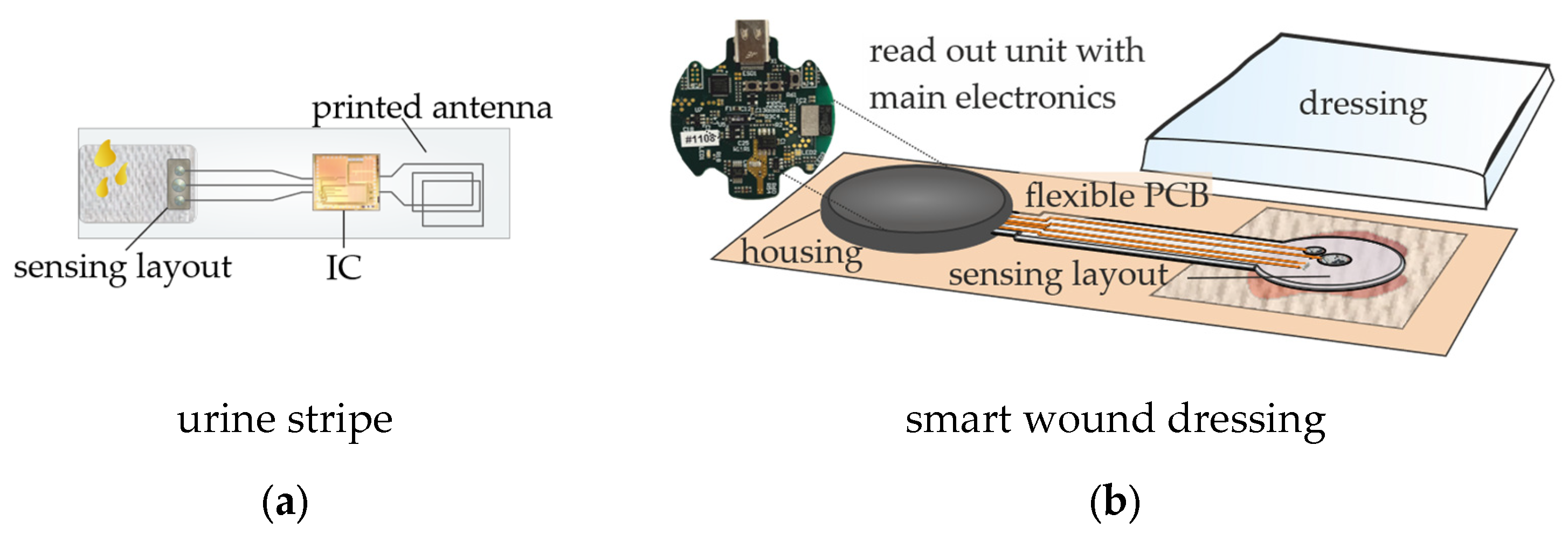
The urine C-peptide strip (henceforth “urine strip”) is a single-use diagnostic device to assess the metabolism of the patient [8]. It is particularly useful in diabetes classification, therapy assessment, gestational diabetes management, and postpartum diabetes monitoring. The device offers an accessible alternative to current practices, where urine tests are conducted and subsequently analyzed in laboratories. Designed for material efficiency and simplified disposal, the strip uses a flexible substrate printed with a three-electrode system. Powered wirelessly via a near field communication (NFC)-enabled IC without onboard batteries, it integrates a printed supercapacitor for stable energy delivery, ensuring reliable measurements. A schematic is shown in Figure 1a.

2.1.2. Smart Wound Dressing for Chronic Wound Care

Designed for continuous monitoring of chronic wounds to prevent severe infections, the smart wound dressing separates reusable electronics from disposable wound contact layers. This aligns with the reuse strategy while maintaining strict hygiene standards. Unlike current practices in wound care, which rely on manual checks of wound status by healthcare providers, this system aims for real-time, non-invasive monitoring of the wound. The disposable sensing layer combines a pH sensor and a temperature sensor on a flexible printed circuit board (PCB), plugged into a reusable readout unit. The reusable electronics include a sensing IC, a Bluetooth Low-Energy (BLE) IC for wireless communication, a rechargeable battery, and an analog front-end (AFE) for signal processing integrated on a standard PCB. Figure 1b depicts the architecture of the system.

2.2. Life Cycle Assessment

This study applies LCA according to ISO 14040 [9] and 14044 [10] standards, encompassing goal and scope definition, life cycle inventory (LCI), life cycle impact assessment (LCIA), and interpretation. The goal of this analysis is to evaluate the environmental impact of two semiconductor-enabled diabetes care devices, each designed to align with different circular economy strategies, and to identify key environmental hotspots within their system architectures. The aim is to support the development of sustainable design strategies to minimize lifecycle impacts, with a particular focus on the potential of integrating renewable electricity into semiconductor manufacturing.
The study employs the GaBi version 10.9.1.10 database [11] for the urine strip and the ecoinvent cut-off database v3.10 [12] for the smart wound dressing. Due to primary data gaps for BLE IC manufacturing, the study focuses on IPCC AR6 Global Warming Potential (GWP) [13], measured in kg CO2-equivalent, as the primary impact category. Biogenic CO2 emissions were excluded from the analysis. The functional unit (FU) defines the healthcare service provided. For the urine strip, the FU corresponds to a single C-peptide test, including activation and data transmission via a smartphone as well as disposal. For the smart wound dressing, the FU is six months of treatment, reflecting the median healing period for diabetic foot ulcers, a prominent chronic wound type [14]. The reusable readout unit was modeled for use throughout the treatment period, with disposable sensing layers replaced per dressing cycle. Related services, such as dressing changes, were also included in the analysis. End-of-life (EoL) treatment involved incineration for disposable components and electronics recycling for the reusable readout unit.
The LCI is based on laboratory-scale system architectures, as shown in Figure 1, with a detailed overview provided in Table A1 and Table A2 in Appendix A. Appendix A compiles the complete LCI (components, use phase, and end-of-life) and documents the data sources and assumptions, including selected literature-based parameters [15]. Primary data for the 130 nm CMOS sensing IC were obtained using a combination of top-down and bottom-up approaches to capture chemicals, energy demand, emissions, materials, waste, and transportation from frontend and backend manufacturing processes. This data was derived from Infineon’s Product Carbon Footprint (PCF) inventory. While this specific PCF data is proprietary and unavailable to the public, the underlying methodology is documented in [16]. For the 55 nm CMOS BLE IC, GWP was scaled using data from Jones [17]. To ensure comparability with the primary data from the sensing IC, the GWP of the 130 nm CMOS was also calculated using the same model, resulting in a deviation of 10% compared to the data used in this study. This deviation is considered reasonable for subsequent comparisons. To evaluate the potential impact of renewable electricity use, green IC scenarios incorporated Germany’s 2024 renewable electricity mix [18] into 130 nm CMOS IC manufacturing for GWP reduction evaluation. The same relative GWP reduction was applied to the BLE IC under a hypothetical scenario, enabling the estimation of environmental benefits in the absence of primary data for 55 nm CMOS manufacturing. Additionally, the use of electric vehicles for healthcare-related transportation was evaluated as a complementary strategy.

3. Results

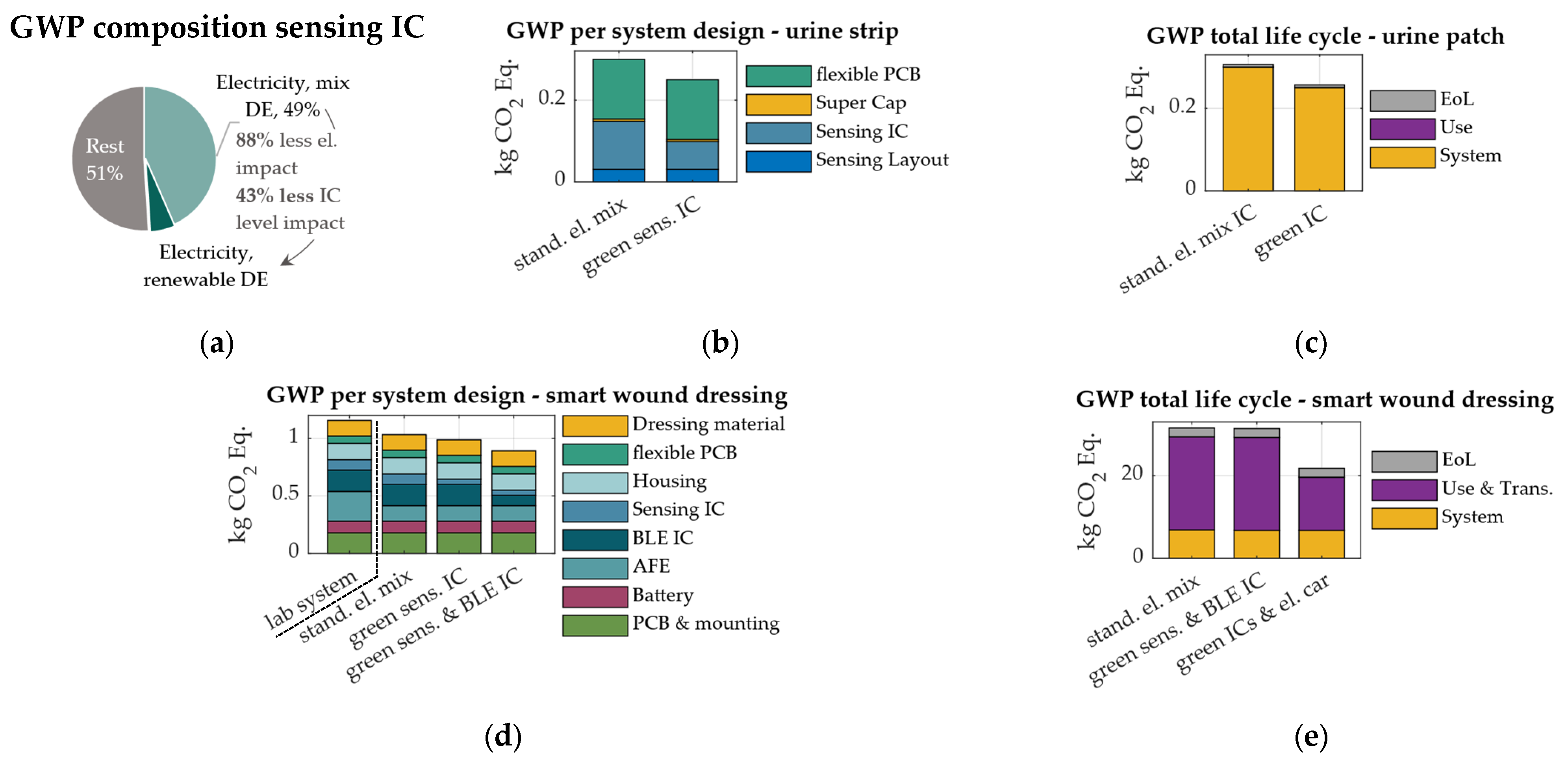
The LCIA results identified IC manufacturing as one key contributor to GWP, with its impact significantly influenced by the electricity mix. Using renewable electricity reduced the GWP of IC manufacturing by 43%; see Figure 2a. In the reduce scenario (urine strip), the sensing IC dominates the system’s GWP footprint, resulting in a 16.5% system-level GWP reduction when green electricity is used for IC manufacturing. This reduction also remains through the full lifecycle, which is dominated by the system impact (Figure 2b,c). In contrast, the reuse scenario (smart wound dressing) showed that while ICs were significant contributors to GWP, the system’s extended lifespan necessitated a more complex design with additional electronic components, which further increased GWP. Among these, the AFE emerged as a particularly dominant contributor (Figure 2d). The laboratory-scale system architecture includes AFE components specifically added for testing and development purposes, which do not directly impact the device’s functionality in its final implementation. For a more realistic evaluation, an optimized design with a higher level of integration was used as a reference for analyzing the impact of green IC manufacturing. Under this optimized layout, system-level GWP reductions of 13.6% may be achieved when both ICs are fabricated using renewable electricity (Figure 2d). As shown in Figure 2e, the total lifecycle GWP of smart wound dressing is dominated by the use phase, driven by emissions from healthcare provider travel for dressing changes. Green IC manufacturing may yield only a 0.4% reduction, whereas modeling travel emissions using an electric vehicle achieved a 30.7% reduction.

4. Interpretation, Discussion, and Outlook

This study highlights the significant environmental burden of adding electronics to diabetes care devices, which substantially increases their cradle-to-gate GWP. The findings underscore the importance of tailored sustainability strategies, based on circular economy principles. For single-use devices like the urine strip, the reduce strategy effectively minimizes GWP through passive NFC-enabled energy harvesting and miniaturized component layouts. For reusable devices such as smart wound dressings, the reuse strategy—extending component lifespans—enables lifecycle impact reductions, despite requiring more complex and resource-intensive designs. Incorporating green ICs further mitigates GWP in both scenarios, with reductions of 16.5% for the urine strip and of 13.6% for the reusable wound dressing. However, total lifecycle GWP improvements for reusable devices are limited to 0.4% due to the dominance of the use phase, highlighting the need for further optimizations, such as the adoption of electric vehicles by healthcare providers—a practice already implemented in many home-healthcare services [19].
ICs were identified as critical GWP hotspots, heavily influenced by electricity use during manufacturing. The sensing IC, manufactured in Germany using a 100% renewable electricity mix, demonstrated a 43% GWP reduction compared to the standard electricity mix, as confirmed by primary data for the 130 nm CMOS process. However, due to the lack of primary data for the BLE IC, the green electricity share for its manufacturing remains uncertain. Future research should focus on the geographic origins of IC production, based on node type, and examine the availability of renewable electricity in those regions, which are particularly relevant for the energy-intensive advanced-node ICs [17,20].
While this study provides valuable insights into the GWP implications of ICs integrated into diabetes care devices, several limitations must be considered to contextualize the results and guide future research. For both designs, primary data from laboratory-scale production of flexible PCBs likely overestimates impacts compared to industrial-scale scenarios. Additionally, the lack of detailed primary data for the 55 nm BLE IC manufacturing restricts the analysis to GWP, rather than a more holistic evaluation incorporating material use and water consumption. Benchmarking of the smart wound dressing against state-of-the-art wound care systems has shown that improvements in personalized care can offset the environmental impacts of added electronics and significantly decrease use case-related environmental impacts [21]. However, further comparisons of urine strip testing with current laboratory-based test methods are required.
In conclusion, sustainably manufactured ICs play a key role in reducing GWP, especially for single-use devices. For long-term treatments, reuse strategies offer the greatest benefits by extending component lifespans and reducing new manufacturing needs, despite more complex layouts and higher cradle-to-gate impacts. These findings provide actionable insights for mitigating the environmental footprint of emerging healthcare technologies.

Author Contributions

Conceptualization, T.S., D.S., and R.Q.; methodology, T.S.; formal analysis, T.S.; investigation, T.S.; resources, T.S. and D.S.; data curation, T.S. and D.S.; writing—original draft preparation, T.S.; writing—review and editing, T.S., D.S., and R.Q.; visualization, T.S.; supervision, R.Q.; project administration, R.Q. All authors have read and agreed to the published version of the manuscript.

Funding

The work was carried out as part of the SUSTRONICS project that is co-funded by the European Union under grant agreement 101112109 and the BMFTR. Views and opinions expressed are, however, those of the authors only and do not necessarily reflect those of the European Union or the Chips Joint Undertaking. Neither the European Union nor the granting authority can be held responsible for them.

Institutional Review Board Statement

Not applicable.

Informed Consent Statement

Not applicable.

Data Availability Statement

Part of the original contributions presented in this study are included in the article. Further inquiries can be directed to the corresponding author. Restrictions apply to the availability of parts of this data. Data were obtained from Infineon Technologies AG and are available from the authors with the permission of Infineon Technologies AG.

Acknowledgments

The authors would like to thank the Sustronics partners for the functional development of the tools and their support and great contributions.

Conflicts of Interest

Author T. Seeholzer was employed by the company Infineon Technologies AG. The remaining authors declare that the research was conducted in the absence of any commercial or financial relationships that could be construed as a potential conflict of interest. The authors declare that this study received funding from the European Union and the BMFTR. The funder was not involved in the study design, collection, analysis, interpretation of data, the writing of this article or the decision to submit it for publication.

Appendix A

Table A1. LCI of the urine patch.
Component (FU)FlowAmountUnitDescription of LCIA Data
printed layout (PET, Ag, dielectric)own model5.8gSphera and Ecoinven, adapted
supercapacitorbased on primary data and the literature1pcs.own model
capacitorcapacitor, ceramic1pcs.Sphera dataset
resistorresistor, flat chip1pcs.Sphera dataset
sensing IC, 130 nmown model: PCF-based1pcs.PCF input from Infineon [16]
lateral flow device systembased on primary data1pcs.own model
use phase–NFC chargingelectricity130Jmeasured
EoL
collection and transportationmunicipal waste collection service by a 21 metric ton lorry0.00004tkmEcoinvent dataset
incineration of MSW (incl. ash treatment)municipal solid waste0.0107kgEcoinvent dataset
Table A2. LCI of the smart wound dressing.
Component (FU)FlowAmountUnitDescription of LCIA Data
printed wiring boardPWB, surface mount15.9cm2Ecoinvent dataset
resistorresistor surface-mounted33pcs.Ecoinvent dataset
capacitorcapacitor, surface-mounted18pcs.Ecoinvent dataset
solder process incl. pastemounting, surface mount technology, Pb-free15.9cm2Ecoinvent dataset
LDO, battery management, switch voltage regulatorelectronic component, active3pcs.Ecoinvent dataset
ESD, attenuation, coil, push button, resettable fuse, jumperelectronic component passive11pcs.Ecoinvent dataset
LEDlight-emitting diode3pcs.Ecoinvent dataset
rech. Li-ion battery 3.7 V, 205 mAhbattery, Li-ion, NMC111, rech.5.4gEcoinvent dataset
sensing IC, 130 nmown model: PCF-based1pcs.PCF input from Infineon [16]
sensing IC, VQFN Package 32own model: PCF-based25mm2PCF input from Infineon [16]
BLE, 55 nmown model, literature-based1pcs.Jones [17], 65–45 nm av.
BLE, QFN Package, 64 mm2own model: PCF-based64mm2scaled PCF input from Infineon
ZIF connectorcable ribbon, with plugs1gEcoinvent dataset
housingPLA, 3D-printed12.7gown model, the literature [15]
neodymium magnetspermanent magnet1.6gEcoinvent dataset
flex. sensor layout (PET, Ag ink)measured, lab scale30.5cm2primary data, Ecoinvent, adapted
dressing material, superabsorberown model, BOM-based5.8gown model
wound contactown model, BOM-based100cm2own model
gauzeown model, BOM-based7gown model
use phase-per charging cycleelectricity0.0005661kWhmeasured
use phase-transportation, V1transportation, passenger car, EURO 52.5kmEcoinvent dataset
use phase-transportation, V2transport, passenger car, electric2.5kmEcoinvent dataset
EoL
used PCBPCB recycling15.9cm2Ecoinvent dataset
used Li-ion batteryused Li-ion battery5.4gEcoinvent dataset
used flex PCBincineration, own model, BOM-based, (incl. ash treatment)30.5cm2Ecoinvent, adapted
used dressing materialbased on Ecoinvent ref. treatment textile soiled (incl. ash treatment)89.3gEcoinvent, adapted
collection and transportationmunicipal waste collection service by a 21 metric ton lorry0.002tkmEcoinvent dataset

References

  1. International Diabetes Federation. IDF Diabetes Atlas; International Diabetes Federation: Brussels, Belgium, 2025. [Google Scholar]
  2. Iyengar, V.; Wolf, A.; Brown, A.; Close, K. Challenges in Diabetes Care: Can Digital Health Help Address Them? Clin. Diabetes 2016, 34, 133–141. [Google Scholar] [CrossRef] [PubMed]
  3. Yu, T.S.; Song, S.; Yea, J.; Jang, K. Diabetes Management in Transition: Market Insights and Technological Advancements in CGM and Insulin Delivery. Adv. Sens. Res. 2024, 3, 2400048. [Google Scholar] [CrossRef]
  4. Wang, Q.; Huang, N.; Chen, Z.; Chen, X.; Cai, H.; Wu, Y. Environmental Data and Facts in the Semiconductor Manufacturing Industry: An Unexpected High Water and Energy Consumption Situation. Water Cycle 2023, 4, 47–54. [Google Scholar] [CrossRef]
  5. Hoveling, T.; Svindland Nijdam, A.; Monincx, M.; Faludi, J.; Bakker, C. Circular Economy for Medical Devices: Barriers, Opportunities and Best Practices from a Design Perspective. Resour. Conserv. Recycl. 2024, 208, 107719. [Google Scholar] [CrossRef]
  6. Or, Z.; Seppänen, A.-V. The Role of the Health Sector in Tackling Climate Change: A Narrative Review. Health Policy 2024, 143, 105053. [Google Scholar] [CrossRef] [PubMed]
  7. Potting, J.; Hekkert, M.; Worrell, E.; Hanemaaijer, A. Circular Economy: Measuring Innovation in the Product Chain; Planbureau voor de Leefomgeving: Den Haag, The Netherlands, 2017. [Google Scholar]
  8. Reintar, S.; Pöchhacker, M.; Obermayer, A.; Eberhard, K.; Zirlik, A.; Verheyen, N.; Von Lewinski, D.; Scherr, D.; Hutz, B.; Haudum, C.W.; et al. Urinary C-Peptide to Creatinine Ratio (UCPCR) as Indicator for Metabolic Risk in Apparently Healthy Adults—A BioPersMed Cohort Study. Nutrients 2023, 15, 2073. [Google Scholar] [CrossRef] [PubMed]
  9. ISO 14040:2006; Environmental Management—Life Cycle Assessment—Principles and Framework. International Organization for Standardization: Geneva, Switzerland, 2006.
  10. ISO 14044:2006; Environmental Management—Life Cycle Assessment—Requirements and Guidelines. International Organization for Standardization: Geneva, Switzerland, 2006.
  11. Sphera (2025) LCA For Experts. (Version 10.9.1.10). [Computer Software]. Available online: https://sphera.com/ (accessed on 20 September 2025).
  12. Wernet, G.; Bauer, C.; Steubing, B.; Reinhard, J.; Moreno-Ruiz, E.; Weidema, B. The Ecoinvent Database Version 3. Int. J. Life Cycle Assess. 2016, 21, 1218–1230. [Google Scholar] [CrossRef]
  13. Masson-Delmotte, V.; Zhai, P.; Pirani, A.; Connors, S.L.; Péan, C.; Chen, Y.; Goldfarb, L.; Gomis, M.I.; Matthews, J.B.R.; Berger, S.; et al. Climate Change 2021: The Physical Science Basis. Contribution of Working Group I to the Sixth Assessment Report of the Intergovernmental Panel on Climate Change; IPCC: Paris, France; Cambridge University Press: Cambridge, UK; New York, NY, USA, 2021. [Google Scholar]
  14. McDermott, K.; Fang, M.; Boulton, A.J.M.; Selvin, E.; Hicks, C.W. Etiology, Epidemiology, and Disparities in the Burden of Diabetic Foot Ulcers. Diabetes Care 2023, 46, 209–221. [Google Scholar] [CrossRef] [PubMed]
  15. Kazmer, D.; Peterson, A.M.; Masato, D.; Colon, A.R.; Krantz, J. Strategic Cost and Sustainability Analyses of Injection Molding and Material Extrusion Additive Manufacturing. Polym. Eng. Sci. 2023, 63, 943–958. [Google Scholar] [CrossRef]
  16. Infineon Product Carbon Footprint (PCF). Available online: https://www.infineon.com/about/company/sustainability/environmental-sustainability-and-climate-protection/product-carbon-footprint-pcf (accessed on 20 October 2025).
  17. Jones, S.W. Modeling 300mm Wafer Fab Carbon Emissions. In 2023 International Electron Devices Meeting (IEDM); IEEE: San Francisco, CA, USA, 2023; pp. 1–4. [Google Scholar]
  18. German Federal Statistical Office Press Release Nr. 091. Available online: https://www.destatis.de/DE/Presse/Pressemitteilungen/2025/03/PD25_091_43312.html (accessed on 20 September 2025).
  19. Erdem, M.; Koç, Ç. Analysis of Electric Vehicles in Home Health Care Routing Problem. J. Clean. Prod. 2019, 234, 1471–1483. [Google Scholar] [CrossRef]
  20. Pirson, T.; Delhaye, T.P.; Pip, A.G.; Le Brun, G.; Raskin, J.-P.; Bol, D. The Environmental Footprint of IC Production: Review, Analysis, and Lessons from Historical Trends. IEEE Trans. Semicond. Manufact. 2023, 36, 56–67. [Google Scholar] [CrossRef]
  21. Seeholzer, T.; Petre, A.-R.; Stuart-Wijesuriya, S.; Quay, R. Advancing Wound Management with Smart and Sustainable Electronics for a Human-Environment-Centric Society: A Life Cycle Assessment Approach. In 2025 32nd IEEE International Conference on Electronics, Circuits and Systems (ICECS); IEEE: Marrakech, Morocco, 2025; pp. 1–4. ISBN 979-8-3315-9585-2. [Google Scholar]
Figure 1. Schematic representation of system architectures. (a) Urine strip with sensing layout, bare die integrated IC, and printed antenna. (b) Smart wound dressing with reusable readout unit and disposable sensing layout.
Engproc 127 00010 g001
Figure 2. GWP results for the urine strip and smart wound dressing with standard and green IC manufacturing. (a) Cradle-to-gate GWP of sensing IC (130 nm CMOS) manufacturing, broken down into electricity and the rest (including chemicals, other energy, emissions, materials, and transportation). (b) Urine strip cradle-to-gate GWP with a 16.5% reduction using a green sensing IC. (c) Cradle-to-grave GWP of the urine strip, maintaining a 16.2% reduction. (d) Cradle-to-gate GWP of the smart wound dressing, comparing the laboratory-scale AFE with an optimized architecture used for further analysis. The optimized version shows reductions of 4.4% with a green sensing IC and 13.6% with green sensing and BLE ICs. (e) Cradle-to-grave GWP of the smart wound dressing, with a 0.4% GWP reduction related to green ICs. Electric vehicle scenario showing a 30.7% reduction.
Engproc 127 00010 g002
Disclaimer/Publisher’s Note: The statements, opinions and data contained in all publications are solely those of the individual author(s) and contributor(s) and not of MDPI and/or the editor(s). MDPI and/or the editor(s) disclaim responsibility for any injury to people or property resulting from any ideas, methods, instructions or products referred to in the content.