Proceeding Paper

GRIPP: An Open-Source and Portable Software-Defined Radio-Oriented GNSS/SBAS Receiver †
1
European Space Agency (ESA), 2201 AZ Noordwijk, The Netherlands
2
European Space Agency (ESA), 31401 Toulouse, France
*
Author to whom correspondence should be addressed.
Presented at the European Navigation Conference 2025 (ENC 2025), Wrocław, Poland, 21–23 May 2025.
Eng. Proc. 2026, 126(1), 6; https://doi.org/10.3390/engproc2026126006
Published: 6 February 2026
(This article belongs to the Proceedings of European Navigation Conference 2025)

Abstract

This paper introduces the GRIPP (GNSS/SBAS Receiver, Independent and Portable PVT) system, an open-source SDR oriented GNSS/SBAS receiver. Composed of a Pocket SDR FE device, an L-band antenna and a computer, this system aims to ease the deployment and test of future GNSS and SBAS evolutions, providing a fully documented and customizable receiver. Acting like a generic navigation toolbox, the main idea is to be able to quickly adapt it for research and development purposes, introducing new filtering methods or PVT algorithms. Besides these engineering applications, the goal is also to use it for educational purposes to introduce GNSS and SBAS to the general audience.

1. Introduction

Global Navigation Satellite Systems (GNSS) (like Galileo, GPS and BeiDou), as well as Satellite-Based Augmentation Systems (SBAS) (like EGNOS in Europe and WAAS in North America) are today widely used in various domains. From aviation to time synchronization and safety of life applications, PNT (Position, Navigation and Timing) is directly involved in the daily life of billions of users. In the coming years, major evolutions of these systems are expected, constantly aiming to improve the overall quality of the PVT (Position, Velocity and Time) solutions. For instance, EGNOS V3 will enhance performance under acute ionosphere conditions by supporting a new Dual Frequency, Multi-Constellation (DFMC) SBAS service using L1/L5 signals from both GPS and Galileo [1]. Regarding Galileo, the progressive deployment of various new services, such as a High Accuracy Service (HAS) [2,3] and Signal Authentication Service (SAS) [4,5], are on-going or expected soon. Both based on the E6 band usage, they aim to improve accuracy with real-time Precise Point Positioning (PPP) and to increase robustness against GNSS spoofing using a semi-assisted authentication system on encrypted pilot signals. Last but not least, new efforts have risen to enhance PNT services by complementing Medium Earth orbit (MEO) GNSS constellations with Low Earth orbit (LEO) satellites with ranging capabilities, offering significant improvements for PNT in terms of accuracy and time-to-first-fix [6].
These evolutions will directly impact the current applications by enhancing PNT performance, and will bring new usages, from pure mobility applications (like hybrid positioning systems and vehicle-to-everything communication) to land air surveying and science applications (like precise orbit determination and space-time metrology). Therefore, the development of adaptable receivers, customizable enough to adjust each stage of GNSS processing to these new services and new applications, is needed. Yet, the use of industrial mass-market and professional receivers can limit the possibility to perform such customizations, due to their non-accessible proprietary algorithms. In contrast, the use of Software-Defined Radio (SDR) equipment can fully comply with this need. Besides the advantage of relying on the minimum possible hardware equipment, SDR usage allows a rich flexibility which permits easy and rapid changes to accommodate new radio-frequency bands, signal modulation types and baseband algorithms. Therefore, this flexibility is beneficial not only for multi-GNSS/SBAS operations but also for prototyping algorithms.
In this context, this paper introduces a new open-source initiative, based on a portable and SDR-oriented GNSS/SBAS receiver, opening access to PVT algorithms to the largest possible audience. This system, GRIPP (GNSS/SBAS Receiver, Independent and Portable PVT), aims to provide a generic navigation toolbox, hardware included, equipped with a fully customizable and documented software that can emulate each stage of a GNSS receiver. GRIPP aims to be adapted to a variety of special engineering research applications, as well as be used by students and introduce GNSS and SBAS technologies to general audiences. In this paper, the main goals of GRIPP are introduced first, followed by the description of its hardware and software architecture, based on the usage of a Raspberry Pi [7], a Pocket SDR FE device [8] and an L-band antenna. The current abilities of the system, as well as the next development steps, are then detailed in the last section.

2. GRIPP Main Goals

The GRIPP system focuses on four main objectives. Table 1 summarizes these four main goals, also introducing associated sub-goals. The GRIPP system is for now focused on Galileo, GPS and EGNOS, as the first use cases identified for this receiver were as follows:
  • Galileo and GPS performance evaluation in one-band and/or multi-bands.
  • EGNOS V3/DFMC early test (data collection of EGNOS L5 SiS).
Galileo E6b (HAS) signal reception and decoding.
In addition, another important use case has been quickly identified: the ability to conduct a performance evaluation considering different sky view conditions, by computing for instance PVT solutions only considering low (or high) elevation space vehicle configuration. If this specific use case is not new regarding systems and research results that already exist in the literature in terms of GNSS/SBAS performance evaluations, the objective for the GRIPP system is to be able to see in real-time the effects on the PVT solutions of these different configurations, which are particularly important for educational purposes. An additional playback mode can be used to evaluate the impact of additional configurations on PVT solutions, and to test new filtering methods, new auto-correlation functions and/or new PLL/DLL algorithms.
Then, if for now the development of the system is focused on Galileo E1/E5/E6, GPS L1/L2/L5, EGNOS L1/L5 signals, the aim is also to be able to extend the usage of GRIPP to other GNSS/SBAS systems, and future LEO-PNT constellations. Additionally, the injection of a beta version of the updated SiS to test their effect on the user segment is aimed at future evolution of the GRIPP system. Finally, one last core requirement of GRIPP is to be an SDR-oriented GNSS receiver, to be able to provide huge flexibility in terms of RF configuration, and to focus on one or several very specific bandwidths on different RF channels.

3. GRIPP Hardware Architecture

3.1. Overall Hardware Architecture

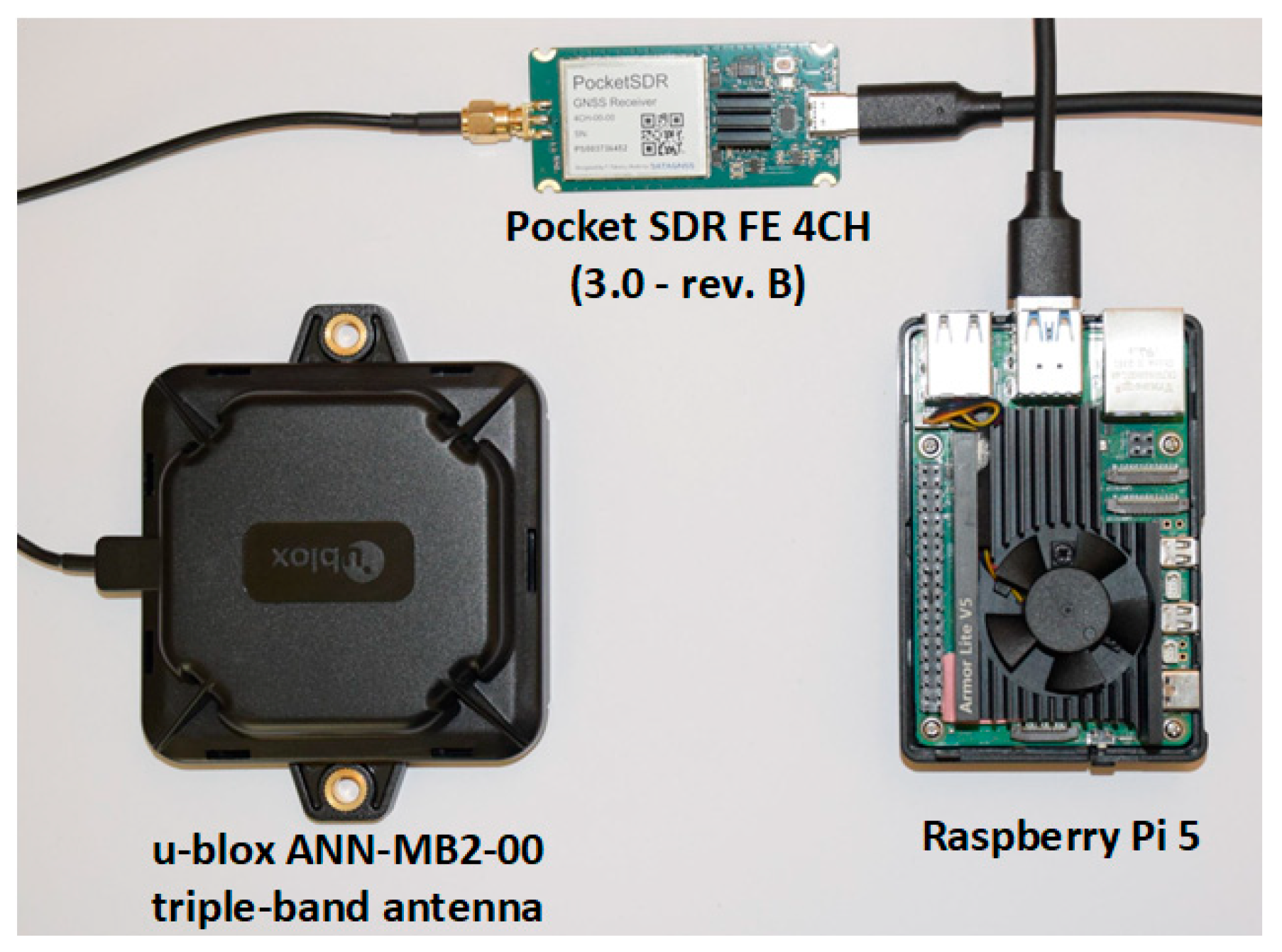
Like any SDR system, the basic hardware blocks needed for the GRIPP, introduced in Figure 1, are as follows:
  • An L-band antenna, multi-band (dual or triple band), able to cover the GNSS lower (from 1164 to 1300 MHz) and upper (from 1559 to 1610 MHz) L-band, as per the Radio-Navigation Satellite Service (RNSS) spectrum specified by the ITU-R (International Telecommunication Union—Radiocommunication sector). In the context of GRIPP project deployment, one antenna that has been used is the u-blox GNSS triple L-band antenna ANN-MB2-00 [9] (see Figure 2).
  • SDR equipment, used as an RF front-end interface to convert the L-band analogic signal received by the L-band antenna to I/Q samples.
  • A computer, able to host the GRIPP software, taking as inputs the I/Q samples forwarded by the SDR equipment, and computing PVT solutions.
Concerning the SDR equipment, it has been decided to use the Pocket SDR Front-End (FE) device [8], based on a concept developed by T. Takasu in late 2010s, at Tokyo University of Marine Science Technology. This device can capture I/Q samples in 16-bit block format from L1/E1, L2, L5/E5 and E6 bands. In addition, it is one of the most affordable and easily accessible devices on the market at the time of writing (about EUR 250 per unit).
For the computing unit, the idea is to be able to use GRIPP software on classic computers/laptops and on single-board computers, on both UNIX and Windows NT operating systems. Regarding the single-board computer, its only hardware constraint is to be equipped with at least three USB ports to ensure a Pocket SDR FE and keyboard/mouse connection, as well as at least one video output. During the GRIPP HW design phase, the single-board computer choice fell on the Raspberry Pi [7].

3.2. Pocket SDR FE

As introduced above, the Pocket SDR Front-End (FE) device [8] is an SDR device specialized in GNSS signal reception. It can include two, four or eight RF front-end channels and supports the GNSS L1 band (1525–1610 MHz) and L2/L5/L6 bands (1160–1290 MHz).
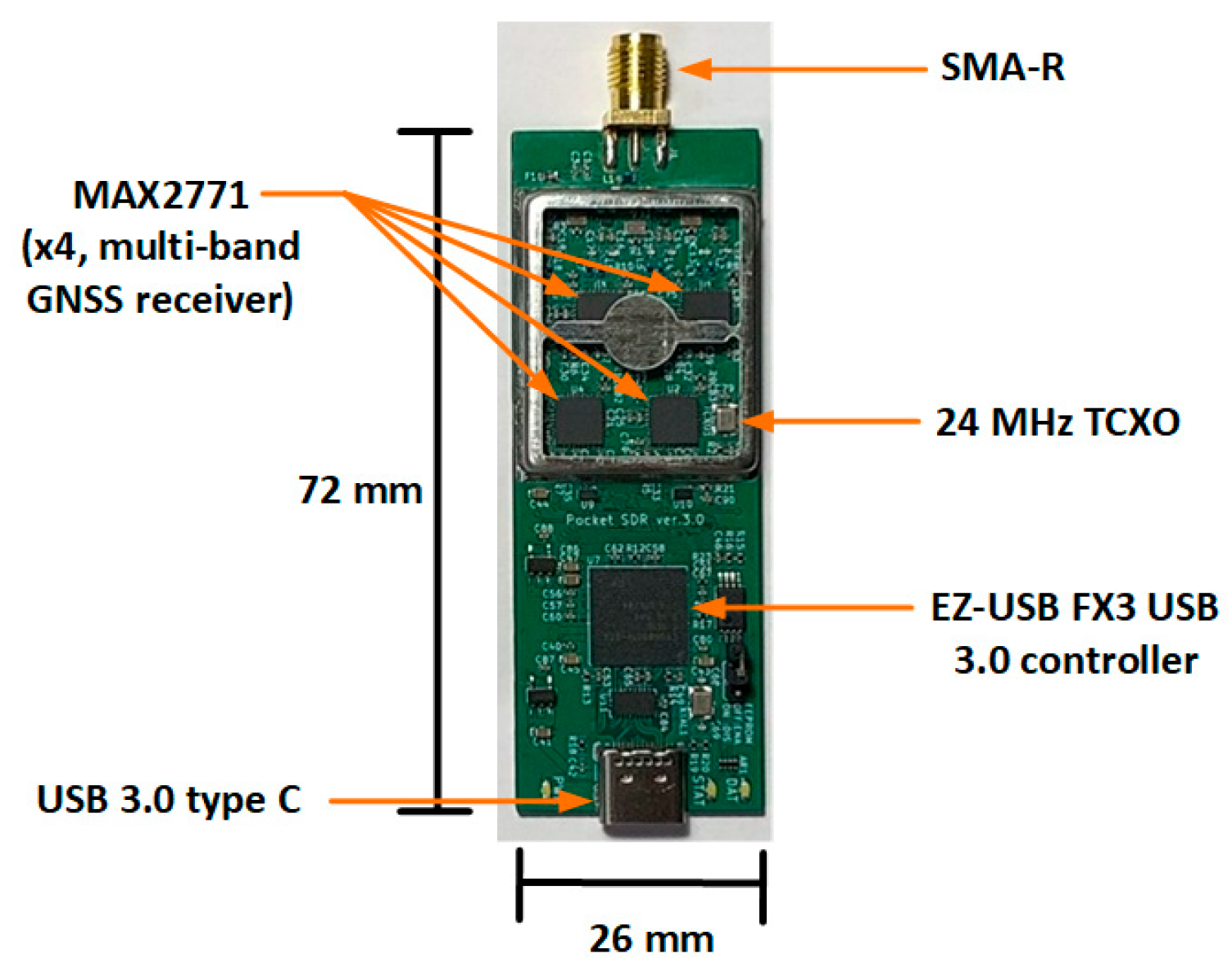
In the context of GRIPP development, the four channels version is being used (4CH-00-00, v3.0 revision A and revision B [10]), equipped with the following:
  • A 4 RF LSI (Large-Scale Integration) MAX2771 multi-band GNSS receiver chip [11];
  • A 24 MHz Temperature Compensated Crystal Oscillator (TCXO);
  • A USB 3.0 controller (EZ-USB FX3).
An SMA-R connector (input from the L-band antenna) and a USB 3.0 type C port (output to a computer) complete the device (see Figure 3). Regarding RF signals management, each of the four MAX2771 chips can receive L1, L2, L5 and L6 bands related GNSS signals. Signal filtering is then performed according to an input configuration managed at the software level. These signals are converted to digital I/Q samples output, in RAW16 format, and finally transferred to the USB 3.0 controller unit and forwarded to the GRIPP computing unit. The high level architecture of the Pocket SDR FE is detailed in [8].

3.3. Computer and Datastore

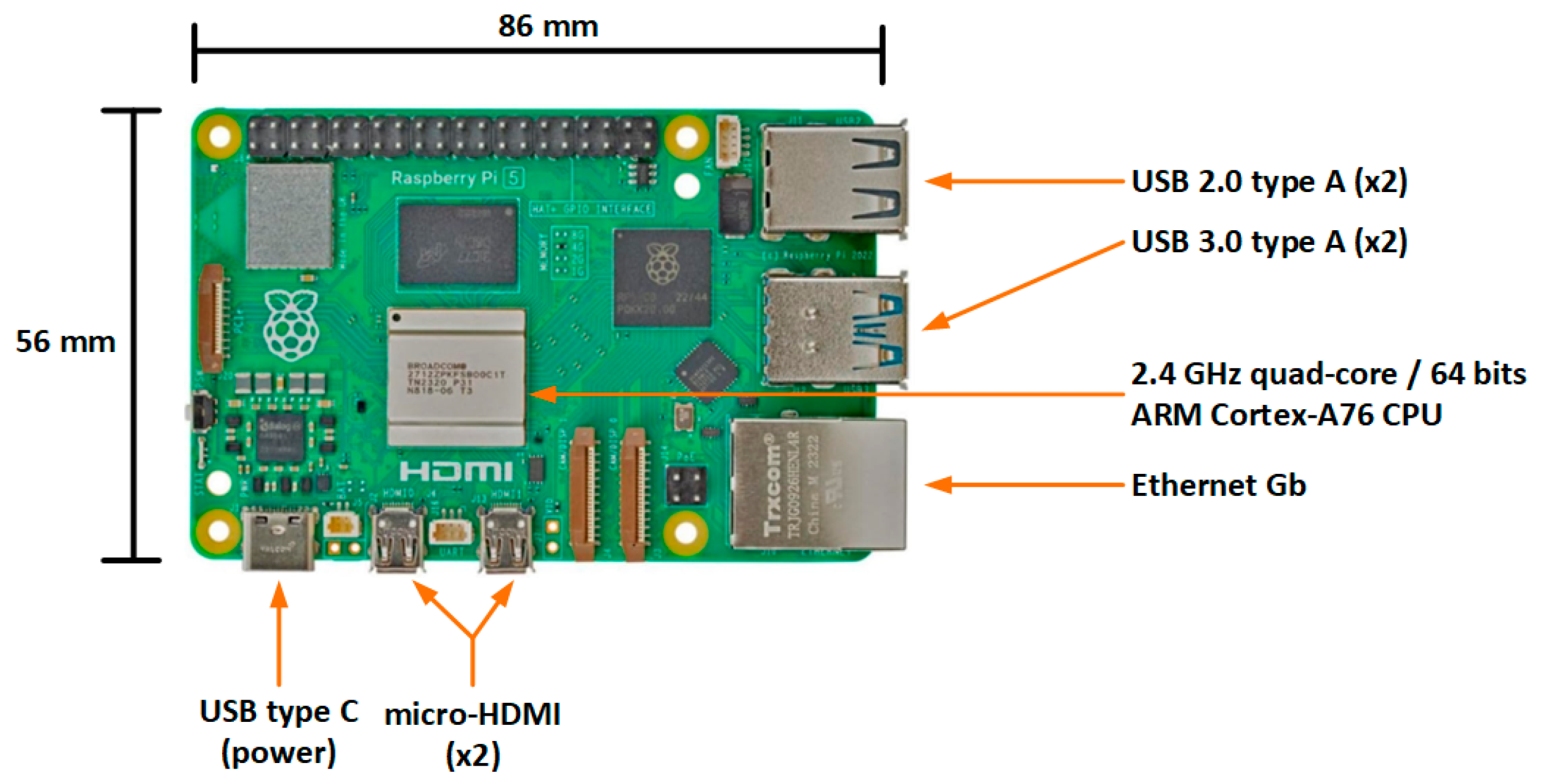
As introduced in Section 3.1, the computing unit of the GRIPP system oversees receiving the I/Q sample streams coming from the Pocket SDR FE and processes them to compute PVT solutions in different configurations as per Section 2 (single or dual-band solutions, single or multiple GNSS system solutions, with or without SBAS/PPP corrections). This computer can be a desktop computer, a laptop, or a single board computer. Regarding the last option, the use of a Raspberry Pi 5 [7,12] has been preferred, considering the popularity of this platform and its available support from the user community. Figure 4 introduces the high-level specifications of the Raspberry Pi 5. In the context of GRIPP development, the 8 GB RAM version has been used, equipped with a 128 GB micro-SD card for the storage of the operating system (Debian GNU/Linux) and the input/outputs of the GRIPP system.

4. GRIPP Software Architecture

4.1. Overall Software Architecture

The GRIPP software architecture is based on a client/server micro-services architecture, where the following occurs:
  • The server aims to retrieve the I/Q samples from the Pocket SDR FE, decode the navigation messages and compute the PVT solutions. A correction decoder module, capable of considering correction messages, is added to the overall software.
  • The client aims to control not only the overall system, by sending commands to the different sub-systems to adapt in real-time the configuration of the Pocket SDR FE, but also the way of computing the PVT solutions (activating segregated or multi-constellations PVT solution computations for instance).
A datastore completes the system, storing the navigation messages (Navbits), the PVT solutions, the measurements made and the I/Q samples. Moreover, this datastore aims to be used as a gateway to store correction messages and records that can be then injected into the server. The interface between the GRIPP server, the client and the datastore is insured by a dedicated communication module, COMMS.
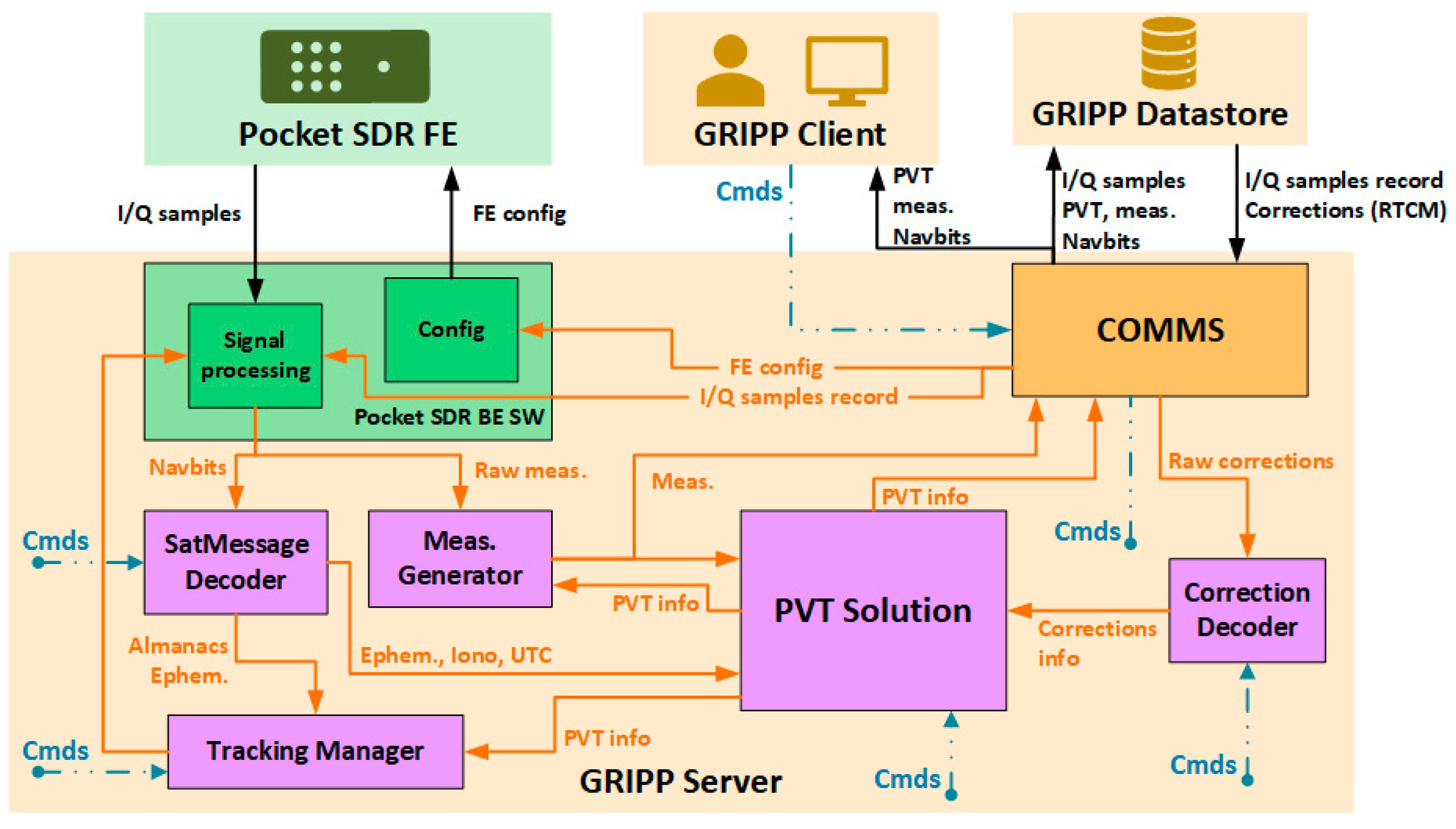
Figure 5 introduces the overall GRIPP software architecture. Each sub-module is designed to act as an independent sub-system in parallel threads, interfacing with each other in real time. This GRIPP software is directly inherited from the Pocket SDR one (version 0.14) [13], maintained by the same team who designed the Pocket SDR FE device. It provides internal modules that can compute PVT solutions, for now only supporting Single Point Positioning (SPP). GRIPP software will act here as an enhancement of this existing software, adding new functionality step by step. In this context, the development language of the GRIPP software is identical to the Pocket SDR software one: C.

4.2. Interface with Pocket SDR FE I/Q Samples’ Data Stream

To retrieve the I/Q samples coming from the Pocket SDR FE, and to be able to tune its configuration, the back end of the Pocket SDR software [13] is directly used, through two of its sub-components:
  • A Pocket SDR configurator: This module is used to load a new configuration for each Pocket SDR FE RF channel. Configuration change is called by the client part of the GRIPP software, and forwarded through COMMS.
  • A Pocket SDR signal processing module: This module is used as a USB event handler thread, reading and sorting the RAW16 I/Q samples from the USB port, and feeding the IF (Intermediate Frequency) data buffer in Navbits and raw measurements. These data are then used as inputs by SatMessage Decoder and Measurements Generator micro-services (see Figure 5).
Both of these modules are directly reused from the original source code of the Pocket SDR software available online [13].

4.3. PVT Computation

The PVT computation is ensured by the GRIPP server core micro-service, PVT Solution, using the following as inputs:
  • The decoded navigation messages of Galileo, GPS and SBAS, streamed from the SatMessage Decoder module. This decoder part in the first version of GRIPP focuses on L1CA and L5I signals on GPS and EGNOS, and E1B, E5AI and E6B (HAS) signals on Galileo.
  • The aggregation of GNSS/SBAS satellite measurements on a per satellite basis, provided by the Measurements Generator module, which also computes overall information about the measurements available in a specific epoch.
  • Corrections messages such as RTCM or any other external streams coming from the Corrections Decoder micro-service, which is itself fed by the corrections files available in the GRIPP datastore and circulating through the COMMS interface.
From these different inputs, the PVT Solution micro-service can generate one or several solutions in real-time, either based on live data or on records (through playback functions directly inherited from Pocket SDR software). For the first version of the GRIPP receiver, the PVT Solution micro-service will only support Single Point Positioning (SPP) and SBAS L1, focused on Galileo open service, followed by the support of EGNOS V3/DFMC and HAS. This approach in the context of the GRIPP system’s early development is motivated by the particular focus given to Galileo and EGNOS performance. Finally, computed PVT information is used by the Tracking-Manager micro-service, responsible for computing satellite visibility and informing the Pocket SDR back-end software of which ones to track.

4.4. COMMS Module

The COMMS micro-service is the main interface between the GRIPP server and the GRIPP client/datastore. This module is responsible for processing all the external inputs (apart from the ones coming from the Pocket SDR FE, managed by Pocket SDR back-end software as introduced in Figure 5). These inputs are generally the commands that can be sent to the different other micro-services, to configure for instance the Pocket SDR FE channels or the PVT Solutions module (activating PPP for instance or requesting the computation of constellation-segregated PVT solutions). In addition to these command-and-control inputs, additional ones coming from the GRIPP datastore, like I/Q sample records or RTCM files, aim also to be managed by the COMMS module.
Additionally, the COMMS module is also in charge of providing three types of output either to the client or to the datastore:
  • Monitoring of the system: data related to the space vehicles in view, the measurements associated with them and their locking status, are streamed to the client.
  • PVT solutions display: PVT solutions are streamed to the client.
  • GRIPP data storage: General system logs, I/Q samples, decoded NAV messages and measurement information, RTCM (Radio Technical Commission for Maritime Services) and NMEA (National Marine Electronics Association) are produced as outputs.
Regarding monitoring and PVT solutions data, their display is managed at the GRIPP client level, in command line view in the first version of the system and then using a dedicated GUI (Graphical User Interface) that will be developed in the next development phases.

5. State of Development as of Today and Conclusions

The GRIPP system aims to ease the deploying and testing of future GNSS and SBAS evolutions, by providing a fully open-source, documented and customizable receiver based on the usage of SDR equipment, associated with a multi-band L-band antenna and a computer (a “classic” computer or single-board one, like Raspberry Pi 5). Acting like a generic navigation toolbox, the main idea is to be able to quickly adapt it for research, development and derisking purposes, considering for instance new filtering methods or PVT algorithms. Besides these direct engineering and research applications, the goal is to also use the GRIPP system for educational purposes, for students and for general audiences, and to introduce GNSS and SBAS technologies at high and low levels. Finally, the GRIPP project is a great opportunity at the ESA level to help young professionals and trainees to ramp-up their knowledge on navigation systems.
GRIPP kicked off in October 2024 and, as an internal ESA project based on the best efforts of all contributors, it is still under development at this time. At the time of writing, the design phase (HW and SW), as introduced in this paper, has been finalized and the GRIPP server, client and datastore alpha version are under development and testing. The next major milestone is to be able to provide the SPP (Single Point Positioning) feature by the end of the second quarter of 2025. In addition, it is planned to contact the Pocket SDR software development team, to initiate a collaboration between the two projects and use each other’s progress to fasten the overall development of both software. The general development plan is introduced in Table 2. Five phases have been identified, covering a development period up to end of 2026, to satisfy the main goals of the GRIPP system as presented in Section 2 of this paper. Yet, future long-term evolutions are already under investigation, like RTK compatibility, a jamming detection/analysis toolbox and support of additional GNSS systems like Beidou. Additionally, discussions on the possibility of including some functions linked to the Search And Rescue (SAR) [14] service are on-going.

Author Contributions

Conceptualization, methodology, G.F., N.C., H.S., C.-V.C., N.B.L., R.M.W., M.M., L.N., J.H., S.W., N.S.; development, validation, N.C., C.-V.C., G.F., H.S.; writing—original draft preparation, G.F.; writing—review and editing, H.S., C.-V.C., N.C., L.N., R.M.W. All authors have read and agreed to the published version of the manuscript.

Funding

This research received no external funding.

Institutional Review Board Statement

Not applicable.

Informed Consent Statement

Not applicable.

Data Availability Statement

The data and documents used for this study are available on request to the corresponding author of this paper.

Conflicts of Interest

The authors declare no conflicts of interest.

Abbreviations

The following abbreviations are used in this manuscript:
BEBack End
DFMCsDual Frequency, Multi-Constellations
DLLDelay-Locked Loop
GRIPPGNSS/SBAS Receiver, Independent and Portable PVT
GUIGraphical User Interface
HASHigh Accuracy Service
I/QIn-phase/Quadrature
LoSLoss of Signal
PLLPhase-Locked Loop
PNTPositioning, Navigation and Timing
PPPPrecise Point Positioning
PVTPosition, Velocity and Time
RFRadio-Frequency
SASSignal Authentication Service
SiSSignal-in-Space
SDRSoftware-Defined Radio
SPPSingle Point Positioning

References

  1. EUSPA. EGNOS New Services; EGNOS Workshop: Dublin, Ireland, 2024; Available online: https://egnos.gsc-europa.eu/sites/default/files/2024-03/18.%20EUSPA%20SPO%20-%20EGNOS%20new%20services.pdf (accessed on 1 March 2025).
  2. EUSPA. Galileo High Accuracy Service—Service Definition Document (HAS SDD); EUSPA: Prague, Czech Republic, 2023. [Google Scholar]
  3. Fernandez-Hernandez, I.; Chamorro-Moreno, A.; Cancela-Diaz, S.; Calle-Calle, J.D.; Zoccarato, P.; Blonski, D.; Senni, T.; de Blas, F.J.; Hernández, C.; Simón, J.; et al. Galileo High Accuracy Service: Initial Definition and Performance. GPS Solut. 2022, 26, 65. [Google Scholar] [CrossRef]
  4. Anderson, J.; Lo, S.; Neish, A.; Walter, T. Authentication of Satellite-Based Augmentation Systems with Over-the-Air Rekeying Schemes. Navig. J. Inst. Navig. 2023, 70, navi.595. [Google Scholar] [CrossRef]
  5. Fernandez-Hernandez, I.; Winkel, J.; O’Driscoll, C.; Caparra, G.; Terris-Gallego, R.; López-Salcedo, J.A.; Seco-Granados, G.; Willems, T.; Motella, B.; Blonski, D.; et al. Galileo Signal Authentication Service (SAS). In Proceedings of the 37th International Technical Meeting of the Satellite Division of the Institute of Navigation (ION GNSS+ 2024), Baltimore, MD, USA, 16–20 September 2024. [Google Scholar]
  6. Le Priellec, A.; Giordano, P.; Limon, M.C.; Grec, F.; Prieto-Cerdeira, R. LEO-PNT end-to-end in-orbit demonstration: An ESA initiative to pave the way for a European GNSS constellation in LEO. In Proceedings of the in Small Satellites Systems and Services Symposium (4S 2024), Palma de Mallorca, Spain, 27–31 May 2024; Volume 13546. [Google Scholar]
  7. Nayyar, A.; Puri, V. Raspberry Pi—A Small, Powerful, Cost Effective and Efficient Form Factor Computer: A Review. Int. J. Adv. Res. Comput. Sci. Softw. Eng. 2015, 5, 720–737. [Google Scholar]
  8. Takasu, T. An Open Source GNSS SDR: Development and Applications; Tokyo University of Marine Science and Technology: Tokyo, Japan, 2022; Available online: https://gpspp.sakura.ne.jp/paper2005/IPNTJ_NEXTWG_202202.pdf (accessed on 15 September 2024).
  9. u-blox. ANN-MB2-00 Datasheet, UBXDOC-963802114-12775, Revision 3. Available online: https://content.u-blox.com/sites/default/files/documents/ANN-MB2_DataSheet_UBXDOC-963802114-12775.pdf (accessed on 1 October 2024).
  10. DATAGNSS. 4CH-00-00/v3.0/Revision B. Available online: https://www.datagnss.com/products/pocketsdr-gnss-receiver?variant=40686273167395 (accessed on 15 September 2024).
  11. Maxim Integrated. MAX2271 Datasheet, Revision 0. Available online: https://www.analog.com/media/en/technical-documentation/data-sheets/MAX2771.pdf (accessed on 15 September 2024).
  12. Raspberry Pi. Raspberry Pi 5 Presentation and Technical Specifications. Available online: https://www.raspberrypi.com/products/raspberry-pi-5/ (accessed on 15 June 2024).
  13. Takasu, T. Pocket SDR Github Repository. Available online: https://github.com/tomojitakasu/PocketSDR/tree/master/src (accessed on 15 September 2024).
  14. EUSPA. Galileo Search And Rescue—Service Definition Document (SAR SDD); EUSPA: Prague, Czech Republic, 2024; issue 3.0. [Google Scholar]
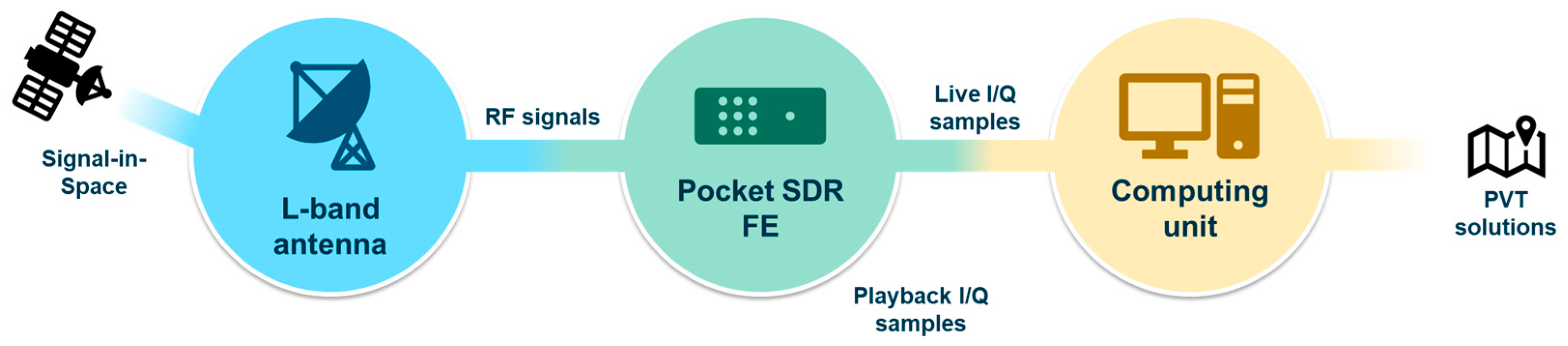
Figure 1. GRIPP hardware architecture.
Engproc 126 00006 g001
Figure 2. GRIPP hardware (u-blox ANN-MB2-00, Pocket SDR FE 4CH and Raspberry Pi 5).
Engproc 126 00006 g002
Figure 3. Pocket SDR FE (4CH-00-00, v3.0 revision A).
Engproc 126 00006 g003
Figure 4. Raspberry Pi 5.
Engproc 126 00006 g004
Figure 5. GRIPP software architecture.
Engproc 126 00006 g005
Table 1. GRIPP system goals.
GoalSub-Goals
Raw navigation message
reception and storage
  • Galileo E1/E5/E6, GPS L1/L2/L5, EGNOS L1/L5
  • Storage of I/Q samples (last 30 min)
  • Storage of RAW navigation messages (up to 7 days)
Compute PVT solutions
  • In real time and playback mode:
    Single Point Positioning (SPP)
    SBAS positioning
    Precise Point Positioning (PPP)
    Multi-bands/constellations PVT
    Customized sky view (low/high elevation, occultation…)
Adaptability
  • SiS reception configuration customization
  • Filtering methods customizations
  • Auto-correlation/PLL/DLL functions customization
  • Adaptable code for future evolutions of existing systems
Open source
  • Code fully available to general audience
  • Use of mass-market equipment
  • SDR-oriented solution
Table 2. GRIPP development plan.
PhaseTimeframeContent
1Q4/2024–Q1/2025Hardware and software design
2Q1-Q2/2025Server/Client/Datastore alpha version
I/Q samples recording and playback (inherited from Pocket SDR software)
Single Point Positioning and EGNOS/SBAS positioning (through Kalman filter)
3Q2-Q4/2025EGNOS V3/DFMC
Galileo HAS through E6B
PPP
4Q4/2025–Q1/2026GRIPP client GUI
GRIPP beta release to the public (end of Q1/2026, integrating features from phases 2 and 3, and also client GUI)
5Q1-Q3/2026Correction feature (external RTCM)
Disclaimer/Publisher’s Note: The statements, opinions and data contained in all publications are solely those of the individual author(s) and contributor(s) and not of MDPI and/or the editor(s). MDPI and/or the editor(s) disclaim responsibility for any injury to people or property resulting from any ideas, methods, instructions or products referred to in the content.