Prototyping Galileo Signal Authentication Service: Current Status and Plans †
 , ,
, ,  , ,
, ,  , , , , ,
  and
and
Abstract
1. Introduction
2. Galileo Signal Authentication Service—Current Technical Definition
3. Galileo SAS Receiver and Testing Prototypes
3.1. SAS Receiver
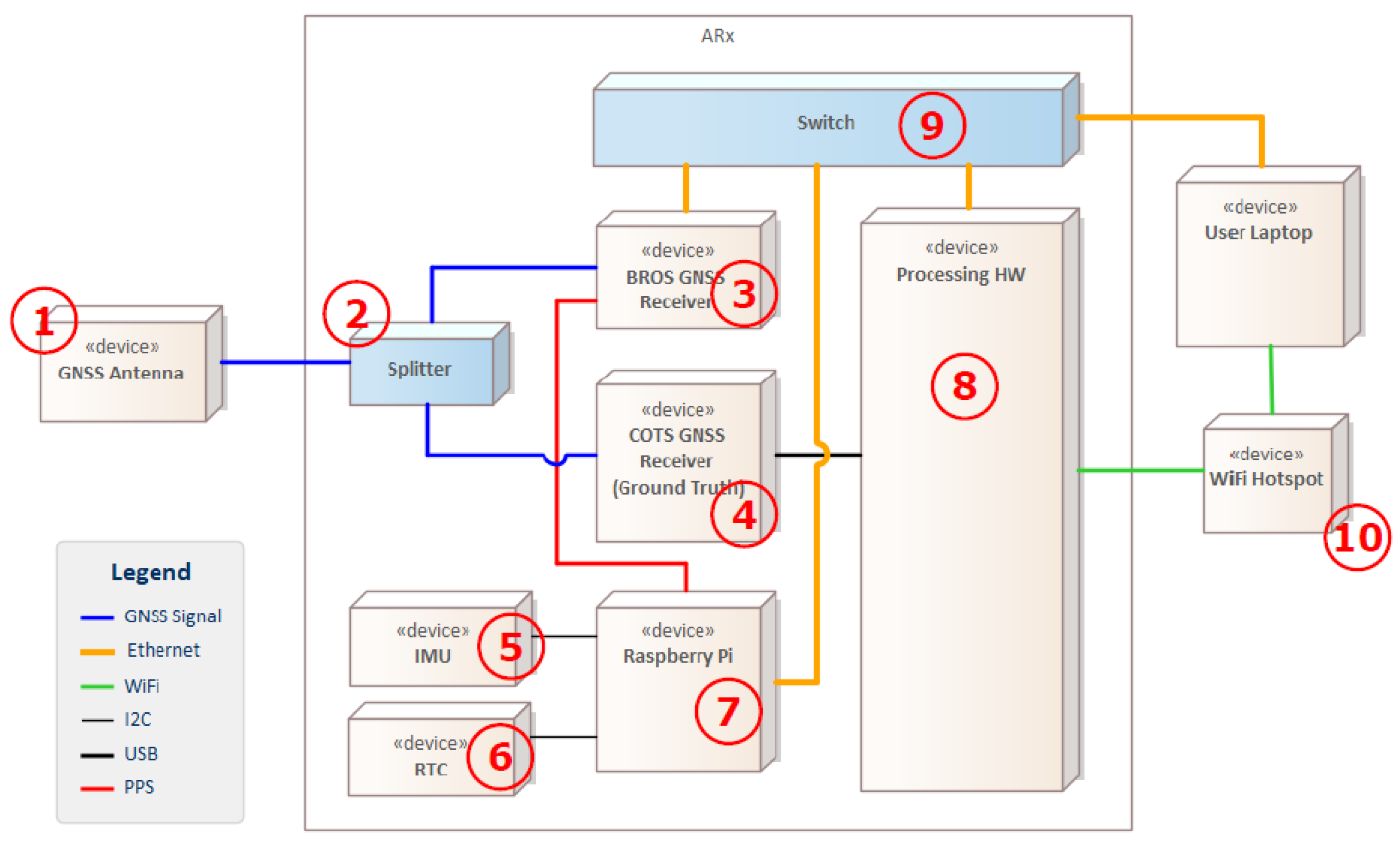
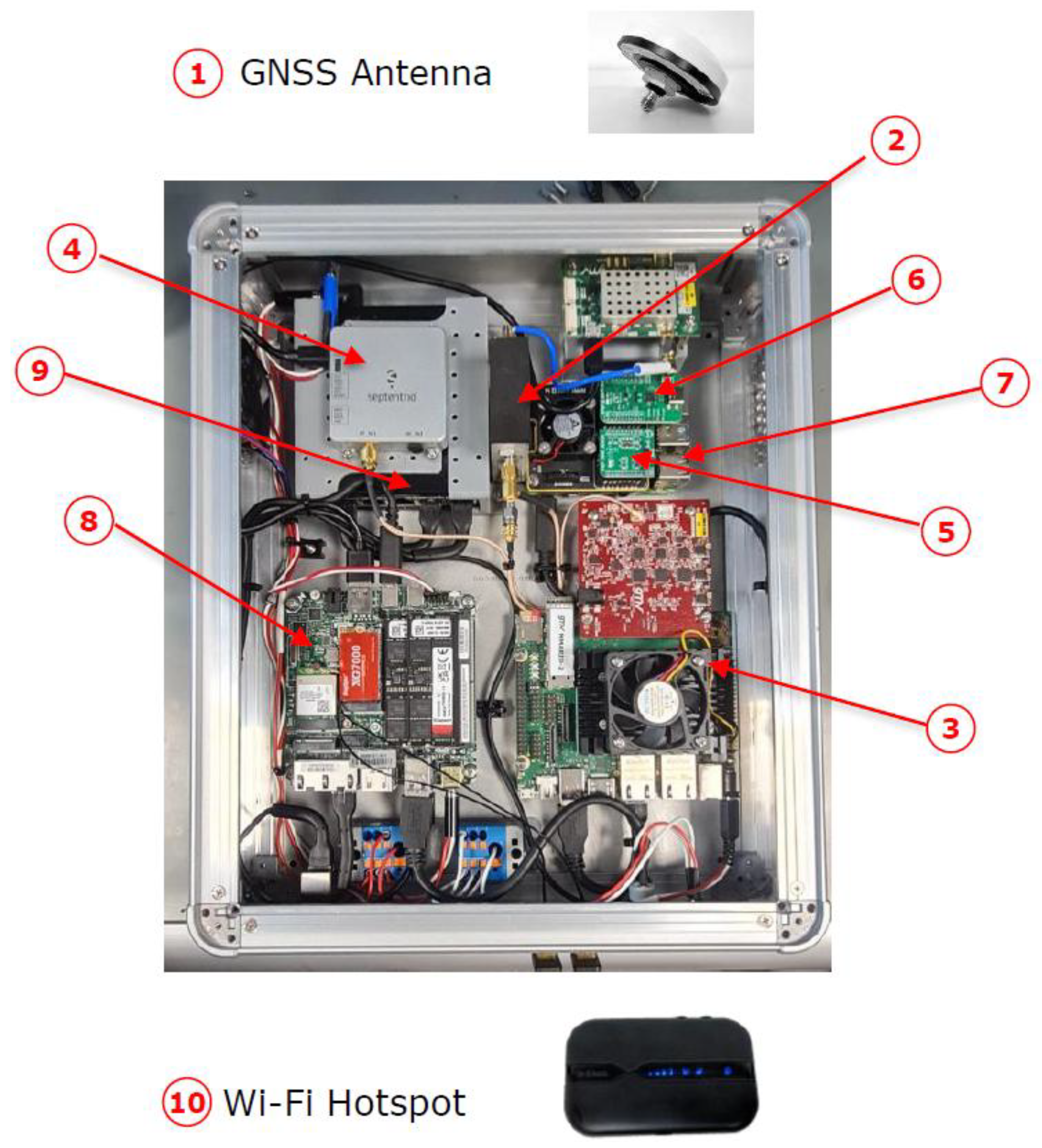
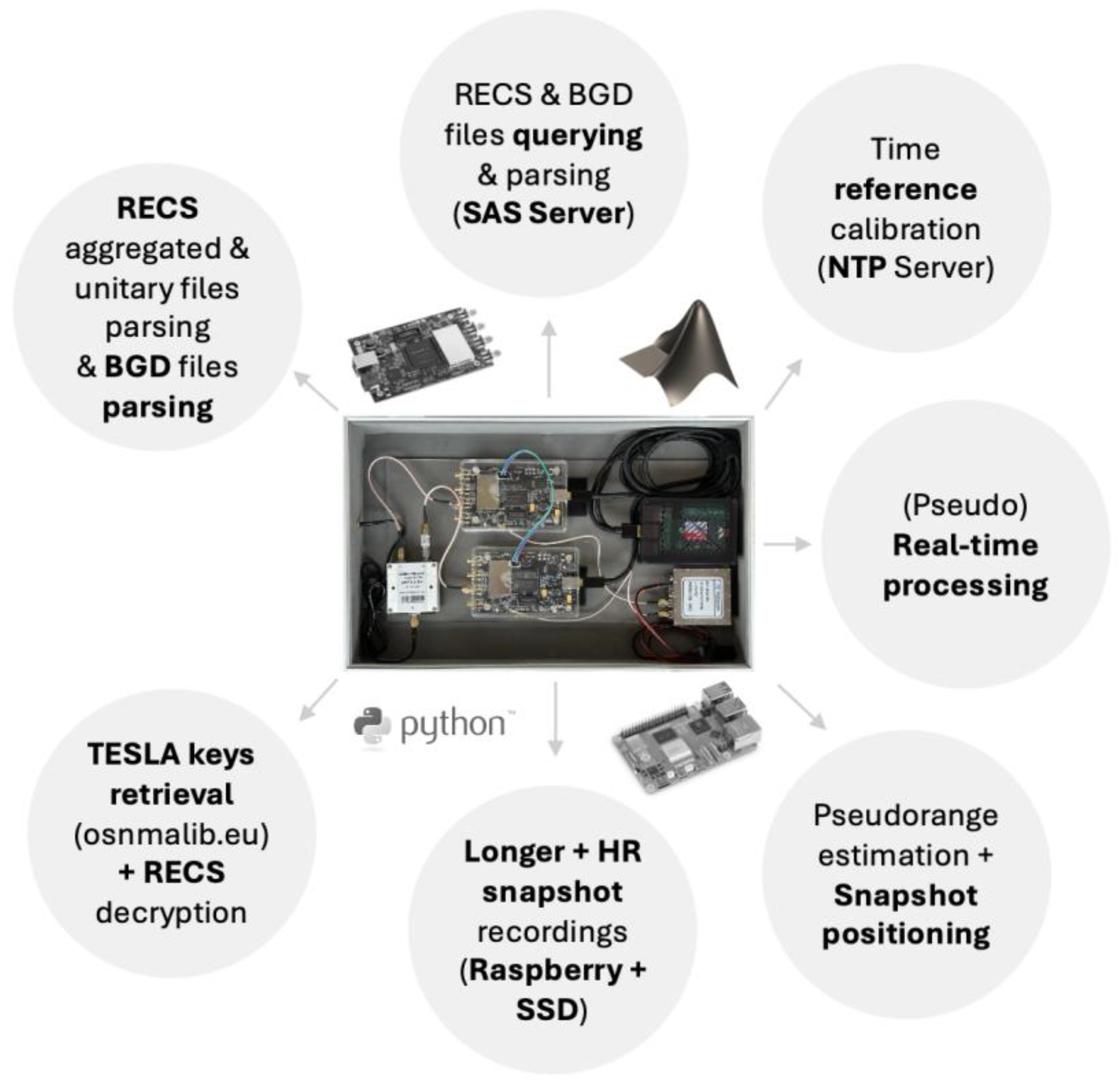
- The pre-selected antenna is a geodetic antenna HX-CVX603A, from Harxon Corp. (Shenzhen, China) [20], which includes E1-E5-E6 frequencies. The receiver will be tested with other non-geodetic antennas.
- The splitter allows the signal to be directed to two receivers, the actual SAS receiver, and a “ground truth” receiver used for validation purposes.
- The main block of the SAS receiver is GMV’s BROS receiver (Breadboard Receiver with OSNMA), which in turn is composed of a THOR Front-End developed by GMV, including three channels (E1, E5, E6), up to 10-bit I/Q samples at 100 Msps and highly configurable, with additional capability to record 200 ms snapshots every second, stored as sample files with 20 MHz bandwidth and 8 bit resolution (4-bit I/Q); a Mercury XU1 System-on-Chip with a compact, space-saving form factor, and based on a Zynq Ultrascale+ MPSoC; and a Mercury ST1 board to integrate XU1’s FPGA, including USB, HDMI and other connectors [21].
- A Septentrio Mosaic X5 reference receiver (Septentrio, Leuven, Belgium) is used as “ground truth”, allowing an independent RTK-based position as well as independent anti-jamming/spoofing checks for comparison purposes.
- A six-axes (3 × accelerometers/gyroscopes) Inertial Measurement Unit (IMU) MIKROE Me6DOF Click is included as a configurable input to the rest of the receiver, that is expected to also function without it.
- A real time clock RTC 8 Click from MIKROE is integrated, as a source of GNSS-independent timing, in addition to NTP/NTS [22].
- The IMU and RTC are connected to a Raspberry Pi (Raspberry Pi Trading Ltd, Cambridge, UK). This system is synchronized with the GNSS signal using the 1PPS provided by the BROS receiver.
- The main processing hardware is based on a ASRock NUC-155H motherboard, using an Intel Core Ultra 7 155H processor (Intel Corporation, Santa Clara, CA, USA). This is the board where the SAS PVT logic, consistency checks, and other processing takes place.
- The SAS receiver includes a switch allowing the connection by Ethernet of the three main modules: the BROS receiver, the ASRock processing hardware, and the Raspberry Pi, and externally to a controlling user laptop.
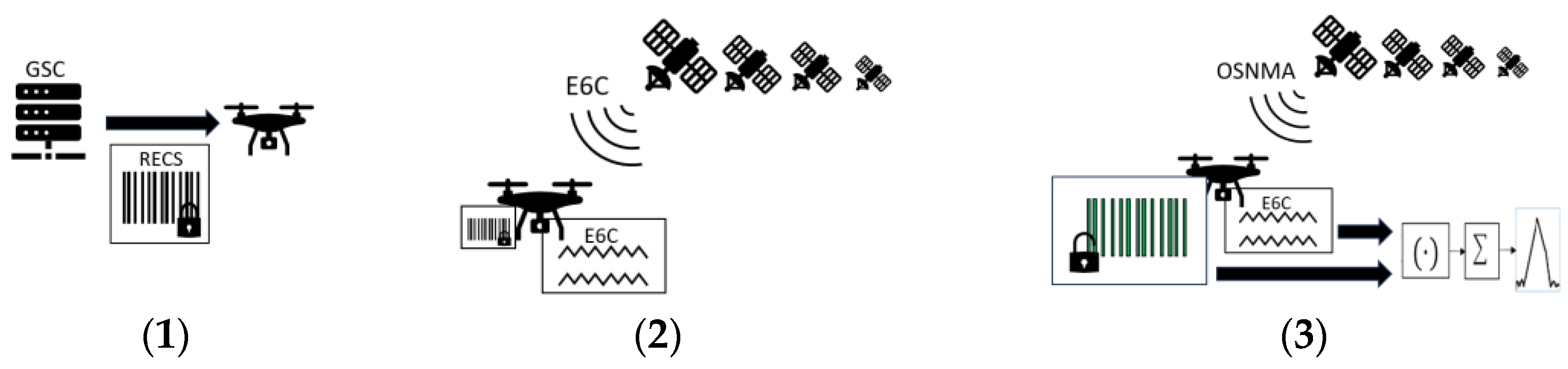
- Finally, a Wi-Fi hotspot allows wireless connection with the laptop and the processing hardware. It also allows downloading the RECS/BGD/SLOG files from the SAS server.
3.2. SAS Prototype Server
3.3. Testing Platforms
3.4. MMARIO Testing Activities
4. SAS Initial Capability and Next Steps Toward Service Declaration
- -
- Initial Capability (Phase 0): It starts with L3 satellites, and will later be extended to the full constellation. It will be based on the SAS prototype server and access will be limited. The access policy to the SAS server information is under definition but it is expected that it will be gradually opened during this phase.
- -
- Initial Service (Phase 1): It will start with the Initial Service Declaration by the end of 2026, allowing global and free use of SAS.
- -
- Full Service (Phase 2): It will start with the Full Service Declaration, introducing some improvements with respect to Phase 1. This is foreseen in the next years, and under consolidation with the Galileo 2nd Generation schedule.
5. SAS Receiver Considerations
6. Conclusions
Author Contributions
Funding
Institutional Review Board Statement
Informed Consent Statement
Data Availability Statement
Acknowledgments
Conflicts of Interest
Abbreviations
| ACAS | Assisted Commercial Authentication Service |
| BGD | Broadcast Group Delay |
| BROS | Breadboard Receiver with OSNMA |
| CS | Commercial Service |
| CAS | Commercial Authentication Service |
| COTS | Commercial Off-The-Shelf |
| GSC | GNSS Service Centre |
| HAS | High Accuracy Service |
| HTTPS | HyperText Transfer Protocol Secure |
| ICD | Interface Control Document |
| IDD | Internet Data Distribution |
| IMU | Inertial Measurement Unit |
| L3 | Launch 3 |
| MMARIO | Message and Measurement Authentication Receiver for Initial Operations |
| NTP | Network Time Protocol |
| NTS | Network Time Security |
| OSNMA | Open Service Navigation Message Authentication |
| PKI | Public Key Infrastructure |
| RECS | Re-Encrypted Code Sequences |
| RTK | Real Time Kinematics |
| SAS | Signal Authentication Service |
| SDD | Service Definition Document |
| SLOG | Status and LOG |
References
- EC. Commission Implementing Decision (EU) 2017/224 of 8 February 2017 (CS Implementing Act); EC: Brussels, Belgium, 2017. [Google Scholar]
- European Union. Galileo OSNMA (Open Service Navigation Message Authentication) SIS ICD v1.1; EUSPA: Prague, Czech Republic, 2023. [Google Scholar]
- European Union. Galileo High Accuracy Service Signal-In-Space Interface Control Document (HAS SIS ICD) Issue 1.0; EUSPA: Prague, Czech Republic, 2022. [Google Scholar]
- EC. Commission Implementing Decision (EU) 2018/321 of 2 March 2018 (Amending Implementing Decision (EU) 2017/224); EC: Brussels, Belgium, 2018. [Google Scholar]
- SKAI Data Services. “GPSwise”. Available online: https://gpswise.aero/map/ (accessed on 5 February 2026).
- Liu, Z.; Lo, S.; Blanch, J.; Walter, T. GNSS spoofing detection and localization using ADS-B data. In Proceedings of the 37th International Technical Meeting of the Satellite Division of The Institute of Navigation (ION GNSS+ 2024), Baltimore, MD, USA, 16–20 September 2024; pp. 796–803. [Google Scholar]
- Fernandez-Hernandez, I.; Damy, S.; Susi, M.; Martini, I.; Cancela-Diaz, S.; Chamorro-Moreno, A.; Calle-Calle, D.; de Blas, J.; Simon, J.; Blonski, D.; et al. Galileo Authentication and High Accuracy: Getting to the Truth. InsideGNSS 2023. Available online: https://insidegnss.com/galileo-authentication-and-high-accuracy-getting-to-the-truth/ (accessed on 5 February 2026).
- EC. Commission Implementing Decision (EU) 2024/1882 Amending Commission Implementing Decision (EU) 2017/224 [...] as Regards the Free Provision of a Signal Authentication Service; EC: Brussels, Belgium, 2024. [Google Scholar]
- Fernandez-Hernandez, I.; Winkel, J.; O’driscoll, C.; Cancela, S.; Terris-Gallego, R.; López-Salcedo, J.A.; Seco-Granados, G.; Chiara, A.; Sarto, C.; Blonski, D.; et al. Semi-Assisted Signal Authentication for Galileo: Proof of Concept and Results. IEEE Trans. Aerosp. Electron. Syst. 2023, 59, 4393–4404. [Google Scholar] [CrossRef]
- Winkel, J.; Fernandez-Hernandez, I.; O’Driscoll, C. Implementation Considerations for ACAS and Simulation Results. IEEE Trans. Aerosp. Electron. Syst. 2024, 60, 5856–5867. [Google Scholar] [CrossRef]
- Winkel, J.; Fernandez-Hernandez, I.; O’Driscoll, C. Combining Galileo’s Assisted Commercial Authentication Service (ACAS) with Vestigial Signal Search for Good Protection. In Proceedings of the 2024 International Technical Meeting of The Institute of Navigation, Long Beach, CA, USA, 23–25 January 2024; pp. 1225–1234. [Google Scholar]
- Terris-Gallego, R.; Fernandez-Hernandez, I.; López-Salcedo, J.A.; Seco-Granados, G. Guidelines for Galileo assisted commercial authentication service implementation. In Proceedings of the International Conference on Localization and GNSS (ICL-GNSS), Tampere, Finland, 7–9 June 2022; IEEE: New York, NY, USA, 2022; pp. 1–7. [Google Scholar]
- Ardizzon, F.; Crosara, L.; Laurenti, N.; Tomasin, S.; Montini, N. Authenticated timing protocol based on Galileo ACAS. Sensors 2022, 22, 6298. [Google Scholar] [CrossRef] [PubMed]
- EC. Galileo Assisted Commercial Authentication Service (ACAS) Specification Proposal V1.2—Defis.c.2(2023)3652705. 2023. Available online: https://ec.europa.eu/info/funding-tenders/opportunities/portal/screen/opportunities/tender-details/docs/etender/14288/14288_171651_EN-Annex%2011%20defis.c.2(2023)3652705.GalileoACASv1.2_ENG_V1.pdf (accessed on 26 September 2025).
- Fernandez-Hernandez, I.; Winkel, J.; O’driscoll, C.; Cancela, S.; Terris-Gallego, R.; López-Salcedo, J.A.; Seco-Granados, G.; Chiara, A.; Sarto, C.; Blonski, D.; et al. Galileo Signal Authentication Service (SAS). In Proceedings of the 37th International Technical Meeting of the Satellite Division of the Institute of Navigation (ION GNSS+ 2024), Baltimore, MD, USA, 16–20 September 2024; pp. 3292–3307. [Google Scholar]
- European Union. E6-B/C Signal-In-Space Technical Note, Issue 1, January 2019; EUSPA: Prague, Czech Republic, 2019. [Google Scholar]
- EUSPA. “Galileo PKI”. Available online: https://www.euspa.europa.eu/about/corporate-documents/pki-public-key-infrastructure (accessed on 5 February 2025).
- European Union. Galileo OSNMA (Open Service Navigation Message Authentication) IDD ICD v1.1; EUSPA: Prague, Czech Republic, 2024. [Google Scholar]
- EC. EU Funding and Tenders Portal—DEFIS/2023/OP/0011. Available online: https://ec.europa.eu/info/funding-tenders/opportunities/portal/ (accessed on 5 February 2026).
- Harxon. Ruggedized Antenna HX-CVX603A. Available online: https://en.harxon.com/product/detail/73 (accessed on 5 February 2026).
- Mercury. Enclustra FPGA Solutions | Mercury + ST1. Available online: https://www.enclustra.com/en/products/base-boards/mercury-st1/ (accessed on 5 February 2026).
- MIKROE. RTC-8-CLICK. Available online: https://www.mikroe.com/rtc-8-click (accessed on 5 February 2026).
- HP. HPE Proliant DL360 Gen11. Available online: https://buy.hpe.com/be/en/compute/c/15351?q=&textSearch=Proliant (accessed on 5 February 2026).
- Franke, D.; Sibold, D.; Teichel, K.; Dansarie, M.; Sundblad, R. Network Time Security for the Network Time Protocol. 2020. Available online: https://datatracker.ietf.org/doc/html/rfc8915 (accessed on 5 February 2026).
- Available online: https://teleorbit.eu/satnav/mgse/ (accessed on 5 February 2026).
- Terris-Gallego, R.; Fernandez-Hernandez, I.; López-Salcedo, J.A.; Seco-Granados, G. E1-E6 SDR platform based on bladeRF for testing Galileo Assisted Commercial Authentication Service. Eng. Proc. 2023, 54, 29. [Google Scholar] [CrossRef]
- Terris-Gallego, R.; López-Salcedo, J.A.; Seco-Granados, G.; Fernandez-Hernandez, I. Preliminary Evaluation of Galileo ACAS Using Existing E1-E6 Open Signals and a Low-Cost SDR Platform. In Proceedings of the 36th International Technical Meeting of the Satellite Division of The Institute of Navigation (ION GNSS + 2023), Denver, CO, USA, 11–15 September 2023; pp. 1388–1402. [Google Scholar] [CrossRef]
- Terris-Gallego, R. Analysis and Implementation of Anti-Spoofing Detection Methods Based on Galileo Signal Authentication Service. Ph.D. Thesis, UAB, Bellaterra, Spain, 2024. [Google Scholar]
- NUAND. BladeRF 2.0. Available online: https://www.nuand.com/bladerf-2-0-micro/ (accessed on 5 February 2026).
- Seco-Granados, G.; Gómez-Casco, D.; López-Salcedo, J.A.; Fernández-Hernández, I. Detection of Replay Attacks to GNSS based on Partial Correlations and Authentication Data Unpredictability. GPS Solut. 2020, 25, 33. [Google Scholar] [CrossRef]
- OSNMAlib Github Repository. Available online: https://github.com/Algafix/OSNMA (accessed on 5 February 2026).
- OSNMAlib. Available online: https://osnmalib.eu/ (accessed on 5 February 2026).
- European Union. Galileo Open Service Navigation Message Authentication (OSNMA) Service Definition Document (SDD). Issue 1.0. 2025. Available online: https://www.gsc-europa.eu/sites/default/files/sites/all/files/Galileo-OSNMA-SDD_v1.0.pdf (accessed on 5 February 2026).
- Galileo Open Service Navigation Message Authentication (OSNMA) Information Note. Available online: https://op.europa.eu/en/publication-detail/-/publication/62b61a6d-4b49-11ec-91ac-01aa75ed71a1/language-en (accessed on 5 February 2026).


Disclaimer/Publisher’s Note: The statements, opinions and data contained in all publications are solely those of the individual author(s) and contributor(s) and not of MDPI and/or the editor(s). MDPI and/or the editor(s) disclaim responsibility for any injury to people or property resulting from any ideas, methods, instructions or products referred to in the content. |
© 2026 by the authors. Licensee MDPI, Basel, Switzerland. This article is an open access article distributed under the terms and conditions of the Creative Commons Attribution (CC BY) license.
Share and Cite
Fernandez-Hernandez, I.; Winkel, J.; O’Driscoll, C.; Willems, T.; Cancela, S.; Ramirez, M.A.; Terris-Gallego, R.; Lopez-Salcedo, J.A.; Seco-Granados, G.; Fuchs, F.; et al. Prototyping Galileo Signal Authentication Service: Current Status and Plans. Eng. Proc. 2026, 126, 40. https://doi.org/10.3390/engproc2026126040
Fernandez-Hernandez I, Winkel J, O’Driscoll C, Willems T, Cancela S, Ramirez MA, Terris-Gallego R, Lopez-Salcedo JA, Seco-Granados G, Fuchs F, et al. Prototyping Galileo Signal Authentication Service: Current Status and Plans. Engineering Proceedings. 2026; 126(1):40. https://doi.org/10.3390/engproc2026126040
Chicago/Turabian StyleFernandez-Hernandez, Ignacio, Jon Winkel, Cillian O’Driscoll, Tom Willems, Simon Cancela, Miguel Alejandro Ramirez, Rafael Terris-Gallego, Jose A. Lopez-Salcedo, Gonzalo Seco-Granados, Florian Fuchs, and et al. 2026. "Prototyping Galileo Signal Authentication Service: Current Status and Plans" Engineering Proceedings 126, no. 1: 40. https://doi.org/10.3390/engproc2026126040
APA StyleFernandez-Hernandez, I., Winkel, J., O’Driscoll, C., Willems, T., Cancela, S., Ramirez, M. A., Terris-Gallego, R., Lopez-Salcedo, J. A., Seco-Granados, G., Fuchs, F., Caparra, G., Blonski, D., Motella, B., Galan, A., & Simon, J. (2026). Prototyping Galileo Signal Authentication Service: Current Status and Plans. Engineering Proceedings, 126(1), 40. https://doi.org/10.3390/engproc2026126040