1. Introduction
Global Navigation Satellite Systems (GNSS) have provided a reliable source of positioning, navigation and timing (PNT) for decades through redundant satellite constellations, making GNSS an essential component with applications across all fields, including terrestrial, maritime and airborne transportation, agriculture, surveying, and more.
A crucial part of GNSS positioning is the estimation and compensation of the various perturbations influencing signal transmission from satellites in medium Earth orbit (MEO) to users. Atmospheric perturbations from the ionosphere and troposphere are major sources of error, delaying signal arrival by a few meters up to several dozen meters [
1]. Realistic modeling of these effects is therefore crucial in GNSS simulation and has historically been provided by empirical models such as the Saastamoinen model. For example, the Skydel simulation software (version 24.4) developed by Safran Electronics & Defense implements the Saastamoinen model combined with Niell mapping functions as one of its available options to model the tropospheric delay applied to GNSS signals.
This paper presents the construction of a feedforward neural network trained to predict the highly variable Zenith Wet Delay (ZWD), an essential component involved in the modeling of tropospheric delay affecting GNSS signals in simulation environments, to create a hybrid tropospheric model. The ZWD component is predicted by the machine learning model using meteorological parameters along with time and position information.
In this paper, we focus on the choices made to establish a model, including the creation of the dataset for training and validation, optimization of the architecture, and integration into a potential hybrid tropospheric model combining machine learning and empirical models for implementation in the Skydel simulator. A comparison of this proposed model with existing tropospheric estimation methods in the simulator, using tropospheric delay measurements from several reference IGS stations, is presented to showcase the efficiency of the new approach.
This paper is organized as follows:
Section 2 provides an overview of current modeling approaches for tropospheric delay.
Section 3 describes the design choices made for the developed machine learning model.
Section 4 showcases the model’s performance compared to existing models and measured data, followed by a discussion in
Section 5.
Section 6 concludes the paper by summarizing the key findings and suggesting directions for future research.
2. Tropospheric Delay Modeling
In the GNSS domain, the “troposphere” refers to the lowest atmospheric layer on Earth, located between the surface and an altitude of approximately 60 km. The troposphere has a significant impact on GNSS signals that travel through it, via the addition of an extra time delay, ranging from a few meters to several dozen meters in terms of additional range. This tropospheric delay, unlike other error sources such as the ionosphere, is a non-dispersive medium. This results in frequency independence for the group delay introduced by the troposphere, making it impossible to remove through the combined usage of GNSS signals of different central frequencies, which is one of the standard ways used to cancel out the group delay introduced by the ionosphere [
1].
The tropospheric delay is therefore mainly compensated using empirical models that approximate its impact on signal propagation delay. In such models, the tropospheric delay is usually separated into two components: the hydrostatic component delay, modeling the impact of dry air components, and the wet component delay, modeling the impact of water vapor and weather conditions on the signal delay. The hydrostatic component accounts for approximately 90% of the total tropospheric delay and is characterized by a slow and predictable variation. In contrast, the wet component accounts for the remaining 10% of tropospheric delay but is more variable and thus harder to predict [
2].
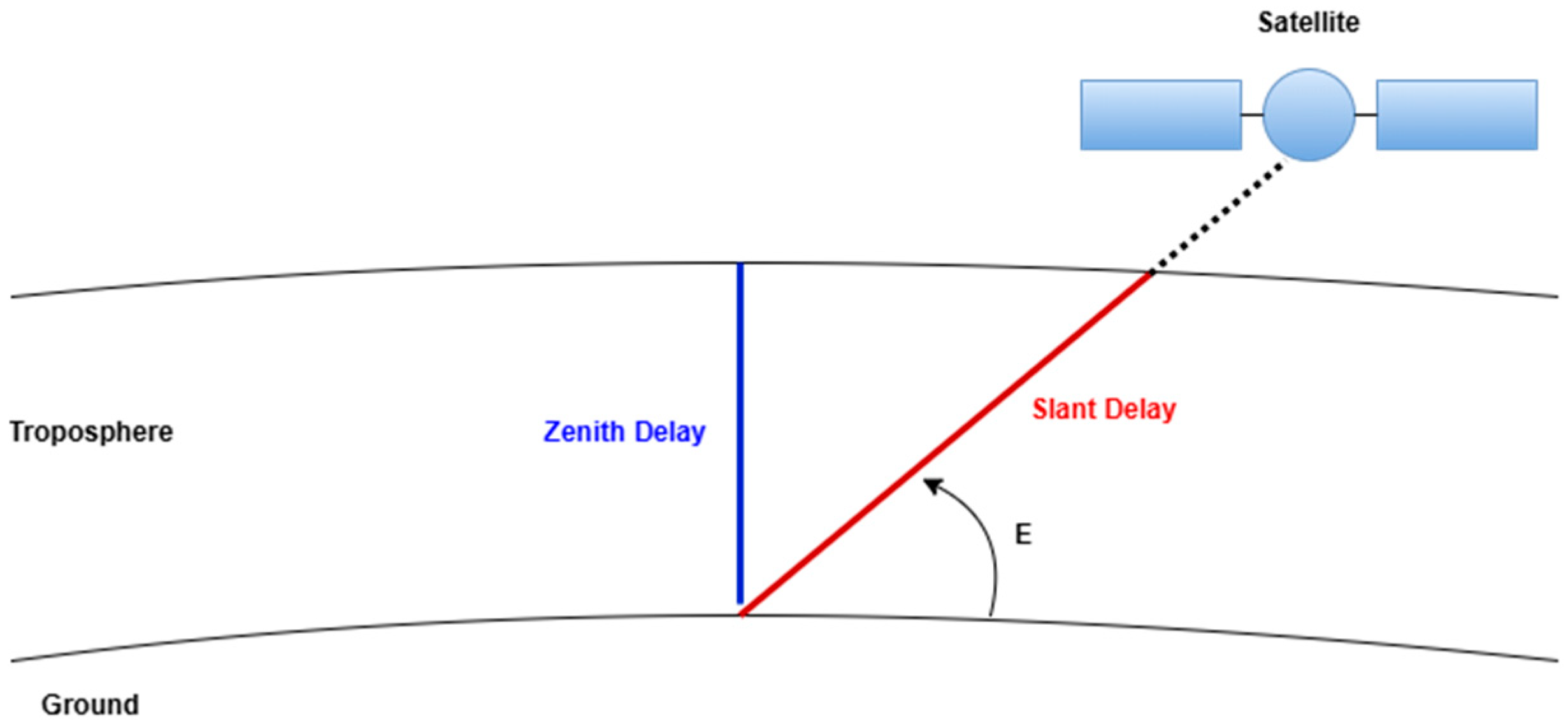
The tropospheric delay added to a satellite signal is generally the lowest when the satellite is at the zenith of the observer’s position, as the signal path will usually travel a shorter distance through the troposphere. Conversely, the tropospheric delay is usually the highest for satellites close to the horizon for an observer on Earth, as the signal travels a longer path through the troposphere, which is schematized in
Figure 1. When modeling the tropospheric delay, it is standard to separate each component into an elevation-dependent coefficient function and an elevation-independent coefficient representing the tropospheric delay for a satellite at zenith. We can summarize the slant tropospheric delay (STD), representing the total tropospheric delay applied to a signal at a given elevation, as
where STD is the slant total delay expressed in meters; E is the elevation angle of the satellite source of the signal in radians; ZHD is the zenith hydrostatic delay in meters, representing the hydrostatic component of tropospheric delay for a satellite at 90 degrees elevation; ZWD is the zenith wet delay in meters, representing the wet component of tropospheric delay for a satellite at 90 degrees elevation; and
and
are coefficient functions modeling the elevation-dependent characteristics of each component, and are referred to as “mapping functions”.
The Saastamoinen model [
3] is an empirical tropospheric model commonly used to represent both wet and hydrostatic zenith components. The zenith hydrostatic component (
) showed in Equation (2) depends on the surface pressure at the receiver location and the satellite position, whereas the zenith wet component (
) shown in Equation (3) depends on temperature and water vapor pressure, and satellite position. In common applications of the Saastamoinen model, such as the Galileo Tropospheric Correction model, the Niell model is usually considered for mapping functions [
4,
5].
where p is the surface pressure in hPa, ϕ is the source satellite latitude in radians, H is the ellipsoidal height in meters, T is the temperature in Kelvin, and e is the vapor pressure in hPa. All meteorological parameters are taken at the receiver location. These equations are commonly used in GNSS simulation, such as in the Skydel GNSS simulation software, to estimate the tropospheric delay applied to all satellite signals. Aside from the latitude, which depends on the simulated user location, other meteorological parameters are usually taken as constants.
Previous studies have showcased the accuracy of the Saastamoinen model for modeling the ZHD component, achieving a root mean square error (RMSE) of less than 2 mm [
6]. In contrast, ZWD modeling produces significantly worse results, with an RMSE reaching up to several centimeters in specific areas [
7], an expected result when considering the unpredictable nature of the ZWD component. This results in the ZWD component being the main source of error for the tropospheric delay modeling, emphasizing the need for a more accurate alternative for the prediction of this component.
3. Machine Learning Model Design
As machine learning approaches have previously showcased remarkable efficiency in modeling highly variable phenomena, it was decided to create and train such a model to predict the ZWD component of the tropospheric delay. A machine learning approach was particularly prioritized due to the large amount of data available, facilitating training and validation of the machine learning model. Indeed, decades of high-quality GNSS data, among which tropospheric delay measurements, are available for hundreds of stations across the globe, particularly from the International GNSS Service (IGS), in open access to the public.
This ZWD-predicting machine learning model aims to be used in conjunction with already implemented Niell mapping functions and Saastamoinen ZHD prediction model, to provide a hybrid tropospheric modeling solution, replacing the empirical model in areas where it was shown to be inaccurate.
Previous studies have demonstrated the efficiency of simple feed-forward neural networks (FFNN) [
8,
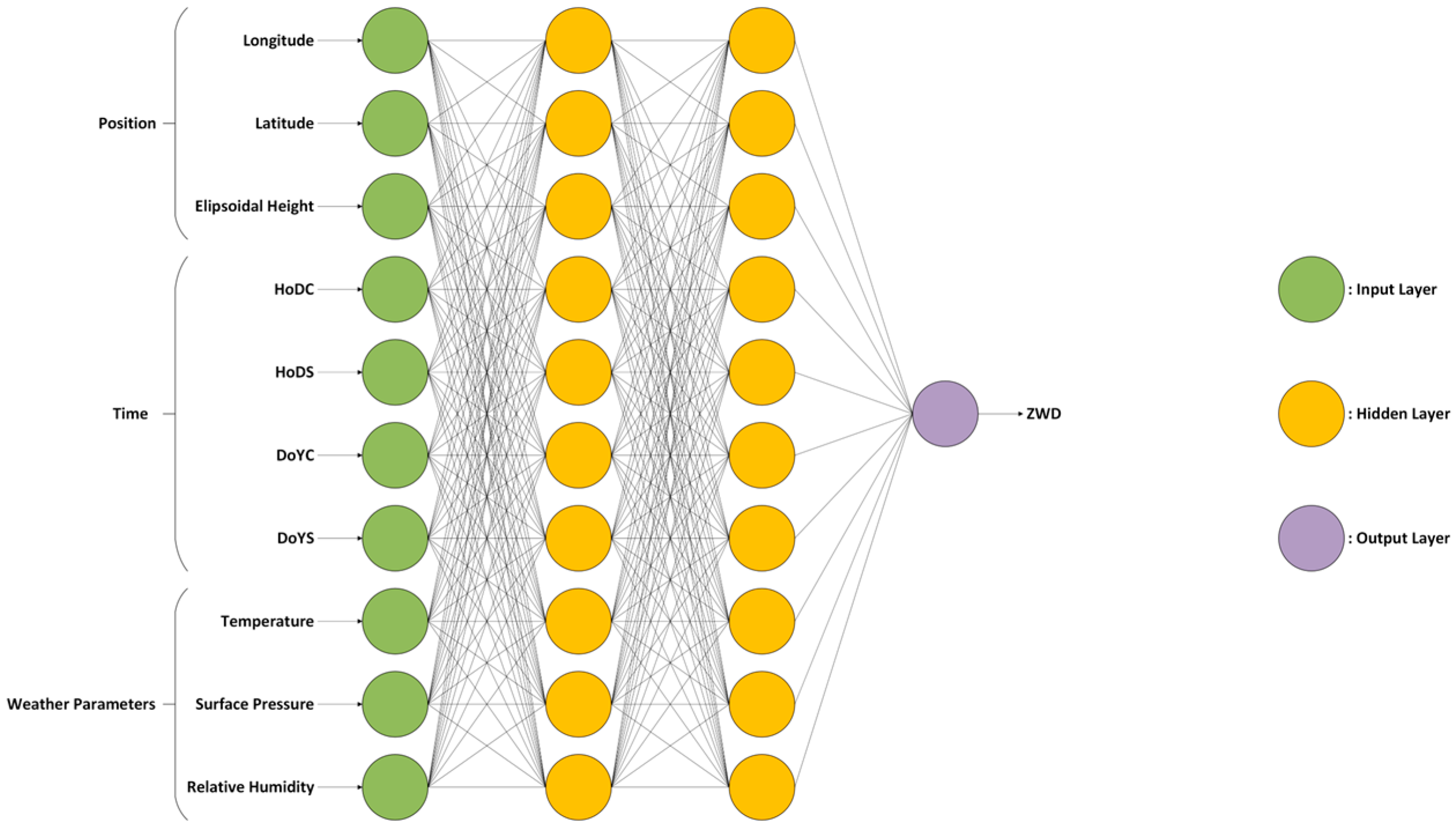
9] in ZWD modeling, resulting in root mean square errors of only a few centimeters. Given these results and the need for real-time inference within the Skydel simulator, a lightweight architecture was selected for its balance of accuracy and computational efficiency. Based on this observation, it was decided to use a fully connected neural network with two hidden layers. The model layout is represented in
Figure 2. The model has only one output—the ZWD value—and ten input neurons, including three position inputs for the geodetic longitude, latitude and the ellipsoidal height of the simulated position; three meteorological inputs for surface temperature; surface pressure and relative humidity; and four time-related inputs representing the quadrature components for the day of year and hour of the day:
This choice was inspired by the study from Jianping Chen and Yang Gao [
8]. The model uses more input features than the Saastamoinen ZWD model, which does not include pressure or time in its formulation.
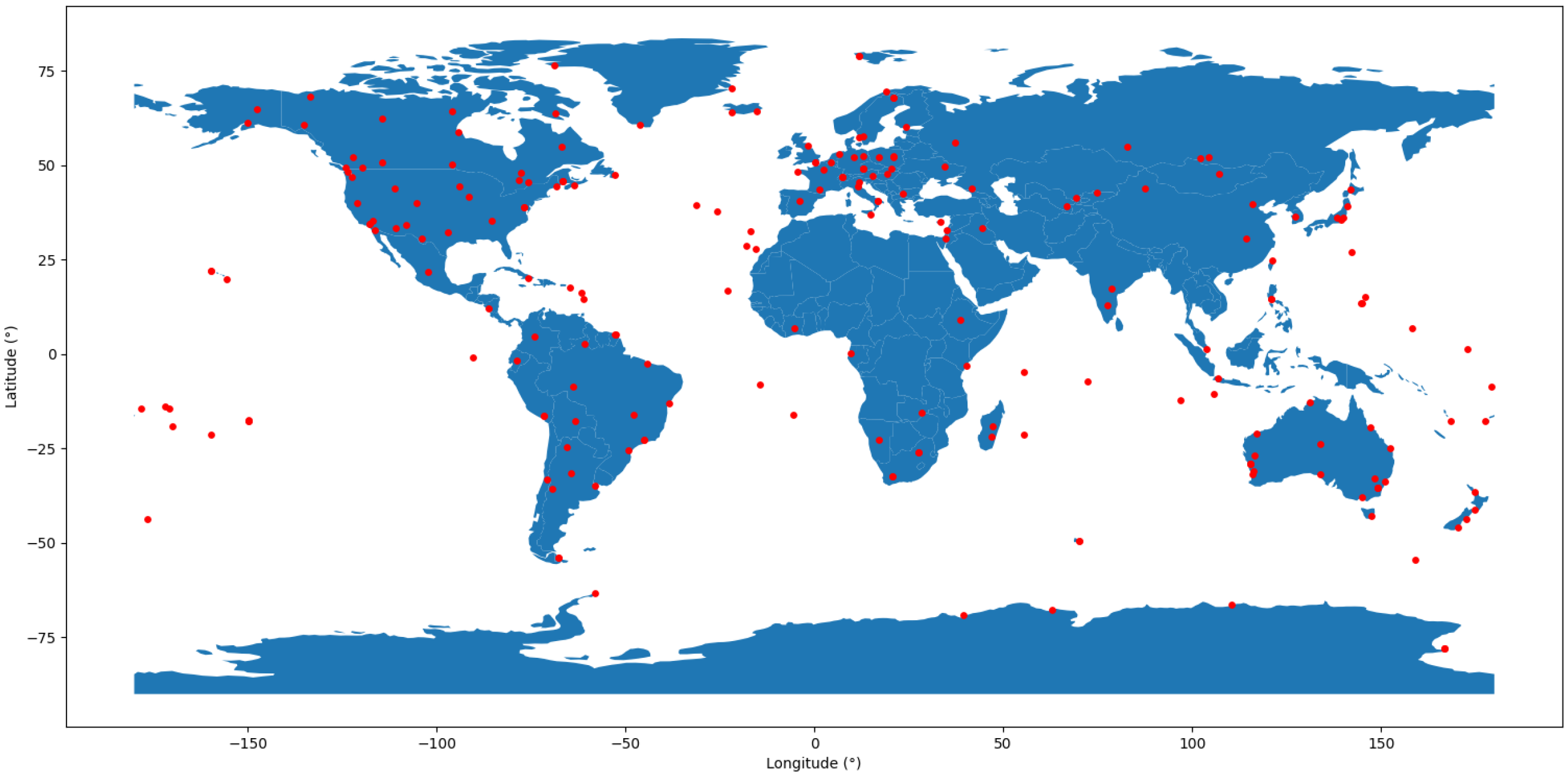
A dataset for training and testing the above-mentioned model was compiled using ZWD measurements from hundreds of IGS network stations worldwide, downloaded from the University of Bern’s FTP server. This selection resulted in 221 station locations, shown on the map in
Figure 3, covering 20 years from early 2004 to the end of 2023, with a two-hour sampling interval. This resulted in a dataset of over 14 million samples. Normalized feature values for all measurements were collected at all station locations, using meteorological data from the historical weather API of Open-Meteo, including pressure, temperature and water vapor values. Time feature values were extracted from the measurement data itself, completing the collection of input features for all samples.
The dataset was split into subsets for training, validation and testing. Data from 2004 and 2021 was used for training, 2022 for validation, and 2023 for testing. Model hyperparameter optimization was then performed. The selected hyperparameters were batch size, learning rate, and dropout. A minimum and maximum value was specified for each hyperparameter, and every possible combination was evaluated. This grid search allowed the model to identify the optimal configuration. The results are summarized in
Table 1:
4. Model Performances
Once the model was finalized and optimized, its performance was evaluated across all 221 locations for the year 2023 by assessing the mean absolute error (MAE) and root mean square error (RMSE) of the predicted ZWD values. The results obtained were 2.56 cm for MAE and 3.44 cm for the RMSE.
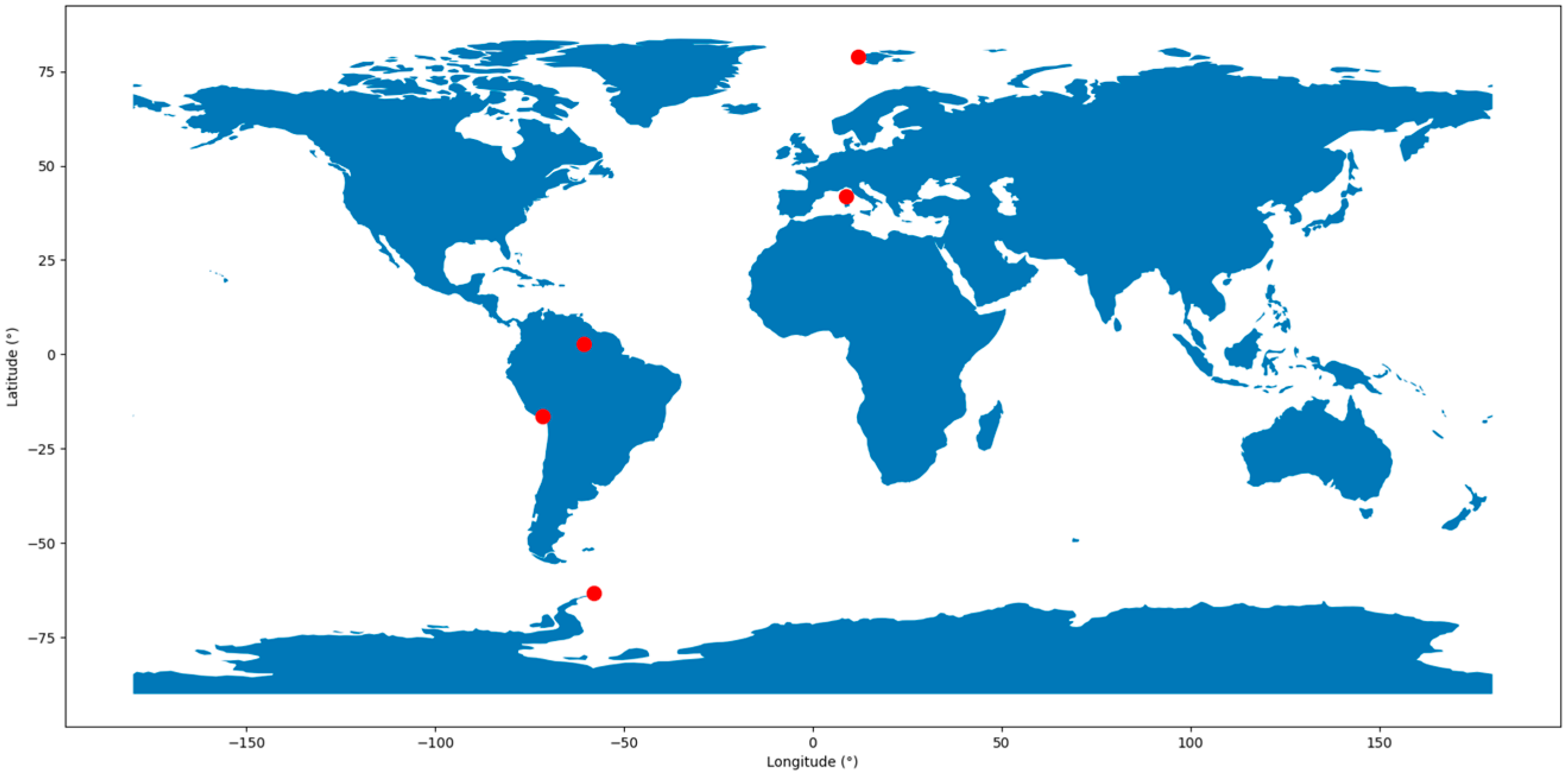
To provide a more detailed analysis, four locations were selected among the 221 stations: NYA1 (78.9° N, island of Svalbard), BOAV (2.8° N, Brazil) and OHI2 (−63.3° N, Antarctica) were chosen to represent high latitude, low latitude and equatorial regions, respectively. AREG (−16.5° N, Peru) was selected as a high-altitude site, located at 2489 m above sea level. Finally, the AJAC station (41.9° N, Corsica) was chosen as a site distinct from the 221 stations used for training to evaluate the model’s capacity to generalize beyond the training dataset. The stations are identified by the first four letters of their site name, following the IGS network convention. The locations of these five stations are shown in
Figure 4.
Table 2 summarizes the MAE values obtained for ZTD, which is the sum of ZHD and the ZWD. The comparison includes two configurations:
ZTD using ZWD predicted by the machine learning model and ZHD from the Saastamoinen model with real-time meteorological inputs from Open-Meteo.
ZTD using both ZHD and ZWD computed from the Saastamoinen model with constant meteorological parameters.
Figure 4.
Location of the five stations selected for analysis: NYA1, BOAV, OHI2, AREG, AJAC. Each station is represented by a red dot.
Figure 4.
Location of the five stations selected for analysis: NYA1, BOAV, OHI2, AREG, AJAC. Each station is represented by a red dot.
Table 2.
MAE values for ZTD using either the ML model (ZWD + Open-Meteo + Saastamoinen ZHD) or the Saastamoinen model with constant parameters.
Table 2.
MAE values for ZTD using either the ML model (ZWD + Open-Meteo + Saastamoinen ZHD) or the Saastamoinen model with constant parameters.
| Station Name | MAE of ZTD for ML Model and Open Meteo (cm) | MAE of ZTD for Saastamoinen Model (cm) |
|---|
| OHI2 (low latitude) | 1.825 | 9.531 |
| NYA1 (high latitude) | 1.018 | 6.331 |
| BOAV (equator region) | 3.767 | 19.796 |
| AREG (high altitude) | 2.046 | 58.230 |
| AJAC (not used for training) | 2.313 | 4.876 |
For each of these stations,
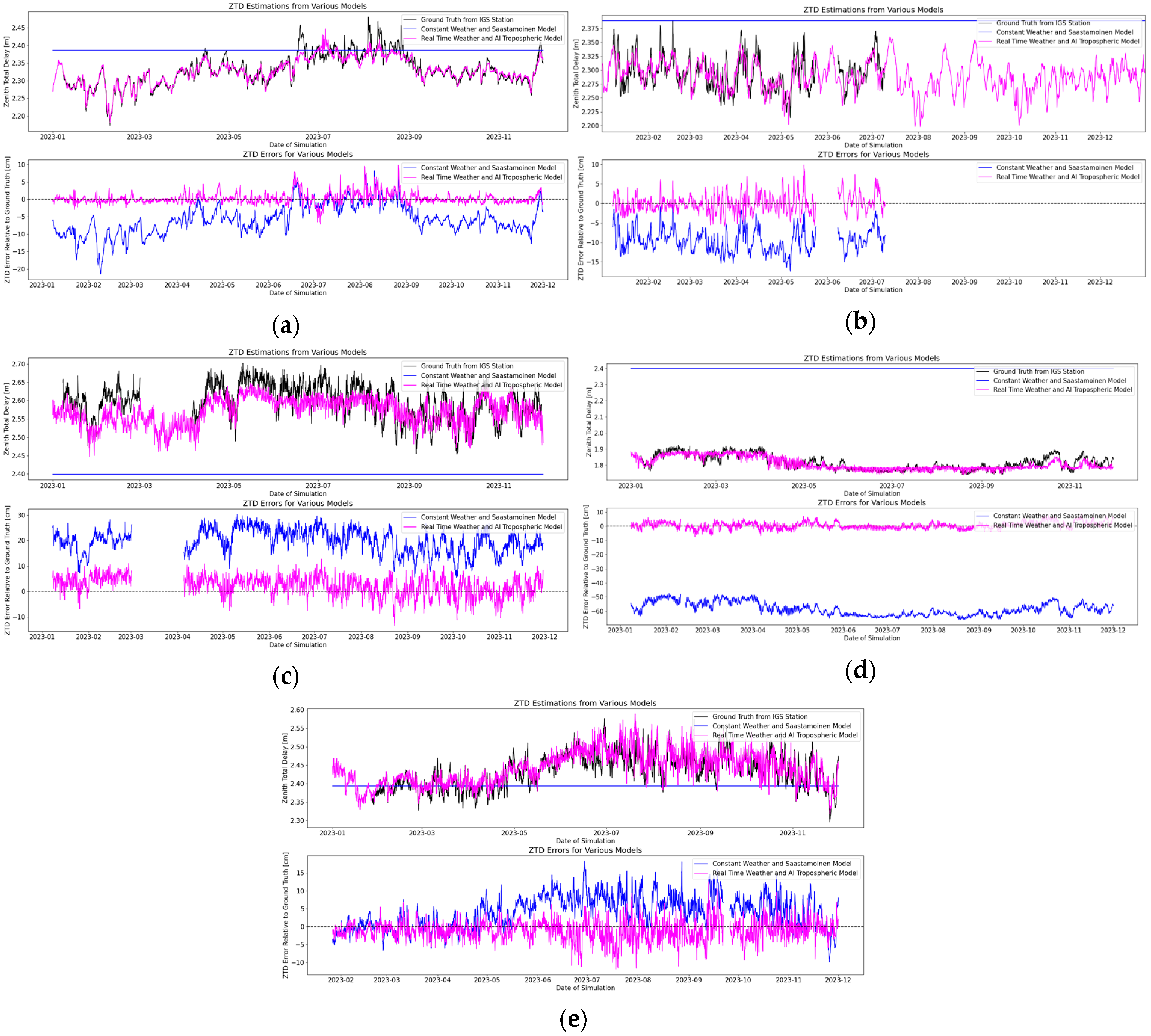
Appendix A provides two plots: the annual ZTD time series and the corresponding error curves comparing both modeling approaches against station measurements.
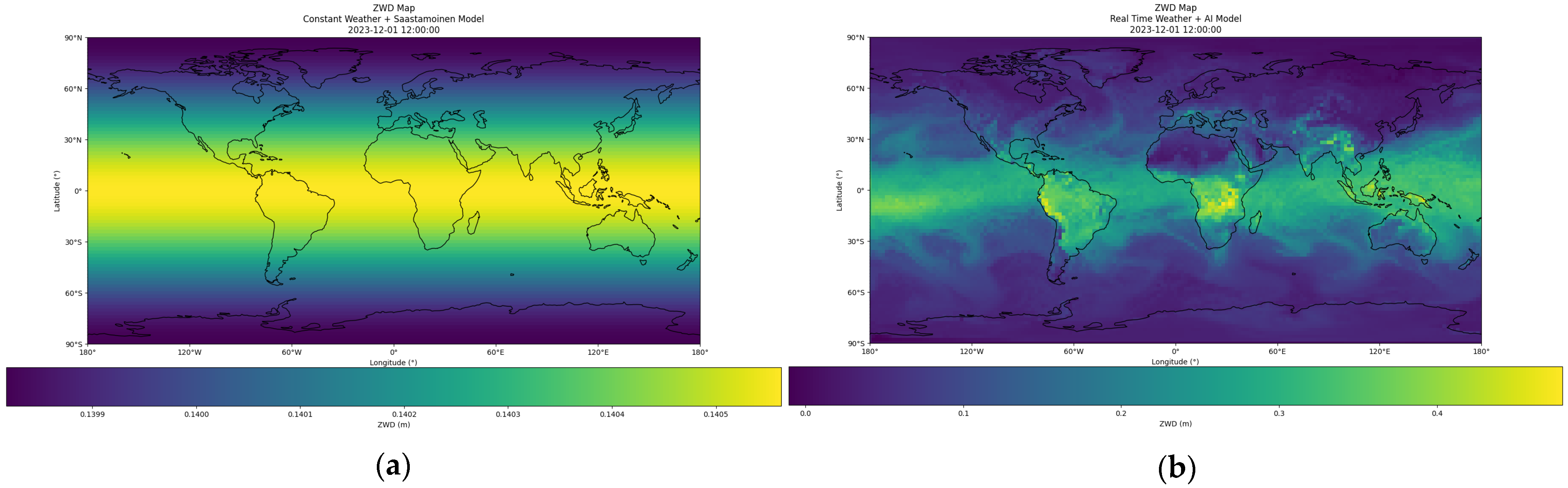
As a final comparison, predictions from the two models were computed globally and plotted on a 2D map. The results are shown and discussed in
Appendix B.
5. Discussion
As shown in
Appendix A (
Figure A1), we can observe at each station that the new model (shown in pink) more closely follows the variations in the station measurements (shown in black) than the existing Saastamoinen model with constant meteorological inputs (shown in blue). Similarly, the error associated with the new model remains closer to zero than that of the existing model. This results in a lower mean absolute error (MAE) for the new model across all five observed stations.
As confirmed by Equation (3), the blue curve—which uses the Saastamoinen equation for ZWD calculation with constant pressure, temperature and humidity values—produces a time-invariant ZTD output. This is a common implementation in GNSS simulation. Since all input variables are fixed for an immobile user (like a ground station), the resulting ZTD does not vary with time. Because the only varying parameter between the plots in
Appendix A is the station latitude, the ZTD curves generated by this model are nearly identical across stations.
The machine learning model with Open-Meteo weather inputs demonstrates significantly better performance, producing ZTD values that vary with time and yield lower errors relative to the station measurements. Unlike the empirical model, this approach captures fast-paced fluctuations, which are typical of the ZWD component. This model exhibits stronger performance at both high and low latitudes, as shown by the MAE values in
Table 2 for the corresponding stations. It also introduces greater spatial variability, resulting in a more realistic representation compared to the nearly uniform values produced by the baseline model, as illustrated in
Appendix B (
Figure A2). However, the accuracy and MAE drop for both models for stations in the equator region.
The combined use of real-time meteorological data and a machine learning model trained on the dataset of 221 global stations appears to be a superior alternative for ZTD estimation, compared to the traditional approach relying solely on empirical formulas with fixed meteorological parameters.
While the evaluation in
Table 2 demonstrates the clear advantage of the hybrid ML model over the traditional Saastamoinen approach with constant parameters, the contributions of real-time meteorological inputs versus the learned ZWD model are inherently combined. Future work may explore comparisons using real-time inputs within the Saastamoinen model to further quantify the impact of each component.
Importantly, the ML model is expected to maintain superior performance even under identical input conditions, as it leverages a large global dataset to capture complex, nonlinear spatiotemporal patterns in tropospheric behavior. This adaptability enables more accurate and dynamic ZWD estimates, particularly in regions with rapidly changing atmospheric conditions.
6. Conclusions
We have developed and trained a simple machine learning model with ten inputs and one output, using over 20 years of tropospheric data from 221 stations worldwide. The model inputs include temporal, positional, and meteorological parameters, and are used to predict the associated Zenith Wet Delay (ZWD) value. Training, validation, and testing were performed using data from IGS network stations between 2004 and 2021, labeled with meteorological data from Open-Meteo. The model achieved a mean absolute error (MAE) of 2.56 cm and a root mean square error (RMSE) of 3.44 cm across all stations for the year 2023.
This model, when used in conjunction with the legacy Saastamoinen model for ZHD prediction and real-time meteorological inputs from Open-Meteo, has demonstrated a significant performance improvement over the existing approach, which relies solely on constant meteorological inputs and empirical models for both ZHD and ZWD.
To improve robustness and flexibility, a complementary machine learning model has also been developed to estimate meteorological inputs (temperature, pressure, and humidity) from time and location data. This enables the hybrid architecture to function even when real-time weather data is unavailable, supporting both retrospective and predictive GNSS simulations.
To build on this work, further evaluation of the individual contributions of the real-time meteorological inputs and the machine learning model could provide deeper insight into the sources of performance gain. Such evaluations will help guide further refinement of the architecture and ensure optimal model selection for varying simulation conditions.
Implementing such a hybrid model in a GNSS simulator, such as the Skydel software (version 24.4) developed by Safran Electronics and Defense, could lead to a global improvement in tropospheric delay simulation accuracy, particularly through the reproduction of rapid ZWD variations. These fluctuations are not captured by existing models, primarily because they rely on constant meteorological inputs, resulting in a static ZTD value for a stationary user. Since the machine learning component of the hybrid model is relatively simple—with only ten inputs, one output, and two hidden layers—the additional computational cost associated with its integration should be minimal.
Author Contributions
Conceptualization, T.C. and Y.M.; methodology, T.C. and Y.M.; software, T.C. and Y.M.; formal analysis, T.C.; data curation, Y.M.; writing—original draft preparation, T.C.; writing—review and editing, Y.M., M.T. and P.-M.L.V.; supervision, M.T. and P.-M.L.V.; project administration, M.T. and P.-M.L.V.; funding acquisition, P.-M.L.V. All authors have read and agreed to the published version of the manuscript.
Funding
This research was carried out with internal advanced R&D funding from Safran Electronics & Defense. The work was conducted during a five-month internship at Safran by Yvan Mezencev, under the supervision of Safran research staff.
Institutional Review Board Statement
Not applicable.
Informed Consent Statement
Not applicable.
Data Availability Statement
The dataset used in this study is a fusion of several independently available data sources: 1. GNSS Tropospheric Data (The tropospheric parameters obtained from GNSS stations are publicly available through NASA’s Crustal Dynamics Data Information System (CDDIS) at:
https://cddis.nasa.gov/archive/gnss/data/ (accessed on 1 June 2024)); 2. Meteorological Data (The meteorological variables used in this work are publicly accessible via the Open Meteo platform:
https://open-meteo.com/ (accessed on 1 June 2024)). The final dataset produced for this study results from the fusion and processing of the above sources. This fused dataset is subject to proprietary and commercial restrictions and is not publicly available.
Conflicts of Interest
All authors were employed by the company Safran Electronics & Defense. The authors declare that this study received funding from Safran Electronics & Defense. The funder was not involved in the study design, collection, analysis, interpretation of data, the writing of this article or the decision to submit it for publication.
Abbreviations
The following abbreviations are used in this manuscript:
| FTP | File Transfer Protocol |
| GNSS | Global Navigation Satellite System |
| IGS | International GNSS Service https://igs.org/ (accessed on 1 June 2024) |
| MAE | Mean Absolute Error |
| ML | Machine Learning |
| PNT | Position, Navigation, and Timing |
| RMSE | Root Mean Square Error |
| STD | Slant Tropospheric Delay |
| ZHD | Zenith Hydrostatic Delay |
| ZTD | Zenith Tropospheric Delay |
| ZWD | Zenith Wet Delay |
Appendix A. Detailed Results for ZTD Predictions by Station
Appendix A.1. Explanation of Figure Contents
For each of the five stations selected for detailed analysis in
Section 4, one figure is presented, containing two plots. These plots display the metrics of interest, described below, over the course of the year 2023. This year corresponds to the portion of the dataset used to test the machine learning model.
The first plot for each station shows:
The ZTD values measured by the station (labeled as “Ground Truth”, in black).
The ZTD values computed using the Saastamoinen model with constant meteorological parameters (in blue).
The ZTD values computed using the AI model for ZWD and the Saastamoinen model for ZHD, with meteorological parameters from Open-Meteo (in pink).
The second plot for each station shows:
The ZTD error using the Saastamoinen model with constant meteorological parameters (in blue).
The ZTD error using the AI model for ZWD and the Saastamoinen model for ZHD, with meteorological parameters from Open-Meteo (in pink).
Appendix A.2. Figures
Figure A1.
Detailed results of ZTD predictions using the Saastamoinen model (blue) and the machine learning model (pink), compared to station measurements (black) during the year 2023, for stations NYA1 (a), OHI2 (b), BOAV (c), AREG (d) and AJAC (e). In each subfigure, the top plot shows the estimated ZTD values, while the bottom plot displays the error (difference) between each model and the station measurements using the same color scheme. A dotted line is included to mark the horizontal axis (y = 0).
Figure A1.
Detailed results of ZTD predictions using the Saastamoinen model (blue) and the machine learning model (pink), compared to station measurements (black) during the year 2023, for stations NYA1 (a), OHI2 (b), BOAV (c), AREG (d) and AJAC (e). In each subfigure, the top plot shows the estimated ZTD values, while the bottom plot displays the error (difference) between each model and the station measurements using the same color scheme. A dotted line is included to mark the horizontal axis (y = 0).
Appendix B. Global ZWD Predictions Maps
Appendix B.1. Explanation of Figure Contents
At the selected date and time (1 December at 12:00 a.m.), Zenith Wet Delay (ZWD) values were computed on a 2° longitude–latitude grid for two configurations:
In addition to verifying that no artifacts contaminate the tropospheric model, these plots also highlight the increased spatial variability provided by the neural network approach compared to the Saastamoinen model, resulting in a more realistic representation.
Appendix B.2. Figures
Figure A2.
Comparison of ZWD predictions from the Saastamoinen model (a) and the machine learning model (b) on 1 December 2024, at 2° spatial resolution.
Figure A2.
Comparison of ZWD predictions from the Saastamoinen model (a) and the machine learning model (b) on 1 December 2024, at 2° spatial resolution.
References
- Xu, G. Physical Influences on GPS Surveying. In GPS: Theory, Algorithms and Applications, 2nd ed.; Springer: Berlin/Heidelberg, Germany; New York, NY, USA, 2007; pp. 55–62. [Google Scholar]
- Bakry El-Arini, M. Tropospheric Effects on GNSS. In Proceedings of the The Atmosphere and its Effect on GNSS Systems, Santiago, Chile, 14–16 April 2008. [Google Scholar]
- Saastamoinen, J. Atmospheric Correction for Troposphere and Stratosphere in Radio Ranging of Satellites. In The Use of Artificial Satellites for Geodesy; Henriksen, S.W., Mancini, A., Chovitz, B.H., Eds.; The American Geophysical Union: Washington, DC, USA, 1973; Volume 15. [Google Scholar]
- Niel, A.E. Global mapping functions for the atmosphere delay at radio wavelengths. J. Geophys. Res. 1996, 101, 3227–3246. [Google Scholar] [CrossRef]
- Marini, J.W. Correction of Satellite Tracking Data for an Arbitrary Tropospheric Profile. Radio Sci. 1972, 7, 223–231. [Google Scholar] [CrossRef]
- Feng, P.; Li, F.; Yan, J.; Zhang, F.; Barriot, J.-P. Assessment of the Accuracy of the Saastamoinen Model and VMF1/VMF3 Mapping Functions concerning Ray-Tracing from Radiosonde Data in the Framework of GNSS Meteorology. Remote Sens. 2002, 12, 3337. [Google Scholar] [CrossRef]
- Yang, F.; Guo, J.; Meng, X.; Li, J.; Zou, J.; Xu, Y. Establishment and assessment of a zenith wet delay (ZWD) augmentation model. GPS Solut. 2021, 25, 148. [Google Scholar] [CrossRef]
- Chen, J.; Gao, Y. A Machine Learning-Based Tropospheric Prediction Approach for High-Precision Real-Time GNSS Positioning. Sensors 2024, 24, 2957. [Google Scholar] [CrossRef] [PubMed]
- Shehaj, E.; Miotti, L.; Geiger, A.; D’Aronco, S.; Wegner, J.D.; Moeller, G.; Rothacher, M. High-resolution tropospheric refractivity fields by combining machine learning and collocation methods to correct Earth observation data. Acta Astronaut. 2023, 204, 591–598. [Google Scholar] [CrossRef]
| Disclaimer/Publisher’s Note: The statements, opinions and data contained in all publications are solely those of the individual author(s) and contributor(s) and not of MDPI and/or the editor(s). MDPI and/or the editor(s) disclaim responsibility for any injury to people or property resulting from any ideas, methods, instructions or products referred to in the content. |