The Influence of Waste Cherry Pits as Coarse Aggregate and Waste Ceramics Powder on Rheological Properties and Strength of Self-Compacting Concrete †
Abstract
1. Introduction
2. Materials and Methods
2.1. Materials
2.1.1. Mixture Design
2.1.2. Concrete Casting and Mixing Procedure
2.2. Test Methods
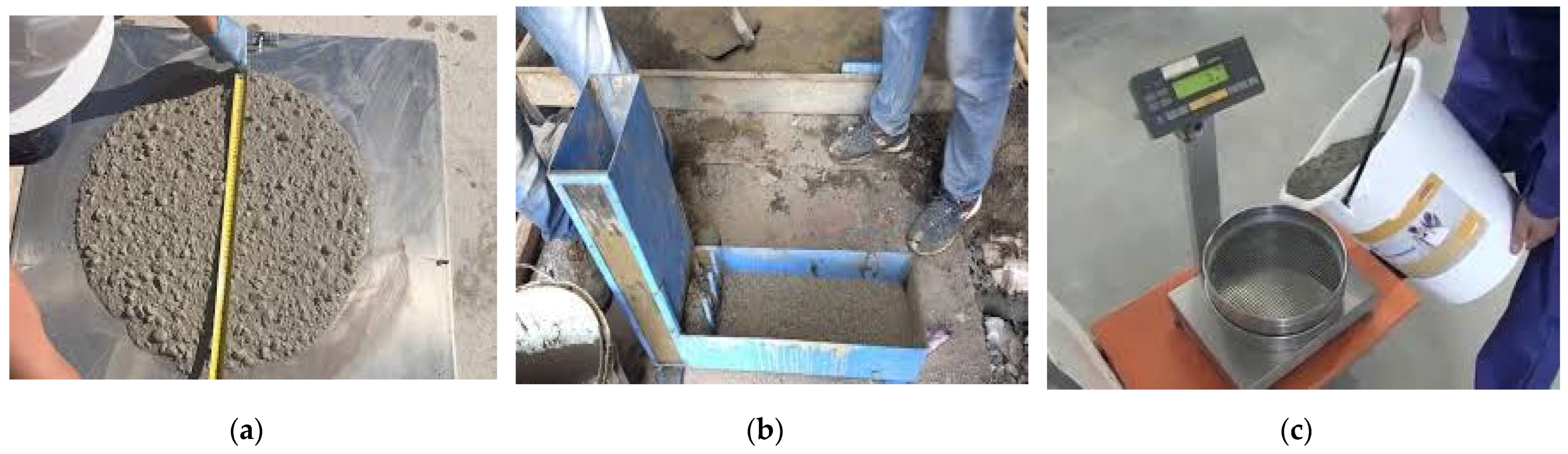
2.2.1. Fresh State Properties
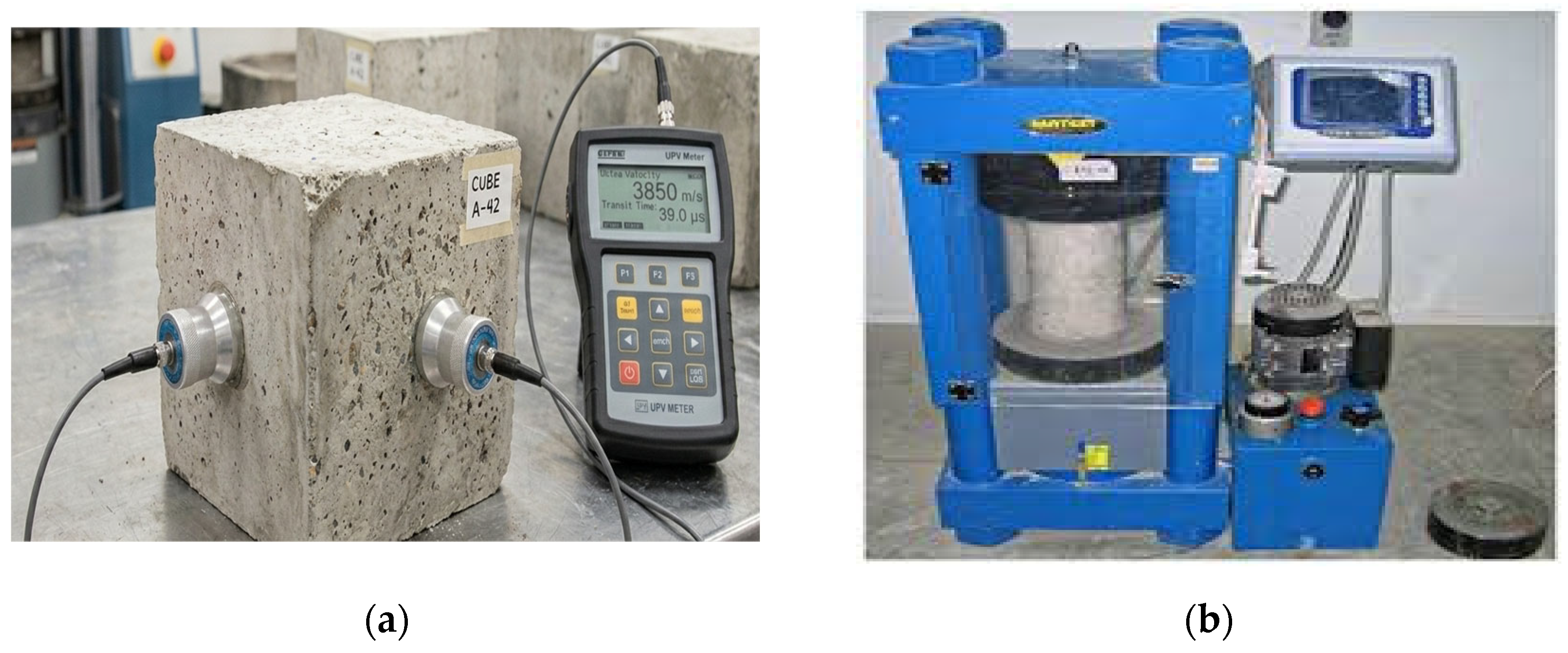
2.2.2. Mechanical Properties
3. Results and Discussion
3.1. Rheological Properties
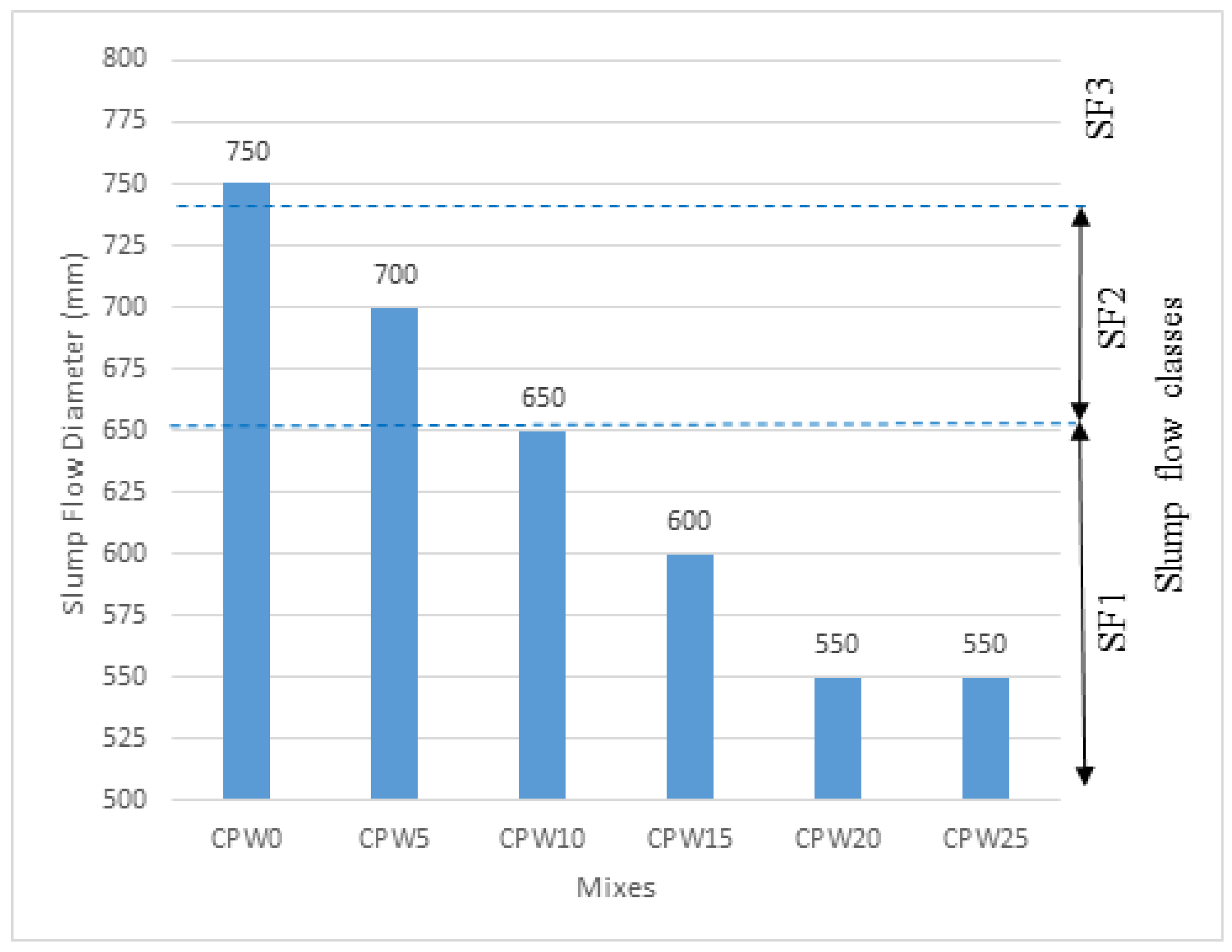
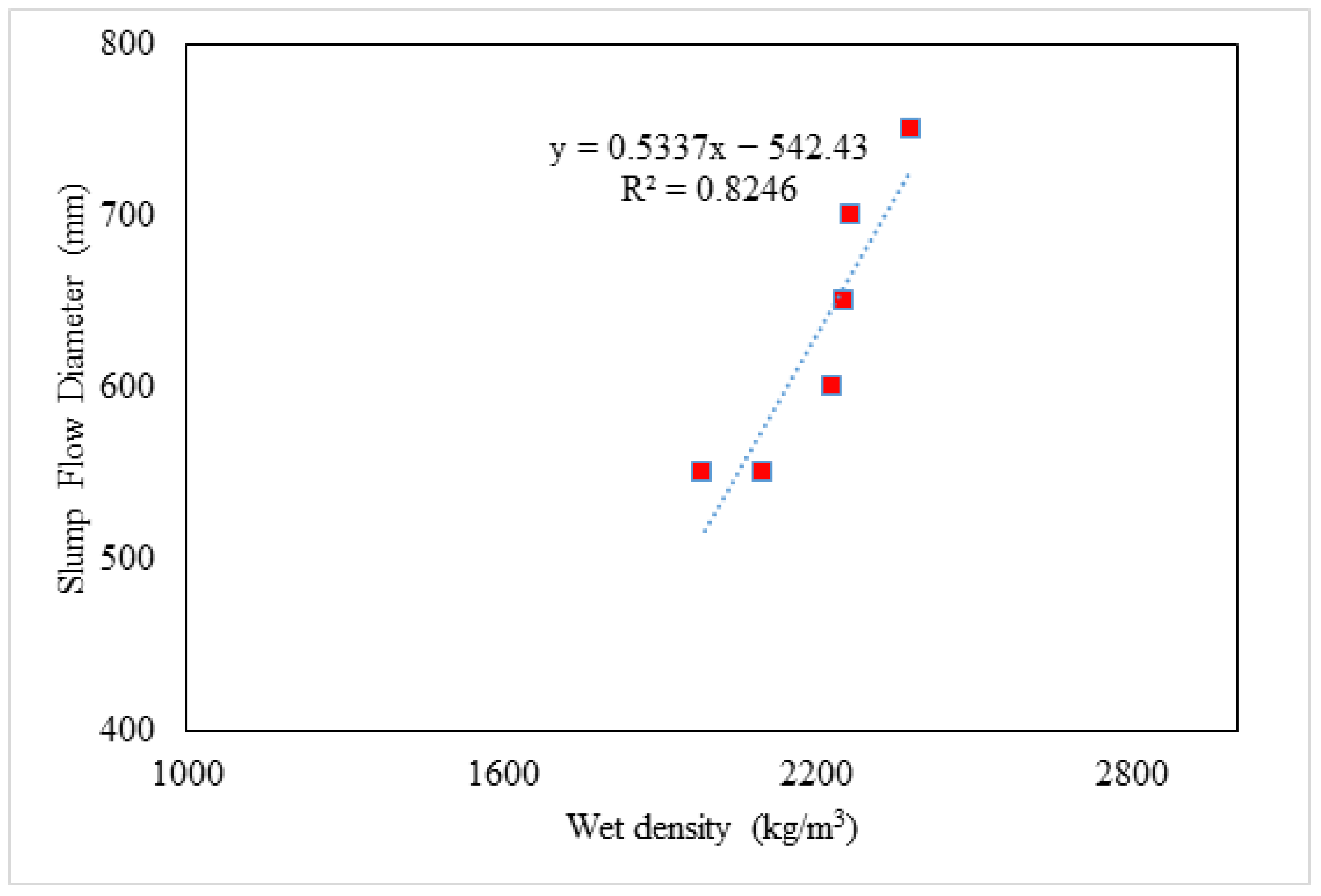
3.1.1. Slump Flow
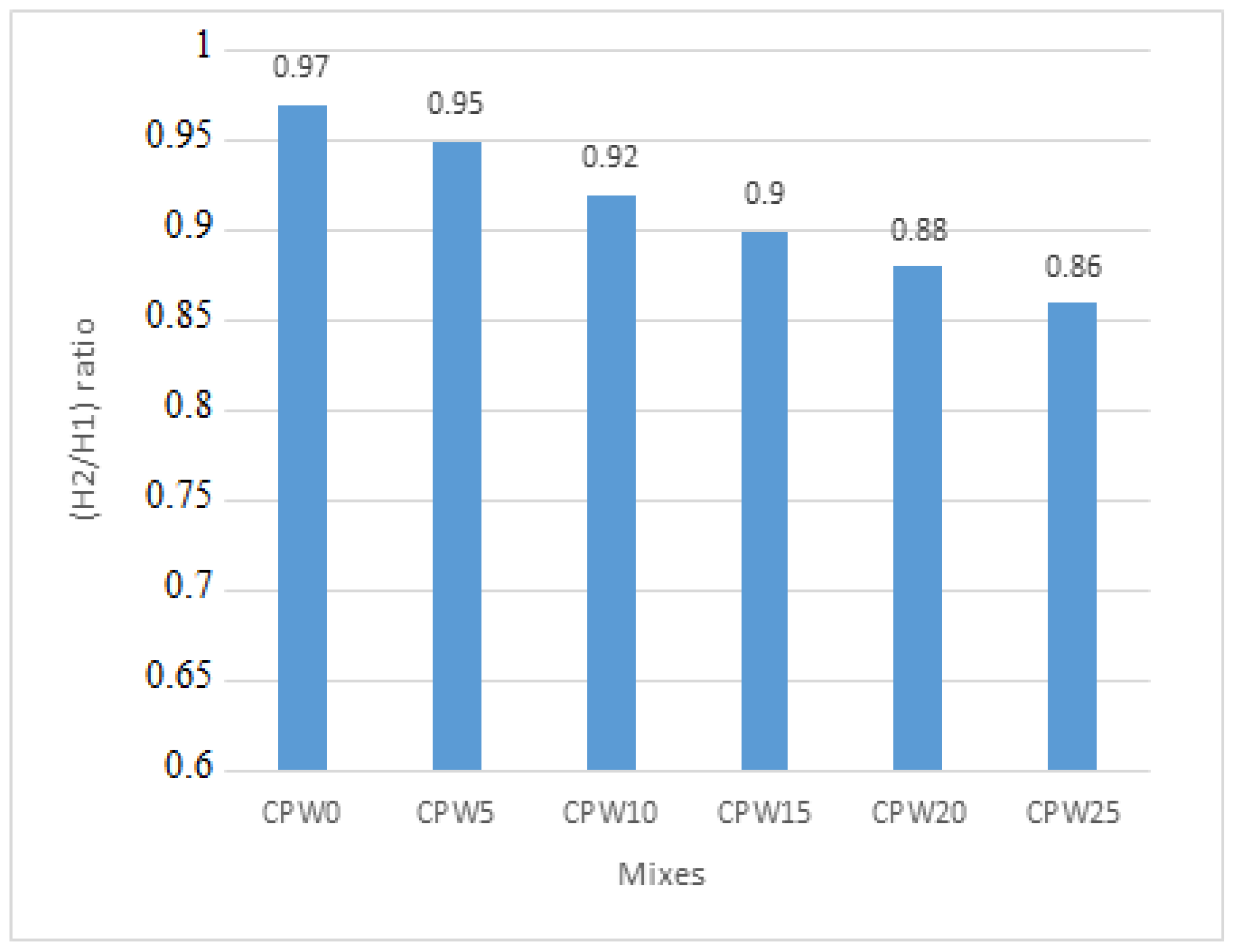
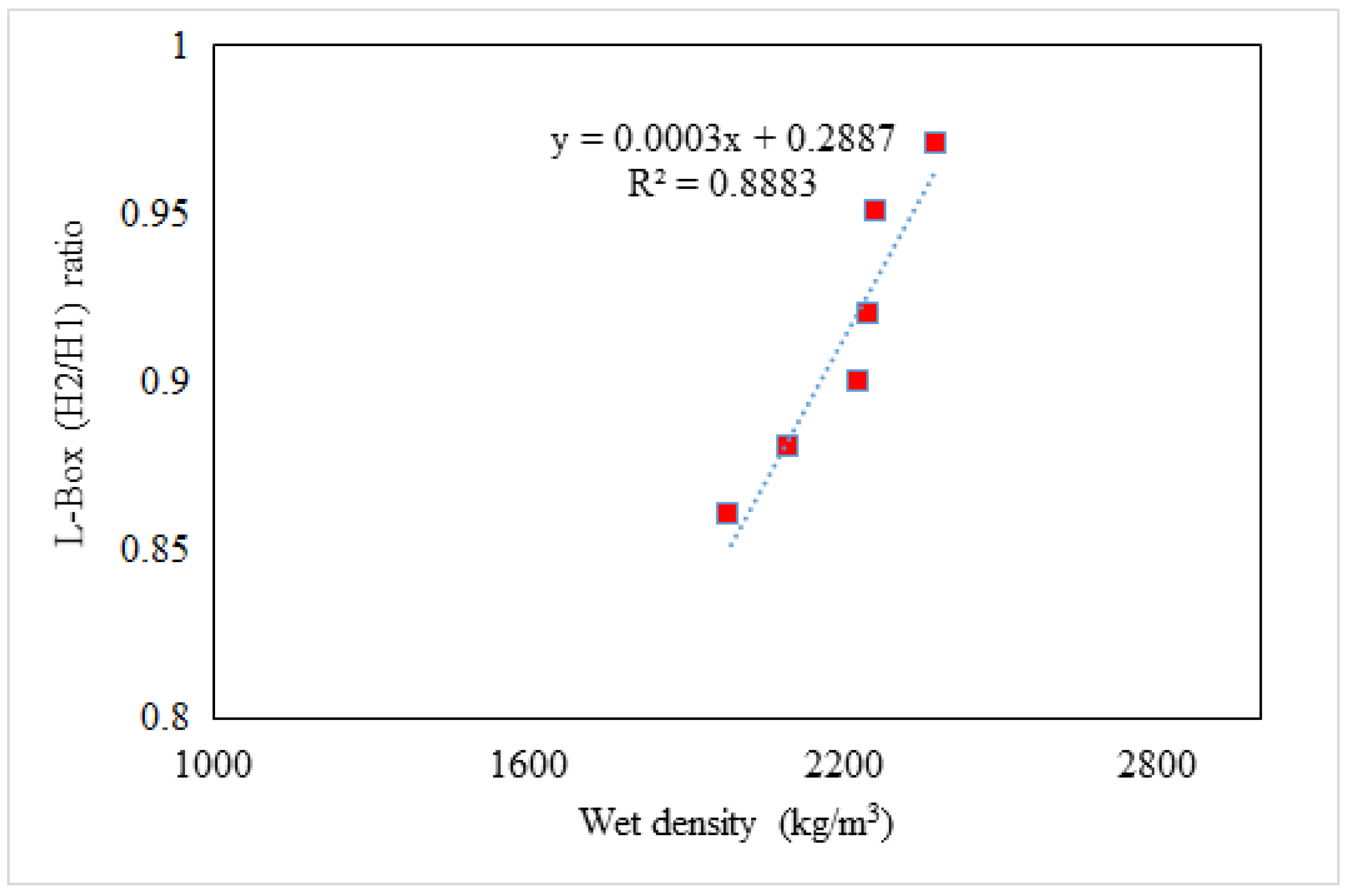
3.1.2. L-Box (H2/H1)
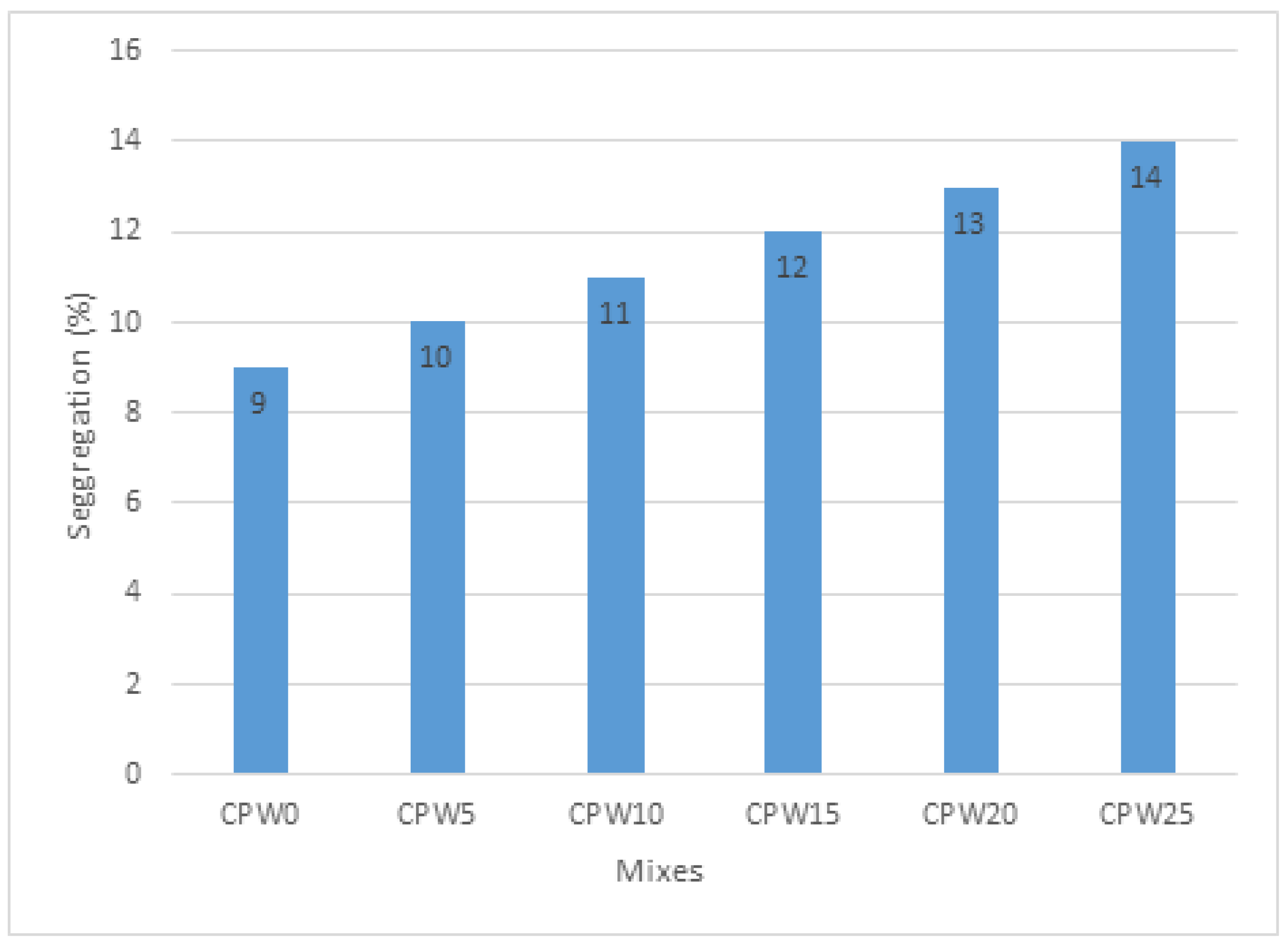
3.1.3. Segregation Ratio
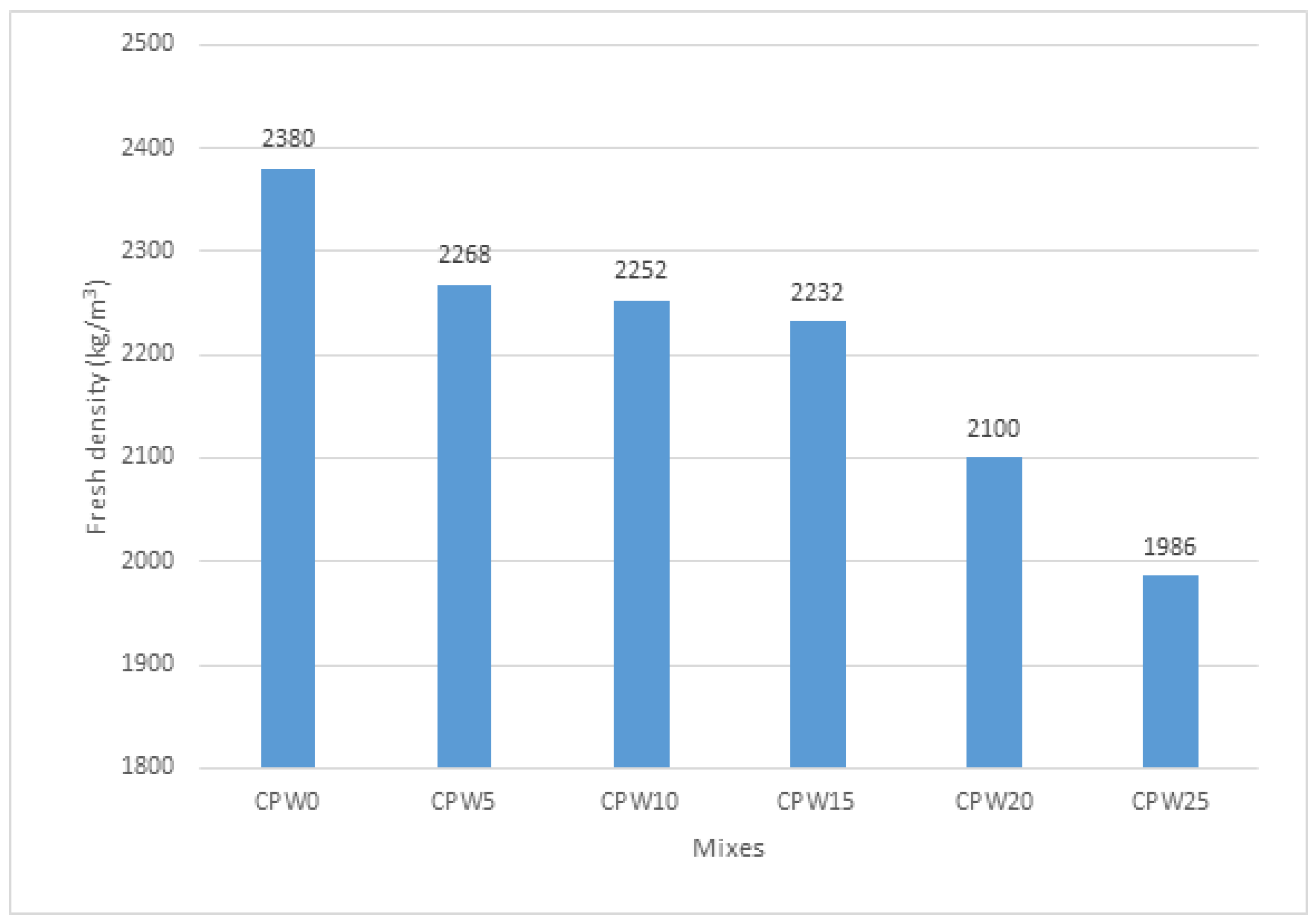
3.1.4. Fresh Density
3.2. Hardened Concrete Properties
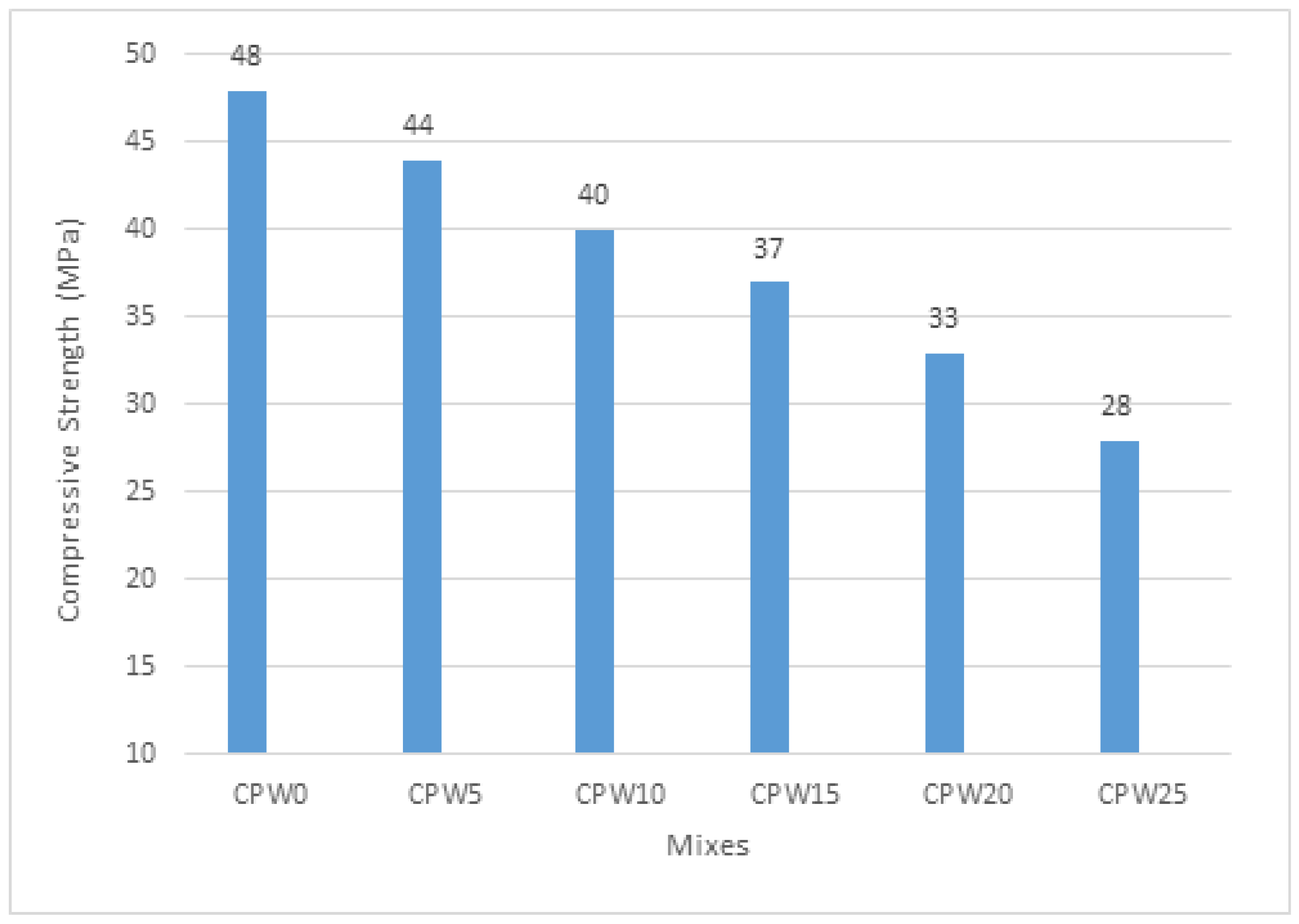
3.2.1. Compressive Strength
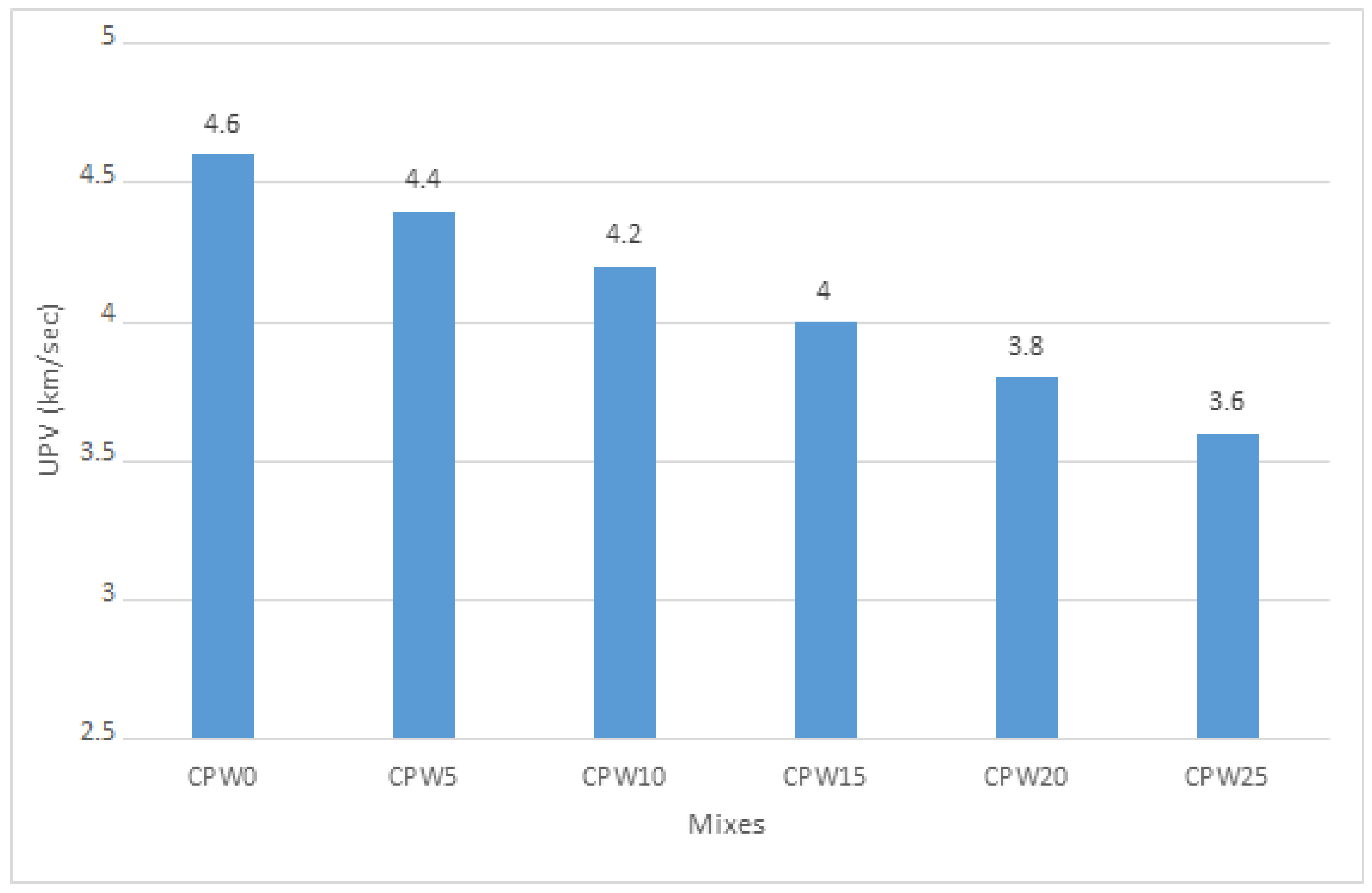
3.2.2. Ultrasonic Impulse Velocity (UPV)
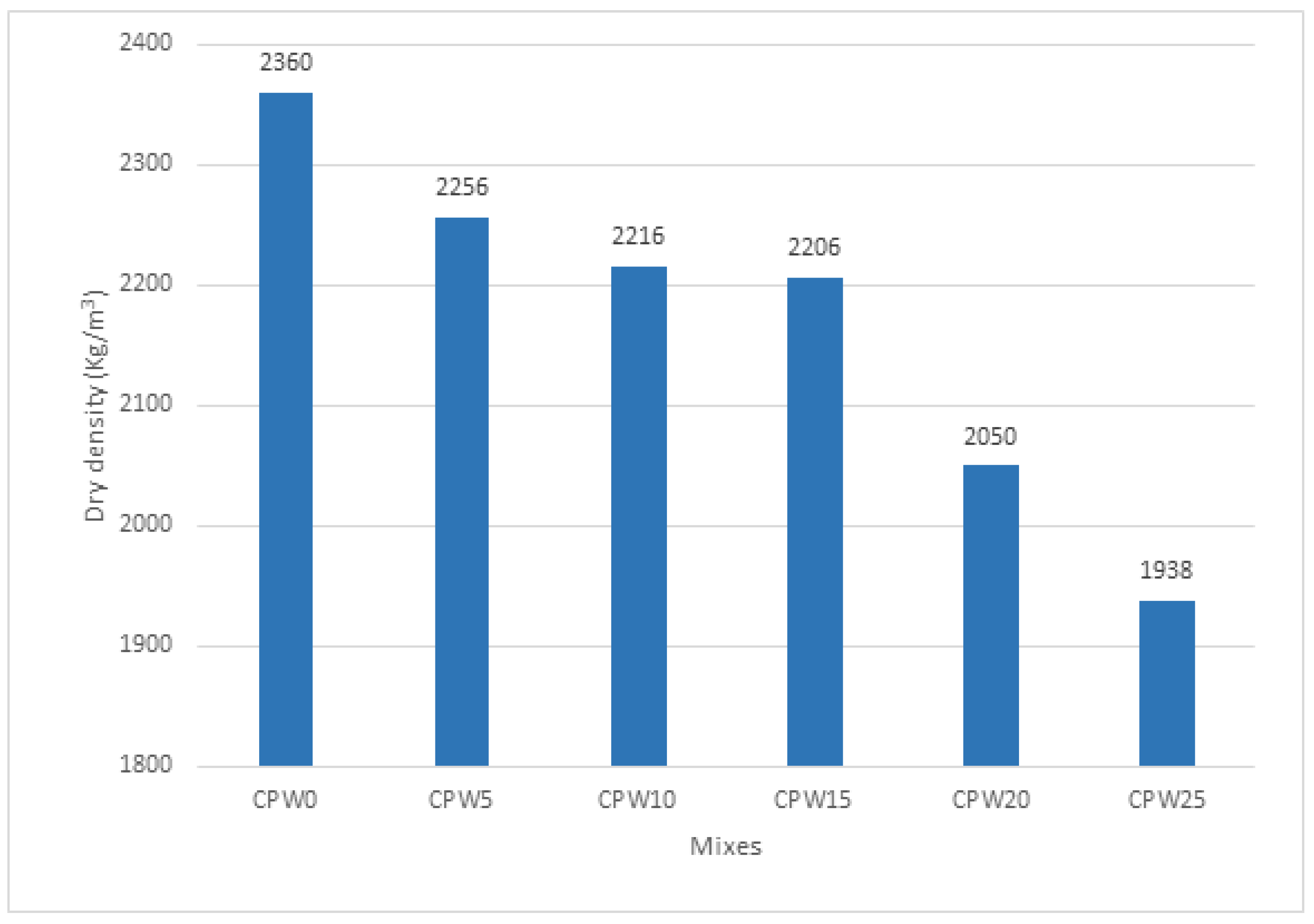
3.2.3. Dry Density
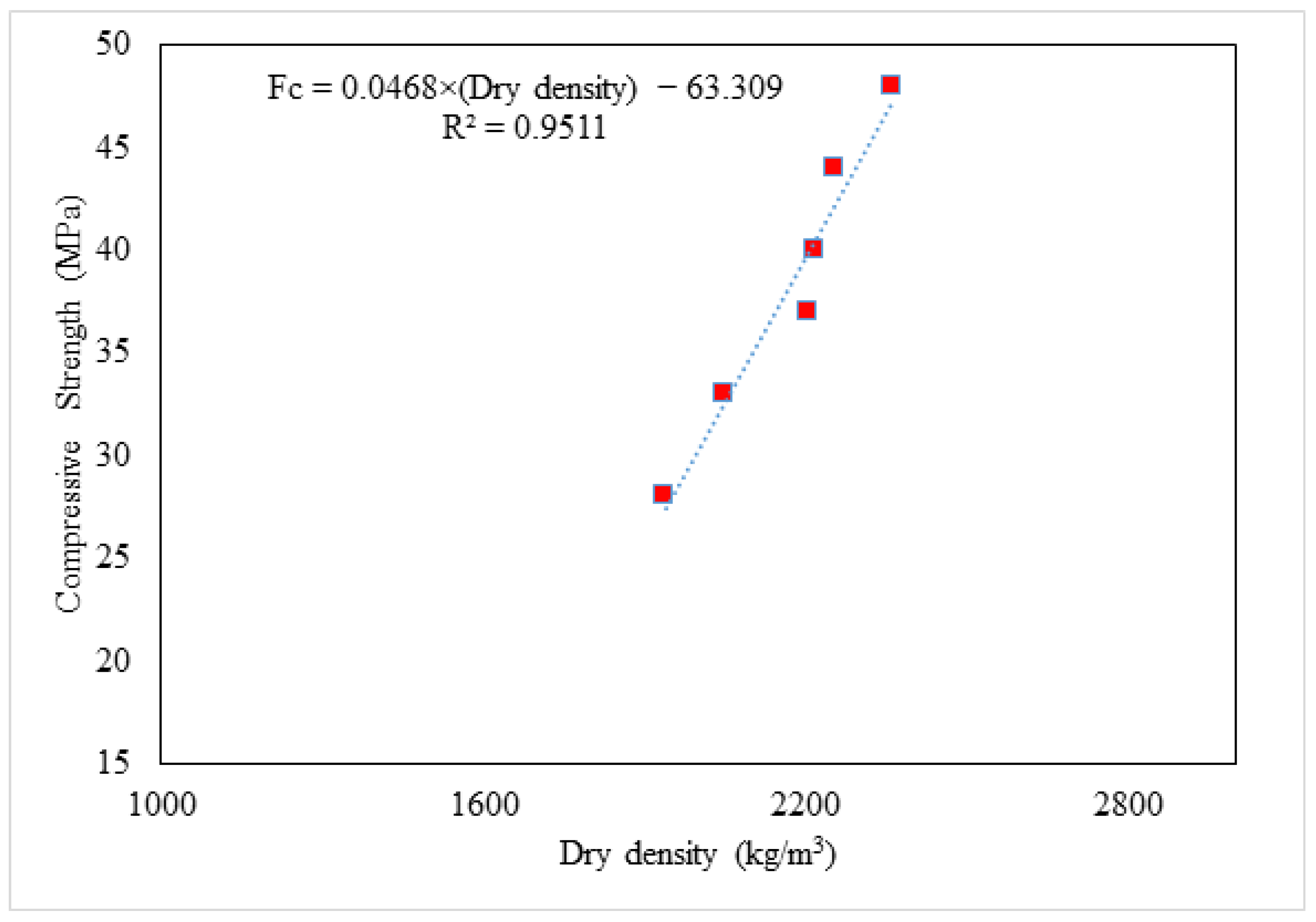
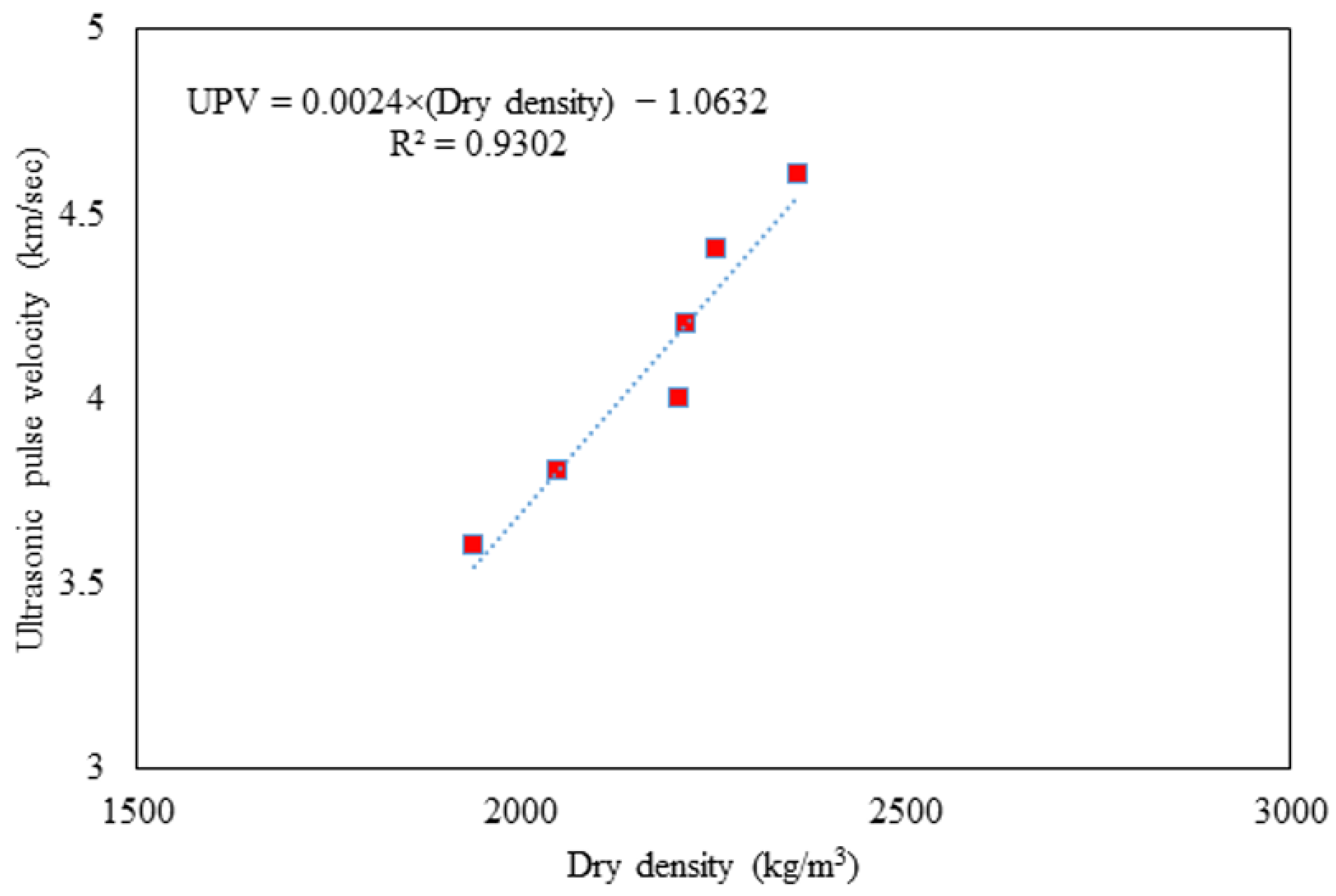
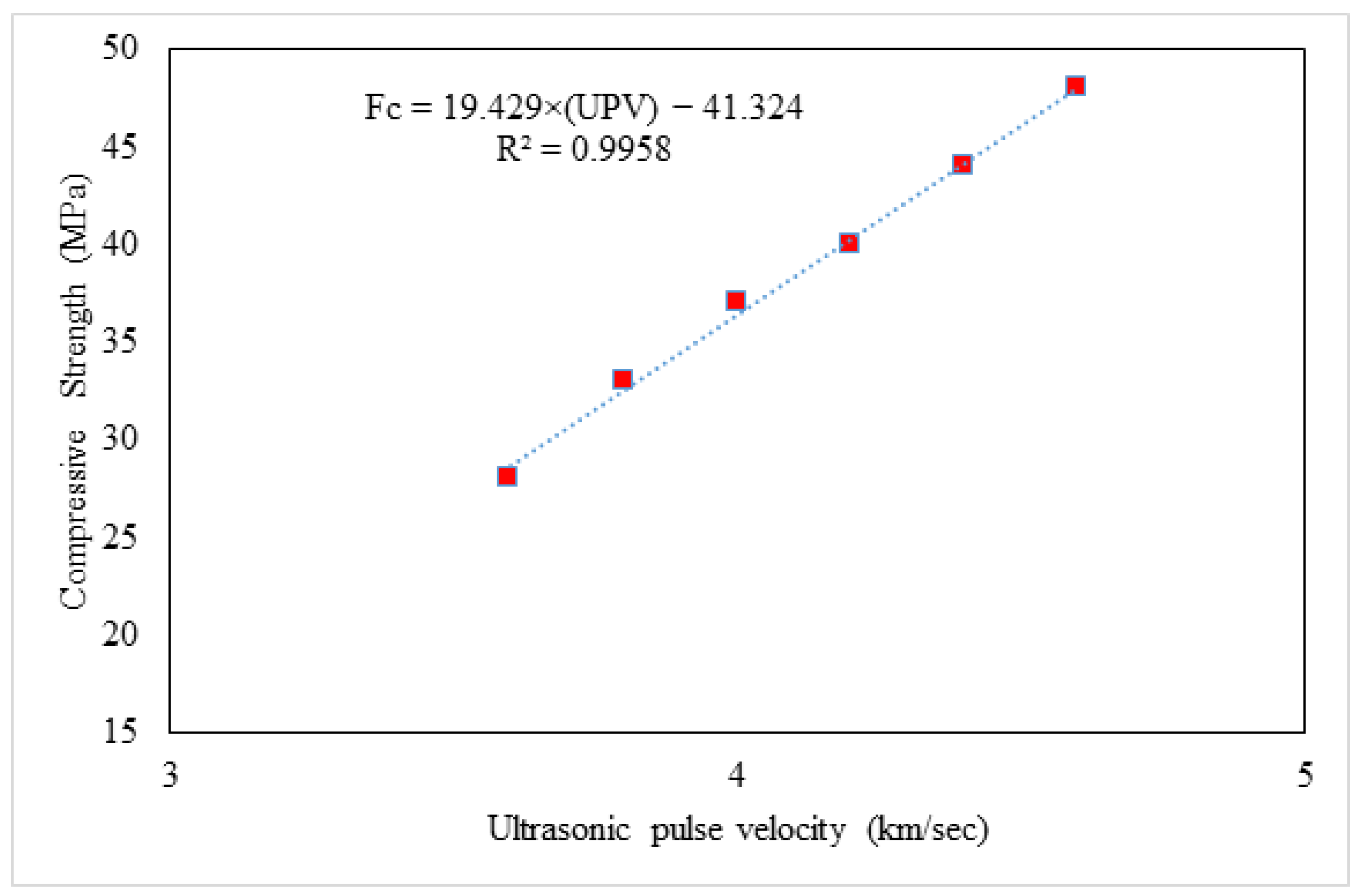
3.2.4. Relationship Between Hardened Properties
4. Conclusions
- Flowability decreased as the CPW content increased, while cohesiveness improved. The reference mix met SF3, 5% CPW mix met SF2, and others fell into SF1, yet remained acceptable per EFNARC.
- Passing ability declined and segregation risk increased with higher CPW content due to its high absorption, requiring more water.
- Wet and dry density dropped with CPW addition, as its specific gravity is lower than that of conventional aggregates.
- Both compressive strength and UPV values decreased with increasing CPW, but all the mixes remained within acceptable limits for lightweight structural concrete.
- The practical applications of SCC with CPW were highlighted more explicitly (e.g., lightweight structural elements, non-load-bearing walls, and precast elements).
- The trade-off between sustainability and performance was discussed, emphasizing that although strength and UPV decrease with higher CPW content, the values remain within acceptable limits for lightweight structural concrete.
- Possible future research directions were suggested, such as durability studies (e.g., freeze–thaw, chloride penetration, and carbonation resistance), long-term mechanical behavior, or optimization of superplasticizer dosage to mitigate the reduction in workability.
- The environmental impact and potential contribution of using agricultural and ceramic waste to circular economy practices in construction were reflected upon.
Author Contributions
Funding
Institutional Review Board Statement
Informed Consent Statement
Data Availability Statement
Conflicts of Interest
References
- PleMalherbe, J.S. Self-Compacting Concrete Versus Normal Compacting Concrete: A Techno-Economic Analysis. Ph.D. Thesis, Stellenbosch University, Stellenbosch, South Africa, 2015. [Google Scholar]
- Al Biajawi, M.I.; Embong, R.; Shubbar, A. Engineering properties of self-compacting concrete incorporating coal bottom ash (CBA) as sustainable materials for green concrete: A review. J. Build. Pathol. Rehabil. 2023, 8, 105. [Google Scholar] [CrossRef]
- Al Biajawi, M.I.Y.; Embong, R. The Impact of Varying Ratios of Water-to-Cement Content on the Fresh and Strength Properties of Self-Compacting Concrete. Constr. Technol. Archit. 2023, 4, 69–80. [Google Scholar]
- Mohammed, T.K.; Hama, S.M. Effect of combination of waste glass powder and plastic aggregate on structural behavior of reinforced concrete beams. Structures 2023, 52, 83–103. [Google Scholar] [CrossRef]
- Gardner, K.H. Life cycle perspectives of recycled materials use in civil Engineering. In Proceedings of the Program and Abstracts of ASTM Inter national Symposium on Testing and Specification of Recycled Materials for Sustainable Geotechnical Construction, Baltimore, MD, USA, 2–4 February 2011; p. 53. [Google Scholar]
- Al Biajawi, M.I.; Embong, R.; Muthusamy, K.; Mohamad, N. Effect of fly ash and coal bottom ash as alternative materials in the production of self compacting concrete: A review. In AIP Conference Proceedings; AIP Publishing: Melville, NY, USA, 2023. [Google Scholar]
- Mohamed, G. Structural mixture proportioning for oil palm shell concrete. Case Stud. Constr. Mater. 2017, 6, 219–224. [Google Scholar] [CrossRef]
- Oti, O.P.; Nwaigwe, K.N.; Okereke, N.A.A. Assesment of palm kernel shell as a composite aggregate in concrete. Agric. Eng. Int. CIGR J. 2017, 19, 34–41. [Google Scholar]
- Edan, H.H.; Hilal, N.; Sor, N.H.; Tawfik, T.A. Durability and hardened characteristics with SEM analysis of eco-efficient self-compacting concrete partially contained waste walnut shell particles as fine aggregate. Iran. J. Sci. Technol. Trans. Civ. Eng. 2024, 48, 745–761. [Google Scholar] [CrossRef]
- Al-Hadithi, A.I.; Hilal, N.N.; Al-Gburi, M.; Midher, A.H. Structural behavior of reinforced lightweight self-compacting concrete beams using expanded polystyrene as coarse aggregate and containing polyethylene terephthalate fibers. Struct. Concr. 2023, 24, 5808–5826. [Google Scholar] [CrossRef]
- Hama, S.M.; Abdulghafor, A.M. Load deflection behaviour and properties of sustainable lightweight aggregate concrete slabs. Int. J. Comput. Aided Eng. Technol. 2022, 17, 45–56. [Google Scholar] [CrossRef]
- Gunasekaran, K.; Annadurai, R.; Kumar, P.S. A study on some durability properties of coconut shell aggregate concrete. Mater. Struct. 2015, 48, 1253–1264. [Google Scholar] [CrossRef]
- Muthusamy, S.; Kolandasamy, P. Lightweight self-compacting concrete of high temperatures. Građevinar 2015, 67, 329–338. [Google Scholar]
- Islam, G.M.S.; Rahman, M.; Kazi, N. Waste glass powder as partial replacement of cement for sustainable concrete practice. Int. J. Sustain. Built Environ. 2017, 6, 37–44. [Google Scholar] [CrossRef]
- younis Khudair, A.; Mohammed, M.K.; Hama, S.M. Optimization of glass powder content in self-compacting concrete as partial replacement of cement. IOP Conf. Ser. Mater. Sci. Eng. 2020, 928, 22140. [Google Scholar] [CrossRef]
- Al Biajawi, M.I.; Embong, R.; Tayeh, B.A. A review of the role of glass waste on the fresh and mechanical properties of concret e as an environmentally friendly materials. Innov. Infrastruct. Solut. 2023, 8, 283. [Google Scholar] [CrossRef]
- Hama, S.M.; Hama, S.M.; Kwad, J.E. Optimum amount of silica fume for best structural concrete properties. In AIP Conference Proceedings; AIP Publishing: Melville, NY, USA, 2023. [Google Scholar]
- Güneyisi, E.; Gesoglu, M.; Naji, N.; Ipek, S. Evaluation of the rheological behavior of fresh self-compacting rubberized concrete by using the Herschel-Bulkley and modified Bingham models. Arch. Civ. Mech. Eng. 2016, 16, 9–19. [Google Scholar] [CrossRef]
- Hama, S.M.; Hamdullah, D.N.; Ashour, H.M. Effects of eggshell powder as partial replacement of cement on flexural behavior of one-way concrete slabs. J. Eng. Sci. Technol. 2019, 15, 2509–2521. [Google Scholar]
- Mansoor, S.S.; Hama, S.M.; Hamdullah, D.N. Effectiveness of replacing cement partially with waste brick powder in mortar. J. King Saud Univ.-Eng. Sci. 2024, 36, 524–532. [Google Scholar] [CrossRef]
- Hilal, N.N.; Mohammed, A.S.; Ali, T.K.M. Properties of eco-friendly concrete contained limestone and ceramic tiles waste exposed to high temperature. Arab. J. Sci. Eng. 2020, 45, 4387–4404. [Google Scholar] [CrossRef]
- Hilal, N.; Saleh, R.D.; Yakoob, N.B.; Banyhussan, Q.S. Utilization of ceramic waste powder in cement mortar exposed to elevated temperature. Innov. Infrastruct. Solut. 2021, 6, 35. [Google Scholar] [CrossRef]
- Lim, N.H.A.S.; Mohammadhosseini, H.; Tahir, M.M.; Samadi, M.; Sam, A.R.M. Microstructure and strength properties of mortar contai ning waste ceramic nanoparticles. Arab. J. Sci. Eng. 2018, 43, 5305–5313. [Google Scholar] [CrossRef]
- Hilal, N.; Tawfik, T.A.; Edan, H.H.; Sor, N.H. The mechanical and durability behaviour of sustainable self-compacting concrete partially contained waste plastic as fine aggregate. Aust. J. Civ. Eng. 2023, 21, 151–166. [Google Scholar] [CrossRef]
- Iraqi Quality Standard (IQS) No. 5, Portland Cement Specifications, 2019. Available online: https://www.samancement.iq/products.aspx?jimare=84 (accessed on 14 May 2025).
- AI Numan, B.S.; Ahmed, F.R.; Rashied, Z.N. Experimental Time-Dependent Deflection of High Strength Concrete Panels. Am. J. Civ. Eng. Architecture. 2015, 3, 153–157. [Google Scholar] [CrossRef][Green Version]
- ASTM C494/C494 M-99a; Standard Specification for Chemical Admixtures for Concrete. ASTM International: West Conshohocken, PA, USA, 2015.
- EFNARC. Specification and Guidelines for Self-Compacting Concrete; European Federation of Specialist Construction Chemicals and Concrete System: Farnham, UK, 2005. [Google Scholar]
- Esmaeilkhanian, B.; Khayat, K.H.; Yahia, A.; Feys, D. Effects of mix design parameters and rheological properties on dynamic sta bility of self-consolidating concrete. Cem. Concr. Compos. 2014, 54, 21–28. [Google Scholar] [CrossRef]
- ASTM C192/C192M-18; Standard Practice for Making and Curing Concrete Test Specimens in the Laboratory. ASTM International: West Conshohocken, PA, USA, 2018.
- ASTM C109/C109M-07; Standard Test Method for Compressive Strength of Hydraulic Cement Mortars (Using 2-in. or [50-mm] Cube Specimens). ASTM International: West Conshohocken, PA, USA, 2007.
- ASTM C597-16; Standard Test Method for Pulse Velocity Through Concrete. ASTM International: West Conshohocken, PA, USA, 2016.
- Hilal, N.; Sahab, M.F.; Ali, T.K.M. Fresh and hardened properties of lightweight self-compacting concrete containing walnut shells as coarse aggregate. J. King Saud Univ.-Eng. Sci. 2021, 33, 364–372. [Google Scholar] [CrossRef]
- Abd-ElAziz, M.A.; Faried, A.S.; Kamel, M.M.A. Influence of silica fume incorporation on the fresh, thermal and mechanical properties of expanded polystyrene (EPS) foamed concrete. Am. J. Civ. Eng. 2017, 5, 188–195. [Google Scholar] [CrossRef]
- Dixit, A.; Pang, S.D.; Kang, S.-H.; Moon, J. Lightweight structural cement composites with expanded polystyrene (EPS) for enhanced thermal insulation. Cem. Concr. Compos. 2019, 102, 185–197. [Google Scholar] [CrossRef]
- Medher, A.H.; Al-Hadithi, A.I.; Hilal, N. The possibility of producing self-compacting lightweight concrete by using expanded polystyrene beads as coarse aggregate. Arab. J. Sci. Eng. 2021, 46, 4253–4270. [Google Scholar] [CrossRef]


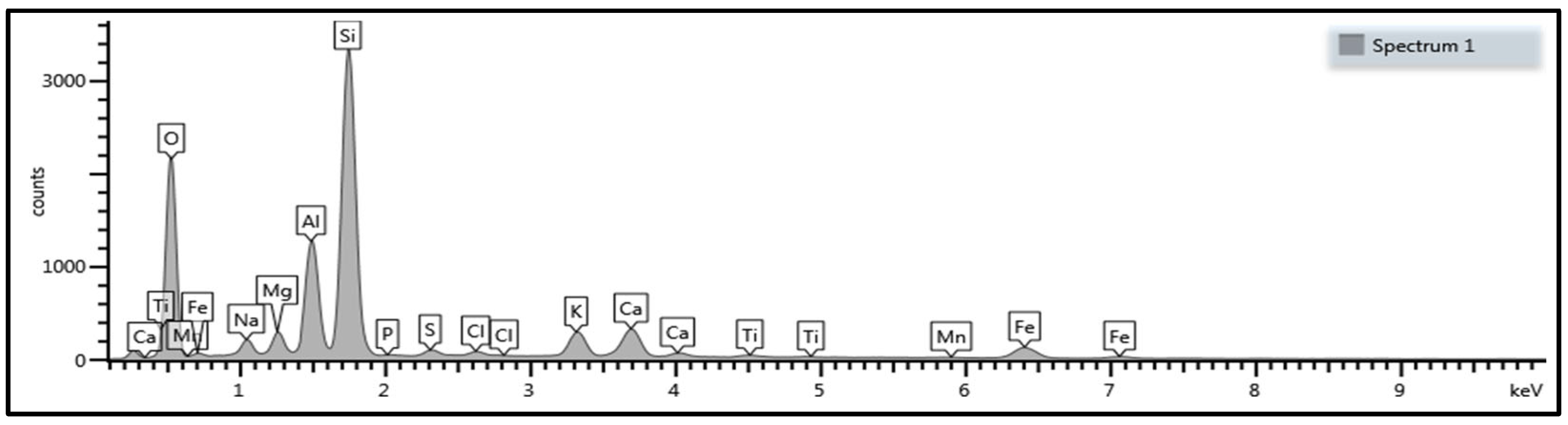
| Oxides (%) | Cement | Ceramic Waste |
|---|---|---|
| CaO | 62.3 | 5.72 |
| SiO2 | 20.28 | 57.4 |
| Al2O3 | 5.55 | 17.98 |
| Fe2O3 | 4.2 | 6.2 |
| MgO | 2.6 | 3.16 |
| K2O | 0.75 | 4.09 |
| Na2O | 0.4 | 2.37 |
| SO3 | 2.27 | - |
| Physical Properties | Test Results | Limits of IQS 5/2019 |
|---|---|---|
| Initial setting time (Minutes) | 198 | ≥45 |
| Final setting times (Hours) | 4.5 | ≤10 |
| Fineness by Plaine method (m2/Kg) | 280 | ≥280 |
| Compressive strength at 2 days (MPa) | 20.45 | ≥10 |
| Compressive strength at 28 days (MPa) | 45 | ≥42.5 |
| Mix ID | Cement | Ceramic Powder | Sand | Gravel | Cherry Pits | Water | SP |
|---|---|---|---|---|---|---|---|
| CPW0% | 400 | 100 | 790 | 965 | 0 | 165 | 8 |
| CPW5% | 400 | 100 | 790 | 917 | 48 | 165 | 8 |
| CPW10% | 400 | 100 | 790 | 869 | 96 | 165 | 8 |
| CPW15% | 400 | 100 | 790 | 821 | 144 | 165 | 8 |
| CPW20% | 400 | 100 | 790 | 773 | 192 | 165 | 8 |
| CPW25% | 400 | 100 | 790 | 725 | 240 | 165 | 8 |
Disclaimer/Publisher’s Note: The statements, opinions and data contained in all publications are solely those of the individual author(s) and contributor(s) and not of MDPI and/or the editor(s). MDPI and/or the editor(s) disclaim responsibility for any injury to people or property resulting from any ideas, methods, instructions or products referred to in the content. |
© 2026 by the authors. Licensee MDPI, Basel, Switzerland. This article is an open access article distributed under the terms and conditions of the Creative Commons Attribution (CC BY) license.
Share and Cite
Ali, R.A.A.; Al-Ani, A.A.; Hilal, N.N.; Al Biajawi, M.I.; Hama, S.M.; Harrat, Z.R. The Influence of Waste Cherry Pits as Coarse Aggregate and Waste Ceramics Powder on Rheological Properties and Strength of Self-Compacting Concrete. Eng. Proc. 2026, 125, 27. https://doi.org/10.3390/engproc2026125027
Ali RAA, Al-Ani AA, Hilal NN, Al Biajawi MI, Hama SM, Harrat ZR. The Influence of Waste Cherry Pits as Coarse Aggregate and Waste Ceramics Powder on Rheological Properties and Strength of Self-Compacting Concrete. Engineering Proceedings. 2026; 125(1):27. https://doi.org/10.3390/engproc2026125027
Chicago/Turabian StyleAli, Rafal Ahmed Abbas, Abdulkareem Adil Al-Ani, Nahla N. Hilal, Mohammad I. Al Biajawi, Sheelan Mahmoud Hama, and Zouaoui R. Harrat. 2026. "The Influence of Waste Cherry Pits as Coarse Aggregate and Waste Ceramics Powder on Rheological Properties and Strength of Self-Compacting Concrete" Engineering Proceedings 125, no. 1: 27. https://doi.org/10.3390/engproc2026125027
APA StyleAli, R. A. A., Al-Ani, A. A., Hilal, N. N., Al Biajawi, M. I., Hama, S. M., & Harrat, Z. R. (2026). The Influence of Waste Cherry Pits as Coarse Aggregate and Waste Ceramics Powder on Rheological Properties and Strength of Self-Compacting Concrete. Engineering Proceedings, 125(1), 27. https://doi.org/10.3390/engproc2026125027