1. Introduction
Checkout service is fundamental for retail operations and has continuously evolved over the past decades to improve efficiency, effectiveness, and customer satisfaction. In the retail industry, such as supermarkets, smooth checkout processes play a crucial role in gaining a competitive advantage by minimizing customer waiting times and ensuring optimal utilization of resources. While waiting in line is a typical part of the retail experience, excessive waiting often leads to customer dissatisfaction and negatively affects key performance indicators and service quality. Previous studies have shown that inadequate checkout counters frequently result in long queues, which can reduce customers’ intention to return or make future purchases [
1]. To address these challenges, many retailers have embraced a digital shift from traditional checkout methods to self-checkout systems that offer greater autonomy while streamlining the purchasing process [
2].
Self-checkout counters are automated systems in retail stores that allow customers to scan, pack, and pay for their merchandise with minimal interaction with store staff [
3]. This advancement has rapidly expanded in many developed countries to improve operational efficiency and enhance the customer experience. In Taiwan, the adoption of self-checkout has become increasingly common across retail and convenience stores due to labor shortages and growing demand for customer convenience [
4]. Similarly, in the United States, 43% of customers expressed a preference for self-checkout over traditional cashier setups [
5]. Despite its rising popularity, there is still limited empirical evidence examining the system performance of self-checkout counters. Recent study results suggested that replacing cashiers with self-checkout counters may not always be the most effective solution [
6]. Likewise, another study found that self-checkout counters tend to have longer transaction times compared to traditional cashier counters [
7].
In this simulation study, the concept of improving the service time of self-checkout counters in a retail store in Taoyuan City, Taiwan, was examined. A simulation modeling approach was used to analyze the existing real-world checkout system of the retail store. Additionally, an improved self-checkout configuration was proposed to enhance operational efficiency and the overall checkout operations of the retail store. We compared multiple checkout configurations through discrete-event simulation to identify the most efficient and cost-effective strategy for improving retail store operations.
2. Materials and Methods
2.1. Research Method
Simulation and modeling are effective methods for exploring different configurations and identifying potential solutions to improve system operations [
8], particularly in retail environments. To conduct the simulation modeling for this study, a structured research process was followed, as illustrated in
Figure 1.
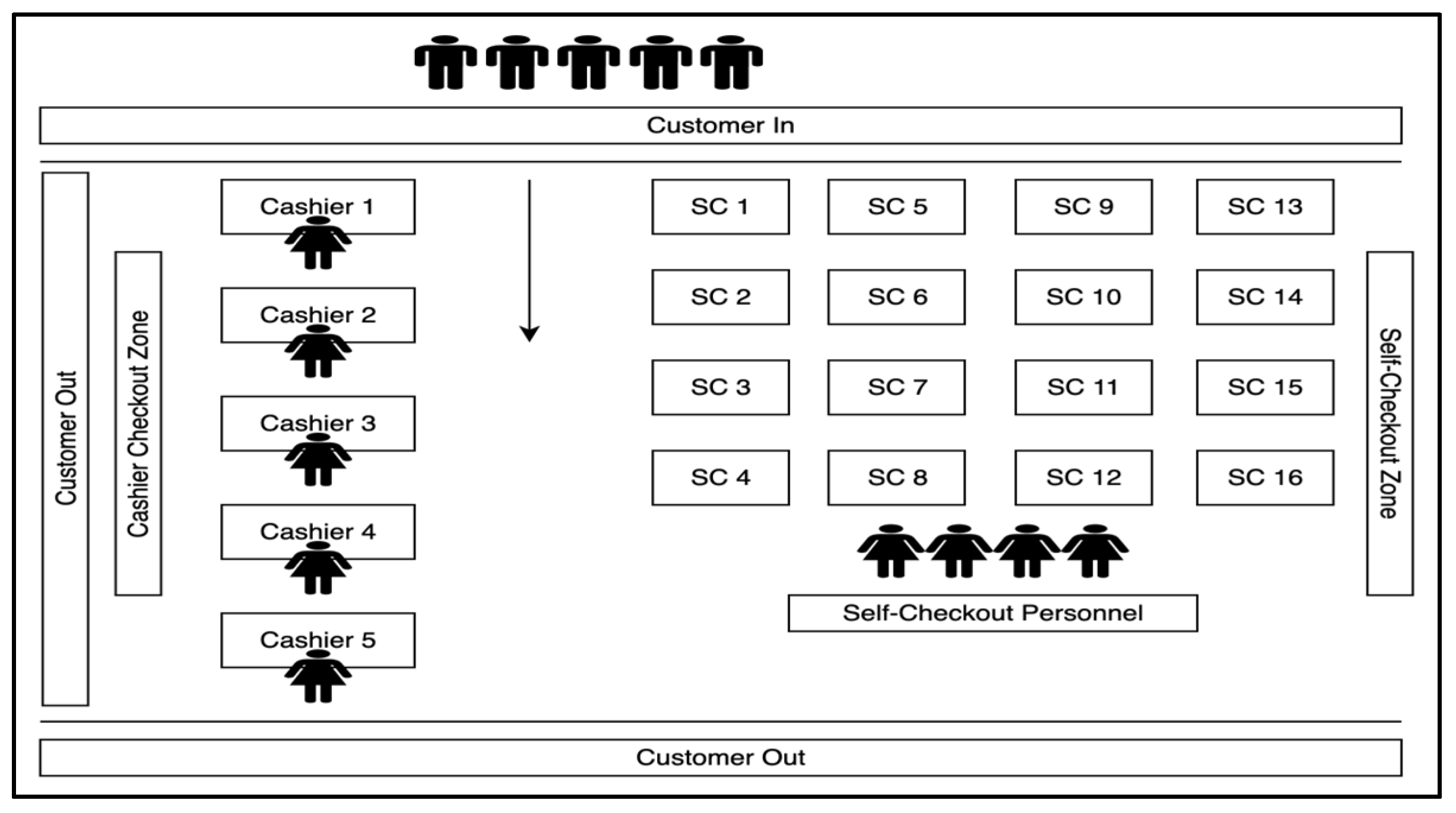
Initially, the existing real-world checkout system of the retail store was observed. This was conducted on a Saturday from 06:00 to 07:00 PM to record the number of cashiers and self-checkout counters operating during normal conditions. Based on the observation results, the base model of the entire system was developed. The layout of the checkout system is presented in
Figure 2.
The checkout system of the retail store consisted of five cashier checkouts and sixteen self-checkout counters. During normal operations, four personnel assist customers in the self-checkout zone; thus, there are a total of nine personnel working within the system.
2.2. Data Collection
A well-known retail store in Taoyuan City, Taiwan, was selected as the use case to simulate real-world checkout operations in this study. This store was chosen because it operates both traditional cashier counters and self-checkout systems, which makes it suitable for the goal of the study.
Table 1 summarizes the descriptive statistics of the collected data.
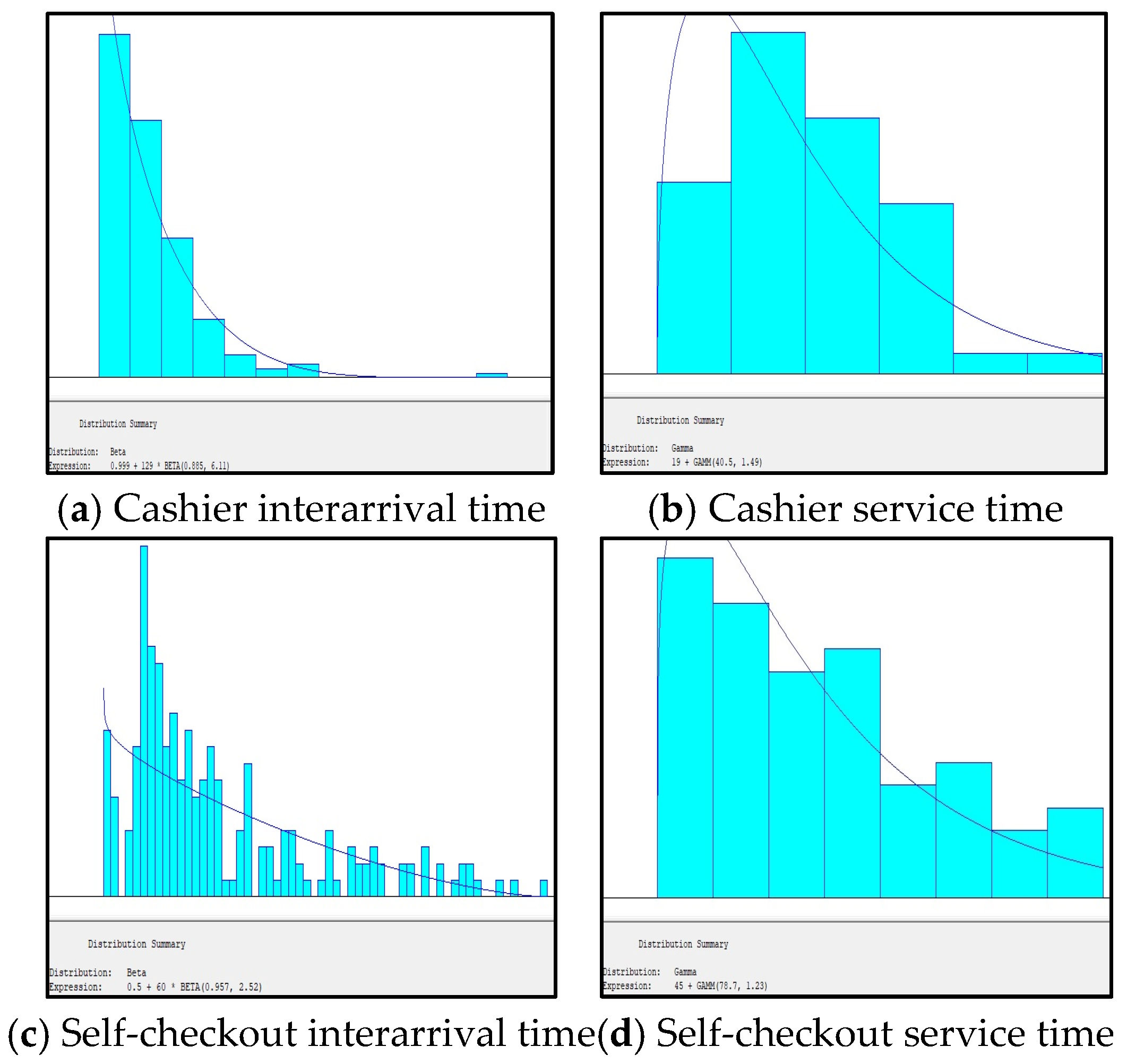
The collected data were analyzed using the ARENA Input Analyzer to determine the appropriate probability distributions. The summary of the input analysis is presented in
Figure 3. For the cashier checkout, the interarrival time was fitted with a BETA distribution, with the probability density function 0.999 + 129 × BETA(0.885, 6.11) (
Figure 3a), while
Figure 3b service time followed a GAMMA distribution, with the probability density function 19 + GAMM(40.5, 1.49). On the other hand, for the self-checkout, the interarrival time was fitted with a BETA distribution, with the probability density function 0.5 + 60 × BETA(0.957, 2.52) (
Figure 3c), while
Figure 3d shows the service time followed a GAMMA distribution with a probability density function 45 + GAMMA(78.7, 1.23).
2.3. Simulation Model
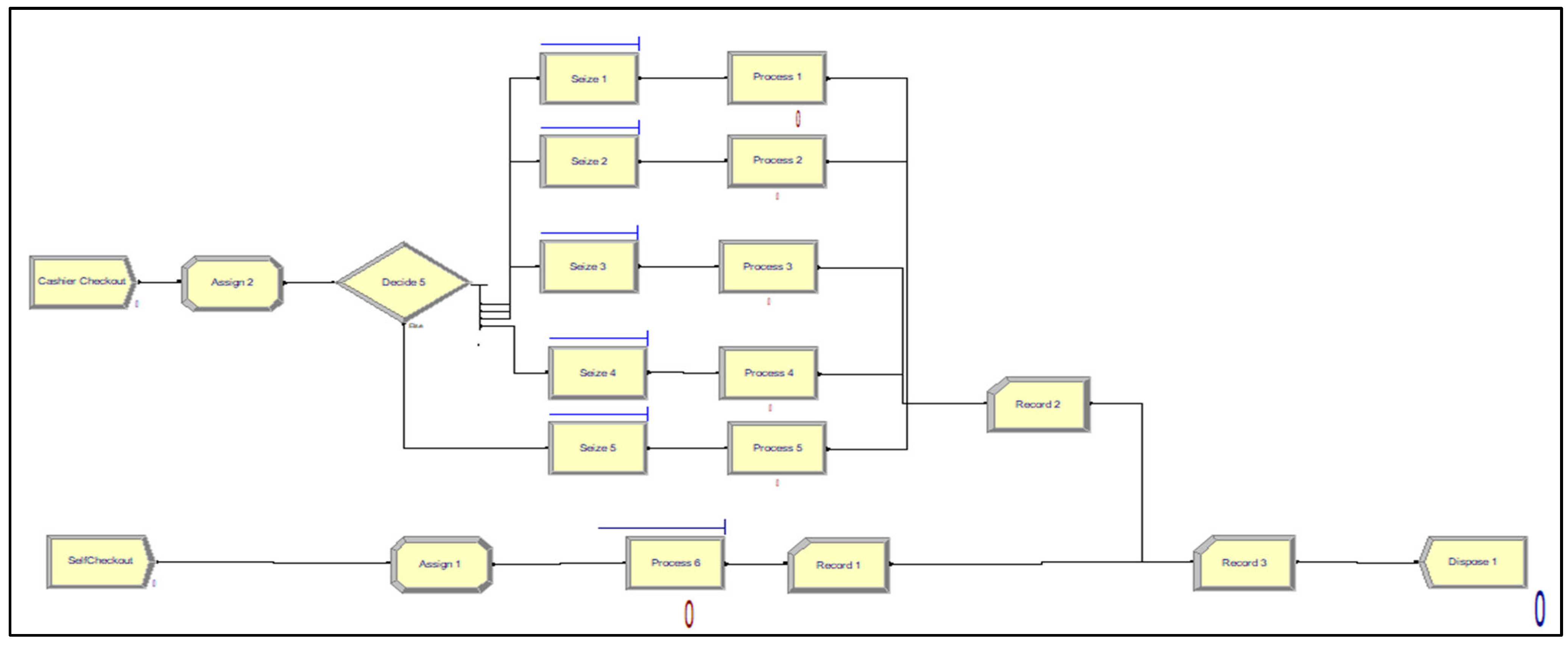
A simulation model of the retail store’s checkout operations was developed using ARENA 16, which served as the base model, as shown in
Figure 4. The simulation parameters were defined based on data from initial observations, and the model was run for two hours with a 10-min warm-up period over 30 replications.
The four model configurations evaluated in this study are as follows.
Model 1 (base model): The cashier checkout has 5 counters, each with its own queue. Customers select the shortest but do not switch lines afterward. The self-checkout has 16 machines with a single common queue, assisted by 4 personnel.
Model 2: 9 cashier counters only.
Model 3: 16 self-checkout machines with 9 assisting personnel.
Model 4 (proposed model): The model has 16 self-checkouts with an improved service speed of 0.8 times the original checkout time. This scenario simulates potential optimizations such as improved self-checkout usability or additional assisting personnel.
3. Results and Discussion
The output data of the simulation are presented in
Table 2, while the statistical tests using multiple analysis of variance (MANOVA) and ANOVA are shown in
Table 3 and
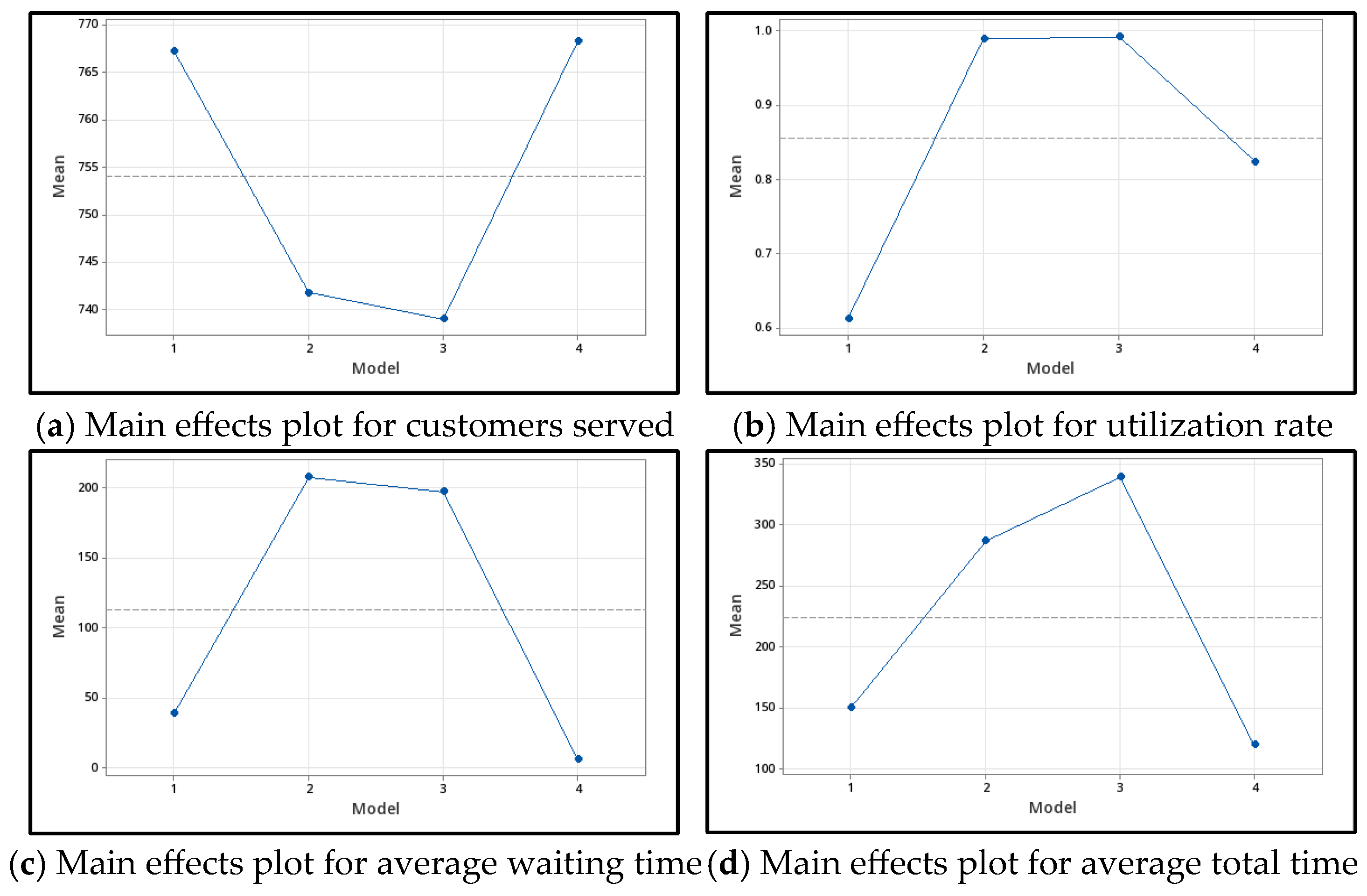
Figure 5, respectively. The ANOVA plot presents the performance of each checkout configuration and helps identify the most effective model.
Table 2 shows the output data of the simulation of the four models. Based on the results, the proposed model outperformed all other configurations in terms of both efficiency and customer experience. The base model served all 767 arriving customers with a utilization rate of 0.61, an average waiting time of 39.76 s, and an average total time of 150.82 s. In contrast, models 2 and 3 both reached a utilization rate of 0.99 with longer average waiting times of 207.97 and 202.77 s, and fewer customers served of 742 and 739, respectively. The proposed model with an improved service time achieved a more balanced utilization rate of 0.83, the shortest average waiting time of 6.70 s, and the lowest average total time of 120.25 s.
Table 3 shows the MANOVA results, which indicate significant overall differences among the four checkout model configurations in terms of customers served, utilization rate, average waiting time, and average total time. All multivariate test criteria, Wilks’ Lambda (
λ = 0.00001,
f = 1683.91,
p = 0.000), Lawley-Hotelling (
f = 9628.41,
p = 0.000), Pillai’s Trace (
f = 106.39,
p = 0.000), and Roy’s Largest Root, confirm the rejection of the null hypothesis of equal means. This implies that at least one model configuration performs significantly better than the others.
Figure 5 illustrates the ANOVA main effects plots for the performance metrics. In terms of the number of customers served, the proposed model performed similarly with the base model, both successfully serving all arriving customers. Regarding the utilization rate, the proposed model achieved a balanced rate compared to other models. For both average waiting time and average total time, the proposed model outperformed all other configurations by achieving the lowest values. Therefore, the proposed model is the best configuration among all models, which offers the most efficient and balanced performance across all metrics.
The results of this study provide actionable insights for retail managers to enhance checkout efficiency, minimize operational costs, and improve customer satisfaction. First, investing in the optimization of self-checkout service speed offers greater benefits than simply increasing the number of counters or cashiers. This can be achieved through user-friendly interface designs, faster scanning technology, and improved payment options to reduce transaction times. Second, deploying dedicated personnel to assist customers in the self-checkout zone during peak hours can help eliminate bottlenecks caused by user errors and unfamiliarity with the system. Finally, the significant reduction in total and waiting times in the proposed model can lead to enhanced customer satisfaction, higher sales volumes, and reduced labor costs while maintaining service quality.
4. Conclusions
By employing simulation modeling, we evaluated and improved checkout operations at a retail store in Taoyuan City, Taiwan. The proposed model, which optimizes self-checkout service time, significantly reduced average waiting and total times while maintaining balanced resource utilization and ensuring that all customers were served. Statistical tests confirmed significant performance differences among the models, which highlights that enhancing self-checkout efficiency is a key strategy for improving overall operational performance, reducing costs, and enhancing customer satisfaction.
Despite these notable findings, there are limitations. The study was conducted based on data from a single retail store and a limited observation period, which may affect the generalizability of the results. Additionally, factors such as express lanes, off-peak staffing, varied payment methods, and customer behaviors (e.g., jockeying, balking, and reneging) were not considered in the simulation model and could influence real-world settings. Future research should expand data collection to multiple retail locations across different time periods and explore the integration of emerging technologies, such as mobile app-based checkouts or AI-assisted checkouts that may offer additional insights.
Author Contributions
Conceptualization, V.J.C.E., S.-Y.L. and W.-J.S.; methodology, V.J.C.E. and W.-J.S.; software, S.-Y.L.; validation, W.-J.S.; formal analysis, V.J.C.E. and W.-J.S.; investigation, V.J.C.E. and S.-Y.L.; resources, S.-Y.L. and W.-J.S.; data curation, V.J.C.E. and S.-Y.L.; writing—original draft preparation, V.J.C.E.; writing—review and editing, V.J.C.E. and W.-J.S.; visualization, V.J.C.E. and S.-Y.L.; supervision, W.-J.S. All authors have read and agreed to the published version of the manuscript.
Funding
This research received no external funding.
Institutional Review Board Statement
Not applicable.
Informed Consent Statement
Not applicable.
Data Availability Statement
Data are contained within the article.
Acknowledgments
The researchers sincerely thank Wei-Jung Shiang for sharing his valuable knowledge and expertise in system simulation, which greatly contributed to the completion of this study.
Conflicts of Interest
The authors declare no conflicts of interest.
References
- Chatzoglou, P.; Chatzoudes, D.; Savvidou, A.; Fotiadis, T.; Delias, P. Factors Affecting Repurchase Intentions in Retail Shopping: An Empirical Study. Heliyon 2022, 8, e10624. [Google Scholar] [CrossRef] [PubMed]
- Thomas-Francois, K.; Somogyi, S. Self-Checkout Behaviours at Supermarkets: Does the Technological Acceptance Model (TAM) Predict Smart Grocery Shopping Adoption? Int. Rev. Retail. Distrib. Consum. Res. 2023, 33, 44–66. [Google Scholar] [CrossRef]
- Su, S.S.; Sheu, S.H.; Wang, K.H. Does Self-Checkout Service Really Improve Customer Service in Systems Subject to Congestion?–An Empirical Investigation in the Retail Industry. Queueing Models Serv. Manag. 2023, 6, 59–76. [Google Scholar]
- Radio Taiwan International. Retail Stores Face Labor Shortage, Turn to Self-Checkouts. 25 March 2024. Available online: https://en.rti.org.tw/news/view/id/2011946 (accessed on 24 June 2025).
- NCR Corporation. More than Half of Gen Z and Millennial Grocery Shoppers Prefer Self-Checkout. 19 April 2023. Available online: https://investor.ncr.com/news-releases/news-release-details/more-half-gen-z-and-millennial-grocery-shoppers-prefer-self (accessed on 24 June 2025).
- Mykoniatis, K.; Angelopoulou, A.; Nichols, S.S. Society 5.0: A Simulation Optimisation Study of Dynamic Scheduling for a Grocery Store. Int. J. Simul. Process Model. 2021, 17, 178–186. [Google Scholar] [CrossRef]
- Zhou, S.; Park, T.; Kwak, J.K. Simulation Modelling for Retail Self-Checkouts: Performance Analysis and Optimisation. Int. J. Serv. Technol. Manag. 2024, 29, 97–106. [Google Scholar]
- Muftygendhis, R.; Shiang, W.J.; Jou, Y.T.; Lin, Y.H.; Rohmat; Sato, J. Simulation Modelling of a Train Station Ticketing System: A Case Study of Zhongli Train Station in Taiwan. AIP Conf. Proc. 2023, 2485, 070014. [Google Scholar] [CrossRef]
| Disclaimer/Publisher’s Note: The statements, opinions and data contained in all publications are solely those of the individual author(s) and contributor(s) and not of MDPI and/or the editor(s). MDPI and/or the editor(s) disclaim responsibility for any injury to people or property resulting from any ideas, methods, instructions or products referred to in the content. |