1. Introduction
Türkiye is characterized by a tectonic window, i.e., an area of intense and current earthquake activity, generated by active faults exhibiting various dynamic characteristics. This tectonic environment is further evidenced by Türkiye’s categorization as one of the most active earthquake belts worldwide. The Anatolian Block is clearly subject to sustained earthquake forces resulting from tectonic interactions between the African Plate to the southwest, the Arabian Plate to the southeast, and the Eurasian Plate to the north. Rupture zones, exemplified by the North Anatolian Fault Zone, the East Anatolian Fault Zone, and Aegean tectonic rupture regime, have been the causative agents of a substantial number of significant destructive earthquakes in both the historical and instrumental periods. The recent Sindirgi–Balıkesir earthquake (Mw = 6.1) of 10 August 2025 occurred in Western Anatolia, with significant regional impacts. This event once again emphasized the urgent need to improve seismic hazard assessments in Northwestern Türkiye; moreover, it demonstrated that the seismotectonic setting of the Biga Peninsula and its surrounding regions continues to pose a considerable risk to densely populated areas, underlining the importance of updated seismic monitoring and evaluation efforts.
Given the theme of the congress, the findings presented here not only provide a scientific basis for understanding active tectonic structures but also have direct implications for disaster preparedness, infrastructure resilience, and regional planning strategies in earthquake-prone areas. As articulated by the authors of [
1,
2,
3,
4], the active faults within the Biga Peninsula have been thoroughly delineated. In this area, the faults forming the regional stress regimes are predominantly laterally thrust faults with a normal component. The area under consideration is characterized by the presence of numerous NE–SW strike–slip faults that are oriented parallel to each other. In the Biga Peninsula, the southern tributary reaches the Aegean Sea via Gönen, Yenice, and Edremit Bay, whereas the central tributary passes through Sarikoy, Can, Bayramic, and Ezine. The 1953 Yenice–Gönen earthquake (M = 7.4, KOERI) resulted in a 3.5 m right-lateral movement along the southern branch and an NE–SW-trending lateral strike–slip rupture zone. The Yenice–Gönen earthquake on 3 March 1969 (M = 5.8, KOERI) exhibited a predominant thrust component, suggesting that the Biga Peninsula experienced uplift through this mechanism [
5].
2. Seismicity
The 2023 Kahramanmaras earthquake sequence (Mw 7.7 and 7.6) profoundly impacted Southeastern Türkiye, causing widespread destruction and drawing global attention to the seismic hazard threatening the country. The lessons learned from this event, including those surrounding cascading rupture behavior, aftershock distribution, and infrastructure vulnerabilities, are highly relevant in our understanding of the potential risks for Northwestern Türkiye. Similar to the Eastern Anatolian Region, the northwestern part of the country is characterized by complex fault interactions and the potential for multi-segment ruptures, which makes comparative evaluations crucial. Integrating insights from both historical and recent destructive earthquakes into seismic hazard assessments ensures that regional models can remain robust and reflective of present-day realities. The Biga Peninsula is in a region of Türkiye that is of particular significance in the context of historical and instrumental seismicity and tectonic characteristics. The region has been subjected to the influence of various tectonic activities in different periods and has been active in terms of earthquakes in the past and present.
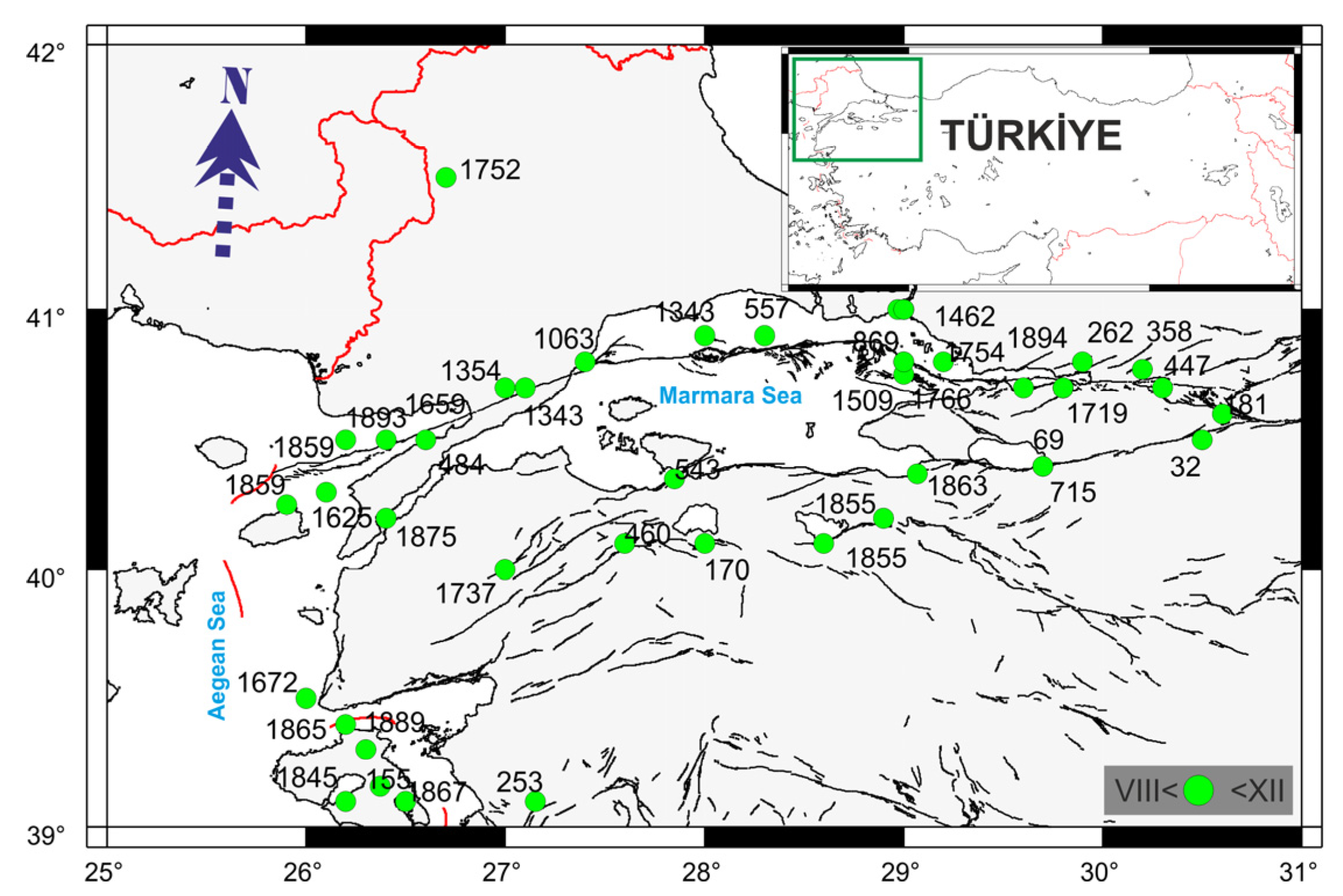
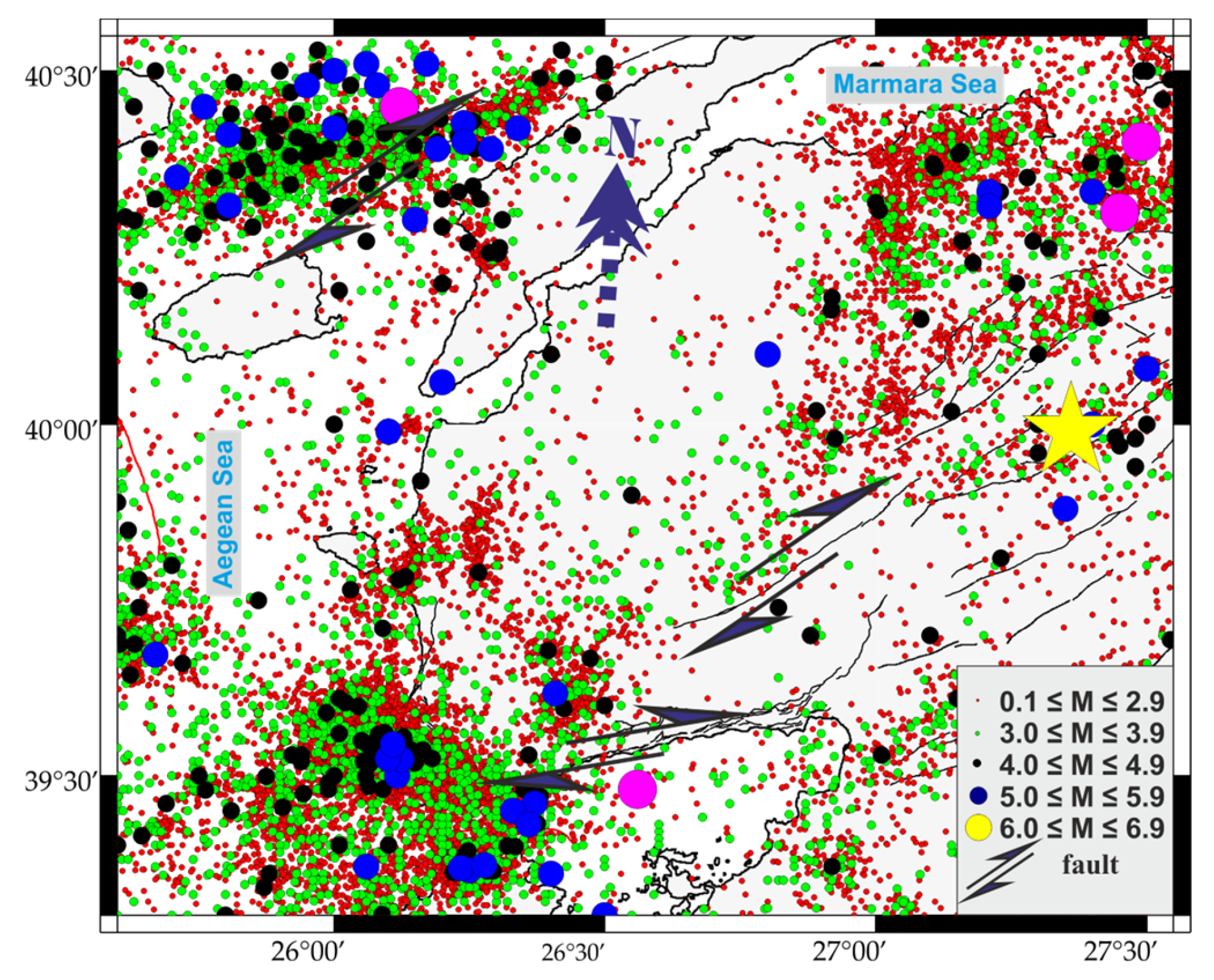
A review of the historical data reveals that a series of significant seismic events transpired in the years 155, 170, 253, 484, 1737, 1855, and 1875, coinciding with specific phases within the instrumental period. This phenomenon is further exemplified by events such as the Saros Bay–Murefte earthquake in 1912, with a magnitude of 7.3 (Mw), the 1935 Erdek Bay earthquake, with a magnitude of 6.4, and the 1935 Can–Biga earthquake, with a magnitude of 6. The 1944 Edremit Bay–Ayvacik earthquake (M = 6.8), the 1953 Yenice–Gönen earthquake (M = 7.2), the 1964 Gönen earthquake (M = 5.8), the 1971 Edremit–Bakircay earthquake (M = 5.5), the 1983 Biga earthquake (M = 5.8), the 2006 Kusgolu–Manyas earthquake (M = 5.2), and the 2006 Bandirma earthquake (M = 5.0) are indicative of significant seismic activity in and around the Biga Peninsula. In
Figure 1, historical seismic events with magnitudes greater than or equal to 6.5 on the Richter scale are displayed for the range of IX–XII. In
Figure 2, the epicentral distributions of the earthquakes of the instrumental period following 1900 are illustrated.
Edremit Bay is widely regarded as a tectonically active graben that developed during the Neogene–Quaternary period in the northwestern region of Anatolia. This geological formation is bordered by the Sakarya continent. In the evaluation of seismic profiles taken in Edremit Bay, strong reflections belonging to a thick accumulation basin and the presence of faults cutting this basin were discussed in [
8]. The present study posits that the low-angle faults oriented in the NW and SSE directions are shaped by the effect of the compressional regime. Furthermore, the dominant synthetic and antithetic faults in the region develop parallel to the basin boundaries. Conversely, the authors of [
8] proposed that the Edremit Gulf is not solely influenced by lateral thrust faulting or the conventional characteristics of the North Anatolian Fault. Despite extensive research into tectonic development and faulting patterns in the northwestern Aegean region, including the Ayvacik, Biga, and Gallipoli peninsulas, there is a paucity of similar studies. The authors of [
9,
10,
11,
12,
13] indicated that the Edremit Gulf is an asymmetric wedge-shaped depression area formed in the gulf region where the North Anatolian Fault enters the Northwest Aegean Sea [
12,
13]. One of the two primary fault systems is a normal oblique NW–SSE-trending fault between the northern shores of Edremit Bay and the island of Lesbos, which extends toward the Aegean Sea. The other fault system is responsible for the formation of the depression between Ayvalik and Lesbos.
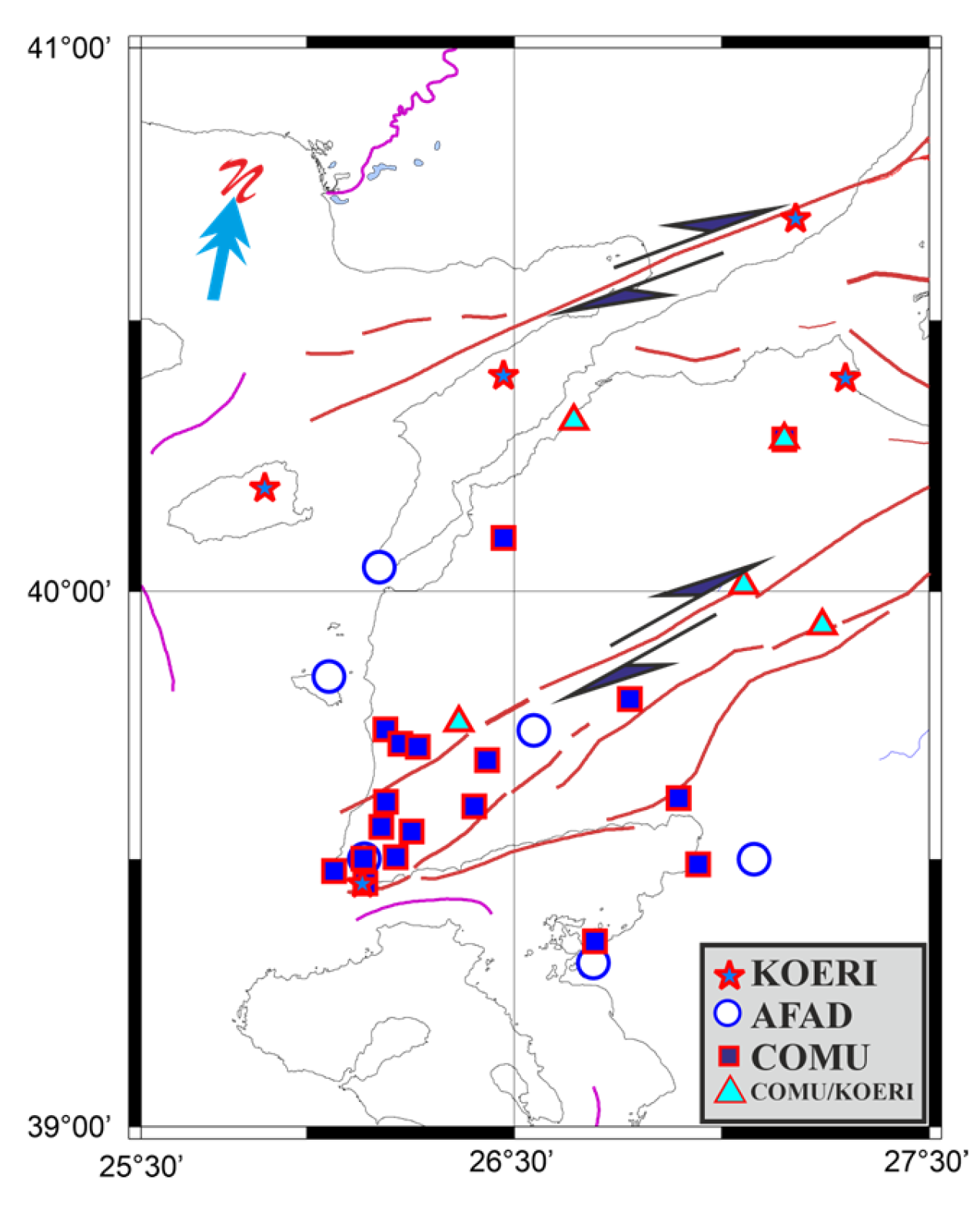
Intense earthquake activity began in Ayvacik and its immediate vicinity at the southwestern tip of the Biga Peninsula on 14 January 2017, with a magnitude of 4.6, continuing on 6 February 2017 with magnitudes of 5.5 (Mw = 5.5, KOERI), 5.3 (AFAD), and 5.4 (Mw = 5.4). To monitor this activity, broadband seismometers were temporarily installed on the Ayvacik Peninsula. Considering the atypical seismic activity observed in the region in recent years, the objective was to enhance the monitoring and evaluation of this activity through the deployment of these temporary stations in conjunction with the earthquake stations comprising the established national networks (see
Figure 3).
3. Tectonic Framework and Earthquake Sources
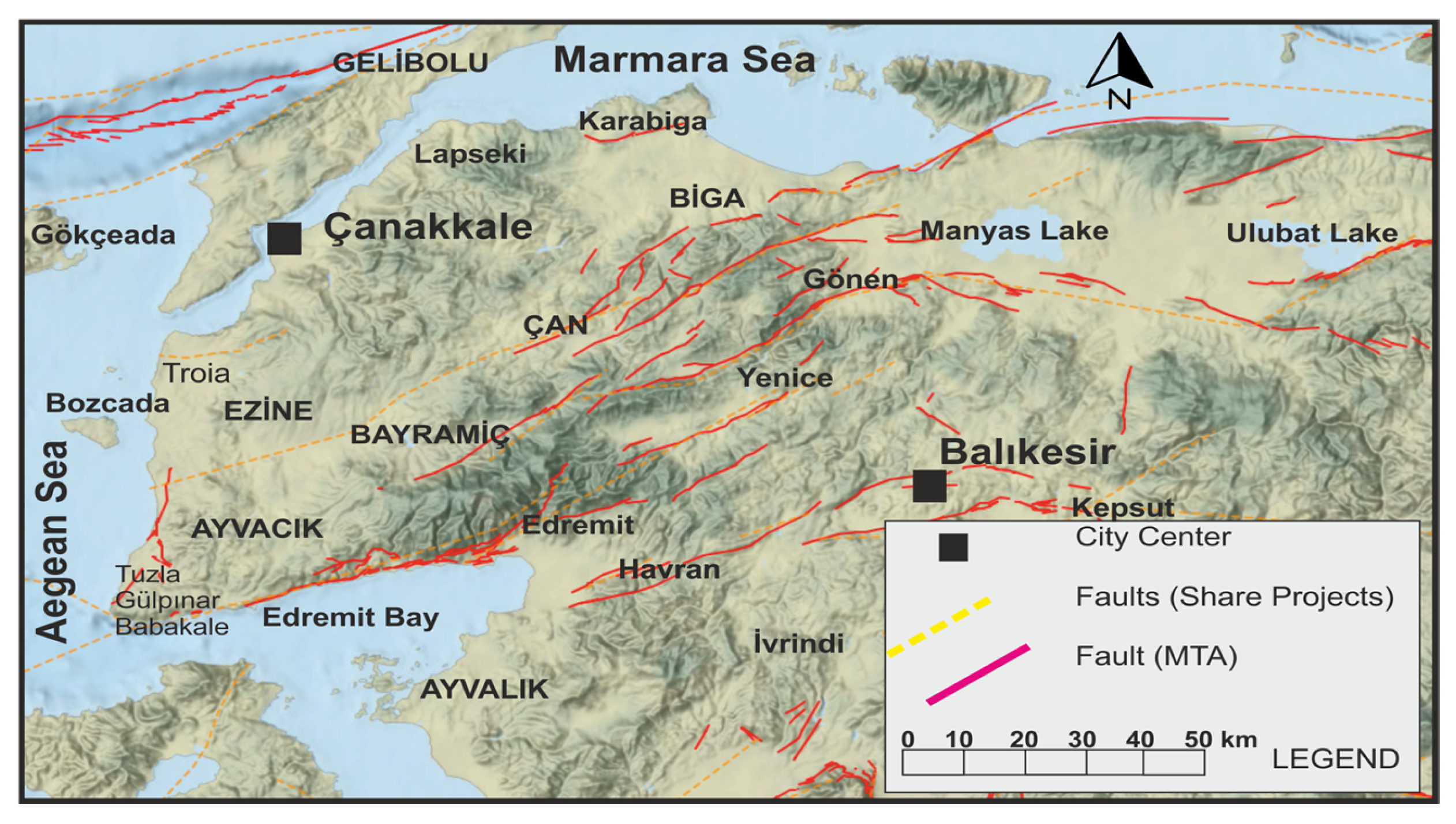
The Biga Peninsula is primarily within the extension of the southern branch of the right-lateral strike–slip North Anatolian Fault in terms of active tectonic elements. The northern branch of the North Anatolian Fault passes through the Saros Gulf north of the peninsula. The Ganos fault is an important strike–slip fault on land here. Its extension in the Saros Gulf especially defines the earthquakes here. South of the peninsula, important normal faults surround the Edremit Fault and the Ayvacik Fault. Far southeast of the peninsula, the eastward extension of the Edremit Fault is the Balıkesir–Havran Fault (
Figure 4). Many large and small earthquakes have occurred along these fault lines in the last century and throughout history. These segments are also shown as active faults on Türkiye’s fault map [
4,
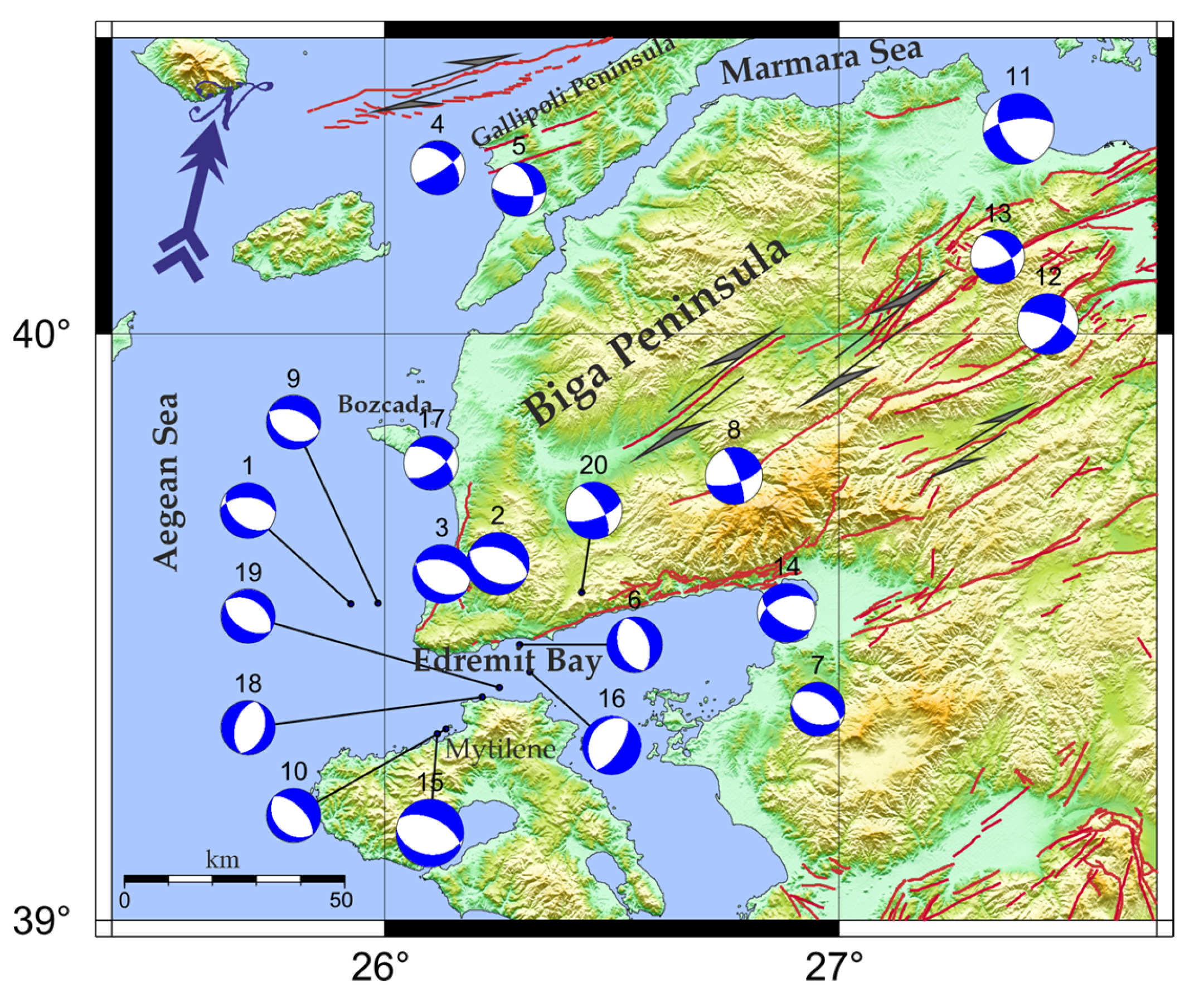
14]. The focal mechanism solutions (
Figure 5 and
Table 1) of the 20 earthquakes that occurred within the Biga Peninsula are examined by considering the active elements in the region. Examining the focal mechanism solutions (
Figure 5) of these 20 earthquakes, and considering the active elements in the region, reveals that earthquakes 1, 2, 3, 6, and 9—the largest of which had a magnitude of Mw = 5.3 on 6 February 2017—occurred in an area that was hit by a series of earthquakes between 14 January and 26 March. The Tuzla, Kocakoy, and Babakale normal faults run through this area from northeast to southwest and northwest to southeast [
15]. These five earthquakes occurred on these faults, and their locations are consistent with the extent of the faults. Earthquake number 11 occurred on the Karabiga fault, a right-lateral strike–slip fault extending approximately 15–20 km.
Earthquake number 13 is located on the right-lateral strike–slip Sarıköy–Inova fault, which has a NE–SW strike–slip motion. Earthquake number 12 occurred on the Yenice–Gönen Fault, which is a right-lateral strike–slip fault with a NE–SW strike in the western segment. Earthquake numbers 10, 15, and 19 occurred on normal faults that trend NW–SE and north, bound for the northern part of Lesvos Island. On the other hand, earthquakes 16 and 18 occurred in almost the same region and are faults that intersect the Mytilene Fault at right angles. These are local earthquakes. Earthquake No. 14 is located at the eastern end of the Edremit fault, a south-trending normal fault running in an approximately north–south direction. Earthquake number 7 is located west of the Balıkesir–Havran fault system at the southernmost tip of the Biga Peninsula. It is a normal fault that is distant from active tectonic elements and consistent with the main regional extension direction. Earthquakes No. 4 and No. 5 are located on two right-lateral strike–slip secondary faults that are consistent with the North Anatolian Fault, which bounds the northern part of the Gallipoli Peninsula and extends into the Saros Gulf. Earthquake number 8 is located at the southwest end of the Pazarköy–Hamdibey–Kalkım strike–slip normal fault, which trends approximately northeast–southwest and has a right-lateral strike–slip component. Earthquake number 20 is a south-trending, strike–slip, normal fault with a prominent right-lateral, strike–slip component. It is located just north of the Edremit fault and is consistent with it. Earthquake 17 is located southeast of Bozcaada. Another strike–slip fault compatible with the extension and characteristics of these faults is located just south of the Troia Fault System [
16]. In
Table 1, the blue-marked earthquakes (1, 4, 5, 7, 8, 11, 12, 13, 14, 17, 20) represent strike–slip faulting, and the red-marked earthquakes (2, 3, 6, 9, 10, 15, 16, 18, 19) represent normal faulting.
Figure 5.
Reproduced map for locations and focal mechanism solutions of earthquakes with magnitudes greater than 3.1 that occurred between 2020 and 2022. The events that were analyzed are plotted with lower hemisphere stereographic projection after [
17].
Figure 5.
Reproduced map for locations and focal mechanism solutions of earthquakes with magnitudes greater than 3.1 that occurred between 2020 and 2022. The events that were analyzed are plotted with lower hemisphere stereographic projection after [
17].
4. Results and Conclusions
The Sindirgi–Balıkesir earthquake (Mw = 6.1, KOERI) of 10 August 2025 provides a striking reminder of the region’s seismic hazard. Its occurrence underscores the necessity of integrating new seismic data into ongoing monitoring systems and re-evaluating risk models for Northwestern Türkiye. This study’s findings, when viewed in light of this most recent destructive event, demonstrate that comprehensive and continuous research remains indispensable. The integration of continuous monitoring systems, updated hazard maps, and lessons from recent destructive earthquakes provides essential guidance for reducing future earthquake risks in Northwestern Türkiye. In terms of active tectonic elements, the Biga Peninsula lies mainly within the extension of the southern branch of the right-lateral strike–slip North Anatolian Fault. The northern branch of the North Anatolian Fault passes through the Saros Gulf north of the peninsula. The Ganos fault is an important strike–slip fault on land. Its extension in the Saros Gulf defines the earthquakes here. The Edremit Fault and Ayvacik fault are surrounded by significant normal faults in the southern part of the peninsula. Accordingly, the Biga Peninsula and its northern and central regions are under the influence of a compressional regime ranging from NW–SSE to NE–SW-SSE, which is active today. Earthquakes present a strike–slip faulting mechanism. The active structures in the region generally trend NE–SW or NW–SSE and are right-lateral strike–slip faults.
Author Contributions
Conceptualization, T.B., A.D. and F.N.B.; methodology, F.N.B. and A.D.; formal analysis, T.B. and A.D.; investigation, F.N.B., A.D. and T.B.; formal analysis, T.B., A.D. and F.N.B.; data curation, A.D. and F.N.B.; writing—original draft preparation, F.N.B. and T.B.; writing—review and editing, T.B., A.D. and F.N.B.; visualization, F.N.B., A.D. and T.B.; All authors have read and agreed to the published version of the manuscript.
Funding
This research received no external funding.
Institutional Review Board Statement
Not applicable.
Informed Consent Statement
Not applicable.
Data Availability Statement
The data presented in this study are available on request from the corresponding author.
Conflicts of Interest
The authors declare no conflicts of interest.
Abbreviations
The following abbreviations are used in this manuscript:
| AFAD | Disaster and Emergency Management Presidency |
| COMU | Canakkale Onsekiz Mart University |
| ESM | Earthquake Source Mechanism |
| KOERI | Kandilli Observatory and Earthquake Research Institute |
| N | north |
| NE | northeast |
| Nw | northwestern |
| NW | northwest |
| M | magnitude |
| Mw | moment magnitude |
| S | south |
| SSE | south–southeast |
| SW | southwest |
References
- Barka, A.; Kadinsky-Cade, K. Strike-slip fault geometry in Türkiye and its influence on earthquake activity. Tectonics 1998, 7, 663–684. [Google Scholar] [CrossRef]
- Siyako, M.; Bürkan, K.A.; Okay, A.İ. Tertiary geology and hydrocarbon potential of the Biga and Gelibolu Peninsula. TAPG Bull. 1989, 1, 183–199. [Google Scholar]
- Sengör, A.M.C.; Tüysüz, O.; Imren, C.; Sakınç, M.; Eyidoğan, H.; Görür, N.; Le Pichon, X.; Rangin, C. The North Anatolian Fault: A new look. Annu. Rev. Earth Planet. Sci. 2005, 33, 37–112. [Google Scholar] [CrossRef]
- Şaroğlu, F.; Emre, Ö.; Kuşçu, İ. The Active Fault Map of Türkiyte; M.T.A. Series; General Directorate of Mineral Research and Exploration (MTA): Ankara, Türkiye, 1992. (In Turkish) [Google Scholar]
- Taymaz, T.; Jackson, J.; McKenzie, D. Active tectonics of the north and central Aegean Sea. Geophys. J. Int. 1991, 106, 433–490. [Google Scholar] [CrossRef]
- AFAD. Historical Earthquakes Periods. Available online: https://deprem.afad.gov.tr/event-historical (accessed on 21 June 2025). (In Turkish)
- Kandilli Observatory and Earthquake Research Institute (KRDAE). Earthquake Catalog. Available online: http://www.koeri.boun.edu.tr/sismo/2/earthquake-catalog/ (accessed on 1 June 2025).
- Kurtuluş, C.; Doğan, B.; Serçelik, F.; Canbay, M.; Küçük, H.M. Determination of the tectonics evaluation of the Edremit Gulf based on seismic reflection studies. Mar. Geophys. Res. 2009, 30, 121–134. [Google Scholar] [CrossRef]
- Yaltırak, C.; Sakınç, M.; Oktay, F.Y. Westward propagation of North Anatolian fault into northern Aegean: Timing and kinematics: Comment. Geology 2000, 28, 187–188. [Google Scholar] [CrossRef]
- Yılmaz, Y.; Karacık, Z. Geology of the northern side of the Gulf of Edremit and its tectonic significance for the development of the Aegean grabens. Geodin. Acta 2001, 14, 31–43. [Google Scholar] [CrossRef]
- Yaltırak, C.; İşler, E.B.; Aksu, A.E. Evolution of the Bababurnu Basin and shelf of the Biga Peninsula: Western extension of the middle strand of the North Anatolian Fault Zone, Northeast Aegean Sea, Türkiye. J. Asian Earth Sci. 2012, 57, 103–119. [Google Scholar] [CrossRef]
- Beccaletto, L.; Steiner, C. Evidence of two-stage extensional tectonics from the northern edge of the Edremit Graben, NW Turkey. Geodinamica Acta 2005, 18, 283–297. [Google Scholar] [CrossRef]
- Altınok, Y.; Alpar, B.; Yaltırak, C.; Pınar, A.; Özer, N. The earthquakes and related tsunamis of October 6, 1944 and March 7, 1867; NE Aegean Sea. Nat. Hazards 2012, 60, 3–25. [Google Scholar] [CrossRef]
- Emre, Ö.; Duman, T.Y.; Özalp, S. 1:250.000 Series Mao of Active Fault Maps of Türkiye; General Directorate of Mineral Research and Exploration: Ankara, Türkiye, 2013. (In Turkish) [Google Scholar]
- Özden, S.; Över, S.; Poyraz, S.A.; Güneş, Y.; Pınar, A. Tectonic implications of the 2017 Ayvacık (Çanakkale) earthquakes, Biga Peninsula, NW Türkiye. J. Asian Earth Sci. 2018, 154, 125–141. [Google Scholar] [CrossRef]
- Kürçer, A.; Chatzipetros, A.; Tutkun, S.Z.; Pavlides, S.; Özden, S.; Syrides, G.; Vouvalidis, K.; Ulugergerli, E.; Ateş, Ö.; Ekinci, Y.L. An assessment of the earthquakes of ancient Troy, NW Anatolia, Türkiye. In Tectonics; Book Series, Chapter 7; IntechOpen: London, UK, 2012; pp. 171–200. [Google Scholar]
- Bekler, T.; Demirci, A. Preliminary Observations and Assessment of Çanakkale-Ayvacık Earthquake Activity. J. Adv. Res. Nat. Appl. Sci. 2018, 4, 1–13. [Google Scholar] [CrossRef][Green Version]
| Disclaimer/Publisher’s Note: The statements, opinions and data contained in all publications are solely those of the individual author(s) and contributor(s) and not of MDPI and/or the editor(s). MDPI and/or the editor(s) disclaim responsibility for any injury to people or property resulting from any ideas, methods, instructions or products referred to in the content. |