1. Introduction
Forest fires represent a pervasive global disaster characterized by large-scale, uncontrolled combustion in unrestricted areas. These events affect various aspects of life, such as natural environments, the economy, and health.
Spanning the last century, uncontrolled forest fires have inflicted catastrophic damage upon wildlife habitats, agricultural landscapes, and built environments throughout Asia, Australia, Africa, and the Americas [
1]. Recent data underscores the urgency of this challenge; in 2021, the intensifying occurrence of these events led to a global reduction of approximately 7.02 million hectares in tree cover [
2].
In India, forest fire activity typically intensifies during the summer months, with the critical window extending from mid-February to late June [
2,
3]. Assessments by the Forest Survey of India reveal that 50% of the country’s forests are prone to fire, including a 6% segment classified as severely vulnerable. In the Indian Himalayas, Vadrevu et al. (2012) reported that 3908 annual fires release 431 tonnes of black carbon and destroy 1129 km
2 of land, primarily (64%) in low-elevation zones [
4,
5].
Timely forecasting is critical for minimizing ecological damage. By enabling targeted early intervention in vulnerable areas, our approach supports strategic decision-making and disaster preparedness. This work also advances United Nations SDGs 13 (Climate Action) and 15 (Life on Land) by enhancing resilience and conserving ecosystems.
To address the limitations of existing reactive forest fire monitoring systems, this study shifts the focus from post-ignition detection to proactive, next-day prediction. The primary contributions of this research are defined across three areas:
Domain-Specific Dataset Curation: We present a custom, high-resolution (30 m) multimodal geospatial dataset. This dataset is engineered to spatially align specific meteorological, topographical, and vegetation variables directly responsible for influencing forest fire ignition and spread.
Proactive Predictive Methodology: In contrast to current operational technologies that detect thermal anomalies only after a fire has ignited [
6,
7], we establish a forecasting framework. By adapting a deep learning approach to this multimodal data, the system predicts geographical locations where a fire is likely to occur or spread 24 h in advance.
Practical Forecasting Workflow: We detail an end-to-end processing and inference pipeline that transforms raw satellite inputs into localized risk maps. This shifts the operational capability from reactive observation to proactive disaster mitigation and resource allocation.
2. Literature Review
The reviewed literature demonstrates a progressive evolution in forest fire prediction methodologies, transitioning from traditional machine learning to sophisticated deep learning architectures:
Convolutional Neural Networks (CNNs): Zhang et al. (2021) developed four architectures (CNN-1D, CNN-2D, MLP-1D, MLP-2D) for global forest fire susceptibility, with CNN-2D achieving the highest performance (AUC = 0.848, Kappa = 0.746) [
8].
Hybrid CNN-BiLSTM: Marjani et al. (2024) proposed a novel CNN-BiLSTM model for near-real-time wildfire spread prediction, achieving an F1 Score = 0.73 (training) and an IoU = 0.58 (validation), outperforming standalone LSTM and CNN-LSTM architectures [
9].
Optimized DNNs: Naderpour et al. (2021) implemented deep neural networks with 36 environmental factors, achieving exceptional performance (ROC = 95.1%, PRC = 93.8%, Kappa = 94.3%) [
10].
Refer to
Table 1 for a comprehensive comparison.
3. Methodology
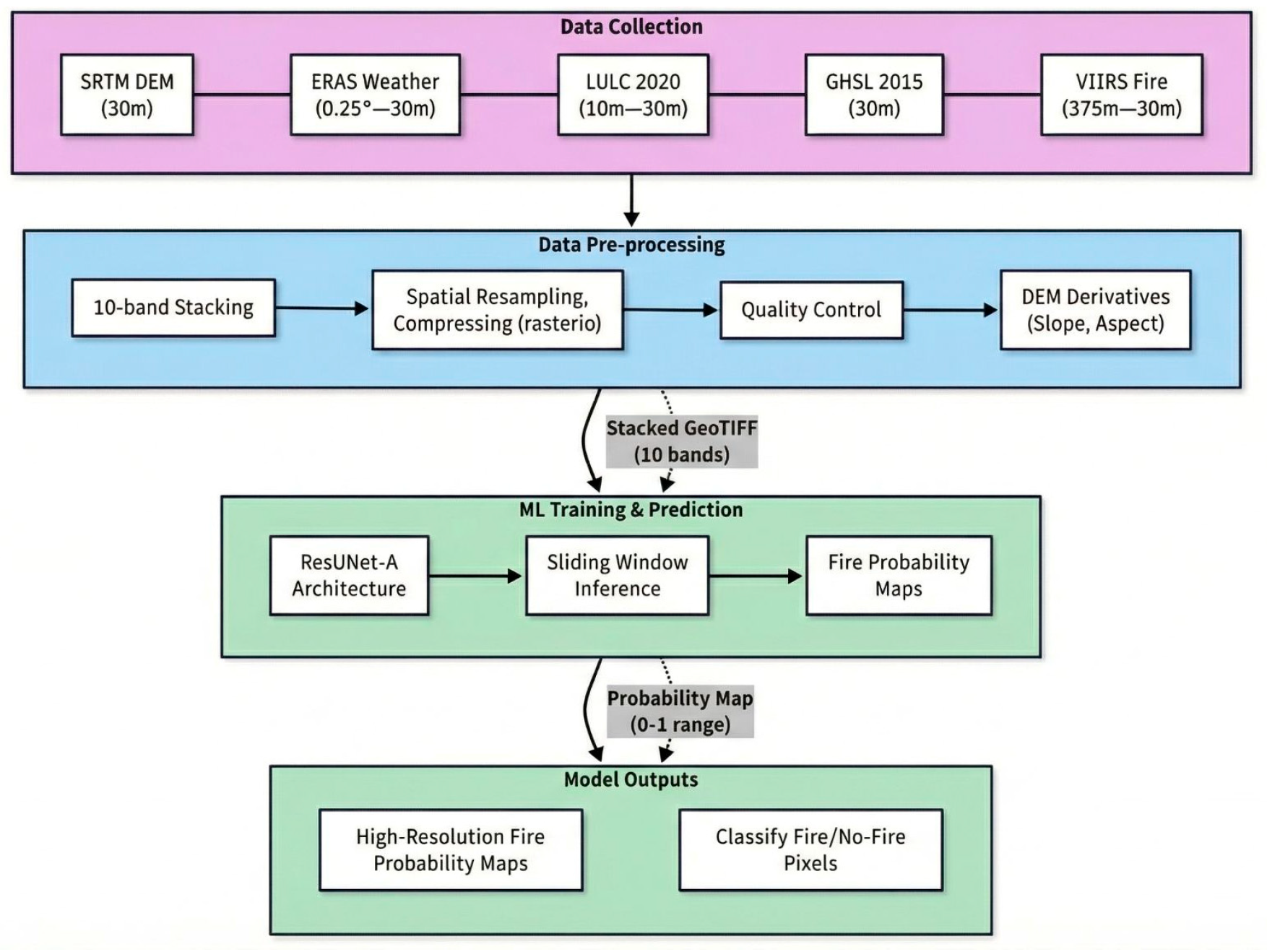
This section delineates the comprehensive methodological framework developed for automated forest fire prediction. The proposed workflow is structured into three primary components (
Figure 1):
The acquisition and preprocessing of remote sensing datasets.
The architectural design of the machine learning model.
The experimental protocols for training and prediction.
3.1. Dataset
Uttarakhand, India, was selected as the study area due to its history of frequent fires, totaling 10,473 events from 2005 to 2015. In the 2016 season alone, 1327 incidents degraded 4423 ha of forest cover by June [
4]. We focused data extraction on the peak severity window of April 1 to May 29, 2016. This specific temporal coverage was necessitated by significant computational and memory constraints during model training. The generation of daily 30 m, 10-band GeoTIFF stacks produced memory-intensive data structures (approximately 240 MB per compressed image). Processing extended multi-year periods exceeded the available hardware limits for this initial study while still ensuring the model captured critical fire dynamics during a high-intensity season.
Fire labels were derived from VIIRS Suomi NPP imagery [
12], retaining only medium-to-high confidence detections to minimize false positives. Forest fire ignition and spread are governed by a combination of environmental, topographical, meteorological, and human-related factors [
13,
14,
15]. Our work focuses on influential geospatial and atmospheric variables, specifically key meteorological indices, topographic derivatives (slope, aspect), vegetation fuel classes, and urban settlement masks.
We integrated and aligned diverse datasets using Google Earth Engine (see
Table 2), resampling all inputs to a uniform 30 m high-resolution grid.
The processed data were stacked to create a 10-band multimodal dataset designed for machine learning training; a dataset summary is provided in
Table 3, and detailed specifications for each band are provided in
Table 4. We utilized Deflate compression [
16] to reduce the 6 GB daily stacks to 240 MB, ensuring efficient data handling.
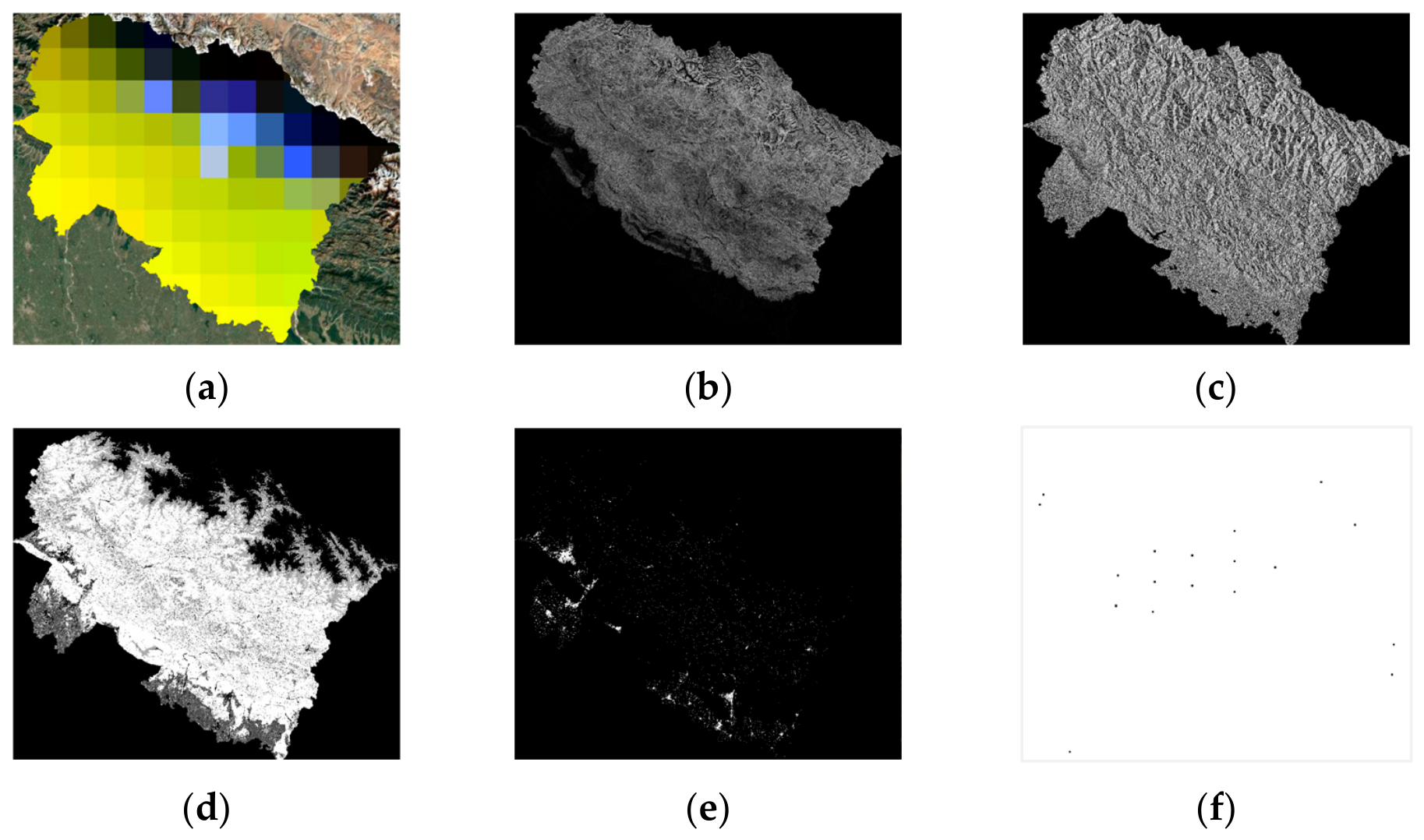
Figure 2 illustrates the specific components of the constructed multimodal geospatial data stack.
3.2. Machine Learning Model: ResUnet-A Architecture
To address the complexity of multimodal fire prediction, we employed ResUNet-A [
17]. This architecture integrates residual connections and atrous convolutions to manage scale variations, ensuring robust semantic segmentation of fire-prone areas.
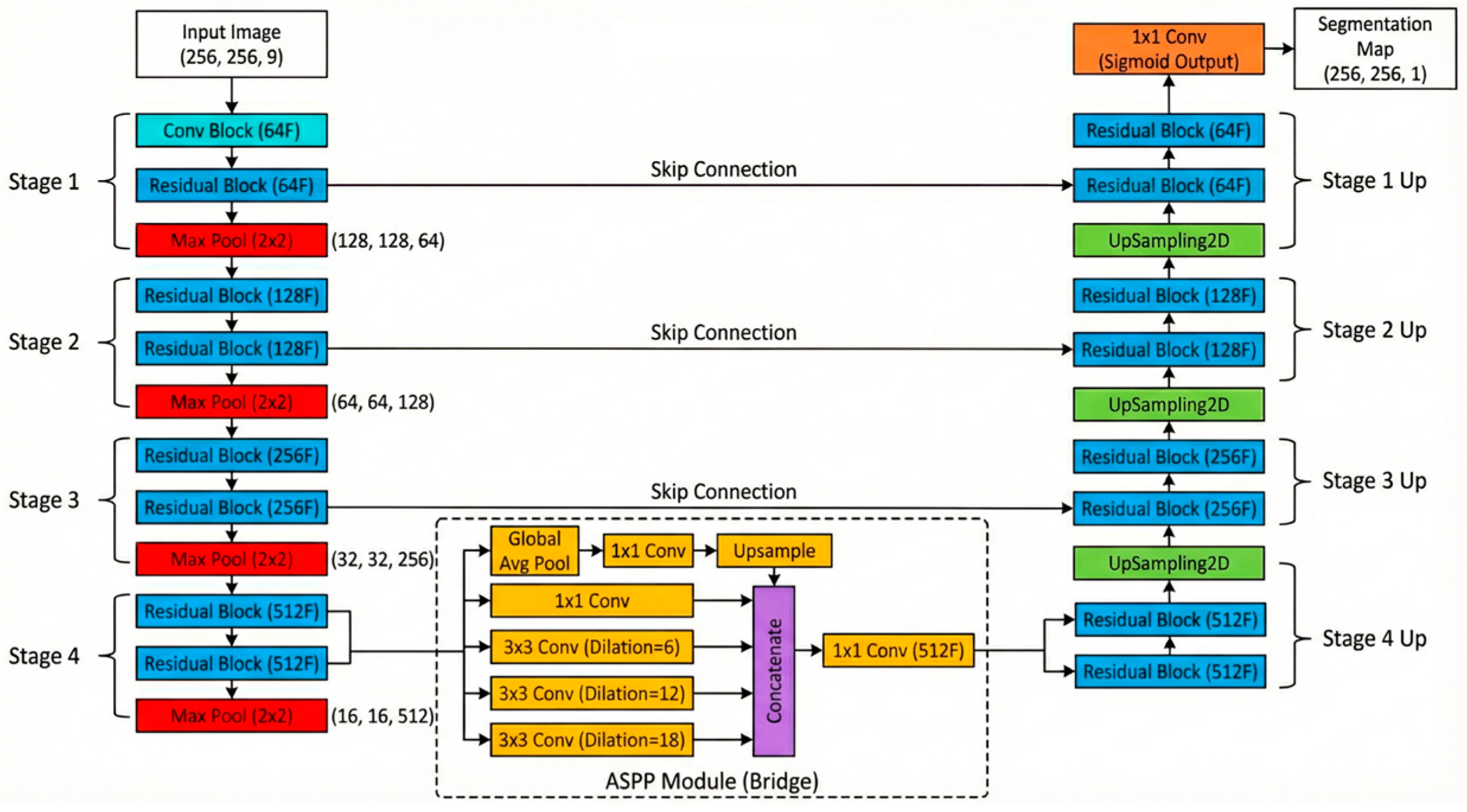
The core structure of our model, as shown in
Figure 3, is built upon the U-Net architecture [
18], which consists of a contracting path (encoder) to capture context and a symmetric expanding path (decoder) that enables precise localization.
However, standard U-Nets often suffer from degradation in deeper networks and a limited receptive field. ResUnet-A overcomes these limitations through two critical innovations:
Residual Blocks: The network employs ResNet-inspired residual blocks [
19], utilizing skip connections to facilitate gradient flow during backpropagation. Mathematically, the output
of a residual block is defined as:
where
is the input, and
represents the residual mapping to be learned. This mechanism prevents vanishing gradients, enabling the training of deeper networks to extract abstract multimodal features without compromising stability.
Atrous (Dilated) Convolutions: To capture multi-scale context without resolution loss, ResUNet-A employs Atrous Spatial Pyramid Pooling (ASPP) [
20]. By applying a dilation rate
, atrous convolutions expand the receptive field exponentially without adding computational overhead.
3.3. Experimental Setup and Training
To evaluate temporal generalization, we employed a strict temporal split rather than random shuffling. The dataset was partitioned into training (1–27 April; 1–3 May), validation (28–30 April; 4–20 May), and testing (21–28 May) subsets to assess performance on unseen future events. The model was implemented using TensorFlow and Keras on the Kaggle platform. Training was accelerated using an NVIDIA Tesla P100 GPU (16 GB VRAM) to handle high-resolution imagery.
To ensure strict experimental reproducibility, rigorous data preprocessing and sampling protocols were implemented prior to training. All continuous geospatial variables (meteorological and topographical bands) were standardized using Min–Max normalization to a [0, 1] scale to stabilize gradient descent across the heterogeneous multimodal data. To manage the extreme memory footprint of the 30 m resolution arrays, a patch-based spatial sampling strategy was employed. We extracted 60 localized pixel patches per daily GeoTIFF. Based on the temporal split, this yielded a total of 1800 training patches (derived from 30 training days) and 1200 validation patches (derived from 20 validation days). Operating with a batch size of 16, the model executed approximately 112 steps per epoch, running for a maximum of 20 epochs until early stopping conditions were met.
The comprehensive training configuration details are summarized in
Table 5.
3.4. Threshold Optimization
To justify the 0.05 decision boundary, we conducted a threshold sensitivity analysis. Due to extreme class imbalance, the model’s raw probabilities are naturally suppressed (mean: 0.0237, max: 0.1600), rendering standard 0.50 thresholds inapplicable. Evaluating candidate thresholds revealed that a low threshold of 0.02 flagged 62.7% of the region, generating excessive false alarms, whereas a strict 0.10 threshold isolated only 417 pixels, risking severe missed predictions. Therefore, 0.05 was selected as the optimal inflection point, effectively filtering background noise to isolate the top 0.33% of highest-confidence predictions as actionable high-risk zones.
4. Results and Discussion
4.1. Training Performance
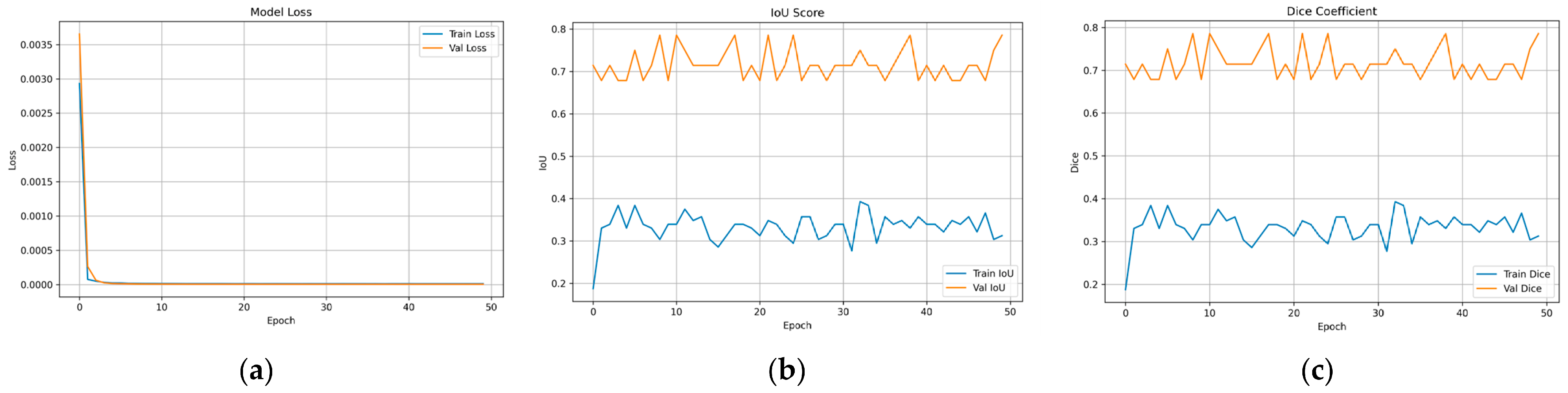
The training dynamics over 50 epochs are presented in
Figure 4. The Model Loss converges rapidly to near zero, indicating effective optimization. As shown in the results, the validation IoU and Dice scores are consistently higher than the training scores.
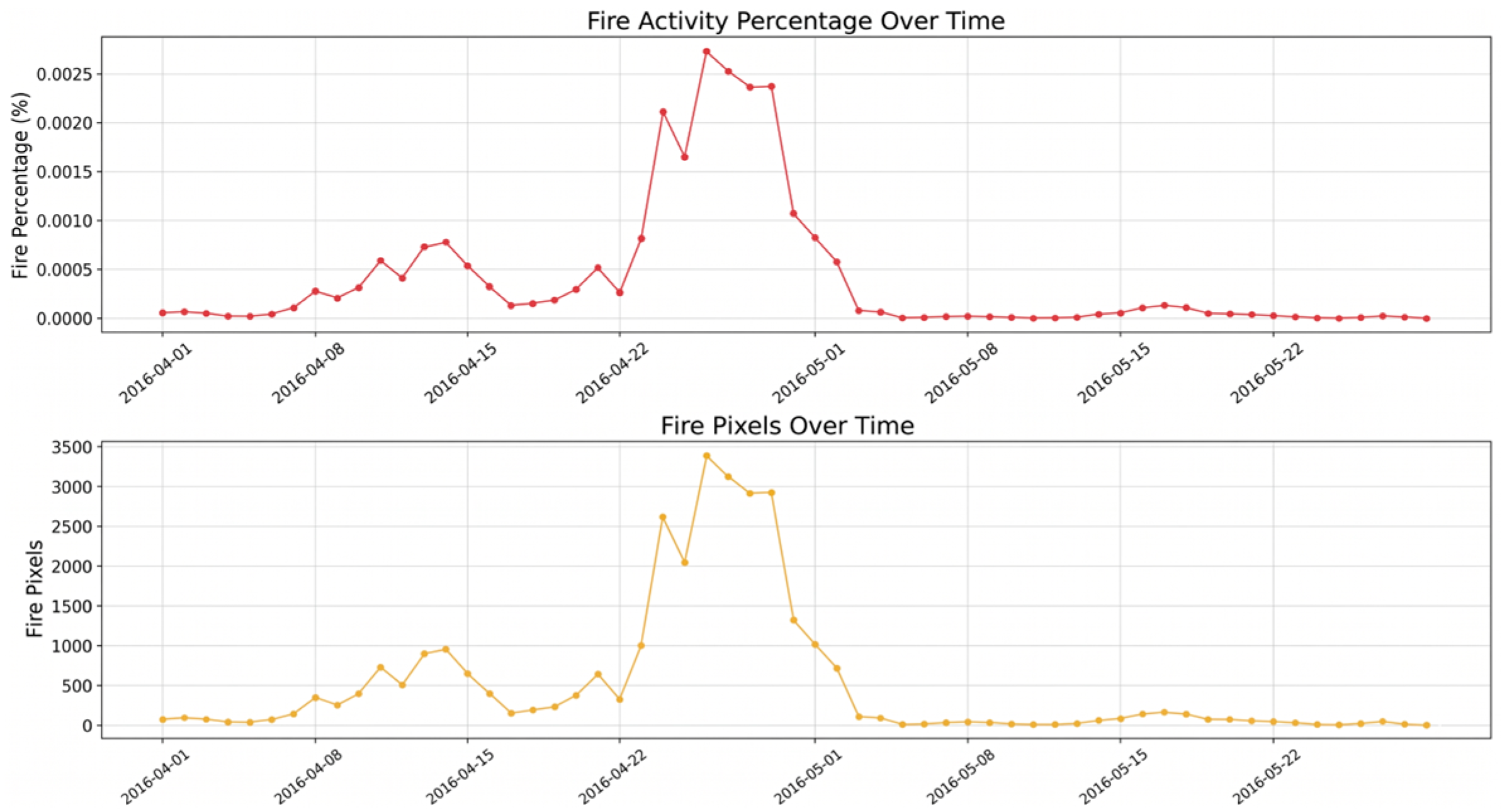
Figure 5 explains this by showing that the validation period (28–30 April; 4–20 May) occurred during the peak fire season, which featured large, connected fire areas. In contrast, the training period (1–27 April; 1–3 May) mainly contained small, scattered fires. Because IoU and Dice metrics mathematically favor large groups of pixels over isolated single pixels, the model naturally scored higher on the validation data. Finally, to ensure a fair evaluation, the model’s initial settings (hyperparameters) were chosen beforehand to handle the extreme class imbalance, rather than being specifically adjusted to boost these validation scores.
4.2. Prediction Analysis and Quantitative Constraints
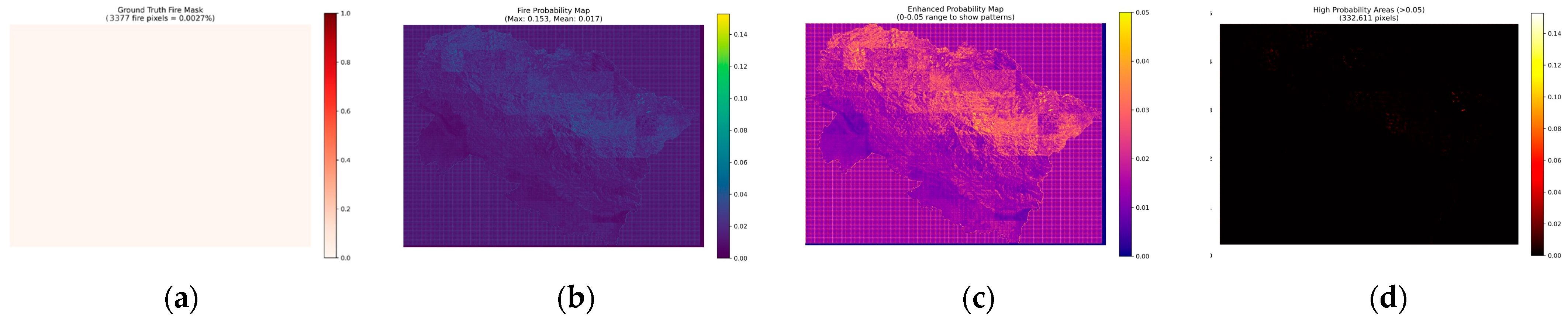
Figure 6 demonstrates the model’s spatial prediction capabilities. Due to the extreme data sparsity, the raw Fire Probability Map yields conservative confidence scores, peaking at 0.16. However, the model successfully captures the relative spatial patterns of fire risk. By applying a tailored threshold of 0.05, the mapping effectively isolates high-risk zones (resulting in a 0.33% fire coverage area), proving that the network can spatially localize threats even when absolute probability values are suppressed by class imbalance.
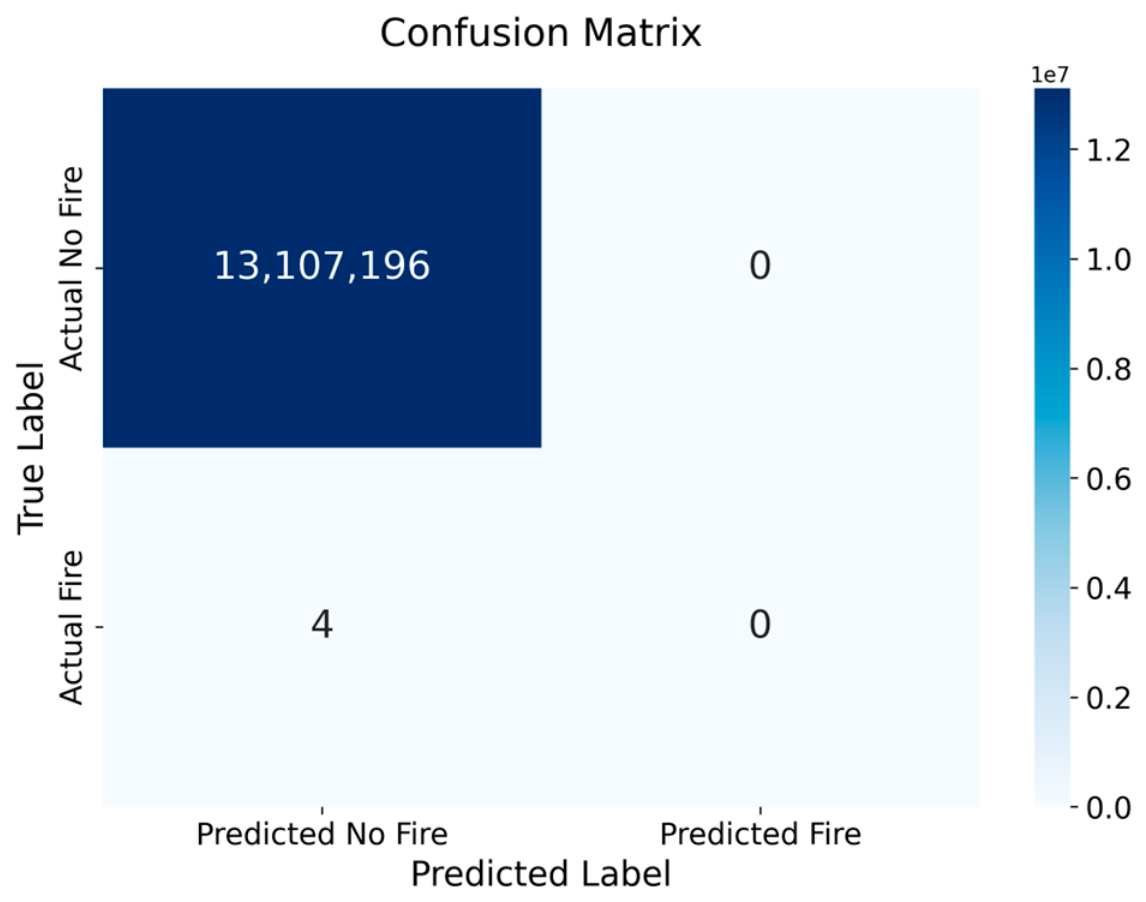
To provide a transparent quantitative assessment of these predictions, we analyzed the model’s performance on the test subset (comprising 200 image patches and over 13.1 million total pixels). Within this highly localized set, only 4 pixels were ground-truth fire events, representing a positive class prevalence of approximately 0.00003%. As a result, the confusion matrix, as shown in
Figure 7, produced 13,107,196 True Negatives and 4 False Negatives, with no True Positives.
Because the network mathematically biases toward the intensely dominant background class to minimize global loss, standard operational metrics such as precision and recall evaluate to zero. While global validation metrics appear artificially high (IoU and Dice compiling at 0.96) due to the dominant ‘no-fire’ class, these test results confirm that traditional pixel-wise classification metrics are unstable under such extreme sparsity. The model demonstrates strong capability in mapping relative spatial hazards; however, refining pixel-level accuracy and reducing false alarms for practical deployment will require addressing current data constraints through temporal expansion and synthetic oversampling.
4.3. Impact of Class Imbalance and Addressing Generalizability
As illustrated in
Figure 5, fire activity in the dataset is highly volatile and extremely sparse. Quantitative analysis reveals that across 123 million pixels, only 3377 were positive, resulting in a fire class prevalence of just 0.0027%. This extreme imbalance poses a significant challenge, as the model naturally biases toward the dominant ‘no-fire’ class to minimize global loss. Furthermore, because the dataset is restricted to a single two-month window, the model’s exposure to varying inter-annual climate conditions and shifting vegetation dynamics is limited. Consequently, while the spatial feature extraction is robust for the 2016 parameters, the model’s immediate generalizability to different fire seasons or other geographic regions remains constrained until the temporal scope of the training data can be expanded.
5. Future Work
To transition this preliminary proof-of-concept into a robust, operationally deployable framework, future research will prioritize the following areas:
Spatio-Temporal Expansion: Extending the dataset across multiple fire seasons and diverse geographical regions to validate model generalizability under varying climatic and vegetation conditions.
Baseline Benchmarking: Conducting comprehensive comparative analyses against classical machine learning algorithms (e.g., Random Forest, XGBoost) and simpler deep learning architectures (e.g., standard U-Net) to strictly quantify the performance gains of the ResUNet-A model across expanded temporal datasets.
Granular Patch Processing: Reducing input dimensions (e.g., to ) to better isolate fire-dense regions and mitigate class imbalance.
Synthetic Augmentation: Implementing SMOTE to address data sparsity by generating diverse artificial minority samples rather than relying on duplication.
6. Conclusions
This study presented a proactive deep learning framework for next-day forest fire prediction in the Uttarakhand region, integrating multimodal geospatial data with the ResUNet-A architecture. Despite the significant challenge of extreme class imbalance, where fire events constituted only 0.0027% of the dataset, the model successfully learned to isolate high-risk zones through effective spatial feature extraction. While currently limited by its single-season temporal scope and constrained quantitative metrics, this research successfully validates our end-to-end processing pipeline and dataset structure as a foundational proof-of-concept. By demonstrating the feasibility of forecasting high-resolution risk maps 24 h in advance rather than relying on reactive thermal detection, this approach paves the way for scalable early warning systems. With the necessary future integration of multi-year data expansion, synthetic augmentation, and interpretability mechanisms, this framework has the potential to become a robust operational tool for resource allocation, directly supporting United Nations Sustainable Development Goals 13 (Climate Action) and 15 (Life on Land).
Author Contributions
P.M.: Data curation, Methodology, Software, Project Administration and Writing—original draft; S.S.S.: Data curation, Methodology, Software and Writing—original draft; A.D.: Data curation and Writing—original draft; R.P.: Conceptualization, Project Administration, Resources and Supervision. All authors have read and agreed to the published version of the manuscript.
Funding
This research received no external funding.
Data Availability Statement
Data is available upon request.
Conflicts of Interest
The authors declare no conflicts of interest.
References
- Kalantar, B.; Ueda, N.; Idrees, M.O.; Janizadeh, S.; Ahmadi, K.; Shabani, F. Forest Fire Susceptibility Prediction Based on Machine Learning Models with Resampling Algorithms on Remote Sensing Data. Remote Sens. 2020, 12, 3682. [Google Scholar] [CrossRef]
- Singha, C.; Swain, K.C.; Moghimi, A.; Foroughnia, F.; Swain, S.K. Integrating Geospatial, Remote Sensing, and Machine Learning for Climate-Induced Forest Fire Susceptibility Mapping in Similipal Tiger Reserve, India. For. Ecol. Manag. 2024, 555, 121729. [Google Scholar] [CrossRef]
- Kale, M.P.; Ramachandran, R.M.; Pardeshi, S.N.; Chavan, M.; Joshi, P.K.; Pai, D.S.; Bhavani, P.; Ashok, K.; Roy, P.S. Are Climate Extremities Changing Forest Fire Regimes in India? An Analysis Using MODIS Fire Locations During 2003–2013 and Gridded Climate Data of India Meteorological Department. Proc. Natl. Acad. Sci. India Sect. A Phys. Sci. 2017, 87, 827–843. [Google Scholar] [CrossRef]
- Negi, G.C.S. Forest Fire in Uttarakhand: Causes, Consequences and Remedial Measures. Int. J. Ecol. Environ. Sci. 2019, 45, 31–37. [Google Scholar]
- Vadrevu, K.; Ellicott, E.; Giglio, L.; Badarinath, K.V.S.; Vermote, E.; Justice, C.; Lau, W. Vegetation Fires in the Himalayan Region—Aerosol Load, Black Carbon Emissions and Smoke Plume Heights. Atmos. Environ. 2012, 47, 241–251. [Google Scholar] [CrossRef]
- Khan, A.H.; Bahar, A.N.; Wahid, K. A Review on Forest Fire Detection Techniques: Past, Present, and Sustainable Future. Sensors 2026, 26, 1609. [Google Scholar] [CrossRef] [PubMed]
- Barmpoutis, P.; Papaioannou, P.; Dimitropoulos, K.; Grammalidis, N. A Review on Early Forest Fire Detection Systems Using Optical Remote Sensing. Sensors 2020, 20, 6442. [Google Scholar] [CrossRef] [PubMed]
- Zhang, G.; Wang, M.; Liu, K. Deep Neural Networks for Global Wildfire Susceptibility Modelling. Ecol. Indic. 2021, 127, 107735. [Google Scholar] [CrossRef]
- Marjani, M.; Mahdianpari, M.; Mohammadimanesh, F. CNN-BiLSTM: A Novel Deep Learning Model for Near-Real-Time Daily Wildfire Spread Prediction. Remote Sens. 2024, 16, 1467. [Google Scholar] [CrossRef]
- Naderpour, M.; Rizeei, H.M.; Ramezani, F. Forest Fire Risk Prediction: A Spatial Deep Neural Network-Based Framework. Remote Sens. 2021, 13, 2513. [Google Scholar] [CrossRef]
- Ghali, R.; Akhloufi, M.A. Deep Learning Approaches for Wildland Fires Using Satellite Remote Sensing Data: Detection, Mapping, and Prediction. Fire 2023, 6, 192. [Google Scholar] [CrossRef]
- NASA VIIRS Land Science Team. VIIRS (S-NPP) I Band 375 m Active Fire Product NRT (Vector Data); NASA VIIRS Land Science Team: Greenbelt, MD, USA, 2020. [Google Scholar]
- Malik, A.; Jalin, N.; Rani, S.; Singhal, P.; Jain, S.; Gao, J. Wildfire Risk Prediction and Detection Using Machine Learning in San Diego, California. In Proceedings of the 2021 IEEE Smartworld, Ubiquitous Intelligence & Computing, Advanced & Trusted Computing, Scalable Computing & Communications, Internet of People and Smart City Innovation (SmartWorld/SCALCOM/UIC/ATC/IOP/SCI), Atlanta, GA, USA, 18–21 October 2021; pp. 622–629. [Google Scholar]
- Kolanek, A.; Szymanowski, M.; Raczyk, A. Human Activity Affects Forest Fires: The Impact of Anthropogenic Factors on the Density of Forest Fires in Poland. Forests 2021, 12, 728. [Google Scholar] [CrossRef]
- Papakis, I.; Linardos, V.; Drakaki, M. A Multimodal Ensemble Deep Learning Model for Wildfire Prediction in Greece Using Satellite Imagery and Multi-Source Remote Sensing Data. Remote Sens. 2025, 17, 3310. [Google Scholar] [CrossRef]
- Akoguz, A.; Bozkurt, S.; Gozutok, A.A.; Alp, G.; Turan, E.G.; Bogaz, M.; Kent, S. Comparison of Open Source Compression Algorithms on VHR Remote Sensing Images for Efficient Storage Hierarchy. Int. Arch. Photogramm. Remote Sens. Spat. Inf. Sci. 2016, 41, 3–9. [Google Scholar] [CrossRef]
- Diakogiannis, F.I.; Waldner, F.; Caccetta, P.; Wu, C. ResUNet-A: A Deep Learning Framework for Semantic Segmentation of Remotely Sensed Data. ISPRS J. Photogramm. Remote Sens. 2020, 162, 94–114. [Google Scholar] [CrossRef]
- Ronneberger, O.; Fischer, P.; Brox, T. U-Net: Convolutional Networks for Biomedical Image Segmentation. In International Conference on Medical Image Computing and Computer-ASSISTED Intervention; Springer International Publishing: Cham, Switzerland, 2015; pp. 234–241. [Google Scholar]
- He, K.; Zhang, X.; Ren, S.; Sun, J. Deep Residual Learning for Image Recognition. In Proceedings of the IEEE Conference on Computer Vision and Pattern Recognition (CVPR); IEEE: New York, NY, USA, 2016. [Google Scholar]
- Chen, L.-C.; Papandreou, G.; Kokkinos, I.; Murphy, K.; Yuille, A.L. DeepLab: Semantic Image Segmentation with Deep Convolutional Nets, Atrous Convolution, and Fully Connected CRFs. IEEE Trans. Pattern Anal. Mach. Intell. 2018, 40, 834–848. [Google Scholar] [CrossRef] [PubMed]
Figure 1.
Proposed methodology pipeline for forest fire risk prediction.
Figure 1.
Proposed methodology pipeline for forest fire risk prediction.
Figure 2.
Components of the multimodal data stack. (a) Meteorological variables (temperature, precipitation, wind). (b) Slope. (c) Aspect. (d) Fuel class (categorical). (e) GHSL urban mask. (f) Zoomed-in view of the binary fire mask (ground truth; the dots represent the fire points).
Figure 2.
Components of the multimodal data stack. (a) Meteorological variables (temperature, precipitation, wind). (b) Slope. (c) Aspect. (d) Fuel class (categorical). (e) GHSL urban mask. (f) Zoomed-in view of the binary fire mask (ground truth; the dots represent the fire points).
Figure 3.
Schematic of ResUNet-A. The model integrates a residual encoder, ASPP module, and skip-connected decoder to generate pixel-wise fire masks.
Figure 3.
Schematic of ResUNet-A. The model integrates a residual encoder, ASPP module, and skip-connected decoder to generate pixel-wise fire masks.
Figure 4.
Training and validation metrics over 50 epochs. (a) Model Loss: Rapid convergence to near zero indicates effective optimization. (b) IoU Score and (c) Dice Coefficient: Both metrics show validation performance (orange, ~0.7–0.8) consistently outperforming training (blue, ~0.3–0.4), confirming robust learning despite dataset imbalance.
Figure 4.
Training and validation metrics over 50 epochs. (a) Model Loss: Rapid convergence to near zero indicates effective optimization. (b) IoU Score and (c) Dice Coefficient: Both metrics show validation performance (orange, ~0.7–0.8) consistently outperforming training (blue, ~0.3–0.4), confirming robust learning despite dataset imbalance.
Figure 5.
Temporal fire distribution (1 April–29 May 2016). The fire percentage (top) and pixel counts (bottom) highlight the class imbalance and peak intensity period.
Figure 5.
Temporal fire distribution (1 April–29 May 2016). The fire percentage (top) and pixel counts (bottom) highlight the class imbalance and peak intensity period.
Figure 6.
Visualization of model predictions versus ground truth. (a) Ground truth fire mask, illustrating the extreme sparsity of positive samples. (b) Raw fire probability map; note the low maximum probability (~0.15) resulting from class imbalance. (c) Enhanced probability map, with the color scale stretched (0–0.05). (d) High probability areas, representing the final prediction mask after applying a decision threshold of 0.05.
Figure 6.
Visualization of model predictions versus ground truth. (a) Ground truth fire mask, illustrating the extreme sparsity of positive samples. (b) Raw fire probability map; note the low maximum probability (~0.15) resulting from class imbalance. (c) Enhanced probability map, with the color scale stretched (0–0.05). (d) High probability areas, representing the final prediction mask after applying a decision threshold of 0.05.
Figure 7.
Confusion matrix for the test set, illustrating the model’s predictive bias toward the overwhelmingly dominant ‘no-fire’ background class.
Figure 7.
Confusion matrix for the test set, illustrating the model’s predictive bias toward the overwhelmingly dominant ‘no-fire’ background class.
Table 1.
Comprehensive comparison of forest fire prediction studies.
Table 1.
Comprehensive comparison of forest fire prediction studies.
| Study | Technique | Region | Key Variables | Best Performance | Data Source | Validation |
|---|
| Zhang et al. (2021) [8] | CNN and MLP
(4 architectures) | Global | 11 factors: Temp, Wind, Humidity, Precip, Soil, SPI, LAI, NDVI | CNN-2D: AUC = 0.848, OA = 0.873, κ = 0.746 | GLDAS-2.1, CFSR, MODIS, GFA (2003–2016) | ROC, AUC, F1, Kappa, WSRT |
| Naderpour et al. (2021) [10] | DNN (Optimized) | Sydney, Australia | 36 factors: Topo, Climate, Human, Social, Physical | ROC = 95.1%, PRC = 93.8%, κ = 94.3% | Remote sensing, multi-source | ROC, PRC, Kappa, RMSE |
| Marjani et al. (2024) [9] | CNN-BiLSTM | Canada | Topo, Land cover, Temp, NDVI, Wind, Precip, Soil, Runoff | F1 = 0.73 (train), IoU = 0.58 (val) | VIIRS active fire, Environmental vars | F1, IoU vs. LSTM/CNN-LSTM |
| Ghali and Akhloufi (2023) [11] | Review (DL) | Global | Review of CNN architectures for detection/mapping/prediction | N/A (Review) | Literature (2018–2022) | N/A |
Table 2.
Specification of the geospatial data used.
Table 2.
Specification of the geospatial data used.
| Data Type | Feature | Description |
|---|
| Daily | Binary Fire Mask | From NASA FIRMS VIIRS (SNPP), 0 = No fire, 1 = Fire |
| 2 m Air Temperature (t2m) | ERA5 daily temperature |
| 2 m Dew Point Temperature (d2m) | ERA5 daily dew point |
| Precipitation | ERA5 total daily precipitation |
| 10 m U-wind (u10) | ERA5 zonal wind |
| 10 m V-wind (v10) | ERA5 meridional wind |
| Static | Aspect | Derived from NASA SRTM DEM |
| Slope | Derived from NASA SRTM DEM |
| Built-up Area Mask | Extracted from Global Human Settlement Layer (GHSL) |
Table 3.
Dataset summary.
Table 3.
Dataset summary.
| Attribute | Value |
|---|
| Time Period | 1 April 2016–29 May 2016 |
| Spatial Resolution, Format | 30 m, GeoTIFF |
| Bands per Image | 10 |
| Temporal Structure | Daily (1 image per day) |
Table 4.
Composition of the multimodal geospatial dataset and temporal predictive rationale.
Table 4.
Composition of the multimodal geospatial dataset and temporal predictive rationale.
| Band Index | Feature Description | Predictive Rationale
(Temporal Lag: Day ) |
|---|
| 1 | Temperature (t2m, °C) | High antecedent temperatures dry out combustible vegetation. |
| 2 | Dew Point Temperature (d2m, °C) | Proxy for relative humidity; lower values increase ignition probability. |
| 3 | Precipitation (tp, mm) | Suppresses immediate fire risk; tracks pre-ignition moisture levels. |
| 4 | Wind U-component (u10, m/s) | Drives oxygen supply and dictates the direction/speed of potential spread. |
| 5 | Wind V-component (v10, m/s) |
| 6 | Slope (degrees, derived from SRTM DEM) | Topography controls solar heating (aspect) and upward fire acceleration (slope). |
| 7 | Aspect (degrees, derived from SRTM DEM) |
| 8 | Fuel Class (categorical: 0–3) | Categorizes available biomass necessary for sustained combustion. |
| 9 | GHSL Urban Mask (binary) | Accounts for anthropogenic ignition sources and distinct land covers. |
| 10 | Fire Mask (binary label: 0 = No Fire, 1 = Fire) | Binary label (, ) representing actual fire occurrence on Day . |
Table 5.
Hyperparameters and training configuration employed for the ML prediction model.
Table 5.
Hyperparameters and training configuration employed for the ML prediction model.
| Parameter/Component | Value/Description |
|---|
| Input Patch Size | pixels |
| Patches per Image, Batch Size | 60, 16 |
| Max Epochs, Optimizer | 20, Adam |
| Initial Learning Rate | |
| Loss Function | Focal Loss |
| Evaluation Metrics | IoU Score, Dice Coefficient |
| Learning Rate Scheduler | Factor: 0.5, Patience: 5, Min LR: |
| Early Stopping | Patience: 10 (Monitor: Validation Loss) |
| Model Checkpoint | Save Best Only (Monitor: Validation IoU) |
| Disclaimer/Publisher’s Note: The statements, opinions and data contained in all publications are solely those of the individual author(s) and contributor(s) and not of MDPI and/or the editor(s). MDPI and/or the editor(s) disclaim responsibility for any injury to people or property resulting from any ideas, methods, instructions or products referred to in the content. |