Proceeding Paper

Prediction of Unsaturated Hydraulic Conductivity in Bio-Treated Stabilized Lateritic Soil †

1
Department of Civil Engineering, Akwa Ibom State University, Ikot Akpaden P.M.B. 1167, Nigeria
2
Department of Civil Engineering, Kampala International University, Western Campus, Ishaka P.O. Box 20000, Uganda
3
Department of Civil Engineering, Ahmadu Bello University, Zaria 81000, Nigeria
4
Africa Center of Excellence on New Pedagogies in Engineering Education (ACENPEE), Ahmadu Bello University, Zaria 81000, Nigeria
*
Author to whom correspondence should be addressed.
Presented at the 6th International Electronic Conference on Applied Sciences, 9–11 December 2025; Available online: https://sciforum.net/event/ASEC2025.
Eng. Proc. 2026, 124(1), 119; https://doi.org/10.3390/engproc2026124119 (registering DOI)
Published: 29 May 2026
(This article belongs to the Proceedings of The 6th International Electronic Conference on Applied Sciences)

Abstract

The measurement and/or evaluation of unsaturated hydraulic conductivity (USHC) is time-consuming and, at the same time, requires the deployment of specialized equipment. Due to this problem, several studies have used analytical methods to evaluate and predict the USHC of soil and modified soil matrix. Since there is a lack of adequate data on studies or cases of USHC in bio-treated soil specimens, this research examines the subject, though not without limitation. This research examines the USHC behaviour of bio-modified lateritic soil using fitting parameters of the soil-water retention curve. These parameters were fitted into the relative permeability function, kr, for van Genuchten (VG), Brooks–Corey (BC), and Fredlund–Xing (FX). The numerical measure of the USHC is the product of kr and the measured saturated permeability value. The saturated hydraulic conductivity and soil–water retention curve of specimens were prepared at −2, 0, and +2% moulding water content relative to optimum (MWCRO), 0 to 2.4 × 10⁹ cells/mL bacteria suspension densities, and RBSL to BSH compactive efforts. At higher suction stress, USHC in most instances decreased as MWCRO increased, culminating in its lowest value of 1.4 × 10⁻¹⁹ m/s for BC at +2% wet of optimum, while increased microbial suspension resulted in a slight decrease and/or variations that translated to the lowest value of 3.32 × 10⁻³⁰ m/s for BC at 1.5 × 10⁸ cells/mL. The USHC decreased with suction in the order BC ˂ FX ˂ VG, presenting how moisture condition, bio-treatment, and compaction interact to govern USHC and confirm the relevance of SWCC-based models in bio-stabilized soil assessment.

1. Introduction

Compacted cohesive soils used as engineered materials in waste containment facilities commonly exist in an unsaturated state during both active disposal and post-closure phases [1]. The main parameters influencing unsaturated soil behaviour include: (i) volumetric swelling and desiccation, (ii) shear strength under overburden pressure, and (iii) the flow and transport of water and contaminants through the barrier [2].
Traditionally, hydraulic barrier design assumes fully saturated conditions under positive pore water pressure throughout service life [3]. However, such materials are often partially saturated, experiencing negative pore pressures [4]. Fluctuations in pore water content due to infiltration, evaporation, or climatic cycles alter suction levels, influencing the soil’s stability, shear strength, and hydraulic conductivity [5]. Hence, unsaturated soil mechanics is central to predicting the performance of compacted barriers in landfills and containment facilities.
The increasing emphasis on sustainable geotechnical solutions has encouraged the use of modified soils and bio-based binders that enhance shear strength, minimize cracking, and reduce permeability. One notable innovation is microbially induced calcite precipitation (MICP), a bio-geotechnological method that promotes calcite formation within soil pores, improving strength and reducing fluid flow [6,7]. Since containment barriers are typically situated in the vadose zone, above the phreatic surface, where soils remain partially saturated [8], understanding the unsaturated behaviour of bio-treated soils is vital.
Previous research has investigated moisture retention and hydraulic characteristics of bio-treated soils under microbial influence [8,9]. They reported a decrease in USHC with an increase in matric suction. However, there is a lack of adequate data in the unsaturated state of bio-cemented soils. This study was evaluated to provide additional data.
Although theoretical frameworks describing unsaturated soil behaviour have evolved substantially [10], their experimental verification remains challenging. Laboratory testing of unsaturated soils is often laborious, time-consuming, and costly. Measurements such as matric suction and unsaturated hydraulic conductivity require specialized equipment and expertise, while soil heterogeneity and boundary effects further complicate data accuracy [11]. These difficulties have led to the development of analytical models that predict hydraulic and mechanical responses using more accessible parameters.
The Soil–Water Characteristic Curve (SWCC) remains the most important constitutive relationship governing unsaturated soil behaviour. By correlating laboratory measurements with theoretical models, the SWCC enables accurate simulation of unsaturated soil behaviour under changing environmental conditions such as infiltration, evaporation, and loading. It thus serves as a critical link between experimental results and design predictions for engineered materials.
Despite substantial advances, the unsaturated properties of MICP-treated soils remain underexplored. The combined effects of moulding water content, microbial density, and compaction energy under unsaturated conditions make this new compared to existing studies. This study focuses on predicting the unsaturated hydraulic conductivity (USHC) of bio-treated lateritic soil under imposed matric suctions ranging from 10 to 1500 kPa. Brooks and Corey of [12], van Genuchten [13] and Fredlund and Xing [14] models were used to fit experimental water retention data and predict the permeability function.

2. Framework for the Study

2.1. Soil–Water Characteristic Curve

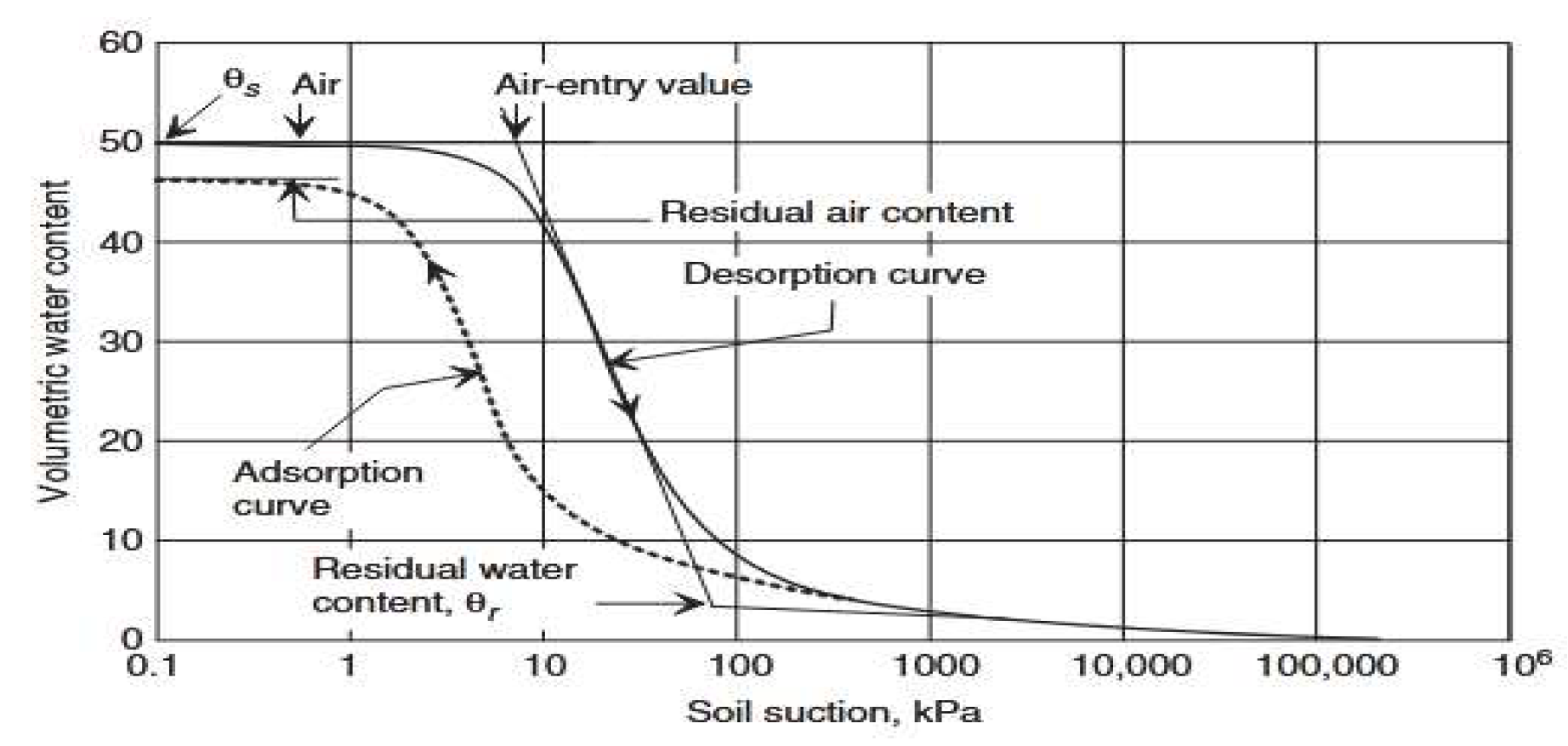
The relationship between soil water content (gravimetric or volumetric) and capillary suction (matric suction, ψ) is expressed through the Soil–Water Characteristic Curve (SWCC) (Figure 1). This curve provides a vital constitutive framework for understanding unsaturated soil behaviour.

2.2. Prediction of Unsaturated Hydraulic Conductivity

The USHC (i.e., k) is usually predicted from the models by multiplying the relative hydraulic conductivity obtained from the various models by the laboratory-measured saturated hydraulic conductivity. The prediction is established based on the relationship of Equation (1):
k r = k k s a t
where kr is a relative hydraulic conductivity; k is the unsaturated hydraulic conductivity of the soil (bio-treated) and is a function of applied or imposed matric suction ψ while ksat is the saturated hydraulic conductivity of the soil as computed from a falling-head permeability test. The various values of kr are obtained by imputing the various related curve fitting parameters extracted from the directly measured soil moisture curves into the relative hydraulic conductivity functions shown in Equations (2)–(4) for Brooks–Corey, van Genuchten and Fredlund and Xing models, respectively [12,13,14]. Several models can be used to fit experimental water retention data, but the Brooks–Corey model is used because it presents the physical meaning by providing a pore scale clarification; van Genuchten is used because it enhances mathematical continuity and numerical operation; and the Fredlund–Xing model optimizes the precision across the spectrum of matric suction.
Based on Brooks and Corey [12], kr in relation to SWCC parameters is given as:
k r =   { 1                                           ;       ψ         ψ a                                     ( ψ a ψ ) 2 + 3 λ             ;       ψ a     >   ψ                                            
Based on van Genuchten [13], kr in relation to SWCC fitting parameters is:
k r = { 1 ( α ψ ) n 1 [ 1 + ( α ψ ) n ] m } 2 [ 1 + ( p ψ ) n ] m 2
m, n and p are as described in SWCC.
For Fredlund and Xing [14], model Equation (4) is used in relation to SWCC fitting parameters for determining the kr [16]:
k r = 1 { l n [ e + ( ψ α ) b ] } c
where kr is a relative hydraulic conductivity; ψ = m a t r i c   s u c t i o n ; ψ a = a i r   e n t r y   v a l u a ; λ = pore-size distribution index and is related to the slope of the curve. a, b, c are three different soil fitting parameters described by Leong and Rahardjo [17]. The parameters a, b, and c of the Fredlund and Xing model are similar to the parameters; , n and m in the van Genuchten model, respectively. The model performance comparison under high matric suction is relevant to waste containment design and performance during the active and post-closure period.

3. Materials and Methods

3.1. Soil

The test soil was obtained from Abagana (6°10′60.00″ N and 6°58′59.99″ E), Anambra state, Nigeria. Properties of the test soil are presented in Table 1.

3.2. Microorganism

The microorganism employed in this study is B. megaterium in varying cell concentrations. The culture conditions, biochemical confirmation and other processes used in the characterization and identification of B. megaterium can be found in previous studies [18]. The mechanism of MICP is represented by Equations (5) and (6). pH increased and favours the system for the deposition of calcite.
C O ( N H 2 ) 2 + 3 H 2 O U r e a s e   e n z y m e   2 N H 4 + + H C O 3 + O H    
C a 2 + + H C O 3 + O H C a C O 3 + H 2 O

3.3. Cementation Reagent

The cementation solution provides Ca2+ and urea for microorganisms to produce calcite. Composition of 30.03 g CO(NH2)2, 12.12 g NaHCO3, 10 g NH4Cl, 55.4 g CaCl2 and 3 g nutrient broth by mass per 1000 mL de-ionized water constitutes 0.5 M [19].

3.4. MICP Treatment Protocol and Preparation of SWCC Specimens

Bacterial suspension and cementation solution were added based on Yohanna et al. [20] using 1/3 and 2/3 of the pore volume, respectively. Specimens were prepared at −2%, 0%, and +2% of optimum moisture content (OMC) and compacted following BS 1377 [21].

3.5. Pressure Plate Extractors and Pressure Application

The pressure plate extractor (with volumetric and gravimetric measurements of water content) is used for a detailed laboratory testing procedure for the measurement and interpretation of SWCCs information according to ASTM D6836-25 [22]. The specimen was subjected to pressures of 10, 30, 100, 500, 1000 and 1500 kPa, respectively, over an extended period of approximately four months. Specimens were prepared in triplicate. However, only 500 kPa and 1500 are presented.

4. Results and Discussion

4.1. Influence of Moulding Water Content on USHC

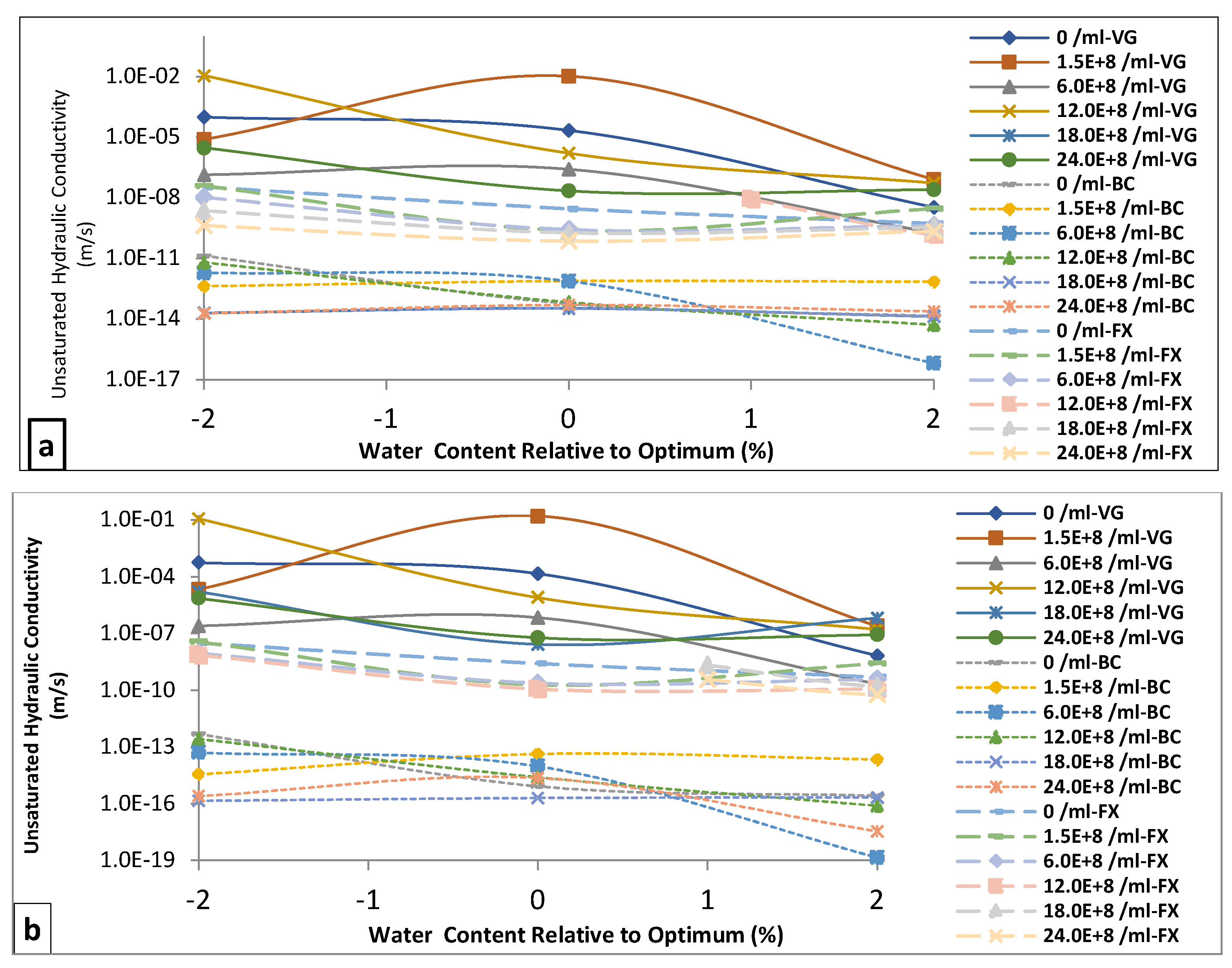
The plots shown in Figure 2a,b represent the effect of moulding water content (MWC) from dry to wet relative OMC, i.e., −2OMC ≤ OMC ≤ 2OMC on USHC estimates of bio-treated lateritic soil and compacted using BSH energy. The predicted USHC values were estimated using VG, BC and FX models for matric suctions of 500 (see Figure 2a) and 1500 kPa (see Figure 2b). From a broad spectrum of the entire results, the general trend of USHC decreased with increasing MWC for the three models, with the exception of extremely limited cases having an uncommon trend. The observed trend may be associated with a decrease in macro pores within the soil matrix, which mainly occurred from the dry to the wet side. Based on this, the higher USHC value recorded for the specimen prepared at the dry side of optimum OMC may be attributed to or possibly be credited to the presence of larger pores, which empty first and fill last, and as the specimen is de-saturated, the pores gradually become hydraulically inactive. Similarly, samples wet of optimum recorded relatively lower USH values since they are characterized with smaller pores, which become inactive last and hence lower USHC. This tendency is similar to those documented by other researchers [23]. Also, the remarked reduction in USHC, which, of course, was evaluated from saturated hydraulic conductivity or has a correlation with the saturated hydraulic conductivity, might not be unconnected with the decrease in saturated hydraulic conductivity (SHC) instigated by bioactivity of microbial urease enzymes that provide nucleation sites for the formation of CaCO3 precipitate via hydrolysis of urea. The pH of the system was eventually raised because of the breakdown of urea into ammonia, bicarbonate and CO2, and thus aided a smooth mechanism of calcite formation. The calcite acted as a binding agent with the soil grains, which resist the free flow of fluid within the fabric [20].

4.2. Influence of B. megaterium Suspension Density on USHC

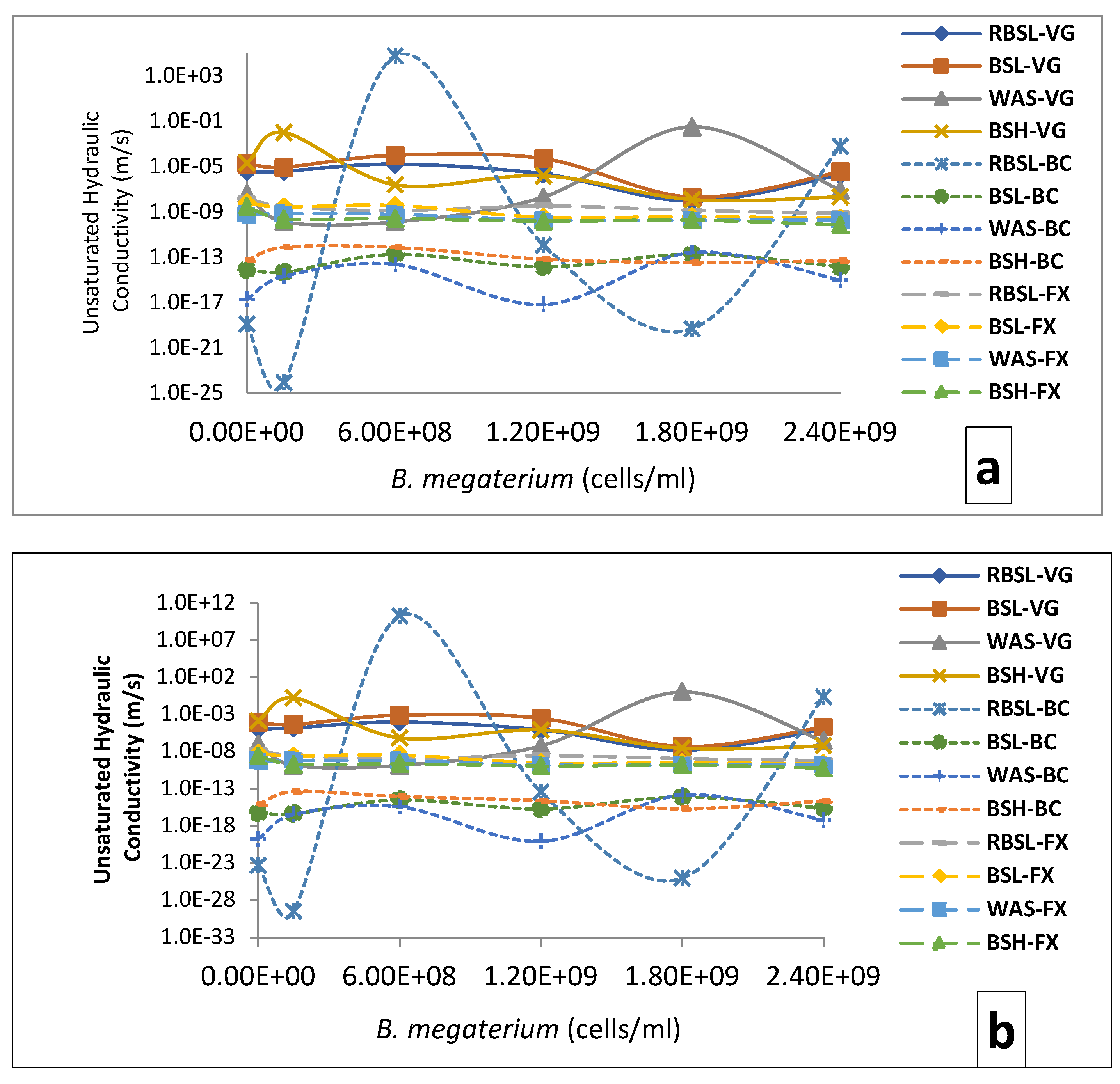
Figure 3a,b show the effect of B. megaterium suspension density on USHC of specimen compacted at OMC of its corresponding RBSL, BSL, WAS and BSH energies as predicted using BC, VG and FX models for 500 kPa and 1500 kPa matric suctions. The USHC decreased marginally, which, in other words, was insignificant, with an increase in the microbe’s suspension density for the three models. The decrease is probably due to a reasonable amount of CaCO3 formed from urease activity, which eventually acts as linking bonds that bind the soil grain particles, thus blocking the pores within the soil matrix and impeding unrestricted flow of fluid. A comparable trend was reported by Abo-El-Enein et al. [24]. The BC models, though with noticeable outlier deviations at (6, 18 and 24) × 108 cells/mL RBSL energy, tend to predict a higher value of USHC at 10 kPa in contrast to the USHC estimate of VG and FX models. The USHC for BC was lower compared with that of VG and FX for 500 and 1500 kPa matric suctions. The USHC at matric suction 500 and 1500 kPa were, in general, a wider spectrum of the entire results, higher in the order VG ˃ FX ˃ BC, except for a few cases where BC at RBSL deviated at 6.0 and 24.0 × (108) cells/mL.

5. Conclusions

Based on the outcome of this study, the unsaturated hydraulic conductivity (USHC) generally decreased with increasing moulding water content and higher bacterial density for the three models: van Genuchten, Brooks–Corey and Fredlund–Xing models. The Brooks–Corey model performed best at higher suction, satisfying barrier permeability criteria, while the Fredlund–Xing model showed optimal performance at lower suction, higher compactive effort, and bacterial density, also meeting regulatory limits for effective hydraulic barrier materials. The Brooks–Corey (BC) model is recommended for predicting unsaturated hydraulic conductivity, as it meets the 1 × 10⁻⁹ m/s design requirement at higher matric suctions (500–1500 kPa), outperforming van Genuchten and Fredlund–Xing models.

6. Limitation and Practical Implication

The potential of non-uniform calcite distribution within treated specimens is a key factor that could affect the repeatability, consistency, and upscaling of MICP in the unsaturated state. Future studies should incorporate advanced computational techniques that use machine learning techniques and artificial intelligence to predict the unsaturated state of MICP-treated fine-grained soils. This will help engineers and professional take ease decision in the design and management of waste containment facilities.

Author Contributions

Conceptualization, K.J.O., R.K.E., T.S.I. and A.O.E.; methodology, R.K.E.; software, R.K.E.; validation, P.Y., A.O.E., T.S.I. and K.J.O.; formal analysis, R.K.E.; investigation, R.K.E.; resources, R.K.E.; data curation, R.K.E.; writing—original draft preparation, R.K.E.; writing—review and editing, P.Y., K.J.O. and A.O.E.; visualization, T.S.I.; supervision, K.J.O.; project administration, A.O.E. All authors have read and agreed to the published version of the manuscript.

Funding

This research received no external funding.

Institutional Review Board Statement

Not applicable.

Informed Consent Statement

Not applicable.

Data Availability Statement

Data generated in this study are included in this article.

Conflicts of Interest

The authors declare no conflicts of interest.

References

  1. Adeyemo, K.A.; Bello, A.A. Hydraulic barrier properties of soil beneath Egbedi active municipal solid waste dumpsite. Hybrid Adv. 2024, 6, 100241. [Google Scholar] [CrossRef]
  2. Fredlund, D.G.; Rahardjo, H. Soil Mechanics for Unsaturated Soils; John Wiley & Sons: New York, NY, USA, 1993. [Google Scholar]
  3. Osinubi, K.J.; Gadzama, E.; Eberemu, A.O.; Ijimdiya, T.S. Unsaturated hydraulic conductivity of compacted bio-cemented lateritic soil in municipal solid waste containment application. MATEC Web Conf. 2021, 337, 04001. [Google Scholar] [CrossRef]
  4. Eyo, E.U.; Ng’ambi, S.; Abbey, S.J. An overview of soil-water characteristic curves of stabilised soils and their influential factors. J. King Saud Univ.-Eng. Sci. 2022, 34, 31–45. [Google Scholar] [CrossRef]
  5. Fredlund, D.G.; Rahardjo, H.; Fredlund, M.D. Unsaturated Soil Mechanics in Engineering Practice; John Wiley & Sons: Hoboken, NJ, USA, 2012. [Google Scholar]
  6. Chandra, K.P.; Reddy, J.S.; Rao, K.M. Improving geotechnical properties of sands using microbially induced calcite precipitation (MICP): Influencing factors and laboratory evaluation. Int. J. Environ. Sci. 2025, 11, 4156–4163. [Google Scholar] [CrossRef]
  7. Kang, B.; Wang, H.; Zha, F.; Liu, C.; Zhou, A.; Ban, R. Exploring the uniformity of Microbially Induced Calcite Precipitation (MICP) solidified fine particle silt using different sample preparation methods. Biogeotechnics 2025, 4, 100163. [Google Scholar] [CrossRef]
  8. Saffari, R.; Nikooee, E.; Habibagahi, G.; van Genuchten, M.T. Effects of biological stabilization on the water retention properties of unsaturated soils. J. Geotech. Geoenviron. Eng. 2019, 145, 04019028. [Google Scholar] [CrossRef]
  9. Yohanna, P.; Ijimdiya, T.S.; Osinubi, K.J.; Eberemu, A.O. A laboratory study on water transfer properties of unsaturated compacted lateritic soil–Bacillus coagulans mixtures. Alger. J. Eng. Technol. 2022, 6, 19–28. [Google Scholar]
  10. Wang, M.; Kong, L.; Zang, M. Effects of sample dimensions and shapes on measuring soil-water characteristic curves using pressure plate. J. Rock Mech. Geotech. Eng. 2015, 7, 463–468. [Google Scholar] [CrossRef]
  11. Dang, M.; Chai, J.; Xu, Z.; Qin, Y.; Cao, J.; Liu, F. Soil water characteristic curve test and saturated–unsaturated seepage analysis in Jiangcungou municipal solid waste landfill, China. Eng. Geol. 2020, 264, 105374. [Google Scholar] [CrossRef]
  12. Brooks, R.H.; Corey, A.T. Hydraulic properties of porous media. Hydrol. Pap. Colo. State Univ. 1964, 3, 1–27. [Google Scholar]
  13. van Genuchten, M.T. A closed-form equation for predicting the hydraulic conductivity of unsaturated soils. Soil Sci. Soc. Am. J. 1980, 44, 892–898. [Google Scholar] [CrossRef]
  14. Fredlund, D.G.; Xing, A. Equations for the soil-water characteristic curve. Can. Geotech. J. 1994, 31, 521–532. [Google Scholar] [CrossRef]
  15. Fredlund, D.G. An introduction to unsaturated soil mechanics. In Unsaturated Soil Engineering Practice; Houston, S.L., Fredlund, D.G., Eds.; Geotech. Spec. Publ. No. 68; ASCE: Reston, VA, USA, 1997; pp. 1–37. [Google Scholar]
  16. Gui, M.; Wu, C.; Lu, C. Comparison of two water storage functions of soil on pore-water pressure of earth-filled dam under changing environment. In Proceedings of the 28th International Symposium on Automation and Robotics in Construction, ISARC 2011, Seoul, Republic of Korea, 29 June–2 July 2011; pp. 534–543. [Google Scholar]
  17. Leong, E.C.; Rahardjo, H. Permeability functions for unsaturated soils. J. Geotech. Geoenviron. Eng. 1997, 123, 1118–1126. [Google Scholar] [CrossRef]
  18. Etim, R.K.; Yohanna, P.; Eberemu, A.O.; Osinubi, K.J.; Ijimdiya, T.S. Assessing the biocementation of lateritic soil using hydraulic conductivity and bio-inspired optimization approach. Sci. Rep. 2025, 15, 27356. [Google Scholar] [CrossRef] [PubMed]
  19. Etim, R.K.; Yohanna, P.; Eberemu, A.O.; Osinubi, K.J.; Ijimdiya, T.S. Assessing multi-parameter performance and acceptability zones of biocemented lateritic soil for sustainable waste containment. Results Eng. 2025, 28, 108129. [Google Scholar] [CrossRef]
  20. Yohanna, P.; Etim, R.K.; Ijimdiya, T.S.; Eberemu, A.O.; Osinubi, K.J. Lateritic soil–leachate compatibility study using MICP approach. Mater. Sci. Forum 2025, 1160, 59–68. [Google Scholar] [CrossRef]
  21. BS 1377; Methods of Testing Soils for Civil Engineering Purposes. BSI: London, UK, 1990.
  22. ASTM D6836-25; Standard Test Method for Determination of the Soil Water Characteristic Curve. ASTM: West Conshohocken, PA, USA, 2025.
  23. Osinubi, K.J.; Moses, G. Compacted foundry sand treated with bagasse ash as hydraulic barrier material. In Geo-Frontiers 2011: Advances in Geotechnical Engineering; Geotech. Spec. Publ. 211; ASCE: Dallas, TX, USA, 2011; pp. 915–925. [Google Scholar]
  24. Abo-El-Enein, S.A.; Ali, A.H.; Talkhan, F.N.; Abdel-Gawwad, H.A. Utilization of microbial induced calcite precipitation for sand consolidation and mortar crack remediation. J. Hous. Build. Natl. Res. Cent. 2012, 8, 185–192. [Google Scholar] [CrossRef]
Figure 1. Typical soil-water characteristic curve [15].
Engproc 124 00119 g001
Figure 2. Influence of moulding water content relative to optimum (MWCRO) on USHC estimate of compacted/bio-cemented lateritic soil for matric suction: (a) 500 kPa and (b) 1500 kPa (BSH compaction).
Engproc 124 00119 g002
Figure 3. Influence of B. megaterium concentration on USHC estimate of compacted/bio-cemented lateritic soil for varying matric suction: (a) 500 kPa and (b) 1500 kPa.
Engproc 124 00119 g003
Table 1. Properties of test soil.
Property% Passing 75 µm NMC (%)LL (%)PL (%)GsAASHTO USCS
Quantity 35.411.641.515.92.65A-4(3)SC
Disclaimer/Publisher’s Note: The statements, opinions and data contained in all publications are solely those of the individual author(s) and contributor(s) and not of MDPI and/or the editor(s). MDPI and/or the editor(s) disclaim responsibility for any injury to people or property resulting from any ideas, methods, instructions or products referred to in the content.