1. Introduction
Lipid-based products, including those derived from vegetable oils, are widely consumed food items incorporated into the daily diet across all population groups [
1,
2]. They serve as important sources of essential nutrients and, when appropriately selected and consumed, contribute significantly to maintaining a balanced and adequate diet [
1,
2,
3,
4]. However, their high energy value and often unbalanced fatty acid composition may promote metabolic disorders [
5,
6]. Consequently, there is an increasing need to expand the assortment of oil-and-fat products by developing new formulations that align with current scientific advances and contemporary nutritional recommendations [
7,
8,
9].
Most researchers agree that the optimal dietary balance of polyunsaturated fatty acids (PUFAs) for a healthy individual corresponds to an
ω-6/
ω-3 ratio of approximately 10:1 [
5,
7,
8,
10]. For therapeutic or preventive nutritional strategies, a lower ratio—typically between 3:1 and 5:1—is recommended [
11,
12]. Maintaining this balance is essential for regulating hormonal, metabolic, cellular, and other physiological processes. According to calculations by A.P. Levytsky, the mixed diet of an average Ukrainian is characterized by an
ω-6/
ω-3 ratio of 43.6:1, which substantially exceeds the acceptable level of
ω-6 PUFAs intake [
13].
One of the key challenges in developing fat-containing foods aligned with healthy dietary trends is optimizing the fatty acid composition. Blending traditional vegetable oils is a cost-effective and practical approach for designing products with targeted levels and ratios of PUFAs [
7,
8,
9]. Refined deodorized sunflower oil is the most widely consumed edible oil in Ukraine [
4,
7,
8,
14]. As a major source of
ω-6 polyunsaturated fatty acids—with linoleic acid accounting for approximately 50–75%—it contains negligible amounts of
ω-3 linolenic acid. Its tocopherol profile is dominated by
α-tocopherol, which represents 90–96% of the total tocopherol content. Refined rapeseed oil is also widely available in Ukraine and produced on an industrial scale [
7,
8,
14]. It exhibits a favorable
ω-3/
ω-6 fatty acid ratio for blending applications and is characterized by a high proportion of
β-,
γ-, and
δ-tocopherols, which together account for 67.4–73.1% of total tocopherols [
7,
8,
14,
15]. Therefore, rapeseed oil is a promising component for blends aimed at enhancing biological value and optimizing the fatty acid composition of the final product. Furthermore, a blend of rapeseed and sunflower oils can be expected to demonstrate improved resistance to autoxidation compared with sunflower oil alone [
9,
15,
16,
17]. This improvement is attributable to the increased total content of the more antioxidant-active
β-,
γ-, and
δ-tocopherol fractions in the blend, while still maintaining a sufficiently high level of the most biologically active α-tocopherol [
15,
16,
17,
18].
Our previous research [
14] identified that a blend of 52% sunflower oil and 48% rapeseed oil provides a balanced
ω-6:
ω-3 ratio of 9.8:1.0. This study aimed to evaluate the basic quality parameters of a sunflower–rapeseed oil blend. These parameters included the fatty acid composition and balance, tocopherol content and composition, sensory assessment and selected physicochemical properties, and the stability of these properties during storage, both in the developed blend and in sunflower oil. While rapeseed oil is an important component of the blend, sunflower oil was used as the reference sample due to its predominant consumption in Ukraine and its relevance for practical applications in the food industry.
2. Materials and Methods
2.1. Raw Materials
The following ingredients were used for the production of sunflower–rapeseed oil blend: refined deodorized sunflower oil called “Oleyna Traditional” (SE Suntrade, Dnipro, Ukraine), refined deodorized rapeseed oil “Korolivs’kyy Smak” (Vlasivka, Ukraine). Sunflower–rapeseed oil blend samples were prepared by mixing sunflower and rapeseed oils at a mass ratio of 52:48.
2.2. Study of the Quality Parameters of a Sunflower–Rapeseed Oil Blend
The quality parameters of the developed blend oil were evaluated in accordance with internationally recognized ISO methods for edible vegetable oils.
The fatty acid composition of the blend and sunflower oil samples was analysed using gas chromatography [
19] on a Hewlett Packard HP-6890 gas chromatograph using an HP-88 capillary column with an internal diameter of 0.25 mm and a stationary phase thickness of 0.2 μm. The studied samples were prepared in accordance with ISO 12966-2:2017 [
20]. To assess the fatty acid balance in oils, several criteria characterize the content and ratio of saturated (SFAs), monounsaturated (MUFAs) and polyunsaturated (PUFAs) fatty acids were used [
10,
11,
17].
The total tocopherol content and composition were determined by high-performance liquid chromatography [
21]. A Smartline chromatographic system was used for this purpose. A 0.5% solution of isopropyl alcohol in n-hexane was used as the mobile phase. The eluent flow rate was 1.5 mL/min. Photometry was performed using a UV detector at 295 nm.
Physicochemical and sensory properties of the blend oil were determined using standard ISO methods applicable to edible vegetable oils. Sensory properties were evaluated using quantitative descriptive analysis in accordance with standardized sensory assessment principles (ISO 13299) [
22], based on transparency, taste, flavour, and colour [
23].
The accumulation of free fatty acids due to hydrolysis in the blend and sunflower oil samples was estimated measuring the acid value [
24]. Accumulation of oxidation products in the blend and sunflower oil samples was evaluated by determining the peroxide value [
25]. The peroxide value (PV) in mmol 1/2O/kg was calculated as a number of millimoles of active oxygen (1/2O) which is equivalent to I
2 released from potassium iodide in glacial acetic acid by peroxides and hydroperoxides found in 1 kg of fat. The data were obtained for the freshly prepared samples, as well as for the samples stored at a temperature of 20 ± 1 °C for up to 30 days.
The kinetics of the oxidation process of the blend and sunflower oil was evaluated by the average rate of increase in the peroxide value during storage of these samples. The average rate of increase in the peroxide value
υ of the samples was calculated using the formula:
where
υ—the average rate of increase in the peroxide value during the storage of samples at a temperature of 20 ± 1 °C; PV
1—peroxide value at the beginning of the storage period of sample, mmol 1/2O/kg; PV
2—peroxide value at the end of the storage period of sample, mmol 1/2O/kg;
τ—sample storage period, days.
2.3. Statistical Analysis
To ensure an objective assessment of data reliability, the experimental results were subjected to statistical analysis. The significance of differences was evaluated using Student’s t-test at a significance level of p < 0.05 with the corresponding degrees of freedom (n − 1). Each parameter was measured at least in triplicate for each test sample to ensure reproducibility.
3. Results and Discussion
The results of the sensory evaluation of the developed sunflower–rapeseed oil blend demonstrated its high quality and compliance with regulatory requirements. The test samples were transparent and odourless, exhibited a neutral oil taste, and were yellow in colour with a slight greenish tint.
The fatty acid composition of the sunflower–rapeseed oil blend and sunflower oil is presented in
Table 1.
The fatty acid composition of the blend reflects the combined contributions of its components. In this context, rapeseed oil was considered a functional component influencing the overall composition and antioxidant profile of the blend, while the analysis focused on the properties of the resulting system. The results showed that the total content of saturated fatty acids in the blend was 10.39 ± 0.07%, with palmitic acid (C16:0) being the predominant component 6.89 ± 0.07%. Unsaturated fatty acids accounted for 89.31 ± 0.28% of the total fatty acid content of the blend. The blend exhibited a favourable fatty acid profile for balanced nutrition, characterized by a high content of monounsaturated oleic acid (42.61 ± 0.25%) and a sufficient level of ω-3 linolenic acid (4.29 ± 0.20%).
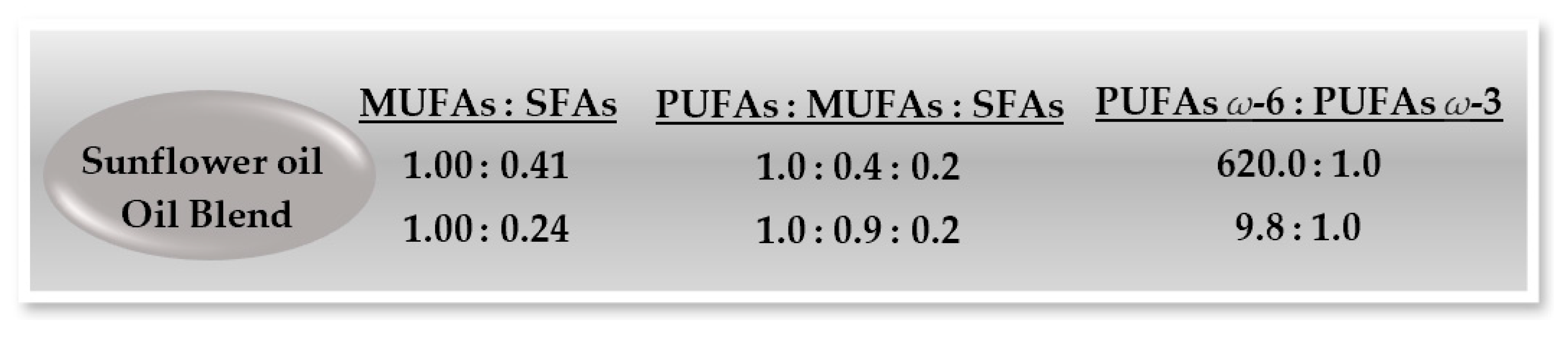
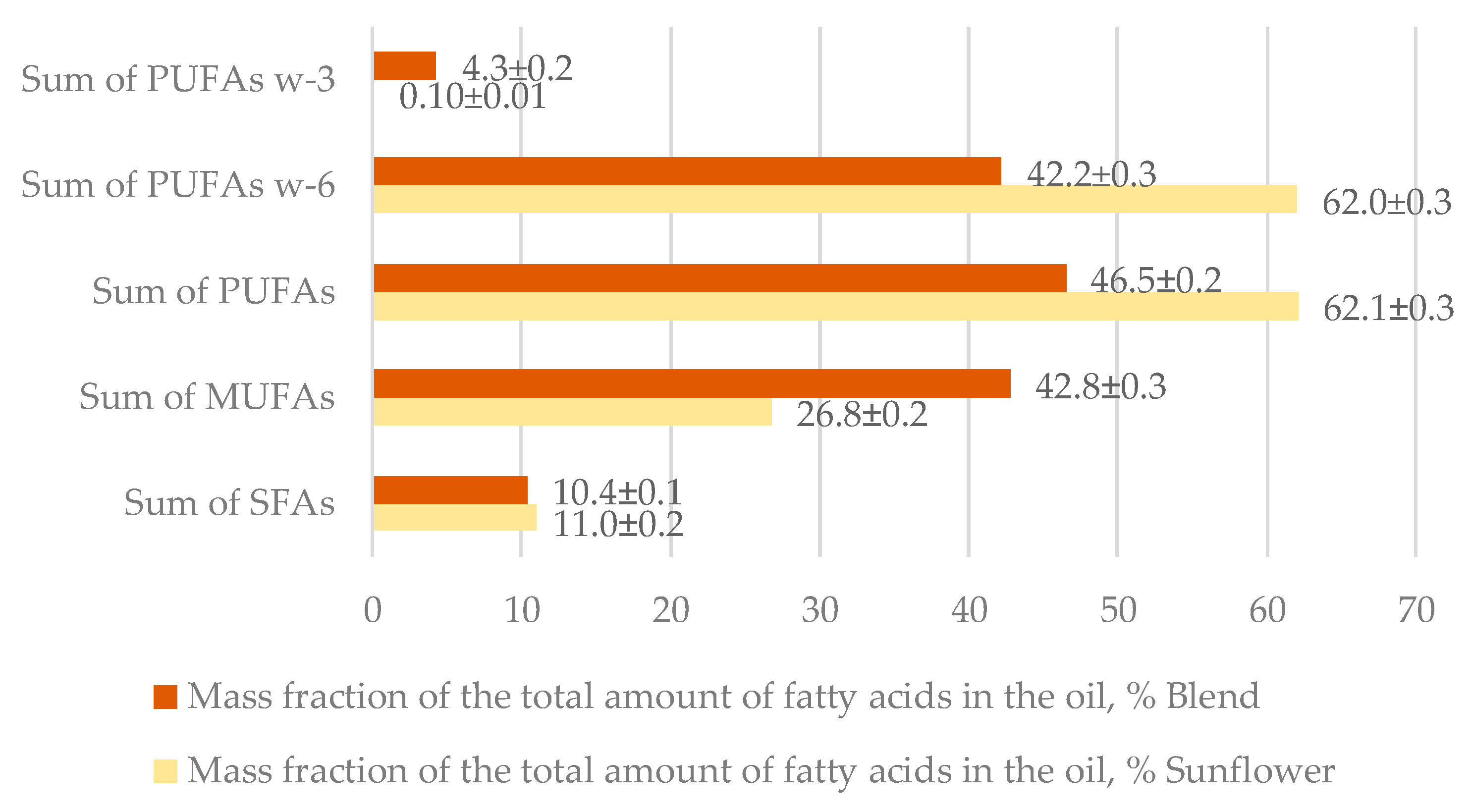
The evaluation of the fatty acid balance of the blend and sunflower oil samples is illustrated in
Figure 1 and
Figure 2.
The content of monounsaturated fatty acids in the blend was 42.8 ± 0.3%, with oleic acid (C18:1) as the dominant component. Compared with sunflower oil, the mass fraction of oleic acid increased by 1.6-fold, indicating an improvement in the nutritional value of the blend and suggesting enhanced resistance to oxidative deterioration.
The total content of polyunsaturated fatty acids in the blend was 46.5 ± 0.2%, mainly represented by linoleic acid (C
18:2; 42.22 ± 0.32%) and linolenic acid (C
18:3; 4.29 ± 0.20%). The obtained results (
Figure 2) confirmed a balanced
ω-6:
ω-3 ratio of 9.8:1.0 in the blend (
Figure 2).
To assess the fatty acid balance, the MUFAs:SFAs ratio was used as a criterion. For the developed blended oil, this value was 4.1, whereas for sunflower oil it was 2.4. According to the studies [
17], this ratio can serve as an indicator of the oil’s potential resistance to oxidation and hydroperoxide formation.
The total tocopherol content in the sunflower–rapeseed oil blend and in sunflower oil was 50.18 ± 0.36 mg/100 g and 42.09 ± 0.36 mg/100 g, respectively. The contents of α-tocopherol and the combined β-, γ-, and δ-tocopherol fractions in the blend were 27.46 ± 0.25 mg/100 g and 22.72 ± 0.24 mg/100 g, respectively. In sunflower oil, these values were 38.92 ± 0.32 mg/100 g and 3.17 ± 0.08 mg/100 g, respectively. In the blend, the total content of the more antioxidant-active β-, γ-, and δ-tocopherol fractions increased, while a sufficiently high level of the most biologically active α-tocopherol was maintained compared with sunflower oil.
Therefore, the next step of the study focused on evaluating triacylglycerol transformations in the blend and sunflower oil during storage. The main processes leading to a reduction in the nutritional value of oils during storage are hydrolysis and oxidation, with acid value and peroxide value serving as key physicochemical indicators. Therefore, the storage stability of the developed blend and sunflower oil was investigated (
Table 2). The blend demonstrated improved hydrolytic and oxidative stability, which was confirmed by the significantly lower acid and peroxide values after 30 days of storage at 20 ± 1 °C compared to pure sunflower oil by 5.3% and 19.7%, respectively.
The accumulation rate of primary oxidation products was 1.5 times lower in the blend (
p < 0.05). This effect may be attributed to a higher content of antioxidant-active tocopherol isomers (
β-,
γ-, and
δ-tocopherols) in rapeseed oil [
18].
4. Conclusions
The fatty acid composition of the balanced sunflower–rapeseed oil blend was determined. The blend was characterized by a high content of unsaturated fatty acids, including 42.61 ± 0.25% oleic acid and 42.22 ± 0.32% linoleic acid. A 1.6-fold increase in the proportion of oleic acid compared with sunflower oil was achieved, enhancing the biological value of the blended oil and contributing to its potentially improved oxidative stability.
The developed blend oil contained 4.29 ± 0.20% of essential ω-3 linolenic acid, which is a key factor determining its biological value. This ensured a balanced ω-6:ω-3 PUFA ratio of 9.8:1.0, corresponding to the principles of balanced nutrition.
The enhanced resistance of the developed sunflower–rapeseed oil blend to hydrolysis and oxidation was experimentally confirmed by peroxide and acid value measurements after 30 days of storage at 20 ± 1 °C. These values were 5.3% and 19.7% lower, respectively, compared with sunflower oil.
Based on the experimental data, the average rate of accumulation of primary oxidation products in the blend was calculated and found to be 1.5 times lower than that of sunflower oil. The obtained results confirm the greater resistance of the developed blend to autoxidation, presumably due to the increased total content of the more antioxidant-active β-, γ-, and δ-tocopherol fractions.
Sensory evaluation further confirmed the high quality of the developed sunflower–rapeseed oil blend.
Overall evaluation of the quality parameters of a sunflower–rapeseed oil blend demonstrated improved performance compared to the widely used sunflower oil. The developed sunflower–rapeseed oil blend is a promising option for functional fat-containing products aimed at dietary improvement and disease prevention.
Author Contributions
Conceptualization, O.U.; methodology, N.M. and O.U.; validation, N.M. and O.U.; formal analysis, N.M.; investigation, N.M. and O.U.; resources, O.U.; data curation, N.M.; writing—original draft preparation, N.M. and O.U.; writing—review and editing, N.M.; visualization, N.M.; supervision, O.U.; project administration, N.M. All authors have read and agreed to the published version of the manuscript.
Funding
This research received no external funding.
Institutional Review Board Statement
Not applicable.
Informed Consent Statement
Not applicable.
Data Availability Statement
The data presented in this study are available on request from the corresponding author.
Conflicts of Interest
The authors declare no conflicts of interest.
Abbreviations
The following abbreviations are used in this manuscript:
| SFAs | Saturated fatty acids |
| UFAs | Unsaturated fatty acids |
| MUFAs | Monounsaturated fatty acids |
| PUFAs | Polyunsaturated fatty acids |
| AV | Acid value |
| PV | Peroxide value |
References
- Zio, S.; Tarnagda, B.; Sankara, S.; Tapsoba, F.; Zongo, C.; Savadogo, A. Nutritional and therapeutic interest of most widely produced and consumed plant oils by human: A review. Appl. Food Res. 2025, 5, 101093. [Google Scholar] [CrossRef] [Scilit]
- Zhang, H.; Xu, X. Nutritional lipids: An overview of nutritional progress and market trends. J. Food Bioact. 2025, 31, 8–30. [Google Scholar] [CrossRef] [Scilit]
- Pérez-Beltrán, Y.E.; Blancas-Benítez, F.J.; Aranda-Carrillo, S.; Ultreras, C.F.; Chairez-Huerta, S.; Tovar, J.; Sáyago-Ayerdi, S.G. Foods elaborated with vegetable by-product effects on blood lipid levels: A systematic review. Food Chem. Adv. 2024, 5, 100846. [Google Scholar] [CrossRef] [Scilit]
- Murlykina, N.; Yancheva, M. Theory and Practice of the Use of Acylglycerol Emulsifiers in the Technology of Meat Products: Monograph; КHSUFТ: Kharkiv, Ukraine, 2015; 207p. [Google Scholar]
- Petersen, K.S.; Maki, K.C.; Calder, P.C.; Belury, M.A.; Messina, M.; Kirkpatrick, C.F.; Harris, W.S. Perspective on the health effects of unsaturated fatty acids and commonly consumed plant oils high in unsaturated fat. Br. J. Nutr. 2024, 132, 1039–1050. [Google Scholar] [CrossRef] [Scilit] [PubMed]
- Calder, P.C. Omega-3 polyunsaturated fatty acids and inflammatory processes: Nutrition or pharmacology? Br. J. Clin. Pharmacol. 2013, 75, 645–662. [Google Scholar] [CrossRef] [Scilit] [PubMed]
- Belinska, K.O. Research of the chemical composition of boney oil and development of buckets based on it. J. Chem. Technol. 2021, 29, 65–76. [Google Scholar] [CrossRef] [Scilit]
- Belemets, T.; Yushchenko, N.; Lobok, A.; Radzievskaya, I.; Polonskaya, T. Optimization of Composition of Blend of Natural Vegetable Oils for the Production of Milk-Containing Products. East. Eur. J. Enterp. Technol. 2016, 5, 4–9. [Google Scholar] [CrossRef] [Scilit]
- Gharby, S.; Asbbane, A.; Nid Ahmed, M.; Gagour, J.; Hallouch, O.; Oubannin, S.; Bijla, L.; Goh, K.W.; Bouyahya, A.; Ibourki, M. Vegetable oil oxidation: Mechanisms, impacts on quality, and approaches to enhance shelf life. Food Chem. X 2025, 28, 102541. [Google Scholar] [CrossRef] [Scilit] [PubMed]
- Sheppard, K.W.; Cheatham, C.L. Omega-6/omega-3 fatty acid intake of children and older adults in the US: Dietary intake in comparison to current dietary recommendations and the Healthy Eating Index. Lipids Health Dis. 2018, 17, 43. [Google Scholar] [CrossRef] [Scilit] [PubMed]
- Gutierres, D.; Pacheco, R.; Reis, C.P. The Role of Omega-3 and Omega-6 Polyunsaturated Fatty Acid Supplementation in Human Health. Foods 2025, 14, 3299. [Google Scholar] [CrossRef] [Scilit] [PubMed]
- Mariamenatu, A.H.; Abdu, E.M. Overconsumption of Omega-6 Polyunsaturated Fatty Acids (PUFAs) versus Deficiency of Omega-3 PUFAs in Modern-Day Diets: The Disturbing Factor for Their “Balanced Antagonistic Metabolic Functions” in the Human Body. J. Lipids 2021, 2021, 8848161. [Google Scholar] [CrossRef] [Scilit] [PubMed]
- Levitsky, A.P. The role of polyunsaturated fatty acids (PUFA) in the formation of the structure and functions of biomembranes. J. Educ. Health Sport. 2020, 10, 101–107. [Google Scholar] [CrossRef] [Scilit]
- Upatova, O.; Murlykina, N. Development of blended oil balanced by ratio ω-6:ω-3 fatty acids. In Prohresyvni Tekhnika ta Tekhnolohii Kharchovykh Vyrobnytstv Restorannoho Hospodarstva i Torhivli: Collection of Scientific Works; КHSUFТ: Kharkiv, Ukraine, 2021; Volume 2, pp. 96–110. [Google Scholar]
- Siger, A.; Józefiak, M.; Górnaś, P. Cold-pressed and hot-pressed rapeseed oil: The effects of roasting and seed moisture on the antioxidant activity, canolol, and tocopherol level. Acta Sci. Pol. Technol. Aliment. 2017, 16, 69–81. [Google Scholar] [CrossRef] [Scilit] [PubMed]
- Radzievska, I.; Melnik, O. Investigation of oxidative degradation of vegetable oils of various degrees of saturation with tocopherol. Sci. Work. NUFT 2016, 22, 206–216. [Google Scholar]
- Nosratpour, M.; Farhoosh, R.; Sharif, A. Quantitative Indices of the Oxidizability of Fatty Acid Compositions. Eur. J. Lipid Sci. Technol. 2017, 119, 1700203. [Google Scholar] [CrossRef] [Scilit]
- Kovaleva, S.O.; Chebanenko, K.V.; Gutsalo, I.V.; Korobka, Y.V. Study of chemical transformations in sunflower oil during heat treatment. Sci. Notes Taurida Natl. V.I. Vernadsky Univ. Ser. Tech. Sci. 2019, 30, 93–97. [Google Scholar] [CrossRef] [Scilit]
- ISO 12966-2:2017; Animal and Vegetable Fats and Oils—Gas Chromatography of Fatty Acid Methyl Esters. Part 2: Preparation of Methyl Esters of Fatty Acids. International Organization for Standardization: Geneva, Switzerland, 2017. Available online: https://www.iso.org/standard/72142.html (accessed on 22 January 2026).
- ISO 12966-4:2015; Animal and Vegetable Fats and Oils—Gas Chromatography of Fatty Acid Methyl Esters. Part 4: Determination by Capillary Gas Chromatography. International Organization for Standardization: Geneva, Switzerland, 2015. Available online: https://www.iso.org/standard/63503.html (accessed on 22 January 2026).
- ISO 9936:2016; Animal and Vegetable Fats and Oils—Determination of Tocopherol and Tocotrienol Contents by High-Performance Liquid Chromatography. International Organization for Standardization: Geneva, Switzerland, 2016. Available online: https://www.iso.org/standard/69595.html (accessed on 22 January 2026).
- ISO 13299:2016; Sensory Analysis—Methodology—General Guidance for Establishing a Sensory Profile. International Organization for Standardization: Geneva, Switzerland, 2016. Available online: https://www.iso.org/standard/58042.html (accessed on 22 January 2026).
- ISO/NP 26114; Vegetable Oils—Determination of Sensory Quality. Standards Development. The British Standards Institution: London, UK, 2026. Available online: https://standardsdevelopment.bsigroup.com/projects/9025-12411 (accessed on 22 January 2026).
- ISO 660:2020; Animal and Vegetable Fats and Oils—Determination of Acid Value and Acidity. International Organization for Standardization: Geneva, Switzerland, 2020. Available online: https://www.iso.org/standard/75594.html (accessed on 22 January 2026).
- ISO 3960:2017; Animal and Vegetable Fats and Oils—Determination of Peroxide Value—Iodometric (Visual) Endpoint Determination. International Organization for Standardization: Geneva, Switzerland, 2017. Available online: https://www.iso.org/standard/71268.html (accessed on 22 January 2026).
| Disclaimer/Publisher’s Note: The statements, opinions and data contained in all publications are solely those of the individual author(s) and contributor(s) and not of MDPI and/or the editor(s). MDPI and/or the editor(s) disclaim responsibility for any injury to people or property resulting from any ideas, methods, instructions or products referred to in the content. |