Proceeding Paper

Towards Reliable 6G: Intelligent Trust Assessment with Hybrid Learning †
by
Elmira Saeedi Taleghani
,
Ronald Iván Maldonado Valencia
,
Ana Lucila Sandoval Orozco
and
Luis Javier García Villalba
*
Group of Analysis, Security and Systems (GASS), Department of Software Engineering and Artificial Intelligence (DISIA), Facultad de Informática, Universidad Complutense de Madrid (UCM), 28040 Madrid, Spain
*
Author to whom correspondence should be addressed.
Presented at the First Summer School on Artificial Intelligence in Cybersecurity, Cancun, Mexico, 3–7 November 2025.
Eng. Proc. 2026, 123(1), 27; https://doi.org/10.3390/engproc2026123027
Published: 6 February 2026
(This article belongs to the Proceedings of First Summer School on Artificial Intelligence in Cybersecurity)

Abstract

Sixth-generation (6G) networks will operate with pervasive autonomy and minimal centralised control, imposing stringent requirements on security and trust. This short communication presents a hybrid trust evaluation approach that combines fuzzy inference for uncertainty management, bidirectional long short-term memory (BiLSTM) networks for temporal prediction, and blockchain for immutable verification. The pipeline first maps multi-source interaction and context metrics into linguistic trust values via fuzzy rules, then leverages BiLSTM to anticipate trust fluctuations under dynamic conditions, and finally anchors trust updates on a permissioned blockchain to ensure integrity and traceability. Using CIC-IoT2023, the proposed approach attains high accuracy and F1-score while reducing Execution Time (ET) and energy demands relative to a recent spatial-temporal trust model for 6G IoT. Results indicate that jointly addressing uncertainty, temporal evolution, and ledger-backed validation yields stable trust trajectories suitable for resource-constrained devices. The study outlines a practical path toward explainable, adaptive, and tamper-resistant trust management for 6G ecosystems.

1. Introduction

The convergence of massive IoT, edge intelligence, and near-real-time orchestration in 6G expands the attack surface and elevates the importance of trust among heterogeneous nodes. Conventional trust mechanisms are typically centralised or static, leaving them ill-suited for rapidly varying traffic, mobility patterns, and adversarial behaviours such as spoofing or routing manipulation. Three gaps are recurrent: (i) robust handling of uncertainty in noisy metrics, (ii) sensitivity to the temporal evolution of trust, and (iii) protection of trust records against tampering. This work introduces a hybrid trust evaluation approach that integrates fuzzy inference, BiLSTM-based temporal learning, and blockchain-backed verification. The design objective is an interpretable, adaptive, and verifiable mechanism that can be deployed on constrained devices while maintaining reliable performance.

2. Related Work

Fuzzy-based trust models provide an interpretable aggregation of noisy and heterogeneous indicators, improving stability under uncertainty but typically lacking explicit temporal learning [1]. Learning-driven approaches enhance detection and prediction; yet, many omit sequential dependencies or do not guarantee the integrity of trust records across domains [2,3]. Blockchain-oriented schemes address tamper resistance and auditability for cross-administrative settings in IoT/6G [4], but they do not natively model time-varying trust signals. Among recent contributions, Ma et al. proposed a spatial–temporal trust model for 6G IoT using clustering and moving-average smoothing [5]. In contrast, the present work unifies fuzzy uncertainty handling with learnt temporal dynamics (BiLSTM) and permissioned-ledger validation to concurrently address interpretability, adaptivity, and integrity within a concise pipeline.

3. Materials and Methods

3.1. Data and Preprocessing

Experiments use CIC-IoT2023 [6], which provides traffic and context-level features that reflect large-scale IoT activity. For each node i at time t, we form a normalised feature vector x i ( t ) [ 0 , 1 ] d from reliability (delivery/loss), QoS (latency/bandwidth/service reliability), and context (mobility/energy/environment). Missing values are imputed by per-feature means; infinities are capped to the maximum finite value. Data is split 80/20 for training/testing.

3.2. Fuzzy Inference

A compact rule base aggregates indicators into a preliminary trust score. Inputs are fuzzified into Low/Medium/High using triangular membership functions. Representative rules include:
IF (delivery is High) AND (latency is Low) THEN trust is High; IF (loss is High) OR (mobility is High) THEN trust is Low.
Defuzzification uses the centroid method, producing a continuous preliminary trust value τ f ( t ) [ 0 , 1 ] .

3.3. Temporal Prediction (BiLSTM)

To capture sequential dependencies, a BiLSTM consumes recent windows of preliminary trust and auxiliary indicators to predict near-term trust τ ^ ( t + 1 ) . Training uses Adam (fixed learning rate), early stopping, and minibatches sized for edge-grade GPUs/CPUs. The bidirectional structure provides context from both past and (in training) future indices, improving robustness to abrupt transitions.

3.4. Blockchain Validation

Each finalised trust update is hashed and appended to a permissioned blockchain via a smart contract that enforces role-based submission and prevents unauthorised overwrites. This layer delivers data integrity, non-repudiation, and auditable provenance. The final decision fuses components as a convex combination:
τ final ( t ) = α τ f ( t ) + β τ ^ ( t ) + γ τ ledger ( t ) , α , β , γ 0 , α + β + γ = 1 ,
with weights tuned to minimise validation error while stabilising variance.

4. Results

4.1. Setup and Metrics

We assess accuracy, precision, recall, F1-score, mean absolute error (MAE), ET, Energy Consumption (EC), and trust-variance stability. Baselines consider the spatial-temporal trust model by Ma et al. [5]. All models are implemented in a uniform environment with identical train/test splits.

4.2. Quantitative Outcomes

The proposed approach attains high classification quality on CIC-IoT2023, with F1-scores near 0.98 and low variance in trust trajectories. Relative to Ma et al. [5], it yields higher precision/recall while reducing ET and EC, indicating suitability for constrained deployments. Table 1 summarises the main indicators.

4.3. Visualisation

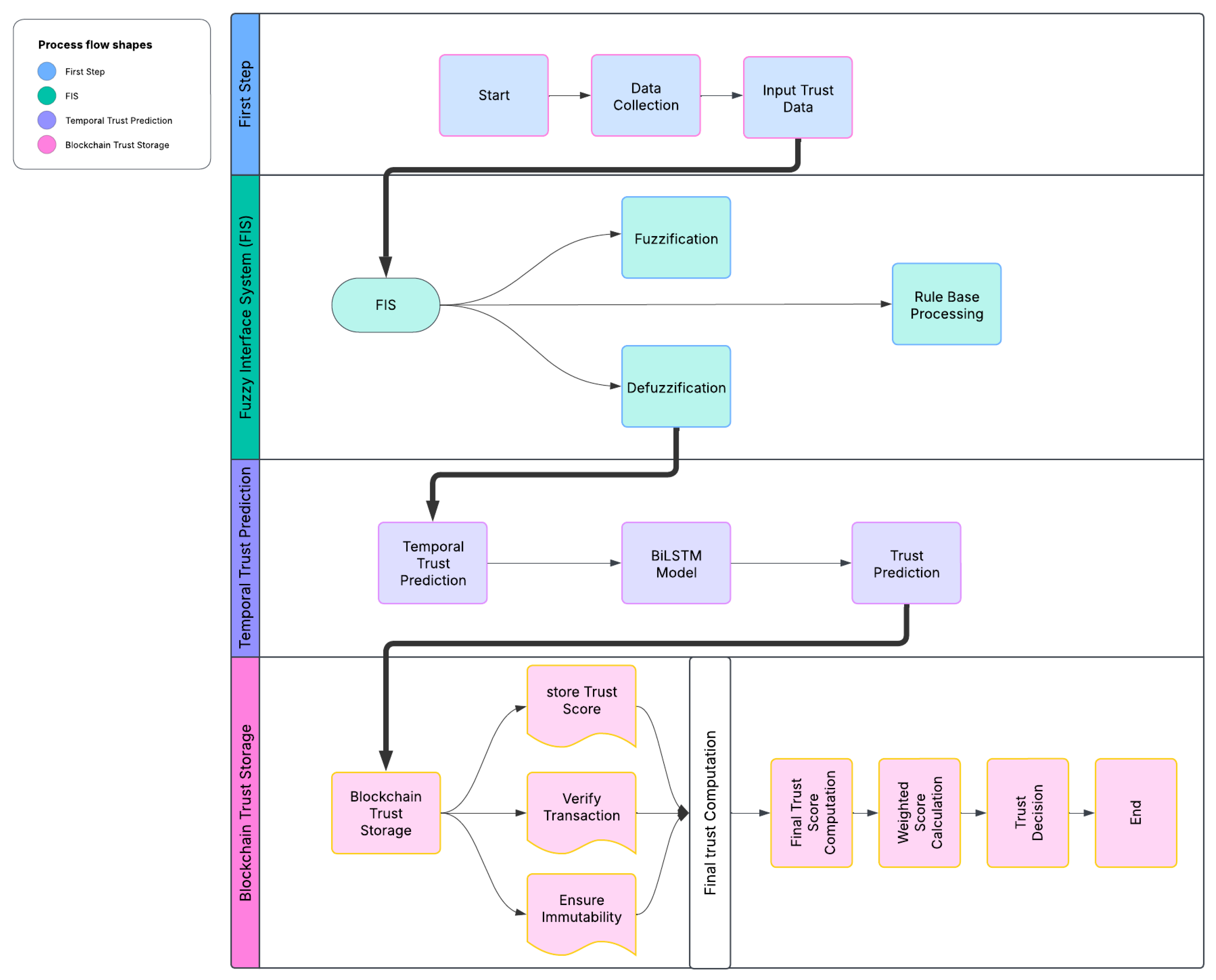
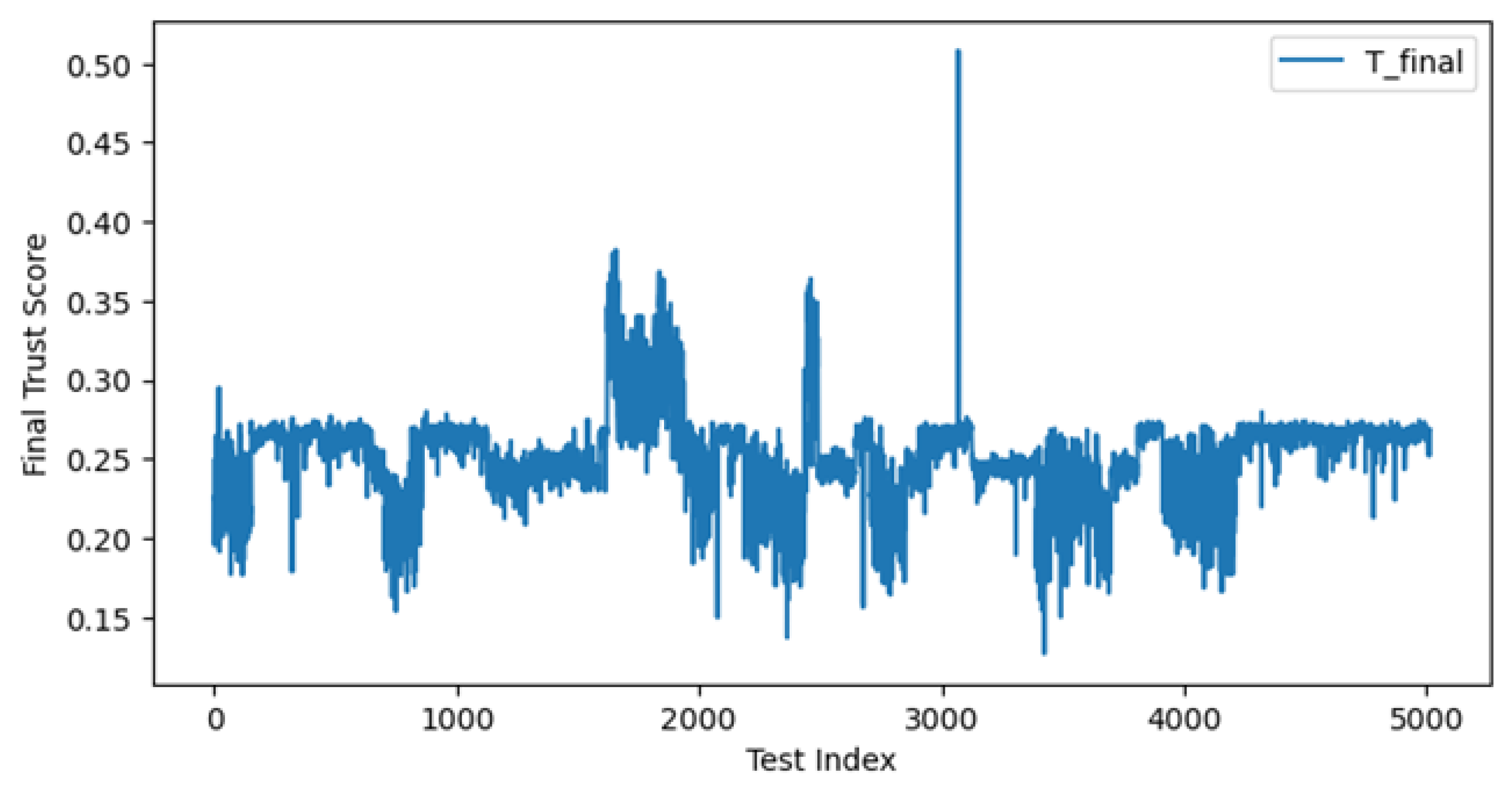
Figure 1 depicts the end-to-end workflow (inputs, fuzzy layer, BiLSTM prediction, and ledger anchoring). Figure 2 illustrates representative trust time series on the test split, showing smooth yet responsive adaptation under fluctuating conditions.

5. Discussion and Conclusions

The results demonstrate that coupling fuzzy reasoning with BiLSTM-based temporal learning and blockchain-backed validation provides complementary benefits: interpretability under uncertainty, responsiveness to time-varying behaviour, and tamper resistance for multi-stakeholder settings. Compared with the spatial-temporal baseline proposed by Ma et al. [5], the approach improves predictive quality and efficiency while preserving the stability of trust trajectories. These characteristics are pertinent for large-scale 6G deployments that must operate with limited energy budgets and require auditable trust management across domains. Future work will investigate adaptive weight tuning and broader cross-domain validation, as well as latency-aware ledger configurations for ultra-dense scenarios.

Author Contributions

Conceptualisation, E.S.T., R.I.M.V., A.L.S.O. and L.J.G.V.; methodology, E.S.T., A.L.S.O. and L.J.G.V.; validation, E.S.T., A.L.S.O. and L.J.G.V.; investigation, E.S.T., R.I.M.V., A.L.S.O. and L.J.G.V. All authors have read and agreed to the published version of the manuscript.

Funding

This research is supported by the PRIVATEER EU project, Grant agreement N 101096110, by the UNICO-5G I+D Programme (Spanish Ministry of Economic Affairs and Digital Transformation) and the European Union-Next Generation EU: ATESTA5G (TSI-063000-2021-0049), TRAZA5G (TSI-063000-2021-0050), and Talent Attraction Plan (TSI-063000-2021-0076), by the Recovery, Transformation and Resilience Plan, financed by the European Union (Next Generation EU), through the Chair “Cybersecurity for Innovation and Digital Protection” INCIBE-UCM and by Comunidad Autonoma de Madrid, CIRMA-CM Project (TEC-2024/COM-404). The content of this article does not reflect the official opinion of the European Union. Responsibility for the information and views expressed therein lies entirely with the authors.

Institutional Review Board Statement

Not applicable.

Informed Consent Statement

Not applicable.

Data Availability Statement

The dataset analyzed in this study is CIC-IoT2023 [6].

Conflicts of Interest

The authors declare no conflict of interest.

References

  1. Hashemi, S.Y.; Shams Aliee, F. Fuzzy, dynamic and trust based routing protocol for IoT. J. Netw. Syst. Manag. 2020, 28, 1248–1278. [Google Scholar] [CrossRef]
  2. Almajed, R.; Ibrahim, A.; Abualkishik, A.Z.; Mourad, N.; Almansour, F.A. Using machine learning algorithm for detection of cyber-attacks in cyber physical systems. Period. Eng. Nat. Sci. (PEN) 2022, 10, 261–275. [Google Scholar] [CrossRef]
  3. Liu, Y.; Wang, J.; Yan, Z.; Wan, Z.; Jäntti, R. A survey on blockchain-based trust management for Internet of Things. IEEE Internet Things J. 2023, 10, 5898–5922. [Google Scholar] [CrossRef]
  4. Putra, G.D.; Dedeoglu, V.; Kanhere, S.S.; Jurdak, R. Toward blockchain-based trust and reputation management for trustworthy 6G networks. IEEE Netw. 2022, 36, 112–119. [Google Scholar] [CrossRef]
  5. Ma, Y.; Chen, X.; Feng, W.; Ge, N. DDoS detection for 6G Internet of Things: Spatial-temporal trust model and new architecture. China Commun. 2022, 19, 141–149. [Google Scholar] [CrossRef]
  6. Neto, E.C.P.; Dadkhah, S.; Ferreira, R.; Zohourian, A.; Lu, R.; Ghorbani, A.A. CICIoT2023: A real-time dataset and benchmark for large-scale attacks in IoT environment. Sensors 2023, 23, 5941. [Google Scholar] [CrossRef] [PubMed]
Figure 1. End-to-end workflow of the proposed hybrid trust evaluation model for 6G environments.
Engproc 123 00027 g001
Figure 2. Final trust over time on the test set.
Engproc 123 00027 g002
Table 1. The proposed hybrid approach improves both predictive metrics and efficiency with the reference method.
MethodPrecisionRecallF1-ScoreET (s)EC (J)TV
Proposed hybrid model0.9850.9780.9821.250.870.0025
Spatial–temporal model ([5])0.8120.7910.8012.651.980.0156
Column headers summarise the following: ET = Execution time (seconds), EC = Energy consumption (joules), TV = Trust variance.
Disclaimer/Publisher’s Note: The statements, opinions and data contained in all publications are solely those of the individual author(s) and contributor(s) and not of MDPI and/or the editor(s). MDPI and/or the editor(s) disclaim responsibility for any injury to people or property resulting from any ideas, methods, instructions or products referred to in the content.