1. Introduction
Global climate change has become one of the most critical challenges of the 21st century, primarily driven by increasing atmospheric carbon dioxide (CO
2) concentrations. Urban green spaces, especially trees, are vital in mitigating these impacts by storing atmospheric carbon and acting as natural carbon sinks [
1]. University campuses, often characterized by dense vegetation, provide a unique opportunity to quantify and monitor carbon stock potential locally, supporting sustainability initiatives and climate change mitigation strategies [
1].
Traditional methods for estimating tree biomass and carbon stock rely on manual field measurements, such as diameter at breast height (DBH) and tree height (H), which are time-consuming and prone to human error [
2]. Light Detection and Ranging (LiDAR) technology has emerged as a powerful alternative, offering non-destructive, accurate, and efficient measurement of tree parameters. LiDAR-based systems have been successfully applied to assess tree volume, biomass, and carbon storage in diverse environments, including university campuses [
1,
2,
3]. However, high costs associated with commercial LiDAR scanners often limit their accessibility for small-scale research and educational institutions [
3].
Several campus-based studies have demonstrated the effectiveness of combining allometric models with LiDAR data for assessing carbon stock. For instance, Sharma et al. [
1] quantified the carbon sequestration of 1997 trees at Amity University, India, estimating a sequestration potential of approximately 139.9 tons of CO
2. Similarly, Canadian and European campus studies have highlighted the potential of LiDAR to provide reliable estimations of tree metrics at reduced costs [
3]. In Turkey, research on forest ecosystems has also highlighted the importance of temporal carbon and oxygen dynamics for sustainable land-use planning [
4].
In addition to these efforts, recent advances in low-cost LiDAR and sensor fusion techniques have enabled the development of portable mobile mapping systems. Tantrairatn et al. [
2] confirm that LiDAR-based DBH and H measurements can achieve high accuracy, with error margins as low as 1.734% for DBH and 1.572% for H, supporting their application in carbon assessment workflows.
Durkaya et al. [
5] conducted a study on pure cedar stands in Antalya, using 36 sample trees to estimate biomass and carbon content for all tree components. They reported that approximately 51% of fresh biomass corresponds to dry Biomass, with carbon content ranging from 49.5% to 52.8%. The results showed that 100 m
3 of stem volume corresponds to 70.27 tons of biomass and 35.56 tons of stored carbon, underlining the high storage capacity of Cedrus libani [
5]. Similarly, Durkaya et al. [
6] developed equations for above-ground biomass in pure Pinus nigra stands in Zonguldak, demonstrating that models incorporating both DBH and H achieve strong correlations (R
2 > 0.95) and provide reliable estimates for carbon sequestration and biomass energy potential [
6]. In the context of urban ecosystems, Shadman et al. [
7] investigated a park in Dhaka, Bangladesh, finding a total lifetime storage of 660.8 t CO
2eq with an annual sequestration of 33.24 t CO
2eq. They also emphasized the role of species selection in maximizing urban carbon sinks [
7].
Building upon these developments, this study proposes a low-cost LiDAR-based 3D mapping system designed to estimate the carbon stock potential of trees within the Gazi University campus. By integrating a 2D LiDAR sensor with a servo motor and odometry data, the system generates 3D point clouds of individual trees. DBH and H values are extracted from these point clouds, and biomass equations are applied to compute the stored carbon and CO2 equivalents. This work aims to demonstrate that affordable LiDAR-based systems can provide reliable estimations of campus-level carbon stock, supporting sustainable urban planning and climate-focused decision-making.
2. Methods and Materials
2.1. System Design
Today, 3D LiDAR systems are widely preferred for high-precision environmental scanning; however, they remain expensive hardware solutions. This high cost poses a significant barrier to their widespread use, particularly in research, education, and prototyping applications. In this context, the present system combines low-cost components to provide an accessible and flexible solution that addresses the need for 3D mapping.
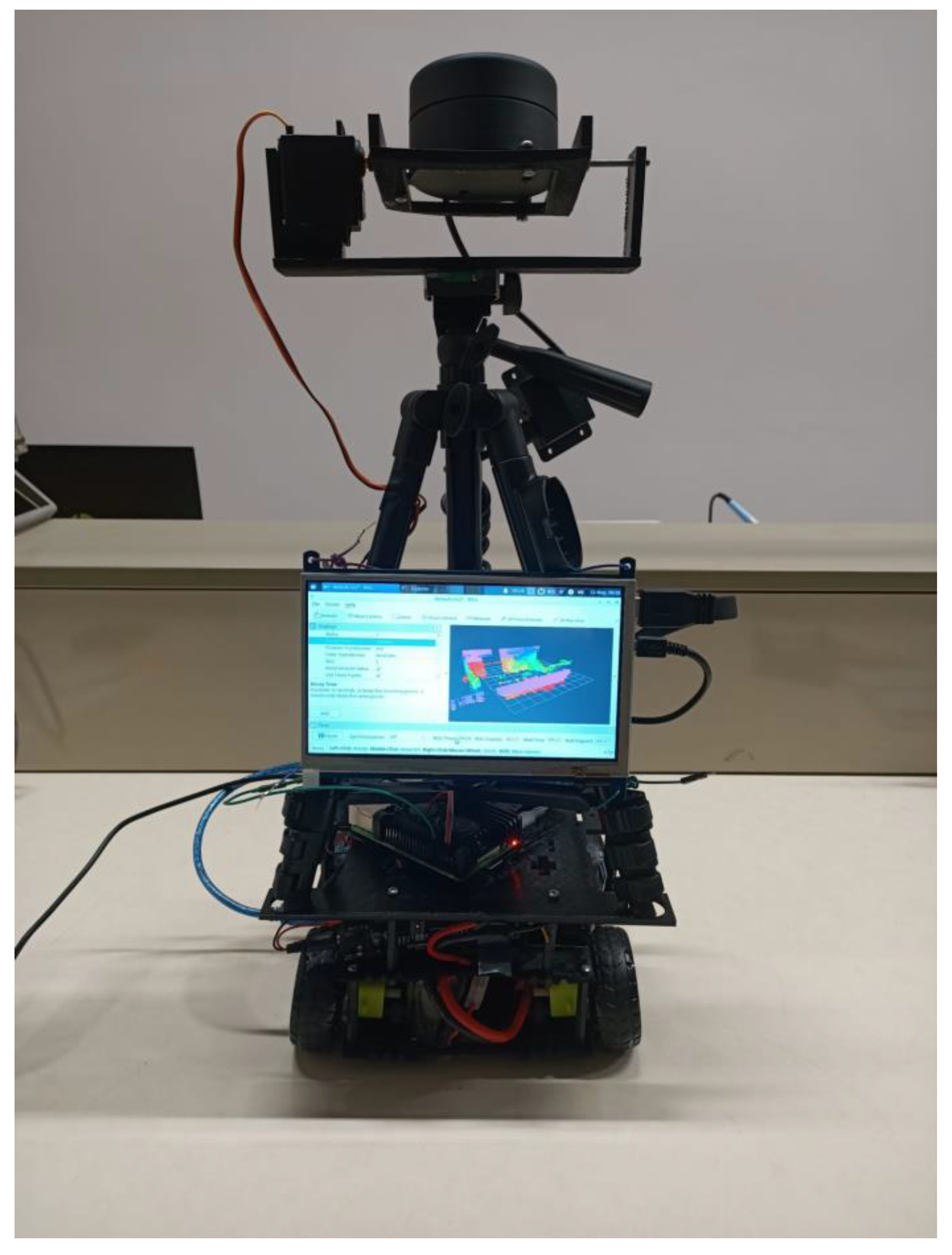
This system architecture represents a modular 3D mapping solution mounted on a mobile robotic platform as shown in
Figure 1. A YDLidar G2 sensor, installed on a platform rotated by a Tower Pro MG996R servo motor, enables 3D environmental scanning by generating slices of 2D scans [
8]. Each scan is captured at 0.5-degree intervals and sequentially added to the previous one, constructing a 3D scan from 2D data. Additionally, odometry data is generated through DC motors driven by an L298N module, controlled by an Arduino Mega 2560, based on motion commands received via an HC-06 Bluetooth module from a mobile application [
9,
10]. These odometry-based movements allow the system to perform scans over larger areas.
The control of the LiDAR and servo motor and the processing of acquired data is handled by a Raspberry Pi 4 (8 GB), which also communicates with the Arduino Mega 2560 to receive odometry data. The system incorporates a 7-inch WaveShare HDMI capacitive touchscreen display for real-time outdoor mapping and visualization. Processed maps and records are stored on a 128 GB SD card, ensuring long-term data storage. The entire software stack is built on the Robot Operating System (ROS) [
11], which provides a flexible framework for sensor integration, data handling, and visualization. This integrated architecture supports real-time mapping, data visualization, and system control in outdoor environments.
The scans are saved as bag files for further analysis. These bag files can be replayed in the RViz application, allowing users to generate a 3D map that can be observed from different perspectives. On this map, essential measurements can be performed, such as determining tree heights and diameters. Additionally, the tf transformation library is utilized to perform sensor fusion, ensuring accurate alignment between LiDAR scans, servo rotation angles, and odometry data, which yields consistent and reliable 3D maps [
12].
2.2. Tree Inventory and Carbon Estimation
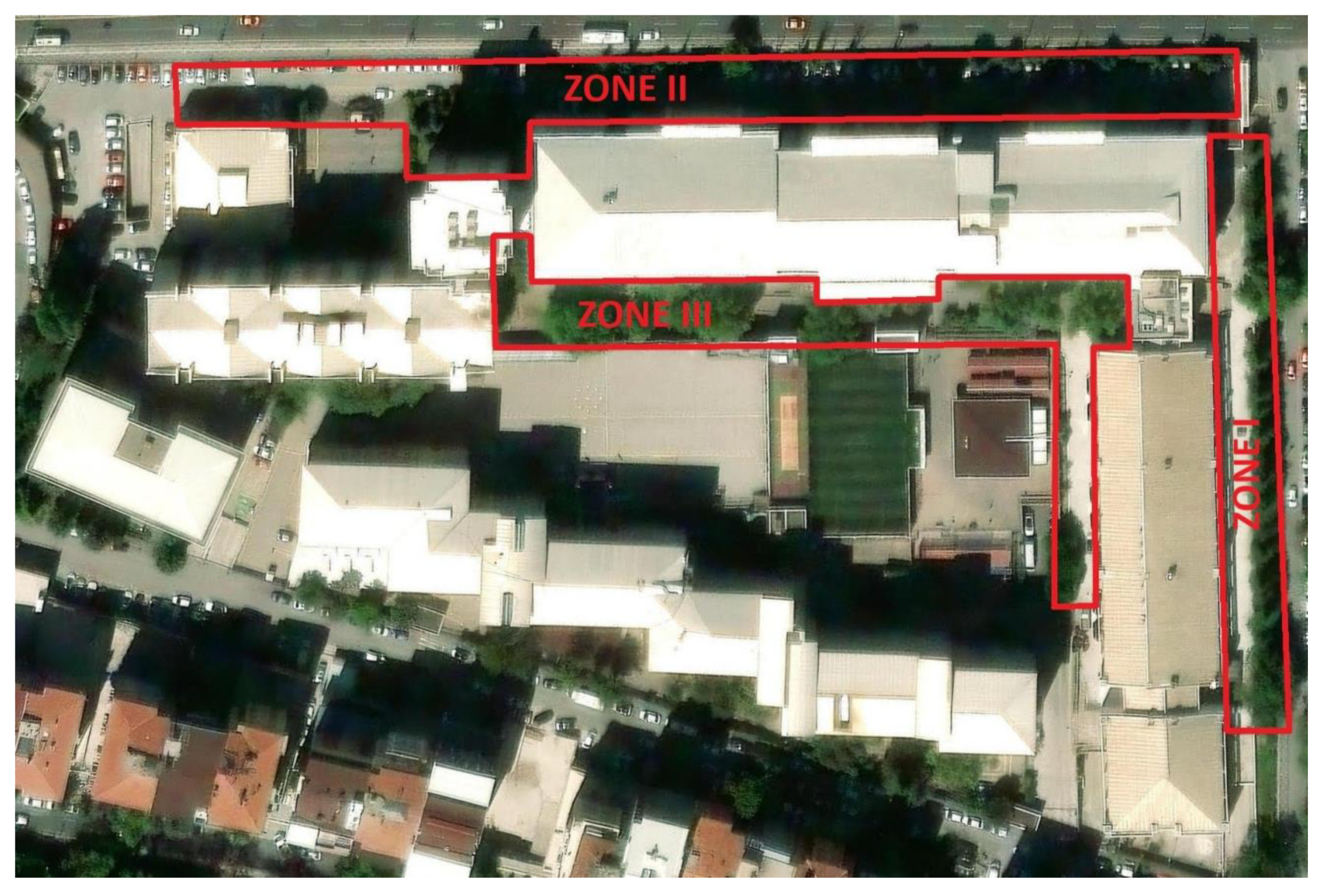
The study is conducted in the green areas of Gazi University campus. To assess the carbon stock capacity of the study area, the campus map is divided into three zones based on the spatial distribution of vegetation density and land use characteristics. A map view of the campus and its zones is shown in
Figure 2. Tree inventories are prepared within each zone by identifying the dominant species present. The principal species included Cedrus libani (Lebanon cedar), Pinus nigra (Black pine), Platanus orientalis (Oriental. plane), Picea orientalis (Oriental spruce), Ailanthus altissima (Tree-of-heaven), and Cupressus arizonica (Arizona cypress).
From the LiDAR-derived point cloud, diameter at breast height (DBH) and tree height (H) are extracted as the fundamental biometric parameters. These measurements served as inputs to species-specific or allometric equations widely used for estimating biomass and carbon.
The calculation steps are summarized as follows:
Individual trees’ above-ground biomass (AGB) is estimated using species-specific or generalized allometric equations. A widely used pantropical model developed by Chave et al. [
13] is expressed as:
where D is the DBH (cm), H is the total tree height (m), and ρ is the wood density (g/cm
3), obtained from published wood density values [
14,
15].
Root biomass (Below-Ground Biomass (BGB)) is estimated as a fraction of AGB, following the IPCC 2006/2019 Guidelines [
16,
17]. The relationship is:
where R is the root-to-shoot ratio, for planted coniferous stands with low-to-medium biomass (≤125 t ha
−1), a value of R = 0.34 is recommended (IPCC, 2019 [
17]).
Total Biomass (TB) equation is:
Biomass is converted to carbon stock using dry biomass’s carbon fraction (CF). According to IPCC 2006/2019 Guidelines [
16,
17], the default value is CF = 0.47–0.50. Carbon Stock equation is (C):
Finally, the amount of sequestered CO
2 is obtained by converting carbon mass into CO
2 equivalent using the molecular weight ratio:
For Cedrus libani (Lebanon cedar), biomass estimation is carried out using a species-specific equation developed by Durkaya et al. [
5], which employs Diameter at Breast Height (DBH, d
1.30) and tree height (H) as independent variables in the Above-Ground Biomass (AGB) equation. Here, D is expressed in centimeters, H in meters, and AGB in kilograms (oven-dry AGB).
This equation, with a high coefficient of determination (R2 = 0.97), provides reliable results, and the estimated biomass values are subsequently converted into carbon and CO2 equivalents using carbon conversion factors. The remainder of the Cedrus libani calculations is carried out the same way as for allometric equations.
Biomass estimation for Pinus Nigra (Black Pine) is performed using the Above Ground Biomass (AGB) equation developed by Durkaya et al. [
6], which incorporates DBH (d
1.30) and tree height (H) as independent variables. Here, D is expressed in cm, H m, and AGB is expressed in kg (oven-dry AGB).
This equation, with a high coefficient of determination (R2 = 0.86), provides reliable results, and the estimated biomass values are subsequently converted into carbon and CO2 equivalents using carbon conversion factors. The remainder of the calculations for Pinus Nigra are carried out in the same way as for allometric equations.
3. Results and Discussion
This study analyzed the green areas of Gazi University campus using a LiDAR-based scanning system. The study area covered approximately 70,000 m
2 [
18] within the Faculty of Engineering region of Gazi University, located at coordinates 39°55′54.4″ N and 32°50′47.6″ E. Trees within the campus are scanned using the developed system, as illustrated in
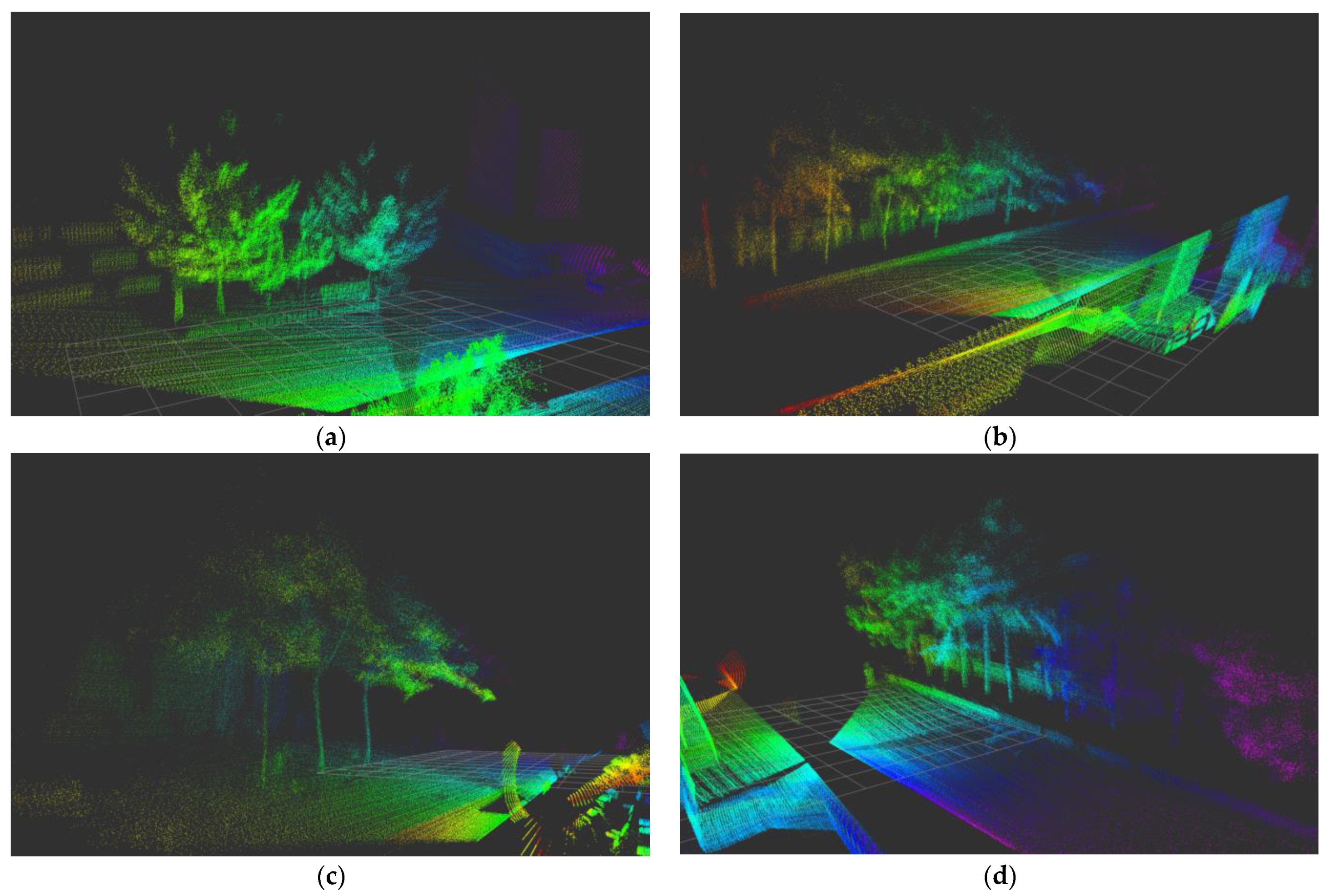
Figure 1, and the acquired data are subsequently processed to generate three-dimensional point clouds, as shown in
Figure 3. The coloring applied to the point clouds enabled a more distinct distinction of tree stems and crowns from surrounding objects, thereby facilitating more precise measurements of diameter at breast height (DBH) and total tree height (H). Example visualizations representing three different study zones (Zone I, Zone II, and Zone III) provide evidence of the methodology’s effectiveness in characterizing campus vegetation.
The extracted DBH and H values are classified by species using RViz, and the results are summarized in
Table 1. The table reports average DBH and height, the number of individuals per species across the zones, carbon stock per tree, and total carbon stock.
The results demonstrate distinct variations in carbon storage capacity among species. Cedrus libani emerged as the most significant contributor, storing 29,468.86 kg C across 58 individuals, primarily due to its abundance and robust size. Despite consisting of only 13 individuals, Platanus orientalis achieved a total of 11,334.76 kg C, owing to its high per-tree carbon stock (871.90 kg). Similarly, Ailanthus altissima, represented by only four individuals, contributed 13,544.83 kg C due to its large DBH and height values. In contrast, Pinus nigra (9 individuals) accounted for 4171.87 kg C, Cupressus arizonica (16 individuals) for 2715.29 kg C, and Picea orientalis (8 individuals) stored only 428.66 kg C, marking the lowest contribution.
Overall, the cumulative carbon stock of campus trees is approximately 16.82 t C, equivalent to 61.66 t CO2eq when applying the conversion factor (44/12). These findings highlight that species-specific traits and their distribution within the campus directly affect total carbon stock. Dominant and fast-growing broadleaf species (e.g., Platanus orientalis, Ailanthus altissima) exhibited disproportionately higher storage capacity. In contrast, coniferous species (Picea orientalis, Cupressus arizonica) contributed less due to smaller sizes and lower abundance.
In comparison with previous studies, the results are consistent with the literature reporting the role of urban green spaces as local carbon sinks. For instance, Nowak and Crane [
19] emphasized that urban trees significantly mitigate CO
2 emissions, while Durkaya et al. [
5,
6] demonstrated that Cedrus libani and Pinus nigra are effective carbon-sequestering species in Turkish forests. Chave et al. [
13] also confirmed the importance of integrating wood density and tree height in allometric models to minimize uncertainties, a practice adopted in this study. Finally, applying IPCC guidelines [
16,
17] ensured methodological consistency in biomass-to-carbon conversion and the estimation of below-ground biomass.
These results underscore the dual contribution of both species richness and measurement technology: while the species composition of the campus ecosystem determines the magnitude of stored carbon, the LiDAR-based, low-cost scanning system has proven to be an efficient, scalable, and non-destructive method for monitoring urban vegetation and assessing carbon sequestration potential at a local scale.
4. Conclusions
This study demonstrated the potential of a low-cost LiDAR-based 3D mapping system to estimate carbon stock in university campuses. By integrating a 2D LiDAR sensor with a servo motor and odometry data, three-dimensional point clouds of trees are generated and used to extract fundamental biometric parameters such as DBH and total height. Combined with species-specific and generalized allometric equations, these parameters enabled reliable estimation of above-ground biomass, below-ground biomass, and total carbon stock.
The experimental results from the Gazi University campus revealed a total carbon stock of approximately 16.82 t C, equivalent to 61.66 t CO2eq, highlighting the role of campus vegetation as a significant local carbon sink. Species such as Cedrus libani, Platanus orientalis, and Ailanthus altissima exhibited disproportionately high contributions due to their size and growth characteristics. In contrast, species like Picea orientalis and Cupressus arizonica contributed less. These findings underline that species composition and distribution strongly influence urban green areas’ overall carbon sequestration capacity.
Compared with previous literature, the results are consistent with international studies emphasizing the importance of urban trees in mitigating carbon emissions. Moreover, the application of IPCC guidelines ensured methodological robustness in biomass-to-carbon conversion. The proposed system thus provides a scalable, affordable, and non-destructive alternative to high-cost professional LiDAR systems, making it especially suitable for educational institutions and local-scale sustainability projects.
Future work can focus on expanding the system with sensor fusion techniques and integration with Geographic Information Systems (GIS) to enhance urban carbon management strategies. Overall, the developed approach contributes to advancing sustainable campus management and demonstrates the broader applicability of low-cost LiDAR technologies in climate change mitigation efforts.
Author Contributions
Conceptualization, H.D. and A.S.K.; methodology, A.S.K., A.B. and Y.B.; software, A.S.K., A.B. and Y.B.; validation, A.B. and Y.B.; formal analysis, A.S.K. and A.B.; investigation, A.S.K., A.B., Y.B. and H.D.; resources, A.S.K., A.B. and Y.B.; data curation, A.S.K., A.B. and Y.B.; writing—original draft preparation, A.S.K., A.B. and Y.B.; writing—review and editing, H.D.; visualization, A.S.K. and H.D.; supervision, H.D.; project administration, H.D.; funding acquisition, A.S.K., A.B. and Y.B. All authors have read and agreed to the published version of the manuscript.
Funding
This research was funded by the Scientific and Technological Research Council of Turkey (TUBITAK) grant program 2209-A-Research Project Support Program for Undergraduate Students with grant number 1919B012446214.
Institutional Review Board Statement
Not applicable.
Informed Consent Statement
Not applicable.
Data Availability Statement
The data supporting the findings of this study are available from the corresponding author upon reasonable request.
Conflicts of Interest
The authors declare no conflicts of interest.
References
- Sharma, R.; Pradhan, L.; Kumari, M.; Bhattacharya, P. Assessment of carbon sequestration potential of tree species in Amity University campus Noida. Environ. Sci. Proc. 2021, 3, 52. [Google Scholar]
- Tantrairatn, S.; Pichitkul, A.; Petcharat, N.; Karaked, P.; Ariyarit, A. Evaluating LiDAR technology for accurate measurement of tree metrics and carbon sequestration. MethodsX 2025, 14, 103237. [Google Scholar] [CrossRef] [PubMed]
- Huai, J.; Shao, Y.; Zhang, Y.; Yilmaz, A. A low-cost portable LiDAR-based mobile mapping system on an Android smartphone. arXiv 2025, arXiv:2506.15983. [Google Scholar] [CrossRef]
- Suryawanshi, M.; Patel, A.; Kale, T.S.; Patil, P.R. Carbon sequestration potential of tree species in the environment of North Maharashtra University Campus, Jalgaon (MS), India. Biosci. Discov. 2014, 5, 175–179. [Google Scholar]
- Durkaya, B.; Durkaya, A.; Makineci, E.; Ülküdür, M. Estimation of above-ground biomass and sequestered carbon of Taurus Cedar (Cedrus libani L.) in Antalya, Turkey. iForest 2013, 6, 278–284. [Google Scholar] [CrossRef]
- Durkaya, B.; Durkaya, A.; Yağcı, H. Biomass equations in natural black pines. Fresenius Environ. Bull. 2019, 28, 1132–1139. [Google Scholar]
- Shadman, S.; Khalid, P.; Hanafiah, M.M.; Koyande, A.; Islam, A.; Bhuiyan, S.; Woon, K.S.; Show, P.-L. The carbon sequestration potential of urban public parks of densely populated cities to improve environmental sustainability. Sustain. Energy Technol. Assess. 2022, 52, 102064. [Google Scholar] [CrossRef]
- Ocando, M.G.; Certad, N.; Alvarado, S.; Terrones, Á. Autonomous 2D SLAM and 3D mapping of an environment using a single 2D LIDAR and ROS. In Proceedings of the 2017 Latin American Robotics Symposium (LARS) and 2017 Brazilian Symposium on Robotics (SBR), Curitiba, Brazil, 8–11 November 2017. [Google Scholar]
- Oprea, M.; Mocanu, M. Bluetooth communications in educational robotics. In Proceedings of the 2021 23rd International Conference on Control Systems and Computer Science (CSCS), Bucharest, Romania, 26–28 May 2021. [Google Scholar]
- Chen, L.; Zhang, J.; Wang, Y. Wireless Car control system based on Arduino Uno R3. In Proceedings of the 2018 2nd IEEE Advanced Information Management, Communicates, Electronic and Automation Control Conference (IMCEC), Xi’an, China, 25–27 May 2018. [Google Scholar]
- Quigley, M.; Gerkey, B.; Conley, K.; Faust, J.; Foote, T.; Leibs, J.; Berger, E.; Wheeler, R.; Ng, A. ROS: An open-source Robot Operating System. In Proceedings of the IEEE International Conference on Robotics and Automation (ICRA), Workshop on Open Source Software, Kobe, Japan, 12–17 May 2009. [Google Scholar]
- Foote, T. Tf: The transform library. In Proceedings of the 2013 IEEE Conference on Technologies for Practical Robot Applications (TePRA), Woburn, MA, USA, 22–23 April 2013. [Google Scholar]
- Chave, J.; Réjou-Méchain, M.; Búrquez, A.; Chidumayo, E.; Colgan, M.S.; Delitti, W.B.; Duque, A.; Eid, T.; Fearnside, P.M.; Goodman, R.C.; et al. Improved allometric models to estimate the aboveground biomass of tropical trees. Glob. Change Biol. 2014, 20, 3177–3190. [Google Scholar] [CrossRef]
- Nowak, D.J. Understanding i-Tree: 2021 Summary of Programs and Methods; General Technical Report NRS-200-2021; U.S. Department of Agriculture, Forest Service, Northern Research Station: Madison, WI, USA, December 2021; pp. 23–24. [Google Scholar]
- Zanne, S.A.; Lopez-Gonzalez, G.; Coomes, D.A.; Ilic, J.; Jansen, S.; Lewis, S.L.; Miller, R.B.; Swenson, N.G.; Wiemann, M.C.; Chave, J. Data from: Towards a worldwide wood economics spectrum. Ecol. Lett. 2009, 12, 351–366. [Google Scholar]
- IPCC. 2006 IPCC Guidelines for National Greenhouse Gas Inventories, Volume 4: Agriculture, Forestry and Other Land Use; Eggleston, H.S., Buendia, L., Miwa, K., Ngara, T., Tanabe, K., Eds.; Institute for Global Environmental Strategies (IGES): Hayama, Japan, 2006. [Google Scholar]
- IPCC. 2019 Refinement to the 2006 IPCC Guidelines for National Greenhouse Gas Inventories, Volume 4: Agriculture, Forestry and Other Land Use; Calvo Buendia, E., Tanabe, K., Kranjc, A., Baasansuren, J., Fukuda, M., Ngarize, S., Osako, A., Pyrozhenko, Y., Shermanau, P., Federici, S., Eds.; IPCC: Geneva, Switzerland, 2019. [Google Scholar]
- Gazi Üniversitesi Mühendislik Fakültesi. Tanıtım; Gazi Üniversitesi. Available online: https://mf.gazi.edu.tr/view/page/150945 (accessed on 1 September 2025).
- Nowak, D.J.; Crane, D.E. Carbon storage and sequestration by urban trees in the USA. Environ. Pollut. 2002, 116, 381–389. [Google Scholar] [CrossRef]
| Disclaimer/Publisher’s Note: The statements, opinions and data contained in all publications are solely those of the individual author(s) and contributor(s) and not of MDPI and/or the editor(s). MDPI and/or the editor(s) disclaim responsibility for any injury to people or property resulting from any ideas, methods, instructions or products referred to in the content. |