Abstract
Flow sensing is essential in biomedical engineering, industrial process control, and environmental monitoring. Conventional sensors, while accurate, are often constrained by high fabrication costs, complex processes, and limited design flexibility, restricting their use in disposable or rapidly customizable applications. This paper presents a novel ultra-low-cost airflow sensor fabricated entirely through fused deposition modeling 3D printing. The device employs a cantilever-based structure printed with PETg filament, followed by the deposition of a conductive ABS piezoresistive layer in a two-step process requiring no curing or post-processing. Experimental characterization reveals that the sensor operates in an ultra-low pressure range of 0.88–26.68 Pa, corresponding to flow velocities of 1.2–6.6 m/s. The sensor achieves a sensitivity of 967 Ω/Pa, a resolution of 9.27 Pa, and a detection limit of 83.27 Pa, with a total resistance change of approximately 51.5 kΩ. This kilo-ohm-scale response enables direct readout via a digital multimeter without requiring Wheatstone bridges or instrumentation amplifiers. The minimalist design, combined with sub-5 min fabrication time and material cost below $0.05, positions this sensor as an accessible platform for disposable, scalable, and resource-constrained flow monitoring applications in both biomedical and industrial contexts.
1. Introduction
Flow sensing plays a vital role in diverse fields, including biomedical engineering (e.g., respiratory monitoring [1]), industrial process control, and environmental monitoring. Conventional flow sensors, while accurate, are often constrained by high production costs, complex fabrication requirements, and limited design flexibility [2]. These limitations restrict their use in applications that demand disposable devices, rapid customization, or low-volume production. As a result, there is a growing demand for cost-effective sensing solutions that reduce manufacturing complexity while maintaining essential performance. Additive manufacturing, particularly 3D printing, has emerged as a promising approach to address these challenges by enabling rapid prototyping and the fabrication of complex geometries with minimal resources [3]. This technology allows for the creation of functional composite systems, such as triboelectric energy harvesters for biomechanical applications or highly personalized devices like 3D-printed insoles for gait analysis [4].
When combined with printed electronics, this approach allows conductive materials to be directly integrated into sensor structures. The ongoing trend in this domain is the advancement of next-generation smart carbon–polymer nanocomposites [5], which are key to improving the performance of flexible sensing devices. Among various sensing mechanisms, piezoresistive sensors [6]—which exploit resistance changes under mechanical deformation—have demonstrated strong potential for low-cost, scalable sensing applications [7]. However, while the field is rapidly advancing towards complex multi-modal sensors featuring piezoelectric and ionic coupling mechanisms [8], these cutting-edge designs often necessitate sophisticated readout electronics. Our work is motivated by the objective of developing an extremely economical and accessible flow sensor that entirely bypasses this complexity-cost trade-off.
In this work, we present a novel 3D-printed piezoresistive airflow sensor designed to overcome the cost–complexity trade-off. The sensor body is fabricated entirely via Fused Deposition Modeling (FDM) using polyethylene terephthalate (PET) filament, followed by the deposition of the sensing element using a conductive Acrylonitrile Butadiene Styrene (ABS) filament on the same substrate. This two-step process results in a highly economical and rapidly fabricated device. The sensor’s operation is modeled using cantilever beam mechanics, and experimental results confirm a nearly linear relationship between airflow velocity and resistance change. Our work establishes an accessible and practical solution for applications in biomedical and industrial monitoring where simplicity and cost-efficiency are paramount. The main contributions of this study are:
- The design of a low-cost and customizable airflow sensor fabricated solely through 3D printing,
- Experimental validation of its performance in biomedical and industrial contexts, and
- Demonstration of its suitability for disposable and resource-constrained applications, including direct resistance readout without external signal conditioning.
2. Related Work
Current research on disposable flow sensors based on the piezoresistive principle faces persistent limitations related to structural design and electronic readout requirements. This section critically reviews these challenges, establishing the motivation for the proposed sensor and its structural and electronic advantages. The rising demand for cost-effective, disposable sensors in biomedical [1] and environmental applications has driven research into printed electronics and flexible substrates. Paper-based sensors, in particular, have gained traction due to their low material cost and inherent flexibility [2], supporting both thermal flow sensors [6,9] and piezoresistive configurations [10].
However, two major limitations restrict their effectiveness. First, thermal sensing approaches are highly sensitive to ambient temperature fluctuations and require continuous power, complicating deployment in field environments [9,11]. Second, most paper-based and printed electronics are confined to two-dimensional substrates [2,6,10]. This restriction prevents the integration of sensing elements into robust, customized three-dimensional geometries that are essential for effective aerodynamic interaction and mechanical amplification of airflow forces. Without such structural optimization, achieving high sensitivity in flow measurements remains difficult. The piezoresistivity principle is widely adopted for low-cost sensing, as resistance changes induced by strain can be modeled with structural mechanics such as cantilever beam theory [12,13]. Despite this advantage, the practical implementation of piezoresistive sensors often involves significant system-level complexity. The resistance variations (ΔR) are typically small (micro- to milliohm range), requiring precision Wheatstone bridge circuits combined with high-gain instrumentation amplifiers (e.g., Texas Instruments INA series [14]) for readout. This increases power consumption, cost, and circuit footprint, undermining the “low-cost” advantage of the sensing element itself. Furthermore, ink- or paste-based sensors often require curing or drying, introducing extra fabrication delays and additional processing steps that hinder rapid prototyping [15]. While prior studies have successfully reduced material costs, two critical gaps remain: limited structural customization and reliance on complex readout signal conditioning. The sensor presented in this work addresses both issues. First, the use of 3D printing enables the fabrication of a single-piece structural body optimized for aerodynamic coupling, overcoming the inherent limitations of 2D substrates. Second, the sensor’s response can be directly measured as a resistance change, eliminating the need for Wheatstone bridges or amplification stages. This approach minimizes component count, reduces manufacturing complexity to only two steps, and enables immediate usability without curing or drying. Through this combination of structural freedom and electronic simplicity, the proposed work establishes a novel, low-cost paradigm for disposable and rapidly deployable airflow sensors.
3. Design of the Airflow Sensor
3.1. Mechanical Design Based on Cantilever Beam Model
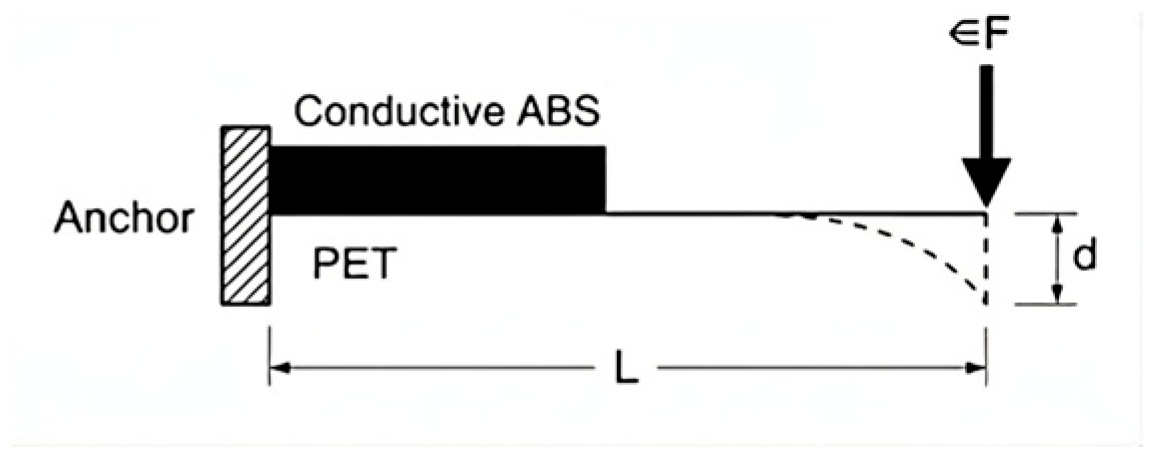
The proposed airflow sensor employs a cantilever beam mechanism as shown in Figure 1, chosen for its ability to maximize deflection and strain under applied force—an essential requirement for piezoresistive sensing. The airflow-induced dynamic pressure is directed perpendicularly onto the beam’s free end surface, generating measurable strain at the fixed support where the sensing element is printed for maximum sensitivity. The tip deflection δ of the cantilever under an external force F is expressed as:
where L is the beam length, E is the Young’s modulus of the structural material, and I is the area moment of inertia. The applied force is derived from the dynamic pressure acting over the sensor’s effective area A, F ≈ Pd⋅A and Pd = where v is the airflow velocity and ρ is the air density. This deflection induces strain ϵ concentrated near the beam’s fixed support, resulting in a resistance change in the piezoresistive layer. The piezoresistive effect is given by:
where is the normalized resistance change and GF is the material’s gauge factor and ϵ is the induced strain. This theoretical foundation directly correlates airflow velocity V with the experimentally measured resistance change ΔR.
Figure 1.
Cantilever beam model of the proposed airflow sensor.
3.2. Practical Sensor Design and Structural Choices
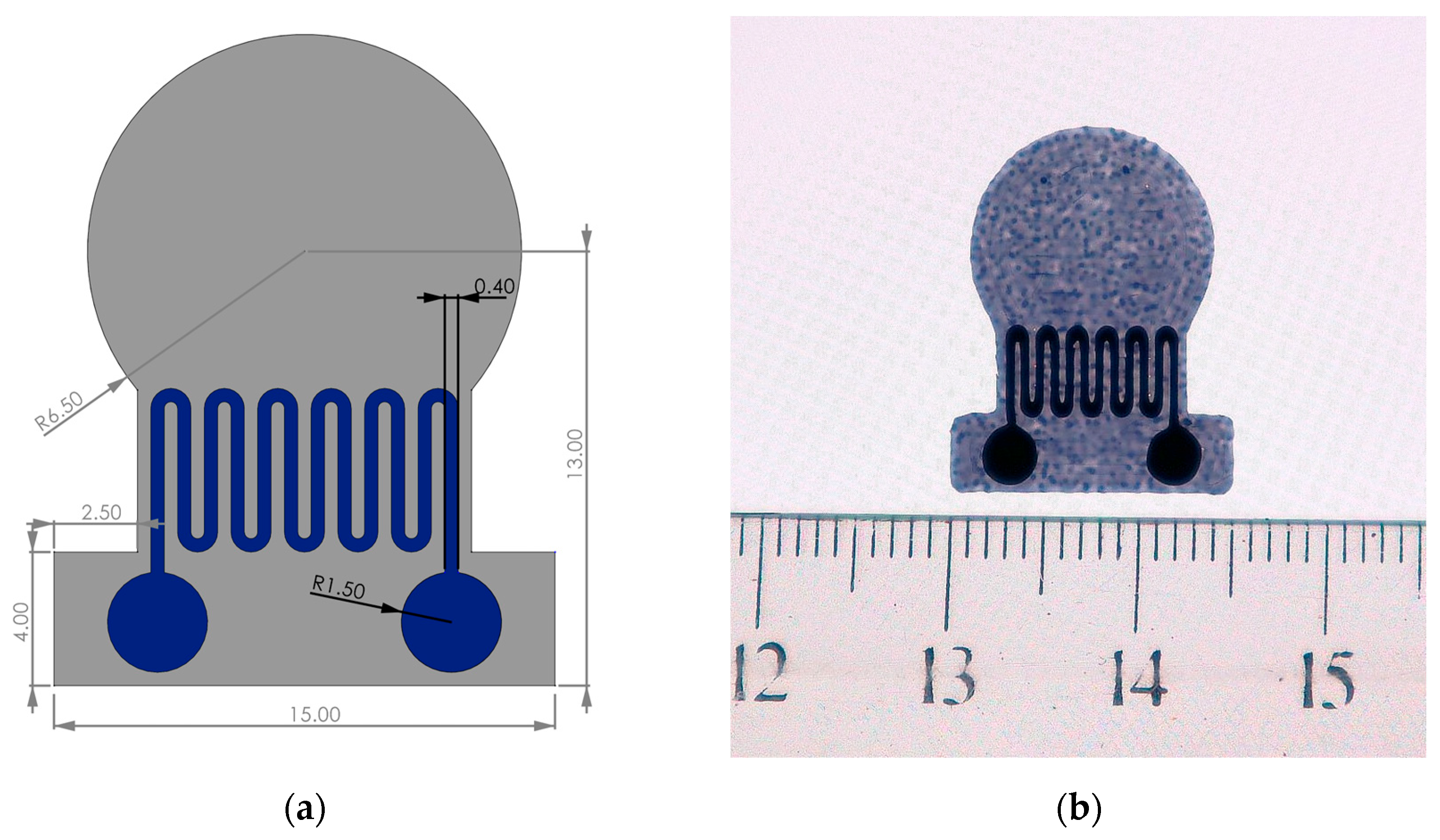
Sensor Design: The sensor design in Figure 2a is fabricated as a monolithic structure via the FDM 3D printing method, as shown in Figure 2b, eliminating assembly requirements and ensuring seamless integration into the airflow channel. The design prioritizes rapid manufacturability, structural robustness, and direct adaptability to standard ducts. The structural body is fabricated using readily available PETg filament due to the optimal balance of structural strength and printability, along with its reliability and flexibility.
Figure 2.
CAD drawing (a) and photo (b) of the proposed 3D printed airflow sensor.
The piezoresistive layer uses a low-cost, Frosch ABS-based conductive filament [14]. This material choice is pivotal, as its ease of application and zero required curing time circumvent the need for time-consuming conventional microfabrication processes. The piezoresistive layer is strategically placed near the fixed support of the cantilever—the zone where the theoretical strain ϵ is maximized as shown in Figure 2a. This placement ensures that even minor deformations caused by the airflow are efficiently converted into the largest possible change in electrical resistance. A summary of the materials and parameters is presented in Table 1.
Table 1.
FDM filament material properties.
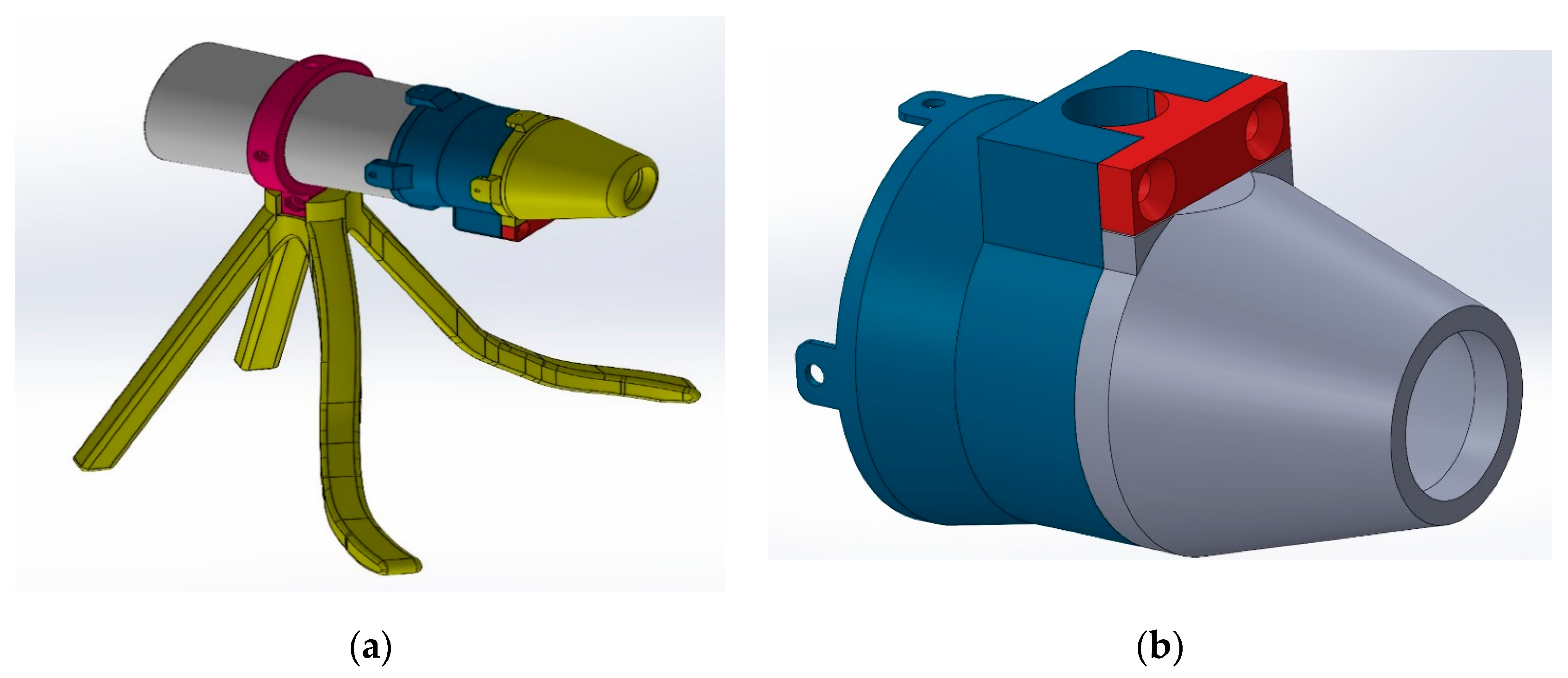
Sensor Testbed Design: The 3D CAD design in Figure 3a acts as the testbed tailored to the specific inner diameter of the air duct generated by the motor of a repurposed hair dryer. The design in Figure 3b is an adapter for the UNI-T UT363BT inline anemometer used as the golden reference for airflow measurements. This configuration ensures that all airflow is channeled directly over the sensing element. The primary sensing element is a single cantilever beam anchored to a central plate. The beam is strategically designed to present a surface area perpendicular to the flow, thereby maximizing the aerodynamic force F applied to the structure. Aerodynamic force F is applied to the structure.
Figure 3.
3D CAD drawing of the 3D fabricated sensor testbed (a) and the mounting adapter for UNI-T 363BT anemometer (b).
3.3. Measurement and Readout Approach
A key novelty of this work is the deliberate exclusion of complex, off-the-shelf analog conditioning circuits such as Wheatstone bridges and instrumentation amplifiers [13]. Instead, the sensor’s performance is validated by measuring the direct change in resistance (ΔR) using a standard digital multimeter. This minimalist approach drastically reduces the total system cost and power consumption, making the sensor platform exceptionally simple and economically viable for field deployment. The performance of the proposed piezoresistive flow sensor was rigorously characterized using a special test setup that facilitates accurate data measurements.
4. Experimental Results
4.1. Experimental Setup
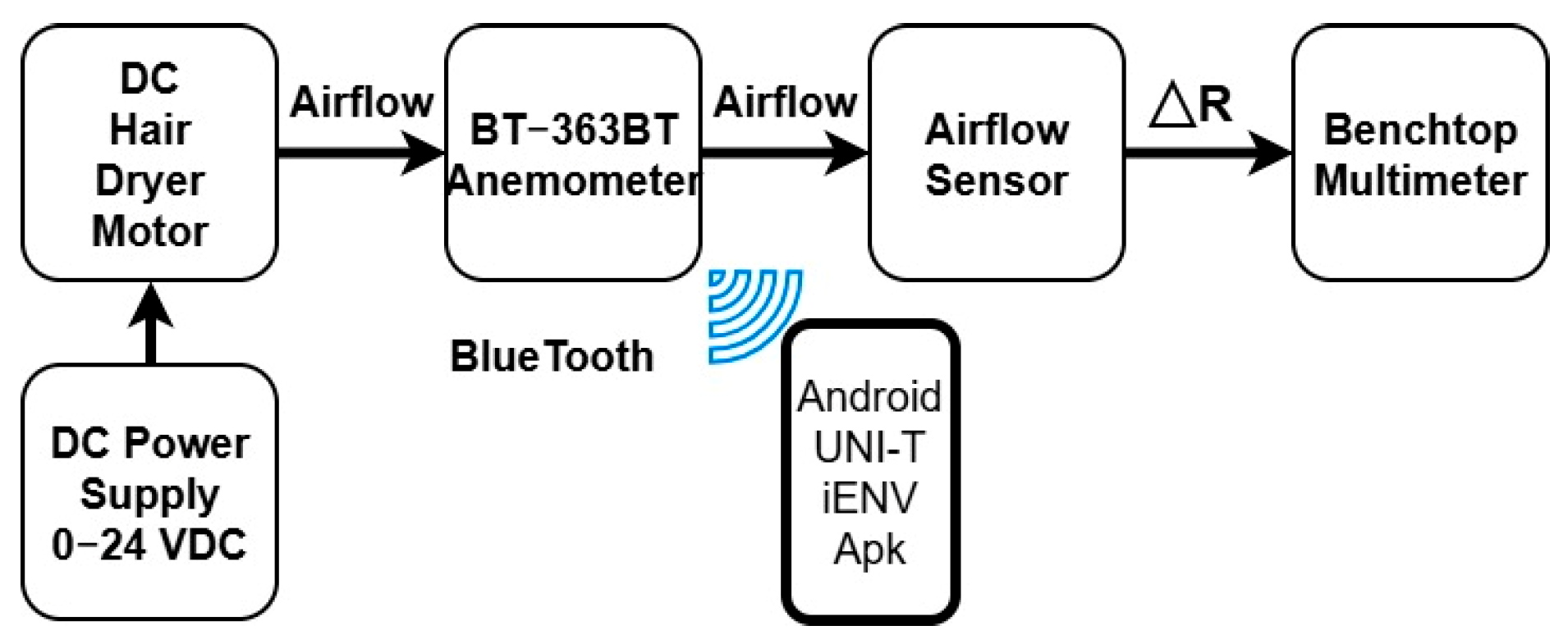
The proposed piezoresistive airflow sensor was characterized using a purpose-built testbed designed for accurate correlation between airflow velocity and resistance response. The airflow source was provided by a repurposed direct current (DC) fan motor (salvaged from a hair dryer), with velocity controlled via the input voltage Vmotor supplied by a GW Instek GPC-3303A DC power supply (Good Will Instrument Co., Ltd., New Taipei City, Taiwan).
A 3D-printed adapter (see Figure 3b) was mounted to the fan outlet of the testbed, ensuring that the entire airflow was directed over the cantilever beam structure. Reference velocity vflow was measured using a UNI-T UT363BT digital anemometer (Uni-Trend Technology Co., Ltd., Dongguan, China), placed immediately downstream of the sensor inside the adapter channel. The UT363BT supports a range of 0.5–30 m/s, with logging of minimum and maximum velocities. Its integrated Bluetooth module enabled continuous real-time data transfer and visualization via the UNI-T iENV mobile application, ensuring reliable acquisition.
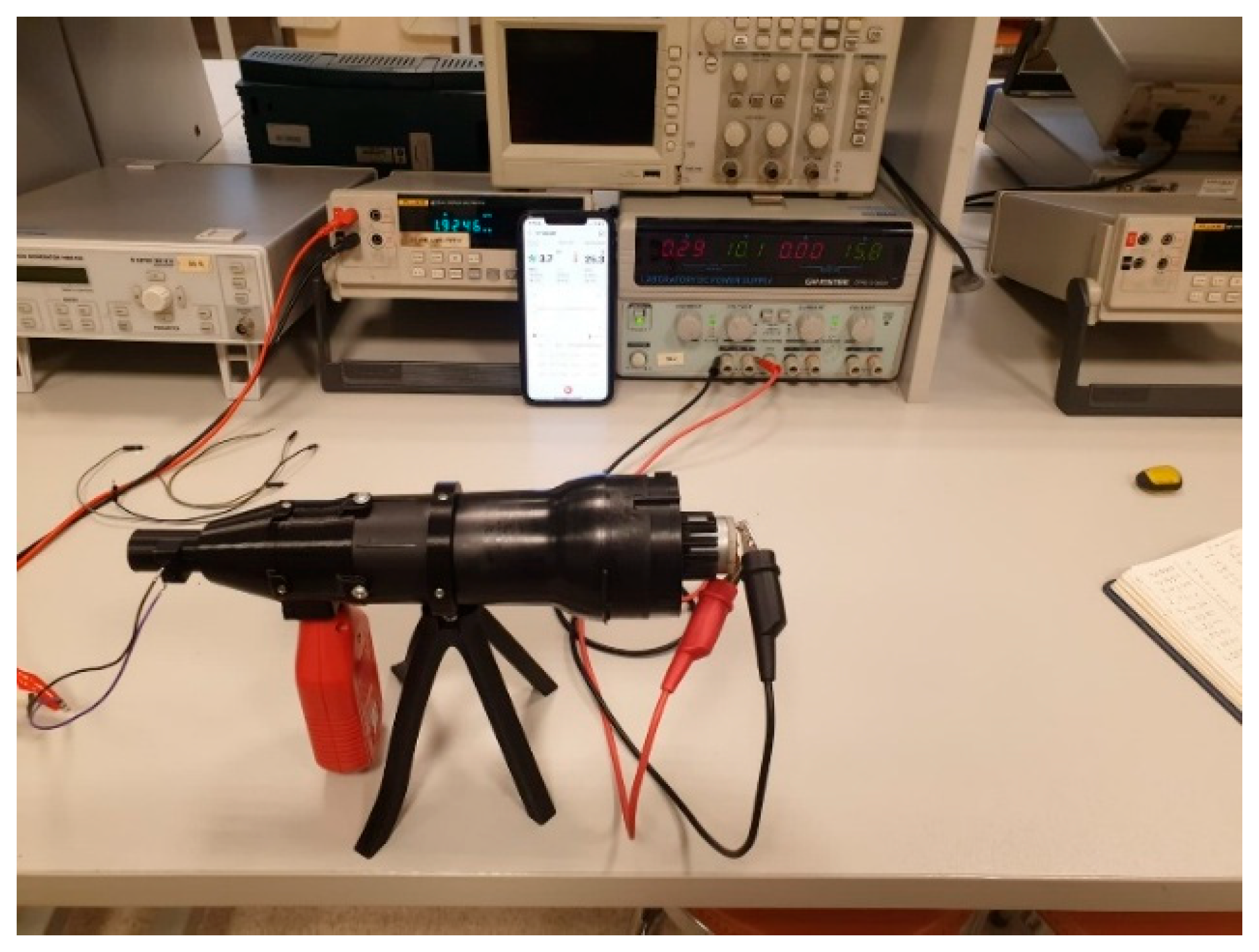
The sensor resistance Rsensor was measured directly using a precision benchtop digital multimeter, Fluke 8808A (Fluke Corporation, Everett, WA, USA), consistent with the simplified testbed architecture introduced in Section 3. A schematic and a photograph of the experimental setup are shown in Figure 4 and Figure 5, respectively.
Figure 4.
Test setup schematic for sensor characterization.
Figure 5.
Photograph of the experimental test setup.
4.2. Sensor Characterization
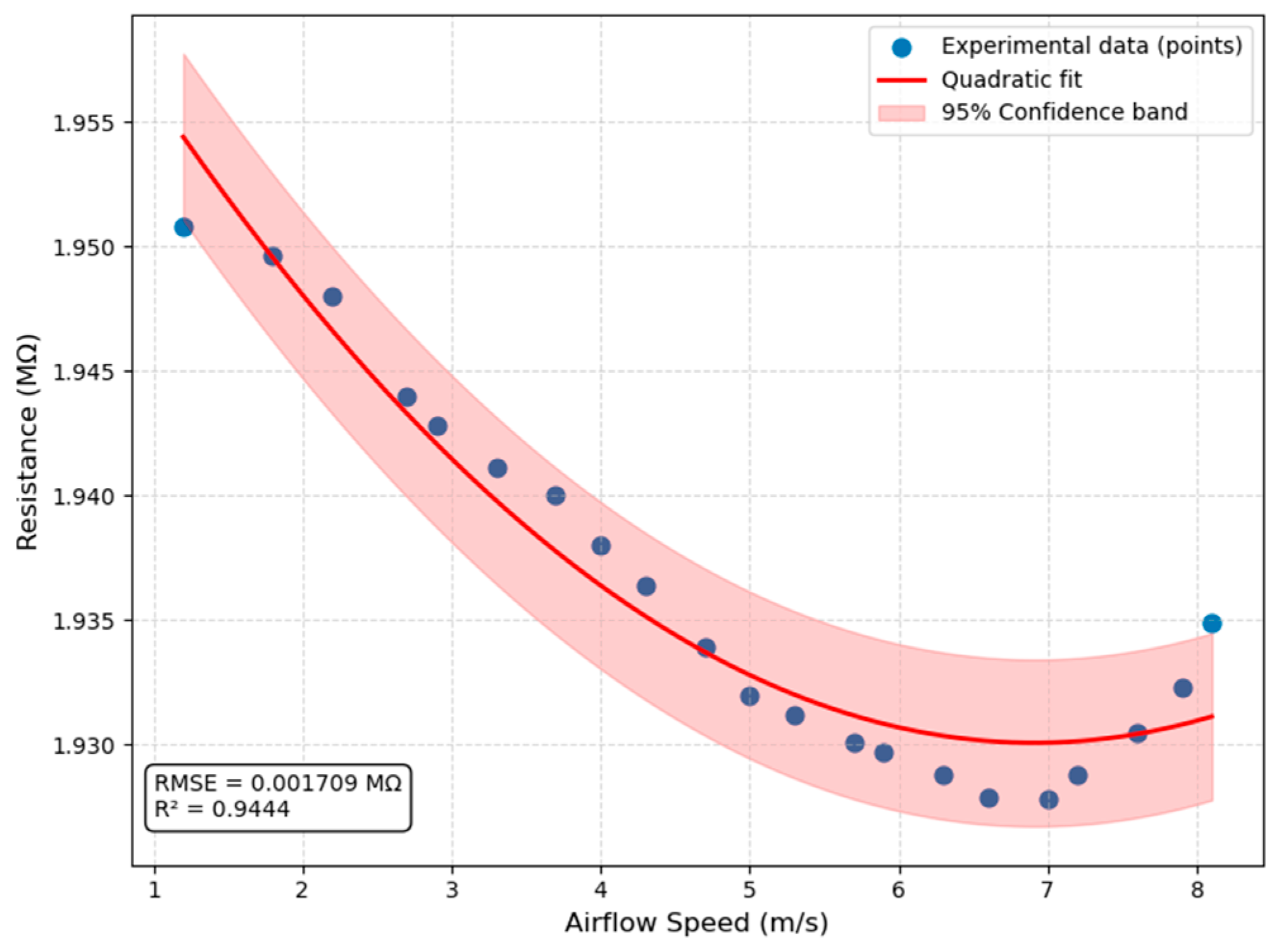
Measurements were taken across the fan’s operational range, corresponding to flow velocities between 0.5 m/s and 15.0 m/s. Each reported point represents the average of multiple steady-state readings to minimize noise. Experimental results confirmed the theoretical prediction from Section 3: since dynamic pressure is proportional to v2, the resulting force and strain also scale quadratically with airflow velocity, as shown in Figure 6. Accordingly, the measured resistance response was best fit by a second-order polynomial:
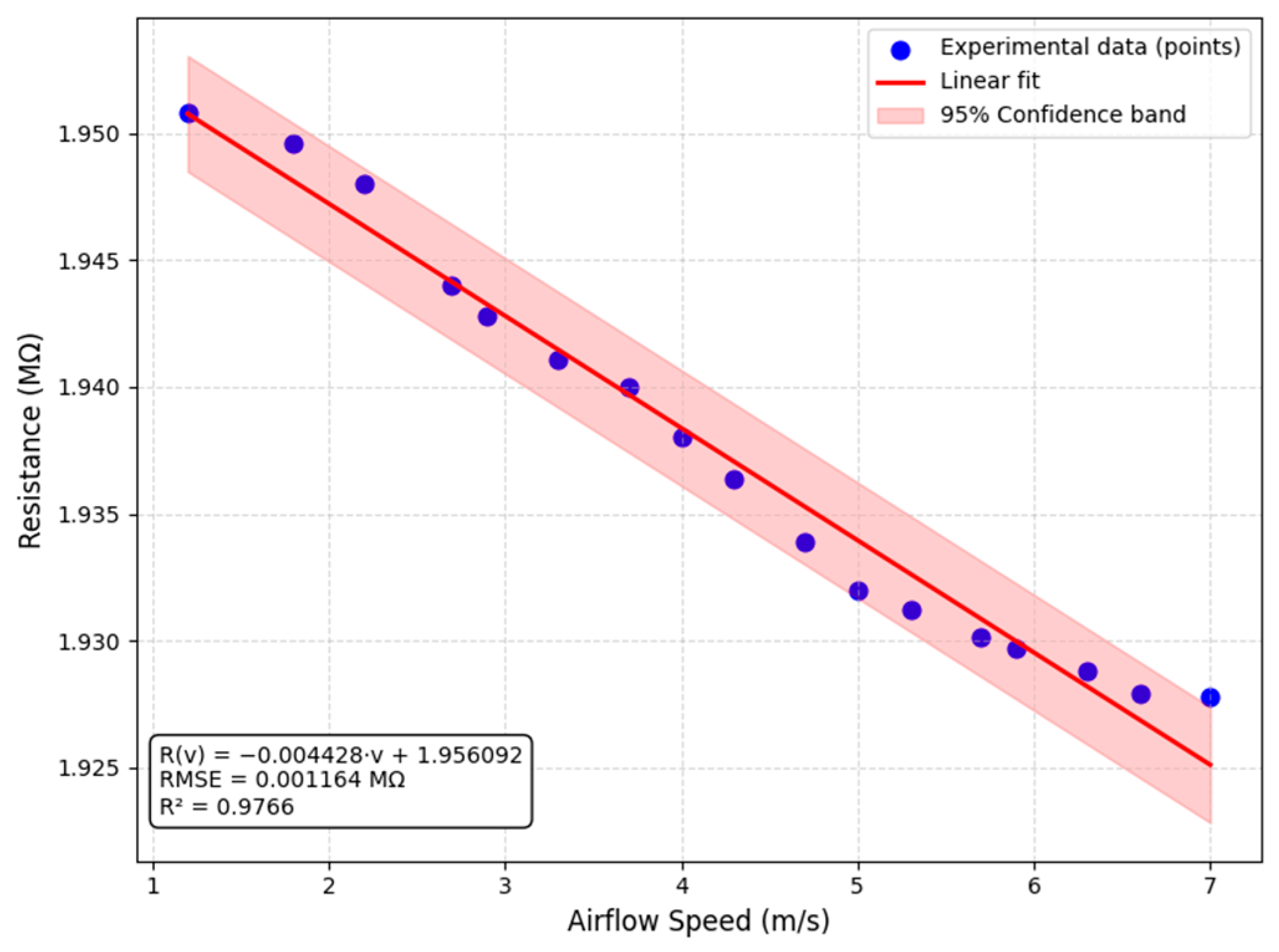
where Rsensor is resistance in Ω, and v is velocity in m/s. The fitted coefficients were: = 1.9657, = −1.031 × 10⁻², = 7.46 × 10⁴. The polynomial model achieved an excellent fit, with RMSE = 1.709 kΩ. A practical quasi-linear region in Figure 6 was also identified between 1.2 m/s and 7 m/s, where the sensor response can be approximated by a first-order model:
with coefficients: = 1.956, = −4.428 × 10⁻³, RMSE = 1.164 kΩ. This region, shown in Figure 7, is particularly useful for applications requiring simplified calibration. To visualize the statistical reliability of the polynomial fit, a 95% confidence band (red-shaded region) was added around the fitted curve in Figure 6 and Figure 7. This band represents the range within which 95% of the experimental data points are expected to fall, thereby indicating the model’s uncertainty and credibility.
Figure 6.
Experimental resistance response and polynomial fitting results.
Figure 7.
Quasi-linear operation region and first-order fitting results.
4.3. Extracted Characteristics
From the fitted model, the following operating characteristics were derived:
- Minimum detectable speed vmin: 1.2 m/s, corresponding to ΔR ≈ 400 Ω.
- Maximum tested speed vmax: 7.0 m/s, with ΔR ≈ 16 kΩ.
- Resolution: 9.27 Pa equivalent, enabled by the large-scale resistance changes measured directly on a DMM.
- Dynamic Range: up to ~51.5 kΩ across the tested range.
4.4. Comparative Analysis
For a broader context, the proposed sensor was benchmarked against similar low-cost piezoresistive flow and pressure sensors from the literature [10,14]. Since many studies report sensitivity in terms of pressure, airflow velocity values were converted to dynamic pressure using:
where is the density of air is taken as 1.225 kg per cubic meter (kg/m3) at standard conditions. This conversion allows for direct, physically sound comparison with other studies in the literature, as presented in Table 2.
Table 2.
Comparison of the proposed 3D-Printed airflow sensor with the literature.
The comparison in Table 2 demonstrates that, while the sensitivity of 967 Ω/Pa is competitive with established low-cost solutions, the key advantage of the proposed sensor lies in its readout simplicity and manufacturing efficiency. Unlike prior works that require Wheatstone bridges and instrumentation amplifiers to resolve milliohm-scale changes, the present design produces resistance shifts on the order of kiloohms, enabling direct digital multimeter readout. Furthermore, the two-step fabrication (3D printing of substrate and sensor deposition) eliminates curing/drying steps, allowing near-instantaneous prototyping and deployment.
5. Conclusions
This work presented the design and characterization of an ultra-low-cost piezoresistive airflow sensor fabricated via FDM 3D printing and conductive paint deposition. Operating over a dynamic pressure range of 0.88–26.68 Pa, the device achieved a sensitivity of 967 Ω/Pa with a resolution of 9.27 Pa. A key outcome is its kΩ-scale resistance response (≈51.5 kΩ total change), which enables direct resistance readout and eliminates the need for complex analog front-end circuits such as Wheatstone bridges and instrumentation amplifiers. This simplification reduces cost, size, and power consumption, positioning the sensor as a practical solution for scalable, disposable, and cost-sensitive flow monitoring applications. Future work will address two directions: (i) integration of a passive reference resistor for thermal drift compensation to ensure long-term stability, and (ii) dynamic response and frequency characterization to establish suitability for time-varying flows in biomedical domains such as respiratory monitoring.
Author Contributions
Conceptualization, U.T., M.A.N. and İ.Ç.; methodology, U.T., M.A.N. and İ.Ç.; software, U.T. and M.A.N.; validation, U.T. and İ.Ç.; formal analysis, İ.Ç.; investigation, U.T. and İ.Ç.; resources, U.T. and M.A.N.; data curation, U.T.; writing—original draft preparation, U.T.; writing—review and editing, U.T. and İ.Ç.; visualization, U.T. and M.A.N.; supervision, İ.Ç.; project administration, İ.Ç. All authors have read and agreed to the published version of the manuscript.
Funding
This research received no external funding.
Institutional Review Board Statement
Not applicable.
Informed Consent Statement
Not applicable.
Data Availability Statement
The original contributions presented in this study are included in the article. Further inquiries can be directed to the corresponding author.
Conflicts of Interest
The authors declare no conflicts of interest.
References
- Malik, S.; Ahmad, M.; Punjiya, M.; Sadeqi, A.; Baghini, M.S.; Sonkusale, S. Respiration Monitoring Using a Flexible Paper-Based Capacitive Sensor. In Proceedings of the IEEE Sensors, New Delhi, India, 28–31 October 2018; pp. 1–4. [Google Scholar]
- Liu, X.; Mwangi, M.; Li, X.; O’Brien, M.; Whitesides, G.M. Based Piezoresistive MEMS Sensors. Lab Chip 2011, 11, 2189–2196. [Google Scholar] [CrossRef] [PubMed]
- Abdalla, O.; Azami, M.; Ameli, A.; Salman, E.; Stanacevic, M.; Willing, R.; Towfighian, S. Experimental Investigation of 3D-Printed TPU Triboelectric Composites for Biomechanical Energy Conversion in Knee Implants. Sensors 2025, 25, 6454. [Google Scholar] [CrossRef] [PubMed]
- Vu, L.T.; Bottin-Noonan, J.; Armitage, L.; Alici, G.; Sreenivasa, M. 3D-Printed Insole for Measuring Ground Reaction Force and Center of Pressure During Walking. Sensors 2025, 25, 2524. [Google Scholar] [CrossRef] [PubMed]
- Mubasshira, N.; Rahman, M.; Uddin, N.; Rhaman, M.; Roy, S.; Sarker, S. Next-Generation Smart Carbon–Polymer Nanocomposites: Advances in Sensing and Actuation Technologies. Processes 2025, 13, 2991. [Google Scholar] [CrossRef]
- Ren, T.-L.; Tian, H.; Xie, D.; Yang, Y. Flexible Graphite-on-Paper Piezoresistive Sensors. Sensors 2012, 12, 6685–6694. [Google Scholar] [CrossRef] [PubMed]
- Huang, J.; Xu, Z.; Zhang, J.; Wei, Y.; Peng, B.; Liang, G.; Yu, S. Recent Advances in Porous Polymer-Based Flexible Piezoresistive Pressure Sensors. Polymers 2025, 17, 2584. [Google Scholar] [CrossRef] [PubMed]
- Ouyang, Y.; Huang, S.; Huang, Z.; Wu, S.; Wang, X.; Chen, S.; Zhang, H.; Yang, Z.; Liu, M.; Gao, L. Dual-Mode Flexible Pressure Sensor Based on Ionic Electronic and Piezoelectric Coupling Mechanism Enables Dynamic and Static Full-Domain Stress Response. Micromachines 2025, 16, 1018. [Google Scholar] [CrossRef] [PubMed]
- Dinh, T.; Phan, H.-P.; Dao, D.V.; Woodfield, P.; Qamar, A.; Nguyen, N.-T. Graphite on Paper as Material for Sensitive Thermoresistive Sensors. J. Mater. Chem. C 2015, 3, 8776–8779. [Google Scholar] [CrossRef]
- Lim, W.Y.; Goh, C.-H.; Yap, K.Z.; Ramakrishnan, N. One-Step Fabrication of Paper-Based Inkjet-Printed Graphene for Breath Monitor Sensors. Biosensors 2023, 13, 209. [Google Scholar] [CrossRef] [PubMed]
- Lu, R.; Arifuzzman, A.K.M.; Hossain, K.; Gardner, S.; Eliza, S.A.; Alexander, J.I.D.; Massoud, Y.; Haider, M.R. A Low-Power Sensitive Integrated Sensor System for Thermal Flow Monitoring. IEEE Trans. Very Large Scale Integr. (VLSI) Syst. 2019, 27, 2949–2953. [Google Scholar] [CrossRef]
- Young, W.C.; Budynas, R.G.; Sadegh, A.M. Roark’s Formulas for Stress and Strain, 7th ed.; McGraw-Hill: New York, NY, USA, 2002. [Google Scholar]
- Chen, J.; Tran, V.-T.; Du, H.; Wang, J.; Chen, C. A Direct-Writing Approach for Fabrication of CNT/Paper-Based Piezoresistive Pressure Sensors for Airflow Sensing. Micromachines 2021, 12, 504. [Google Scholar] [CrossRef] [PubMed]
- 3DYazdiralim.com. Frosch Conductive ABS Filament Specifications. Available online: https://www.3dyazdiralim.com/frosch-iletken-abs-filament (accessed on 4 October 2025).
- Anuar, A.F.M.; Johari, S.; Wahab, Y.; Zainol, M.; Fazmir, H.; Mazalan, M.; Arshad, M. Development of a Read-Out Circuitry for Piezoresistive Microcantilever Electrical Properties Measurement. In Proceedings of the IEEE Regional Symposium on Micro and Nanoelectronics (RSM), Penang, Malaysia, 19–21 August 2015; pp. 1–4. [Google Scholar]
Disclaimer/Publisher’s Note: The statements, opinions and data contained in all publications are solely those of the individual author(s) and contributor(s) and not of MDPI and/or the editor(s). MDPI and/or the editor(s) disclaim responsibility for any injury to people or property resulting from any ideas, methods, instructions or products referred to in the content. |
© 2026 by the authors. Licensee MDPI, Basel, Switzerland. This article is an open access article distributed under the terms and conditions of the Creative Commons Attribution (CC BY) license.