

Proceeding Paper

Electromagnetic Field Parameters in the Coverage Area of a Base Station †
by
Miroslav Tomov
1,*,
Michail Malamatoudis
2,
Dimitrios Kazolis
2,
Konstantinos Tramantzas
2 and
Stanimir Sadinov
1
1
Department of Communications Equipment and Technologies, Technical University of Gabrovo, 5300 Gabrovo, Bulgaria
2
Department of Physics, Democritus University of Thrace, 65404 Kavala, Greece
*
Author to whom correspondence should be addressed.
Presented at the 6th International Conference on Communications, Information, Electronic and Energy Systems, 26–28 November 2025, Ruse, Bulgaria.
Eng. Proc. 2026, 122(1), 21; https://doi.org/10.3390/engproc2026122021
Published: 19 January 2026

Abstract

This paper presents an exploration of the electromagnetic field characteristics and parameters in the area of coverage of a particular base station, as well as the radio signal strength and the data speed values for optimal service. Although there are many investigations concerning the influence of the electromagnetic field on the reactions of the people positioned in such areas and general impact on humans’ health, it is worth exploring some specific aspects of that problem. One of them is to focus the investigation on some particular radio frequency ranges. The second is to propose some practical consequences of the steps and ways to perform the measurements, with fast opportunity to collect the results and to compare them with identical measurements performed by different equipment or different algorithms for measurements. As a consequence, approaches should be developed to allow relatively accurate measurements of the electromagnetic background with devices more accessible to ordinary people instead of the expensive specialized measuring instruments used by specialists in this field. Such alternative methods of control of the electromagnetic flux radiation could help reliably to update the permissible parameters set in the existing regulations.

1. Introduction

An unavoidable problem in modern life is the electromagnetic background, a result of the operation of mobile and wireless networks and, more precisely, the interpretations of the real influence of electromagnetic fields in the vicinity of base stations on other radio communications and telecommunication networks [1].
Electromagnetic irradiance, standardized by the term “power flux density”, is defined as the radiant flux received by a surface per unit area. The SI unit of irradiance is the watt per square meter (W/m2). The same physical phenomenon caused by the radio connections infrastructure in telecommunication networks is named RF power flux density and is measured in μW/m2 or μW/cm2. This is the main parameter used to evaluate the safety of the living environment in and around residential areas [2]. The other parameters measured are the electric field (V/m) and the magnetic field strength (μT) [3,4].
The RF power level of the radio signals is also an important and widely used parameter, which is easily measured by ordinary affordable radio technical equipment. In most cases, it is measured in logarithmic units dBm, which are normally the unit set by default in the instruments. This physical quantity could be measured in units derived from the watt—μW, nW, pW, or fW [5,6].
Human health safety is very important, and limits set by global and local regulations must be obeyed without any doubt. In the same time, radio signal connections widely applied in the contemporary telecommunication services need high-quality and very fast data transfer, which can be achieved by RF signals with enough strength. Achieving this trade-off is not an easy optimization task. Mobile service providers often allow signal levels to exceed legal limits emitted by transmitters in some base station, usually those in unfavorable positions in terms of insufficient antenna installation height or due to the presence of tall surrounding buildings. When the signal distributed by a transmitting antenna is stronger than permitted, the signal level inside the area covered by that cell will also be over the legal limits, and this violation in the long term could create health problems for the people living under this RF signal coverage, as well as cause interference with other radio channels [7,8].
In order to measure the above-mentioned standardized quantity properly, a spectrum analyzer is an absolutely irreplaceable tool for RF signal analysis. The radio frequency section of modern spectrum analyzers has a complex architecture with a calibrated RF mixer—or one capable of calibration— at the input port. The reasons for this complexity are the requirements for achieving proper working parameters in accordance with the limitations set [9].
Apart from the strictly specialized instruments for measuring power flux density, instruments with a frequency-domain display are very useful for measuring radio frequency radiation, although not so convenient for direct manipulation. They provide simultaneous results on the power level of each radio signal that forms the spectrum of the studied frequency range, and identify which frequencies of this range have a significant contribution to the level of values of the electromagnetic field parameters in the signal coverage area. At the expense of the less convenient manipulation of these instruments, they provide the opportunity for detailed data exchange with a computer resource through a practical and reliable communication interface, and this allows for easy recording and analysis of tons of data—the result of specific measurements.
Concerning regulated HF power flux density limits, it can be seen that there are different standards in different countries all over the world. Even in Europe, there are a lot of differences. But all these specific problems need to be explored by measurement and analysis in order to improve health safety while maintaining the high quality, reliability, and efficiency of telecommunication services [5,10].

2. Experimental Setup and Measurement Concept

2.1. Experimental Setup

The aim of this study is to investigate the correlation between the signal level (measured in dBm) of a particular base station and the power flux density (measured in μW/m2) within its area of coverage. Assuming that probably there are some negative effects on the people in the area covered by HF radio signals, it is important to find the optimal level of the RF signal at the imaginary border of the coverage area in order not to exceed the limits of the power flux density stated in the regulations.
Two specialized instruments were chosen for the characterization of components, systems, and signals in the radio frequency (RF) range.

2.2. Measurement Instruments

For measurements of power flux density, a High Frequency Analyzer HFE35C (Gigahertz Solutions, Langenzenn, Germany) is used, capable of operating over frequencies between 27 MHz and 2.7 GHz and equipped with three types of receiving antennas.
The measurements of the power flux density are made by a portable instrument, the HF Analyzer HFE35C, and to establish its proper simulation model, each single measurement is recorded separately after testing of HF exposure levels inside a room in a home or an apartment.
As some parts of the radiation are reflected or absorbed, it is important that the permeability of the constructive materials to HF radiation to be taken into account. Usually, wood, drywall, and wooden or plastic window frames are rather transparent spots in a house.
Radio waves are polarized vertically or horizontally. When the antenna is attached, the meter measures the vertically polarized component if the display is positioned horizontally. A change in the polarization plane accordingly can be performed by rotating the instrument around its longitudinal axis.
The peak HF radiation value is regarded as the most critical measurement affecting the human body and is compared to recommended safety limits.
The average value (“RMS”) of signal power density is usually a very small fraction of the peak value, although it practically defines the base for most of the safety regulations.
The RF signal spectrum is measured using a portative spectrum analyzer TinySA ULTRA (Hugen, Ningbo, China), which has the ability to precisely catch radio frequency signals from 100 kHz to 7.3 GHz and has very useful software interface to transfer measurement data to a computer in real time and/or as files formatted for appropriate word processing.
The effective radiated power (ERP) is a well-established physical quantity that estimates the amount of directional radio frequency (RF) power that is equivalent to the power radiated by a particular radio transmitter. In practice, it represents the full “useful” power, in watts, that a half-wave dipole antenna would radiate to obtain exactly the same signal strength or power flux density. This is correct provided that the transmitting antenna of a remote radio signal source is in the direction of the strongest beam of the receiving antenna at the measurement location. ERP takes into account both the radio frequency power itself radiated by the transmitter and the ability of the transmitting antenna to radiate this power in the corresponding direction. ERP is calculated as the product of the antenna gain and the input radio frequency power to the antenna. This quantity finds wide practical application in radio communication systems for relatively easy quantification of the “apparent” power of the radio station under study in its reception area.
Radio frequency sources like wireless routers, cordless phones, etc., have been removed from the room where the measurements take part. This important step ensures that the measured values belong to the outside signals only. For higher precision of measurement, it is necessary to mark and consider all areas of the ceiling, floor, and walls, including doors and windows, which the RF flux penetrates through [11,12].
Effective isotropic radiated power (EIRP) is a more appropriate parameter that measures the relation of the power emitted by the transmitter and the ability of the antenna to direct that power in a given direction as ERP does, but EIRP gives a comparison relative to the performance of a theoretical isotropic antenna. It is given by the following equation:
E I R P   ( d B W ) = G   ( dBi ) + P in   ( dBW ) ,
where G (dBi) is the isotropic gain given by the equation:
G   ( dBi ) = 10   l o g 10 S m a x S m a x , i s o ,
where Smax and Smax,iso are, respectively, the maximal RF signal strength and isotropic maximal RF signal strength, measured in μW/m2 [13,14].
On the other hand:
EIRP = 4   π r 2 S
where S is the RF currently measured signal strength in μW/m2 [10,11].
Another purpose of this exploration is to find a proper way to calculate the power flux density using a spectrum analyzer, i.e., to convert the meter reading by the RF power levels of signal spectral components [15,16].
The dispersion of the RF energy flux density is calculated using a formula that applies the relations between the proper physical qualities which describe precisely the propagation of electromagnetic waves. The following equation calculates the radiation intensity existing at a particular point above the Earth’s surface and receding from the vertical axis of the antenna, provided that the true antenna’s technical specifications are considered appropriately [17]:
EIRP = 4   π r 2 SS = 2.65 · 10 3 i = 1 n F i Δ F i φ K Z K H 30 P i G i η i 2 x x i 2 y y i 2 z z i 2  
where S is the RF energy flux density, measured in μW/m2; N is the number of antennas in the particular base station or cell; Pi is the transmitters output RF power in W; Gi is the antenna gain, dBi; ηi represents the common losses, dBi; Fi(∆) is the vertical plane directivity factor; Fi(φ) is the directivity factor of a horizontal diagram; KH represents the roughness of the horizontal directivity diagram (this value varies between 1.26 and 1.41); KZ evaluates inequality of the landscape in village areas, as well as the reflective surface effects in towns and cities. Those parameters depend on the position, as well as the quantity and volume of buildings and other above-ground objects, and vary from 1.3 to 1.15; x, y, and z are the space coordinates at the spot of measurement [17].

2.3. Measurement of Power Flux Density Inside the House

A log-periodic antenna is applied for this measurement. It is shielded from the ground RF signal impact and must be directed about 10 degrees below the emitting source one wants to measure to avoid the majority of distortions in the area of sensitivity transition.
In this particular case during the measurements, the log-periodic antenna of the device is positioned towards the elevated base station mast, which is mounted on a nearby building roof. Measurements in four different spots inside the house were taken.
To perform the measurements correctly, the HF Analyzer operates around the center of the room, measuring in all directions, while the log-periodic antenna is directed and positioned close to the wall in order to monitor the permeable areas. The antenna lobe size widens when the frequency increases. It can be seen that the measured RF power flux density does not exceed 900 μW/m2.
Measurements of the RF spectrum from 27 MHz up to 2.7 GHz are made at four different spots in the house by the portative spectrum analyzer TyniSA ULTRA. The same spots of measurements by the High Frequency Analyzer HFE35C are used. Also, the same log-periodic antenna is used for these consecutive measurements, conducted in approximately 1 min time frame.
The spectrum analyzer is set to display RF power in derivatives of watts—μW, nW, pW, etc. This is performed so that the readings from the two instruments can be compared.
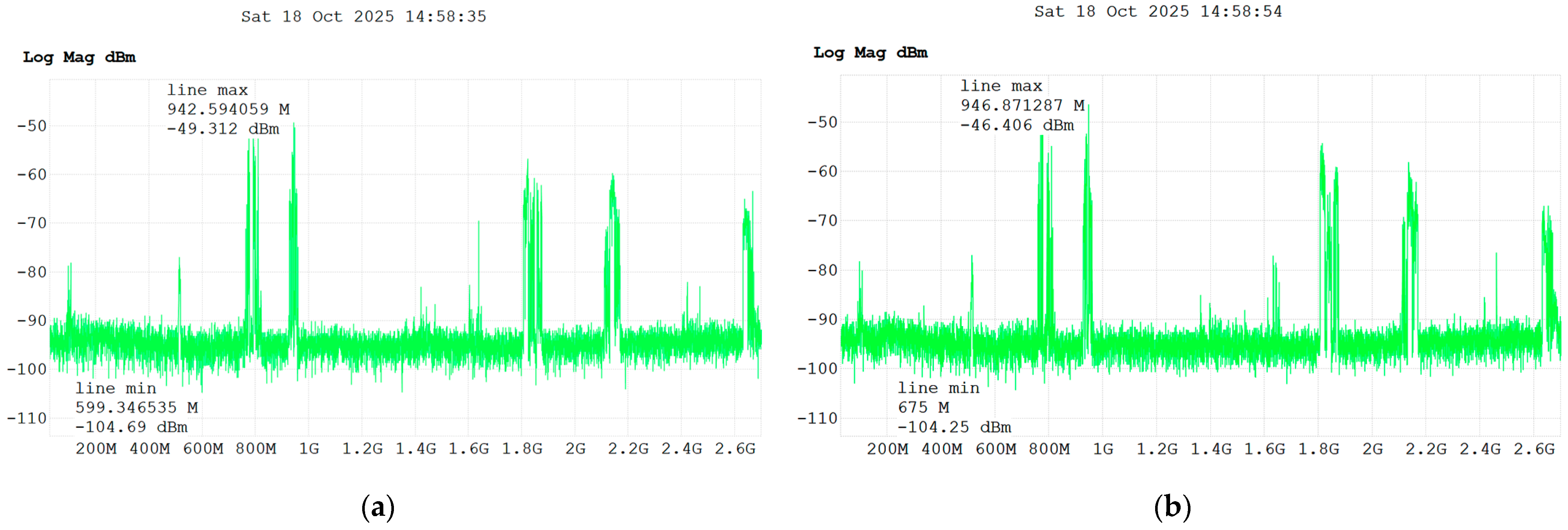
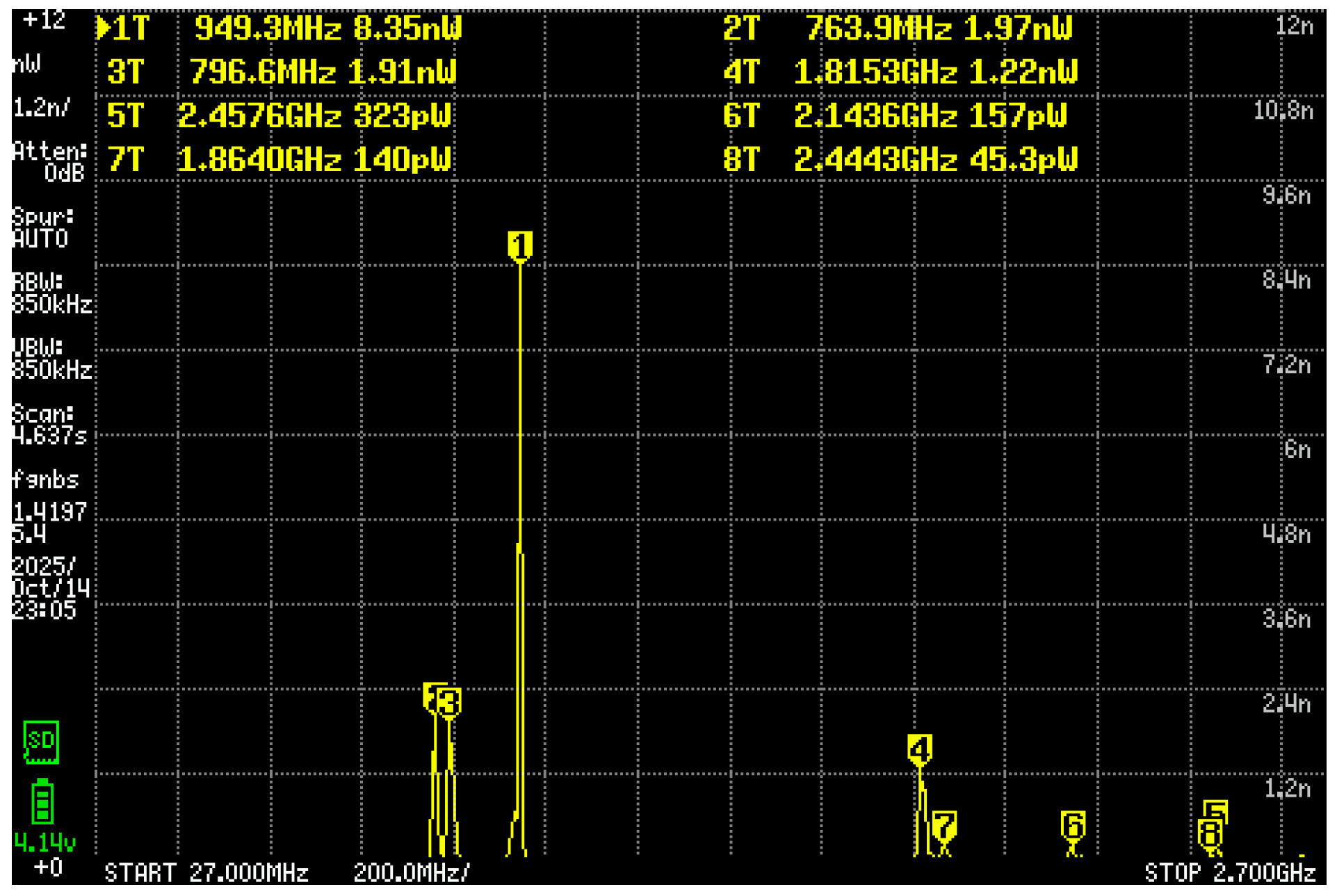
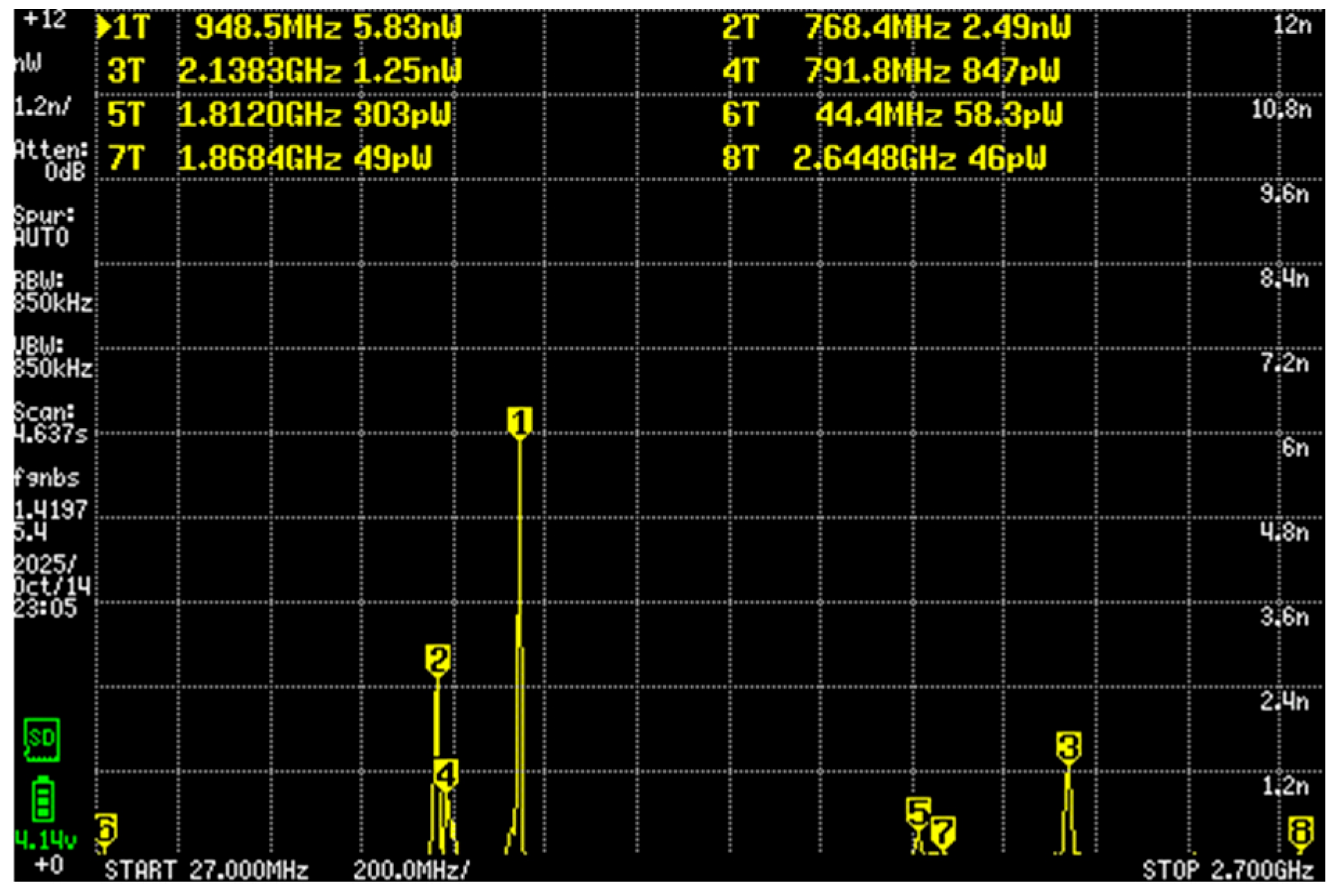
Figure 1 displays the spectrum of the explored frequency range, from 27 MHz to 2.7 GHz, intercepted by the analyzer at two separate spots on the second floor of the house.
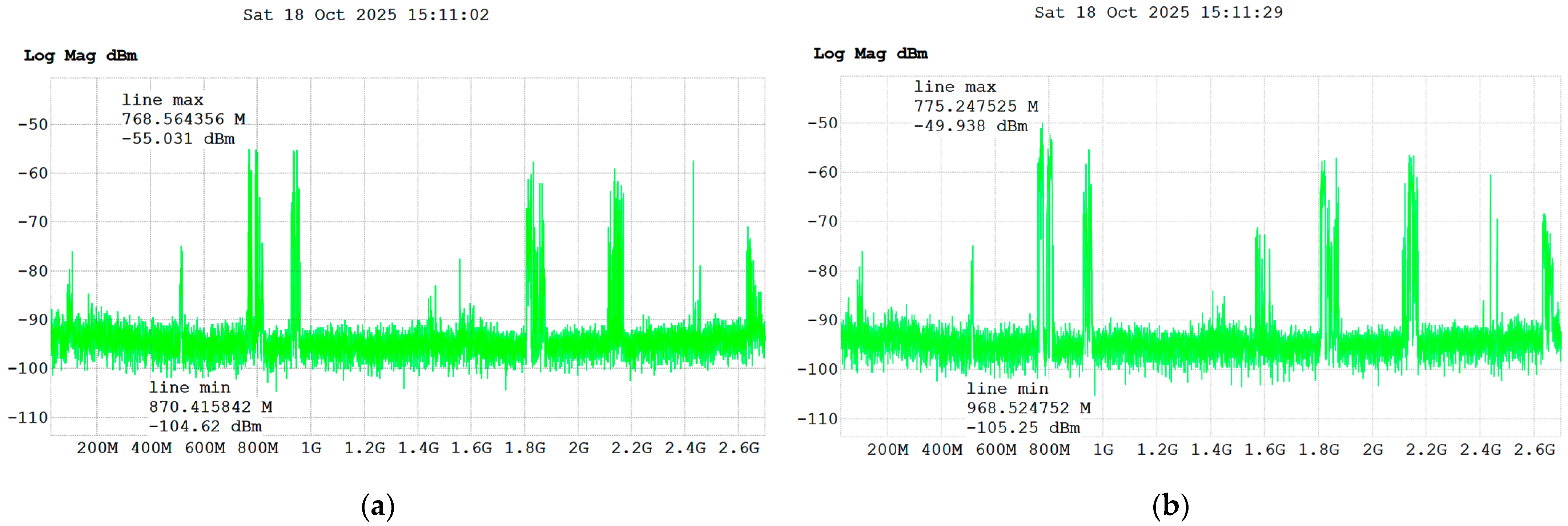
Figure 2 depicts the spectrum of the same frequency range (27 MHz to 2.7 GHz) intercepted by the analyzer at two separate spots on the first floor of the house.
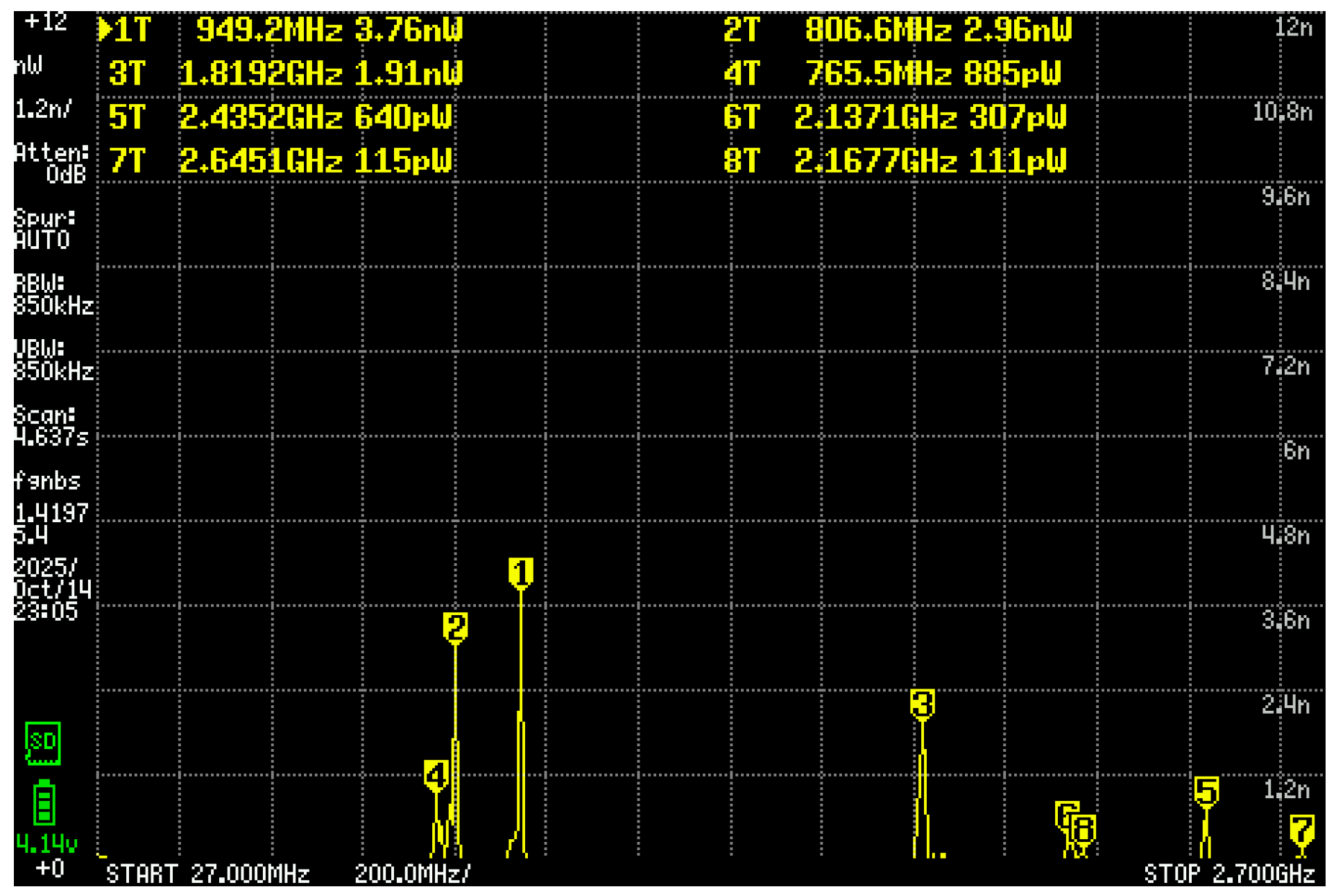
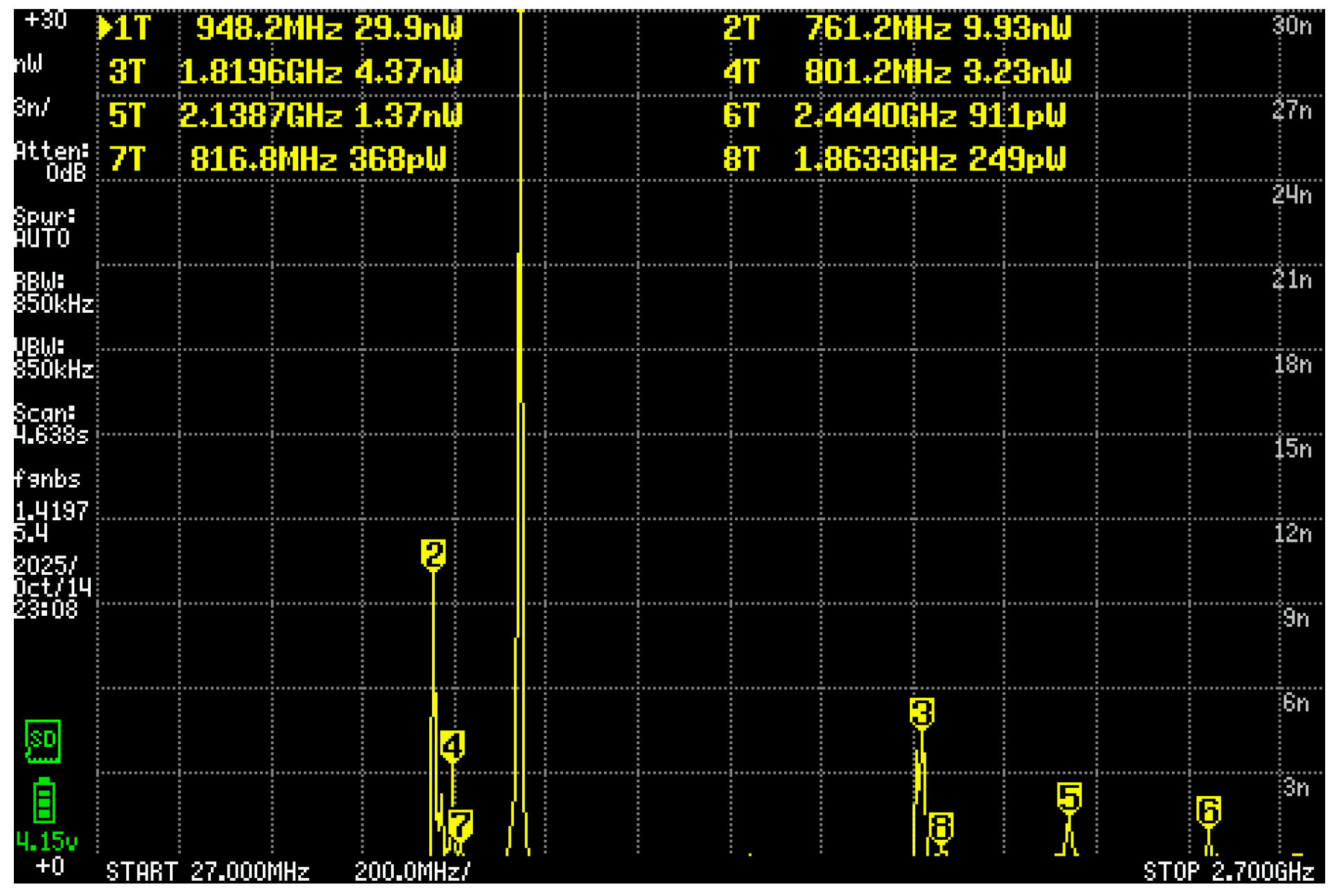
The instrument setup allows up to eight (8) signal level markers simultaneously. The software automatically selects the 8 strongest RF signals by order and displays their values in a tabular format. The rest of the peaks could be measured using a manually operated marker as an internal functionality of the instrument. In the current case, the eight (8) highest RF signals in the spectrum were considered.
The radio frequency spectrum of the studied frequency range from 27 MHz to 2.7 GHz is shown in Figure 3, Figure 4, Figure 5 and Figure 6 which displays the levels of the strongest components (measured in nW or pW) of the radio frequency signal in this range using a 1000-point sweep.
Measured data from the power scan in instantaneous values and in the frequency domain are saved in *.csv format, and the power is summed automatically after processing the files in a spreadsheet. The total RF signal power is shown after each of the following figures.
It should be noted that each individual measurement presents a unique spectral pattern that is never repeated, but the signals with the highest power remain in their places along the frequency axis. For a more representative sample and higher accuracy of the measured total radio frequency power at the measurement location, sweeps were measured consecutively for 8, 1000, and 10,000 frequency values (sweep points), set within the studied frequency band.
As expected, increasing the number of sweep points results in higher precision and a larger estimated value of the total RF power in the frequency range 27 MHz–2.7 GHz. Measurement at the first spot inside the house is shown below (Figure 3).
The results from the first measurement site in the house are shown in Table 1.
Screen shot of measurement at the second spot inside the house is shown in Figure 4.
The results from the third measurement site in the house are shown in Table 2.
Screen shot of measurement at the third spot inside the house is shown on Figure 5.
The results from the third measurement site in the house are shown in Table 3.
Screen shot of measurement at the fourth spot inside the house is shown in Figure 6.
The results from the fourth measurement site in the house are shown in Table 4.
An expected, an increase in total power is observed with an increasing number of sweep frequency points. Including more spectral components increases the total radio frequency power within the studied frequency range 27 MHz–2.7 GHz.
The picture of the signal spectrum looks similar on each of the screenshots above, as the shape and the major signal pics are clearly recognizable, but the values of the extremums after the measurements are slightly different after each particular measurement. This is inevitable with the measurement methodology used, i.e., the same antenna used by both instruments. The manipulation of changing the instruments and unplugging and plugging the SMA connector of the log-periodic antenna to the respective meter takes less than a minute, but this is a considerable time frame and could not guarantee a high precision in the comparison between the readings of both instruments.
After equating the unit of measurement for radio frequency power to microwatts when measuring with both devices, it seems at first glance that only the unknown value of the area with respect to which the power is measured makes the main difference in the readings. In reality, however, many more factors have an influence, and due to the impossibility of directly measuring them, mathematical tools must inevitably be applied.
To be able to extract a mathematical correlation between the readings of both the HFE35C and TinySA ULTRA, a second log-periodic antenna with absolutely the same geometry and electrical parameters is necessary to make possible real-time simultaneous measurement. A large number of ultimate measurements must be performed with the purpose of collecting enough statistical type of data to be processed using appropriate mathematical tools to derive a functional relationship between the signal power measured by the spectrum analyzer and its density. A Lagrange interpolation polynomial or cubic spline approximation could transform the accumulated statistical data from the measurements into a high-order, high-accuracy approximating function.
The derivation of such a relationship could turn any portable spectrum analyzer into a high-accuracy RF power flux density meter.

3. Conclusions

The measurement of the radio frequency power flux density contributes significantly in evaluating the level of radiation caused by the electromagnetic field around antennas for mobile and radio signals of other telecommunication systems. A properly selected methodology of measurement, simulation, and analysis allows us to be able to estimate preliminarily the electromagnetic fields caused by telecommunications, as well as to determine visually each spot or area where electromagnetic radiation exceeds the regulated standards. The described analyses help to control the values of RF—and generally HF—signal frequencies in order to alert for RF power density levels that exceed the standardized health limits, but also to force the mobile service providers to maintain the transmitting power from base stations at optimal levels to ensure the quality of services—connections, data transfer speed, etc.
Similar methods of analysis can be applied to update the regulations in accordance with the balance between the people’s modern technological service needs and the actual changes in the radio frequency environment related to human health considerations.

Author Contributions

Conceptualization, M.T. and M.M.; methodology, M.T.; software, D.K.; validation, S.S. and M.T.; formal analysis, M.T. and M.M.; investigation, M.T. and K.T.; resources, M.T.; data curation, K.T.; writing—original draft preparation, D.K.; writing—review and editing, M.T.; visualization, D.K.; supervision, S.S.; project administration, S.S.; funding acquisition, S.S. All authors have read and agreed to the published version of the manuscript.

Funding

The presented work is supported under project SRP 2025-14 (NIP 2025-14), “Contemporary Methods and AI Solutions for Secure Data Transmission in Broadband Communication Networks”, by the University Center for Research and Technology at the Technical University of Gabrovo.

Institutional Review Board Statement

Not applicable.

Informed Consent Statement

Not applicable.

Data Availability Statement

The original dataset is available upon request from the authors.

Acknowledgments

Thanks are extended to all staff of the Department of Communications Equipment and Technologies at the Technical University of Gabrovo.

Conflicts of Interest

The authors declare no conflict of interest.

Abbreviations

The following abbreviations are used in this manuscript:
ERPEffective radiated power
EIRPEffective isotropic radiated power

References

  1. Ida, N. Antennas and Electromagnetic Radiation. In Engineering Electromagnetics, 4th ed.; Springer: Cham, Switzerland, 2021; pp. 915–991. [Google Scholar]
  2. Lingvay, D.; Borș, A.G.; Borș, A.M. Electromagnetic pollution and its effects on living matter. Electroteh. Electron. Autom. (EEA) 2018, 66, 5–11. [Google Scholar]
  3. Mihaylov, G.; Iliev, T.; Bikov, T.; Ivanova, E.; Stoyanov, I. Test cases and challenges for mobile network evolution from LTE to 5G. In Proceedings of the 2018 41st International Convention on Information and Communication Technology, Electronics and Microelectronics (MIPRO), Opatija, Croatia, 21–25 May 2018; pp. 449–452. [Google Scholar] [CrossRef]
  4. Iliev, T.B.; Mihaylov, G.Y.; Ivanova, E.P.; Stoyanov, I.S. Power control schemes for device-to-device communications in 5G mobile network. In Proceedings of the 2017 40th International Convention on Information and Communication Technology, Electronics and Microelectronics (MIPRO), Opatija, Croatia, 22–26 May 2017; pp. 416–419. [Google Scholar] [CrossRef]
  5. van Wel, L.; Liorni, I.; Huss, A.; Thielens, A.; Wiart, J.; Joseph, W.; Röösli, M.; Foerster, M.; Massardier-Pilonchery, A.; Capstick, M.; et al. Radio-frequency electromagnetic field exposure and contribution of sources in the general population: An organ-specific integrative exposure assessment. J. Expo. Sci. Environ. Epidemiol. 2021, 31, 999–1007. [Google Scholar] [CrossRef] [PubMed]
  6. Tomov, M.; Kogias, P.; Malamatoudis, M.; Sadinov, S. Local Area Improvement of GSM Network Coverage. Eng. Proc. 2024, 60, 24. [Google Scholar] [CrossRef]
  7. Garaio, E.; La Roca, P.; Gómez-Polo, C.; Sánchez-Alarcos, V.; Recarte, V.; Pérez-Landazábal, I.; Martensitic, J. Transformation Controlled by Electromagnetic Field: From Experimental Evidence to Wireless Actuator Applications. Mater. Des. 2022, 219, 110746. [Google Scholar] [CrossRef]
  8. Kim, H.; Lee, Y.; Choi, H.D.; Lee, A.K.; Jeon, S.; Pack, J.K.; Kim, N.; Ahn, Y. Effect of Exposure to a Radiofrequency Electromagnetic Field on Body Temperature in Anesthetized and Non-Anesthetized Rats. Bioelectromagnetics 2020, 41, 104–112. [Google Scholar] [CrossRef] [PubMed]
  9. Nyquist, H. Certain topics in telegraph transmission theory. Trans. AIEE 2002, 47, 617–644. [Google Scholar] [CrossRef]
  10. Shannon, C.E. Communication in the Presence of Noise. IRE 1949, 37, 10–21. [Google Scholar] [CrossRef]
  11. Hardell, L.; Carlberg, M.; Hedendahl, L. Radiofrequency radiation from nearby base stations gives high levels in an apartment in Stockholm, Sweden: A case report. Oncol. Lett. 2018, 15, 7871–7883. [Google Scholar] [CrossRef] [PubMed]
  12. Sagar, S.; Adem, S.M.; Struchen, B.; Loughran, S.P.; Brunjes, M.E.; Arangua, L.; Dalvie, M.A.; Croft, R.J.; Jerrett, M.; Moskowitz, J.M. Comparison of radiofrequency electromagnetic field exposure levels in different everyday microenvironments in an in-ternational context. Environ. Int. 2018, 114, 297–306. [Google Scholar] [CrossRef] [PubMed]
  13. Birks, L.E.; Struchen, B.; Eeftens, M.; Wel, L.; Huss, A.; Gajšek, P.; Kheifets, L.; Gallastegi, M.; Dalmau-Bueno, A.; Estarlich, M. Spatial and temporal variability of personal environmental exposure to radio frequency electromagnetic fields in children in Europe. Environ. Int. 2018, 117, 204–214. [Google Scholar] [CrossRef] [PubMed]
  14. Choi, J.; Min, K.; Jeon, S.; Kim, N.; Pack, J.K.; Song, K. Continuous Exposure to 1.7 GHz LTE Electromagnetic Fields Increases Intracellular Reactive Oxygen Species to Decrease Human Cell Proliferation and Induce Senescence. Sci. Rep. 2020, 10, 9238. [Google Scholar] [CrossRef] [PubMed]
  15. Przystupa, K.; Vasylkivskyi, I.; Ishchenko, V.; Pohrebennyk, V.; Kochan, O. Electromagnetic pollution: Case study of ener-gytransmission lines and radio transmission equipment. Przegl Ad Elektrotechniczny 2020, 96, 52–55. [Google Scholar]
  16. Röösli, M.; Hertach, P.; Bolte, J.; Neubauer, G.; Cardis, E.; Feychting, M.; Gajšek, P.; Heinrich, S.; Joseph, W.; Mann, S. Conduct of a personal radiofrequency electromagnetic field measurement study: Proposed study protocol. Env. Health Glob. Access Sci. Source 2010, 9, 23. [Google Scholar] [CrossRef] [PubMed]
  17. Buckus, R.; Chlebnikovas, A.; Strukcinskiene, B.; Stukas, R.; Austys, D.; Caban, J.; Bogucki, M.; Sidlauskiene, A.; Seleviciene, V.; Kilikevičius, A.; et al. Simulating the Dispersion of the Energy Flux Density of the Electromagnetic Field Generated by Antennas for Mobile Communications. Electronics 2022, 11, 2431. [Google Scholar] [CrossRef]
Figure 1. RF power spectrum measured in two different sites on the second floor: (a) screenshot of the spectrum at spot 1; (b) screenshot of the spectrum at spot 2.
Engproc 122 00021 g001
Figure 2. RF power spectrum measured in two different sites on the first floor: (a) screenshot of the spectrum at spot 1; (b) screenshot of the spectrum at spot 2.
Engproc 122 00021 g002
Figure 3. Display of RF power level values of each of the eight (8) strongest intercepted signal frequencies after the first measurement.
Engproc 122 00021 g003
Figure 4. Display of RF power level values of each of the eight (8) strongest intercepted signal frequencies after the second measurement.
Engproc 122 00021 g004
Figure 5. Display of RF power level values of each of the eight (8) strongest intercepted signal frequencies after the third measurement.
Engproc 122 00021 g005
Figure 6. Display of RF power level values of each of the eight (8) strongest intercepted signal frequencies after the fourth measurement.
Engproc 122 00021 g006
Table 1. RF power level after 1st measurement.
Frequency Sweep Points of Measurement8100010,000
Total RF Power Measured, μW0.0141150.0162580.0244146
Table 2. RF power level after 2nd measurement.
Frequency Sweep Points of measurement8100010,000
Total RF Power measured, μW0.0108730.0131270.0330637
Table 3. RF power level after 3rd measurement.
Frequency Sweep Points of Measurement8100010,000
Total RF Power Measured, μW0.0106880.0132690.0384721
Table 4. RF power levels after 4th measurement.
Frequency Sweep Points of Measurement8100010000
Total RF Power Measured, μW0.0503280.0537310.057612
Disclaimer/Publisher’s Note: The statements, opinions and data contained in all publications are solely those of the individual author(s) and contributor(s) and not of MDPI and/or the editor(s). MDPI and/or the editor(s) disclaim responsibility for any injury to people or property resulting from any ideas, methods, instructions or products referred to in the content.