Proceeding Paper

Novel Indoor Positioning System Based on Bluetooth Direction Finding and Machine Learning †
1
Department of Electrical Engineering, National Formosa University, Yunlin 632, Taiwan
2
Department of Communications Engineering, National Chung Cheng University, Chiayi 621301, Taiwan
*
Author to whom correspondence should be addressed.
Presented at 8th International Conference on Knowledge Innovation and Invention 2025 (ICKII 2025), Fukuoka, Japan, 22–24 August 2025.
Eng. Proc. 2025, 120(1), 67; https://doi.org/10.3390/engproc2025120067
Published: 16 February 2026
(This article belongs to the Proceedings of 8th International Conference on Knowledge Innovation and Invention)

Abstract

We developed an indoor positioning system combining Bluetooth direction-finding antennas with machine learning to improve localization accuracy and stability cost-effectively. It integrates existing indoor positioning and lighting control with a Bluetooth angle of arrival (AoA)-dongle, compatible with current mesh networks, using the message queuing telemetry transport protocol for data transmission to a server. The system, developed with nRF5340 and u-blox AoA antenna boards, was evaluated in an experimental field with 12 positioning points arranged in a grid. Datasets categorized by AoA antenna quantity and data preprocessing were used to train K-nearest neighbors, support vector machine (SVM), random forest, and multilayer perceptron models. Optimal parameters were identified using grid search, and models were validated using confusion matrices and F1-scores. Results indicated significant accuracy improvements of 11.11–30.51% without preprocessing and 1.17–6.32% with preprocessing when incorporating AoA features. Real-time tests revealed SVM as the best-performing model, achieving up to 96.58% accuracy, significantly enhancing positioning stability. The results of this study underscore Bluetooth direction-finding combined with machine learning as a promising solution for the Internet of Things applications.

1. Introduction

The rapid growth of the Internet of Things (IoT) and wireless communication technologies has significantly boosted the popularity of Bluetooth due to its low power consumption, short-range transmission capability, and compact device size. These characteristics make Bluetooth technology an ideal candidate for IoT devices and indoor positioning applications. However, traditional Bluetooth indoor positioning methods relying on received signal strength indicator (RSSI) face considerable challenges in complex indoor environments, primarily due to signal instability and insufficient reliability. Consequently, improving positioning accuracy has become crucial for IoT applications.
To address the instability of RSSI signals, the Bluetooth Special Interest Group introduced Bluetooth direction finding technology [1,2] in the Bluetooth 5.1 specification, specifically the Angle-of-Arrival (AoA) technique. AoA significantly enhances localization accuracy by measuring the angle at which signals reach the receiver. This advancement is particularly critical for high-precision indoor scenarios, such as asset tracking, personnel tracking, and indoor navigation, enabling positioning errors below one meter. Despite its enhanced precision, Bluetooth Direction Finding equipment is substantially more expensive than traditional RSSI-based Bluetooth devices, making complete system replacement economically challenging.
We developed a system that combines a minimal number of Bluetooth direction-finding antennas with machine learning techniques to enhance indoor positioning performance economically. The proposed system integrates existing indoor positioning and lighting control functionalities, ensuring compatibility between the developed Bluetooth AoA-dongle and existing dongles within the same mesh network while providing Bluetooth direction-finding capabilities. Data collected in the network is transmitted to the server using the message queuing telemetry transport (MQTT) protocol, using a Bluetooth gateway for positioning computations. Utilizing the nRF5340 platform and u-blox AoA antenna boards, we developed equipment for receiving Bluetooth dongles and deployed it in an experimental setting, completing field testing and performance analyses.

2. Related Works

2.1. Bluetooth Direction Finding Technology

Indoor positioning technology is an indispensable component of IoT applications. Among the various wireless technologies, Bluetooth plays a critical role in IoT devices and indoor localization due to its low power consumption, moderate transmission range, and compact device size. Traditionally, Bluetooth Low Energy (BLE)-based indoor positioning systems have relied primarily on RSSI values. However, Bluetooth Direction Finding, particularly the AoA technique, significantly enhances localization accuracy by estimating the angle at which a signal arrives at the receiver, achieving errors of less than one meter.
The AoA technique operates by using an antenna array at the receiver to calculate the phase differences in signals arriving at different antenna elements, thereby determining the direction of the beacon relative to the receiver. To ensure accurate phase measurement, the Bluetooth 5.1 specification introduced the constant tone extension (CTE), a signal characterized by continuous phase, constant amplitude, and high stability, specifically designed to support accurate In-phase and quadrature component (IQ) sampling. IQ sampling decomposes the received sinusoidal signal into two orthogonal components with a 90-degree phase difference. The amplitude of these components is used to evaluate the signal’s phase and composition.
In this study, given that the receivers (dongles) are deployed at fixed locations while the transmitters (beacons) are worn by individuals, the AoA mode was selected to avoid the higher power consumption and increased system complexity associated with the Angle-of-Departure (AoD) mode, making it more suitable for practical indoor localization scenarios.

2.2. Related Studies

In indoor positioning, particularly in BLE and AoA-based localization and tracking, numerous related studies have been conducted. Several studies have employed Kalman Filters to mitigate RSSI signal instability, thereby improving positioning accuracy [3]. A novel AoA localization method is used with omnidirectional antennas to collect RSSI signals for AoA computation. This approach integrated support vector machine (SVM) algorithms to train on RSSI vectors (fingerprint data), aiming to reduce the impact of complex indoor environments on AoA-based positioning and minimize angular estimation errors [4]. Two different AoA directional antenna placements and four beacon orientations are also employed with AoA directional antennas on the ceiling, parallel to the floor, for better localization than wall-mounted configurations [5]. A weighted AoA method, in which the estimated angles were weighted based on parameters related to estimation accuracy, improves angle estimation precision [6].
We developed an indoor positioning IoT system that integrates a Bluetooth Mesh network [1] with BLE dongles to control panel lights and collect RSSI data from beacons. Although machine learning methods were applied in earlier work to mitigate RSSI fluctuations caused by environmental interference and signal attenuation, each positioning operation still required approximately 20 s of data collection, making real-time performance suboptimal. To enhance positioning accuracy, two AoA antennas are added to the original system. However, due to hardware limitations of the dongles, the direction-finding antennas could not be integrated directly into the Mesh network. Consequently, positioning data had to be uploaded through a PC-based database connection for further computation.
Based on the previous results, the present study aims to develop a new AoA-dongle capable of integrating direction-finding antennas into the Mesh network. By leveraging machine learning techniques, this system seeks to improve localization accuracy while reducing the latency between consecutive positioning estimations.

3. System Design

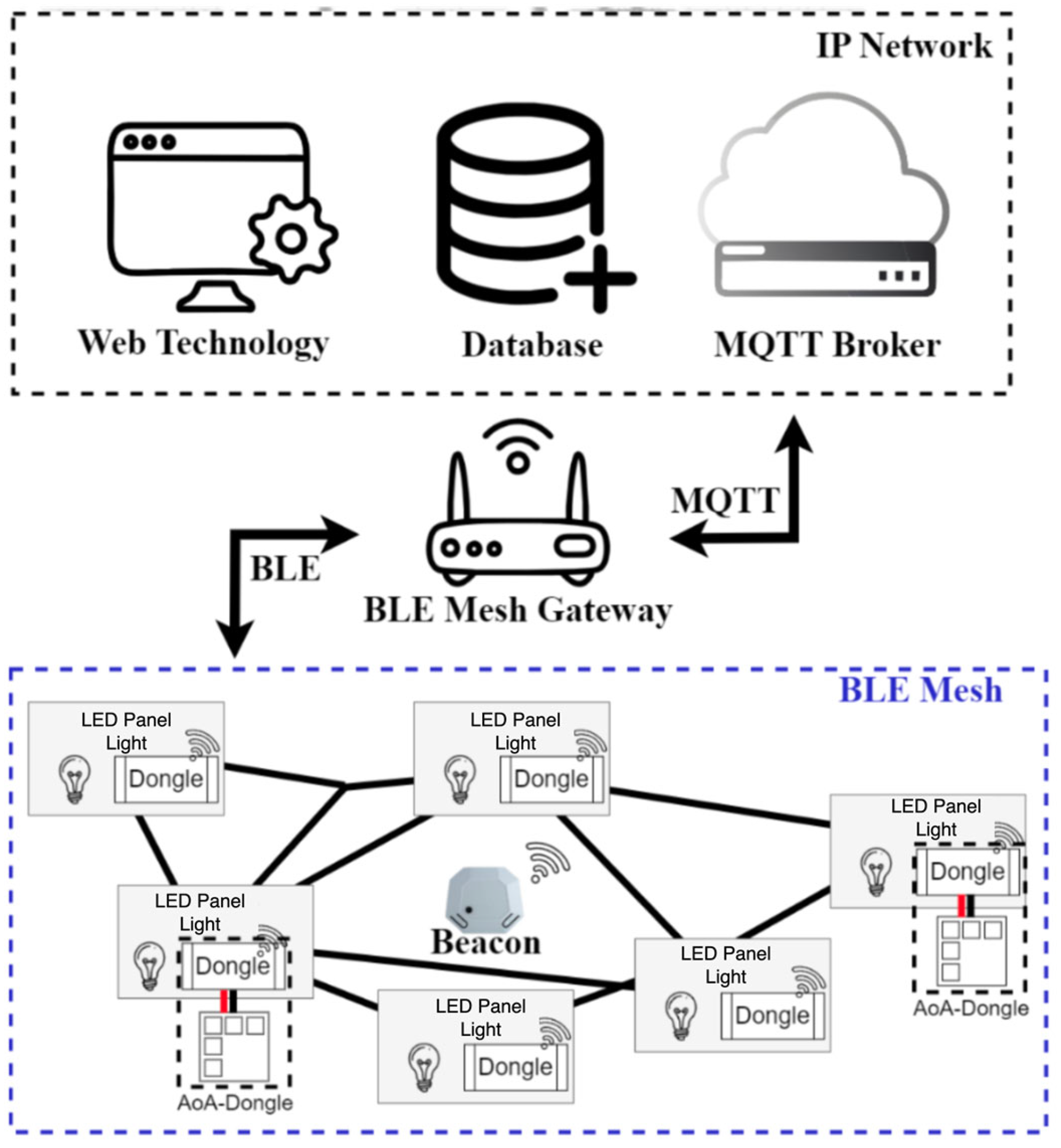
The developed system is designed to integrate existing IoT-based lighting control with enhanced indoor positioning capabilities. The system architecture is illustrated in Figure 1. The system consists of a Bluetooth Mesh Network, a gateway for relay transmission, a server for localization computation, and a web-based user interface for interaction [7].
The system is developed using a dedicated hardware development kit in conjunction with several open-source software components. The hardware platform of the system is based on the nRF5340-DK development kit, manufactured by Nordic Semiconductor ASA, whose headquarters is located in Trondheim, Norway. The company specializes in the design and production of low-power wireless communication chips and related development tools. The nRF5340-DK is primarily used for prototyping and testing dual-core system-on-chip (SoC) architectures, consisting of an application core and a network core, and is well suited for IoT and embedded system applications.
At the messaging and communication layer, the system employs Mosquitto as the MQTT broker, version 2.0.18. Mosquitto is an open-source MQTT broker project maintained by the Eclipse Foundation, which is headquartered in Ottawa, Ontario, Canada. Mosquitto is lightweight, highly stable, and fully compliant with the MQTT standard, making it suitable for real-time message exchange between IoT devices and backend platforms.
For the data storage layer, the system uses MariaDB Server version 10.11.14. MariaDB is primarily developed and commercially supported by MariaDB Corporation Ab, whose headquarters is located in Espoo, Finland. MariaDB is a MySQL-compatible relational database management system that offers high performance, scalability, and long-term support (LTS), making it an appropriate choice for backend data storage and management.
At the web service layer, the system adopts a combination of Apache HTTP Server and PHP, where Apache is version 2.4.58 and PHP is version 8.3.6. Apache HTTP Server is maintained by the Apache Software Foundation, which is based in Forest Hill, Maryland, USA. PHP, on the other hand, is maintained by the PHP Group, a global open-source community without a single fixed city or country. This widely used software stack provides a mature ecosystem and high stability, effectively supporting the system’s management interface and backend data access requirements.
The system’s components and its collaborative operations are as follows.
  • Bluetooth Mesh Network
    • Composition and functionality: The network is built on BLE technology, with multiple nRF5340-DK development kits serving as BLE dongles. These dongles are deployed alongside panel lights to establish the experimental field. Each dongle not only controls lighting but also acts as a critical data receiver node within the network.
    • Localization data collection: Each dongle is responsible for detecting Bluetooth advertising signals from beacons and measuring RSSI to estimate the distance between the beacon and the node. The beacons used in this study are based on the u-blox C209 module, capable of broadcasting iBeacon, Eddystone, and other customizable signals, including optional CTE for AoA applications.
    • Bluetooth direction finding integration: A core innovation of this research lies in the development of an AoA-dongle, which integrates the nRF5340 with a u-blox AoA antenna board. These AoA-dongles replace a subset of the conventional dongle nodes in the Bluetooth mesh network. In addition to receiving RSSI signals, they are capable of measuring the angle (both azimuth and elevation) between the beacon and the dongle using Bluetooth direction-finding technology. This integration overcomes the limitations of prior research, where AoA antennas could not be directly incorporated into the mesh network. The AoA-dongles enable AoA data to be transmitted directly within the mesh network. The AoA technique determines signal direction by computing phase differences across antenna elements in the array, providing sub-meter positioning accuracy even in complex indoor environments.
  • BLE mesh gateway
    • Role: The system uses Delta’s xBeacon-Cloud-w model as the intermediary relay between the mesh network nodes and the backend server.
    • Communication mechanism: The gateway enables bidirectional communication between the server and mesh nodes using the Bluetooth Mesh protocol and the MQTT publish/subscribe architecture. It relays lighting control commands issued from the web interface to the corresponding devices and uploads beacon signal data—comprising RSSI and AoA information—received from the mesh nodes to the server-side database. MQTT, being a lightweight messaging protocol, is well-suited for devices operating under limited bandwidth and hardware constraints.
  • Localization computation server
    • Data integration and processing: All RSSI and AoA data collected by both AoA-dongles and standard dongles are transmitted through the gateway via MQTT to a MySQL database on the server for integration and storage.
    • Machine learning-based prediction: The server’s core functionality involves applying pre-trained machine learning models—including K-nearest neighbors (KNN), support vector machine (SVM), Random Forest (RF), and multilayer perceptron (MLP)—to predict indoor locations based on the incoming data. To improve model performance, data preprocessing techniques such as missing value handling, outlier filtering, normalization, and Gaussian filtering were employed.
    • Performance enhancement: Compared with previous implementations that required approximately 20 s per localization cycle, the developed system significantly reduces localization latency while improving accuracy through optimized machine learning techniques.
  • Web architecture
    • User Interface: The web-based interface was jointly developed by the EMNA research group and Chung Shan Technology. It leverages asynchronous JavaScript and extensible markup language (AJAX) and Leaflet JavaScript for frontend implementation.
    • Functionality: The web interface provides users with real-time visualization of current location data and intuitive lighting control capabilities. User interactions on the interface trigger AJAX-based hypertext transfer protocol requests to the server, which then returns location results or control commands in formats such as JavaScript object notation. These results are rendered dynamically and in real-time on the webpage.

4. System Implementation and Testing

4.1. Experiment

The experimental field for this study was located on the basement level of the Electrical Engineering Building at National Formosa University. Detailed descriptions of the test environment are as follows.
  • Space dimensions: The test area is a rectangular space measuring 15.50 m in length, 10.10 m in width, and an average height of 2.71 m. All measurements reflect direct distances between opposing walls.
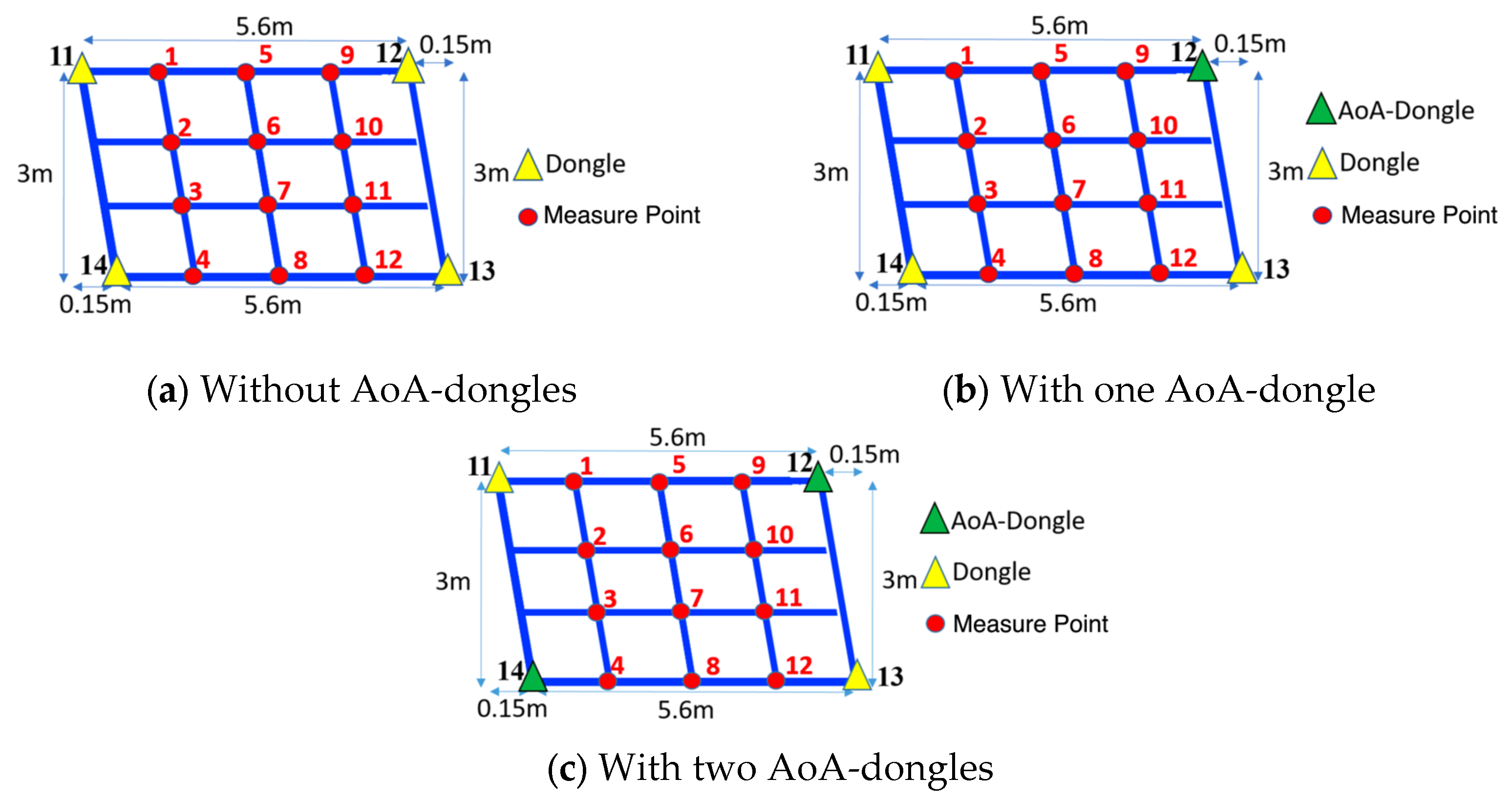
  • Study area selection: To minimize interference in the RSSI readings caused by obstacles in the environment, the experiment utilized only the left half of the room, specifically four panel lights located in that region. The area is illustrated in Figure 2.
  • Device deployment
    • BLE Mesh Dongles: BLE Mesh Dongles were installed on the selected four panel lights. These dongles served as nodes within the Bluetooth Mesh network, functioning not only to control lighting and receive beacon signals but also to perform Bluetooth direction-finding in certain units. The IDs and coordinates of the deployed dongles are listed as follows:
      -
      Dongle 11: (3.00, 3.00);
      -
      Dongle 12: (8.60, 3.00);
      -
      Dongle 13: (8.75, 6.00);
      -
      Dongle 14: (3.15, 6.00).
    • Beacons: During data collection, the beacons were fixed at a height of 1 m above the ground.
  • Localization point configuration: Twelve localization points were defined within a red rectangular test area. This region formed a parallelogram with dimensions of 5.6 m in length and 3 m in width. The coordinates of all localization points were documented accordingly.
  • Dataset construction scenarios: Three different training datasets were constructed based on the number of AoA-dongles in use:
    • Without AoA-dongles: All four nodes at the corners were standard dongles, shown in Figure 2a.
    • With One AoA-dongle: Dongle 12 was upgraded to an AoA-dongle, shown in Figure 2b.
    • With Two AoA-dongles: Dongles 12 and 14 were upgraded to AoA-dongles, shown in Figure 2c.

4.2. Results

The performance of machine learning models was evaluated using preprocessed datasets for real-time indoor localization in a physical test environment. The models were trained using optimal parameters identified through grid search and validated using five-fold cross-validation. Real-time application refers to data collection at each localization point at a frequency of one sample per second over a duration of 500 s, with indoor positioning results for each beacon computed immediately. The comparison of actual measurement positioning performance is shown in Table 1.
Incorporating AoA antenna features significantly enhanced the real-time localization performance of all machine learning models. Among the preprocessed datasets, the SVM model achieved the highest accuracy of 96.58%. Other models also performed well, KNN with an accuracy of 95.72%, RF with 95.69%, and MLP with 92.67%. Through RSSI preprocessing and integration of Bluetooth direction-finding features, all four models demonstrated average real-time localization accuracies exceeding 92.67%, with each localization point of over 85% accuracy. This marks a substantial improvement compared to models trained on raw RSSI data alone, where the best average accuracy was only 51.72%, and certain localization points fell below 20%.

4.3. Performance Analysis

Without the use of AoA antennas, the MLP model achieved an accuracy of 79.58%. When a single AoA antenna was introduced, the accuracy improved to 91.59%. The inclusion of two AoA antennas further increased the accuracy to 92.67%. The KNN model recorded an accuracy of 76.92% in the absence of AoA antennas. With one AoA antenna, the accuracy rose to 91.70%. The deployment of two AoA antennas resulted in a substantial improvement, reaching an accuracy of 95.72%. Without AoA antennas, the SVM model achieved an accuracy of 74.19%. The addition of one AoA antenna enhanced the accuracy to 91.44%. When two AoA antennas were used, the model attained its highest accuracy of 96.58%. The RF model demonstrated an accuracy of 73.85% without AoA antennas. The integration of one AoA antenna increased the accuracy to 90.93%, while the use of two AoA antennas further improved it to 95.69%.
These results underscore the effectiveness of incorporating AoA features into indoor positioning systems. By combining Bluetooth AoA data with robust data preprocessing techniques—such as filtering, missing value imputation, and outlier removal—the system successfully mitigates the inherent instability of traditional RSSI signals. This integrated approach significantly enhances both the real-time accuracy and the operational stability of indoor localization systems, thereby enabling more reliable and practical deployment in real-world environments.

5. Conclusions

We designed an advanced indoor positioning system that integrates Bluetooth direction-finding technology with machine learning algorithms to enhance localization accuracy and system responsiveness. A custom-designed AoA dongle was developed to enable seamless integration into existing Bluetooth Mesh networks, effectively overcoming hardware limitations that prevented AoA antennas from participating directly in mesh communication. The system demonstrated substantial improvements in both accuracy and latency. In real-time localization experiments, the SVM model achieved a peak accuracy of 96.58%, while all evaluated machine learning models exceeded 92% accuracy when utilizing two AoA dongles—compared to sub-80% accuracy under traditional RSSI-based configurations. Additionally, the system significantly reduced localization intervals, rendering it suitable for real-time IoT applications.
The results of this study confirm the practical feasibility of enhancing BLE-based indoor localization systems through modular upgrades that preserve compatibility with existing infrastructure. The hybrid integration of AoA measurements and machine learning inference offers a scalable and cost-effective solution for deployment across diverse indoor environments.
By extending the system to support three-dimensional positioning across multi-story buildings, its applicability is enhanced. Second, dynamic model adaptation based on environmental feedback and signal quality needs to be investigated to improve robustness and flexibility. Third, the integration of complementary sensing technologies, such as inertial measurement units (IMUs), visual simultaneous localization and mapping (SLAM), and ultra-wideband (UWB), can enhance system resilience in complex or obstructed environments. Finally, large-scale deployment in real-world settings, including smart buildings, healthcare facilities, and industrial environments, is required to evaluate the system’s scalability, long-term stability, and interoperability. These enhancements aim to establish the system as a versatile, high-precision indoor localization solution for next-generation IoT applications.

Author Contributions

Conceptualization, H.-K.S., H.-E.Z. and C.-S.W.; methodology, H.-K.S. and H.-E.Z.; software, H.-E.Z.; validation, H.-K.S. and H.-E.Z.; formal analysis, H.-K.S. and H.-E.Z.; investigation, H.-K.S., H.-E.Z. and C.-S.W.; resources, H.-K.S.; data curation, H.-E.Z.; writing—original draft preparation, H.-K.S. and H.-E.Z.; writing—review and editing, H.-K.S., C.-S.W. and Y.-S.C.; visualization, H.-K.S. and H.-E.Z.; supervision, H.-K.S.; project administration, H.-K.S.; funding acquisition, H.-K.S. All authors have read and agreed to the published version of the manuscript.

Funding

Smart Machinery and Intelligent Manufacturing Research Center, National Formosa University, Taiwan.

Institutional Review Board Statement

Not applicable.

Informed Consent Statement

Not applicable.

Data Availability Statement

The data presented in this study are available from the corresponding author upon reasonable request.

Conflicts of Interest

The authors declare no conflict of interest.

References

  1. Bluetooth SIG. Bluetooth Direction Finding. Available online: https://www.bluetooth.com/learn-about-bluetooth/feature-enhancements/direction-finding/ (accessed on 20 July 2025).
  2. Bluetooth SIG. Bluetooth® Mesh. Available online: https://www.bluetooth.com/learn-about-bluetooth/feature-enhancements/mesh/ (accessed on 20 July 2025).
  3. Essa, E.; Abdullah, B.A.; Wahba, A. Improve Performance of Indoor Positioning System using BLE. In Proceedings of the 14th International Conference on Computer Engineering and Systems (ICCES), Cairo, Egypt, 17 December 2019; pp. 234–237. [Google Scholar]
  4. Malajner, M.; Gleich, D.; Planinsic, P. Indoor AoA Estimation Using Received Signal Strength Parameter and a Support Vector Machine. In Proceedings of the 2019 International Conference on Systems, Signals and Image Processing (IWSSIP), Osijek, Croatia, 5–7 June 2019; pp. 133–137. [Google Scholar]
  5. Mavilia, F.; Barsocchi, P.; Furfari, F.; Girolami, M. Evaluating the Impact of Anchors Deployment for an AoA-based Indoor Localization System. In Proceedings of the 18th Wireless On-Demand Network Systems and Services Conference (WONS), Madonna di Campiglio, Italy, 30 January–1 February 2023; pp. 20–23. [Google Scholar]
  6. Zheng, Y.; Sheng, M.; Liu, J.; Li, J. Exploiting AoA Estimation Accuracy for Indoor Localization: A Weighted AoA-Based Approach. IEEE Wireless Commun. Lett. 2019, 8, 65–68. [Google Scholar] [CrossRef]
  7. Zhang, H.-E. Development of an Indoor Positioning System Enhanced by Bluetooth Direction Finding and Machine Learning Techniques. Master’s Thesis, Department of Electrical Engineering, National Formosa University, Yunlin, Taiwan, 2024. [Google Scholar]
Figure 1. Developed system architecture.
Engproc 120 00067 g001
Figure 2. Experimental environment.
Engproc 120 00067 g002
Table 1. Comparison of positioning performance.
ModelNumber of AoA AntennasAccuracyRecallPrecisionF1-Score
MLP079.58%79.62%81.42%78.54%
191.59%91.59%92.10%91.64%
292.67%92.66%92.38%92.66%
KNN076.92%76.92%79.48%74.90%
191.70%91.70%91.95%91.65%
295.72%95.72%96.11%95.70%
SVM074.19%74.18%78.65%71.34%
191.44%91.44%92.21%91.56%
296.58%96.58%96.79%96.55%
RF073.85%73.84%80.19%71.29%
190.93%90.93%91.85%90.98%
295.69%95.68%95.93%95.64%
Disclaimer/Publisher’s Note: The statements, opinions and data contained in all publications are solely those of the individual author(s) and contributor(s) and not of MDPI and/or the editor(s). MDPI and/or the editor(s) disclaim responsibility for any injury to people or property resulting from any ideas, methods, instructions or products referred to in the content.