Proceeding Paper

Predicting University Student Dropout Risk Using Deep Learning and Ensemble Voting Mechanism †

Department of Information and Communication Engineering, Chaoyang University of Technology, Taichung 413310, Taiwan
*
Author to whom correspondence should be addressed.
Presented at 8th International Conference on Knowledge Innovation and Invention 2025 (ICKII 2025), Fukuoka, Japan, 22–24 August 2025.
Eng. Proc. 2025, 120(1), 66; https://doi.org/10.3390/engproc2025120066
Published: 13 February 2026
(This article belongs to the Proceedings of 8th International Conference on Knowledge Innovation and Invention)

Abstract

By integrating deep learning techniques with a multi-model voting mechanism, this study aimed to predict the risk of student suspension and dropout. Conducted at the College of Informatics, Chaoyang University of Technology in Taiwan, the research utilized the AutoKeras automated machine learning framework and student data from academic years 2019 to 2023 (academic year (AY) 108–112) for model training. A majority voting strategy was employed to aggregate predictions from multiple models. To address class imbalance within the dataset, random undersampling was applied to achieve a more balanced distribution. Features from the second semester of AY 112 were used to predict enrollment status for the first semester of AY 113. Experimental results demonstrated that models trained exclusively on AY 108–112 data outperformed those trained on a broader dataset spanning AY 100–112, with the F1-score improving from 16.67 to 19.05%. Further enhancement through the ensemble voting mechanism led to an increase in overall accuracy from 66.67 to 73%, precision from 10.53 to 12.09%, and the F1-score to 21.36%. The proposed predictive model serves as an effective early warning system for identifying students at risk of suspension or dropout, thereby enabling timely counseling interventions and contributing to improved student retention.

1. Introduction

With the increasing accessibility of higher education, issues related to student suspension and dropout have garnered growing attention [1]. Such occurrences impact students’ personal and professional development and institutional resource allocation, and reputation. Traditionally, schools have relied on manual judgment or retrospective tracking, which makes it difficult to provide timely warnings and effective support. Therefore, we applied deep learning techniques to historical student data to identify those at potential risk of suspension or dropout. By improving the accuracy and efficiency of prediction, the goal is to enable early intervention and counseling [2], thereby reducing student attrition. In addition, the study analyzes possible factors influencing suspension and dropout, offering valuable insights for educational policy and decision-making.
Neural architecture search (NAS) has been proposed for automatically optimizing deep neural network architectures. However, existing search algorithms, such as neural architecture search network and progressive neural architecture search, require high computational costs. Network morphism, which preserves the functionality of neural networks while altering their structure, facilitates more efficient training during the NAS process. Jin et al. proposed an innovative framework that enables Bayesian optimization to guide network morphism, thereby achieving efficient neural architecture search [3]. This framework enables the development of a neural network kernel and a tree-structured acquisition function optimization algorithm to effectively explore the search space. Based on their approach, an open-source automated machine learning (AutoML) system, AutoKeras, was developed.
Considering the importance of model stability and reliability in educational decision-making, we adopted a majority voting mechanism to integrate the predictions of multiple models. Alaiad et al. investigated the application of the open-source automated deep learning framework, AutoKeras, in detecting malaria-infected cells from blood smear images. Their results demonstrated that the proposed approach outperformed traditional neural networks [4]. The evaluation results of the model showed high efficiency and impressive accuracy. This inspired the present study to explore the feasibility of using the AutoKeras framework for predicting student suspension and dropout.

2. Methods

2.1. Experimental Setup

The experiment was conducted in this study on the Windows 11 operating system, using Visual Studio Code (version 1.97) as the development platform and launching an Anaconda virtual environment for implementation. To ensure consistency and reproducibility of the experimental setup, Anaconda Navigator (version 24.7.1) was adopted as the virtual environment management tool. The Python version was set to 3.9, and ipykernel (version 6.29.5) was accessed through the virtual kernel for interactive development. During the experiment, two main file formats were utilized: Jupyter Notebook files in .ipynb format for program development and experimental documentation, and .csv format for data storage and processing.

2.2. Data Collection and Preprocessing

2.2.1. Data Request

We ensured student privacy while obtaining the necessary information for research, and obtained permission from the Research and Development Center of Chaoyang University of Technology for access to de-identified data. The acquired data fall into three categories: (1) basic student information, including student identification (ID), gender, and admission type; (2) course performance records covering academic performance across various subjects; and (3) attendance records documenting students’ class attendance status. These datasets provide comprehensive indicators of student learning behavior and academic performance for this study.

2.2.2. Data Preprocessing

The data preparation process began with the integration and filtering of three datasets. These datasets were merged using student ID and semester fields, and subsequently filtered to include only students enrolled in the College of Informatics. The resulting raw dataset contained 54 columns and 60,504 records specific to that college.
Following integration, feature selection was performed by reviewing each column to identify variables that could influence student suspension or dropout [5]. The selection criteria focused on academic performance indicators such as class ranking and average grades, attendance records including the number of absences and total missed classes, basic personal information such as gender and admission type, and changes in enrollment status such as transfers between departments or institutions. Columns deemed irrelevant or uninformative were removed to reduce the feature space and mitigate the risk of dimensionality-related issues.
To ensure data completeness, missing values were addressed by uniformly filling missing entries in numerical columns with zero. The dataset was then segmented by academic year (AY) and semester to produce semester-specific subsets, ensuring that each sample corresponded to a distinct time point and avoiding temporal ambiguity in prediction outcomes.
Cross-semester samples were constructed by using student ID as a key to merge the enrollment status of the subsequent semester into the feature columns of the preceding semester. This process yielded sample records comprising 25 feature columns and one label column.
Finally, the dataset was partitioned into training and testing sets. Features from the second semester of AY 112 were designated as the test set, while the corresponding enrollment status in the first semester of AY 113 served as the test labels.

2.3. Model Architecture and Design

2.3.1. AutoKeras Model Construction

AutoKeras, an automated machine learning tool built on the Keras/TensorFlow framework, is designed to dynamically adjust model architectures and hyperparameter combinations based on the characteristics of the input data. The framework is used to analyze input data in terms of dimensionality, class distribution, and sample size to automatically generate an optimized neural network architecture. In terms of optimizer selection, the system sequentially tests mainstream algorithms such as Adam, stochastic gradient descent, and root mean square propagation, and dynamically adjusts learning rates and momentum parameters based on validation set performance. Regarding activation function configuration, rectified linear unit (ReLU) is used as the default function in hidden layers to balance computational efficiency and non-linear representational power. For the output layer, activation functions are selected based on the task type. Since this study involves a binary classification problem, the Sigmoid function is used to convert outputs into probabilities, while retaining the flexibility to switch to the Tanh function to accommodate special data distribution scenarios.

2.3.2. Mathematical Formulation of the Neural Network Architecture

The mathematical operations of the fully connected neural network (FCNN) architecture are as follows. The first hidden layer applies the ReLU activation function, as shown in Equations (1) and (2):
z [ 1 ]   = a [ 1 ] x + b [ 1 ]
n [ 1 ] = R e L U ( z 1 )  
Here, x represents the input vector, a [ 1 ] denotes the weight matrix of the first layer, b [ 1 ] is the bias term, and n [ 1 ] is the number of neurons in the first layer.
The second hidden layer also uses the ReLU activation function, as shown in Equations (3) and (4).
z [ 2 ] = a [ 2 ] n 1 + b [ 2 ]
n [ 2 ] = R e L U ( z 2 )
The output layer uses the Sigmoid activation function for binary classification, as shown in Equations (5) and (6).
z [ 3 ] = a [ 3 ] n 2 + b [ 3 ]
y = σ ( z 1 )
Here, the output value y ranges between 0 and 1, and is used to predict whether a student is at risk of suspension or dropout.

2.4. Data Balancing and Model Training Strategy

2.4.1. Handling Class Imbalance and Implementing a Voting Mechanism

Given that the number of students who suspend or drop out accounts for only a small portion of the overall dataset, training a model on such imbalanced data can lead to predictions that overwhelmingly favor the non-dropout class. Although this may result in an overall accuracy exceeding 90%, it causes all at-risk students to be misclassified as false negatives, with zero true positives. To address this issue, we adopted a data balancing technique. By randomly shuffling and pairing dropout and non-dropout student data, the model is trained on a more balanced dataset [6]. This effectively improves its ability to detect students at risk of suspension or dropout.
Due to the limited reliability of a single model, we used an ensemble approach using a majority voting strategy to enhance prediction performance [7]. After data balancing, 21 samples were obtained, and 21 independent models were trained accordingly. Each model makes an individual prediction on the test samples, and the final result is determined by the majority vote among these models. This ensemble method has demonstrated improved predictive performance compared to individual models.

2.4.2. Model Training Configuration and Comparison

Two experiments were conducted, and the results were compared. The first experiment involved training individual data-balanced models using datasets from AY 100–112 (2011–2023) and 108–112 (2019–2023), respectively. For the 100–112 AY dataset, there are 2309 samples each for students who did not suspend/drop out and those who did, totaling 4618 training samples. For the 108–112 AY dataset, there are 684 samples in each category, totaling 1368 training samples. The validation dataset contains 288 non-dropout samples and 12 dropout samples, totaling 300 records. Details are provided in Table 1 and Table 2.
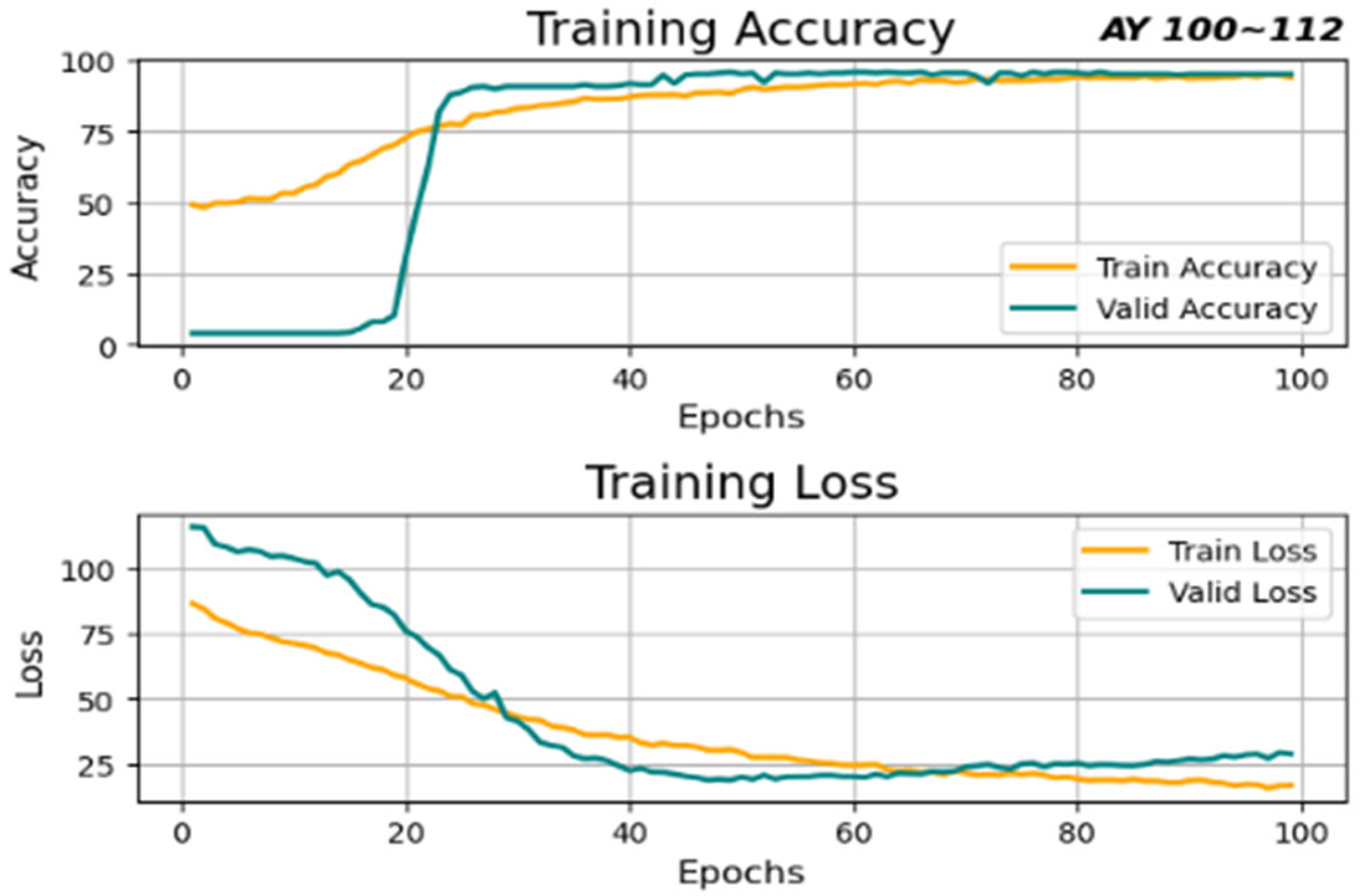
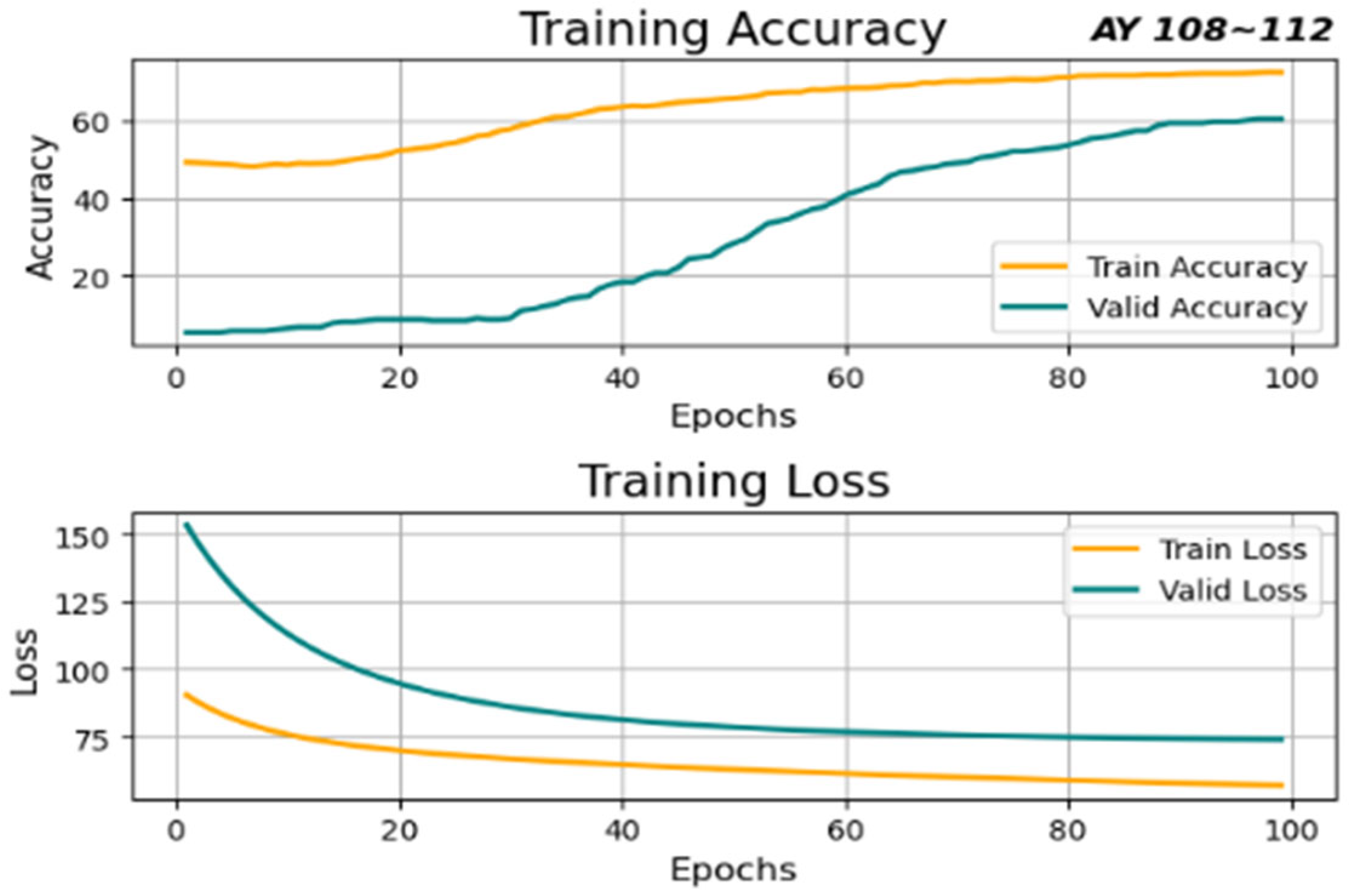
To ensure consistency in training conditions and maintain fairness when comparing datasets from AY 100–112 and 108–112, the experiments were conducted with a unified setting of epochs = 100. Training accuracy and loss curves were monitored for both datasets. As shown in Figure 1 and Figure 2, the model trained on the 100–112 dataset reached peak accuracy around epoch 30, accompanied by a noticeable decline in the loss function. In contrast, for the AY 108–112 dataset, accuracy began to rise around epoch 30 and stabilized around epoch 90. The loss function showed a steady decline from epoch 0 to epoch 60, after which it plateaued.

3. Result and Discussion

3.1. Evaluation of Majority Voting Strategy

Using data from AY (AY) 108 to 112, models were trained and tested for each year individually. Their predictions were then aggregated using a majority voting strategy to generate the final classification results. To evaluate the effectiveness of this ensemble strategy in handling imbalanced educational data, the performance of the voting-based model was compared with that of the best-performing individual model. Key metrics analyzed include overall accuracy, precision, recall, and F1-score. As shown in Table 3, although the voting model’s true positives (TPs) slightly decreased from 12 to 11, and false negatives (FNs) increased from 0 to 1, resulting in a drop in recall from 100 to 91.67%, there was a significant improvement in other metrics. False positives (FPs) dropped from 102 to 80, while true negatives (TNs) increased from 186 to 208. Overall, the accuracy improved from 66.67 to 73%, precision rose from 10.53 to 12.09%, and the F1-score increased from 19.05% to 21.36%, indicating the ensemble voting model offers enhanced and more balanced predictive performance.

3.2. Limitations and Challenges in Model Performance

Despite ground truth labels in the test data, the model’s overall accuracy remained below 80%. The primary reason is the influence of institutional interventions, such as academic support or counseling, which allow students originally at risk of suspension or dropout to continue their studies. These students often exhibit characteristics similar to those who actually drop out, making it difficult for the model to distinguish them accurately and increasing the likelihood of misclassification. Additionally, students who do suspend or drop out represent a minority class in the dataset. This class imbalance leads to a higher occurrence of false positives, where many students are incorrectly predicted as high-risk despite continuing their studies. This challenge limits the precision of the model and highlights the difficulty of applying predictive models to real-world educational scenarios involving complex human and institutional factors.

4. Conclusions

We compared the predictive performance of models trained on the training datasets based on a significant policy shift at the university, covering AY 100–112 and 108–112. The results indicate that the model trained on post-policy-adjustment data (AY 108–112) exhibited more stable performance. Furthermore, by employing a multi-model majority voting strategy to integrate prediction results, the overall accuracy and precision were effectively improved compared to single-model approaches. The study successfully applied the AutoKeras automated machine learning framework for suspension and dropout prediction. Through data balancing techniques and a voting mechanism, the model demonstrated effectiveness in addressing the common issue of data imbalance in educational datasets. The resulting predictive model provides schools with a valuable early-warning tool to identify at-risk students, enabling timely intervention and counseling.

Author Contributions

Conceptualization, Y.-H.C. and C.-E.L.; methodology, Y.-H.C. and C.-E.L.; validation, C.-E.L.; writing—original draft preparation, Y.-H.C. and C.-E.L.; writing—review and editing, Y.-H.C. and C.-E.L.; supervision, Y.-H.C.; funding acquisition, Y.-H.C. All authors have read and agreed to the published version of the manuscript.

Funding

This research received no external funding.

Institutional Review Board Statement

Not applicable.

Informed Consent Statement

Not applicable.

Data Availability Statement

The data are not publicly available due to institutional restrictions and privacy concerns.

Conflicts of Interest

The authors declare no conflict of interest.

References

  1. Araque, F.; Roldán, C.; Salguero, A. Factors influencing university dropout rates. Comput. Educ. 2009, 53, 563–574. [Google Scholar] [CrossRef]
  2. Borrella, I.; Caballero-Caballero, S.; Ponce-Cueto, E. Taking action to reduce dropout in MOOCs: Tested interventions. Comput. Educ. 2022, 179, 104412. [Google Scholar] [CrossRef]
  3. Jin, H.; Song, Q.; Hu, X. Auto-Keras: An Efficient Neural Architecture Search System. In Proceedings of the 25th ACM SIGKDD International Conference on Knowledge Discovery and Data Mining (KDD ’19), Anchorage, AK, USA, 4–8 August 2019; Association for Computing Machinery: New York, NY, USA, 2019; pp. 1946–1956. [Google Scholar]
  4. Alaiad, A.; Migdady, A.; Al-Khatib, R.M.; Alzoubi, O.; Zitar, R.A.; Abualigah, L. Autokeras Approach: A Robust Automated Deep Learning Network for Diagnosis Disease Cases in Medical Images. J. Imaging 2023, 9, 64. [Google Scholar] [CrossRef] [PubMed]
  5. Al-Sarem, M.; Saeed, F.; Boulila, W.; Emara, A.H.; Al-Mohaimeed, M.; Errais, M. Feature Selection and Classification Using CatBoost Method for Improving the Performance of Predicting Parkinson’s Disease. In Advances in Intelligent Systems and Computing, Proceedings of First International Conference of Advanced Computing and Informatics (ICACIn 2020), Casablanca, Morocco, 12–13 April 2020; Springer Nature Singapore Pte Ltd.: Singapore, 2021; Volume 1188, pp. 189–199. [Google Scholar]
  6. Batista, G.E.A.P.A.; Prati, R.C.; Monard, M.C. A study of the behavior of several methods for balancing machine learning training data. ACM SIGKDD Explor. Newsl. 2004, 6, 20–29. [Google Scholar] [CrossRef]
  7. Ruta, D.; Gabrys, B. Classifier selection for majority voting. Inf. Fusion 2005, 6, 63–81. [Google Scholar] [CrossRef]
Figure 1. Training accuracy and loss curves for AY 100–112.
Engproc 120 00066 g001
Figure 2. Training accuracy and loss curves for AY 108–112.
Engproc 120 00066 g002
Table 1. Comparison of individual data-balanced models.
DatasetStatus: NoStatus: YesTotal
AY 100–112230923094618
AY 108–1126846841368
Validation Set28812300
Table 2. Comparison between voting strategy and individual data-balanced models.
DatasetStatus: NoStatus: YesTotal RecordsSample
Single sample68468413681
Majority voting22
Sample validation set288123001
Table 3. Confusion matrix and evaluation metrics: single model vs. majority voting.
DataSingleMultiple
Actual
LabelYesNoYesNo
Predicted
(students)
Yes121021180
No01861208
Evaluation
Metrics
(%)
Accuracy66.67%73%
Precision10.53%12.09%
Recall100%91.67%
F1-score19.05%21.36%
Disclaimer/Publisher’s Note: The statements, opinions and data contained in all publications are solely those of the individual author(s) and contributor(s) and not of MDPI and/or the editor(s). MDPI and/or the editor(s) disclaim responsibility for any injury to people or property resulting from any ideas, methods, instructions or products referred to in the content.