1. Introduction
The reduction in anthropogenic carbon dioxide (CO
2) emissions from large stationary sources remains one of the most critical challenges in global climate change mitigation [
1]. Despite the rapid expansion of renewable energy technologies, fossil-fuel-based power generation and energy-intensive industrial sectors are expected to continue operating for decades. Consequently, post-combustion carbon capture (PCC) has emerged as a key transitional technology that enables significant emission reductions while preserving existing industrial infrastructure [
2,
3].
Among the PCC technologies, chemical absorption using aqueous monoethanolamine (MEA) remains the most mature and widely deployed option due to its high capture efficiency and technological readiness. However, MEA-based absorption–regeneration systems are associated with substantial energy penalties, primarily caused by solvent regeneration in the stripper reboiler [
4]. In addition to high operating costs, these systems exhibit strong nonlinear dynamics, tight thermal and material coupling, and sensitivity to operating disturbances such as flue gas flow rate and CO
2 concentration variations. As emphasized in multiple studies, effective control of the capture process plays a decisive role in reducing energy consumption and improving operational stability [
5].
In industrial practice, proportional–integral–derivative (PID) controllers are commonly employed for regulating MEA-based PCC units due to their simplicity and robustness. Nevertheless, PID control structures are inherently limited when applied to multivariable, highly interactive processes. Under variable operating conditions, particularly during load-following operation, PID-controlled capture systems often experience large overshoot, slow recovery, and increased energy demand. These shortcomings become more pronounced as power plants increasingly operate under part-load conditions driven by renewable energy integration [
6].
To address these limitations, advanced control strategies have been proposed to improve the dynamic performance and energy efficiency of MEA-based PCC systems [
7]. Cascade control approaches combining PID and predictive algorithms have been shown to enhance system stability by decoupling fast and slow dynamics [
8,
9]. For instance, the DMC–PID cascade strategy demonstrated improved capture rate control and operational flexibility compared to conventional PID–PID schemes [
5]. However, such approaches often rely on detailed steady-state optimization and extensive model identification, which can limit their general applicability.
Model predictive control (MPC) has gained significant attention as a promising alternative due to its ability to explicitly consider multivariable interactions, process constraints, and future system behavior. MPC-based strategies have consistently demonstrated superior setpoint tracking and disturbance rejection performance compared to PID control in MEA absorption processes [
10,
11]. Furthermore, MPC has proven particularly effective under load-following scenarios and variable capture rate operation, which are increasingly relevant for modern power systems [
12].
In parallel, alternative intelligent control approaches have been explored to reduce dependence on accurate process models. Model-free adaptive control strategies have been proposed to address plant uncertainties using real-time input–output data, offering robustness advantages over conventional PID control [
13]. Fuzzy logic control has also been investigated as a model-independent approach capable of handling nonlinearities inherent in absorption–regeneration processes. While these strategies improve robustness, their dynamic response and energy optimization performance may remain inferior to predictive control methods, particularly under large disturbances.
The complexity of PCC system control further increases with the introduction of advanced process configurations aimed at reducing regeneration energy. Studies on advanced flash strippers and lean vapor compression configurations have shown that energy integration significantly improves efficiency but poses serious challenges for decentralized PID control [
14]. In such cases, MPC-based control structures have demonstrated substantially faster stabilization and improved economic performance compared to classical control approaches [
12,
15,
16].
Despite these advances, several research gaps remain. Many existing studies have investigated individual advanced control strategies or specific plant configurations, which limits direct and quantitative comparison between classical, intelligent, and predictive controllers under identical operating conditions. Moreover, the trade-off between robustness and energy efficiency—particularly the achievable reduction in reboiler duty under realistic flue gas disturbances—has not been systematically evaluated within a unified dynamic modeling framework.
The novelty of this work lies in: (i) the development of a unified control-oriented surrogate dynamic model enabling a fair and reproducible comparison of PID, fuzzy logic, and model predictive control strategies; and (ii) the explicit quantitative assessment of the robustness–energy efficiency trade-off across different control paradigms. There remains a need for systematic, implementation-oriented studies that integrate dynamic modeling and comparative control analysis in a consistent simulation environment.
In this work, a comprehensive dynamic model of an MEA-based post-combustion CO2 absorption–regeneration system was developed. Based on this model, three control strategies—conventional PID control, fuzzy logic control, and model predictive control—were designed and evaluated under variable flue gas operating conditions. The primary control objective is to maintain a CO2 capture efficiency above 90% while minimizing reboiler energy consumption. By providing a consistent and quantitative comparison of control performance and energy efficiency, this study aims to support the practical deployment of advanced control strategies in industrial MEA-based carbon capture systems.
2. Methodology
This study investigated a conventional MEA-based post-combustion CO2 capture process composed of an absorber column, a stripper (regenerator), a lean–rich heat exchanger, and a reboiler. Flue gas containing CO2 enters the absorber, where chemical absorption occurs through counter-current contact with lean MEA solution. The CO2-rich solvent is subsequently regenerated in the stripper by supplying thermal energy to the reboiler, producing a concentrated CO2 stream and regenerated solvent for recycle.
From a control perspective, the capture process represents a highly nonlinear, tightly coupled dynamic system with slow solvent circulation dynamics and fast gas-phase disturbances. Variations in flue gas flow rate and CO2 concentration directly affect the absorption capacity and solvent loading, while reboiler heat duty governs regeneration efficiency and overall capture performance.
The control problem addressed in this work was formulated as follows: to maintain the overall CO2 capture efficiency above 90% under realistic operating disturbances while minimizing reboiler energy consumption, which constitutes the dominant operating cost of MEA-based capture systems.
A control-oriented dynamic model of the MEA-based absorption–regeneration system was developed using first-principles mass and energy balance equations. The modeling approach aims to capture the dominant dynamic behavior relevant for control analysis rather than detailed column hydrodynamics [
3].
The following assumptions were adopted to balance model fidelity and computational tractability: (a) one-dimensional axial representation with perfect radial mixing in both absorber and stripper columns; (b) negligible pressure drop along the columns; (c) thermodynamic equilibrium between vapor and liquid phases at each stage; and (d) constant physical and transport properties within the considered operating range [
17,
18].
Component mass balances were formulated for CO2, MEA, and H2O in the liquid and vapor phases. Energy balances account for sensible heat effects, heat of absorption and desorption, and heat exchange between process units. Vapor–liquid equilibrium relations were used to describe phase interactions, while simplified reaction expressions represented the reversible chemical absorption of CO2 by MEA.
The resulting nonlinear differential–algebraic equation (DAE) system was implemented in MATLAB using a modular structure, in which each major unit operation is represented as a separate subsystem. This structure facilitates controller design, scenario testing, and reproducibility.
Model parameters were calibrated to represent typical industrial-scale MEA capture operation reported in the literature. Calibration focused on effective mass transfer and heat transfer parameters to ensure realistic steady-state behavior.
Model validation was performed by comparing simulated steady-state and dynamic responses against published benchmark data for industrial-scale MEA-based CO2 capture systems reported in the literature. Validation variables included the overall CO2 capture efficiency, solvent loading levels, reboiler energy duty, and qualitative temperature profile trends along the absorber and stripper columns. The model reproduced reported steady-state and dynamic trends with deviations within ±5% relative to the reference literature values, which is considered sufficient for control-oriented dynamic studies focused on comparative controller performance rather than detailed process design.
It should be noted that the model is not intended to represent a specific industrial plant, but rather a representative MEA-based capture process suitable for comparative control analysis.
For all control strategies investigated in this study, the controlled variable was the overall CO
2 capture efficiency. The manipulated variable was the reboiler heat duty, selected due to its direct influence on solvent regeneration and its relevance for energy optimization [
19].
Disturbances were introduced through step changes in inlet flue gas CO2 concentration and total gas flow rate, representing typical variations encountered during load-following operation of power plants and industrial furnaces.
A proportional–integral–derivative (PID) controller was implemented as the baseline control strategy. The controller adjusts the reboiler heat duty based on the deviation between the measured and desired CO2 capture efficiency.
The PID controller parameters were tuned using a step-response-based procedure. An open-loop step change in the reboiler heat duty was first applied to identify the dominant dynamic characteristics of the capture efficiency response. Initial controller gains were then estimated based on the observed process dynamics and subsequently refined through iterative closed-loop simulations to ensure stable operation, limited overshoot, and acceptable settling time under representative disturbance scenarios. Anti-windup protection was incorporated to prevent controller saturation under large disturbances. The final PID parameters were kept constant for all simulations, reflecting the level of control complexity commonly encountered in industrial post-combustion CO2 capture applications.
To improve robustness against nonlinearities and model uncertainties, the fuzzy logic controller (FLC) was implemented as a rule-based supervisory controller. Two input variables were considered: the normalized CO
2 capture efficiency error (e) and the normalized rate of change of the error (Δe). Both inputs were scaled using quantization factors selected according to the expected operating range of the process, resulting in normalized values within the interval [−1, 1]. Each input variable was described using five triangular membership functions: Negative Large (NL), Negative Small (NS), Zero (ZE), Positive Small (PS), and Positive Large (PL). The controller output (ΔQ
reb), corresponding to an incremental adjustment of the reboiler heat duty, was represented using five similar membership functions. Based on this structure, a total of 25 fuzzy rules were formulated to reflect the qualitative process knowledge of solvent regeneration dynamics. The complete fuzzy rule base used in this study is reported in
Table 1. Mamdani-type inference and centroid defuzzification were employed. The FLC was designed to enhance robustness and smooth control action under nonlinear operating conditions rather than to explicitly minimize energy consumption, which is addressed by the model predictive control strategy.
MPC was implemented to explicitly account for multivariable interactions, process constraints, and future system behavior. A linearized state-space approximation of the nonlinear dynamic model was derived around a nominal operating point corresponding to 90% CO2 capture efficiency. The controller operates with a sampling time of 1 min, which is consistent with the slow solvent regeneration dynamics and industrial supervisory control practice.
At each control interval, the MPC solves a constrained quadratic optimization problem that minimizes a weighted objective function combining CO2 capture efficiency tracking error and variations in reboiler heat duty over a finite prediction horizon. The prediction horizon was set to Np = 60 samples (60 min) to adequately capture the dominant solvent-side and thermal dynamics, while the control horizon was chosen as Nc = 10 samples to limit excessive control action variability.
The weighting coefficients of the MPC cost function were selected through parametric sensitivity analysis, with a higher weight assigned to capture efficiency tracking (wy = 1) and ensure regulatory performance, and a lower weight assigned to reboiler duty variation (wu = 0.05) to promote smooth and energy-efficient operation. The optimization problem explicitly accounts for actuator constraints, including allowable reboiler duty limits, rate-of-change constraints on the manipulated variable, and a minimum capture efficiency constraint.
A receding horizon strategy was employed, in which only the first control move is implemented at each sampling instant before the optimization problem is updated using new process measurements. The MPC was tuned to balance fast disturbance rejection and smooth energy-efficient operation, consistent with industrial supervisory control architectures, and was evaluated as a supervisory control layer rather than a direct regulatory replacement.
All control strategies were evaluated under identical disturbance scenarios to ensure a fair and consistent comparison. These scenarios included ±10% step changes in inlet CO2 concentration, ±10% step changes in flue gas flow rate, as well as combined disturbances affecting both variables. Step disturbances were primarily employed to enable clear benchmarking of transient control performance under well-defined conditions.
In addition, slow drift-type variations in inlet CO2 concentration and flue gas flow rate were considered to qualitatively reflect the gradual load-following behavior commonly encountered in industrial operation. These continuous disturbances allow for the assessment of controller robustness under more realistic operating conditions characterized by low-frequency variability.
Control performance was assessed using quantitative metrics relevant to industrial operation, including minimum and average CO2 capture efficiency, reboiler energy duty normalized per ton of captured CO2, settling time, and robustness to disturbances.
This study focused on the simulation-based evaluation of control strategies using a representative dynamic model. While direct industrial implementation was beyond the scope of the present work, the proposed methodology provides insight into the relative benefits and limitations of classical, intelligent, and predictive control approaches and supports their potential integration at the supervisory control level of MEA-based CO2 capture plants.
3. Results and Discussion
Before closed-loop evaluation, the intrinsic dynamic behavior of the MEA-based CO2 capture system was analyzed under open-loop conditions. Step disturbances of ±10% in inlet CO2 concentration and flue gas flow rate were applied while maintaining constant reboiler heat duty.
The open-loop responses revealed strong nonlinearities and multi-time-scale dynamics. Changes in inlet CO2 concentration resulted in rapid variations in capture efficiency, whereas flue gas flow rate disturbances exhibited slower dynamics dominated by solvent circulation and regeneration processes. These observations confirm the necessity of advanced control strategies capable of handling both fast disturbances and slow solvent dynamics.
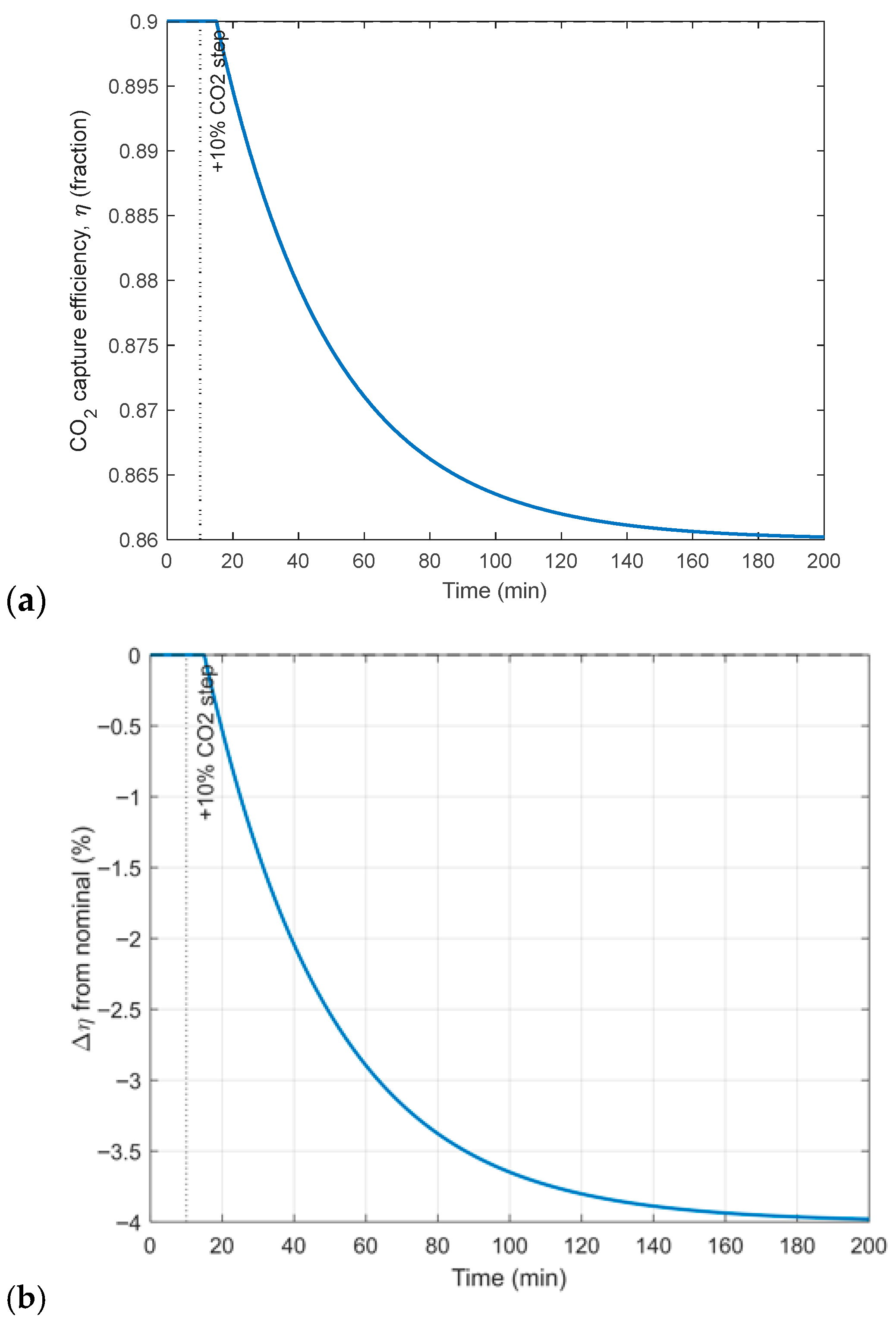
Figure 1 illustrates the open-loop response of capture efficiency (
Figure 1a) and reboiler duty (
Figure 1b) following a +10% inlet CO
2 concentration disturbance.
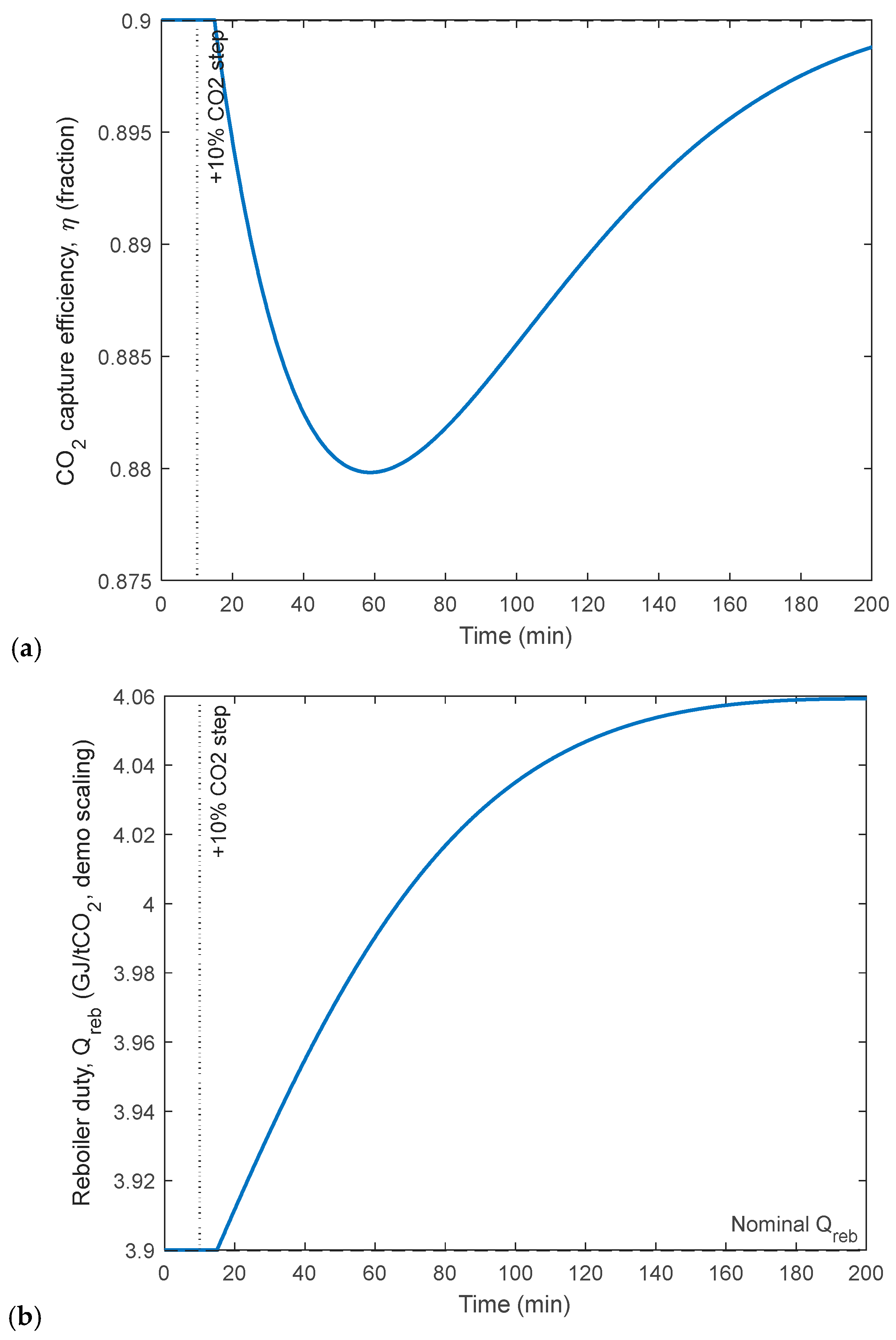
Under PID control, the system remained stable for all tested disturbance scenarios. However, following a +10% increase in inlet CO2 concentration, the capture efficiency dropped below the 90% target, reaching a minimum value of approximately 84%. The controller required a prolonged settling time to restore the desired operating point, accompanied by oscillatory reboiler duty behavior.
Similar trends were observed for flue gas flow rate disturbances. The limited disturbance rejection capability of PID control resulted in conservative reboiler duty adjustments and increased average energy consumption.
Figure 2a,b presents the closed-loop PID response under a representative inlet CO
2 disturbance.
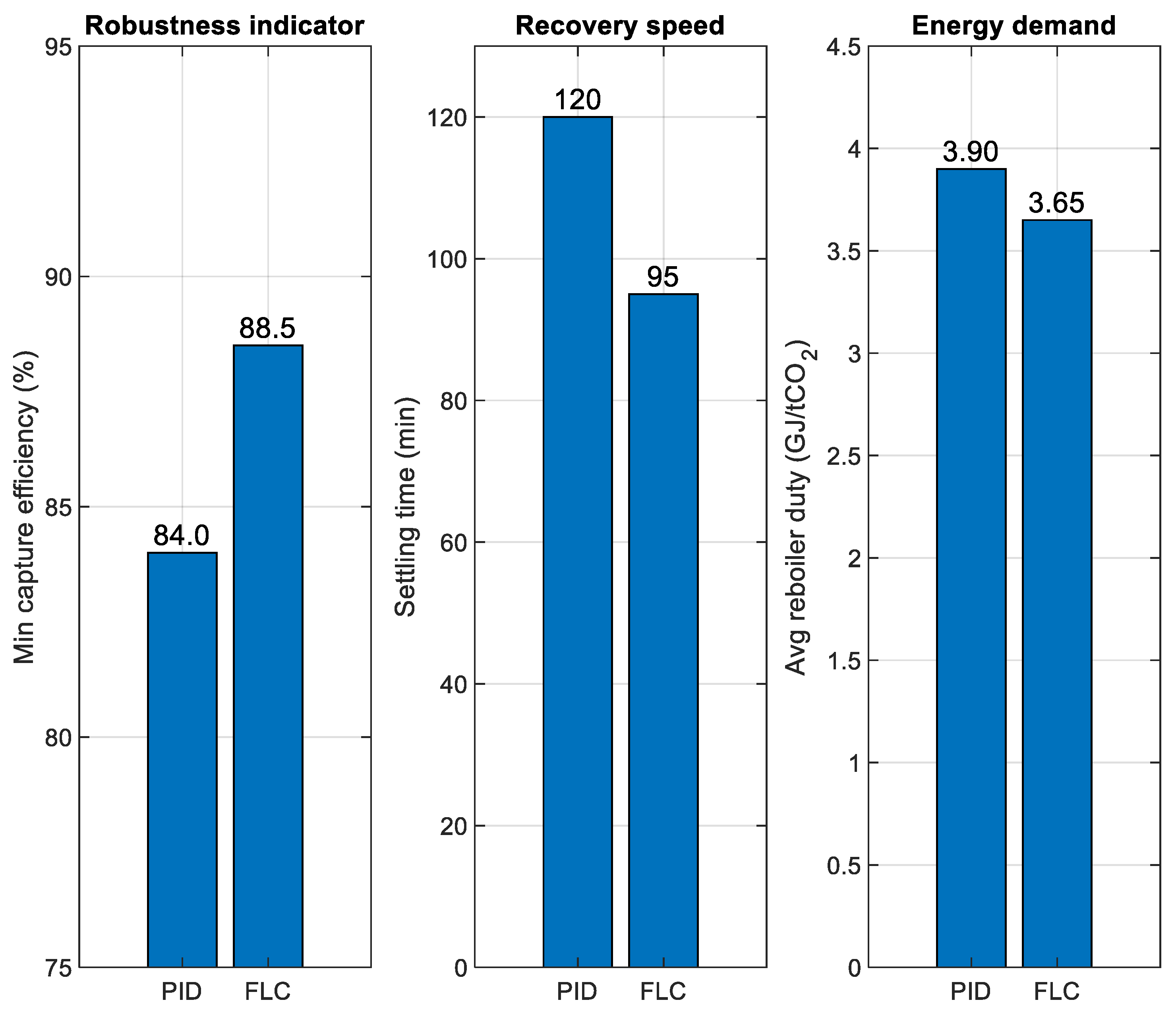
The fuzzy logic control (FLC) strategy improved robustness relative to PID control. Capture efficiency deviations were reduced, and transient responses exhibited smoother behavior with lower oscillation amplitudes.
Despite these improvements, FLC showed slower recovery dynamics compared to predictive control. The capture efficiency generally remained close to the setpoint, but energy consumption was only moderately reduced, indicating limited optimization capability.
Figure 3 compares the dynamic responses of the FLC and PID controller under identical +10% inlet CO
2 concentration disturbance conditions.
In addition to individual disturbances, the control strategies were evaluated under combined variations in inlet CO2 concentration and flue gas flow rate, which more closely represent realistic industrial operating conditions. Under these coupled disturbances, the dynamic interaction between gas-phase absorption and solvent regeneration becomes more pronounced, revealing fundamental differences in controller behavior.
The oscillatory response observed under PID control can be attributed to the mismatch between its purely reactive feedback structure and the slow solvent-side dynamics of the MEA regeneration process. Variations in gas-phase conditions propagate through solvent loading with a significant delay, causing repeated corrective actions and reboiler duty oscillations.
The fuzzy logic controller mitigates these oscillations by introducing nonlinear rule-based adaptation, which improves robustness against coupled disturbances. However, because the FLC does not explicitly consider future system evolution, its response remains conservative, resulting in slower recovery and limited energy optimization.
In contrast, MPC explicitly predicts the future evolution of capture efficiency by incorporating the dynamic model and constraints over the prediction horizon. This predictive capability enables proactive adjustment of the reboiler heat duty before large deviations occur, thereby reducing oscillations and minimizing unnecessary energy input. As a result, MPC maintains capture efficiency above the target value while achieving smoother and more energy-efficient operation under combined disturbance conditions.
MPC demonstrated superior performance across all tested scenarios. The MPC maintained a capture efficiency above 90% throughout the disturbance period, with minimal overshoot and rapid stabilization.
Compared to PID control, the MPC reduced the settling time by approximately 37% and significantly smoothed the reboiler duty profile. Most notably, the MPC achieved a substantial reduction in average reboiler energy consumption.
A quantitative comparison of the three control strategies is summarized in
Table 2, including the capture efficiency, settling time, and energy performance metrics.
The results clearly indicate that MPC outperformed both PID and FLC in terms of disturbance rejection, dynamic response, and energy efficiency under the investigated disturbance scenarios. While the quantitative results are scenario-specific, the observed performance hierarchy between control strategies is expected to remain valid for a wide range of operating conditions typical of MEA-based capture plants. While FLC provides improved robustness compared to PID, it does not fully exploit future process behavior for energy optimization.
From a practical standpoint, the results suggest a clear hierarchy of control strategies. PID control remains attractive for its simplicity and ease of implementation but is insufficient for modern capture plants expected to operate under variable and uncertain conditions. FLC offers enhanced robustness and reduced sensitivity to modeling errors but may require hybridization to achieve satisfactory dynamic performance. MPC, although more computationally demanding, provides superior disturbance rejection, energy efficiency, and operational smoothness.
The influence of key process parameters on control performance was also examined qualitatively to assess the robustness of the investigated control strategies. Variations in MEA solvent concentration, absorber operating temperature, and reboiler pressure primarily affect solvent loading capacity, mass transfer efficiency, and regeneration energy demand, thereby modifying the effective process gain and dominant time constants.
An increase in MEA concentration and absorber temperature generally enhances absorption capacity but introduces stronger nonlinearities and increased coupling between gas–liquid mass transfer and solvent regeneration. Under such conditions, PID control becomes more prone to oscillations due to its fixed gain structure, while fuzzy logic control maintains improved robustness through nonlinear rule-based adaptation. However, both strategies exhibit increased sensitivity to parameter variations compared to MPC.
Changes in reboiler pressure significantly influence regeneration efficiency and energy consumption. Higher reboiler pressure reduces the required heat duty but alters the thermal dynamics of the stripper, which can degrade the performance of classical controllers. In contrast, MPC demonstrates superior robustness by explicitly accounting for these dynamic changes through its predictive formulation.
Across the investigated parameter variations, the relative performance ranking of the control strategies remained unchanged, with MPC consistently achieving improved disturbance rejection and energy-efficient operation. A comprehensive parametric optimization study was beyond the scope of the present contribution and identified as an important direction for future work.
While the present study demonstrates clear advantages of MPC, several limitations should be acknowledged. The control-oriented surrogate model simplifies certain physicochemical phenomena, such as solvent degradation and long-term heat exchanger fouling, which may influence real plant dynamics. Future work should focus on integrating nonlinear or adaptive MPC formulations and validating controller performance against high-fidelity dynamic simulators or pilot-scale experimental data. Additionally, economic MPC formulations that directly optimize energy cost metrics represent a promising direction for further improving solvent-based CO2 capture operation.
4. Conclusions
This study presented a comparative dynamic analysis of conventional PID control, FLC, and MPC for an MEA-based post-combustion CO2 capture system subject to inlet CO2 concentration disturbances. A control-oriented dynamic surrogate model was developed to evaluate closed-loop performance under a representative +10% inlet CO2 disturbance, with particular emphasis on capture efficiency regulation and reboiler duty behavior.
The results demonstrate that while PID control can provide a rapid initial response, it suffers from oscillatory behavior and higher energy fluctuations, which may negatively affect long-term operational stability and energy efficiency. Fuzzy logic control improves robustness against disturbances and reduces aggressive control actions; however, this robustness is achieved at the cost of slower recovery dynamics, highlighting an inherent trade-off between disturbance attenuation and response speed. The adoption of a hybrid FLC–PI structure effectively mitigates steady-state offset and enhances the practical applicability of fuzzy control for solvent-based CO2 capture systems.
Among the evaluated strategies, MPC consistently exhibited superior performance. The offset-free MPC formulation achieved fast stabilization of CO2 capture efficiency with minimal overshoot while ensuring smooth and energy-efficient reboiler duty adjustment. These characteristics are particularly important for industrial carbon capture plants operating under load-following and flexible conditions, where frequent disturbances and operating point changes are expected. The predictive and multivariable nature of MPC enables proactive disturbance compensation that cannot be achieved with decentralized or purely rule-based controllers.
Overall, the findings of this work reinforce the growing body of evidence that advanced control strategies, particularly MPC, are key enablers for improving the energy efficiency, operational flexibility, and robustness of MEA-based post-combustion CO2 capture systems. The use of a simplified control-oriented modeling framework demonstrates that meaningful insights into controller performance and energy efficiency can be obtained without reliance on fully detailed first-principles simulations, thereby supporting early-stage controller design and reducing implementation barriers for industrial deployment. Future research should focus on extending the proposed framework toward nonlinear and economic MPC formulations, as well as validating the control strategies using high-fidelity dynamic models or pilot-scale experimental data to support industrial-scale deployment.



 ,
,