Proceeding Paper

Magnetic Thin Film Inductor Characteristics and Packaging Stress †
1
Department of Mechanical and Energy Engineering, National Chiayi University, Chiayi 600355, Taiwan
2
Department of Mechanical Engineering, National Chung Cheng University, Chiayi 621301, Taiwan
3
Advanced Institute of Manufacturing for High-Tech Innovations, National Chung Cheng University, Chiayi 621301, Taiwan
*
Author to whom correspondence should be addressed.
Presented at 8th International Conference on Knowledge Innovation and Invention 2025 (ICKII 2025), Fukuoka, Japan, 22–24 August 2025.
Eng. Proc. 2025, 120(1), 50; https://doi.org/10.3390/engproc2025120050
Published: 5 February 2026
(This article belongs to the Proceedings of 8th International Conference on Knowledge Innovation and Invention)

Abstract

We investigated how mechanical material properties, magnetic material properties, and geometric structure affect the performance of magnetic inductors. Magnetic thin film samples were prepared using a sputter deposition system. Mechanical properties, including hardness and elastic modulus, were measured with a nanoindenter, while magnetic properties such as saturation magnetization were characterized using a magnetometer. The measured properties were then integrated with finite element simulations to analyze how geometric structure influences magnetic inductor performance sensitivity. The results present the manufacturing process for magnetic thin film preparation and the development of a finite element method for analyzing mechanical and magnetic effects in magnetic inductors.

1. Introduction

With the increasing complexity and scale of AI models, the demand for high-performance computing resources has risen substantially, making energy consumption a critical bottleneck in system design. To address this challenge, integrated voltage regulator technology has emerged as a promising solution by integrating power management integrated circuits with discrete power components within a single module, package substrate, or even monolithic chip. This integration enhances power conversion efficiency and power density, underscoring the importance of magnetic thin films, which serve as a key material and technology in the realization of miniaturized, high-performance inductors [1,2,3].
Various geometrical configurations of thin-film inductors have been proposed, including 2-D spiral inductors, 2-D racetrack inductors, and 3-D solenoidal inductors [4,5,6,7,8,9,10,11]. Each structure demonstrates distinct inductance values due to differences in geometry. Furthermore, recent studies have shown that the choice of magnetic thin-film materials, as well as the implementation of multilayered magnetic films, can significantly enhance inductance performance [12,13,14,15,16,17]. Therefore, this research aims to optimize the performance of thin-film inductors through the investigation of magnetic thin films.
Cheng et al. [18] highlighted that during the physical vapor deposition (PVD) sputtering process, vacuum pressure and DC/radio frequency power exert considerable influence on the magnetic properties of the films. Consequently, adjusting the power parameters during film fabrication offers a strategy to mitigate the hard magnetic characteristics that adversely affect electromagnetic performance. Additionally, we consider the potential influence of mechanical properties by employing nanoindentation techniques and relevant mathematical models [19] to calculate the Young’s modulus. For numerical analysis, thermal stress effects on magnetic thin-film inductors are evaluated based on their geometrical structures, and electromagnetic simulations are conducted to investigate the relationship between inductor geometry and electromagnetic performance.

2. Materials and Methods

2.1. Magnetic Properties of Materials

Cobalt (Co) is a well-known soft magnetic material, and the Co-Zr-Ta (CZT) alloy has emerged as a promising candidate for high-performance inductor core applications due to its relatively high saturation magnetization, low coercivity, and reduced hysteresis loss. In this study, magnetic thin films composed of CZT ternary alloys were fabricated using physical vapor deposition (PVD) sputtering for subsequent characterization. The magnetic properties of the films were measured using a Quantum Design SQUID-VSM.
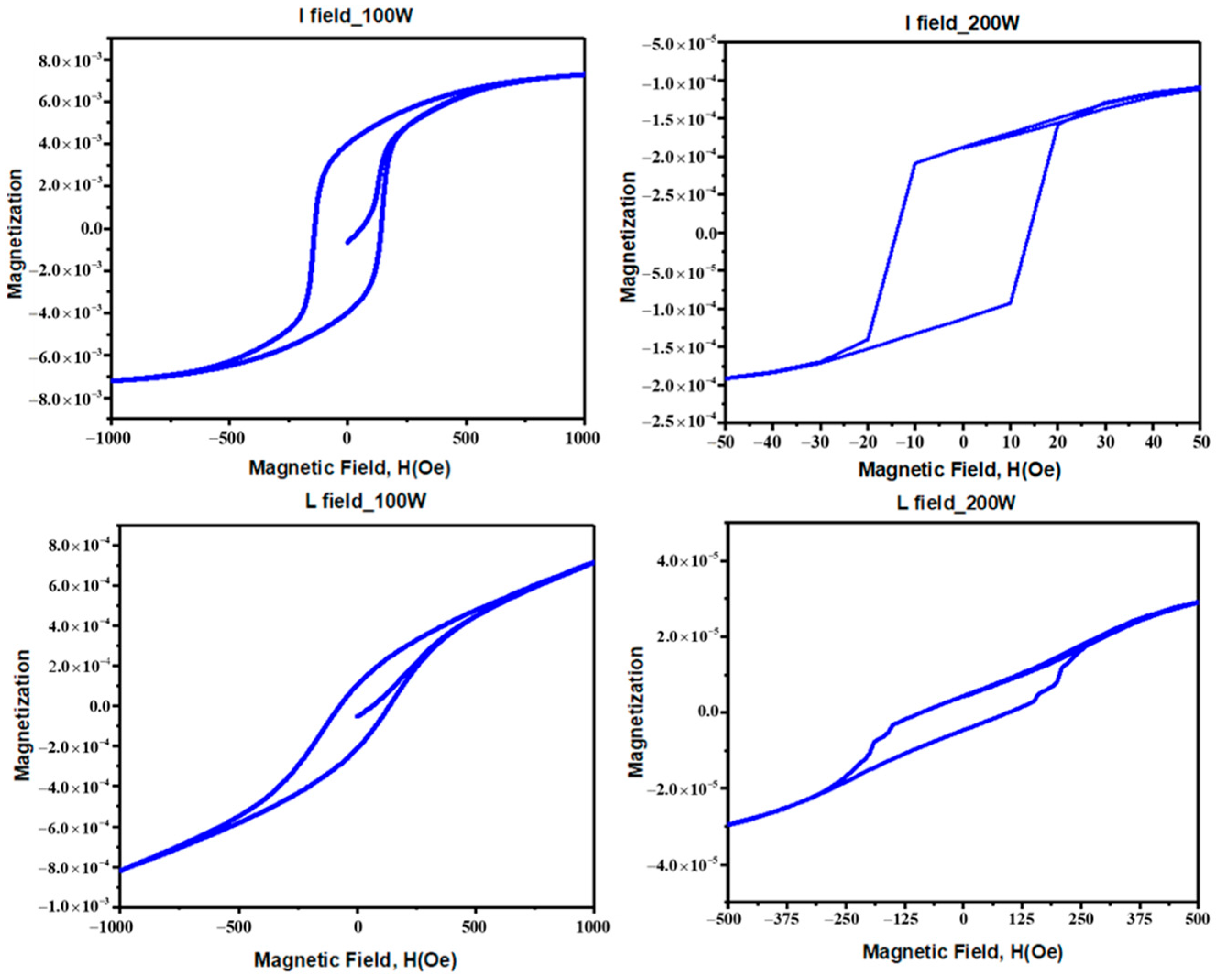
To investigate the influence of deposition power on the magnetic characteristics, samples were sputtered at varying powers ranging from 100 W to 200 W. As shown in Figure 1, increasing the sputtering power significantly improves the electromagnetic properties of the films, facilitating a transition from hard magnetic to soft magnetic behavior. For inductor applications, soft magnetic materials are particularly desirable due to their high magnetic permeability, which enhances magnetic flux density and enables greater inductance within the same volume. Additionally, low coercivity allows rapid magnetization and demagnetization, which is essential for minimizing hysteresis loss. Therefore, maintaining soft magnetic behavior in inductor materials is a critical design consideration.
After the deposition of the magnetic CZT thin films, magnetic hysteresis loops were obtained using a Quantum Design SQUID-VSM. During measurement, two magnetic field orientations were considered: one parallel to the film surface (in-plane field and I Field) and the other perpendicular to the film surface (out-of-plane field and L Field).
For both field orientations, the hysteresis loops of the high-power-deposited samples reached saturation magnetization more rapidly under lower applied magnetic fields compared to those deposited at lower power. This behavior enhances soft magnetic properties, as materials with soft magnetic characteristics tend to saturate quickly under modest external magnetic fields.

2.2. Mechanical Properties of Materials

Although the electromagnetic performance of magnetic thin-film inductors has been extensively investigated, relatively few studies have addressed the mechanical properties of the magnetic films themselves, including interfacial adhesion and the influence of fabrication parameters. Therefore, this study aims to evaluate the mechanical properties—specifically, hardness and Young’s modulus—of magnetic thin films through nanoindentation experiments. Using a nanoindenter equipped with a Berkovich diamond tip, indentations were performed under load control with a maximum applied force of 1000 μN. The reduced modulus was extracted from the load–displacement data, and the Young’s modulus of the sample was subsequently calculated using a standard conversion formula, as shown in Equation (1).
1 E r = ( 1 ν 2 ) E + ( 1 ν i 2 ) E i
Here, E r   represents the reduced Young’s modulus, E i is the Young’s modulus of the indenter, and ν i denotes the Poisson’s ratio of the indenter material. In this study, a diamond indenter was used, with a Young’s modulus of 1140 GPa and a Poisson’s ratio of 0.07.
To ensure accurate nanoindentation measurements, the surface of the specimen must be sufficiently smooth. Excessive surface roughness can introduce significant errors in the evaluation of mechanical properties. The measured results are summarized in Table 1. The magnetic thin-film samples prepared in this study exhibited an average Young’s modulus of 93.399 GPa.

3. Results and Discussion

3.1. Thermal Stress Simulation of Magnetic Thin-Film Inductor Structure

In this study, the cross-sectional morphology of the magnetic thin-film inductor was examined using scanning electron microscopy, and its dimensions were measured to serve as reference parameters for finite element model (FEM) construction. FEM was developed to simulate thermal stress effects by increasing the temperature from room temperature to the annealing temperature of 280 °C (Figure 2). Additionally, the influence of geometric variations in different structural regions was investigated to assess their impact on the thermal stress distribution within the inductor.
The simulation results indicate that stress concentration tends to occur at the interfaces between the stacked layers of CZT and OCZT magnetic films. This localized stress accumulation suggests a higher risk of delamination at these interfaces due to excessive thermal stress.
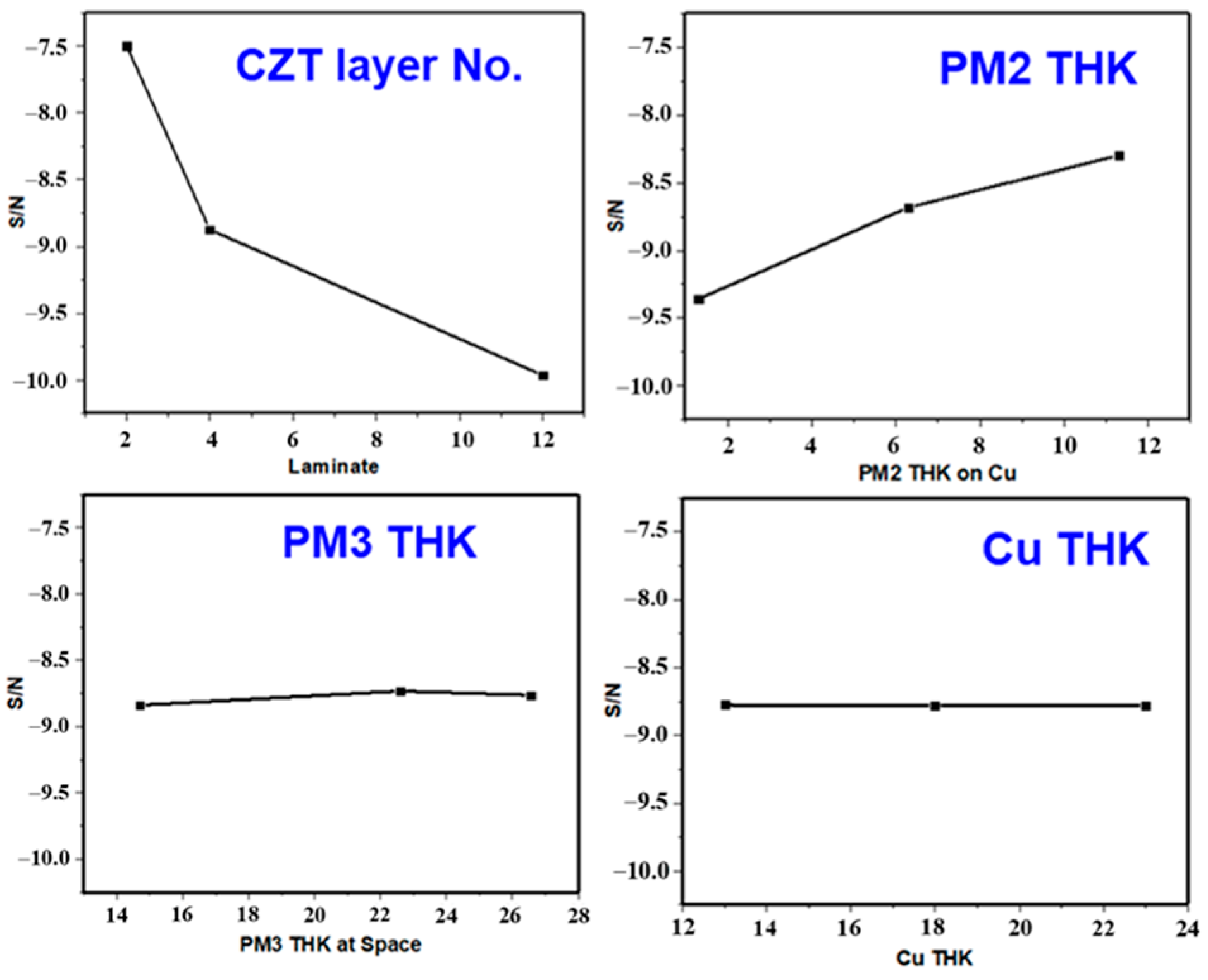
Subsequent analysis was conducted using the Taguchi method to identify the influence of various structural factors on dimensional variations, as illustrated in Figure 3. The results reveal that the number of magnetic thin-film layers and the thickness of the PM2 layer are the most critical parameters affecting thermal stress. Specifically, an increased number of magnetic layers—under the condition of a constant total thickness—leads to thinner individual layers, which in turn results in greater thermal stress impact on the overall structure. Conversely, increasing the thickness of the PM2 layer enhances its ability to buffer thermal expansion, thereby providing improved protection to the magnetic thin films during high-temperature processing.

3.2. Electromagnetic Simulation

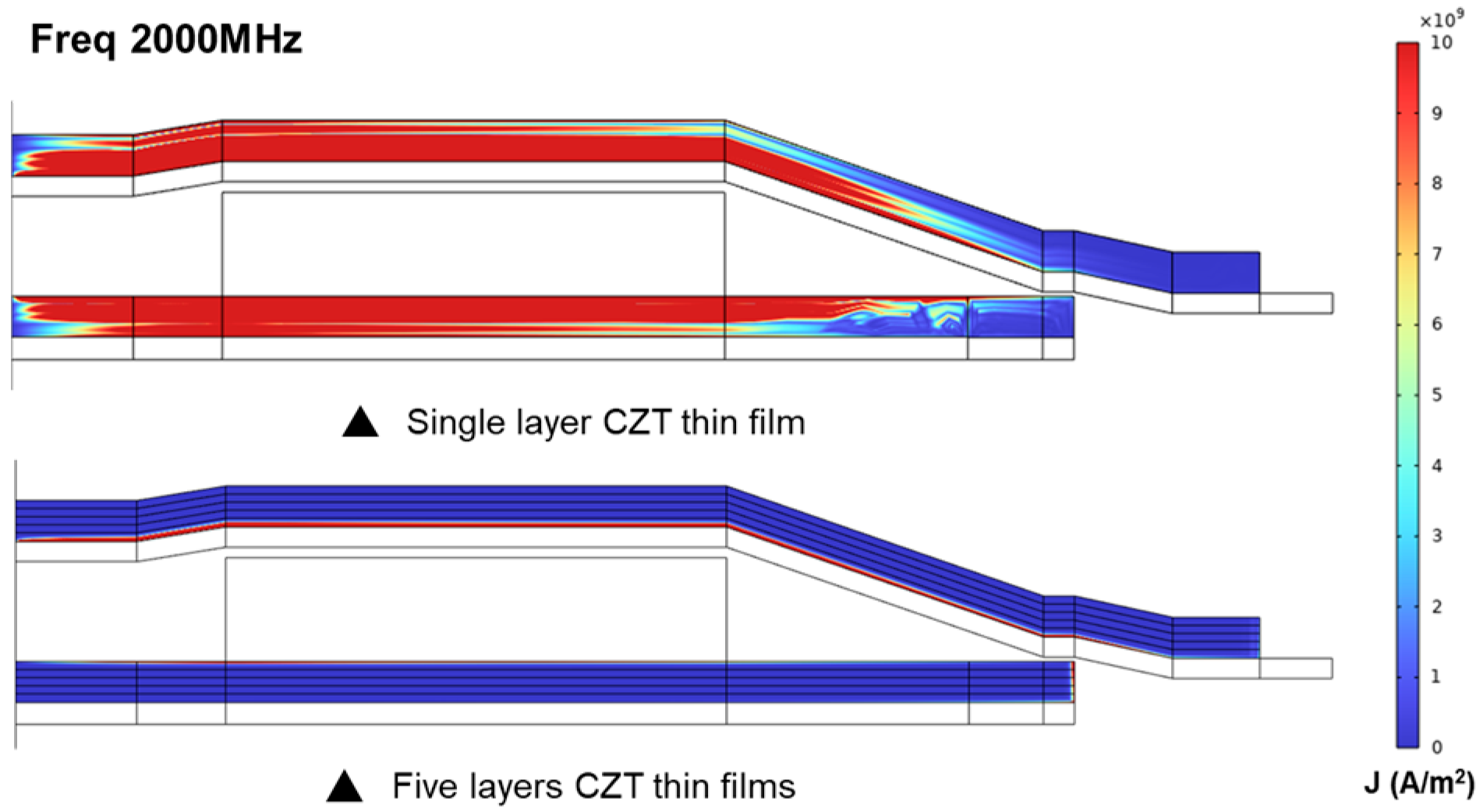
Stress analysis was conducted to identify the number of magnetic thin-film layers, which is a critical factor influencing the structural integrity of the inductor. Electromagnetic simulations confirmed that the number plays a significant role in determining the inductor’s performance. As shown in Figure 4, simulations were performed using CZT magnetic materials with identical geometric configurations. By comparing inductors composed of a single magnetic layer versus five stacked layers, it was observed that the current density within the copper windings was significantly reduced in the multilayer configuration when subjected to alternating current. The reduction in current density suggests that multilayer magnetic films can effectively suppress eddy currents, thereby minimizing energy loss during high-frequency AC operation. These findings highlight the dual mechanical and electromagnetic advantages of adopting multilayer magnetic thin films in inductor design.

4. Conclusions

In this study, CZT magnetic thin films were fabricated using PVD, and soft magnetic characteristics favorable for inductor applications were successfully achieved by adjusting the sputtering power. Regarding mechanical properties, nanoindentation testing combined with analytical calculations was employed to determine the Young’s modulus of the films. Finite element simulations were then conducted to investigate the effects of structural dimensions and thermal cycling on thermal stress. Taguchi method analysis results showed that the number of magnetic film layers and the thickness of the PM2 layer are key factors influencing thermal stress and reliability. An increased number of magnetic layers, under a fixed total thickness, results in thinner individual layers and higher thermal stress, whereas a thicker PM2 layer helps mitigate thermal stress by providing greater mechanical buffering. Electromagnetic simulation results demonstrated that multilayer magnetic film structures significantly reduce current density and energy loss under high-frequency operation. Such results underscore the importance of optimizing the geometric configuration of CZT magnetic thin films to achieve enhanced mechanical and electromagnetic performance in integrated inductor designs.

Author Contributions

Conceptualization: Y.C.; Methodology: Y.C.; Finite Element Analysis and Testing: T.C.; Investigation: Y.C. and D.L.; Writing—Original Draft: T.C.; Writing—Review and Editing: Y.C. and T.C.; Supervision: Y.C. and D.L. All authors have read and agreed to the published version of the manuscript.

Funding

This research was funded by the by the National Science and Technology Council (NSTC) of Taiwan, R.O.C., under grant numbers NSTC 112-2221-E-415-013-MY2 and NSTC 114-2221-E-415-008.

Institutional Review Board Statement

Ethical review and approval were waived for this study, due to the study did not involve human or animal subjects.

Informed Consent Statement

Not applicable.

Data Availability Statement

The data presented in this study are available on request from the corresponding author.

Conflicts of Interest

The authors declare no conflict of interest.

References

  1. Chen, W.; Bottoms, W.R. Chapter 10 Integrated Power Electronics, Sec. I Embedded Integrated Voltage Regulators, November version 2021. In Heterogeneous Integration Roadmap; IEEE: New York, NY, USA, 2021; pp. 9–10. Available online: https://eps.ieee.org/technology/heterogeneous-integration-roadmap/2021-edition.html (accessed on 25 January 2026).
  2. Burton, E.A.; Schrom, G.; Paillet, F.; Douglas, J.; Lambert, W.J.; Radhakrishnan, K.; Hill, M. FIVR—Fully integrated voltage regulators on 4th generation Intel® Core™ SoCs. In Proceedings of the 2014 IEEE Applied Power Electronics Conference and Exposition—APEC 2014, Fort Worth, TX, USA, 16–20 March 2014; pp. 432–439. [Google Scholar]
  3. Ahmed, F.U.; Sandhie, Z.T.; Ali, L.; Chowdhury, M.H. A Brief Overview of On-Chip Voltage Regulation in High-Performance and High-Density Integrated Circuits. IEEE Access 2021, 9, 813–826. [Google Scholar] [CrossRef]
  4. Radhakrishnan, K.; Swaminathan, M.; Bhattacharyya, B.K. Power delivery for high-performance microprocessors—Challenges, solutions, and future trends. IEEE Trans. Compon. Packag. Manuf. Technol. 2021, 11, 655–671. [Google Scholar] [CrossRef]
  5. Ding, Y.; Fang, X.; Wu, R.; Sin, J.K. Fan-out-package-embedded coupled inductors for integrated voltage conversion. In Proceedings of the 32nd International Symposium on Power Semiconductor Devices and ICs (ISPSD), Vienna, Austria, 13–18 September 2020. [Google Scholar]
  6. Gardner, D.S.; Schrom, G.; Hazucha, P.; Paillet, F.; Karnik, T.; Borkar, S. Integrated On Chip Inductors With Magnetic Film. In Proceedings of the 2006 International Electron Devices Meeting, IEDM 2006, San Francisco, CA, USA, 11–13 December 2006. [Google Scholar] [CrossRef]
  7. Sturcken, N.; O’Sullivan, E.; Wang, N.; Herget, P.; Webb, B.; Romankiw, L.; Petracca, M.; Davies, R.; Fontan, R.; Decad, G.; et al. A 2.5D integrated voltage regulator using coupled-magnetic-core inductors on silicon interposer delivering 10.8A/mm2. In Proceedings of the 2012 IEEE International Solid-State Circuits Conference, San Francisco, CA, USA, 19–23 February 2012; pp. 400–402. [Google Scholar]
  8. Sturcken, N.; O’Sullivan, E.J.; Wang, N.; Herget, P.; Webb, B.C.; Romankiw, L.T.; Petracca, M.; Davies, R.; Fontana, R.E.; Decad, G.M.; et al. A 2.5 D integrated voltage regulator using coupled magnetic-core inductors on silicon interposer. IEEE J. Solid-State Circuits 2013, 48, 244–254. [Google Scholar] [CrossRef]
  9. Lambert, W.J.; Hill, M.J.; O’Brien, K.P.; Radhakrishnan, K.; Fischer, P. Study of Thin-Film Magnetic Inductors Applied to Integrated Voltage Regulators. IEEE Trans. Power Electron. 2020, 35, 6208–6220. [Google Scholar] [CrossRef]
  10. Lee, D.W.; Hwang, K.-P.; Wang, S.X. Fabrication and analysis of high-performance integrated solenoid inductor with magnetic core. IEEE Trans. Magn. 2008, 44, 4089–4095. [Google Scholar] [CrossRef]
  11. Krishnamurthy, H.K.; Vaidya, V.; Kumar, P.; Jain, R.; Weng, S.; Kim, S.T.; Matthew, G.E.; Desai, N.; Liu, X.; Ravichandran, K.; et al. A digitally controlled fully integrated voltage regulator with on-die solenoid inductor with planar magnetic core in 14-nm tri-gate CMOS. IEEE J. Solid-State Circuits 2017, 53, 8–19. [Google Scholar] [CrossRef]
  12. Gardner, D.S.; Schrom, G.; Hazucha, P.; Paillet, F.; Karnik, T.; Borkar, S.; Hallstein, R.; Dambrauskas, T.; Hill, C.; Linde, C.; et al. Integrated on-chip inductors using magnetic material. J. Appl. Phys. 2008, 103, 07E927. [Google Scholar] [CrossRef]
  13. Gardner, D.S.; Schrom, G.; Paillet, F.; Jamieson, B.; Karnik, T.; Borkar, S. Review of On-Chip Inductor Structures With Magnetic Films. IEEE Trans. Magn. 2009, 45, 4760–4766. [Google Scholar] [CrossRef]
  14. Burghartz, J.N.; Rejaei, B. On the design of RF spiral inductors on silicon. IEEE Trans. Electron Devices 2003, 50, 718–729. [Google Scholar] [CrossRef]
  15. Beraki, M.; Trovão, J.P.; Perdigão, M. Comprehensive comparison and selection of magnetic materials for powertrain DC–DC converters. IET Electr. Syst. Transp. 2020, 10, 125–134. [Google Scholar] [CrossRef]
  16. Liang, X.; Dong, C.; Chen, H.; Wang, J.; Wei, Y.; Zaeimbashi, M.; He, Y.; Matyushov, A.; Sun, C.; Sun, N. A Review of Thin-Film Magnetoelastic Materials for Magnetoelectric Applications. Sensors 2020, 20, 1532. [Google Scholar] [CrossRef] [PubMed]
  17. Wu, H.; Gardner, D.S.; Xu, W.; Yu, H. Integrated RF on-chip inductors with patterned CZT B films. IEEE Trans. Magn. 2012, 48, 4123–4126. [Google Scholar] [CrossRef]
  18. Cheng, C.; Davies, R.; Sturcken, N.; Shepard, K.; Bailey, W.E. Optimization of ultra-soft CoZrTa/SiO2/CoZrTa trilayer elements for integrated inductor structures. J. Appl. Phys. 2013, 113, 17A343. [Google Scholar] [CrossRef]
  19. Oliver, W.C.; Pharr, G.M. An improved technique for determining hardness and elastic modulus using load and displacement sensing indentation experiments. J. Mater. Res. 1992, 7, 1564–1583. [Google Scholar] [CrossRef]
Figure 1. Hysteresis loops measured along the in-plane and out-of-plane magnetic field directions.
Engproc 120 00050 g001
Figure 2. Finite element modeling and stress analysis.
Engproc 120 00050 g002
Figure 3. Taguchi method analysis results.
Engproc 120 00050 g003
Figure 4. Electromagnetic simulation analysis of the relationship between stacked magnetic thin films and the skin effect.
Engproc 120 00050 g004
Table 1. Measurement of Young’s modulus using nanoindenter.
Measurement PointEr (GPa)E (GPa)
193.87592.637
295.54794.429
394.17092.953
494.25693.045
595.08193.929
Disclaimer/Publisher’s Note: The statements, opinions and data contained in all publications are solely those of the individual author(s) and contributor(s) and not of MDPI and/or the editor(s). MDPI and/or the editor(s) disclaim responsibility for any injury to people or property resulting from any ideas, methods, instructions or products referred to in the content.